• About PeterSIronwood

petersironwood

~ Finding, formulating and solving life's frustrations.

petersironwood

Category Archives: psychology

The Path not Taken

23 Tuesday Apr 2019

Posted by petersironwood in America, psychology, story, Uncategorized, Veritas

≈ 1 Comment

Tags

alternatives, consequences, love, myth, romance, story, truth, Veritas, war

Many Paths awoke smiling. A soft pink and golden glow suffused her cabin. She relished the warmth beneath her blankets. She lay for a moment enjoying the distant happy sounds of her tribe and the many chirping birds. She thought of the legend that long ago the people had learned to speak by mimicking the sounds of the fields and forests. Each time she listened to the birds, her conviction grew that the various kinds of birds spoke to each other, not only to those of their own kind. Indeed, they did this both at dawn’s first light and in the evening. Of course, they hid and stayed silent during storms, but in fine weather such as this, they also held dialogue just as the Veritas themselves had done the night before. 

Soon, she would check on plans for making major paths to the Center Place of the Veritas less accessible to horses or those upon them. But for a moment, she relished the image of Shadow Walker, tall and handsome. She smiled again as she recalled the many trials that she and Shadow Walker had faced. Her love for him first blossomed as he explained his observations about snakes. She chuckled. Now, that takes some empathy! She wondered whether she could ever love snakes as much as she loved the wolves. She again toyed with the First Ring of Empathy. Every time she did so, she felt an even stronger connection to Shadow Walker. Perhaps these rings held magic as yet undiscovered. 
09280FF4-C3FC-45E4-927B-B1DD020CA3FC

A knock interrupted her reverie. “Good morning?” someone queried. 

She recognized the surprisingly soft voice of Trunk of Tree. Many Paths wrapped a blanket about herself and padded to the door. There stood Trunk of Tree, his thick, well-muscled thighs were bare from the edge of his smock to his moccasins. There was a delightful twinkle in his eye. “Trunk of Tree. I hope you are well this day.” 

“I am indeed, Many Paths. I hope you are also well. I am sorry if I awoke you. I wanted to let you know that we have modified the cool path to make it impassible for those who would stand atop horses.”

“What? When? Did you work all night?” 

“No, Many Paths, but we arose at first light. For we do not know when another such attack may come. Or, it might happen that our search party will return with those who stand atop horses in pursuit. In any case….” Trunk of Tree looked at Many Paths and, not for the first time, noticed how deeply and wisely her dark eyes sparkled. 

95C601BA-DFA0-4F54-9E6E-EDD83BEDC48D

After a pause, Many Paths smiled and prompted, “In any case…?” 

“Oh, sorry. In any case.” Trunk of Tree blushed as he realized how much he loved to hear the voice of Many Paths — so much so that it was hard to listen to the words and find their meanings. He found himself wondering whether she and Shadow Walker really had betrothed as everyone supposed. And, what if Shadow Walker did not return? He banished that thought as soon as it arose. Shadow Walker was Trunk of Tree’s best friend and had gladly ventured out to find Tu-Swift despite the danger.  Now, Trunk of Tree found himself lusting after Many Paths. He must not feed the bad wolf. “In any case…” he began again, “as we were making the cool path between the cliffs impassible, Stone Chipper suggested another adjustment that would be hospitable to those on foot but make travel difficult for those who sit atop horses.” 

“Yes? Go on.” She looked kindly at Trunk of Tree, but, she hoped, not too kindly. 

“We wish to modify the path along the far side of the North River so that it would encourage any on horses to ford at the lower path rather than the upper path. This should look as though it’s a better road, but then, it will end at the bog near the field of flowers. The Veritas know how to leap from one grassy mound to the next, but we imagine such will prove impossible for anyone who stands atop a horse. None of us has seen a horse run there. Nor deer, nor elk. They only go very slowly in such a circumstance. We would love you. I mean, we would love you to think upon whether this is a good idea.” Trunk of Tree stared at Many Paths as the rising sun now strayed a golden ray upon the dark hair of Many Paths lighting it up like a special kind of sparkling rainbow. 
IMG_9329

Many Paths smiled at Trunk of Tree. “It sounds good. We must think about this together. How will it affect others of the Veritas and how will it affect other creatures, large and small? In any case, I need to attend now to my own needs for a short time. Then, I will ask She Who Saves Many Lives about your plan.”

Trunk of Tree softened his deep voice and said, “You are the Leader now, Many Paths.” 

“I am indeed, Trunk of Tree. But She Who Saves Many Lives has seen far more summers, and far more winters than I. What kind of a foolish leader would not to seek the counsel of those whose experience is greater? Such a person as that would not be a leader at all. The wise leader would seek wisdom from the great tree of life, our ancestors, our legends, our leaders, and even the children, but in this matter, I will definitely seek the wisdom of She Who Saves Many Lives.” She smiled that smile that Trunk of Tree considered as great a miracle as a rainbow. 

“You are wise, as always, Many Paths.” 

Many Paths answered, “I will always strive to be wise, but I know I cannot foresee all consequences.” She paused, then added, “I will travel presently to this place and meet you there so we may consider your plan. And, I would also like to see your work on the cool path between the cliffs as well if you would be so kind as to accompany me. Shall we meet at the North River pass about when Sun is here?” 

Many Paths raised her arm and pointed up at a slight angle. 

In a short time, after consulting with She Who Saves Many Lives, Many Paths began walking to the North River. As she walked, she begin thinking about Trunk of Tree. His strength and beautiful physique, it seemed to Many Paths, somehow encouraged people to overlook his intelligence and creativity. As she neared the bog, she recalled how Trunk of Tree had once told her of being attacked near here by a red-winged blackbird! He had been wearing a red mask which apparently fooled the red-winged male into thinking that Trunk of Tree was a rival! Many Paths had heard stories of humans as well who had fought each other over mates. Would Shadow Walker show such a jealous rage? 

IMG_9988

Many Paths noticed a nice and thriving crop of yellow dock along the path so she harvested some leaving enough to reseed itself. It would require a first boiling to remove something not good from the good and then add a bit to her stew for tonight but save most of it for drying. It formed part of the wound poultice that She Who Saves Many Lives had shown her many moons ago. 

As she had thought back to her childhood conversations with the elder shaman, Many Paths had come to realize that what had seemed friendly chit-chat at the time was already the beginning of an assessment that led She Who Saves Many Lives to choose her original twelve acolytes from among the youngsters of the tribe. And that meant, she supposed, when the current crisis was over, she too should begin the long process of choosing her successor. Or, perhaps a crisis was just such a time as to observe how various young ones of the tribe reacted. She thought of Horse Viewer, as he was now known, and, then, all at once, the image of Tu-Swift came to her and pulled at her heart, causing a single tear to creep down her cheek. 

“Thanks for coming, Many Paths” the gentle voice of Trunk of Tree began.

“Greetings, Trunk of Tree. Show me first about the path you plan to make into the bog.” 

“Certainly, Many Paths. Are you all right? Are you crying?” asked Trunk of Tree with genuine concern. 

nature romantic blue garden

Photo by Pixabay on Pexels.com

“I am all right. I am worried about Tu-Swift. But worrying is a waste of time. Let us make arrangements to make sure no more children are stolen. Hopefully, Tu-Swift will some day return to tell us of his adventures. I wish Eagle Eyes or even Easy Tears were here to help you make such alterations look natural.” 

“I am sorry about Tu-Swift, Many Paths. I am sure he will be … I hope he will return shortly and unharmed. Take my hand, and I will remind you of the path through the bog.” 

“Thank you, Trunk of Tree, but I think I can see such paths and trying to hold hands…holding hands will only complicate my path. You understand?”

Trunk of Tree swallowed. Now was as good a time as any. He tried to sound casual. “Many Paths, I need to ask you frankly. Are you and Shadow Walker betrothed?” 

“Ah, that is an interesting question. We love each other. Of that we have no doubt. But with all that is going on… you see, we had decided to have a long and difficult conversation after the Feast of Bell-Tane. And, then…after the attack… We have not had a chance.”

“If you really love each other, then what is there to discuss?” asked Trunk of Tree. 

“Having Tu-Swift stolen from me makes being leader much more difficult for me. Imagine if I had a child. Or two. Or three. That is serious business. I would really need the whole tribe to help. And, now is not the time to ask that. Anyway, let us discuss all that later. Show me about the path to the bog,” Trunk of Tree.

“Indeed, I shall.” Trunk of Tree bit his lip. “I only ask because. Because I too fancy you.” 

“Ah. Well, yes, I realize that. I find you attractive as well, but we must put all that aside until after these strange people who steal other people’s children have been dealt with. Otherwise, how could I be happy to have your baby? Or anyone’s?” 

Smiling wide-eyed baby

Photo by Mohamed Moustapha on Pexels.com

“Many Paths, as usual, you are wise, but I must tell you. I wish… We could pleasure each other without having babies.” 

“Trunk of Tree, you are pleasing to my sight, but don’t you see how the eagles mate for life? I am thinking first of Shadow Walker.”

“True, but many animals do not mate for life as you well know. They seem to mate at every opportunity! And, after all your name is ‘Many Paths’ not ‘One Path.” 

Many Paths laughed. “Nice try, Trunk of Tree, but I seek to think about many paths in order to choose one to walk. I do not seek to walk many paths all at once without thinking about any of them!”

“So, Trunk of Tree, let us please get to our task at hand which is for the future of the tribe, not just for our personal and momentary pleasure. If we avoid, destroy, or make peace with those who steal children, everyone will have more pleasure for many years, not just this day and not just us. I ask you again to show me your plan.” 

1F0737E1-DF24-43DB-9267-300AA07352CE

——————————————————-

The Creation Myth of the Veritas

The Myth of the Orange Man (whose Lying and Greed destroyed a people)

The First Ring of Empathy (which begins the current tale)

Feast and Fire (which begins Book Two of the Myths of the Veritas)

Author Page on Amazon


The Drums of Hooves, Humans, & Hearts

20 Saturday Apr 2019

Posted by petersironwood in America, management, psychology, Uncategorized, Veritas

≈ 1 Comment

Tags

empathy, horses, innovation, myths, politics, rescue, truth

76FA50AD-5BEC-44D4-B353-D8CCC66FECD2

The search party followed the obvious signs of the horses. Eagle Eyes and Fleet of Foot took the lead. Just as they approached a considerable foothill covered mainly in weeds and scrub oak, Fleet of Foot noticed that Eagle Eyes glanced ahead and shook her head. Fleet of Foot queried her. “What does your head shaking signify, Eagle Eyes?” 

Eagle Eyes laughed slightly. “I cannot fathom how they can be so bad at hiding their trail. How can they be smart enough to train horses and yet too stupid to cover their own trail?”

IMG_5419

Fleet of Foot paused in his long, loping strides. “Indeed. Unless it is a trap. It is very much as though they actually want us to be able to follow their trail.” He held up his hand and they all stopped before ascending the hill in order to parley briefly. 

Lion Slayer and Hudah Salah came up to the scouts and Lion Slayer asked quietly, “What’s up? Did you lose the trail? No, I can see you didn’t.” 

Eagle Eyes spoke next. “That’s just it. This trail is so easy to follow, we again worry that we may be following the trail into a trap of some kind. I know we all hurry to save Tu-Swift, but it won’t help him much if we are all captured!”

Shadow Walker sensed the group worry of facing an uncertain enemy. Each of them, even their banquet guests, felt urgency to find Tu-Swift as quickly as possible, even knowing that he might have been killed days ago. He scanned the land ahead. 

E28F293B-71DA-48D6-BF86-0396BD1009AE

“You are right to be cautious. A people who stand on horses and steal children are difficult to understand. Now, we also learn from our friends from the South that such people lie as a way of life, pretending to something they do not really believe to gain material benefit. Also, we see from our own eyes and fingertips and ears that they have some kind of hard, dead rock that they have fashioned to their own purposes. Who knows what other tricks they may have. Still, the trail is clear for now. Let us ascend this hill at least and before we attain the summit, before we may be clearly seen to stick out among the brush, we will stop again and plan our next steps. There is insufficient cover for a large party to ambush us. The pups seem to sense no danger either but are eager to continue. I still suspect, but do not know, that these people rely on speed more than stealth. Perhaps they judge that it takes too long to cover their trail. Covering the trail of trained warriors is one thing. Covering the trail of our huge four legged cousins might be too difficult and time-consuming. It would diminish their advantage of speed.” 

After a silence, they all nodded their agreement and the group again spread out and ascended to just below the hill crest without further discussion. They reached a pleasant spot near a bent oak. Eagle Eyes crept alone to the brim of the hill, being careful to move only when the wind moved the grasses and weeds. She crawled back after a time to report on what she had seen. 

“I think we are close! The trail continues just as obvious as ever. The other side of this hill is much like the side we already know. At the end of the downslope there is another stream to ford. It appears that there is a broad road down there. On the far side of the stream, I see the smoke of several fires rising among the fir trees. Of course, I do not know what lies further beyond, but it appears we are close to at least one of their villages. Yet, I see no sign of lookouts.” 

IMG_2223

Shadow Walker considered this as everyone seemed to look at him for a plan. “You do have amazing sight, Eagle Eyes. Though the child stealers do not care about their trail, we now much proceed with some caution. Rather than come up over the crest of the hill, where we could easily be seen, I think we should descend on this side and wait until cover of dark and very carefully ford the stream to scout out their camp without being seen or heard. We should go in our three pairs, see what we see, and return to this place to further plan with our new knowledge. Does that seem a good plan?” 

The group looked at each other, but no-one had a better plan and they all nodded. When the moon rose, they began to pick their way down the leeward side of the hill. Privately, Shadow Walker had been a bit concerned as to whether the Nomads of the South could tread silently but he quickly realized that they were every bit as stealthy as the Veritas themselves. 

Soon, they were all at the edge of the icy river. Each braced themselves for the cold shock so as not to gasp aloud. The river proved easy to ford and on the far side they split up into pairs, cautiously and slowly approaching the camp though none could see a sign of any guards. 

time lapse photography of lake

Photo by Rachel Baskin Photography on Pexels.com

Shadow Walker and Easy Tears crept around the eastern side of the encampment, giving a wide berth. The ROI, if that’s what they were, seemed singularly inactive at night. They heard no dancing, drumming, or singing. At they worked their way further north, Shadow Walker heard the noise of horses. He made a gesture to signify the animals with his fingers and Easy Tears nodded. Shadow Walker recalled that once, long ago, he had played with a very young Tu-Swift making the shapes of all manner of creatures with their hands while mimicking their sounds as well. He felt his love for Tu-Swift and, for a moment, wanted to scream his name out in the night. But such foolishness, he knew, could mean death for them all, including Tu-Swift. At last, they came quite close to a large fenced in space where many horses milled about and nickered nervously. The human duo hid behind a large, nearby stack of split wooden logs. 

Shadow Walker peered again at the horses and frowned. Something was not right about these horses. Although their main task was to free Tu-Swift, he also wished to know more about these horses. Putting his head close to the ground, he spied around the wood pile at the horses. He frowned. He could see that they were tethered leg to leg and foot to foot so that they could not really run free but only walk slowly from place to place. Shadow Walker grimaced. It felt unnatural and anti-life to him to tether a creature with such an obvious love of speed and freedom. Apparently, the horses did not much care for such tethering either for several of them were attempting to chew through these ropes or vines that ligated their legs. He watched the horses but learned little more. 

He looked over at Easy Tears and noticed how beautiful her skin looked in the glow of the moon. He thought then of Many Paths and wished once again that they had had time to talk of whether they should marry. He smiled as he recalled the first time he had felt true love for her beyond his strong desire. It had happened when she was describing what she had learned about the wolves. He had listened to her words and felt beyond her words to her imagination, her cunning, her careful observation, her empathy and even love for the wolves. 

IMG_2645

He wished that he could have her advice right now along with the gentle touch of her hand. He looked at his own rings of empathy and remembered their trials. He took off the First Ring of Empathy, with its odd double-vision crystal and took it between forefinger and thumb and turned it in the moonlight. Easy Tears noticed and smiled at him. 

He looked at the face of Easy Tears. She said nothing, but he distinctly heard the voice of Many Paths say, “Drums” as clearly as though she had been right beside him. He looked again at Easy Tears but she had not spoken. He was sure of it. And, the clear and gentle voice he had heard was definitely that of Many Paths, not Easy Tears. 

Shadow Walker shook his head. He was probably tired from the long journey and the lack of sleep. Perhaps they should be turning back to rejoin the others. Who knew how late these people awoke, these stealers of children. Again, he heard Many Paths speak the word “Drums” quite clearly and distinctly. He shook his head at his own foolishness and recalled the time that they had used drums to communicate with Pond Mud among the … 

Shadow Walker returned the ring to the ring finger of his left hand. 

“Drums!” he whispered aloud. Easy Tears turned to him and frowned, thinking it odd he had broken protocol to speak, even in a whisper, so deep inside an enemy camp. 

brown wooden percussion instruments

Photo by Pixabay on Pexels.com

————————————————————————-

Trees Die at the Edges

16 Tuesday Apr 2019

Posted by petersironwood in America, creativity, psychology, Uncategorized, Veritas

≈ 3 Comments

Tags

despression, fear, innovation, learning, legends, myths, politics, psychology, stories, truth

When Tu-Swift had awakened after his first day of stable duty, he initially thought that these people who stand atop horses must have beaten him. When he considered the matter, he realized it was simply that his body was not used to the particular work. That did not lessen the pain. 

IMG_2607

When he awoke after the second day of duty with the horses, however, he was even sorer and his hands were blistered. As he awoke, and the dim light shattered his night dreams, the physical pain stabbed most when he first began moving. He had long ago learned, as had all the Veritas, to put physical pain out of mind. He chose not to do this. Focusing on his physical pain helped fuel his resolve to escape this place and to take his small companion with him. The aches and burns also kept a deeper, darker pain at bay — the doubt that he would ever be rescued. 

He imagined the voice of his sister, Many Paths, encouraging him not to fill his belly with the first plausible hypothesis that came to mind. Yes, it was possible that the Veritas had been utterly destroyed in the surprise attack, but was it likely? He reminded himself that the Veritas had not only defeated the surprisingly numerous Cupiditas, but also withstood two potential enemies — the Nomads of the South and the Fierce and Formidable Warriors of the North without even fighting them. 

The Veritas might still be engaged in battle with the horse people. Or, they may be on their way to rescue him but it would take longer on foot. They might have already been here with a small party and seen that this compound is too heavily guarded for a small force. That seemed somewhat unlikely, but still possible. Surely, if they had gotten close, they would have signaled or queried him with the modified calls of birds. And, he would have responded to let them know he was here. The modified bird call language was not sufficiently nuanced for him to know how to warn them that there was another child here in need of rescue. 

IMG_3606

He silently thanked his tribe for all that they had taught him about survival. But Day-Nah was a problem. It wasn’t his “fault” that he was so young and small, nor that he knew so little Veritas. While even Fleet of Foot could surely not outrun a horse on open ground, Tu-Swift felt he stood a good chance to outrun his pursuers if he could find the right kind of terrain. But Day-Nah? A better option for him would probably be to hide high in a tree or in a small hole until they gave up looking for him. Tu-Swift realized he knew little about these people who stand on horses and steal children. Day-Nah was not much use as a slave so perhaps they would give up on the search without much persistence. 

Three large, well-muscled men came to awaken the children and left them each a bowl of food. Soon, they were pushed and pulled out into the large open place with horses and foals again. The men gestured and made it clear that Tu-Swift should separate and catch more foals and tie them up. As they entered the clearing, Tu-Swift noticed that poison ivy vines hung heavy on the trees surrounding the paddock. 

He recalled the words of She-Who-Saves-Many-Lives when he had remarked to her a few summers ago about the poison ivy in his own village. The elder shaman had explained how trees needed each other to survive high winds and to kill off parasitic intruders such as poison ivy and boring insects. In the manner of such a teacher, she had gone on to say that it was the same with the Veritas. Each member of the tribe helped nurture and protect all the others.

fullsizeoutput_1977

“Tress die at the edges. That is the way of it. And, so it is with us. A person alone in the vast world is much more at risk than the tribe,” she had pointed out.

At the time, he had take much comfort in her words. 

Today, however, a great sadness and despair threatened to overwhelm him because now he himself was a “tree at the edge.” 

A memory now flashed into his mind — a huge spider web that he and Shadow Walker had happened upon. Shadow Walker had invited him to observe with him for a time. The spider hung out at the very center of his web. Whenever a flying insect strayed into its web, it would rush to the bug, bite it, and wrap it with webbing. Once, however, it happened that two bugs hit the trapping web at the same instant. The spider rushed off to wrap up the larger one for later consumption. Spider then returned to the center. Spider seemed unable to remember where the second insect had landed. One by one, he carefully and methodically thrummed the strings, one by one, at last, one of the strings caused a renewed struggling by the insect. Instantly, the spider travelled up that spine of his string to the hapless bug, bit it, and prepared it for later consumption. Shadow Walker had questioned Tu-Swift who at last saw that the bug’s fear had caused it to give away its position and hastened its own death. 

blur close up design focus

Photo by Pixabay on Pexels.com

Shadow Walker waited until Tu-Swift had seen this before putting it into words. “Fear is natural when one is trapped. But we are humans. We can wrap our fear in our own thoughts for a time and hide it – and ourselves – until we find a way to escape. To further cement the point, Shadow Walker grabbed Tu-Swift by the wrist and held him tight. “Get loose!” 

Tu-Swift had tried to jerk his hand away. He pulled and tugged, but Shadow Walker was much stronger. It seemed hopeless. Then, he realized that Shadow Walker was encouraging him to think — not simply to react. He looked at his wrist and noticed that it was more of an oblong than a circle across. And Shadow Walker’s hand was not a completed circle but a circle with a gap. Rather than struggle, Tu-Swift had relaxed. He imagined sliding the edge of his wrist out through the slight opening where Shadow Walker’s thumb and fingertips came together. Tu-Swift imagined a swift jerk of his wrist through that opening. He forced himself to relax still further. Then…zip! He slipped his wrist out through the gap before Shadow Walker could react.  

IMG_7215

Fear could kill you. And calm thought could save you. Tu-Swift had learned his lessons well. 

Tu-Swift took deep breaths of the cool clean air. Even the horses smelled good to him as he breathed in their sweet odor. He looked around at all the life that thrived around him. None of it survived and thrived through sadness. Feeling sorry for oneself might be “justified” but it was not the path to survival. The path offering promise, the path of resolve spoke to his inner heart of courage. He would wrap his fear and sadness up for now so that these captors of kids could not see it. He would think instead.

He gestured to one of the three burly ones who accompanied Dah-Nah and Tu-Swift to give him a switch such as they all carried to whip the horses with. The man complied assuming that Tu-Swift wished to use the whip to help separate mare and foal. Instead, Tu-Swift used the handle of the switch to draw his plan quickly in the sandy soil outside the paddock. When he began, one of the men reached to take the switch away, mumbling some words in anger. Then, the men began talking to each other in their odd and unfathomable language. At last, they allowed him to continue his drawing.

He first made a drawing in the shape of the current paddock. Then, he showed an addition with many narrow quick turns. Now, he used his hand as a horse to show that his hand was too big to fit through these narrow passages. He reinforced this analogy by making sounds mimicking the horses and whinnying when his hand was “stuck.” He gently took one of Day-Nah’s hands in his and showed how the small boy’s hand would fit through these narrow passages. Then, he gestured out to the horses. He pointed to one of the nearby mares, a beautiful palomino. Again, he showed how his hand unable to get through the passage. Next, he pointed to her foal and used Dah-Nah’s hand to go through the narrow passage. Dah-Nah’s face lit up. He understood. Surely, the men would as well, he hoped. 

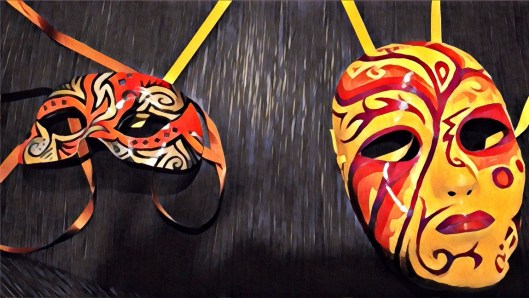
Original Masks by Sarah Morgan

Original Masks by Sarah Morgan

And, slowly, one by one, the men’s faces revealed that they all “got” Tu-Swift’s idea. They felt a little chagrin that they had not thought of such an obvious ploy themselves, but the ROI were a practical lot. If they found an idea that they could use, they used it. They did not reject it out of hand as the Z-Lotz might have done simply because they had not thought of it themselves. 

The men made it clear that the boys themselves were to construct this addition. The largest of the burly men pointed to a large set of cut planks that had already been cut to use for fence repairs.

Tu-Swift nodded enthusiastically. He returned to his drawing. He showed how he would keep the existing fence in place while they constructed the maze addition and a smaller place for the foals to gather. When all that was finished, they could remove the piece of fence that would prevent the foals from entering. 

Tu-Swift had transformed his fear and despair into a plan. He thought to himself, “Not all trees die at the edges. Not these two.” 

IMG_2342

————————————————

Author Page on Amazon. 

The Winning Weekend Warrior focuses on strategy, tactics, and the ‘mental game’ for all sports including golf, tennis, baseball, and others. 

Turing’s Nightmares illustrates possible ethical issues around AI and robotics with 23 scenarios of the future. 

Fit in Bits suggests numerous ways for the ultra-busy to work more fun and exercise into daily activities such as sitting in meetings, walking to your car, shopping, traveling, playing with kids, etc. 

Tales from an American Childhood recounts early experiences and relates them to contemporary issues and events. 

—————————————————-

The Alliance of the ROI & the Z-Lotz

13 Saturday Apr 2019

Posted by petersironwood in America, psychology, Uncategorized, Veritas

≈ 1 Comment

Tags

Business, legend, myths, politics, religion, search, story, Veritas

Eagle Eyes chatted quietly with Easy Tears, and their conversation drifted easily among many topics. Suddenly Eagle Eyes stopped in her tracks. Her eyes spun to something sparkling among the rocks. She thought that perhaps it was merely a piece of shiny rock but as she drew nearer, she realized it was not a rock, or at least nothing like any rock she had seen before. Soon, the others drew near and stared down with her. Even the pups busied themselves sniffing its edges.

white wolf

Photo by Flickr on Pexels.com

A hand-sized ornament had drawn the attention of Eagle Eyes. It consisted of a perfect full-moon shape within which were inscribed three smaller circles. Every member of the search party found the ornamented piece intriguing. Apart from the pups, Shadow Walker touched it first. “It is of the same — or at least very much like — the circles of cold rock at the bottom of the wall door we moved.”

In turn, the others touched the cool circle of rock. 

IMG_5866

Easy Tears said, “Whatever this is, it gives me chills. It feels like touching…death, actually.” Lion Slayer picked up and turned it in his hands. “I see one. Long ago. My father’s father called it, ‘Tree Quarto’ or something like that.”

Hudah Salah whispered something into the ear of Lion Slayer. He nodded and said to the group, “Yes, Hudah remind me that this is a symbol used by the Z-Lotz. Grandfather showed us one when he tell us the Legend of the Unholy Alliance. I dream about it night before dawn, but then forgot when I … when I awoke.” He glanced at Shadow Walker. 

Shadow Walker smiled, “When I woke you up. Sorry. What can you tell us of that legend?” 

IMG_2439

Lion Slayer frowned as he began. “The Legend of the Unholy Alliance” has been told in our tribes for at least six generations. I am not storyteller, but this symbol is supposed to represent the world – the larger full moon shape; and the three smaller full moon shapes represent body, mind, and spirit.” 

Shadow Walker waited while Lion Slayer gathered his thoughts. Easy Tears broke in. “So, this is a symbol that the ROI like?” 

“No, Easy Tears. It is a symbol of the Z-Lotz. That is where the unholy alliance comes. Far beyond our lands, the Z-Lotz ruled but they often fought with the ROI. At last, so the legend goes, the greatest leader of the Z-Lotz and the leader of the ROI had a parley. They agreed to stop fighting. The ROI care nothing for the spirit world, nor really for much of anything except to get more and more as fast as possible. They make deal. Z-Lotz agree to leave the ROI alone and not try to make them believe all the impossible things that the Z-Lotz believed. 

IMG_2466

“But in return, the ROI, promise to pretend to believe and wear the symbols of the Z-Lotz. In return, the Z-Lotz would not only leave the ROI alone; they would pretend that anything that the ROI did was commanded by Giant Sky Bear himself, which the Z-Lotz pretended to be able to talk to. In this way, the ROI were able to conquer many people’s by force and then teach these conquered people that it was their lot in life to be slaves because it was commanded by Giant Sky Bear. The ROI never believed it, of course, for they cared nothing for such things, but these lies proved helpful in convincing the slaves that there was no point in resisting because they would be struck down by the powerful claws of the Giant Sky Bear. The ROI gave the Z-Lotz many material gifts as well. Though the Z-Lotz pretended not to care about material gifts, they never refused any such gifts.”

Fleet of Foot thought perhaps Lion Slayer was finished so asked a question. “And, did the Z-Lotz actually believe this Great Bear in the Sky would really do that? Or, did the ROI? I am confused.” 

nature animal bear teddy bear

Photo by Pixabay on Pexels.com

“Fleet of Foot, you ask good question, but we do not know. We do not know what they truly believe. I have never even met ROI or Z-Lotz. But when our legends are tested, they are generally accurate. I suppose that beliefs actually vary quite a bit among the ROI and among the Z-Lotz, but they all steadfastly pretend to believe such things and this allows them to manipulate people. At least that is what legend says. So, if our supposition is correct that ROI were stealers of children, and they are wearing this symbol of Z-Lotz, that would tend to be in alignment with legend. It does not prove it, of course. But it seems consistent.” 

Eagle Eyes asked, “But do your legends say that the ROI make or use these cold, smooth, hard rocks?” 

Lion Slayer glanced at his wife, and she shook her head. “Not that we recall. No. I am sure I would have remembered such a tale. Such a soul-sucking object, I would have recalled. Neither of us has heard of such before.” 

Shadow Walker put the ornament into his knapsack and the six continued swiftly on their journey. 

———————————————————-

Author Page on Amazon

The Myths of the Z-Lotz

The Myths the ROI

The Creation Myth of the Veritas

The No-Rock Rock & the No-Door Door.

09 Tuesday Apr 2019

Posted by petersironwood in family, psychology, story, Uncategorized, Veritas

≈ 1 Comment

Tags

innovation, myths, ROI, story, tracking, truth, Veritas

Shadow Walker took the first watch along with Easy Tears. After their long day’s march, it would be too easy for a single sentry to fall asleep. Shadow Walker felt as though, for him, it was an unnecessary precaution but he realized that could be a delusion. He might be more prone to sleep than he realized. Easy Tears and Shadow Walker had known each other since childhood and they were comfortable with each other. The wolf pups lay beside them and helped stave off the chill of the night air. Though the pups appeared to be in a deep sleep, he suspected they would be awake in a flash if more ambushers tried to sneak up on their search party. 

bonfire burning camp campfire

Photo by Vlad Bagacian on Pexels.com

Quietly, Shadow Walker began to chat with Easy Tears, the better to keep them both awake. “We should watch out for snakes as well. They are drawn to body heat as well as the fire. I suspect this is the sort of place that many rattlesnakes may make their home.” 

Easy Tears responded, “I am not so much a friend to the snakes as you are. They aren’t always so easy to see either. I recall once almost stepping on a large snake who had a rattle-tail of ten rattles.” 

Shadow Walker considered this, allowing the silence to flow between them. “Those snakes can fool the eyes. That is true. A walking stick, a butterfly with the eyes of an owl. Many animals make themselves look or sound like something else…or just fade into the background.” 

white brown and orange moth

Photo by Pixabay on Pexels.com

A shooting star streaked across the sky. Shadow Walker had jerked his finger to share with Easy Tears and though she turned quickly, she only caught a brief glance. “Like those whom we pursue. They don’t hide their trail well at all. But then they simply disappear!” 

Shadow Walker considered this. “You’re right. I suspect that once we search in daylight we will find some sign of continuing trail. I’m impatient to continue but we need the rest and … the sunlight will show us the way.” Shadow Walker noticed that the soft glow of the firelight flickered on the eyes and hair of Easy Tears in a most pleasing way. Shadow Walker thought of Many Paths and the serious conversation that they had postponed. 

IMG_5044

Easy Tears shivered slightly. Shadow Walker considered sidling up to her and putting his arm around her so that they would both enjoy the warmth of the other. It would be all right. Pleasurable even. But sometimes, it is difficult to know what is around the next bend and the one after that. Instead, he stood and got another blanket and draped it around her shoulders, then added another log onto the fire. He sat back down and reflected on his discovery that snakes could sense the heat of their prey. If only they could train a snake to be a helper. That could prove useful. He wondered aloud, “Easy Tears, if people can train horses and wolves and eagles, do you think it is possible to train snakes?” 

Easy Tears chuckled slightly. “I wouldn’t think so, but you are the expert. I don’t really care for them, though I do appreciate their eating the rats and mice that try to steal our grain.” She considered for a time. “I suppose you could train them. Yes. I suspect you could train anything with enough love and patience. But you see how it is. Despite your love and patience, there is always a chance they would bite you or misunderstand your intention. I suppose it might be something that would take a long time. What would you train a snake to do?”

“I wish we could have their sense of heat. Perhaps we could use them to follow trails or find hidden enemies. Maybe we could even train them as guards. Ours did not work so well for some reason. That bothers me. How could such as these who do not cover their tracks elude our guards?”

“I don’t know. Perhaps they did not try to elude our guards at all, but simply overpowered them too quickly for them to sound the alarm. Or perhaps, they feigned being peaceful? Trunk of Tree will figure it out. I like him.” She smiled and glanced at Shadow Walker. “Do you think he likes me?” 

Shadow Walker considered this. Trunk of Tree had never said anything, but judging from the actions and looks of Trunk of Tree, probably so. “Yes, I think so. He looks at you…with longing. You are a beautiful woman, after all.” 

fullsizeoutput_120e

Easy Tears smiled and Shadow Walker realized that he really found her attractive, but not in the deep way that he loved Many Paths. The half moon set and it grew darker. “It’s time to wake the next guards. He calmed his mind and thought of their serious quest in order to cool his blood. Then, he stood and walked over to Lion Slayer. He stood almost on top of Lion Slayer but Lion Slayer appeared to be a sound sleeper. He snored loudly and Shadow Walker joked, “I wonder whether he actually slew the lion with a spear…or with that snore.” 

Easy Tears laughed aloud but all the others remained asleep. Shadow Walker squatted down on his haunches and shook Lion Slayer. The snoring continued. For a moment, he considered shaking Hudah Salah but decided against it. He shook  Lion Slayer again and whispered his name. Hudah Salah suddenly sprang to his feet and pressed his thumbs against Shadow Walker’s windpipe. Shadow Walker smacked the hands away and jumped back, “Lion Slayer! It’s all right. It’s me. Time for your watch, as agreed.” 

Lion Slayer shook his head. He looked hard at Shadow Walker and mumbled something unintelligible. At last, he seemed to come to his senses. “Yes,” he said and awakened his wife. 

Easy Tears lay down and smiled at Shadow Walker. She moved her body so that sufficient space appeared next to her for the body of Shadow Walker to fit snugly. Shadow Walker sighed and lay down instead by himself and dreamt of Many Paths. 

aerial photo of mountain surrounded by fog

Photo by icon0.com on Pexels.com

The next thing Shadow Walker sensed was light. It was not yet dawn. The troop all awoke and had a small breakfast and then began exploring the cliffs for a sign or a path. As they explored, they continued to chew pemmican and some dried fruit. Shadow Walker had asked Fleet of Foot to explore with Easy Tears, who took the wolf pups with her. Shadow Walker walked with Eagle Eyes. It was understood now by the group that Lion Slayer and Hudah Salah were fairly inseparable. 

Although Eagle Eyes had the best vision, Shadow Walker’s eyes were also sharp but he found nothing but sheer cliffs. Eagle Eyes said, “Wait.” 

“What do you see?” asked Shadow Walker. 

“Nothing really. But something’s not right. It does not look right here. I’m not sure why.” Eagle Eyes stood with her hands on her hips staring at the sheer cliff face. She looked up the cliff face and noted various hand holds. “This wall might be scalable to a good climber.” 

“Yes, I can see that as well though it would be dangerous. But horses? They are horses, not mountain goats” Shadow Walker said without blame or sarcasm. 

“I know, but still, something is not right.” Eyes of Eagle shook her head and asked herself what she was missing.

Because the pair had stopped their systematic exploring, the rest of the search party converged on them. Fleet of Foot was the first to arrive. “Did you find something?” 

Eagle Eyes smiled at him. “Not really. But his does not look right.” 

canyon

Photo by Renata Cholpankulova on Pexels.com

Easy Tears arrived next with the wolf pups who immediately began jumping and whining. They sniffed around the base of the rocks and ran back and forth between the rocks and Easy Tears. They had clearly caught a scent of something.  “Perhaps Tu-Swift?” suggested Shadow Walker.

The pups took turns trying to stick their nose into a small cleft in the rock. On impulse, Shadow Walker, put his fingers in the cleft and tried pulling. He could not budge the rock, which did not surprise him. But the feel of the rock did surprise him. It was much like flint but harder and colder. Beyond that, there was no texture to the rock. It felt, somehow, dead, even more dead than the bleached bones of a long dead buffalo. Shadow Walker lay on his back and tried to push on the cleft with his feet. Soon, all six of them pushed and pulled on the rock face though they had no hope of moving it. 

And then, it did move, though very slightly. The group positioned themselves and pushed even harder. The rock slid more easily now like a smooth stick along the winter lake ice. Instead of the grinding sound of rock on rock, however, they heard an unearthly screeching sound like a very large eagle. 

At last, a huge slab of the cold rock had been moved aside and behind it, all could see a large, short passageway into a sunlit path beyond. The wolf pups bounded through and out into the sunlight. The people followed. Eagle Eyes looked back at the strange rock and noticed something stranger yet. The back of the rock had many handles. She supposed they were to replace the rock. But at the bottom of the rock, she saw something that made her gasp aloud. 

“What is this?” she asked. All of them turned and looked at the base of the weird rock. There were circles of rock on the bottom! What strange magic was this? Despite their hurry to find Tu-Swift and their excitement at finding the way out of the box canyon, each knelt down to marvel at the smooth circles of rock. 

After some time, Shadow Walker said. “We cannot solve the mystery of this rock. We must follow the trail. Should we close this … door? If we do not, it may be apparent to any of the Stands on Horses people that we are coming for Tu-Swift. But when we return, we may be in a hurry to go through this way.” 

Eagle Eyes spoke next. “We could leave it just slightly open so that we could squeeze through but no horses could. I think we could make this door, as you call it, harder yet to open or close.” 

Fleet of Foot spoke. “We should hurry up and get to Tu-Swift as quickly as possible. We have no idea how badly hurt he may be.” 

Shadow Walker: “We cannot know for certain the best course of action. I think it best to put it back the way it was. We are not going to be able to overwhelm our enemy with force. We must rely on secrecy. We may or may not be able to save Tu-Swift. But others of those who stand on horses find out we are on the way to their camp, they may go more swiftly and warn their people. That will make rescue impossible and even reconnaissance riskier. Let us move this back and follow the trail. We may also find another way back that is less familiar to those who ride on horses.” 

I proved difficult to move the rock back, but they succeeded and they then resumed their tracking, which was again an easy task. Perhaps, thought Shadow Walker, those who stood on horses felt they were so fast they would not be pursued. Or, perhaps, they had not learned to hide their trail. Or, perhaps they thought that odd rock door would cut short any pursuit. Eagle Eyes with Easy Tears led the team with the pups trotting along side them. Next came the pair from the Nomads of the South. Shadow Walker and Fleet of Foot carried the heaviest loads and kept looking for and erasing signs of their trail. They stayed within the confines of the large swaths of changed lands that the galloping horses provided. This made “covering” their trail fairly easy. Trackers of the Veritas might wonder at the paw prints of two wolf cubs traveling without a pack, but Shadow Walker felt it likely that these would not raise suspicions among those he was tracking since they seemed so unconcerned about their own trail. 

Shadow Walker was happy to concentrate on the trail ahead and to check to make sure there were no more of those who stand on horses behind them. In this way, he could avoid wondering about things that he could neither control nor prepare for. Many Paths was or was not okay with the rest of the Veritas. Tu-Swift was or was not okay. The only distraction that he really couldn’t block out was the smooth cold feel of the rock that was not rock and the circles of rock. There was also a very odd smell about that rock – something he had never smelled before, but it reminded him of death. 

IMG_2866

———————————————————

Books by the Author: 

The Winning Weekend Warrior focuses on strategy, tactics, & the mental game for all sports including golf, tennis, softball, basketball, etc., as well as business. 

Turing’s Nightmares consists of 23 fictional scenarios of humans interacting with technology for good or evil. 

Fit in Bits suggests numerous ways to work more fun and exercise into daily activities such as watching TV, sitting in meetings, shopping, playing with kids, traveling, etc. 

Tales from an American Childhood recounts early experiences and then relates them to contemporary issues and events.     


The Bonds of Horses and Humans

08 Monday Apr 2019

Posted by petersironwood in family, psychology, Uncategorized, Veritas

≈ 1 Comment

Tags

ethics, family, innovation, myth, politics, story, truth

The Bonds of Horses and Humans

Tu-Swift awoke in pain. He began to panic. At first he wondered and quickly then became sure that they must have beaten him again. Inventory. “Don’t jump to conclusions.” That’s what Many Paths would have said. Inventory. He quickly realized nothing was broken. No, it was just that his muscles were sore. Although he spent a lot of time running, playing, and working among the Veritas, his ride on the back of a horse and then spending a day shoveling manure used his muscles in new ways. His body was okay. As he thought of the Veritas, however, his heart sank. Up to now, he had secretly thought that he would soon be rescued. Now a new and uglier thought crept into his soul. He took deep slow breaths and tried to calm himself. Day-Nah was beginning to stir and Tu-Swift didn’t want to alarm him by appearing scared. But the truth was, all the Veritas may be killed or enslaved. He might even be the only one to transmit their long collective years of wisdom accumulated. 

4B6A1004-D8CC-4D79-BD63-4AC265A4BD06

Painting by Jeremy Colier

That was the cold, bitter spider of doubt that clutched his heart. Though he had no idea whether or not the Veritas had survived the attack, he had been assuming that they had been alive. But there were many other possibilities. Tu-Swift set his jaw. He had always been one to leap before looking while Many Paths kept reminding him to consider other alternatives. But now — Many Paths was not here. He would have to rely on the Many Paths in his head. And, others. There were other voices Among the Veritas who he could use to help him find a means for escape. Meanwhile, he must keep his spirits up by reminding himself of what he liked; what he was grateful for. Tu-Swift realized that, among other things, he was actually grateful to have this small boy as a companion. Worrying about his small jail mate distracted Tu-Swift from his own predicament and uncertainty. 

Just then, Day-Nah stirred and whimpered. He suddenly sat up and yelled. Day-Nah’s eyes returned to that wild-eyed stare that Tu-Swift had first observed. Tu-Swift patted his own chest forcefully and said, “Tu-Swift! Tu-Swift!” Then, he gestured toward Day-Nah by opening his arms and hands outward toward the youngster and said, “Day-Nah. Day-Nah!” The young boy blinked several times and seemed to recall his present circumstances. His breathing slowed, but he pulled his legs up, wrapped his arms around his knees and began rocking and silently crying. 

IMG_2223

Like all of the youth of the Veritas, Tu-Swift knew how to comfort the young of his own tribe, but he felt uncertain about approaching the boy in this state. Though tempted to hug him, he decided distraction might be a wiser course and he reviewed the language lessons they had already gone through, being a little more particular about pronunciation, both in his attempts to mimic the sounds of Day-Nah and in Day-Nah’s repetition of of Veritas. This seemed to calm the boy and his silent tears abated. Once more Tu-Swift grew both angry and troubled that anyone would steal such a young boy from his family. 

The horses were stirring as well, though it was early morning, judging from the gray light that crept into the horse enclosure. In the distance, Tu-Swift could hear many people stirring and getting ready for the day. Again, he had the distinct feeling that it was like and yet very unlike mornings among the Veritas. There were footsteps, and there were voices. The accent and cadence of the voices was different, but something more profound was different. He heard birds chirping, squawking, crowing, cooing and so on, but some note was missing. Tu-Swift thought of a rainbow and imagined what it would be like to see a rainbow that was missing the blue or the red. But no! This rainbow was missing all color. Why did it sound like a colorless rainbow? That made no sense. Tu-Swift shook his head. He wished he could have a real conversation with Day-Nah, but he knew of no way to try to communicate such subtlety. 

IMG_2199

Three large, burly men came into the large horse room. One of them put down two dishes of food and a flask of water. He grumbled something at them. Tu-Swift noted that none of these people seemed very interested in trying to teach them their language. The other two stood nearby and all three watched as the boys ate whereupon they were led out to an open pit toilet and from there to a large field fenced in with logs. There were a large number of free running horses in this particular field and among them, Tu-Swift could see five foals. Working together, the three large men managed to separate one of the foals from its mother. Tu-Swift could see that the mare stomped around dangerously, whinnied, and that the whole herd seemed agitated. Every horse in the herd, however, shrunk back, terrified of the men and eventually one man managed to tie a rope around the foal’s two back legs and another around the forelegs. Tu-Swift looked to his own legs and those of Day-Nah and saw that they were in much the same predicament. They, like the foal, could walk, but not run or jump. 

Tu-Swift realized how much he loved to run free. He reveled in the feeling and he felt both sadness and anger at being prevented from running. He wondered whether he would ever be able to run free again. He begin to wonder whether he — or the foal — could ever be truly happy if they could not run free. Then, Tu-Swift thought of the snails that he had so often collected from the Veritas gardens. He had looked fairly closely at the creatures. They were fairly cute actually. Of course, as Many Paths would point out, he had no way to tell how a snail felt. But there was no reason to think they wouldn’t be happy. Finding something nice to chew on would probably make the snail happy just as it made him happy. But it was not in the nature of a snail to run. At imagining this, Tu-Swift laughed. 

slow slug snail shell

Photo by Chris Peeters on Pexels.com

Day-Nah tilted his head with his brows pinched together as he regarded the older boy. Tu-Swift smiled at the boy and at his situation. How could he explain that he had been imagining a snail trying to run? Then, it suddenly hit Tu-Swift that the “color” that was missing from all the morning sound of these captor-people was laughter — not just laughter itself, but any kind of fun, or enjoyment. So far as he could tell, they did the same things that the Veritas did (except for tying up other creatures), but they didn’t seem to enjoy any of it! What a strange, gray life that must be, thought Tu-Swift. And he suddenly realized that he actually felt sorry for his captors! He imagined telling Many Paths. 

Just then, all three men came over to them and shouted at the same time. Neither of the boys had even the slightest idea what they said and this must have been obvious to the three because they all switched to miming what the boys were to do. They were to do what the three grown men had just done! Somehow, they were to cull four more foals and tie their legs with rope! The Veritas had ropes, but Tu-Swift decided that it was a fair bet that Capture-People didn’t know that. The Veritas were all taught at an early age that those with more power seldom bother to learn even what would be of immense value to them if that knowledge lies with those out of power. The Capture-People had horses — and they had captured one, at least, of the Veritas. So, they would think themselves superior and be willing to believe any lack of intelligence or knowledge on the part of Tu-Swift. 

iPhoneDownloadJan152013 697

He acted quite incapable with the ropes at first, only slowly catching on. Tu-Swift had no idea how the two of them were supposed to accomplish what looked very difficult even for three large men, three who did not have their legs tethered. Cautiously, they sidled into the pen staying near the exit that only they could squeeze through. Oh, thought Tu-Swift, Eagle Eyes will love to hear about that! Although tinged with sadness, he realized that he wasn’t really away from his own village at all! They all lived in his own head! As long as he lived, the Veritas lived! 

Most of the herd headed to the far end as the boys entered, but one mare and her foal chanced nearing. The mare seemed to like their company! Perhaps she could see that they were tethered as they were. Tu-Swift gently tugged at Day-Nah by the arm and positioned him so that the men could not get a clear view of the mare. The mare smelled something nice on the rope between Tu-Swift’s legs. It began chewing on the rope. Tu-Swift admired the teeth and jaws of the horse before him. He spoke to the horse in Veritas though he was under no illusion that the horse would understand him, at least in any detail or words. “I am Tu-Swift. You are?” 

At this point, the horse made a sound like “Kneeeeee -Kwah” 

Tu-Swift continued, “‘eee-qua’ it is then.”  

animal close up countryside farm

Photo by Francesco Ungaro on Pexels.com

“Tu-Swift likes to run. Ee-qua like to run. We don’t like ropes. (Here he made a show of waving the ropes in the air so the three men would think they were making progress.) “We want to run free. Tu-Swift and Ee-qua run free one day. Yes, we will.” 

Tu-Swift hobbled over to the foal and sat on the ground. “Hello little one. We have a predicament. I have these ropes on my legs. I don’t like them, but if we don’t wear them, they will beat us until we do. Your mother, Ee-qua chewed my ropes nearly through. So, I am going to put these ropes on you. But you will be able to run free in a few hours. I know you don’t understand a word I’m saying but maybe the sound of my voice will help you know that I am your friend regardless of how it seems.” Tu-Swift meanwhile, had succeeded in tying a rope around one of the young colt’s legs and “secured” it with a granny knot rather than the square not that the men had shown him. It was chancy to make life difficult for those that seemed to have power over him, but it had to be done; carefully, and never in the same way twice, but each day, Tu-Swift knew that he could find some way to make the lives of the Capture-People less pleasant, just as they were making his less pleasant. 

931D1948-69AF-4F80-94CC-8064833AEFB5

Hiding tools, wrecking tools, backing up sewage, polluting water, passing on disease, poisoning — these were just a few of the ways he might or might not be able to fight back. Meanwhile though, he also had to be careful not to be caught and to have a well-worked out and plausible excuse. As Tu-Swift tied more legs with granny knots, he planned that he would feign astonishment and excitedly show his captors how he had tied the knots. He would tie granny knots. They would smack him about a bit of course. But then they would show him the correct way. He would again copy but make a granny knot. The Capture-People would smack him around a bit, so he imagined, and then show him again. He would feign insight and make a true square knot the next time. This would serve two purposes. It would cause them grief, but it would also, he hoped, endear him to them in some perverse way. It would be as though he could learn their tricks — eventually — but being more stupid than they are — it would take him longer naturally to learn to do things correctly. And, then again, he thought, fastening the fourth leg with a granny know, I may never even be accused. 

Just then it occurred to Tu-Swift that the horses could chew threw their own tethers! Why hadn’t they thought of that. Maybe that’s not the sort of thing horses “think of.” Maybe they need to be shown. If they will eat through my ropes — and she could have easily gone all the way through — they could eat through their own, but how can I get food to put on those ropes? 


Author Page on Amazon

Start of the Myths of the Veritas

Symmetry

23 Sunday Dec 2018

Posted by petersironwood in management, psychology, Uncategorized

≈ 5 Comments

Tags

Business, Design, HCI, human factors, Human-Computer Interaction, politics, truth, UX, Web design

{Something went wrong with WordPress the first two times I tried to post this. I tried to track it down. As best I can tell, my problems came from trying to cut and paste pictures from my Pages file. Even though it looked fine in the editing interface, it appeared blank in the actual viewing interface.}

Symmetry

IMG_3316

(Original, free-hand drawing by Zoe Colier).

There are many varieties of symmetry. In many cases, symmetry exists rampantly in nature and symmetry is incorporated into many human designs as well. In this short essay, I want to remind people of several varieties of symmetry and then show how symmetry may also be used as a tool of thought to help solve problems by simplifying the space of possibilities that must be considered. 

Symmetry is a concept with far broader application than cutting out paper snowflakes or choosing a nice looking Christmas Tree, Menorah or other Holiday decoration. It is fundamental in logic, mathematics, physics, chemistry, biology, and even in social science. Symmetry exists at many different scales as well. Planets are generally roughly spherical and their orbits are roughly circular. 

IMG_5895

The human body, along with most other animals, exhibits rough bilateral symmetry in external appearance. If you examine your own fingerprints or the pattern of your moles, for instance, you will see that one side of your body looks slightly different from a mirror image. If, like me, you are a righty who play tennis, you will find the forearm muscles on your right arm are slightly larger than those on the left. What is remarkable to me is not that there are slight variations between left and right but just how slight those variations are! And, we are not alone. Fish, insects, flatworms, roundworms, snakes, turtles, lizards, horses, dogs, cats, apes, and humans are all roughly bilaterally symmetrical in appearance. I say “in appearance” because our internal arrangement of organs is not at all symmetrical.  

External Appearance and Internal Organs

In general, it seems to me that most animals possess more complete or “perfect” bilateral symmetry than do most plants. I suspect that this is because animals generally move through a physical environment. Since we can move around, the environmental forces are generally symmetrical and so our ability to react to those environmental forces is also symmetrical. A tree, on the other hand, may have a genetic “blueprint” to be bilaterally or (more likely) radially symmetrical, but it may be subject to strong asymmetrical forces such as wind, a water source, or sunlight versus shade. 

Our designed objects are also most often (at least) bilaterally symmetrical, and particularly for those objects which must interact and move through the physical world. Cars, boats, motorcycles, busses, trains, trucks, bikes, skis, surfboards, roller skates, ice skates, snowshoes and tennis shoes all tend to be bilaterally symmetrical. On the inside, however, again just like us, there are often some irregularities. The arrangement of controls of the car, for instance, are asymmetrical. (Each control in itself often does show symmetry. In some cases, this makes it easier to use, especially without looking. I suspect that the symmetry may often be for aesthetic reasons, for ease of manufacturing, for ease of maintenance or replacement or some combination.) The asymmetry of arrangement “works” because the arrangement of displays and controls does not interact with the natural world the way that the car body and wheels do. The controls are designed to interact with a human being. There are also rough conventions for where controls are laid out, how they operate, and what each type looks like. Asymmetry of arrangement is also evident under the hood. However, some of the components such as the engine, the battery, the radiator have symmetry within them. The radiator, which arguably has the most interaction with the outside world, is symmetrically placed though its plumbing is not. 

automobile car customized drive

Photo by Pixabay on Pexels.com

In the design of User Interaction and Experience, an argument can be made for certain kinds of symmetry. For example, in the Mac editor Pages, which I am using to write this, if the B for bold button background turns blue when bolding is turned on, I expect the background will turn back the way it was (white) when bolding is turned back off. I also expect that italics and underlining  will behave the same way, especially because all three are in the same toolbar. 

Where possible, it also generally makes sense, I believe, to design so that the functionality of a system is symmetrical. This isn’t always possible. Some actions are necessarily irreversible. If you don’t believe me, ask anyone who has toddlers or who has cats as pets. In the real world, if you shoot someone dead, you cannot “unshoot” them. Unlike a computer system who asks, “Do you really want to delete all your files?” before doing so, guns do not ask that. If you are designing what can be done with a toy robot however, if you can make it go forward, you want to make it so it can go back as well. If it can turn right 90 degrees, you would like to enable it to turn left 90 degrees. Saying, “Oh, yes, but don’t you see, you can, in effect, make it turn left 90 degrees by making it turn right 90 degrees three times?!” does not cut it, IMHO. 

Typically, you not only want the functionality to be symmetrical, you also want the control functions and appearances to mirror the symmetry of the functionality. For example, if you can issue the command: “MOVE ROBOT FORWARD THREE PACES” you want the symmetrical function to be evoked this way: “MOVE ROBOT BACKWARD THREE PACES” and not, “THREE PACES BACKWARD FOR ROBOT MOVE.” If you decide to give auditory feedback for the first command that says, “ROBOT MOVING FORWARD THREE PACES” you do not want the reverse command to provide feedback that says, “ROBOT THREE PACES BACKWARD MOVING.” (Oh, by the way, if you cannot provide symmetrical functionality, please do not pretend to do so with a facade of symmetrical looking commands that actually behave asymmetrically!)

action android device electronics

Photo by Matan Segev on Pexels.com

A lack of symmetry (or consistency) in the functionality, command structure, or visual appearance often arises because of a lack of communication within the development team. If different functions of the robot are to be implemented by different people, then it’s important that those various people use an agreed upon style guide or Pattern Language or that they  communicate frequently. Of course, this is not the only cause of asymmetry. Even if your team communicates really well, they can’t design an effective gun with an “unkill” function. 

There are, of course, various types of symmetry. Bilateral (mirror) symmetry is what the external appearance of our bodies has. There is also translational symmetry, where the same shape is repeated along a line. The string ABCCBA shows bilateral symmetry while ABCABC exhibits translational symmetry. Most human factors people now agree that hot water faucets (usually on the left) and cold water faucets (usually on the right) should both be turned off by turning to the right and turned on by turning to the left (translational symmetry) as opposed to having the faucet on the right turn off to the right and the left faucet turn off to the left. But you will definitely experience both types. 

In both music and poetry, at least in the culture I am most familiar with, translational symmetry is more common than mirror symmetry. It does sometimes happen that musical composers experiment with playing a tune backwards or even with the staff turned upside down. But this is far less common than repeating a theme or melody. Similarly, a rhyme scheme like ABCABC is much more common than is ABCCBA. {In this notation, ABCABC means that the first line rhymes with the fourth line, the second line rhymes with the fifth line and the third line rhymes with the sixth line.} 

black and brown millipede on a green and brown branch

Photo by Pixabay on Pexels.com

In biology, we also find translational symmetry or something close to it. The segments of a tape worm, the segments of the body of a millipede or centipede, the small legs of a lobster, and even our own vertebrae and ribs show translational symmetry. In social structures as well, we find both mirror symmetry and translational symmetry. For instance, the Golden Rule says to do unto others as you would have them do unto you. In addition, as it happens, if we are nicer to other people, then, generally speaking, they are also nicer to us. This is not always true, however. Some people simply take advantage and view all of life as a zero sum game. Whatever you gain, they lose and vice versa. This is a very limited, inaccurate, and self-defeating attitude in most social situations. Most social situations, are, of course, much more complicated. Generally speaking, there are a great many situations that both you and your “opponent” or even your “enemy” would agree are good and a great many others that both of you would agree are bad. If you are playing tennis or golf outdoors, for instance, you may be fiercely competitive but both of you would probably find a game that brings out the best play is better for both of you. Both of you would probably also agree that being rained out is a bad outcome.  

men in black and red cade hats and military uniform

Photo by Pixabay on Pexels.com

In the military and in many industrial settings, there is a great deal of translational symmetry. The “ideal” set-up is to have many groups at each of many levels and each group is meant to be as similar as possible to all the other groups at that level. The marching that military groups learn is both symbolic of this translational symmetry and practice in behaving as a unit composed of identical parts. Whether or not this is the best way to run a military is debatable. To me, it’s undeniable that this management style has been imported into a huge number of organizations where it is definitely not the best way to organize. 

The last thing to note is that symmetry also pops up in design. There is often a whole series of information exchanges from people who have quite different areas of expertise. These exchanges can result in mutual learning, solutions that work, and often patents, and occasionally, some really cool, transcendent, game-changing designs. In my experience, it is much better to have a design process based on symmetrical relationships founded in mutual respect than to have a design process based on having someone in a hierarchical power relationship make decisions that are to be implemented by an identical set of “underlings.”  

macro photography of snowflake

Photo by Egor Kamelev on Pexels.com

The Takeaway

Symmetry is everywhere. There are many forms. If you start looking for symmetry, you will find examples in nature, in mathematics, poetry, art, music, machine design, the military and even in design problems and design processes. Thinking quite consciously about the types of symmetry that exist in a problem space and what could or should exist in that problem space, can lead to novel solutions.  

——————————————-

Author Page on Amazon. 


Resonance

20 Thursday Dec 2018

Posted by petersironwood in America, management, psychology, Uncategorized

≈ 2 Comments

Tags

creativity, Design, Feedback, golf, harmonics, learning, politics, programming, resonance, sports, testing, thinking, timing

Resonance

If you have ever pushed your kids on a swing, you know that timing is important. If you add the power of your next push just as the child reaches the apex and begins to fall back, you will swing your child higher and higher with little effort. On the other hand, if you add the power of your next swing at the bottom of the arc just as the swing is moving toward you at maximum speed, you will nearly stop the swing and likely injure yourself and/or your kid. Please don’t try it.

boy wearing blue shirt sitting on swing

Photo by Git Stephen Gitau on Pexels.com

In sports as well, the timing of when you add your effort is critical. In golf, for instance, many beginners think a lot about their hands, probably because we use our hands for many daily tasks such as texting, flipping burgers, playing video games, etc. While the hands are certainly important in the golf swing, they are the last thing to bring to bear on the golf swing, not the first. If you add your hands and wrists at the last moments right before you hit the ball, you will  be accelerating the club face as you hit the golf ball. You will have greater velocity and also more stability and hence more accuracy for the shot. 

woman playing golf

Photo by Jopwell x PGA on Pexels.com

The golf swing is a complex athletic move that I cannot describe in detail. Here’s what is important in this context. Some parts of the golf swing (notice the word: swing) are much like a pendulum. The longer parts of the body (e.g., the arms) take longer to swing on their own. The shorter parts of the body take a shorter time to swing on their own (e.g., the hands). In addition, the shortest pendulum (the hands) is at the end of the longer arm swing. This means that for the arm swing and the hand/wrist moves to multiply effectively, you must engage the hands and wrists toward the bottom of the arm swing when the arms are already moving at top speed. 


What is True in Mechanics and Sports is also True in Social Engineering.  

If you work in a highly competitive, even cut-throat sales environment, in which there is a long tradition of stealing commissions, grabbing each other’s customers, etc., having the sales manager say something like, “You know what? Let’s cooperate! Put the customer’s interests first, not your own commission” is pretty much useless. A manager’s exhortation to cooperate is a short term high frequency “push” but it will be just as ineffective as trying to start your golf swing with your hands, or trying to push a swing with all your might when your kid is swinging toward you at top speed. If the cultural milieu is cut-throat, the manager’s statement will not be sufficient to change that culture. What the sales people will do is make sure that they have a semi-plausible story ready about how stealing someone else’s commission was really best for the customer. 

group of people raising right hand

Photo by rawpixel.com on Pexels.com

On the other hand, imagine instead that sales people have shared commissions for years and that the company takes many steps to build social capital and cooperation among everyone on the sales force. Now, the manager may do something publicly to praise an actual instance of cooperation. It doesn’t have to be heavy-handed or over the top. It is a gentle push that adds energy to what people are already doing. This is akin to adding the hands to a good golf swing or adding your swing push just as your kid begins to descend. 

Don’t get me wrong. If your house is on fire, you should leave. Grab your kids and pets but don’t bother with last weeks losing lottery tickets. 

But — you also need to understand why your house caught fire – perhaps faulty wiring – and why the fire was not immediately doused – e.g., your fire extinguishers are out of date. If you don’t fix underlying problems, your next house is likely to catch fire as well. 

If your culture is so materialistic and superficial that a blow-hard sleaze bag who seems to have great material wealth is celebrated no matter how he or she came by that wealth and fame, you may have to deal with the short term problem first, but unless you also deal with the underlying cultural, social, and economic problems, you’ll likely find yourself in precisely the same situation again. The same or other foreign enemies will attempt to exploit those same weaknesses again by finding a different celebrity with deep underlying character defects. Those enemies will push particularly hard during a crisis or an election and they will push particularly hard in the errant directions that society is already trending toward. 

The String’s the Thing Wherein We’ll Capture the Conscience of a King

Next time you have access to a piano, try the following experiment. Gently push down the C, E, and G keys above middle C. Keep them pressed down with your right hand and then strike middle C sharply with your left hand and let it go. What you will hear is that the strings of C major (C, E, G) will vibrate for quite a time after you release the middle C key. If instead, you gently push and hold down the D, F, and A keys above middle C, you will hear very little sound coming from them. Why? Because the harmonic resonance of  middle C is greater with the C, E, and G than it is the D, F and A keys. Similarly, some people will tend to “resonate” with certain messages more than others will. 

close up photo of person playing piano

Photo by Juan Pablo Arenas on Pexels.com

This is why, for example, Russian fake news that was meant to suppress the black vote carried false stories to indicate Democratic candidates didn’t care about the “Black Lives Matter” movement, while false stories about how Democratic candidates don’t care about gay rights were targeted toward the LGBTQ community. Of course, even putting Russian election interference aside, candidates typically target their messages to those that will “resonate” with particular voters. For instance, a candidate who believes in an isolationist foreign policy, forgiving student loans, low estate taxes, and better benefits for veterans might focus a speech to a group of veterans on their desire to see better benefits for veterans.  The same politician, when speaking to college students, will tend to focus on forgiving student loans. That has been “business as usual” for my entire adult life. What was really new to me in 2108 was this: an entire raft of Republican candidates promoted the idea that they were concerned about making sure that insurance companies covered pre-existing conditions. In fact, they had always voted against it and were suing to make this provision of Obamacare illegal. 

Prior to the existence of lying news networks and fake web sites who would echo such lies, politicians of either party would be reluctant to employ blatant lying about their positions because, even putting ethics aside, they would be easily discovered. However, if some of their constituents only believe fake news networks, then such politicians feel that they can lie with impunity The news presented on such networks resonates with what the lying politicians say and resonates with what those viewers want to hear and believe about the people toward whom they are already favorably disposed.

person woman music musician

Photo by Skitterphoto on Pexels.com

Resonance and the Overly Long Time                                                     Lag.

While managing a research project on the psychology of aging at Harvard Med School, I lived in a suburb called Woburn. This rented house had a hot water heating system, and at some point, during a particularly bitter cold New England winter, the furnace stopped working. I could have called in a professional, but instead, I tried to fix it myself. As a part of this system, there was a small gauge that looked a lot like the gauges in a level, but this one was upright and generally half filled with water. I noticed that now, instead of being half filled with water, it was only about 1/10 filled with water. I didn’t exactly understand why this could be problematic but the instructions said it should be half filled with water and there was a valve to let more water in. So, slowly and cautiously, I opened the valve. Nothing happened. I opened it a bit more. Nothing happened. I opened it a bit more. Nothing. I was about to give up and call a repair person. All at once, the little vial began to fill. Yay, me! I turned the valve off because the instructions also said the gauge should not be overfilled. But it kept filling. And filling. Damn! I made sure the valve was closed tightly. It kept filling anyway! Double damn! The gauge exploded! I had been the victim of — well hubris, of course, because I thought I could figure it out — but also a victim of delayed feedback. When feedback is delayed, all sorts of havoc can ensue. 

photography of green and red fire works display

Photo by Anna-Louise on Pexels.com

You may have experienced a similar time lag issue with hotel showers. You turn up the hot water and the shower water stays cold. You turn it up more. It stays cold. You turn it up more and it still stays cold. And then…all at once you’re being boiled to death in your own shower and you begin wondering who will find the naked body. 

Back in the early days of using LOTUS NOTES, there was a button on my screen that said, “REPLICATE.” And if I clicked on that button, a replication process would start. (Basically, it was downloading my email from the server to my ThinkPad). But sometimes, the mouse click did not register. This might not be a giant issue. In other cases, I would simply click again and this worked for most applications. But in this case, NOTES put up another button, in the same exact spot as the REPLICATE button, that said, “STOP REPLICATION.” The State of the Replication Process, however, was not accurately reflected by the State of the Button on the screen! This was endlessly annoying and could easily have been avoided. There was plenty of screen real estate to put a “REPLICATE” button along side the “STOP REPLICATION” button. Once connection speeds were faster and the computational facilities themselves were faster, this UX issue ceased to be an issue because there was no noticeable time lag between the state of the process and the state of the button. 

man holding remote control

Photo by JESHOOTS.com on Pexels.com

However, I still run into similar issues with Cable TV remotes. Do you? The time lags associated with clicking something on the remote and something happening on the screen is so long, that you begin to wonder whether the battery has gone dead or whether it is aimed wrong or whether the button was not fully depressed. Indeed, I sometimes wonder whether the entire system is truly electronic. I have begun to believe that the button press actually sends an ultrasonic dog whistle to a pack of hungry weasels who hear the whistle. To them, it’s a signal that they are about to be fed. They begin scampering in unseen cages toward their food dishes. The scampering of their feet is picked up by sensors under the floors of the cages. These sensors cause dials to change in a control room staffed by retired school janitors who push a series of buttons that change the channel or the input designation or turn on captioning, but only after they finish the New York Times crossword puzzle they are working on. Then, and only then, does the desired action take place. But if and only if you’ve been patient enough not to hit the button a second time. 

adult audio concert control panel

Photo by Roman Pohorecki on Pexels.com

Of course, if you are the user in this scenario, there is a fix. Push the button once and only once. Now, go outside and run around the neighborhood for fifteen minutes before interacting a second time with the remote. Sure, it takes a long time to get to your program but you’ll be in much better shape after just a few months of this regimen. 

On the other hand, if you are the designer of such systems, you might consider that it would be less expensive in the long run to replace the ultrasonic dog whistles, the weasels and the retired janitors with an actual system of electronics which, after all, is supposed to run at nearly the speed of light.

landscape photography of field with wind mill with rainbow

Photo by Paweł Fijałkowski on Pexels.com

The Takeaway

In comedy, timing, as in life, and UX design, and pushing your kid on the swing, and your golf swing, and social interventions, and election interference, and human short term memory limitations, is everything. 

—————————-

Author Page on Amazon. 

Non-Linearity

20 Thursday Dec 2018

Posted by petersironwood in America, management, psychology, Uncategorized

≈ 4 Comments

Tags

environment, equilibrium, feedback loops, ping pong, research, science, systems thinking, table tennis, testing, truth

Non-linearity

A Chessboard Full of Rice

According to myth, the Emperor’s wise adviser once did him a great favor. So grateful was the Emperor that he begged his wise advisor to take any gift she might like from the vast treasures of gold or jewels, any lands or gardens, any of the Emperor’s many male children to be her companion. However, the advisor answered as follows: “Thank you for your generosity, oh mighty Emperor. I have no need of great material wealth. My needs and wants are simple. I do get hungry and thirsty, of course, as do we all, and sometimes my household runs short of rice. You see this fine chessboard?”

battle black blur board game

Photo by Pixabay on Pexels.com

“Oh, yes, my wise counselor, it is indeed finely made of gold and silver and I would gladly give you twenty such!” 

“Thank you again for your generosity, but I only wish for a some grains of rice. Give me one grain on this space and tomorrow, two grains on this space and the next day, four grains on this space. Each day for 64 days, double the number of grains of rice you gave me the day before. At the end of the 64 days, I will ask for no more.” 

The Emperor looked puzzled. “Surely, you must have something more valuable than rice! Name it!” 

“No, Sire, that is all I desire. Just the doubled rice will do quite nicely.” 

“Well, it shall be so!” And thus the Emperor told his staff that they were to provide a grain of rice for the first day, two grains of rice for the next day and to double the amount each day until all 64 days had passed. At first, it seemed such a pathetic gift for such a great favor. 

Even after 8 days, the wise counselor only received 128 grains of rice – not even a bowlful. 

Readers familiar with exponential growth realize that on the 64th day, the Emperor has promised to deliver 2**63 grains of rice. This is not only more rice than the Emperor had at his disposal. It is more grains of rice than exist in all the kingdoms of earth. To be exact, the last payment is meant to be 9,223,372,036,854,775,808 grains of rice while the total is one less than 2**64. To put the matter scientifically — it’s a lot of rice! Much more than exists in the world. 

How would you like the story to end? A wise Emperor, to my mind, would thank the counselor after a couple weeks and say, “I see, oh wise Counselor, that you used my gift to give me another gift to enhance my wisdom. For I now understand that what seemed at first an easy thing to do is actually quite hard. Doubling soon undoes even the richest king. I will keep this in mind when I think about interest rates and population growth.” 

A crummy Emperor, on the other hand, might say, “I offer you a gift and you see fit to embarrass me by making me agree to an impossible task? Boil her in oil!”

The Lily Pad Pond Puzzle. 

Beside my house is a pond. In this pond, a lily pad began to grow. Every day, it doubled in size. On day 20, it completely covered the surface of the pond. The surface of the pond is 400 square feet. How many days did it take to cover half of the pond? 

red and green lily pads focus photography

Photo by Skitterphoto on Pexels.com

At first glance, you might think this problem is insoluble because you don’t know how big the lily pad was initially. In fact, you don’t even need to know how large the pond is. It will cover half the pond on day 19.  

The Ping Pong Table Ping Pong Player Population

When I began at IBM Research in 1973, I soon discovered that a fair number of researchers were avid table tennis players. At lunch time, somewhere between six and twenty researchers would show up to play. There were two tables and some small amount of room for spectators to stand on the edges of the two ping-pong rooms and watch. Our rule was that if a person won, they would stay at the table and a new challenger would play. However, if you won three times in a row, you had to sit down regardlessly. I didn’t go over every lunch time, but I went over quite a few times over the course of my first ten years there and there was invariably someone to play with. Sometimes, I had a longer wait time than others, but it was never too long a wait. 

Then, because management wanted to use one of the two ping-pong rooms for other purposes, they repurposed one of the rooms. Now, there was only one ping pong table. In the two ping-pong table case, remember, I never had to wait too long nor did I ever go there and have no-one to play. As I said, the number of players varied between somewhere around six to twenty. What is your prediction about how many players showed up when there was only one ping pong table? 


Here’s what happened. The first day after this change happened, I went over and about fifteen people showed up. I, like everyone else, waited a long time for a game. Our “official” lunch hour was actually 42 minutes and the building was a five minute walk away. So, if you had to wait a half hour for your chance to play, it really wasn’t that much fun. In addition, there were some more subtle effects. All the players were good, but there some substantial differences in skill level. People tried to arrange it so that they played someone at about the same level. WIth only one table, this was trickier. In addition, when a relatively large number of people showed up, it was too crowded for everyone to see the match without interfering with play. It happened that I was too busy to go for a few days. The next time I showed up, no-one was there. Some of us talked about trying to “organize” the ping pong to insure that enough people showed up but everyone was busy and no-one wanted to take this on. Scheduling researchers is harder than you might think. It was hard for people to make a commitment to show up at noon because a meeting might run over, their manager might give them extra work, etc. The number of people showing up swung wildly for about two weeks and then stabilized. 

At zero. 

What had been a vibrant community with two ping pong tables did not stay the same size, or shrink to half when we were limited to one table. It went to zero. 

Warring Positive Feedback Loops. 

We’ve already talked about “positive feedback loops” which are also known as “vicious circles.” Sometimes, there are actually (at least) two positive feedback loops hiding beneath what appears to be a stable system. In the Case of the Missing Ping Pong Table described above, one positive feedback loop was simply that when you went there and had a good time through some combination of watching good matches or playing yourself, you were more likely to go there again. There was also a positive feedback loop that was more of a social nature. The more people who were there, the more likely it was you would find a good or interesting match. It was also more likely to be able to find someone you wanted to have a conversation with although the venue prevented this from being a big part of the adventure. Another way that having more people there increased the chances that more people would be there the next day was that it was kind of exciting to have a larger audience watching, cheering, throwing the ball back when the ball crept under the radiator after pin-balling around for awhile after a decent slam. 

IMG_1075

At the same time, there were other feedback loops, sometimes of the same factors but in a different range. For instance, beyond the point of having the periphery of the playing field covered one or two deep, additional spectators added only a little excitement and they were more likely to infringe on the needed space around the table. In addition, while the first ring of spectators felt very much a part of the action, the experience for the second ring of spectators was far less engaging. While I mentioned above that more players meant a better change of finding a good match, it also meant that one had to wait longer between matches. The worst case scenario, of course, is that you are the only one who shows up. 

Behind Every Abstraction are a Host of Personal Stories. 

Yes, you can practice against the wall, and I did this a few times, but it is significantly less fun than a real match. I love to serve, for instance. I have a raft of difficult serves. Just to give you one example, with most set-ups, I can hit the right side of the ball so thinly that I put enough side-spin for the ball to appear as though it isn’t even going to hit the table on the second side, but it does; it curves radically back around the left. Sometimes people are so surprised that they miss it entirely. Even if they get there, the sidespin often makes them hit it off the table or the curve causes them to mis-hit the ball on their thumb or finger. I can also add a fair amount of top-spin or under-spin as well. Anyway, I didn’t get to do any of that just hitting the ball against the wall. The wall was not perfectly smooth either. So I might hit three of four shots and then the ball would hit a little imperfection in the plaster and careen off to scribble scrabble along the floor and then crawl under the radiator. It’s the kind of annoyance that everyone has experienced. And if someone else is there, you can kind of glance at your friend who nods nearly imperceptibly as you get down on your hands and knees and stretch your fingers into the territory of God-knows what spiders or broken glass and feel around through the grit and dust until you retrieved the ball. And that little glance and that little nod actually make quite a difference. If you’re on your own, it’s not any fun at all. It’s just an annoyance. The only reason I even bother to hit against the wall is to learn to keep focus for extended periods of time. For this, it is good practice and a good challenge. But, if I’m interrupting this to go fish my hand into a pile of dust every couple minutes, it isn’t so likely I’ll come back. 

close up portrait of owl against sky

Photo by Pixabay on Pexels.com

These various factors were all in a dynamic balance so long as there were two tables. When the tables went from two to one, however, what had been a stable equilibrium became a very unstable one. Eventually, of course, it did find a new equilibrium point and that was zero. To crawl out of that, one person might show up. But most of the time, they were the only one. So, they would be less likely to come again. Even if two showed up, since no-one could play every day, you might still find yourself wondering whether someone would be there the next time. 

bandwidth close up computer connection

Photo by panumas nikhomkhai on Pexels.com

You might have read this whole story and wondered why the hell this building full of Ph.D.’s couldn’t get their act together and arrange some matches. It’s an interesting question and here is my personal opinion. When it came to these brilliant scientists and engineers, they came from every part of the globe and they came in all shapes and sizes. Some were vastly overweight and others were ultra marathoners. But the ones who liked to play table tennis were, by and large, athletic and “hyper” – an impatient lot. What all of us really loved was working to find out the truth. And, these truths that we sought were ones the company that we worked for wanted us to seek. True enough, but by the same token, that meant the truth found and utilized would make people’s lives better in some way in the not too distant future. But working in a corporation also meant doing a bunch of administrivia. So, the ping pong set in particular, wanted to get up from their intense sedentary mental and administrative work and play hard at something completely physical and different. The last thing any of us wanted to do was add more administriva to our lives. 


The Takeaway

 It’s easy and common to assume implicitly that the systems you deal with are linear.

They often aren’t. 

Things can go out of control extremely quickly (into a dominant positive feedback loop) once the dynamic equilibrium is disturbed. 

Would the invention of the iPhone have kept the ping pong community going? 

Another takeaway: there are two quite distinct ways of analyzing that are going on in the essay above: a fairly abstract one (even if it uses concrete examples like rice and lily pads) and a very concrete and experiential one. In my experience, both of these modes are useful and valid and if taken together give a fuller picture of what’s going on. My experience in this was mainly in human computer interaction but I think it is equally true for many in law, medicine, management and many other fields. What’s your experience? 

———————————

Author’s Page on Amazon.  

Problem Finding

18 Tuesday Dec 2018

Posted by petersironwood in America, management, psychology, Uncategorized

≈ 2 Comments

Tags

Design, life, marketing, media, problem finding, problem solving, research, truth

Problem Finding

IMG_5193

Today, I googled “problem solving” and it returned 287,000,000 results. In most of our school life as well as most people’s work life, we are given problems and asked to solve them. “Problem finding” only returned about 2.5 million or fewer than 1/100th as many hits. Solving problems can make processes more efficient and more effective. Solving problems can even save lives. We generally reward people both at school and at work for being good problem solvers. We seldom train people in problem finding. In fact, the reaction of many teachers and many managers when someone finds a problem is to dismiss it as being a non-problem. 

I can understand this sentiment. As a teenager driving my dad’s car home from a date with my girlfriend, somebody beside me tried to make a right turn from the left lane and ran right into my dad’s blue Dodge. I heard what sounded like the voice of God say “NO!!” loud and clear. It was actually louder than the sound of crumpling metal. For a split second, I was in complete denial. Even some moments later, when we pulled over to assess the damage, it looked minor enough to ignore in my mind and just drive off. A more experienced guy from the corner gas station near where this happened said that while it may look minor, it would cost hundreds of dollars to fix and we therefore needed to trade information. I was stunned.

grayscale photo of wrecked car parked outside

Photo by Александр Неплохов on Pexels.com

In many cases, it is a human tendency to want to deny that a problem really exists. If you can get past that tendency however, and embrace problems and indeed, even learn to seek them out, you may be able to create tremendous value for yourself and for those around you. Problem solving can make your bookstore more profitable. Problem finding lets you invent Amazon. Problem solving lets you build a better internal combustion engine. Problem finding leads you to a Tesla.

What might you do to discover problems? First, you might take your own negative emotions as a jumping off place. If you find yourself angry, or anxious, or depressed, to the extent that you can trace back what is going on to the initiating event, you may be able to be consider whether that event is unique to you — or, more likely, that event is likely to trigger a negative reaction in many people. 

person holding white polaroid land camera

Photo by fotografierende on Pexels.com

If you found waiting even 48 hours to have your photographs developed and printed — and you thought others might also be impatient to see the results, you might invent Polaroid instant photos. If you found cooking a casserole too time-consuming and messy for your taste, you might invent frozen dinners. If you drove a lot in hot, humid climates, you might be motivated to put air conditioning in cars. 

Of course, you do not have to limit yourself to your own misfortune. If you read about someone having a miserable time, you could dig a little deeper and ask yourself how a tragedy might have been prevented or how an accident could have been avoided. You can also look at a change that seems minor and ask yourself what will happen if this change becomes widespread. 

For example, if you read in the newspaper that a robot has been invented that harvests tomatoes, you might extrapolate to a more universal situation. What if all crops were harvested by machine? This might make groceries cheaper. But what else would it mean? Tomatoes are rather delicate, after all. You might wonder whether growers using a machine to harvest tomatoes would harvest them early to avoid them being mashed by the machine. You might wonder whether they would even genetically alter the tomatoes so that they were easier to harvest by machine (even if they were no longer as tasty). You might wonder what will happen to the tomato pickers? Politicians may tell you that they will all be retrained for higher paying jobs as machine inventors, machine programmers, and machine maintenance folks. But this makes no sense. If there were an equal number of IT jobs as there used to be tomato pickers but each of the new jobs came with a higher salary, why would the growers use robots? There will be fewer jobs after automation and in some cases, far fewer. 

close up of hands holding cherry tomatoes

Photo by rawpixel.com on Pexels.com

You might look at the global temperature trends and ask yourself what will happen if they continue. What will happen if global temperatures continue to rise? What can be done about it? Of course, once people start seriously mapping out the consequences, some people will react by saying, “Oh, it isn’t really happening!.” Why do they think that? Because it’s too scary to contemplate the truth; or too inconvenient to take the necessary actions. There are vested interests in old energy sources who will be happy to help you along in your fantasy of denial. In the short run, it’s often easier to imagine that problems do not exist, or are not that bad, or won’t get worse, or that there is just nothing to be done. 

Even most of the people who rail against what most of us think of as sensible gun regulation (requiring a license, showing ID, getting at least some training and testing the would-be gun owner’s knowledge, competency, and eyesight as we do with cars) don’t think that mass shootings of innocent children is a fine thing. They see it as a problem — just one that cannot be solved or one that can only be solved by adding cost and inconvenience to the potential victims. After such a tragedy, they may even send “thoughts and prayers.” 

black rifle

Photo by Specna Arms on Pexels.com

There is a possible “down side” to problem finding. The greedy may decide that they can make a lot of money by generating a solution to a problem that isn’t really a problem and making you believe it is a problem. My favorite, and so far made up, example is “Elbow Cream” for those unsightly skin wrinkles that appear on the back of your elbow when you straighten your arm. But that made up example is not too far off. You eat spicy food and it upsets your stomach? We can fix that! Of course, you could too by not eating spicy food! But nobody makes money that way. So they will sell you something that supposedly fixes the “problem.” While it might be fantasy to imagine “Elbow Cream” that will “fix” your “unsightly elbow wrinkles” it is not fantasy to imagine that people have been hoodwinked into spending money on “fixing” their faces and bodies. 

fullsizeoutput_11b5

Americans spent 16 billion dollars on cosmetic plastic surgery in 2017. There are 50 countries who each have a lower GDP than that. The beauty industry in the USA overall was supposedly around $445 billion in 2017. That’s more than the GDP of each of 151 countries! Both figures are also less than the federal government spends on reducing climate change. Or cancer research. 

Do you see that as a problem? I do. 

——————————————————

Author Page on Amazon. 

← Older posts
Newer posts →

Subscribe

  • Entries (RSS)
  • Comments (RSS)

Archives

  • April 2026
  • March 2026
  • February 2026
  • January 2026
  • December 2025
  • November 2025
  • October 2025
  • September 2025
  • August 2025
  • July 2025
  • June 2025
  • May 2025
  • April 2025
  • March 2025
  • February 2025
  • January 2025
  • December 2024
  • November 2024
  • October 2024
  • September 2024
  • July 2024
  • April 2024
  • March 2024
  • February 2024
  • January 2024
  • December 2023
  • August 2023
  • July 2023
  • May 2023
  • April 2023
  • March 2023
  • February 2023
  • January 2023
  • December 2022
  • November 2022
  • October 2022
  • September 2022
  • August 2022
  • July 2022
  • June 2022
  • May 2022
  • April 2022
  • March 2022
  • February 2022
  • January 2022
  • December 2021
  • November 2021
  • October 2021
  • September 2021
  • August 2021
  • July 2021
  • June 2021
  • May 2021
  • April 2021
  • March 2021
  • February 2021
  • January 2021
  • December 2020
  • November 2020
  • October 2020
  • September 2020
  • August 2020
  • July 2020
  • June 2020
  • May 2020
  • April 2020
  • March 2020
  • February 2020
  • January 2020
  • December 2019
  • November 2019
  • October 2019
  • September 2019
  • August 2019
  • July 2019
  • June 2019
  • May 2019
  • April 2019
  • March 2019
  • February 2019
  • January 2019
  • December 2018
  • November 2018
  • October 2018
  • September 2018
  • August 2018
  • July 2018
  • June 2018
  • May 2018
  • April 2018
  • March 2018
  • February 2018
  • January 2018
  • December 2017
  • November 2017
  • October 2017
  • September 2017
  • August 2017
  • July 2017
  • June 2017
  • May 2017
  • April 2017
  • March 2017
  • February 2017
  • January 2017
  • December 2016
  • November 2016
  • October 2016
  • September 2016
  • August 2016
  • July 2016
  • June 2016
  • May 2016
  • April 2016
  • March 2016
  • February 2016
  • January 2016
  • December 2015
  • November 2015
  • October 2015
  • September 2015
  • August 2015
  • May 2015
  • January 2015
  • July 2014
  • January 2014
  • December 2013
  • November 2013

Categories

  • AI
  • America
  • apocalypse
  • cats
  • COVID-19
  • creativity
  • design rationale
  • dogs
  • driverless cars
  • essay
  • family
  • fantasy
  • fiction
  • HCI
  • health
  • management
  • nature
  • pets
  • poetry
  • politics
  • psychology
  • Sadie
  • satire
  • science
  • sports
  • story
  • The Singularity
  • Travel
  • Uncategorized
  • user experience
  • Veritas
  • Walkabout Diaries

Meta

  • Create account
  • Log in

Blog at WordPress.com.

  • Subscribe Subscribed
    • petersironwood
    • Join 662 other subscribers
    • Already have a WordPress.com account? Log in now.
    • petersironwood
    • Subscribe Subscribed
    • Sign up
    • Log in
    • Report this content
    • View site in Reader
    • Manage subscriptions
    • Collapse this bar
 

Loading Comments...