• About PeterSIronwood

petersironwood

~ Finding, formulating and solving life's frustrations.

petersironwood

Tag Archives: stories

Too Many Tu-Swifts?

26 Sunday May 2019

Posted by petersironwood in America, creativity, psychology, story, Uncategorized, Veritas

≈ 1 Comment

Tags

dissociative state, fables, gratitude, legends, myths, psychology, stories, strategy, Veritas

{Translator’s Note}: Sometimes, when one finds oneself in an emergency room, they ask you to rate your pain on a ten point scale. It seems that the Veritas had quite a rich and varied vocabulary for pain — and for pleasure. Although it is clear that the Veritas could count (at least that; though the academic debates are raging now about how they could have made the astronomical predictions that they apparently made without advanced mathematics), they would have found the concept of “rating” pain or pleasure bizarre. Even in my own childhood, the idea of rating something as complex as a movie (let alone a human being!) on a numerical scale would have seemed preposterous. As for the Veritas, precisely because they have so many dimensions and nuances of pain, there are not very many instances of any particular token. So, what follows is, as always, my best effort attempt to describe the pain of Tu-Swift. 

IMG_3108

Tu-Swift literally forgot who he was; or, more precisely, Tu-Swift trifurcated. The Tu-Swift that he considered to be him found himself embedded in stickiness, as though he were a hapless bug caught in the web of an onrushing horror of hairy legs and giant fangs. Yet, the more he struggled, the more entrapped he became. He could sense but not really see the spider. He could not even control his eyes. An invisible force focused them on the scene ahead where two other versions of Tu-Swift struggled with each other. 

Tu-Swift (the observer) felt a surge of pride at the image on the right. He appeared taller, stronger, prouder looking than he had ever remembered feeling. But despite the outward beauty, something was wrong here. Instead of being connected to life in general and the Veritas in particular, he felt himself to be “it” – the only thing that mattered. From that odd perspective, he didn’t have to “know” how things worked and how to solve problems. He only had to tell a convincing story convincingly — so convincingly that people would mistake it for the truth. He felt strong when he looked at this shadowy reflection of himself; strong, and a little ashamed. He felt ashamed because he recognized that that had been pretty much how he saw the world when he was yet a toddler. Still, it was tempting. In a way, it would be so much simpler never having to know what is actually true; never having to take the needs of others into consideration.

baby child close up crying

Photo by Pixabay on Pexels.com

On the left, the Tu-Swift avatar looked small and somehow — broken. This version of himself made him feel weak and powerless. It (he) sat cross-legged on the grass and petulantly broke blades off. Tu-Swift spoke to the boy. “Get up! Get up!” 

The boy on the left spoke back. “I can’t. It’s too much effort. Anyway, it doesn’t matter. Look!”

The boy pointed at something behind Tu-Swift. He struggled mightily to turn to see what it was, but he could not turn his head. But he could feel the searing heat of the spider. He could only stare at the two boys before him and suddenly, he saw the boys disappear into a web of memories. He did not have to be exactly like the boy on the right or exactly like the boy on the left. He could pick and choose the situations when he wanted to be one or the other, but he was in no way limited to those two boys. He could pick and choose from everyone he ever met. Why had he not seen this before? It was like choosing a mask or garb for a ritual dance. Only … it need not be superficial. Thinking like Many Paths — that was more than putting on a mask. I think better with her.

IMG_5555

He grabbed what he wanted from each of the two boys and immediately felt the searing heat of the monster that burned and blackened everything before it. Tu-Swift began rolling. His pain changed from an ember of deeply burning ruby red to a thunderstorm of flashing blue light and every bolt struck deep into the knee of Tu-Swift. Each bolt exploded outward in further flashes of blue so that, for a moment, his entire left leg erupted in blue pain. 

After a few such rolls, Tu-Swift felt the freezing cold of rushing water. It stung and made him catch his breath, but it felt wonderful and somehow safe. But cold. What’s wrong with my knee, he asked himself. “Where is everyone?” he said aloud. His thoughts now began to once again unravel as he muttered to himself.  

“Need … to take … inventory. Right knee. What is wrong with you, knee?” Tu-Swift, in his altered state, half expected the knew to answer back. “But something … something is very wrong. I fell. Need shelter.”

Near the river bank, on one side, lay hard rock cliffs. Tu-Swift managed to crawl into a cleft in such a cliff. His self once more disintegrated.  

photography of flowing plunge waterfall

Photo by Anne-sophie Parent on Pexels.com

This time, instead of seeing two other versions of Tu-Swift, he saw everyone he had ever encountered, or at least, that is how it seemed. Just as he had always been able to hear the voice of Many Paths offering apt advice, he now realized that he could get advice from anyone in the tribe; or those of other tribes; even from the People Who Steal Children.

Tu-Swift imagined the voice of Shadow Walker calling out and showing him how to speak with drums or the sounds of birds. Those turned out to be important skills and he was filled with gratitude for Shadow Walker. And, he imagined he could hear the memory of Hudah Salah also calling out his name with her strange accent. It was exciting to think that people could speak so that only some might understand. Of course, he had been told that there were other tongues besides that spoken by the Veritas people. But it wasn’t until he had really heard such voices that he understood how important it could be to know other languages. Now, it was real and he was filled with gratitude for Hudah Salah for opening his eyes. 

Tu-Swift realized that his own eyes were extremely tired. And he mentally waved farewell to the multitude of people out there ready to lend their knowledge to whatever task was at hand. He closed the eyes of every Tu-Swift he could and fell into a deep, unknowing sleep. 

IMG_2540

————————————————————-

Author Page on Amazon

The Creation Myth of the Veritas

The Myths of the Veritas: The Orange Man

An Essay on Gratitude

Trees Die at the Edges

16 Tuesday Apr 2019

Posted by petersironwood in America, creativity, psychology, Uncategorized, Veritas

≈ 3 Comments

Tags

despression, fear, innovation, learning, legends, myths, politics, psychology, stories, truth

When Tu-Swift had awakened after his first day of stable duty, he initially thought that these people who stand atop horses must have beaten him. When he considered the matter, he realized it was simply that his body was not used to the particular work. That did not lessen the pain. 

IMG_2607

When he awoke after the second day of duty with the horses, however, he was even sorer and his hands were blistered. As he awoke, and the dim light shattered his night dreams, the physical pain stabbed most when he first began moving. He had long ago learned, as had all the Veritas, to put physical pain out of mind. He chose not to do this. Focusing on his physical pain helped fuel his resolve to escape this place and to take his small companion with him. The aches and burns also kept a deeper, darker pain at bay — the doubt that he would ever be rescued. 

He imagined the voice of his sister, Many Paths, encouraging him not to fill his belly with the first plausible hypothesis that came to mind. Yes, it was possible that the Veritas had been utterly destroyed in the surprise attack, but was it likely? He reminded himself that the Veritas had not only defeated the surprisingly numerous Cupiditas, but also withstood two potential enemies — the Nomads of the South and the Fierce and Formidable Warriors of the North without even fighting them. 

The Veritas might still be engaged in battle with the horse people. Or, they may be on their way to rescue him but it would take longer on foot. They might have already been here with a small party and seen that this compound is too heavily guarded for a small force. That seemed somewhat unlikely, but still possible. Surely, if they had gotten close, they would have signaled or queried him with the modified calls of birds. And, he would have responded to let them know he was here. The modified bird call language was not sufficiently nuanced for him to know how to warn them that there was another child here in need of rescue. 

IMG_3606

He silently thanked his tribe for all that they had taught him about survival. But Day-Nah was a problem. It wasn’t his “fault” that he was so young and small, nor that he knew so little Veritas. While even Fleet of Foot could surely not outrun a horse on open ground, Tu-Swift felt he stood a good chance to outrun his pursuers if he could find the right kind of terrain. But Day-Nah? A better option for him would probably be to hide high in a tree or in a small hole until they gave up looking for him. Tu-Swift realized he knew little about these people who stand on horses and steal children. Day-Nah was not much use as a slave so perhaps they would give up on the search without much persistence. 

Three large, well-muscled men came to awaken the children and left them each a bowl of food. Soon, they were pushed and pulled out into the large open place with horses and foals again. The men gestured and made it clear that Tu-Swift should separate and catch more foals and tie them up. As they entered the clearing, Tu-Swift noticed that poison ivy vines hung heavy on the trees surrounding the paddock. 

He recalled the words of She-Who-Saves-Many-Lives when he had remarked to her a few summers ago about the poison ivy in his own village. The elder shaman had explained how trees needed each other to survive high winds and to kill off parasitic intruders such as poison ivy and boring insects. In the manner of such a teacher, she had gone on to say that it was the same with the Veritas. Each member of the tribe helped nurture and protect all the others.

fullsizeoutput_1977

“Tress die at the edges. That is the way of it. And, so it is with us. A person alone in the vast world is much more at risk than the tribe,” she had pointed out.

At the time, he had take much comfort in her words. 

Today, however, a great sadness and despair threatened to overwhelm him because now he himself was a “tree at the edge.” 

A memory now flashed into his mind — a huge spider web that he and Shadow Walker had happened upon. Shadow Walker had invited him to observe with him for a time. The spider hung out at the very center of his web. Whenever a flying insect strayed into its web, it would rush to the bug, bite it, and wrap it with webbing. Once, however, it happened that two bugs hit the trapping web at the same instant. The spider rushed off to wrap up the larger one for later consumption. Spider then returned to the center. Spider seemed unable to remember where the second insect had landed. One by one, he carefully and methodically thrummed the strings, one by one, at last, one of the strings caused a renewed struggling by the insect. Instantly, the spider travelled up that spine of his string to the hapless bug, bit it, and prepared it for later consumption. Shadow Walker had questioned Tu-Swift who at last saw that the bug’s fear had caused it to give away its position and hastened its own death. 

blur close up design focus

Photo by Pixabay on Pexels.com

Shadow Walker waited until Tu-Swift had seen this before putting it into words. “Fear is natural when one is trapped. But we are humans. We can wrap our fear in our own thoughts for a time and hide it – and ourselves – until we find a way to escape. To further cement the point, Shadow Walker grabbed Tu-Swift by the wrist and held him tight. “Get loose!” 

Tu-Swift had tried to jerk his hand away. He pulled and tugged, but Shadow Walker was much stronger. It seemed hopeless. Then, he realized that Shadow Walker was encouraging him to think — not simply to react. He looked at his wrist and noticed that it was more of an oblong than a circle across. And Shadow Walker’s hand was not a completed circle but a circle with a gap. Rather than struggle, Tu-Swift had relaxed. He imagined sliding the edge of his wrist out through the slight opening where Shadow Walker’s thumb and fingertips came together. Tu-Swift imagined a swift jerk of his wrist through that opening. He forced himself to relax still further. Then…zip! He slipped his wrist out through the gap before Shadow Walker could react.  

IMG_7215

Fear could kill you. And calm thought could save you. Tu-Swift had learned his lessons well. 

Tu-Swift took deep breaths of the cool clean air. Even the horses smelled good to him as he breathed in their sweet odor. He looked around at all the life that thrived around him. None of it survived and thrived through sadness. Feeling sorry for oneself might be “justified” but it was not the path to survival. The path offering promise, the path of resolve spoke to his inner heart of courage. He would wrap his fear and sadness up for now so that these captors of kids could not see it. He would think instead.

He gestured to one of the three burly ones who accompanied Dah-Nah and Tu-Swift to give him a switch such as they all carried to whip the horses with. The man complied assuming that Tu-Swift wished to use the whip to help separate mare and foal. Instead, Tu-Swift used the handle of the switch to draw his plan quickly in the sandy soil outside the paddock. When he began, one of the men reached to take the switch away, mumbling some words in anger. Then, the men began talking to each other in their odd and unfathomable language. At last, they allowed him to continue his drawing.

He first made a drawing in the shape of the current paddock. Then, he showed an addition with many narrow quick turns. Now, he used his hand as a horse to show that his hand was too big to fit through these narrow passages. He reinforced this analogy by making sounds mimicking the horses and whinnying when his hand was “stuck.” He gently took one of Day-Nah’s hands in his and showed how the small boy’s hand would fit through these narrow passages. Then, he gestured out to the horses. He pointed to one of the nearby mares, a beautiful palomino. Again, he showed how his hand unable to get through the passage. Next, he pointed to her foal and used Dah-Nah’s hand to go through the narrow passage. Dah-Nah’s face lit up. He understood. Surely, the men would as well, he hoped. 

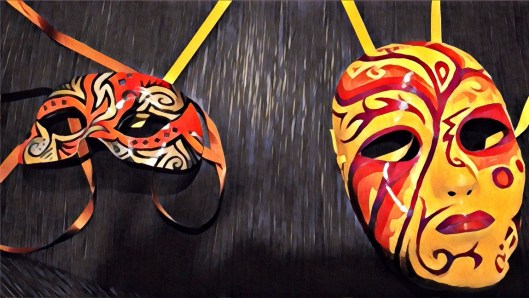
Original Masks by Sarah Morgan

Original Masks by Sarah Morgan

And, slowly, one by one, the men’s faces revealed that they all “got” Tu-Swift’s idea. They felt a little chagrin that they had not thought of such an obvious ploy themselves, but the ROI were a practical lot. If they found an idea that they could use, they used it. They did not reject it out of hand as the Z-Lotz might have done simply because they had not thought of it themselves. 

The men made it clear that the boys themselves were to construct this addition. The largest of the burly men pointed to a large set of cut planks that had already been cut to use for fence repairs.

Tu-Swift nodded enthusiastically. He returned to his drawing. He showed how he would keep the existing fence in place while they constructed the maze addition and a smaller place for the foals to gather. When all that was finished, they could remove the piece of fence that would prevent the foals from entering. 

Tu-Swift had transformed his fear and despair into a plan. He thought to himself, “Not all trees die at the edges. Not these two.” 

IMG_2342

————————————————
Author Page on Amazon. 

The Winning Weekend Warrior focuses on strategy, tactics, and the ‘mental game’ for all sports including golf, tennis, baseball, and others. 

Turing’s Nightmares illustrates possible ethical issues around AI and robotics with 23 scenarios of the future. 

Fit in Bits suggests numerous ways for the ultra-busy to work more fun and exercise into daily activities such as sitting in meetings, walking to your car, shopping, traveling, playing with kids, etc. 

Tales from an American Childhood recounts early experiences and relates them to contemporary issues and events. 

—————————————————-

Fostering Community Learning via Transformed Narratives

01 Tuesday May 2018

Posted by petersironwood in family, management, psychology, Uncategorized

≈ 1 Comment

Tags

cooperation, innovation, learning, organizational learning, pattern language, politics, religion, stories, Storytelling

Fostering Community Learning via Transformed Narratives

IMG_5400

Prolog/Acknowledgement: 

The idea for this Pattern emerged from work done around 2000 with colleagues at IBM Research (including Cynthia Kurtz, Carl Tait, Frank Elio, Debbie Lawrence, Neil Keller, Andrew Gordon), Lotus (including Dan Gruen, Paul Moody, Michael Muller), and at the IBM Knowledge Institute(including Dave Snowden, Larry Prusak, Sharon Darwent & Fiona Incledon) on the business uses of stories and storytelling. However, the essence of the idea is not that new. The British Navy uses a cartoon of a silly Admiral doing something to be avoided. Apparently, there was a process to collect anonymous stories of “mistakes” that people had made. Rather than being ascribed to the actual person, they were “ascribed” in the cartoon to the fictional Admiral. The point was to help insure that others would not make the same mistake. Mullah Nasreddin stories predate that practice by centuries. This fictional character often was reputed to have done silly things but in a way that made a point for others to learn from.

Author, reviewer and revision dates: 

Created by John C. Thomas April, 2018.

IMG_6012

Abstract: 

Stories are memorable and motivating. One popular type of story is the “Cautionary Tale” which describes what happens when a person makes a significant kind of error. Stories of this type can be valuable ways for a community as a whole to learn from the errors of one person thus preventing others in the community from making the same mistake. However, many communities also punish people for making errors. One solution is to alter the story of what actually happened slightly so that the community learns from the mistakes of individuals without the individual suffering from an unrecoverable loss of status.

Context: 

Groups across many contemporary cultures and throughout history have tended to tell, learn, and repeat stories as a way of codifying what is desirable and acceptable behavior, understanding the world, and communicating important lessons learned across generations. One such type of story is the “Cautionary Tale.” Many of Aesop’s Fables, for example, The Boy Who Cried Wolf and The Dog and its Reflection fall into this category. Such stories are potentially excellent ways to teach a lesson in a memorable way. For example, The Dog and its Reflection cautions that one may be so obsessed with greed that they will lose even what they already have in the attempt to grasp for more.

While Aesop’s Fables and other folk stories make very general points about values and “right action,” stories also serve an important way for a very local community to learn from the mistakes of individuals so that these same mistakes are not made over and over.

David's DreamDeeply

Problem. 

In communities, families, and organizations there are often negative sanctions applied to members who make mistakes. This sets up a dilemma. For the group as a whole to learn optimally, it is best to be able to learn from the experiences of every other member. On the other hand, the member who freely shares stories of his or her mistakes may find themselves punished and the “cautionary tale” repeated in the community then becomes a lesson about how not to admit mistakes, or not to be discovered, or how to shift blame to someone else. Rather than learning as a community and having such learning experiences increase social capital, such a practice instead reinforces self-serving denials and lies. The process is unpleasant and the group loses opportunities to learn from each other. While giving appropriately structured feedback can help, it is not a complete solution. Indeed, a culture that celebrates self-serving lies may quickly devolve into a “race to the bottom” with everyone mistrusting everyone else. The group as a whole is incapable of improving actual performance and so are its members.

halloween2006007

Forces:

  • Life is too complex, changing, and chaotic to describe completely in empirically falsifiable scientific statements.
  • Learning from the stories of others who have made mistakes can prevent everyone else from making the same mistake.
  • Humans are social creatures who tend to reward those who do well and punish those who do not do well.
  • Since people avoid punishment, if the punishment for admitting and relating mistakes is more severe than the reward for knowledge sharing, people will tend not to admit mistakes.
  • Once it becomes known in a culture that admitting mistakes leads to punishment, then it becomes even less likely for people to admit their mistakes.
  • The details of a story that are most important for the group to learn are often different from the details needed to mete out punishment.


PicturesfromiPhoneChinaParisPrinceton 131

Solution:

When someone in the community makes a mistake that might teach a valuable lesson but could also result in loss of face, there are alternatives in the presentation of the story that allow for the community to learn the lesson but also protect the person involved from social ostracism. This may be done by “projecting” the story onto a fictional character such as Mullah Nasreddin. Another method is to slightly alter the story flow. For instance, instead of a story that says, “I did X and this terrible thing occurred” once could alter the story to: “I almost did X and if I had, this terrible thing would have occurred.” Or, one might say, “I did X and this really bad thing happened. Good thing we noticed right away because otherwise, this much worse thing, X! would have happened.” Another alternative: “Our team did X. This put us in a terrible position vis a vis our crucial customer Y. Luckily, we had a contingency plan in place and were able to immediately repair our relation with customer Y. Of course, next time, we will know not to do X in the first place.”

PicturesfromiPhoneChinaParisPrinceton 035

Examples: 

  1. At once point, IBM was trying to save money and suggested that employees only use sardine class airline tickets. I overheard an IBM executive relate the following story. “I was high enough in the hierarchy that IBM made an exception for me. I could have gotten the first class ticket but I decided to take the sardine class ticket anyway. As I boarded that plane, I could see a dozen people in my own organization sitting in steerage. I was really glad to be able to sit down in my teeny seat along with everyone else.” This may have actually been true. On the other hand, it’s also possible that he only wished he had done this and altered what really happened to avoid opprobrium but still get the message across.

Resulting Context:

The altered story allows the team, family, culture or other group to learn from the mistake while protecting the person who made the mistake. As a result, people are more willing to admit to mistakes.

Needless to say, these kinds of alterations are not ethically done so as to avoid punishment for criminal behavior. Even apart from criminal behavior, there are certainly cases where the public has the right to know about actions that reveal a person’s character and this may outweigh concerns for ensuring that the community focuses on learning.

References: 

Pan, Y., Roedl, D., Blevis, E., & Thomas, J. (2015). Fashion Thinking: Fashion Practices and Sustainable Interaction Design. International Journal of Design, 9(1), 53-66.

Thomas, J. C. (2012). Patterns for emergent global intelligence. In Creativity and Rationale: Enhancing Human Experience By Design J. Carroll (Ed.), New York: Springer.

Darwent, S., Incledon, F., Keller, N., Kurtz, C., Snowden, D., Thomas, J.(2002) YOR920000749US2 Story-based organizational assessment and effect system (granted).

Thomas, J. C., Kellogg, W.A., and Erickson, T. (2001) The Knowledge Management puzzle: Human and social factors in knowledge management. IBM Systems Journal, 40(4), 863-884.

Thomas, J. C. (1999) Narrative technology and the new millennium. Knowledge Management Journal, 2(9), 14-17.

https://en.wikipedia.org/wiki/Nasreddin

—————————————

Author Page on Amazon

Lost Horizon.

17 Sunday Sep 2017

Posted by petersironwood in America, apocalypse, psychology, story, Uncategorized

≈ 2 Comments

Tags

Business, celerity, history, innovation, life, politics, stories


IMG_2870

One of my favorite movies as a young child was Lost Horizon. I believe I happened across this movie quite by accident (but then, maybe it was no accident after all). In any case, for those who haven’t seen it, the basic plot is that an Englishman, Robert Conway, ends up, seemingly by accident, in a semi-magical city high in the Himalayas, “Shangri-La.” It turns out that he was actually brought there intentionally to be the new head of Shangri-La. However, he heads back to England and later decides that was an error and nearly dies of exposure on the icy slopes of the mountains trying to scrabble his way back to Shangri-La. The plot echoes the idea of a lost Eden. In the Biblical account of Eden, humans lived a kind of carefree existence before defying God and thereby incurring his wrath which cursed all humanity to have pain bearing children, having to work, etc. There are many stories and myths of an earlier time or a magical place where life is much longer, more fulfilling, less filled with strife and disease, and generally speaking, better in every way than where we are now.

https://en.wikipedia.org/wiki/Lost_Horizon_(1937_film)

I believe that there really is a “Lost Horizon” in much of modern civilization and that horizon is a longer time horizon. In the book, Amusing Ourselves to Death, Neil Postman argues that people used to have a tolerance for much longer and more nuanced debate about about public issues than we do now. For example, the famous “Lincoln-Douglas Debates” about slavery lasted all day! Now, we try to compress dialogue, discussion and debate into a sound bite or a 140 character tweet.

I never had the pleasure of climbing “real” mountains when I was a youngster. I never even saw the rockies till my early twenties. However, my neighborhood did have a large empty field. And in the middle of that field was a small hill. Because the land around was mainly flat, even this small hill provided a panoramic view of woods, fields, and nearby houses. Whenever I faced some particularly weighty decision facing me, I instinctively walked about a half mile to this hilltop. I went there, surveyed everything I could, and thought about the problem at hand. This seemed the most natural thing in the world and whether true or not, it certainly gave me the impression that I could think about the problem more holistically than if I simply sat in a chair or walked through a forest crowded with trees. On that small hill, the silence from human voices was broken only by the noise of distant traffic, the wind in the grass, and the trills of bob-whites. Sometimes, I would whistle to them for advice. Their “answers” always seemed timeless and untinged by hurry.

In 2003, I was invited to give a keynote talk at a conference in Madeira about my work on a socio-technical Pattern Language (some of which, not so coincidentally, encouraged a broader look over time and space). My wife and I decided to make a vacation out of it with our nephews, Mark and Ryan. On the way to Funchal, we visited Oxford University and a professor friend in cognitive psychology, Peter McLeod. We played “lawn bowling” (the English version of Bocci) at Oxford. While we did our best to out-bowl Peter, he pointed out to us a grove of gigantic Oaks. He said that they had been planted hundreds of years earlier and some of them would be culled soon for renovating one of the buildings. This, he claimed, was no accidental windfall. These oaks had been planted specifically for that purpose centuries earlier.

https://www.slideshare.net/John_C_Thomas/toward-a-sociotechnical-pattern-language


It wasn’t just Oxford, however, that had been planned with the future in mind. Medieval cathedrals often took a quarter century or a half century to complete. Notre Dam and Lincoln Cathedrals took about a century while the Cologne cathedral took 600 years! Meanwhile, here in the 21st Century, the US Congress seems powerless to pass legislation to repair our crumbling dams, highways, and bridges.

http://natgeotv.com/ca/ancient-megastructures/q-and-a

The US has an opioid addiction problem. In addition, there is an obesity epidemic. There are many reasons for these, but at least part of the problem with any kind of addiction is that people are unable, unwilling, or unpracticed at behaving in what is their own long term interests and instead doing what feels good in the short term. While one might imagine that the advent of widespread literacy, electronic communication and access to a huge amount of humanity’s knowledge via the Internet would encourage people to take a longer view of life and happiness, instead, many people seem more short-sighted than ever.

IMG_1265

Think how we cherish the word “instant.” We have “instant coffee”, “instant pudding”, “instant messaging.” We have “speed dialing,” “speed dating,” and just plain “speed.” Software companies feel the need to release new versions and “subversions” at a breakneck pace that necessarily sacrifices sufficient testing.  While people often used to invest in a company’s stock and keep it until they retired decades later, now people invest in a portfolio of ever-changing stocks and a CEO who doesn’t deliver quarter over quarter improvements may soon find themselves out of a job. Many people, in fact, do “day trading” to try to make money. Imagine investing and then uninvesting a few moments later in companies whose products and services change over month or years.


IMG_9175
IMG_9856

While parents encourage their kids to get good grades now so that they can have a good career later in life, the parents themselves often vote on their short term interests. Politicians cannot solve budget deficits or the over-reliance on fossil fuels. Large number of people who would feel demeaned to be or to be called a heroin addict, will nonetheless buy the SUV, throw the recycling and trash together, and generally accept the rhetoric that denies global climate change and its impacts. Together, our obsession with speed has sometimes been called, the “Cult of Celerity.”

https://deepblue.lib.umich.edu/handle/2027.42/26391

Why does a society that has more material wealth and seems to require less of a “hand to mouth” existence, instead, seem ever more focused on the near term and less on the long term? I suppose one possibility is that it is a symptom of a transitional period in humanity’s evolution from a collection of individuals with strong ties to a small number of people to a world-wide interconnection in which individuals become more like “parts” in a giant machine and the “processing” of information that each person does becomes more and more fragmentary.

In teaching Intro Psych, I constructed an exercise for the students in which the class as a whole solved a simple problem. But each individual person had a slip of paper with simple instructions. For example, one student’s instructions might say, “Take a piece of paper from the person on your left. If the paper they hand you has a cross on it, pass it to your right. If it has a circle on it, pass it to the person ahead of you.” No individual person could possibly understand what they collectively were doing.

Indeed, this aligns precisely with “Taylorism” that shaped so much of the so-called “Industrial Revolution.” Some one person or small group of people designs an assembly line. They understand the overall process. But a person actually working on the assembly line may only know that they see a series of widgets passing by and for each widget, they are supposed to turn a screw. They are not supposed to worry about how their job fits into the overall picture. Indeed, they were not encouraged to take a broad view or a long view of their work. Many such jobs have been replaced by robots.

too brief an article which claims Taylorism “ended” in the 1930’s!

An alternative to ever-increasing atomization and automation of work is instead to structure small teams of people to design and build cars. They can do this, incidentally, with a view toward overall energy costs of manufacturing, distribution, and driving rather than just reducing the emissions of the vehicles after construction.


http://radar.oreilly.com/2015/06/the-future-of-car-making-small-teams-using-fewer-materials.html

Even when people are part of a deconstructed process, it can still be worthwhile for them to “see the bigger picture.” Knowing how your job fits into a larger picture provides motivational advantages and knowledge advantages. As a common folk story goes, two travelers are passing by a wall where two folks are laboring. Each laborer selects rather large rocks in a nearby field; carries them to a wall and places them carefully then using cement to fill in tiny cracks. Objectively, these two workers appear to have the same job. However, one of the two was happily going about their work humming and smiling while the other slumped their shoulders and sported a grim visage; could be heard ever muttering beneath his breath. Curious, one of the travelers asked the Glum one, “What are you doing here, my good fellow?”

“Oh, what a pain! I’m building a wall, of course.”

Then, the traveler approached the cheery builder and asked, “What are you doing here, if I may ask?”

“Oh, what a joy! I’m helping to create a marvelous cathedral, of course!”

IBM’s Think magazine once contained an interesting example of the cognitive benefits of seeing the big picture. People who worked on the Endicott, NY assembly lines were given a few hours of training to see how their job fit into the overall picture. At one point, one of the mask inspectors jumped up and yelled, “Oh, no! I’ve been doing it wrong all these years!” It turned out that they had not wanted to “throw out” a mask that “only” had a few errors because they knew a lot of time and effort had gone into making the mask. They thought it prudent to pass masks as “okay” unless there were a lot of errors. Of course, each mask was used to make many thousands of chips, so it was vitally important not to pass a mask if there were even the slightest error. But until this training program, no-one had really made this clear.

At IBM, I managed a research project for several years on the business uses of stories and storytelling. One of the “knowledge management” consultants I worked with, Dave Snowden, told a story of the Thames Water Company. At that time, when people in this part of the UK had trouble with their water or sewer, they called up a help line and the people who staffed the help lines (almost all women) were to follow a script and dispatch engineers (nearly all men) to go and fix the problems. Of course, as is customary, they were measured on how many calls they could handle in an hour. Most of the help personnel were young, but one middle aged lady took about two and a half times as long to dispatch engineers. She was about to be fired for being so slow, when some enlightened individual decided to look a little more deeply. It turned out that, indeed, she was slower. However, it turned out that her husband was one of the engineers who fixed problems. Because of the knowledge she gained from talking over their jobs together as well as her long experience, she actually solved many problems on the phone herself. In fact, while the average service rep sent an engineer out into the field on about one out of every ten calls, this woman sent an engineer out only one out of a thousand calls. By taking slightly longer on the phone, she was actually saving the company a lot of money! Chances are excellent that he probably did a much better job as an engineer for having conversations with a dispatcher as well.

IMG_3067

It seems as though more widespread public education and literacy would allow people to undertake their jobs as well as their political and personal decisions with a longer time horizon and a broader view of what the impact of their behaviors are on others. Beyond that, it seems to me that many of the problems of today require longer and broader views in order to take appropriate action. In fact, it seems the evolutionary advantage to early (and contemporary) humans does not lie in our sharper teeth or stronger jaws; it does not lie in our sharper vision or hearing; it does not rely on our superior strength or speed. Our only advantages are to be able to cooperate and communicate over a longer period of time and space. Yet, here we seem to be — focusing on smaller pieces of complex problems, over-simplifying both the problem and the solution, and insisting on instant answers and speedy resolutions.

Rather than pay a dollar more in taxes to build mass transit to help stem global climate change, we would rather wait for a hurricane and spend ten dollars more in taxes or thousands more to repair things. Rather than pay a penny more in taxes and find a cure for cancer, we would rather pay a hundred thousand in medical expenses. Rather than pay to repair a bridge, we’d rather wait till it collapses with scores of people on it. Rather than wait three years for a new software release with minimal bugs, we would rather wait three months and get the newest with a mosquito horde of bugs. Rather than take the time to fully understand a problem before trying to solve it, we’d rather categorize it quickly and apply a solution that might or might not be appropriate or better yet, “hand it off” to someone else. Rather than take the time to enjoy what we are doing at the moment, we’d rather jump ahead to the next moment.

Maybe “Shangri-La” is not a magical village hidden deep in the Himalayas. Maybe Eden is not something humankind “lost” but something we are yet to build. Together. Slowly. Over time. Maybe finding or rediscovering Paradise is not so much a question of scrambling up frozen mountainsides as simply taking a deep breath, a break, a pause in the action in order to see things from a more global perspective.  Even a small hill can help you collect your thoughts and see the broader picture. It might be quiet there and you can hear, not the voices of bosses, managers, advertising and overlords urging you to buy more, get more, work more but instead you can hear the clear call of birdsong reminding you that Eden may only be a few deep breaths away.

IMG_3947—————————-

Author Page on Amazon

Fool Me!

24 Thursday Aug 2017

Posted by petersironwood in America, psychology, Uncategorized

≈ 3 Comments

Tags

IBM, life, magic, NYNEX, school, stories, user experience, user interface


IMG_7320

Long before seeing television, or even knowing it existed, I listened to stories on the radio mainly with my grandmother. As I mentioned earlier, my favorites were The Lone Ranger, Hop-along Cassidy, and Tom Corbett and The Space Cadets. Looking back on it, I’m not sure why she listened although she might have answered questions for me or provided some additional commentary. As I only learned much later, these programs used special props for the sound effects of whizzing bullets, thunder, horse hooves, rocket engines, etc. At the time, it never occurred to me that there were “sound effects.” I just listened and constructed an entire “TV program” in my mind’s eye. More accurately, I was there along with the villains and heroes.

Although the stories presented each week in these programs fascinated me, my grandma’s “Old Pete Stories” captivated me even more. Grandma presided over the Firestone Park Dramatic Club and her performances for me were filled with all the drama she could muster. Her “Old Pete Stories” arose out of an actual character she knew from her days growing up on a farm. Old Pete was a hired hand on the farm; a loner and a drifter, Old Pete had a talent for getting into trouble. In fact, it is rather surprising that Old Pete seemed to get into precisely the type of trouble that a five year old boy might get into and rarely into the kind of trouble that you would expect an adult farm hand to get into. Makes you wonder, doesn’t it? But it didn’t make me wonder! Not at the time. Instead, I found myself, just like Old Pete, wondering what mysteries that deep blue pond held. I found myself, just like Old Pete, terrified when he became tangled in the unseen currents and forces below the surface. And, like Old Pete, my gratitude and relief came in waves when I … er, Old Pete, I mean … struggled to the shore and pulled himself out. Although “Old Pete” inspired my grandmother’s stories, I’m pretty sure that the plots she constructed were “cautionary tales” much like Aesop’s Fables.

My mother also read me stories, mainly from a giant book of stories. Each story typically only had one ink drawing on the title page for that story. There was one about a mouse who played the piano and another about a Bull in the China Shop. She too loved to practice her most dramatic voice when reading aloud. And then, some time in the first grade, something magic happened. We were sitting around in a circle struggling through our primers when my teacher made some comment that caused everything to “click into place” for me and from then on, I could pretty much read anything! I could now read stories to myself! The stories in the school primers were generally pretty lame, but soon, I got my own books and soon after that, Tootle, and The Adventures of Raggedy Ann and Raggedy Andy gave way to Tom Sawyer! Huckleberry Finn!  I went to the library every week and picked out three books. Generally, these included some science books and some fiction books and often some combination. The Earth for Sam was a fictionalized account of a boy going back in time to see first hand what dinosaurs were like (among other things). I discovered that our library had a copy of our first grade science text. In fact, it also had a copy of every grade 1-6 science texts. I went through them like the proverbial knife whose molecules had extremely high kinetic energy through butter. Stories of the Knights of the Round Table thrilled me as well as The Hardy Boys and Nancy Drew. Some people found it odd that I read Nancy Drew, but I think they are better written and I can relate to a girl hiding in the closet trying not to get caught and not trying to scream when a spider dropped on her just as easily as if a boy were hiding in the closet trying not to get caught and trying not to scream when a spider dropped on him.

You might think from my catholic tastes and prolific reading that I would forgo television when we finally got a TV set. No way! I loved Gabby Hayes, for instance, and Superman. We had a couch and a reclining rocking chair in our living room. When Gabby Hayes explained that Quaker Oats were shot from guns (!), I hid behind the rocker as the cereal exploded out of the canon. When the Superman theme song or that of The Lone Ranger came on, I ran across the room full speed and flung myself into the recliner. My parents hated this and told me on numerous occasions not to do it despite the fact that I only knocked over the rocker once. Their story was that I would “hurt myself” or “break the chair.” But neither of these things happened. I don’t recall ever actually getting severely punished so I concluded this was just one of those things parents feel obligated to say because they see themselves as responsible adults who must therefore say such things. Meanwhile, I didn’t understand how they could be so blasé about these shows. Why on earth were they also not running across the room and flinging themselves into the chair or couch? Did they not hear the strains of The William Tell Overture? Didn’t they realize that this meant that another episode of The Lone Ranger was about to begin? Didn’t they understand that he would right wrongs? The Lone Ranger not only prevailed every week; he did so without bloodshed! He would gallop up alongside some bad guy and then jump and tackle him off his horse, wrestle him to the ground and subdue him with fists alone. On occasion, The Lone Ranger would shoot, but only to defend himself or others and even then, only shoot the gun out of the villains’s hand! He never missed the target and accidentally gave the bad guy a free appendectomy or craniotomy. And, Superman? Come on! In case you forgot from last week, it always began by reminding you that he could leap tall buildings at a single bound (though why he needed to do this when he could fly is unclear). He was faster than a speeding bullet! He was more powerful than a locomotive! How could they possibly forgo these shows to do some other thing? That seemed incredible but only for the first few milliseconds of the show. After that, I was glued to the tube and lost interest in what they were doing.

Although people hate to “be fooled” so much that when they are fooled, no matter how much evidence accumulates, they tend to dismiss the evidence and insist that they were not fooled. And yet, there are other occasions, like movies, television, novels, and plays were people welcome being fooled. This really struck me hard many many years later watching Apollo Thirteen for the third time. I knew this movie was based on a true story and I knew how the real life events had unfolded and I had seen the same exact movie twice before. But that didn’t stop me from being excruciatingly worried about whether the astronauts would make it back alive. Other species of animals and plants can certainly “communicate” with their own kind and even with other species. It seems doubtful, at least so far, that they can “tell stories” however. This may be one of the quintessential differences between humans and other species. Whether we sit down in a campfire circle to trade ghost stories or streak across the room to throw ourselves into a rocking chair, we seem to be saying “Fool me!”

“Fool me” arises in other contexts as well. The first few years that I lived on North Firestone Boulevard, a peddler appeared several times each summer with a small hand cart filled with toys, puzzles, and games. Generally, these items were not to be found in stores. One item in particular held my attention. A small number of wooden rectangular blocks, roughly card-sized but much thicker, were held together with ribbon. However, when he held them up, he ticked one and allowed them to cascade in a magical fashion so that each block changed from one side to the other. He did tell some cock-a-mamie story as he did this and no doubt, like any other magician’s patter, it was designed to draw attention away from what was actually going on. But in this case, it wasn’t the story, per se, that was so cool. It was the (seeming) physical impossibility of what was happening before my very eyes. In this case, it wasn’t that I wanted to stay fooled. I wanted to see the trick again to understand what was really happening. The peddler, however, relished making money. He wasn’t really trudging up and down the street in his rather heavy coat (especially for summer) for his health nor to entertain children. He wanted to turn a buck. So, despite our pleadings, he would never do this trick more than twice. After that, if we wanted to see it again, we would have to pay for one of these sets of “magic” interconnected blocks and figure it out on our own. I raced back inside to wheedle my parents into giving or at least lending me some money so I could buy one of these. I breathlessly and ineptly explained how these were magic blocks but they seemed singularly unimpressed with my analysis. Dad muttered something vague and incoherent about it just being the way the blocks were connected by the ribbons, but he had not seen the actual demonstration. I did not score the money nor the blocks, at least that time. I did, however, save up my money. My allowance at that point was a dollar every two weeks. So, I had to forgo my favorites from the popsicle man, substituting grape popsicles at 4 cents each rather than the more expensive (and much tastier Mr. Goodbars or even fudgesicles) in order to save, but save I did. The next time the peddler appeared, I was ready! But damn! He wasn’t! He didn’t have any more of the magic tumbling blocks and tried to interest me and my friends in some other toys. I suppose some of those were pretty cool too, but I didn’t care. You’ll be happy to know that I eventually found some when I had my own kids. I was delighted that they were delighted but they no longer held any mystery for me personally.

https://www.youtube.com/watch?v=KiIpUUsIsVE

Everyone I know likes stories and magic tricks. What I find hard to understand are people who prefer to stay fooled. They don’t want to know how a Jacob’s Ladder works. They don’t want to know how a magic trick works. They don’t want to know whether their political candidate lies and cheats. They don’t want to know whether climate change is really going to affect the lives of their children and grandchildren. If there were only say, 100 stories in the world, maybe I could understand that they wouldn’t want to know the outcomes of those 100 stories. But there are way more than 100 stories! There are way more than 100 damned good stories; I don’t see any shortage. But more than that, I don’t see any problem with knowing the outcome (as I did with Apollo XIII) still being engaged and entertained and transported by a good story, well told.

Don’t get me wrong. Just because I want to know how magic tricks work, doesn’t mean I think it is necessarily right for me to explain it and that people who don’t want to know are inferior or stupid. Different people have different preferences. I like cilantro and anchovies and blue cheese but not everyone does. When it comes to what is actually happening in the world in ways that impact our ability (and even more importantly, the ability of our families) to live and function though, it seems to me the truth is much more important than is the pleasure of listening to the same false but comforting story over and over.

IMG_9333

Imagine that we are all sitting around a campfire listening to a “ghost story” about a guy trapped in a pit with scores of foot long spiders who come out and nibble on him whenever he tries to sleep. I am not going to spoil everyone’s “fun” by pointing out that this is very unlikely. No way. On the other hand, if I see a forest fire headed our way, I am going to interrupt the frigging story and let people know! Furthermore, I cannot fathom why some people would rather stay and hear the story if it means they are going to die or at least suffer a lot of third degree burns. Perhaps stories are not only one of humanity’s greatest gifts, but also, under some circumstances, our greatest curse as well.

My fascination with stories continued throughout grade school, high school, and college. Although as an undergraduate at Akron U and then Case-Western Reserve, I took almost a dozen psychology courses, none of them delved with any depth into stories. I did, however, also take courses in English Literature, Shakespeare, and Drama. Even to this day, it’s a little hard to believe that these psychology courses largely skirted the whole issue of stories considering how important and fundamental they are to understanding the human psyche. Freud and Jung did discuss stories in some depth. Even in four years of graduate study at the University of Michigan, stories seldom came up as a topic in cognitive psychology. In fact, the whole enterprise of experimental and cognitive psychology at that time seemed to be about deconstructing human thinking, problem solving, learning, and decision making into different little boxes and finding out about the little boxes.


Humans are notoriously varied but one thing you can pretty much count on is that whatever else is going on, these little boxes communicate with each other. My senior year as an undergraduate, I had three part time jobs. One of these was teaching astronomy and space science at the Sixth Grade Educational Center in downtown Cleveland. Another was working with kids in a psychiatric hospital. Another was as a research assistant to a Professor doing experiments in operant conditioning. In the latter set of experiments, kids went into a large “Skinner Box” and pulled a lever for nickels. In front of them, during training, was a large red circle. Later, they continued to pull the lever but got no coins. During this phase of the experiment, they might be shown a smaller red circle, a red ellipse, a green circle and so on. During the time the kids were actually in the Skinner Box, there wasn’t much for me to do. So, I went out to the waiting room and used the blackboard there to teach the kids who were waiting a little astronomy such as the names of the planets and their “order” around the sun. Although my Professor was a behaviorist, he did ask me to debrief each kid as to what they thought about the experiment. To my astonishment, the kids who had heard my little mini-lecture about astronomy tried to relate what I said to the little circles and ellipses that were shown during the experiment. Of course, once they said that, I realized that to them, it made perfect sense to try to relate these experiences. After all, they came to the University, and here was the same guy (me) telling them about weird unusual things. Naturally, they tried to make one unified story out of it.

In graduate school, I got my chances for story telling to my kids but also at a more adult level. It was tradition for each sub-area within the Psychology Department to put on “skits” and I co-authored two satirical musicals, mainly about the professors (and still managed to get my degree). To show you how much on the edge I was, my advisor the first year was Dr. Reitman who studied cognitive psychology and artificial intelligence. One of the main characters in the play was “Dr. Brightman” whose student (played by me) was building an AI program and trying to impress a very cute grad student.

I told her my program simulated human thought. “Oh, really?” she replied. “Your program simulates human thought?”

“Absolutely,” I answered, “although for now, purely for convenience and ease of measuring accuracy, we’ve decided to focus on mathematical thinking as a representative domain of human thought.”

“I see,” she answered, “So, this program simulates the way humans do mathematical reasoning.”

“Precisely!” I continued. “Of course, because of storage limitations on our computers, we are initially focusing on arithmetic.”

Now, her brow furrowed to signal that she was less impressed. “So, you are saying your program actually does arithmetic problems?”

So, I said, “Indeed! Or, at least it will if I ever get the code debugged.”

Well, you get the tenor of this satire. (And, by the way, the hype in AI still exceeds the actuality by about the same ratio today 50 years later!) Looking back on it, I am very impressed that the Professors in the department were able to take it all as good-natured fun.

There were important stories told in graduate school. For example, my Professor in physiological psychology discovered the “pleasure center” in the rat brain. The reason he discovered it was his inexperience. He and his professor were doing research on stimulating the “Reticular Activating System” in rats. This part of the rat (and human) brain is important in keeping you awake and alert. A small current into this part of the brain makes the rat much more alert but is punishing to the rat. You can “prove” this by implanting electrodes into the brain and turning on a very tiny current (which is not painful in the sense of an electric shock) and then the rat will soon avoid whatever part of their environment they are in when you turn on the current. But something was terribly wrong with the rat that James Olds had prepared. Instead of avoiding the area, his rat was falling head over heels in love with that area! The rat kept going back for more! When the rat was “sacrificed”, it turned out that Olds had not waited long enough for the cement to dry and the electrode had moved forward into another area of the brain. A whole line of research grew out of this “mistake.” What was “good” here was that Olds and his professor did not try to hide this unlikely result or sweep it under the rug. Instead, they strove to understand it. Although there are certainly scientists who are not as honest as these two, by and large, people go into science in order to find the truth. Not many people go into science in order to make a career out of lying. If you want to be dishonest as a career, you’ll make much more money much more easily by becoming a con artist, or some kind of unscrupulous business person than becoming a scientist. I’m not saying it never happens, but it is a rather stupid path to take. Besides the fact that people who go into science want to know the truth (and do not go into it to get rich), there are all sorts of checks and balances in science to “weed out” dolts who lie about or cover up results.

IMG_0505

My interest in stories and my interest in psychology, though both strong, for many years stayed separate. At one point in my IBM career, I was trying various ways to study and improve a system called “The Speech Filing System” which later transformed into the “Audio Distribution System.” This was a system which functioned a little bit like an answering machine, but was much more sophisticated. One big advantage was that you called it on purpose to leave an audio message. This puts the user in a much better frame of mind than an answering machine. If you call a human being and expect to talk to a human being and instead, get an answering machine, you are (even to this day) more likely to leave a somewhat incoherent and incomplete message such as:

“Leave a message after the beep. BEEP!”

“Oh, hi. It’s me. I wanted to … well, I… I wanted to … maybe it’s .. . you know what? Call me back. I will be gone for an hour or so unless you call in the next ten minutes. Anyway, you know my number, right?”

Yeah, we’ve all been there. By now, a few decades later, people are not quite so surprised by an answering machine, but it still sucks.

Instead, if you called the Audio Distribution System, you knew ahead of time you were going to be leaving a message so you prepared it mentally. You could also easily edit or delete your message and start over. That is just a taste of its many features. But it was new; not just a new product, but a new concept. Furthermore in those dark days of the distant past, there were no mobile phones. People were not used to using something with twelve buttons for a User Interface. The system had a lot of functions but only twelve buttons. Speech recognition was too unreliable to be used for the command interface. So this provided something of a puzzle; how could the buttons be used to make a good interface. Luckily, there were plenty of psychologists on the case. In fact, the main inventor of the concept, Stephen Boies, had been a student of Mike Posner, one of the most brilliant experimental psychologists ever, and John Gould, a prominent and experienced member of the Human Factors Society was also on the project as was I. In addition, the team included Jim Schoonard and John Richards. John was another Posner student. We may have had the only project team with more psychologist by training than computer scientists! As it turned out, both John Richards and Stephen Boies ended up doing a lot of the programming and most of the maintenance.

By using standard processes of design, test, and re-design, we developed a good set of commands. Beyond that, the interface, prompts and documentation were all derived from a state transition table so that changes in the User Interface could be made fairly easily and the documentation could be automatically updated and kept congruent with each other. However, I felt the need for something else. It wasn’t that people had much trouble “figuring out” how to accomplish a particular thing with the User Interface. That, they could do. The problem was that many of them never thought to use the Audio Distribution System. It did not require anything different. There on the desk was your same old phone. (True, there was a little template of commands that sat around the square keys). The trick was, how do you get someone to send an audio message as opposed to calling someone or sending a memo or email? For that purpose, I found a bit of video story-telling to be more effective. I portrayed by voice over what was going through my head and modeling what I hoped the thought process of the user might become.

For a variety of reasons, the Audio Distribution System, although it became an IBM product briefly, never became a “best seller.” For one thing, it was inexpensive. That’s right, inexpensive. It provided a lot of function for the customer but not a lot of sales commission for the sales person. On the other hand, for the sales person to sell the Audio Distribution System required them to learn a whole new way of thinking and then a whole new way of convincing their customers. It was much easier, and much more lucrative, to sell the customer on more storage or processing power.

I happened to attend a talk at an IBM meeting by Shelly Dews who mentioned storytelling. She worked in Raleigh at the time on a new IBM suite of networking products. We ended up working together on what was essentially a story to explain to customers what Netview was and what it did. That seemed to work very well and people who read the “story” version remembered the concepts better than the standard form of documentation and training. However, at about that time, I had an opportunity to begin an Artificial Intelligence Lab at NYNEX and so left IBM for a dozen years. At NYNEX, I mainly sublimated my storytelling by writing a play and three novels and some day we’ll come back to that.

I also worked with Heather Desurvire to develop a variation on the User Experience technique called “Heuristic Evaluation.” In that technique, you basically ask people to look for issues in the User Experience. It works better if you use experts, but even non-experts can find many of the issues in the User Experience that would come out in tests.  The variation builds on people’s ability to use empathy. So, rather than simply being asked to find issues with the User Experience, people are told to look at the interface via a series of different perspectives; e.g., a cognitive psychologists, a worried mother, a physical therapist, a Freudian therapist, and so on. People who look at the interface in a variety of ways were able to see more issues and also to make more suggestions for additional features than folks who spent an equal amount of time simply looking at the interface (presumably from their “own” perspective). This relates to story in that people who enjoy stories must be able to experience what is going on in the hearts and minds of the characters in order to comprehend and enjoy stories. It’s a little disconcerting that education doesn’t spend more time improving on people’s natural empathic abilities.

It was not till I returned to IBM to work on “Knowledge Management” however, that I was fully able to marry my interest in stories with my interest in cognitive psychology and indeed with the applied field of “Human Computer Interaction.” I was lucky enough to manage a project for several years that was focused on the “Business Uses of Stories and Storytelling.” This is not the time or place to try to summarize all of that work here, but here are a few interesting tidbits.

PicturesfromiPhoneChinaParisPrinceton 097

At the time, there was a fairly well-known commercial about “Knowledge Management” that claimed that the “secret” to “Knowledge Management” was “simply” to provide the right knowledge to the right person at the right time. Of course, it is anything other than “simple” but even assuming you could do that, it seemed problematic in concept. I immediately thought back to my college professor who taught German. Professor Maciw was Ukrainian by birth and spent most of World War II in a German Prison Camp which is where he learned German. Perhaps that was part of the reason he tended to be a bit on the sadistic side.

At the end of the first semester, rather than giving us a written test as most Professors do, he determined he would give us an oral exam. He prefaced this by saying, “Who is dis class vants A?” Well, of course, every student in the class raised their hand. Who doesn’t want an A? In our class, happened to be a young woman who had had four years of German in high school, and had lived in Germany for three years. Her German was quite a bit better than mine or anyone else’s in the class. He began with her. His method was simple but mind-boggling. He would begin with a question, always shouted, never spoken, such as “In story of small village, who was main character?”

She would begin with “Eric.”

He would then scream in somewhat broken English (never German), “Please to give complete sentence!”

She would begin answering in German in a complete sentence, but she would not get far. After about three words, he would shout: “Please to decline!” This meant that she would have to think back to the last noun she uttered and then say the noun with the various grammatical cases. Nouns in German all come with articles that differ according to whether the noun is masculine, feminine or neuter, as well as whether it is singular or plural and what the grammatical case is. And, so she would begin with the declination of, say, “Der Hund.”

But no sooner had she begun than he would scream, “In story of Hans, who was wife?”

So, she would say, “Erica.”

Then, the Professor would yell, “Please to say in complete sentence!!”

So, she would put it in a sentence and he would immediately interrupt with: “Please to conjugate!!”

This meant that whatever the last verb out of her mouth was, she would have to conjugate the verb.

This went on for about forty minutes. At last she broke down in tears.

I am quite sure she could have correctly answered any of his questions correctly. It wasn’t the information that was problematic. It was the way in which he interrogated her.

The professor strutted around the room for a few moments with his back turned to the class and then spun about facing us as he said, “NOW, who is dis class still vant A?” Only two of us, out of a class of about thirty raised our hands. Then he started on me. I poured buckets of sweat but did not panic or break down in tears. At last he curled the outer part of his lips down to his shoulders and shook his head a little up and down. Then he started out on the other student, Mr. Lepke whose main sin, I am pretty convinced was that he had been born in the wrong country though I no longer remember what that was. At least twenty minutes of a typical hour and half class were taken up by arguments (in English, or some semblance thereof) about European history. I honestly don’t think I recall a single fact from all that argumentation. In any case, Mr. Lepke’s turn began and after about two minutes the bell rang signaling the end of the double period. All of us left.

By chance, around dinner time, I ran into the professor at the student union. He eagerly strode up to me, his eyes ablaze, “Ah! I had Mr. Lepke in class for two more hours! Finally, he said, ‘No more Dr. Maciw No more, I beg you.’” Now, I have never been in a prison camp so I can’t really say what was up with that particular professor. And, I have to say that his method, although it may have temporarily broken the other two students, gave me a great deal of confidence. Nothing since has so far been as harrowing a verbal interchange. So, in a weird way, it was actually useful for job interviews, exam questions, presentations, and so on in later life.

In any case, the next semester, we were back. None of the three of us who had been questioned dropped out. One of the early spring lectures about European history, the professor stopped mid-sentence and said, “Vat is DIS?! Someone in my class passing notes?” He sped down the aisle and snatched the note out of a student’s hand, striding back to the front of the classroom. !” I vill read note in front of entire class!” 

In his loudest stage voice meant for hundreds of students, though we were only about thirty, he read, “Dr Maciw. Your zipper is open.” And, so it was. But here too, this was the right information, delivered to the right person, at the right time. So, it seemed to me that it was crucial to think, not just about the right information content getting to the right person at the right time. It was also very much about how that information was presented. Certainly, one way that information is presented with thought about how is in the story format. Stories are about emotions, feelings, character, relationships, in other words about people. And, by the way, it doesn’t matter whether the characters are doorman or ducks or dogs or dragons or demigods from Damian three or doctors. The stories are always about people. As a child, or as an adult, I am every bit as stricken with “Lady” in the “Lady and the Tramp” as if she been a beautiful woman. I know just how Tramp feels!

IMG_0530

Another interesting feature of stories as a communication medium is that they allow us to talk about the union of our experiences rather than the intersection. In business, one reason the meetings are almost universally boring is that everyone must frame everything into a single corpospeak which tends to be gray and rectangular. Stories, on the other hand, are a different matter. They come in a huge variety of shapes, sizes, colors, textures, smells, tastes, and movements. Since each is about people, the variety of possible characters is essentially infinite.

Another consideration about stories is that they tend to focus on the edges of human experience rather than the “central tendency.” The universe is a complicated place, full of wonderful and dangerous surprises. Try as we might, we can never step in exactly the same stream twice. Our knowledge is limited and our personal knowledge is very limited. But, we can learn from the experiences of others. We find this especially interesting if it is something on the edges of human experience. In the same way that we find the largest and smallest and fastest mammal to be interesting, we find it interesting to see what happens when the vilest criminal imaginable falls in love with the nicest person on earth. It makes us consider what we would do; it makes us see the question of “what is love, anyway?” in a new light. A story, in other words, is far more than “mere entertainment.” It can literally be life-changing.

Charles Dickens, for instance, is largely credited at least by some for ultimately improving conditions for the poor in England. Little Tom’s Cabin, by Harriet Beecher Stowe opened the eyes of many to the horrors of slavery in a way that statistics could never do. Why? Because if you actually read the story with an open heart, you become just a little, of a slave. And, hopefully, of course, you realize that whatever pain you feel in merely reading about something hateful, terrifying, or despicable is only a teeny fraction of the pain a person actually experiencing these things would feel.

David McClelland, a former Harvard professor of psychology helped develop a three factor theory of needs: Need for Achievement, Need for Affiliation, and Need for Power. Some people, and some organizations, have various mixtures of these needs. I identify personally a lot with the need for achievement. I want to find problems, solve them, get things done, understand how things work, improve things, etc. I also identify a lot with the Need for Affiliation. I like people. I like their variety and their surprise. I do not identify much at all with the Need for Power. I like it okay, but only when it’s combined with the other two. If I am in charge and I can make good decisions and genuinely feel that I am doing what’s best for the entire group, I am totally fine with being in charge. But the instant I feel like I want to manipulate someone or bully them or make them do something so that I personally benefit, I will quit. I want no part of that.

McClelland studied children’s literature and found that over time and cultures, these needs were more or less in evidence. What he further found was that about forty years after a particular need was most prevalent in the children’s literature, that need begin to manifest itself in society. Whenever, for instance, the need for Achievement was exulted in most children’s stories, then, when those people grew up and began to make decisions and impact life, that society embodied that need and people made a lot of advances with relatively little violence. On the other hand, when the need for power was prevalent, then the adults raised on those stories had a generation with lots of heat and not much light; a lot of violence but not much progress. Stories are powerful.

Let’s now briefly revisit Jacob’s Ladder, the peddler’s toy that fascinated me so much as a small kid. Recall that the Peddler told a story as he demonstrated Jacob’s Ladder. This was no random story, after all. I recall now that in the story, the various tiles/blocks represented places such as a house or temple. The coins used in the story stood for people. So to my five year old imagination, this was not about coins disappearing and reappearing, though that would be a good trick. No, this was about human beings, being in one place and then, suddenly disappearing from that place and then reappearing in another place! Holy Toledo! If that could happen to Jacob and his brother, maybe it could happen to me! This was magic I had to understand! I didn’t realize this until this moment.  I bought one of these for my kids, and they failed to show anything like the level of interest in it that I had. But, I never told them the story.

What is your story?


UPA talk about stories with more links and references about story

Author page on Amazon

twitter

Selection of my short stories

You Fool!

15 Tuesday Aug 2017

Posted by petersironwood in America, family, psychology, story, Uncategorized

≈ 2 Comments

Tags

advertising, Business, ethics, family, life, magic, marketing, politics, stories

snowfall


Make no mistake. You have an *amazing* brain! Whether you flunked out of high school or aced every test at Princeton, your brain has astounding and amazing capabilities! Perceiving things in space, watching a soccer match, engaging in small talk, navigating your way to the front door without tripping over the cats…it doesn’t matter. You and your brain are doing amazing things all the time! In fact, one of the beneficial side-effects of doing research in “Artificial Intelligence” is that it makes you realize how flipping amazing the human brain is. Everyone is creative. Everyone learns, adapts, solves problems and so on. You have a good brain.

However. Make no mistake. You (and me and everyone else) are prone to many kinds of illusions and delusions. I cannot recount them all in one blog post, or even in one thick psychology textbook. At one point, soon after joining IBM, I wrote a speculative research report entitled, “Cognitive psychology from the standpoint of wilderness survival.” (IBM Research Report, RC-6647. Yorktown Heights, NY: IBM Corporation). The thesis of that report was that some of the many illusions and delusions we are prone to are because we evolved for over 4 billion years in a series of “natural” environments and now we live in a very “artificial” one. For example, people have a lot of trouble with the concept of true randomness. Suppose you have a “fair” coin and you flip the coin five times and it comes up heads every time. Now, you go and flip it again. What are the chances that it comes up heads this time? The answer is that it is still equally likely to be heads or tails. The coin has no “memory” and no “desire to be fair.” It has no ability to “go on a hot streak.” If it really is a fair coin toss, the probability of each toss remains the same. Here’s another related problem. You throw a coin a hundred times. What are the chances of getting 50 head and 50 tails?  Perhaps surprising to many, this will happen only about 8% of the time. The chances of getting fairly close to a fifty-fifty split is fairly high, but the chance of getting exactly a fifty-fifty split is fairly low. I speculated in the aforementioned article that one reason these types of problems are difficult for people is that in nature, true randomness is rare, at least at the scale that we typically care about. Mountains are not “randomly” strewn across the planet. Blackberry bushes are not randomly distributed. Bison are not randomly distributed. Good flint for making axes or arrowheads is not randomly distributed. Fresh water is not randomly distributed. Nearly everything is “clustered.” If you find a mountain, you are likely to find other mountains nearby. If you find a blackberry, other blackberries are likely to be close by. If you find a bison, others are likely to be close by. And so on. The same goes for most events we care about. Is it raining? Chances are much greater it will be raining in five minutes than not. Is it extremely hot out? Chances are it will also be extremely hot in five minutes. “Things we care about” are very likely to be clustered in space and in time. So, when we present people with problems that presuppose true randomness, yes, human brains have trouble with it.

iPhoneDownloadJan152013 955

Well, at least humans are the “smartest” species on the planet, right? Not so fast. We are the only species in serious danger of making the planet uninhabitable for our own species. That doesn’t strike me as particularly brilliant. Leaving that aside, consider this very simple problem. There are three levers. If you press the left-most lever you get something good 1/3 of the time on a random basis. If you press the middle lever or the right most lever, you never get something good. If you want to get as much good stuff as you can, your best bet is to press the leftmost lever every single time. And, so you will…eventually. But you know who is better at this problem than you are? A kid. Yes, a two-year old will very quickly press only the left most lever. You know who else will beat you at this problem? A monkey, a dog, a cat, a bird, and a fish. All of them will focus on pressing the left-most lever all the time and will do so fairly quickly. You and me? Not so much. No, we are too “smart” for that! We will think that there must be some “system” for getting something good every time. So we think, “Let’s see. If I press the left one the number of letters in my grandmother’s maiden name and then press the middle one six times and then the right one once and then the left one with the successive digits of pi….” Yeah. We tend to assume that there must be some really complicated rule and that we are smart enough to figure it out. And, in fact, in life there often are some complicated rules. But it won’t work for you in this experiment. And, it won’t make you rich in Vegas. People have palaces because of gamblers in Vegas. But it isn’t the gamblers who get rich. It’s the people who sucker in the gamblers. They are the only ones who profit consistently. Once upon a time, you could win by counting cards, so they added more cards. And when people could still count cards, they made it illegal. And, they watch on cameras to make sure you don’t. And, if you did come up with a fool-proof system based on the phases of the moon and the number of letters in the title of the pop chart-topper, they wouldn’t let you play any more! (If you’re lucky). See, they want to make money. They are not in the business of making you rich. They are in the business to make themselves rich. And, they rely on these illusions and delusions we have about probability to do it.

Consider a lottery game. Let’s say there are 75 numbers and you are to pick five. If all five of your numbers come up, you win! So, you pick 5, 22, 37, 68 and 75. The winning numbers are: “5, 22, 45, 60 and 75” and you think, “Damn! I was so close! I had three of the five numbers!” Yeah. How close were you? If I somehow told you ahead of time what three of the numbers were and you only had to guess the remaining two, you would have a 72×71 divided by 2 chance of winning: one chance in 2556. In other words, when you had “three out of five” numbers correct, you were not close at all. People are also good at finding “patterns.” The problem is that finding a “pattern” after the fact, doesn’t really “prove” anything because there are pretty much an unlimited number of patterns to be found. You might think, in the example above, “Oh, man! I was so close! My third number was just 8 less than the winning 45 and my fourth number  was also just off by 8 from the winning number!” But suppose the winning numbers had instead been: “5, 22, 44, 60, and 75.” Then, you might think, “Oh, man, I was so close! My third number was 7 off and my next number missed by 8. Damned! Next time, I’ll get two lottery cards and add 7 to my third number and 8 to my fourth number.”

IMG_9136

Seeing patterns isn’t just limited to numbers, of course. When people look up at clouds, trees, rocks, marble, inkblots,  they often see faces, animals, etc. Our brains are great at finding patterns. And, often we see patterns that aren’t even there. In the wilderness environment, however, what are the relative costs? If we look up in the sky and see a horse head that isn’t really there, what harm is done? You “know” it isn’t really a horse. If you look in the bushes and see a bear and the bear isn’t really there, it might cost you an unnecessary spear throw, but if you fail to see a bear that really is there, you could get eaten. It’s not surprising that we tend to “see” patterns even when they aren’t really there. This generally works well. However, since other people are well aware that people tend to see patterns that aren’t really there, they can use that information to “fool you” into thinking there’s a pattern when there isn’t.

In the case of the wealthy casino operators, they are perfectly happy to get rich off your tendency to imagine that you can find a pattern in random events. But casino operators aren’t the only ones. People who make a percentage on all your stock trades are essentially doing the same thing; they are hoping you will trade a lot based on some imagined pattern. The casino owner and the stockbroker are involved in legal business practices but both take advantage of human illusions and delusions. The real experts on human illusions and delusions, however, are the experts in marketing and advertising.

Their actual job is to get you to spend your hard-earned money on things you don’t want, don’t need, and in many cases are actually harmful to you and your family. True enough, for example, humans did evolve in situations where salt, sugar, and fat were hard to find. But in many (but by no means all) parts of the world now, over-eating is more of a problem than starvation and malnutrition. Most people “know” that too much sugar and too many calories are detrimental to health. Yet, the people who put together commercials are able to convince you to spend money on a kid’s cereal that is not at all good for them. A short visual vignette, for instance, may imply that your kid will love you if you provide this cereal. To assuage your guilt, they may also “fortify” the cereal with some vitamin that the kids are actually very unlikely to be deficient in if they have a natural diet. In other cases, commercials are designed to convince you that a product will make you “cool” or “desirable” or “smart.” Some commercials go further and convince you that you have a problem you didn’t even know you had! “Do you suffer from crenelated elbow skin? When your arms hang down at your sides, you may not see the ugly ridges and valleys of your crenelated elbow skin, but your your friends do. And, let’s face it, that cute junior executive will not be asking you out after all, once he sees the giant crevices of your unsightly flapping elbow skin. Sad, but not incurable! The good news is that now, there is “SMOOTHAWAY” the wonderful new patented elbow cream that dissolves extra flaps of extra elbow skin! Not available in stores, you can order from our toll-free number where our operators are standing by to take your order. If you order in the next five seconds, we will give you two tubes of SMOOTHAWAY, each a $150 value (says who?) for the low, low price of $49.95 plus shipping and handling.”

IMG_9659

I have already mentioned in previous posts that there seems to be almost no accountability any more in advertising. “Unscented” cat litter is actually scented — with a scent whose trade name is “Unscented.” “Air Fresheners” do not actually “freshen” the air at all. The contain three ingredients know to cause cancer, mess with your hormone balance, and destroy your sense of smell. “All natural fruit drink” might contain almost nothing that is natural and as little as five per cent fruit juice. There is also the common tactic advertisers of product X use of making you believe that the competitors to product X are really bad for you.” “Our apples are guaranteed gluten free!” “Be confident! Keep your child safe! Our disposable diapers are not made from radioactive wastes.” (Of course, none of them actually are…but it does make you wonder).

Magic shows also “work” because the magician plays on all your illusions and delusions. One of the most persistent illusions is that we “see” everything before us in color and detail. This is completely untrue! You actually see, at any one time, a very small part of the visual field in front of you in color and in detail. Your brain remembers a lot of color and detail as you scan around the scene. But if something changes, you might or might not see it depending on where your attention and your eyes are currently focused.

I remember my Uncle Karl, who landed with the Allies at Omaha Beach, doing “card tricks” for me when I was about five or six. He would take an ordinary deck of cards and show me the four Jacks. He very carefully put the four Jacks into four seemingly random spots in the middle of the deck and then told me an elaborate story about the four Jacks, who were all friends, and their shenanigans. Amazingly, somehow these four Jacks ended up together at the end on the top of the deck. It was utterly impossible, yet Uncle Karl managed it. I don’t recall enough of the details of the trick now to describe how it was actually done but I’m sure you’ve seen similar card tricks. Maybe Karl used real magic. While he was involved in jogging up the beach in Normandy, a point came where suddenly everyone around him disappeared, blown to bit. Only he survived and moved forward from that group of bloody corpses. He didn’t tell me a lot about his experiences in WWII fighting the Nazis except that, toward the end of the war, the German “troops” that they faced consisted largely of boys aged 11-13. That’s the kind of thing an egomaniacal dictator ends up doing to save his delusions of power.

IMG_8483

Some magic tricks depend on “sleight of hand.” Others primarily depend on subtle mathematical relationships so that the outcome is guaranteed. One of my favorite tricks is to “force” a card on someone. This one depends on people’s long established habits. If someone hands you something, you take it. It is so ingrained, that you don’t even know you’re doing it, particularly, if I am saying something that requires or entrains your attention. So, I fan out the cards face down, mainly holding them with my thumbs. I ask you to pick a card. Since you are looking down at the cards, you cannot see that underneath the fanned cards, my right middle finger is on the card I want to “force” on you. As I fan the cards back and forth, I move the whole stack as well as the relations slightly. You have some trouble picking a card because of the motion. At last, when the time is right, and your own finger is about to choose a card near the one I want you to pick, I change the angle slightly and flick the desired card into your hand. You believe you’ve made a free choice, but you really haven’t. I keep making it hard to take a card until you are nearly picking the one I want and then I “promote” that card, just a little.

Now, this little trick does not always work. And, it wouldn’t be prudent to try it more than once on someone. (If done repeatedly, most people will eventually catch on that they are being manipulated).  If someone does stubbornly take a different card, you simply move to a different trick. But if they do take your card, oh, my that is a breathtaking moment. Imagine this. You know what card they have already. They think that they have chosen a card at random and you do not yet have any idea what it is. So, now you are free to do anything at all! The sky (and your imagination) are the limit. You can have them shred the card, burn the card, eat the card, put in an envelope and send it Certified Mail to White House. It doesn’t matter. You already know it’s the Four of Clubs. You can open a book at random and pretend to pick a word at random. It has four letters. Now you start turning over cards for “vibrations” and then you turn over a club, you keep going but then, say, “Wait!” and go back to it. “Yes, Yes” you say, “there is something here. Clubs. Definitely the four of clubs.”

IMG_3071 - Version 2

One favorite variant on this trick is to have the person put the card back in the deck and have another person shuffle and cut the cards. Now you take the deck and start turning over the cards so they are face up. Once you find the “targeted card”, say the Four of Clubs, you turn over a few more and then say, “OK. I’ll bet you $20 that the next card I turn over is your card.” 95% of the time they will take this bet since you have already turned over their card. You shake on the bet and then rifle through the cards already turned over till you find the Four of Clubs. Now you turn it over. And collect the $20. I don’t actually take people’s money, by the way. And the reason I don’t think it’s fair is that I knew something that they didn’t and I intentionally misled them in several ways. I’m tricking them into taking a “bet” which is for me a sure thing (although they also think it’s a sure thing for them because they’ve already seen me turn their card over). I’ve turned over most likely around 25 cards and each time, I’ve turned it from back to front. I’ve already turned their card over from back to front, so naturally they think my next act is to turn the next card in sequence over from back to front as well. But I don’t. Instead, I turn over their card from front to back. So, our oral contract actually meant one thing to the audience member and something else entirely to me. However, the words that I actually said were consistent with both interpretations. So, in a written contract, I could have collected on this bet. But I still don’t think it would be fair to do so.

Make no mistake. Don’t be fooled. Just because I wouldn’t take your $20 doesn’t mean there aren’t plenty of others who would. Oh, yes! They would be happy to take your money by making you believe one thing was going to happen while in fact something else entirely happened. If you notice, even professional magicians have the audience pay for the show. They don’t bet them for money or possessions that they are going to keep because they too think it’s unfair. I think that most people would consider actually taking the money unfair under the circumstances above. What do you think?

I am convinced that there are at least a small percentage of people who not only think it fair to take money under these circumstances; they think it is smart. In fact, they would think I’m being ridiculous for not taking the money. Of course, it need not stop with one bet. A person can parlay one bet into much more because of another little aspect of the human psyche “cognitive dissonance.”

trapped bee

Basically, the idea is that you don’t like it when two apparently contradictory statements are in your head. For example, let’s say you lost the bet above. You think: “Wow. What a sucker I am. I just lost $20!” But, at the same time, you have a concept about yourself which is: “I’m pretty damned clever. I am hard to fool. I am careful with my money. I am a winner!” So, now I offer you a chance to make your money back — and then some. What are you going to do? Well, you might want to reduce that “cognitive dissonance” and think something along these lines. “Hah. I can beat this guy at his own game. I’m smarter than he is. I’ll come out on top in the end and walk away richer.” But you see — no, you aren’t. You might actually be smarter in general, but I know the game. I am setting the rules. This is not some “fair” contest of wits or will. It’s a “game” that I invented. For my benefit.

So “cognitive dissonance” is a kind of potential multiplier on every other illusion and delusion that humans fall prey to. We all make mistakes of perception, judgement, inference, and so on. We all see bears in the clouds. But what if someone points out to you that there is no bear in the clouds? How do you react? Do you say, “Oh, okay, thanks for pointing that out.” Or, do you say, “Oh, yeah?! Well, I see a bear there so there’s a bear there.” If you have that defensive reaction, people will tend to avoid you and if they do run across you, they have no interest in giving you honest feedback. Over time, you will come to have another delusion: “That you are much more often right than anyone else you know.” Why? Because you contradict a lot of other people but they hardly ever contradict you.” You attribute this to your being right, but it’s actually only because you’re much more of a dick than most people when it comes to being confronted with the truth.

Before there were mass e-mails with variations on the “Nigeria scam”, people sent out actual snail mail with essentially the same ruse. I received one such letter in the mail in the 1980’s. At the time, I had not actually heard of this scam. Luckily, I did not reply. It sounded too good to be true, so I figured it probably was. Such scams offer a huge reward if only you will put a little cash up front. Of course, if you do put a little cash up front, you will be asked for more — either more cash or more information or both. The more you “put into” this scam, the more you are willing to risk further in order to get the reward. The mechanism at work here may be similar to what happens to people who go along with abusive relationships as well. “I’ve already invested all this time and energy and pain. Maybe this time, he (or she) really will change and stop (drinking/beating me/lying/being unfaithful, etc.).

Although I did not fall for the Nigerian riches scam, I have had my share of being fooled. Not only was my Uncle Karl’s magic beyond my ken. Most stage magic still astounds me even though I know the general principles that are at work. It still seems that they are doing the “impossible.” The closer I am to the trick, the more amazing it becomes. For instance, at our high school senior prom, we had a stage magician. I was one of four “volunteers” who held a rope around a box that held (or at least thought I held) the magician’s scantily clad female assistant. This was done on the gym floor at Ellet High School. Unlike a stage, I knew quite well that there were no “trap doors” here. All at once the assistant was gone. She literally disappeared right in front of my eyes from a box no more than six feet away. In a magic show, it’s all for fun, but the same principles of playing on your expectations and illusions can be used against you.

IMG_1245

As I’ve mentioned before, my older cousin took great delight in manipulating me to my detriment. Among other things, he once “tricked me” into ranting about the failings of our grandfather. He found a moment when I was slightly ticked off at grandpa. Then he took me aside and told me all sorts of bullshit about grandpa. Most of it was just made up, but some of it had some truth to it. Grandpa was skinny. He was old. He was strict. He didn’t like to be interrupted when classical music or opera was playing. But my cousin ranted and raved about this and how unfair Grandpa was and so on. Of course, I wanted to be like my older and bigger cousin. At some point not long after, all of us were together along with the whole family and my cousin said something that triggered one of those aroused dislikes I now had for my grandfather. My mouth began to spout almost exactly what my cousin had just said. Everyone was horrified, especially my cousin. When I called him on it, he simply denied it and said I was just trying to shift the blame for such an unfair and outrageous display against the man we all loved, Grandpa. What a frigging fool I was! Hopefully, you have never been tricked into being mean-spirited to someone who deserved your respect.

Here’s an illusion of a quite different sort. For the first decade I worked at IBM Research, my commute through the beautiful woods and reservoirs of northern Westchester took me through a steel truss bridge. My Datsun at that time only had an AM radio. So, every time I went through the metal bridge, the bridge prevented receiving a strong signal and the volume for “Imus in he Morning” faded. The sound would diminish remarkably upon entering the bridge and then, on the other side, it would return to normal. One day, after work, I “treated myself” to a decent stereo system that included an FM radio as well as a cassette tape player. This was great because now I could listen to “Books on Tape” during my commute. So, the next day, I was driving to work, when all at once, the volume of the tape I was listening to went way up! Then, a few seconds later, the sound went back down to normal. It flashed through my mind that there must be a loose wire from the new installation so that when I went over the bump at the beginning of the bridge…wait a second! I’m so used to the sound going down when I enter the bridge and up when I exit it, that when I had a sound source of constant volume, it sounded as though it was changing!

Technology, of course, can itself be another source of illusions.  One rainy Saturday afternoon in my sixth year, the four main adults in my life were in the living room watching TV. (Now, it is important to your understanding of what follows to know that when I am talking about our “TV” of 1951, it is nothing like the TV you have today. Apart from the fact that there were only three channels, and that it was only black and white, the resolution was far less than what you have today. In addition, the image flickered noticeably. Content-wise, it was all rated G. In fact, even most of the things that are G today would not have been allowed on commercial television. Sex was portrayed on TV by implication, not demonstration. And, the implications were carefully aimed to be above the level of an innocent (no Internet) child so that sometimes there were really two shows going on at once; one for children and a slightly edgier version for adults. There was no way that nudity would be presented on TV!)

IMG_4695

Anyway, I was in my room and I didn’t hear anything but quiet music coming from the living room of our tiny one floor bungalow. The adults were hardly talking. It sounded boring. But eventually, it also bored me to play with my toys all alone. So, at some point, I wondered out to see what they were watching that enforced such quiet among the normally chatty adults. As I turned the corner into the living room, my mouth literally fell open — for there right in front of me on the TV screen were men and women dancing naked! I like to call a spade a spade so I remarked in amazement, “Mom! Dad! They’re dancing *naked*!” My mom, dad, and grandfather all immediately over-talked each other telling me the same story: “Oh, they’re not naked; they’re wearing their tights!” “Oh,” I replied sagely and went back to my bedroom, whereupon I immediately stripped completely and then re-entered the living room stark naked, dancing in joyful imitation of the professional dancers leaping and twisting on TV. Well, okay, maybe not precisely as they did, but as close as I could manage. As you might imagine, the four adults erupted in unison. “John!! You’re dancing naked!” “No,” I calmly replied, “I’m wearing my tights.” And, I folded my naked arms over my naked chest in triumph and nodded my chin down in a note of finality.

My brilliant answer did not go over well.

But at least the day was no longer boring.


author page on amazon

More on “Cognitive Dissonance”

“Obedience” studies of Stanley Milgram


Only You…

08 Tuesday Aug 2017

Posted by petersironwood in America, apocalypse, psychology, story, Uncategorized

≈ 1 Comment

Tags

creativity, family, feelings, life, school, stories

Only You….

IMG_3256

Perhaps, like me, you recall “Smokey the Bear” from your childhood along with his famous slogan, “Only you can prevent forest fires.” In English, we seem to have stuck with the completely unmarked and ambiguous second person pronoun. “You” could refer to one single individual or to two people or to everyone on the planet! And, at least in English, the verb form doesn’t help you much either. Of course, verb forms don’t typically help much in English in any case, but you would think, since the pronoun is ambiguous, there would be some other clue in the syntax, but there isn’t. “I can, you can, he/she/it can; we can, you can, they can.” Brilliant. Although many verbs do mark for singular third person with an “s” for the verb which, come to think of it, also makes little sense. If anything, “s” on an English verb should mark for plural. Whatever. I am not bringing this up to criticize English syntax to start a revolution in order to make it more consistent and logical. I learned my lesson from George Bernard Shaw who left his fortune to at least make English spelling phonetic. He sponsored a contest resulting in a beautiful “Shavian alphabet” but his will was contested. He died in 1950 and now, 67 years later, English is just as difficult to spell as ever. Sigh.

https://en.wikipedia.org/wiki/Shavian_alphabet

So, no, I am not going to try to convince you to start saying, “you can” for singular you and “you cans” for the plural. In the South, some feel that “y’all” or “you-all” marks for plural but that is not a universally held belief. In any case, when I first heard, “Only you can prevent forest fires” I thought Smokey the Bear was talking about me personally. This was no doubt reinforced by the posters which clearly showed Smokey pointing his “fingers” at me. He wasn’t gesturing to a crowd. He was pointing at me. I had already seen the Disney movie Bambi which graphically portrays the flaming horror of a forest fire so I really did want to prevent them. But how? Smokey went on to offer some helpful rules such as not dropping my cigarettes carelessly on the ground and putting out my campfires completely. I was only about five so I didn’t have much of a nicotine habit. And, several more years would pass before I went to YMCA camp or Boy Scout camp. At five, I didn’t really have much chance to make sure my campfires were out because I didn’t have any campfires. My parents didn’t let me play with matches. Yet, forest fires persisted. Smokey must have been leaving out some crucial steps as to how I was supposed to prevent forest fires.

https://en.wikipedia.org/wiki/Smokey_Bear

I generally tried to work out such puzzles for myself, but eventually I gave up and asked my grandpa how I could prevent forest fires. He patiently explained that Smokey was talking about people in general, not just me in particular. I don’t think I totally “bought” this explanation, but it did assuage my guilt somewhat. “People in general” is an odd concept anyway. It was weird for a five year old, but it remains weird to this day. People are very diverse in their abilities, motives, goals, backgrounds — so how can you possibly make sure “people in general” do anything at all? It wasn’t till many years later that I learned that some people set fires intentionally while a larger number are criminally careless.

OLYMPUS DIGITAL CAMERA

Of course, it isn’t just forest fires that need to be prevented. Parents caution kids in a thousand ways and perhaps 900 of those are actually valid concerns. “Don’t run with scissors!” “Look both ways before crossing!” “Don’t stick anything in your nose!” “Don’t stick anything in your ears!” You may have heard the expression, “It takes all kinds.” It basically means that our world needs different kinds of people in it. I agree! But I must confess, I had no understanding of why my parents would say to me, “Don’t stick anything up your nose!” “Don’t stick anything in your ear!” What!? By this time in my life, I had experienced things stuck in my nose and ears (to name two places doctors like to jam things into you). Every doctor’s visit required that Dr. Miller jam some ice cold metal thing up my nose and when that was done, into my ears! I hated it! But apparently, some kids loved that so much that they wanted to recreate the experience. A few times, playing, hiking or just hanging out a bug flew into my eyes, nose, or ears. I hated that. True, they weren’t ice cold but they moved and buzzed making it even more terrifying. So, now my parents caution me not to stick something up my nose? Of course, once the idea is planted….No, I did not partake.  Once they cautioned me, of course, I did consider it for the first time. But I couldn’t get over the horror. I actually seriously considered two possibilities as to why they would give such advice. 1. They were insane. 2. They knew something I didn’t. Hidden just beyond my view loomed an alternate universe in which things behaved quite differently. And, apparently, a person — even a five year old person like me — could accidentally slip into this alternative universe. In this alternative “up is down” “left is right” universe, it actually would be totally cool to stuff a crayon up your nose and not be able to breathe out of one side of your nose like you had the worst most disgusting bugger ever invented stuck and you could not sneeze it out. And, then, you would have a horde of grown ups hovering around you in a panic like you were going to die, and very soon, unless extreme measures were taken. So, off you went to the “Emergency Room” and some sleep-deprived intern whose mind swam with images of the cute nurse in pediatrics, stuck some cold instrument up your nose and spread your nose tissue like it was going to explode. Whether she needed to do that or enjoyed the movie about the nurse in pediatrics so much, she wasn’t paying attention, I don’t know. But either way, horrible is horrible. So, yeah, I considered it. And I considered it stupid to stick a crayon up my nose.

However, a few years later, I learned that there really were kids who stuck crayons up their nose. What!? This meant that my parents weren’t insane after all. Instead, there really hovered some alternative universe in which it made perfect sense to stick a crayon up your nose. Yeah, sure. Good times. But it isn’t a universe I particularly want to slip into. At least not ahead of schedule. I figure, if I’m lucky enough to live long enough, I may end up with quite a few tubes stuck in me various places. I might not, but I might. In that case, I guess I will have to change my attitude. I wonder whether kids who did stick crayons up their noses have an easier time with this?  In any case, please remember: “Don’t stick crayons up your nose.”

Well, okay, I can think of a scenario where it would make sense to stick crayons up your nose. Let’s say that you’re James Bond and have been issued a very special crayon; when snuffed up your nose, it provides an instant antidote to the poison you are about to release by clicking your heels together three times. BANG. Fog. Your assailants all crumble to the ground. You remove their weapons, tie them together, and waltz back to the hotel to order a double martini, two olives, shaken not stirred. Under those circumstances, I probably would do the nasty.

Sadly, a much more common set of circumstances also exist. In my real life, I had the luck to be born into a loving family. From birth on, like most kids, I was surrounded by love. And, although I wasn’t always the center of attention, as I secretly knew I should be, I had plenty of attention. My parents had their times they didn’t want me to butt in but I also had plenty of time that I wanted to be alone or with my own friends. Live and let live. But what if, instead, I had been unlucky enough to be born into a family that provided very little if any love or attention? Under those circumstances, I might have been desperate enough to try putting a crayon up my nose or even playing with fire.

Just as I never felt compelled to stick crayons up my nose, I never understood kids who enjoyed “playing with fire.” I personally don’t like getting burned, not even a little bit. I recall accidentally touching my thumb to a hot soldering iron my dad was using. Oh, my god that hurt! I didn’t want to admit to anyone that I had burned myself. How I discovered this, I have no idea, but I discovered that if I lay down on the living room rug and vigorously rubbed the burned part back and forth on the rug, the pain went away. But when I stopped, the pain returned even worse than before. So, naturally, I did the only sensible thing a six year old would do. I resumed rubbing the burn on the rug. Ah. Relief. Of course, from today’s perspective, rubbing the burned part screams of stupidity. At the time though, I eventually confessed when my parents asked me why I kept making persistent thumb love to the rug. Whatever they did to treat the pain, I can tell you it wasn’t as effective in the short term as rubbing it on the rug. But they were adults. They were interested in what is best in the long run. And, I just bring that up because it seems somewhere along the line, we seem to have forgotten that.

OLYMPUS DIGITAL CAMERA

In the universe where I grew up, the adults had responsibilities. Top most among all those responsibilities was to provide for future generations. At least most parents are overjoyed when their kids are born. It doesn’t seem too much of a stretch of the imagination to realize that your kids will also be overjoyed when they have kids and so on down the line. If adults are collectively unable to put off their own pleasures for the good of future generations, this particular branch of the tree of life is about to be pruned.

The idea that we adults should squeeze every ounce of earth’s resources and leave future generations far worse off in terms of the beauty of the earth, the healthfulness of the air, water, and food supply — no way! That’s what little kids might do. And, lying about it to avoid any consequences? That’s what you expect a little kid to do. Not an adult. Only a child would play with fire. It might burn far far beyond any original intention. You know, Smokey was right:

“Only you can prevent forest fires!”


Author Page

What if…?

21 Friday Jul 2017

Posted by petersironwood in America, family, health, Uncategorized

≈ 4 Comments

Tags

competition, creativity, culture, family, life, politics, stories

IMG_8651

This is a kind of print medium, backed-up electronically. So, it will still be here in a few minutes, hours, and days. Here’s my suggestion. Read through once while your inner “Yeah-but”-ite chorus is otherwise occupied. You know the “Yeah-but”-ites. We all do. “Yeah but, You can’t possibly afford that.”  “Yeah but, you aren’t smart enough to do that.” “Yeah but, no-one would be that kind.” “Yeah but, yeah but, yeah but.” Give the Yeah-but chorus a TV show to watch, knock em out with whiskey — whatever it takes. Read the following once and see where the train of thought takes you. I have been thinking about this in terms of “America” because that’s where I happen to have been born and where I live now. But I suspect you can read what is below and substitute the name of your own country wherever it says “America.” If you do that, can you see these suppositions as equally applicable to your own?

You can always go back and rip my suppositions to shreds when you go through it a second time. In fact, knock yourself out. Read it fifty times and find fifty things wrong every time. First, read it once though, without doing that. Just flow along with the story. I realize it’s a story. I’m not trying to steal your pocketbook or convince you of tax reform or against it or any of that. It’s simply a “what-if” train of thought. I don’t know exactly where it will lead and neither will you, although the “Yeah-but”-ite chorus would insist after line one, that they knew exactly what I am going to say and why it would never work. By the way, if you do go back and read it a second time and find some better alternative, unstated assumption, another line of speculation, etc., I really would like to know. Anyway, here goes…

What if…

The vast majority of Americans actually wanted pretty much the same things for the country?

What if…

The vast majority of Americans wanted the basics for everyone and a few luxuries and a better life for their kids?

What if…

There actually is enough wealth for everyone to have the basics and a few luxuries and build a better life for their kids?

What if…

That were true regardless of political party, religion, region of the country, education level, gender, race, generation, or occupation?

IMG_9291

What if…

Agreements and Cooperation actually occur across every boundary in this country far far more often than acts of crime, or even nastiness?

What if…

Acts of crime or violence or scandal are reported far, far more often than the much more numerous cooperative actions?

What if…

Media have discovered that they make a lot more money if they report on sensational rather than inspirational or informational content.

What if…

The politicians, in order to gather our contributions, tend to exaggerate the negative attributes of their opponents and minimize their own while meanwhile exaggerating their own positive qualities and down-playing those of their opponents.

What if…

There were a vast number of improvements that could be made that everyone would agree on?

riverrushing

What if…

Our roads, bridges, and schools could be repaired and rebuilt?

What if…

We discovered that whether buildings and bridges stood or fell depended on physics and not on the political persuasions of the architects?

What if…

We made education a higher priority and spent more money on it than on cosmetics?

IMG_9489

What if…

We worked together to improve health in the country by encouraging everyone, male and female, young and old, to exercise more, eat healthier meals, and spend more time interacting with each other than watching TV?

What if…

We forced politicians to do what was best for their constituents rather than what was best for their wealthiest donors (when those are in conflict — they are not always in conflict)?

What if…

We focused on working together to accomplish what we agree on while we have a full and open debate on those things we don’t agree on?

IMG_9595

What if…

We took it upon ourselves every day to give each other the benefit of the doubt?

What if…

The next time we are stuck in bumper to bumper traffic, instead of weaving frantically in and out to “save” a few seconds, we kept up as smooth and steady a pace as possible while minimizing lane changes, accelerations, and breaking?

What if…

When we disagree about ends or means, we first recount what we have in common and how we want to deal with disagreements rather than rushing to resolve things once and for all immediately.

IMG_3066

What if…

We thought that life itself was a pretty cool gift to be enjoyed and that many human activities such as gardening, dancing, reading, making love, making music, teaching, participating in sports, walking, eating — that they are all pleasurable in and of themselves and not means to some other end like making more money?

What if…

It were possible for people to get together in neighborhoods, cities, states, nations, and world-wide to find, formulate, and solve problems even without governments?

What if…

We saw every human being to be an individual with their own desires, talents, ideas, issues, that to them were just as important as our own are to us?

IMG_5452

What if…

The successes, failures, short-comings and talents of each individual were partly based on luck and individual effort, but were also largely based on the actions of their parents, grandparents, neighbors, great-grandparents, uncles, aunts, strangers, teachers, doctors, Founding Fathers, explorers, scientists, artists, writers, bakers, truck drivers, fire fighters, police officers, farmers…?

What if…

A major way to reduce abortions would be to educate women better and to give them economic opportunity, and if they did get pregnant without wanting to, they had a much wider variety of choices than: 1. carry to term and give them up for adoption and never see them again or 2. carry to term and then struggle to make ends meat while trying to take care of a a kid on their own or 3. abortion?

What if…

Everyone promised to take care of every child born and make sure any mother who wanted to had the economic, social, and educational resources to give that child an opportunity for a full happy life with the mother being as involved as she wanted to be?

What if…

People viewed jury duty as a civic responsibility rather than something idiotic to be avoided so they can concentrate on more important things?

IMG_9428

What if…

People cared as much for the looks of their neighborhood and yard as much as they cared for the appearance of their clothes and hair?

What if…

Every American realized that people from other countries had just as much pride and hope for their own country as we do for ours?

What if…

People who made millions of dollars despite not producing any tangible work product or useful service were not viewed as some higher form of life, but as a kind of parasite on society?

What if…

In other words, actually providing direct value by building, discovering, cooking, growing, teaching, for instance, were viewed as much more valuable than redistributing money that was created by primary work.

What if…

We all realized that we are someplace we’ve never been before and no-one knows for sure what the path forward is, but that whatever the correct path is, it cannot be based on mutual fear and hate but must be based on love and trust?

IMG_2644

What if…

Realizing that, we collectively tried to determine how to follow or build paths of love and trust and found ways to overcome hate and fear?

What if…

We used our choices of media to watch and products to buy, not just on how much momentary pleasure they gave us, but also on how they were impacting the world and its people?

What if…

By working together we can build a better world for everyone?

hubble3

What if…

By respecting everyone, we can come to a better appreciation for the complexity that we live in?

What if…

Things are just a means to ends while life is an end in itself?

What if…

People came to see that everyone on earth is closely related?

What if…

People saw life on earth as something precious and worth saving and that that was even more important even than getting a new pair of sneakers?

What if…?

earthfromspace


Author Page on Amazon.

Pies on Offer: Rhubarb & Mincemeat

20 Thursday Jul 2017

Posted by petersironwood in America, Uncategorized

≈ 6 Comments

Tags

competition, creativity, ethics, life, politics, sports, stories

So, here we all are, somewhere on earth, each of us is unique; a product of our evolutionary, cultural, and personal histories. I am convinced that the vast majority of us are trying to do their best regardless of country, party, religion, race, or background. And, before launching into a discussion of anything else, it is worth at least a few moments of reflection on the fact that we have changed our world tremendously even in the space of my personal lifetime. I was born in 1945, the year the atomic bomb first devastated human lives. Since Hiroshima and Nagasaki, seventy two more years have passed and we have not had an atomic war. Of course, there is no guarantee that we won’t ever have one but we have survived decades when we might have wreaked this kind of heartless havoc on each other. And, we haven’t.

Another thing that impresses me is that we regularly communicate and cooperate with people across the world. Countries share ideas, products, services, and people. True enough, war persists. Yet, generally, people today enjoy the lowest death rate by violence at any time in our history. (Of course, if you or a loved one is a casualty, there is little comfort in knowing that “in general” people aren’t killed as much by violence as they used to be). But the general decrease is fairly remarkable when you consider a few vital accompanying changes. First, we have far deadlier weapons than ever before. Don’t get me wrong, if you smash someone’s skull with a large rock they are every bit as “dead” as if you drop a bomb on them or poison them. But, today we can kill a great many people at a very great distance. And whereas the strongest and healthiest and best-trained knights may have had a much better chance of survival than weaker or less able cousins, today it does not matter how well-trained you are or how much you can bench press. You will not survive in close proximity to an all-out attack whether by atomic weapons, chemical weapons, or biological ones. Second, we have far more people on earth than we ever have before. More people have been born since I was born than were born from the beginning of history until my birth. We evolved to be hunter-gatherers. We lived in small tribes. Now, we have 7 billion people on this planet.

IMG_1285

Imagine that there is only one large pie and four people all must satiate their appetites from that one pie. They might discuss things a bit. Maybe one person would claim to be famished while another does not really care that much for pie but would like to taste it. I would not foresee much trouble with four people. Would you?

Now, imagine that instead of four people, you had four hundred people and they only had one pie to stem their hunger. Wouldn’t you expect a much louder level of argument if not actual fighting to break out? Now, imagine that instead of four hundred people, there were 40,000 people and the only thing to eat was that one pie? Of course, there is a good chance for violence. However, it might also be possible that they would realize one pie split 40,000 ways is not much improvement over nothing. Why fight? It might be better to do a lottery and have the winner lay claim to the whole pie. If they liked, they could share with their friends and family. This may not be great, but it is probably still better than having everyone fight for the pie. Or, people might decide that they will have a contest based on what they value most. If they value physical strength more than any other human attribute, they might have a shot put contest or a wrestling match. The winner of the contest would get the whole pie and would be free to wolf it down themselves or share as they see fit.

twinsthreemonthbirthday

Suppose that everyone agreed to a wrestling contest and as the semi-finalists entered the ring, many were shocked at the discrepancy between their apparent physical abilities. Odysseus, let’s call him, sported legs like tree trunks, arms thick with banded muscles. Despite his giant proportions, he walked like a lion displaying a quick, easy grace. By contrast, Cassius, say, appears a bit on the thin side. His gait impresses the crowd as someone who might stumble or fall frequently. How can they both be one match away from champion?

Here’s how. Cassius isn’t using his strength at all. He’s using poison. As in ancient Greece, contestants wear gloves and Cassius, for each of his previous matches, has put a nearly undetectable ointment on the outside of his gloves. He touches his opponent, and they begin to get weary; they nearly fall asleep. But before they are so clearly drugged that foul play would be obvious, Cassius headlocks his disabled and wobbly opponent. The crowd mainly attributes his success to having, despite appearances, a terrifically effective headlock. Why do they do this? They are prone to give Cassius the benefit of the doubt. They do not assume or presume that when someone is successful despite a rather obvious lack of relevant talent, that every one of his previous matches was due to nastiness and breaking the rules.

Now at last, it has become clear. Cassius has succeeded only by some foul means even though the precise nature of that means is not yet clear. The crowd grows restless. Cassius was supposed to embody what the crowd agreed was the most important, best defining characteristic of their hero: physical strength. Instead, Cassius does embody a trait — treachery — a willingness to say one thing and do another; a willingness to break any and all rules in order to win the entire pie for himself to then further dole out as he wishes.

It would be wrong to say that treachery is never a good trait and it would be equally incorrect to say that immense physical strength is always a good thing. For example, what if you appear to agree to be a spy for space aliens but meanwhile tipped off the humans and thus saved humanity from certain annihilation? It seems to me that an ability to be that “treacherous” would be good. On the other side, imagine  two people get extremely frustrated trying to level a door. The weaker one pounds the side of his fist on the door twice to vent their frustration then goes back to leveling the door. The stronger one, however, whams the door with his fist hard enough to break the door and embed his hand into the splintered wood. He becomes trapped there and bleeds out through his shredded brachial artery.

IMG_9333

However…

It needs to be noted that everyone agreed that the they wanted their hero to be the one with the most physical strength, not the one most willing and able to be treacherous. Odysseus played the agreed upon game and stood poised to win. Cassius on the other hand, did not argue with the crowd and try to convince them that treachery trumped strength and therefore they should have a treachery contest. No. Cassius pretended to agree to play the game of “who is stronger than whom” but what he really played was the treachery game all along. In a way, this is not all that surprising because that is the game he is best at. Cassius isn’t so deluded as to think that he is better at actual wrestling than Odysseus.

The thing that I find surprising about this scenario is that people didn’t catch on much sooner that Cassius was not winning his matches through ability but through treachery. As I said, I believe one reason for this is simply that most people are willing to give others the benefit of the doubt. Second, while many might have admired Odysseus, others may have been secretly resentful. They realized that they could never be as agile, as strong, as skilled as Odysseus. On the other hand, when they looked at Cassius, they might think, “Hey. Here’s a regular guy like me. If he can win the pie, it’ll be almost as good as if I get the pie! Anyway, he promised to distribute ten of these pies to everyone if he wins, so maybe, just maybe, I won’t think about other possible ways he could have ousted bigger, stronger, faster opponents.” Of course, once more and more people come to recognize the fundamental treachery of Cassius, the ones who knew the longest become more and more vested not to admit that they knew all along. They keep on cheering for Cassius: “Look at those biceps! No wonder he beat all those others! Killer headlock! Go Cassius!” Others in the crowd look at the biceps of Cassius and what they see is pretty damned ordinary arms; if anything, a bit on the puny side. There is nothing to their eyes, that trumpets: “Look out! Killer headlock!”

IMG_9373

So, here we find a divided crowd. Those people who believe ability is most important believe basically this: “This is insane. Has the rest of the crowd gone blind? How can they speak of the ability of Cassius as being the cause of his success. It’s poison and we will prove it. And people guilty of treachery will be punished.”

The Cassiusists, on the other hand, believe: “…that treachery wins the day and, in fact, that it is a kind of wily intelligence. The human race didn’t get where it is because of strength. We aren’t anywhere near the strongest. But we may well be the wiliest. We set traps for other animals. We learn their habits and hunt them down. We bait hooks for fish. We domesticate other animals for our purpose. All of it hinges on a kind of treachery. As they say, hunting is the only sporting event where only one side knows it’s playing. Anyway, there’s always been treachery in politics, hasn’t there? It’s smart to win any way you can.”

Yes, I agree it is smart to win any way you can. Under the following two conditions: 

  1. What counts as “you” winning is only what happens to the protoplasm inside your skin. This attitude is off by orders of magnitude. As discussed in an earlier blog post, most of you is outside the boundaries of your own skin. Most of what is in the interest of Cassius is not within the boundaries of his own skin but in everyone else in the entire crowd and therefore how his actions impact them, is on the whole, hugely more important than the impact on himself, even from the standpoint of self-interest. 
  2. One note does not make a symphony. The pie splitting contests are not a one-time deal. People play over and over and over again. If you use treachery, you encourage treachery in others. Yes, if everyone else is trusting, you will gain a lot in the very short term. But in the long term, you will be punished right back. And your descendants will live in world that much more ruled by treachery than ability. It’s actually a long-term lose for everyone, including those who are “best” at treachery and that is true regardless of whether you are “found out.”

Meanwhile, of course, what is even more important is what is not happening to the extent it could while people argue about how the pie should be split and who should get to decide. Diseases are not being cured to the extent and rapidity to which they could. People are not getting the education to the extent they could. Better international cooperation and mutual respect is not being accomplished. Better roads are not being built. Crumbling bridges are not being repaired. Scientific discoveries are not expanding our knowledge of the universe as quickly as they could. Affordable healthcare and wellness are not improving in the country.

IMG_9136

What this all amounts to is that we are not creating more pies. We are too busy fighting about who should be awarded the pie we have. This is the other reason why treachery is not a reasonable value for a society to hold dear, let alone primary. Treachery leads to treachery. And, although it is true that those in power can do a lot of dictating, no matter how heavy-handed a reign of terror becomes, it is always subject to overthrow and revolution. And, during such a struggle, we are essentially fighting over who gets how much of the pie and — oh, by the way — killing each other in the process. We are not during tyranny or revolution making all that many pies. That’s why, to me, it is antithetical to the whole idea of any society whatsoever; any form of cooperation; to reward treachery.

There is room for legitimate debate about which qualities are most important for someone who gets to decide who gets how much pie. If that same person also gets to decide how much energy we put into making which additional pies, this adds another set of important qualifications. If splitting pies is the hero’s only job, being fair-minded, open-minded, generous, would seem to be good qualities. If the hero also had a large role in determining how many and what kinds of new pies to create, then, being vastly knowledgeable and intelligent would be vital; being able to communicate across disciplines and interests in order to make difficult tradeoffs would be important. In the best case scenario, this person would take in good ideas from all angles and help produce even better ones on output.

IMG_1245

The only scenario that makes sense for me to have a treacherous leader would be to imagine that we live in a completely treacherous world internationally and in that sense, there is a “fixed pie” model of the world economy. What France gains, I necessarily lose and vice versa. This is, by the way, an insanely incorrect model of the world. It is far more cooperative than competitive. Of course, this is not to say that countries do not sometimes compete for Olympic venues or airline contracts. But this is overwhelmingly accomplished without treachery by staying within agreed upon rules of the game. People don’t always agree with every specific rule; they may try to change them, but for now, everyone’s agreed to play by them.

Yes, under the incorrect scenario of a treacherous world, having a treacherous leader would make some sense, but only provided treacherousness was “maxed out” because otherwise it is still in someone’s best interest not to be treacherous. Of course, the other critical proviso is that we would have to completely trust that the person would be treacherous to other countries but honest and above-board with its own crowd or citizens. A Medieval king or queen may have been able to pull this off. I submit it’s impossible today except for a few dictatorships where news from the outside world is heavily censored. When people have access to the internet and social media, for example, you cannot say one thing to one nation or group or crowd and a completely different thing to a different crowd or nation or reporter. So, it seems completely paradoxical to have a leader who is maximally “treacherous” to be of any long-term value. You couldn’t trust him on a long-term basis and neither could any other nation. Once trust is completely gone, it takes a long time to win it back. As a strategy, treachery seems a really out-dated one. If you really love treachery, I can see why you would want to cut back on education, quash any dissenting views and so on. Without that, you couldn’t get it to work against your own citizens more than once or twice. But if you prevent people from ever finding out, it will take longer. It won’t take forever. But it will take awhile. And meanwhile, treachery metastasizes throughout the land. I like to think the immune system of the crowd is sufficiently strong to treat the tumor successfully or isolating it from the rest of the body. These are the best ways.

(The story above and many cousins like it are compiled now in a book available on Amazon: Tales from an American Childhood: Recollection and Revelation. I recount early experiences and then related them to contemporary issues and challenges in society).

Author Page

Claude, the Radio Operator

28 Sunday May 2017

Posted by petersironwood in America, apocalypse, family, management, Uncategorized

≈ 6 Comments

Tags

communication, dinosaurs, diversity, family, learning, politics, soldiers, stories

PicturesfromiPhoneChinaParisPrinceton 278

When I was about seven, I got my first bronzed dinosaur, the Tyrannosaurus Rex. I earned bribe money for being good about getting my butt stabbed by penicillin shots. In any case, I discovered these dinosaurs on the last page of my grandpa’s The Natural History Magazine. They looked really cool! The designers had chosen to make the T-Rex’s forearms look more robust than would have been a perfectly scale model with those teeny hands. The T-Rex was great! It was solid and cold and heavy because it was metal. There is something about metal or wood or stone that resonates with me much more deeply than plastic ever could. (Sorry, plastic. I know you are a cool invention and really inexpensive and very malleable and all of that. But, you just don’t touch my soul like wood, metal, and stone do.) When I moved the T-Rex, my muscles felt it. Perhaps this is one reason that I still have much of my dinosaur collection 65 years later. (How many of your plastic toys do you still have from 65 years ago?) I didn’t think so. But they are out there somewhere, along with my own forgotten plastic toys, polluting the world for centuries to come.

Bronze, as you have seen many times in your life, does not look worse when it oxidizes as iron does when it rusts. Instead, Bronze turns a beautiful powdery light green with the slightest hint of blue. So, T-Rex looked beautiful as well.  So, you might well think that the next time I had enough cash for one of these statues (1$ for the small size and 2$ for the large size) I would get another T-Rex. No, I got a Dimetrodon and a Stegosaurus. Later I got a Trachodon and a Brontosaurus. Anyway, what was fun about this diverse cast of characters is how different they were from each other and the richness with which they interacted. There’s no way it would have been as much fun if it were one army of T-Rex’s against another. (Poor brontosaurus’s tail fell off many times but my dad is no longer here to solder it back and anyway, the tail got lost in the last move).

IMG_0771

Similarly, a few years later, when I owned toy soldiers, I enjoyed having ones with different properties; that is, mainly different weapons. Liking the variety must have been true for other kids as well because the sets that I could buy were always mixed. My favorite type of soldier were hollow lead ones.  They were well enough hand-painted that you could see their faces, although not so well that you could determine whether they were fighting out of hate, out of fear, loyalty, patriotism, duty, because it’s a job, or for some private demon. I especially liked the bazooka men. I think I owned four of them. Of course, this weapon takes a while to reload and there probably aren’t a huge number of rounds. On the other hand, there were machine gunners, riflemen (more of them than anyone else), and a couple of officers who were pointing a pistol. There were also a couple of dudes sitting on the ground with a *serious* machine gun tucked between their spread-eagled legs. There were also a couple of hand grenade throwers. Another soldier had a rifle with a bayonet raised up above his head. This made arranging them for a pitched “battle” all that much more interesting. Although they had very different weapons, all of them had obvious lethal capabilities. All but one. There was one poor guy with no weapon whatever. His job was communications. His only visible “weapon” was a rather large boxy radio set. I suppose in a pinch, he could whack someone in the face with it. Even if that didn’t kill them, it would for sure put a crimp in their dinner plans.

It was difficult for me to decide which one of these soldiers I would “be.” I liked the bazooka man a lot. The rifleman looked cool. By the way, there were three versions. One type of rifleman lay on the ground with legs spread and the rifle stabilized by his elbows on the ground. Another type of rifleman sat on the ground and put the rifle across his upright knees for support. The third type, and my favorite, was the proudly standing rifleman. Thinking about it from an adult perspective, he’s probably the guy who was voted by his platoon:  “most likely to die quickly.” But I didn’t think about that then. Sometimes, I thought it would be cool to be the officer pointing the pistol. Obviously, in most ways, it wasn’t as devastating a weapon as a rifle. Although conceivably in very close quarters, he might outmaneuver a rifleman. But there was one guy that I definitely did not want to be.

You guessed it. I never wanted to be the guy on the radio. Let’s call him “Claude.” Claude didn’t get to actually fight! And, it seemed to me at that point that I could stay alive no matter what obstacles and enemies were thrown at me — if only I were an excellent enough rifleman (or bazooka man, or pistol-wielding officer). On the other hand, it seemed as though “anybody” could do Claude’s communications job and would do it equally well. Furthermore, it seemed any enemy could just walk right up and shoot this dude Claude before he knew what hit him and way before he transforms his awkward radio set into a lethal weapon. Of course, Jason Bourne could do it, but I don’t think Claude had that kind of training. And, anyway, the first movie didn’t come out until 2002 and this was the early 1950’s. Treadstone didn’t exist back then. (BTW, this is not “my” Claude but it’s the closest image I could find.)

Claude

As I mentioned, these hand-painted lead soldiers were my favorites but I owned three other types. One were extremely detailed and beautiful lead soldiers. These suckers were expensive and, as I quickly discovered, not very durable in real “battles.” When you smashed them into each other, the horses tended to break, or what was more typical and worse, not break but bend into an uncomfortable and unrealistic position. At that point, I would very carefully ease the broken leg into position, Angstrom by Angstrom… Snap!! It would break off in my hands. That was worse. I felt as though I had personally snapped that beautiful white horse’s leg in half. It always seemed as though I could ease it back into position and I almost succeeded each time. Then, SNAP. Suddenly I am holding a three legged horse in one hand and a piece of horse leg in the other. My favorite of these collections were the “Coldstream Guards” with their white and bright red uniforms with splashes of gold.  It is sad, I can tell you, to be an eight year-old general and not be able to put your most beautiful soldiers into battle. But, beautiful as they were, they were fragile. I did manage to break a few of the hollow leaden ones as well, but I had to work at it.

Then, there were unpainted plastic soldiers. They came in a kind of gray-green suggestive of olive drab. Let’s call it “off-olive drab” like the olive from that bottle of garlic clove filled green olives that you accidentally left at the very back of the fridge for five years. Then, when you finally discovered, it, the olives looked as toxic as rain forest frogs; but far from a beautiful bright warning color, these were so drably off-olive that you almost didn’t see them. But, as for the soldiers, it wasn’t just their uniforms that were off-olive drab. All of them, including the little flat plastic stands, their expressionless faces, and their normal-sized (well, normal scaled I should say) hands exuded that same toxicity of colorlessness. Their one giant advantage was that they were far cheaper than the painted leaden ones. And, whereas the fancy ones were fragile and the leaden ones were rugged but breakable, these all-plastic soldiers could not be broken. For some reason, I do know that they can be cut with an ordinary steak knife provided you have enough patience and are smart enough after you’re caught the first time “ruining” the steak knives, to make sure the second time you experiment when you’re alone. The plastic ones can also be melted. However, melting them had the side-effect of greatly disturbing my parents because of the toxic fumes that permeated our house. (I think we will have to leave for another time the question of why I wanted to know these things). One great thing about these plastic soldiers was that they were to the same scale as the metal ones. So, they could all participate in the same battles without stretching the credibility till it snaps like a rubber band and stings the soul of make-believe.

Ah, but there was as well a fourth type of soldier. These were insanely cheap plastic soldiers! A hundred soldiers for a dollar! I ordered two sets so I would have an amazing two hundred soldiers along with the probably 75 I already had. And then they arrived. Yay! Imagine! My army would now rival those of Caesar, Hannibal, Grant, Patton!

My first clue that something must be terribly wrong was the size of the shipping box — unbelievably small for 200 soldiers. I opened the boxes and then got to the actual soldiers. They were in 2 point font.  They were approximately the size of one of the feet of my other soldiers. And, these soldiers gave a whole new depth of meaning to the expression, “cheap plastic.” These soldiers were fabricated out of some material that was like what plastic uses when it doesn’t bring out the good stuff for company. And, “fragile” doesn’t quite do justice to the care with which these teeny slats of plastic needed to be handled. Oh, by the way, speaking of “slats,” did I mention that they were two dimensional? Did I mention that not only couldn’t you discern the motivations of the solider from their face, you couldn’t discern whether they even had faces. These soldiers were not of molded plastic; they were basically stamped. In fact, each solider had to be detached from a long plastic rod by twisting.

How could I have possibly known I would waste my two dollars? The picture that accompanied the advertisement for these soldiers depicted something other than their product. The picture showed something every bit as detailed and colorful and three dimensional as the hollow leaden soldiers. These same comic books also advertised “sea monkeys.” In the picture, there are “families” of little human-looking aquatic monkeys. You can tell what mood they are in and how the various family members interact. Well, I thought this was fantastic! But I didn’t totally believe it was possible either so I asked my grandpa whether they were real. He said they were just brine shrimp. I also saw that there was a teeny asterisk in the corner of the picture, half hiding in the seaweed that some of the “sea monkeys” were harvesting for the family meal. Then, in almost unreadably tiny type, the asterisk was explained, “visual depiction may not precisely duplicate visual characteristics of crustacean provided”  or some equally incomprehensible legalese gibberish that very few 8 year olds are going to comprehend (in the more recent version shown here, I don’t even see that cryptic warning).

SeaMonkeys

Apparently, we live in a society where that’s okay. I think part of the reason it’s okay is that we live in a very differentiated society. If you think about the single artist, craftsman, or chef, they are much more about substance than puffery. You don’t typically expect someone who makes something to be dishonest about what it was they did. However, hiring a advertising expert brings into play a different set of factors. The advertising person cannot make a better painting, or chair or soufflé. Their expertise and their “product” is in making people buy the substantive product. If they can lie, exaggerate, or mislead and get away with it, so long as sales go up, that is a win for the advertiser. Needless to say, they would never describe what they do as a lie. Because, after all, who would advertise a “lie” as being a “lie”? Then, you might not want to buy one. They have a whole raft of explanations as to why what they are doing is really in everyone’s interest. They’ve rehearsed it and perfected it and —- since this is what they expert in — they will probably have you agreeing with them. I’m not sure it is just fine and dandy, especially when it’s combined with a low quality product such as brine shrimp or “toy soldiers” that are too small to be used or played with as toy soldiers. In these cases, the actual product is nothing like what they “depicting” it as.

It gets a bit murkier when their are unstated but implied benefits. BMW actually does make a fine car. However, you are not going to be driving it long if you drive it the way it is portrayed on commercials. Similarly, a car is not going to be very often the snappifying head-turner among young people seeking a mate that the advertisers would have you believe. It isn’t merely that advertising tends to have us spend money on products and services that aren’t really filling our needs, although that is problematic. We spend a huge amount of money on junk food, cosmetics, and so on — and more than on medical research. But in addition to that, doesn’t it seem to undermine the meaning of truth in all human discourse? Or, is it okay to lie if you are an advertiser because they are doing it for money? In other words, it’s okay to lie if you are benefiting yourself, perhaps because you are undoubtedly benefiting your client even more?

We are more and more and more connected electronically. This is good news. And this is bad news too. One thing, though is certain. The potential impact of a lie is tremendous and much much more than it was in the past. In distant times, a lie had only local impact. Now, a lie could literally destroy the world. So, to me, the balance point of when it’s “okay to lie” is way different than it was 20,000 years ago.

I believe there is a way for people to provide value to each other honestly and still have a thriving economy. In any case, even if we never reach that point and advertisers continue to oversell products, can we at least try to be vigilant not to let that attitude toward the truth permeate every other aspect of life? A large complex and highly differentiated society can only exist in an atmosphere of trust. You must trust that the drivers of the other cars on the road are not trying to kill you. You must trust that the food you buy is not poison. You must trust that the policeman is there to protect you. If that trust breaks down, there is no longer a society. So intentionally lying in order to make a buck (or a point) is really a push toward utter chaos and anarchy. Obviously, no single push will bring us there, but we must be extremely careful. Why? Because lack of trust is contagious (as is trust). A slight imbalance between trust and mistrust could become a vicious cycle. Information is the resolution of uncertainty, not the multiplication of uncertainty.

A communication network of people becomes more valuable as the number of people increases. A network of, say, 350,000,000 people is much more valuable than 10 relatively homogeneous networks of 35,000,000 each. And, to take this to the extreme, it’s much more valuable than 350,000,000 networks of one person each, no matter how smart or strong that one person is or how many treasure-troves of weapons they have. We need to work together whatever differences exist. That’s why it’s important that we all keep communicating. That’s why it’s important that we try to be as truthful as possible. That’s why I now think that Claude, the radioman, may be the most skilled and crucial solider of all.

IMG_1289


(The story above and many cousins like it are compiled now in a book available on Amazon: Tales from an American Childhood: Recollection and Revelation. I recount early experiences and then related them to contemporary issues and challenges in society).

Find it on: my Amazon author page

← Older posts
Newer posts →

Subscribe

  • Entries (RSS)
  • Comments (RSS)

Archives

  • December 2025
  • November 2025
  • October 2025
  • September 2025
  • August 2025
  • July 2025
  • June 2025
  • May 2025
  • April 2025
  • March 2025
  • February 2025
  • January 2025
  • December 2024
  • November 2024
  • October 2024
  • September 2024
  • July 2024
  • April 2024
  • March 2024
  • February 2024
  • January 2024
  • December 2023
  • August 2023
  • July 2023
  • May 2023
  • April 2023
  • March 2023
  • February 2023
  • January 2023
  • December 2022
  • November 2022
  • October 2022
  • September 2022
  • August 2022
  • July 2022
  • June 2022
  • May 2022
  • April 2022
  • March 2022
  • February 2022
  • January 2022
  • December 2021
  • November 2021
  • October 2021
  • September 2021
  • August 2021
  • July 2021
  • June 2021
  • May 2021
  • April 2021
  • March 2021
  • February 2021
  • January 2021
  • December 2020
  • November 2020
  • October 2020
  • September 2020
  • August 2020
  • July 2020
  • June 2020
  • May 2020
  • April 2020
  • March 2020
  • February 2020
  • January 2020
  • December 2019
  • November 2019
  • October 2019
  • September 2019
  • August 2019
  • July 2019
  • June 2019
  • May 2019
  • April 2019
  • March 2019
  • February 2019
  • January 2019
  • December 2018
  • November 2018
  • October 2018
  • September 2018
  • August 2018
  • July 2018
  • June 2018
  • May 2018
  • April 2018
  • March 2018
  • February 2018
  • January 2018
  • December 2017
  • November 2017
  • October 2017
  • September 2017
  • August 2017
  • July 2017
  • June 2017
  • May 2017
  • April 2017
  • March 2017
  • February 2017
  • January 2017
  • December 2016
  • November 2016
  • October 2016
  • September 2016
  • August 2016
  • July 2016
  • June 2016
  • May 2016
  • April 2016
  • March 2016
  • February 2016
  • January 2016
  • December 2015
  • November 2015
  • October 2015
  • September 2015
  • August 2015
  • May 2015
  • January 2015
  • July 2014
  • January 2014
  • December 2013
  • November 2013

Categories

  • AI
  • America
  • apocalypse
  • cats
  • COVID-19
  • creativity
  • design rationale
  • driverless cars
  • essay
  • family
  • fantasy
  • fiction
  • HCI
  • health
  • management
  • nature
  • pets
  • poetry
  • politics
  • psychology
  • Sadie
  • satire
  • science
  • sports
  • story
  • The Singularity
  • Travel
  • Uncategorized
  • user experience
  • Veritas
  • Walkabout Diaries

Meta

  • Create account
  • Log in

Blog at WordPress.com.

  • Subscribe Subscribed
    • petersironwood
    • Join 664 other subscribers
    • Already have a WordPress.com account? Log in now.
    • petersironwood
    • Subscribe Subscribed
    • Sign up
    • Log in
    • Report this content
    • View site in Reader
    • Manage subscriptions
    • Collapse this bar
 

Loading Comments...