• About PeterSIronwood

petersironwood

~ Finding, formulating and solving life's frustrations.

petersironwood

Tag Archives: innovation

Collaboration Patterns: A Pattern Language for Creative Collaborations. 

14 Thursday Jun 2018

Posted by petersironwood in management, psychology, Uncategorized

≈ 1 Comment

Tags

Business, collaboration, cooperation, creativity, Design, innovation, pattern language, teamwork

Collaboration Patterns: A Pattern Language for Creative Collaborations. 

(Takashi Iba with Iba Laboratory).

In response to a look at my on-going efforts to build a Pattern Language of ‘best practices’ in collaboration and teamwork, one of my readers suggested I take a look at the work of Takashi Iba at Keio University in Japan. I fondly recall visiting Keio University back in 1977 and giving a lecture on our work at IBM Research with John Carroll and Ashok Malhotra on the “Psychology of Design.” (See references below). In any case, I bought the book and read it and here I am recommending it to you. 

The approach taken in Collaboration Patterns: A Pattern Language for Creative Collaborations is somewhat different from the one I’ve been taking so far. The Patterns here are fairly elaborate and “wordier” while the ones in Collaboration Patterns are much shorter and more at a strategic level. They deal more with what one should do rather than how how to achieve the results. Another way to think about it is that some of the Patterns in this blog are more about mechanisms or processes to achieve many of the goals expressed in Collaboration Patterns. 

The Patterns in Collaboration Patterns are each only two pages (one of which are quotes and cartoons). You can read the book quickly and an entire group could come up to speed on using this book fairly rapidly. By contrast, understanding all the Patterns in this blog will take a longer time. Anyway, if you are in the middle of a project right now or about to start one and would like to improve your creative collaboration, I would suggest starting with Collaboration Patterns. It gives excellent suggestions for how to use the book in multiple ways. Hopefully by now, everyone sees that collaboration has always been vital for humanity to have many of the things that now exist to make life more beautiful, comfortable, and safe. I think that there is a place for these longer Patterns as well. 

https://www.amazon.com/Collaboration-Patterns-Language-Collaborations-Catalogue/dp/1312447168

Carroll, J. and Thomas, J.C. (1982). Metaphor and the cognitive representation of computer systems. IEEE Transactions on Man, Systems, and Cybernetics., SMC-12 (2), pp. 107-116. 

Thomas, J.C. and Carroll, J. (1981). Human factors in communication. IBM Systems Journal, 20 (2), pp. 237-263. 

Malhotra, A., Thomas, J.C., Carroll, J. & Miller, L. (1980). Cognitive processes in design. International Journal of Man-Machine Studies, 20 , 119-140.

Carroll, J. Thomas, J. Miller, L. & Friedman, H.  (1980). Aspects of solution structure in design problem solving. American Journal of Psychology, 93 (2), 269-284.

Malhotra, A., Thomas, J.C. and Miller, L. (1980). Cognitive processes in design. International Journal of Man-Machine Studies, 12, pp. 119-140. 

Carroll, J., Thomas, J.C. and Malhotra, A. (1980). Presentation and representation in design problem solving. British Journal of Psychology/,71 (1), pp. 143-155. 

Carroll, J., Thomas, J.C. and Malhotra, A. (1979). A clinical-experimental analysis of design problem solving. Design Studies, 1 (2), pp. 84-92. 

Thomas, J.C. (1978). A design-interpretation analysis of natural English. International Journal of Man-Machine Studies, 10, pp. 651-668. 

————————————————-

Author Page on Amazon 

Use Diversity as a Resource

31 Thursday May 2018

Posted by petersironwood in management, psychology, Uncategorized

≈ 8 Comments

Tags

collaboration, competition, Design, diversity, innovation, learning, pattern language, politics, problem solving, Representation

Use Diversity as a Resource

IMG_9333

Prolog/Acknowledgement/History: 

On the one hand, I’ve always been fascinated with biology. If you learn or recall even a little about biology, you’ll know that diversity is a fundamental aspect of life. Life repeats patterns. But it balances that repetition with variation and diversity. 

At the same time, I’ve found it much more interesting in nearly every aspect of life to seek some substantial level of variety rather than constancy. That includes everything from flowers to fields of study to people to interact with. My “favorite color” is blue. But the last thing I want is to see only my favorite shade of blue. That is, after all, equivalent to being blind. While I love eating cashews, it would be hell to have only them for every meal. 

My first job after grad school was managing a project on the “Psychology of Aging” at Harvard Med School. We focused on such tasks as reaction time and memory but I also looked into adjacent fields; for example, it was clear that “ageism,” as well as sexism and racism, was alive and kicking. True enough, there are general trends of age-related slowing and memory issues, but there are several caveats. First of all, there is huge variability within an age group. In our studies of generally healthy veterans from their 20’s to 70’s, the differences within an age group were about 2.5 x as large (roughly speaking) as the overall age-related changes that we saw. The fastest individual in the whole study of several hundred people was not in their 20’s nor in their 30’s. In fact, it was a 55-year old school superintendent who raced motorcycles cross-country on the weekend. The effect of the way various tasks were constructed was far more important than individual differences. In over-simple but basically accurate terms, age is a weak variable when it comes to “mental performance,” individual differences are a moderate variable and the conditions of the tasks are strong variables. In my experience, having individuals with a diversity of ages produces better results. (Relevant studies of aging, not empirical proof of the immediately previous statement: 9, 10, 22, 28, 31, 37 in references below). 

portrait promenade la nature homme

Photo by hermaion on Pexels.com

When I started the Artificial Intelligence Lab at NYNEX, I learned something of the history of the phone company including the fact that the telephone was invented to try to help people with special needs (in this case, hearing loss). There are many other cases where inventions that are of great use to huge numbers of people were first inspired by trying to aid those with special needs. Already aware of the possible enrichment of the field of human-computer interaction by making it more accessible to people outside of Western Europe and North America, I helped organize and run workshops on “cross-cultural issues in HCI” and as I met people from different cultures, I became even more convinced that diversity offered a resource for innovation and excellence. (Reports on a few of these activities: 2, 8, 32, 33, 36).

OLYMPUS DIGITAL CAMERA

Working with people in other cultures or people with special needs, in my experience, provides a much greater wealth of possibilities than sticking with only one. (Some studies of relevance that I have been personally involved with: 11, 15, 16, 27, 30, 35, 38, 39, 40, 41).

Excellent arguments have been made by many as to why supporting diversity is the ethical thing to do and I quite agree with those arguments. Here, however, I am not making an argument on the basis of what is right; I am merely claiming that it is in everyone’s interest to support diversity and use it as a resource for creativity and innovation. 

Author, reviewer and revision dates: 

Created by John C. Thomas in May, 2018 


Related Patterns: 

Who Speaks for Wolf?, Build from Common Ground.

Abstract: 

Human societies have widely different customs about what is appropriate behavior. As people grow up in a culture, they generally learn one (or, more rarely two) ways to dress, eat, speak, walk, and so on. Diverse groups of people, regardless of how that diversity arises, will have a wider range of skills, experiences, perspectives, and attitudes to apply to solving a problem. This diversity is a resource that can help throughout problem solving to improve the chances of solving a problem, generating a good design, or resolving an issue. Therefore, when faced with a problematic situation, improve your chances of success by bringing to bear diversity on the problem. 

Context: 

Cultures developed separately in many places around the world. Partly to adapt to specific conditions and partly by accident, these cultures developed different cultural practices. In addition, humans, like every other living species, exhibits diversity on thousands of dimensions even at birth. Beyond that, people are further influenced to develop differently based on their families of origin and their peer groups. These differences are critical in having allowed us to develop a complex, highly interconnected society of many specialists. People can become incredibly skilled at tennis or playing the piano or writing poetry or programming in LISP or fixing plumbing problems or planting trees or hunting or cooking, to name a few of the thousands of specialities that now exist. Everyone doesn’t have to do every single task for themselves. If we did, we would all be moderately good at the same relatively small set of skills. Instead, we can mainly rely on others who are extremely good at doing what they do and trade the fruits of our labors at what we are expert at for the fruits of their labors. 

All these differences mean that it often takes slightly longer to find and work from common ground; to understand each other, than it might if everyone were born and raised identically. 

Many of us live in societies that push for the fastest possible answer, solution, design, or resolution. There is an absurd push toward speed at the expense of quality. This tends to make people impatient to “just get on with it” by which they actually mean, “just get on with it the way I want to do it.” 

IMG_2480

Problem: 

When people push to the fastest possible solution, it tends to compromise quality in every way. One of the most important ways it compromises quality is that it pushes people not to consider a large variety of ideas but instead to pick the first one or two that come to mind. Generally, the first few ideas that come to mind are not original in any significant way. The ideas will be largely deployed or implicit in the dominant culture already. There will be very few real innovations. 

There is another problem with such an approach. Whatever the “answer” is, it will typically not appeal to everyone or even be in everyone’s interest. As a result, a design will fail to gain the widest possible audience and may instigate a backlash among those whose needs are not being met or whose needs are actually being subverted. 

In a fairly homogeneous group, it is very likely that some vital aspects of the problem or situation will be overlooked. A solution will be derived based on limited data and then marketed based on limited appeal. This failure will be surprising to the homogeneous group because they are only looking at it from one perspective; viz., their own. 

Forces:

  • Diversity of background leads to diversity of experiences.
  • The expectations of any one person are primarily based on their own past experiences.
  • The behavior of any other person is largely based on that person’s past experiences. 
  • People in fairly homogeneous groups tend to focus on their similarities rather than their differences; in some cases, they may even denigrate or make fun of other groups. 
  • Fairly homogeneous groups who focus on their similarities will further reduce the space of possible ideas to ones that are shared by the entire group. In other words, the group will work within the constraints of the intersection of their experiences rather than the union of their experiences. 
  • Ideas and approaches that appeal to those in a fairly homogeneous group will engender a false sense of universality of the appeal. It is easy to believe that the idea will be liked by everyone as much as it is by this particular group.  
  • The same unconscious close-mindedness that prevents the fairly homogenous group from generating very innovative ideas will also make it very difficult to accurately diagnose the real source of the failure.  
  • People in a diverse group will provide that group with an initial set of ideas that is far larger than the set of ideas generated by a homogeneous group. 
  • Moreover, people in a diverse group, if they see diversity as a resource, will tend to more often work from the union of their ideas than limiting themselves only to the intersection of their ideas and experiences.   
  • Ideas can play off against each other and produce still other new ideas. Thus, the diverse group who views their diversity as a strength will start off with a larger pool of ideas; will produce still more “recombinant” new ideas; and will more likely allow a look at the large space formed by the union of ideas rather than being limited by the intersection. 
  • Moreover, people in a diverse group will not only be more likely to produce an innovative service, product, or solution; they will also be more able to see how to market the idea, or specialize it, or localize it to any population represented within the group.    

Solution: 

When facing any particularly challenging situation, try to construct a highly diverse group of people to face that challenge. Respect and learn from each other’s differences. Focus on your diversity as a resource to be capitalized on rather than a handicap to be overcome. 

IMG_9325


Examples: 

  1. Artists as diverse as Frank Lloyd Wright, Vincent Van Gogh, and The Beatles intentionally allowed themselves to be exposed to Asian versions of their art in order to enhance and extend their own styles.

2. High level chefs who specialize in a particular type of cuisine may also become conversant in other types of cuisine to expand the palette of tastes from which to select. 

3. In problem solving, it often happens that the representation a person uses can have a huge impact on how easy a problem is to solve. Similarly, different things are often better said in different languages.  Even when it comes to advances in an entire field, they often follow new ways of representing things. For example, understanding human speech began making much more progress once the sonogram (which shows time on the X-axis, frequency on the Y-axis and amplitude as darkness) came into use as a representation (rather than the earlier representation of a speech waveform with time on the X-axis and amplitude on the Y-axis). Modern medicine today relies on many kinds of “scans” – not just X-rays, though X-rays certainly allowed a big advance over guesswork. (Studies indicating the importance of representation: 1, 3, 4, 5, 6, 13, 18, 19, 20, 23, 24, 25, 26).  

Resulting Context:

Generally speaking, when diverse groups work together and view their diversity as a resource, the result is a better product, service, solution, or resolution. In addition, it typically happens as a kind of side-effect, that the roads to marketing in diverse markets are also opened up. Finally, everyone within the group learns from the others in the group. Inclusion and diversity have another very powerful positive impact. Everyone sees that what one does is the basis for reward rather than what one is or who they know. (Studies on the impact of diversity on team performance: 7, 12, 17, 42). 

This is a huge win for teams, groups, companies, and nations. If people feel that they will be rewarded based on what they do, then people are incentivized to do the best they can. If people feel that they are rewarded based on their age, race, sex, national origin etc. — that is, things over which they have no control, then no-one is motivated to do their best. Those in the out-group feel it is fairly pointless and those in the in-group feel it is unnecessary. 

Of course, there are many other factors besides diversity that impact creativity and innovation. The latter depend on leadership, organizational context, process, support, incentives, etc. In the short term, if people are under time pressure, some may perceive that they haven’t been as productive even if they have if there more ideas and more varied ideas are discussed. Arranging the context so that people are motivated to do well rather than do quickly will be critical to success. 

IMG_6566

References: 

[1] Bellamy, R., Erickson, T., Fuller,B., Kellogg, W.,  Rosenbaum, R., Thomas, J. and Vetting Wolf, T (2007) Seeing is believing: Design visualization for managing risk and compliance. IBM Systems Journal 46:2, 207-218.

[2] Best, M., Deardon, A., Dray, S., Light, A., Thomas, J.C., Buckhalter, C., Greenblatt, D., Krishnan, S., Sambasivan, N. (2007). Sharing perspectives on community centered design and international development.  Human-Computer Interaction, INTERACT 2007. New York: Springer.

[3] Carroll, J. and Thomas, J.C. (1982). Metaphor and the cognitive representation of computer systems. IEEE Transactions on Man, Systems, and Cybernetics., SMC-12 (2), pp. 107-116. 

[4] Carroll, J. Thomas, J. Miller, L. & Friedman, H.  (1980). Aspects of solution structure in design problem solving. American Journal of Psychology, 93 (2), 269-284.

[5] Carroll, J., Thomas, J.C. and Malhotra, A. (1980). Presentation and representation in design problem solving. British Journal of Psychology/,71 (1), pp. 143-155. 

[6] Carroll, J., Thomas, J.C. and Malhotra, A. (1979). A clinical-experimental analysis of design problem solving. Design Studies, 1 (2), pp. 84-92. 

[7]Chow, I. (2018) “Cognitive diversity and creativity in teams: the mediating roles of team learning and inclusion”, Chinese Management Studies, 12 (2), 369-383, https://doi.org/10.1108/CMS-09-2017-0262

[8] Dearden, A., Dunckley, L, Best, M., Dray, S., Light, A. & Thomas, J.C. (2007).  Socially responsible design in the context of international development. Panel presented at INTERACT 2007, Rio de Janiero, BZ,

[9] Fozard, J. L., Thomas, J. C., and Waugh, N. C. (1976). Effects of age and frequency of stimulus repetitions on two-choice reaction time. Journal of Gerontology, 31, (5), pp. 556-563. 

[10] Fozard, J. and Thomas, J. (1975). Psychology of aging: Basic findings and some psychiatric implications.  In J. Howells (Ed). Modern Perspectives in the psychiatry of old age. NY: Brunner/Mazel.

[11] Friedman, B., Brok, E., Roth. S. K., Thomas, J. C. (1996). Minimizing bias in computer systems. SIGCHI Bulletin, 28(1), pp. 48-51. 

[12] Kurtzberg, T. (2005). Feeling creative, being creative: An empirical study of diversity and creativity in teams. Creativity Research Journal, 17(1), 51-65.

[13] Malhotra, A., Thomas, J.C., Carroll, J. & Miller, L. (1980). Cognitive processes in design. International Journal of Man-Machine Studies, 20 , 119-140.

[14] Malhotra, A., Thomas, J.C. and Miller, L. (1980). Cognitive processes in design. International Journal of Man-Machine Studies, 12, pp. 119-140. 

[15] Srivastava, S., Dhanesh, K., Basson, S., Rajput, N., Thomas, J., Srivastava, K. (2012). Voice user interface and growth markets. India HCI conference.

[16] Srivastava, S., Rajput, N, Dhanesha, K., Basson, S., and Thomas, J. (2013). Community-oriented spoken web browser for low literate users. CSCW, San Antonio, TX, 2013.

[17] Stahl, G., Maznevski, M., Voigt, A., and Jonsen, K. (2009). Unraveling the effects of cultural diversity in teams: A meta-analysis of research on multi-cultural work groups. Journal of International Business Studies, 1-20. 

[18] Thomas, J.C. (1991). The human factors of voice interfaces. Journal of the Washington Academy of Sciences 80 (3), 138-151. 

[19] Thomas, J.C. and Schneider, M. (1982). A rose by any other alphanumeric designator would smell as sweet. Behavior and Information Technology, 1 (4), 323-325. 

[20] Thomas, J.C. (1978). A design-interpretation analysis of natural English. International Journal of Man-Machine Studies, 10, pp. 651-668. 

[21] Thomas, J.C. and Carroll, J. (1978). The psychological study of design. Design Studies, 1 (1), pp. 5-11. 

[22] Thomas, J. C., Fozard, J. L. and Waugh, N. C. (1977). Age-related differences in naming latency. American Journal of Psychology, 90(3), pp. 499-509. 

[23] Thomas, J.C. (1974). An analysis of behavior in the hobbits-orcs problem. Cognitive Psychology 6 , pp. 257-269. 

[24] Thomas, J. (2015). Chaos, Culture, Conflict and Creativity: Toward a Maturity Model for HCI4D. Invited keynote @ASEAN Symposium, Seoul, South Korea, April 19, 2015.

[25] Thomas, J. (2014). Mobile Systems for Computational Social Science: A Perfect Storm. Invited keynote address at UbiComp workshop, Sept. 13, 2014, Seattle, WA.

[26] Thomas, J., Diament,J., Martino, J. and Bellamy, R., (2012). Using “Physics” of Notations to Analyze a Visual Representation of Business Decision Modeling. Presented at VL/HCC 2012 conference in Salzburg, Austria.

[27] Thomas, J. C. , Basson, Sara H., and Gardner-Bonneau, D.  (2008 & 1999) Universal access and assistive technology. In D. Gardner-Bonneau (Ed.), Human factors and voice interactive systems. Norwell, MA: Kluwer. 

[28] Thomas, J.C. (2003), Social aspects of gerontechnology.  In Impact of technology on successful aging N. Charness & K. Warner Schaie (Eds.). New York: Springer.

[29] Thomas, J. C. (2001). An HCI Agenda for the Next Millennium: Emergent Global Intelligence. In R. Earnshaw, R. Guedj, A. van Dam, and J. Vince (Eds.), Frontiers of human-centered computing, online communities, and virtual environments. London: Springer-Verlag. 

[30] Thomas, J.C. (1997). Steps toward universal access in a telecommunications company. In B. Friedman (Ed.), Human values and the design of computer technology. Stanford, CA: CSLI. 

[31] Thomas, J. C. (2017). Old People and New Technology: What’s the Story? Presented at Northwestern University Symposium on the Future of On-Line Interactions, Evanston, Ill, 4/22/2017. 

[32] Thomas, J.C. (2007). Panelist, Meta-design and social creativity: Making all voices heard. INTERACT 2007, Rio de Janeiro, BZ, Nov., 2007.

[33] Thomas, J.C. (2007).  E-learning: An opportunity to meld modern technology and ancient wisdom? Panelist, E-learning.  INTERACT 2007, Rio de Janeiro, BZ, Nov. 2007.

[34] Thomas, J.C. (2005). Patterns to promote individual and collective creativity.  Presented at the Human Computer Interaction International, Las Vegas, NV, July 27, 2005.

[35] Thomas, J.C. (1996). Invited panel presenter at the National Research Council’s workshop: Toward an every-citizen interface to the national information infrastructure, Washington, DC., August 23, 1996.

[36] Thomas, J.C. & Kellogg, W. (1993). Cross-cultural perspectives on human-computer interaction: report on the CHI ’92 workshop. SIGCHI Bulletin, 25 (2), 40-45.

[37] Trewin, S., Richards, J., Hanson, V., Sloan, D., John, B., Swart, C., Thomas, J. (2012). Understanding the role of age and fluid intelligence in information search. Presented at the ASSETS Conference, Boulder CO.

[38] Trewin, S., Bellamy, R., Thomas, J., Brezin, J., Richards, J., Swart, C., and John, B.E., (2010). Designing for Auditory Web Access: Accessibility and Cellphone Users.  The 7th International Cross-Disciplinary Conference on Web Accessibility, W4A.

[39] Trewin, S, Richards, J.,Bellamy, R, John, B.E.,Thomas, J.C., Swart, C.Brezin, J. (2010). Toward Modeling Auditory Information Seeking Strategies on the Web. CHI Work In Progress. 

[40] Trewin, S., Bellamy, R., Thomas, J., Brezin, J., Richards, J., Swart, C., and John, B.E., (2010). Designing for Auditory Web Access: Accessibility and Cellphone Users.  The 7th International Cross-Disciplinary Conference on Web Accessibility, W4A.

[41] Trewin, S, Richards,J.,Bellamy, R, John, B.E.,Thomas, J.C., Swart, C.,Brezin,J. (2010). Toward Modeling Auditory Information Seeking Strategies on the Web. CHI Work In Progress. 

[42] Yap, C., Chai, K. & Lemaire, P. (2005). An empirical study on functional diversity and innovation in SMEs. Creativity and Innovation Management, 14 (2), 176-190. 

Fostering Community Learning via Transformed Narratives

01 Tuesday May 2018

Posted by petersironwood in family, management, psychology, Uncategorized

≈ 1 Comment

Tags

cooperation, innovation, learning, organizational learning, pattern language, politics, religion, stories, Storytelling

Fostering Community Learning via Transformed Narratives

IMG_5400

Prolog/Acknowledgement: 

The idea for this Pattern emerged from work done around 2000 with colleagues at IBM Research (including Cynthia Kurtz, Carl Tait, Frank Elio, Debbie Lawrence, Neil Keller, Andrew Gordon), Lotus (including Dan Gruen, Paul Moody, Michael Muller), and at the IBM Knowledge Institute(including Dave Snowden, Larry Prusak, Sharon Darwent & Fiona Incledon) on the business uses of stories and storytelling. However, the essence of the idea is not that new. The British Navy uses a cartoon of a silly Admiral doing something to be avoided. Apparently, there was a process to collect anonymous stories of “mistakes” that people had made. Rather than being ascribed to the actual person, they were “ascribed” in the cartoon to the fictional Admiral. The point was to help insure that others would not make the same mistake. Mullah Nasreddin stories predate that practice by centuries. This fictional character often was reputed to have done silly things but in a way that made a point for others to learn from.

Author, reviewer and revision dates: 

Created by John C. Thomas April, 2018.

IMG_6012

Abstract: 

Stories are memorable and motivating. One popular type of story is the “Cautionary Tale” which describes what happens when a person makes a significant kind of error. Stories of this type can be valuable ways for a community as a whole to learn from the errors of one person thus preventing others in the community from making the same mistake. However, many communities also punish people for making errors. One solution is to alter the story of what actually happened slightly so that the community learns from the mistakes of individuals without the individual suffering from an unrecoverable loss of status.

Context: 

Groups across many contemporary cultures and throughout history have tended to tell, learn, and repeat stories as a way of codifying what is desirable and acceptable behavior, understanding the world, and communicating important lessons learned across generations. One such type of story is the “Cautionary Tale.” Many of Aesop’s Fables, for example, The Boy Who Cried Wolf and The Dog and its Reflection fall into this category. Such stories are potentially excellent ways to teach a lesson in a memorable way. For example, The Dog and its Reflection cautions that one may be so obsessed with greed that they will lose even what they already have in the attempt to grasp for more.

While Aesop’s Fables and other folk stories make very general points about values and “right action,” stories also serve an important way for a very local community to learn from the mistakes of individuals so that these same mistakes are not made over and over.

David's DreamDeeply

Problem. 

In communities, families, and organizations there are often negative sanctions applied to members who make mistakes. This sets up a dilemma. For the group as a whole to learn optimally, it is best to be able to learn from the experiences of every other member. On the other hand, the member who freely shares stories of his or her mistakes may find themselves punished and the “cautionary tale” repeated in the community then becomes a lesson about how not to admit mistakes, or not to be discovered, or how to shift blame to someone else. Rather than learning as a community and having such learning experiences increase social capital, such a practice instead reinforces self-serving denials and lies. The process is unpleasant and the group loses opportunities to learn from each other. While giving appropriately structured feedback can help, it is not a complete solution. Indeed, a culture that celebrates self-serving lies may quickly devolve into a “race to the bottom” with everyone mistrusting everyone else. The group as a whole is incapable of improving actual performance and so are its members.

halloween2006007

Forces:

  • Life is too complex, changing, and chaotic to describe completely in empirically falsifiable scientific statements.
  • Learning from the stories of others who have made mistakes can prevent everyone else from making the same mistake.
  • Humans are social creatures who tend to reward those who do well and punish those who do not do well.
  • Since people avoid punishment, if the punishment for admitting and relating mistakes is more severe than the reward for knowledge sharing, people will tend not to admit mistakes.
  • Once it becomes known in a culture that admitting mistakes leads to punishment, then it becomes even less likely for people to admit their mistakes.
  • The details of a story that are most important for the group to learn are often different from the details needed to mete out punishment.


PicturesfromiPhoneChinaParisPrinceton 131

Solution:

When someone in the community makes a mistake that might teach a valuable lesson but could also result in loss of face, there are alternatives in the presentation of the story that allow for the community to learn the lesson but also protect the person involved from social ostracism. This may be done by “projecting” the story onto a fictional character such as Mullah Nasreddin. Another method is to slightly alter the story flow. For instance, instead of a story that says, “I did X and this terrible thing occurred” once could alter the story to: “I almost did X and if I had, this terrible thing would have occurred.” Or, one might say, “I did X and this really bad thing happened. Good thing we noticed right away because otherwise, this much worse thing, X! would have happened.” Another alternative: “Our team did X. This put us in a terrible position vis a vis our crucial customer Y. Luckily, we had a contingency plan in place and were able to immediately repair our relation with customer Y. Of course, next time, we will know not to do X in the first place.”

PicturesfromiPhoneChinaParisPrinceton 035

Examples: 

  1. At once point, IBM was trying to save money and suggested that employees only use sardine class airline tickets. I overheard an IBM executive relate the following story. “I was high enough in the hierarchy that IBM made an exception for me. I could have gotten the first class ticket but I decided to take the sardine class ticket anyway. As I boarded that plane, I could see a dozen people in my own organization sitting in steerage. I was really glad to be able to sit down in my teeny seat along with everyone else.” This may have actually been true. On the other hand, it’s also possible that he only wished he had done this and altered what really happened to avoid opprobrium but still get the message across.

Resulting Context:

The altered story allows the team, family, culture or other group to learn from the mistake while protecting the person who made the mistake. As a result, people are more willing to admit to mistakes.

Needless to say, these kinds of alterations are not ethically done so as to avoid punishment for criminal behavior. Even apart from criminal behavior, there are certainly cases where the public has the right to know about actions that reveal a person’s character and this may outweigh concerns for ensuring that the community focuses on learning.

References: 

Pan, Y., Roedl, D., Blevis, E., & Thomas, J. (2015). Fashion Thinking: Fashion Practices and Sustainable Interaction Design. International Journal of Design, 9(1), 53-66.

Thomas, J. C. (2012). Patterns for emergent global intelligence. In Creativity and Rationale: Enhancing Human Experience By Design J. Carroll (Ed.), New York: Springer.

Darwent, S., Incledon, F., Keller, N., Kurtz, C., Snowden, D., Thomas, J.(2002) YOR920000749US2 Story-based organizational assessment and effect system (granted).

Thomas, J. C., Kellogg, W.A., and Erickson, T. (2001) The Knowledge Management puzzle: Human and social factors in knowledge management. IBM Systems Journal, 40(4), 863-884.

Thomas, J. C. (1999) Narrative technology and the new millennium. Knowledge Management Journal, 2(9), 14-17.

https://en.wikipedia.org/wiki/Nasreddin

—————————————

Author Page on Amazon

Narrative Insight Method

16 Monday Apr 2018

Posted by petersironwood in management, psychology, story, Uncategorized

≈ 1 Comment

Tags

Business, collaboration, cooperation, coordination, innovation, learning, pattern language, story, Storytelling

Narrative Insight Method

fullsizeoutput_1335

Prolog/Acknowledgement: 

Since my dad worked mainly as an electrical engineer and my mother as an English/Drama teacher, I’ve always felt pulled in two directions: toward science, mathematics, systemization, practical solutions, and formalism and simultaneously toward the arts, particularly various types of storytelling. I finally had a chance to synthesize these two areas while managing a project for several years at IBM Research on the business uses of stories and storytelling. Though this project provided value in various ways to many within IBM, there was no single part of IBM whose main business was stories. For this reason, finding funding was a continual challenge. Our closest allies, apart from my senior manager, Colin Harrison, were The IBM Knowledge Management Institute, researchers at LOTUS, and a part of IBM internal education located in Atlanta. My group at IBM Research included Carl Tait, Andrew Gordon, Cynthia Kurtz, Debbie Lawrence, and Frank Elio. Larry Prusak and David Snowden from the IBM Knowledge Management Institute were particularly interested in stories as were Michael Muller, Dan Gruen, and Larry Moody at LOTUS. The method described here was mainly developed by Cynthia Kurtz, Dave Snowden, and Neal Keller of IBM Research Education though writing the method as a “Pattern” is my own responsibility.

Author, reviewer and revision dates: 

Created originally by John C. Thomas in January of 2002, and revised substantially during April, 2018.

MikeandStatue

Synonyms: 

Story Circles.

Abstract: 

Experts learn valuable lessons from their experiences. Such lessons can guide less experienced people. In small trusted groups, a natural, effective, and traditional way for experts to share their knowledge is to trade stories (See, e.g., Orr, 1990, Talking about Machines). A challenge for large organizations is to extend this process to larger groups and non-co-located personnel. Writing stories is a possibility; however, in many cases experts are too busy to write stories and find the process of writing stories difficult and unnatural as compared with telling stories. The method describes here minimizes the time of the expert, allows them to tell stories in a natural setting and organizes the knowledge in a useful manner.

Basically, about 12-24 people who are all interested in a topic but have various levels of experience are brought together for an hour. After a short introduction, the large group is subdivided into smaller groups of 3-5 people each, making sure that each group includes at least one experienced person and at least one less expert. For about 35 minutes, the group tells stories about their experiences and these are recorded for later transcription and analysis. The small group decides which story would be best to share with the larger group. The “best” story from each subgroup is shared with the larger group and this is followed by a short discussion. This plenary session is also recorded. People are thanked for their participation and given some sort of very nominal gift or memento.

OLYMPUS DIGITAL CAMERA

Context: 

Within societies and organizations, people generally differentiate into specialties. Many of these specialties require years of training and experience before people reach maximum effectiveness. In most societies, mechanisms have been set up so that those with more experience can help those with less experience learn more effectively and efficiently than if every generation had to learn completely on their own. People tell stories for many reasons, but one major use of stories is to help create and share knowledge across levels of expertise and across generations.

Less expert people in a large organization or community of practice typically want to learn from more experienced people. This is beneficial for the individuals as well as for the larger organization or community of practice. In modern societies, many of the people who have relevant knowledge are physically distant from the people who need the knowledge. In many cases, much of the most valuable knowledge of experts is tacit knowledge.

An organization typically has people available who may not be expert in the subject matter but have relatively more expertise in writing stories and organizing educational materials. The experts in a given subject matter are typically very busy and in most cases, may lack both the skills and the time to produce good written stories.

IMG_1289

Problem:

Experts have valuable knowledge based on their experience. However, experts in organizations are typically very busy people. They are willing to share stories informally and orally but do not necessarily have the skill or patience to write stories. Moreover, it can be difficult to find stories relevant to a specific situation. In addition, stories often reveal lessons learned through the sharing of mistakes that were made by the experts. In fact, experienced people have generally made many mistakes through the course of their careers. They do not typically want to have all of these mistakes made public inside and outside of an organization.

If one is telling a story face to face, there are many cues about how the story is being received. The teller can sense whether the audience is understanding, interested, bored, or shocked for example. The teller can then adjust the story to suit the audience and the situation as they continue to tell the story. The writer of a story lacks this type of information to mold the story while it is being created.

iPhoneDownloadJan152013 526

Forces:

· The time of experts is valuable.

· Subject matter experts are typically not experts in producing educational materials.

· People expert in producing education materials need to gain access to high quality content.

· In many fields, much of the most important knowledge that experts gain through their experience is in the form of tacit knowledge.

· Tacit knowledge is not well communicated by formal methods but can often be well communicated by stories*.

· Experts telling stories of their relevant experiences orally to small groups that contain other experts as well as some novices comprises a natural way for experts to share experience.

· Storytelling occurs only when the social situation is right.

· Telling a story about one’s experiences increases the probability that someone else in a group will also share a story about their experiences.

· Producing written stories requires special skills.

· Experts who have experience relevant to novices may be remotely located from them.

· Different learners learn best at different rates, by different media, and in different styles.

· Since stories often reveal errors on the part of the storyteller, it can be important in competitive organizations to hide the identity of the storyteller while retaining the lessons learned.

IMG_4100

Solution:

Provide an informal setting conducive to storytelling; this is encouraged by several factors. 1. Provide non-standard seating arrangements with easily movable chairs. 2. Conduct in a room with an informal atmosphere. 3. The structure and content of the invitation should be friendly but make clear the importance of the activity. 4. Gather a commitment to participate, making sure people know their time commitment is for one hour only. 5. Provide friendly but clear reminders near the time of the session with an additional check on the commitment to participate. 6. Provide refreshments at the beginning of the meeting. 7. Limit participation to a group of 8 to 20. 8. Groups should include experts as well as people knowledgeable in the topic but less expert. 9. Set expectations both prior to and during the session that people will be sharing stories, (E.g., “We find that when a group of experts get together like this, they generally end up telling stories about their experiences.”). 10. Make the recording clear but not obtrusive, and modeling storytelling at the outset.

During the session itself: 1. Greet people warmly and thank them for coming. 2. Break people into 3-4 smaller groups. 3. Each group should include a facilitator/recorder. 4. Digitally record the sessions with separate high quality tape recorders for each subgroup. 5. Tell the subgroups that they will be sharing stories based on their experiences and that then the group will choose one story from each subgroup to share with the larger group. 6. Implement this plan. 7. Facilitate to gently guide people back to telling stories of concrete instances (as opposed, for instance, to making general statements or pronouncements). 8. After each subgroup shares its story with the whole group, allow discussion to continue, encouraging but not insisting on storytelling.

Examples:

  1. We used this methodology to provide learning materials in the form of stories for NOTES 5. Such stories were not focused on how to invoke specific functions but rather on how to use NOTES to enhance your work practices or enhance team coordination and communication.
  2. We used this methodology to develop stories about “boundary spanning skills.” This was used for R&D personnel from a number of diverse organizations interested in organizational learning.
  3. Finally, we also used this method to develop learning materials for the IBM Patent Process based on multiple sessions.

Resulting Context:

After such sessions, it is necessary for the tapes to be transcribed and for analysts to find the lessons learned. The stories leading to the lessons learned were also included in shortened and anonymized format. In the case of the learning materials for the IBM Patent Process, the learning materials were in the form of Guided Exploration Cards. This form of documentation was originally developed by John Carroll and colleagues for product documentation. (See The Nurnberg Funnel, John Carroll, in references).  In other situations, stories and their lessons could be arranged in other ways.

While the intended “product” of using this method with respect to materials for “how to” produce patents were the Guided Exploration Cards, it also happened that master inventors and more novice inventors who were initially brought together for this exercise subsequently began additional fruitful collaborations and consultations. Indeed, sharing stories may typically have the effect of increasing group cohesion in the longer term as well as providing lessons learned.

IMG_4945

References: 

Carroll, J. M. (1990), The Nurnberg Funnel: designing minimalist instruction for practical computer skill. Cambridge, MA: MIT Press.

Orr, J. (1996), Talking about machines: an ethnography of a modern job. Ithaca, NY: ILR Press. (Available on Amazon).

https://www.amazon.com/Talking-about-Machines-Ethnography-Collection/dp/0801483905

*Thomas, J., Kellogg, W., & Erickson, T. (2001), The Knowledge Management Puzzle: Human and Social Factors in Knowledge Management. IBM Systems Journal, 40(4):863 – 884.

————————————

Author Page on Amazon:

https://www.amazon.com/author/truthtable

Positive Deviance

07 Saturday Apr 2018

Posted by petersironwood in health, management, psychology, sports, Uncategorized

≈ 1 Comment

Tags

cooperation, family, Feedback, innovation, life, pattern language, Peer Learning, sports

IMG_9659

Positive Deviance

Prolog/Acknowledgement: 

The idea for this Pattern comes from a book of that title.

I am continuing in the style of trying to write something that explains the Pattern and why it works along the lines of Christopher Alexander’s original book. For this particular suggested Pattern, it seems important to point out some of the caveats and challenges. I may be that this is important for all Patterns but I’m still puzzling over how much these should be a specific part of each Pattern.

Author, reviewer and revision dates: 

Created by John C. Thomas March 23-April 7, 2018

Abstract: 

In any complex situation that you might want to “improve” or “fix,” there are some who are in that situation and have already figured out how to succeed. Instead of designing and imposing a solution, you can find out who the success stories are, observe what they are doing, get feedback from the observed and then encourage those involved in the success stories to share what they do with their larger community. 

https://en.wikipedia.org/wiki/Positive_deviance

Context: 

Complex problems can often only be solved by groups. In some cases, a problem seems overwhelming, impossible, or insoluble.  People from the “Global North” for example, see a situation such as illiteracy or malnutrition and wish to use their resources and knowledge to solve a problem for others who are experiencing the problem. It is certainly worthy to want to help others and to share abundant resources. However, even when one is careful, it is easy to intervene in such a way that the problem is not really solved but only temporarily ameliorated. In other cases, the problem is actually made worse or the problem that is focused on is solved, but other even more severe problems result.

For example, a so-called primitive society may rely on hunting and gathering for its existence. The people are okay under normal circumstances but have no extra resources to “better” their life. Instead, they are taught by well-meaning people in the “Global North” to grow a cash crop that brings in enough money that they can buy a variety of foods as well as more clothing, medical supplies, and housing. This all works fine until the monoculture crop gets a disease. If the “primitive society” is lucky, this happens fairly quickly while the tribe still retains the necessary hunting, fishing, and gathering skills to survive. In worse cases, perhaps the skills or the lands needed no longer exist and the people are much worse off than they were before the intervention by the “Global North.”

Of course, not every such intervention is well-intentioned. In some cases, the real goal of the interveners is to make a lot of money off a crop of tea, coffee, opium, or cocaine. In other cases, the natives become miners for diamonds or precious metals. It might or might not also be an intention to destroy any possibility that the natives in the land can still live off that land in the way that they and their ancestors have done for millennia.

Even in the best of circumstances, there will be unknown and often deleterious side-effects of interventions. For example, perhaps the women of a particular tribe used to spend considerable time together in the village center pounding roots and talking with each other. Because they were doing this in the center of the village, they also easily helped each other watch all the village’s children and to watch for predators. During this time, all sorts of other “work” might also have been done. The women as a group may have solved many budding feuds within the tribe, or done gentle match-making, or experimented with different shaped tools and so on. Because they bonded with each other, they may have also made family break-ups due to infidelity less likely. The point is that an outside look at the culture may only see “inefficiency” in what is actually an effective social and economic system.

fullsizeoutput_11a7

Regardless of how it came to be, the fact of today is that many people in various parts of the world are in dire need of clean water, food, shelter, or medical care. Within the so-called “developed” world or Global North, there are other widespread problems such as the opioid crisis, obesity, vast wealth inequalities, and, in the United States, mass shootings. We tend to think of such large scale problems, regardless of the geography, as being both general and systemic. And we typically look to use analytical tools to diagnose problems and generate solutions to be imposed by the government or NGO. Such imposed solutions will almost always have unintended consequences, some of which will be negative.

Problem:

There are many problems in the world and the most severe have to do with people’s basic needs not being met. If one tries to solve a problem and then impose that solution, there is a good chance that the solution will be wrong. Even if it’s “correct” in solving the given problem, there’s a good chance that it will have negative side-effects that may be worse than the original problem. Moreover, even if the solution is “perfect” and avoids negative side-effects, it may still fail to be adopted because the people necessary for implementing the solution were insufficiently involved initially in finding, formulating, and solving the problem.

When it comes to problems in logic and mathematics, there can be some reasonable notion of the “goodness” of a solution which people will agree on, given enough background and training. However, problems in real world settings are generally too complex to allow of legitimate “proof.” People will have different values, preferences, and experiences so that they will tend not to agree unless everyone involved at least has a chance to feel as though they have been involved throughout the process.

IMG_3524

Forces:

  • Real world problems dealing with basic needs are likely to be complex. (If there were “simple” solutions, they would already have been found).
  • An outside group may have knowledge or perspective that allows them to see possible solutions that the people experiencing the problem may not know about or see.
  • Sometimes, people intentionally mislead others; they claim to have a solution to a problem based on superior knowledge or technology but actually, they are just manipulating others.
  • Even when operating with the best of intentions, outside problem solvers may not understand enough about the context, values, and culture to design solutions that will work.
  • People generally want to be consulted on decisions that impact their lives.

* Typically, people within a community are more trusted than outsiders.

  • When feedback loops are slow, delayed, or noisy, people may not know when they have solved a problem or made progress on it.
  • Most solutions to complex problems require the active cooperation of the people most affected in order to be implemented and maintained.
  • A proposed solution is more likely to be adopted if the solution comes from community members.

* In complex problems in the real world, there will often be a large variation in how well people are solving these on their own.

Solution:

When facing a complex, real world problematic situation, instead of having an outside group find, formulate and solve a problem and then try  to implement that solution, instead, seek to find people within the community who have already solved it or partially solved it. Help to understand the nature of the solution and facilitate the communication so that those who have solved it are aware of how they solved the problem and communicate it to the larger community.

Examples: 

1. The idea of “positive deviance” is similar to the progress in “best practices” that is often achieved in sports, arts, and crafts. For instance, in tennis, hitting the ball harder means your opponent has less time to get to the ball and more trouble judging how to hit their own shot. However, if a player hits the ball too hard, it will tend to go out of bounds. Some tennis players have experimented with hitting the ball with a huge amount of topspin. This allows the ball to be hit fast but with a trajectory that allows it to clear the net but still dive down into the court. Because such tennis players have tended to be successful, newer players try to copy these techniques.  Similarly, good weavers, painters, and writers try to understand how those who are “best” at the particular craft achieve the results that they do.

IMG_2562

2. In the opening example in Positive Deviance, aid workers are concerned about malnutrition among rural children in Viet Nam.  Various charities have, in the past, handed out additional foodstuffs to families and the children do better…for a time. Once the charity moves on or runs out of money, however, the nutritional needs stop being met and kids are just as bad off as they were before.

Instead, the authors of Positive Deviance discovered that among a large number of extremely poor rural families in Viet Nam, there were a few who had kids who were not suffering from malnutrition. In order to to find out why, they initially interviewed both these families and the (much larger) group of families whose kids did have malnutrition. These interviews revealed no differences. Of course, there are many possible explanations including luck of getting or not getting diseases or parasites or possibly genetic factors.

When the authors investigated by careful observation, however, they discovered three crucial differences between the numerous underweight kids and the few normal weight kids. First, the families of the normal weight kids included an older relative who fed the kids a noon meal every day. Most of the families fed the kids in the morning before going out to work in the rice fields all day and again upon coming home. The kids could only eat so much during two meals; though hungry, their stomachs were small capacity. The kids ate more total during three meals. Second, the families with healthier kids included in the daily soup, not only rice, but tiny crustaceans and bitter herbs that grew among the rice stalks. Third, the parents of healthier kids were more rigorous about hand-washing. All the kids were supposed to wash their hands before eating, but in the case of the healthier kids, if the family dog came up and the kid petted the dog during a meal, that kid would have to go wash their hands again.

After these discoveries were made, the authors of Positive Deviance did not “explain” to the villagers what the solution was. Instead, the kids were publicly weighed each week. The families of those who were of “normal” weight explained what they were doing. Some families adopted these practices and everyone could see that, over time, these kids began to thrive too. The community became convinced on the basis of what worked for others within the community and as explained by others in the community and they altered their behavior to match those in the community who had a better solution.

3. Of course, in some sense, having the whole species “learn” from the cases of “positive deviance” is more or less how major mechanisms of evolution work. There is always variation along many dimensions among the individuals of a species. In any given environment, there are some variations which will confer a relative advantage compared with others. Those with an “advantage” will tend to prosper and have more offspring that those who do not have this advantage. Over time, most of the members of the species will come to have the advantageous trait.

tennisinstruction

Resulting Context:

Once people participate in a community-wide effort to see who and what is being successful and then understand what they need to change in their own behavior. The cohesion and self-efficacy of the community is increased. The solution tends to have fewer “side-effects” and is necessarily respectful of the community culture.

Related Patterns: 

Reality Check, Small Successes Early, Build from Common Ground.

Caveats and Limitations: 

There were no reported bad side-effects to implementing the nutrition and lifestyle changes suggested by the observations in the study. However, we must realize that there could be. For instance, it might have been the case that when everyone started harvesting the bitter herbs and crustaceans, those species might have been killed off. As a result, it could have turned out that none of the kids would now have that advantage.

In general, a solution that “works” for a small minority might not work if everyone does it. We can easily imagine a situation where a few people in a village of farmers are rich while most people are not. A thorough investigation might reveal that the few who are rich got that way because they cheated when they weighed their produce and stole from the church collection plate. This is obviously not a “solution” that will work when everyone does it!

References: 

Pascale, Richards & Sternin, Jerry. (2010). The Power of Positive Deviance: How Unlikely Innovators Solve the World’s Toughest Problems. Cambridge, MA: Harvard Business Press.

http://www.betterevaluation.org/en/plan/approach/positive_deviance

—————————————————-

Author Page on Amazon:

https://www.amazon.com/author/truthtable

Give a Sympathetic Reading

29 Thursday Mar 2018

Posted by petersironwood in management, psychology, Uncategorized

≈ 1 Comment

Tags

cooperation, family, innovation, interpretation, learning, pattern language, teamwork

IMG_3077

Give a Sympathetic Read

Prolog/Acknowledgement: 

As a high school debater, I instinctively knew that it was my job to find the holes in the arguments of the other side and then try to find arguments, examples, facts, figures, metaphors, and so on to try to show how those holes, however small, were fatal flaws. In my English literature and interpretation class at Case-Western University, however, I was first introduced to the notion of a “sympathetic reading.” Since English (and other natural languages) are extremely ambiguous and vague, if we want to understand what the author is getting at, it is vital to take a “sympathetic reading.” In other words, try to find one or more interpretations that do make sense rather than finding ones that do not make sense.

Author, reviewer and revision dates: 

Created by John C. Thomas March 28-30, 2018

IMG_5507

Abstract: 

In highly competitive societies, it is easy to fall into the habit of finding holes in the arguments of others and one easy way to do this is to exploit the ambiguity and vagueness of anything said in natural language. Instead, if there is an interest in teamwork and cooperation, it is important to first find a way to interpret the other person’s statements in a way that does make sense rather than a way that does not make sense. Instead, presume that the other person is trying to make a contribution and try to build on it. This imparts three advantages. First, it moves the problem solving forward. Second, it moves the problem solving process forward. Third, it makes the entire process more pleasant for everyone during the problem solving process.

Context: 

Complex problems can often only be solved by groups. In many cases, problem solving and design moves forward at least partly through the presentation of oral or written argumentation in natural language. In some cases, this is supplemented by models, sketches, or prototypes. Though generally less ambiguous than words, such artifacts still allow some ambiguity.

Naturally, there are some contexts for which using only a sympathetic reading is not appropriate. For example, if you are presenting a mathematical proof, you want your colleagues to find and point out any errors or ambiguities. Similarly, if you are aiding in a code walk-through, you want to point out cases where the proposed code will fail. The same holds for a usability walk-through. You want to find the cases where users will be confused or likely choose the wrong option.

There are many other contexts, however, where it is much more appropriate to find a sympathetic reading. These are contexts in which the team or group needs to work together to solve a problem, design a system, or reach a goal even though there may be disagreements along the way of how best to achieve a solution, system, or goal. This includes civic debate and disagreement on contentious issues. If you make the “worst possible” interpretation of someone else’s comments, instead of making any progress on the overall goal, you will instead end up in arguments about how to interpret things, what was meant, and the rules of grammar rather than the difficult issues that do need to be worked through.

fullsizeoutput_1351

Problem:

Especially in competitive societies, it’s easy to fall into the trap of viewing every statement that has an absurd interpretation as an opportunity to “score points” against the “other side.” The ridiculous interpretation only serves as “proof” of how stupid or ill-informed the other side is (and, by comparison, how right and righteous your own side is). If every ambiguity and vagueness in an argument is treated in this way, very little if any progress will ever be made. It is the nature of natural language that such ambiguities abound. In fact, every attempt to “clarify” or “specify” what was meant will typically be another set of natural language statements that will only further proliferate into set of arguments about what was meant.

Examples:

You are working as a part of a large software development team of 500 people. Your generally reasonable project manager sends an email that says: “Remember: everyone is responsible for everyone writing bug free code.” A sympathetic and reasonable interpretation of this is that the entire software team will be rewarded on the basis of the success of the team as a whole and that therefore, the team needs to use a process in which all the code is double checked and that there is adequate time in the development schedule for testing the code. In all likelihood this is at least close to what was meant. Another interpretation, arguably closer to the precise words, is that all 499 people on the project are responsible for checking your code and that you are personally responsible for checking the code of each of the other 499 people. If your project manager is at all reasonable, this is not what they meant. What would be gained by pointing out that it’s not feasible to have everyone check everyone’s else’s code in detail?

In another case, you get instructions for a hike along the Pacific Crest Trail. Included is the statement, “Make sure you have a good pair of hiking boots that you fit into.” This may not be the best possible way to put this, but don’t show up in size 12 hiking boots just because your size 7 feet indeed “fit into” the size 12 hiking boots. Even more absurd would be to show up with a house-sized shoe like the mythical shoe of “Old Mother Hubbard” from the Mother Goose Nursery rhyme, because, after all, you need a shoe that big for you to fit into it (rather than just your feet).

fullsizeoutput_11a7

This procedure becomes even more important (and more difficult) when interpreting other people’s statements about a contentious political issue.  For example, someone might say, “We should license gun use the way we regulate automobiles.” This is admittedly a vague statement, but it does nothing toward problem solving if the retort is, “There’s nothing in the Constitution about driving automobiles!” or “So, you think a gun owner should be forced to take a driving test?” What is recommended instead is to assume a reasonable rather than an unreasonable interpretation and then discuss more precisely what kind of licensing, training testing make sense for guns. Or, someone says, “I want to have a gun to protect my family.” You could say, “How is that going to protect them from an atomic bomb or a plague or the heat death of the universe?” Again, the original statement is vague. It doesn’t really specify how a gun is going to help protect a family against which kinds of threats. If instead, the parties tried to specify various scenarios and see how likely the various scenarios are statistically, at the end, the parties might still disagree but at least they would be disagreeing based on differences they actually have about what they actually believe rather than a made up fantasy about what is believed, a fantasy constructed from rather intentionally misunderstanding or misinterpreting what is said to make it absurd, ridiculous, unethical, etc.

Forces:

  • Groups of groups must sometimes work together to achieve common goals.
  • Often the only practical way to communicate about complex situations is in natural languages.
  • Natural language is vague and ambiguous.
  • If one person seizes on the vagueness and ambiguity in natural language to set up a “straw man” argument, it fails to move problem solving forward.
  • If one person seizes on a ridiculous interpretation of another person’s statement, it makes the first person feel disrespected.

* When people feel disrespected, they are less likely to be cooperative.

  • When people feel respected, they are more likely to be cooperative.

Solution:

Therefore, when people are working together to try to solve a problem, design a system, or address an issue, it behooves everyone to take a sympathetic reading of the other person’s statements. 

Resulting Context:

Once people participate in debate, discussions, or dialogue in which everyone is attempting to find interpretations of each other’s statements that make sense, it increases trust and social capital. People stop wasting time trying to attack and defend positions that don’t even exist. Progress toward solutions is more likely for the particular issue at hand. Perhaps even more important, people are more likely to work together cooperatively in the future.

PicturesfromiPhone 238

Related Patterns: 

Reality Check, Iroquois Rule of Six, Build from Common Ground.

References: 

http://www.kmworld.com/Articles/Column/David-Weinberger/Perspective-on-knowledge-Sympathetic-Knowledge-105751.aspx

http://www.goingtoseminary.com/2009/09/08/an-ethic-of-reading/

———————————

https://www.amazon.com/author/truthtable

Negotiate from Needs, not Positions

24 Saturday Mar 2018

Posted by petersironwood in America, psychology, Uncategorized

≈ 1 Comment

Tags

competition, cooperation, innovation, negotiation, pattern language, politics, problem solving, teamwork

fullsizeoutput_17f9

Negotiate from Needs, not Positions

Prolog/Acknowledgement: 

So long as I can recall, I’ve seen negotiation as an arena for creativity, but most people don’t like to play that way so I was very happy to learn about the Harvard Negotiation Project. When I was Executive Director of the NYNEX AI lab, Beth Adelson developed a short course in negotiation based on the Harvard Negotiation Project. (That project later evolved into the Project on Negotiation).

I have been struggling with a recurrent issue in writing these Patterns. The issue nearly every time is separating the “Problem” from the “Context.” In the format that I’ve been trying to use consistently, the “Problem” comes first and then the context. But in attempting to tell a compelling story, I typically find myself needing to say at least something about the context early on in order for the reader (or at least my mental representation of the reader) to make sense of why the problem arises. I had thought that Christopher Alexander might finesse the issue because people are typically already familiar with towns, cities, buildings etc. and because he uses an evocative image to remind people of the context. It generally seems much more difficult to point unambiguously to a social situation with a picture. I returned to A Pattern Language in order to find out how CA and his team handled this issue. Well, it turns out, A Pattern Language does not make anything like these separate categories! Patterns typically begin with a lead-in which contextualizes the problem. I think the format I was trying to use might work for the Object-Oriented Programming Language community because, in a sense, programming solutions are typically themselves decontextualized. Having separate and well-defined sections also helps someone using a Pattern Language navigate to a specific point. However, it may damage the logical and compelling presentation of the idea to begin with. This provides something of a puzzle, but for now, I am going to try to follow the spirit of CA’s original Pattern Languages for a time and thought I will attempt to keep separate sections, I will put Context before Problem.

The following Pattern is especially relevant today because as of this writing, there seem to be an increasing number of “leaders” in the world who are presuming that negotiating by positions is the only way to go and every negotiation leads to winners and losers. 

https://en.wikipedia.org/wiki/Harvard_Negotiation_Project

Author, reviewer and revision dates: 

Created by John C. Thomas March 15-24, 2018

Abstract: 

Especially in highly competitive societies, it is common to view negotiation in terms of a zero sum game. In this view, a “good negotiator” is someone who gets more of what they want at the expense of the other person. Instead of assuming that everyone else is just like us in every way and therefore wants the same exact things as we do, one might explore a more open problem solving space by finding out what the other person actually wants and discovering what you really want. Put another way, each negotiator might put on the table what their actual needs are rather than simply their position about one or a few things. Often both (or all) sides can work together to creatively construct a solution that satisfies the needs of all parties. If parties to a negotiation view each issue as unidimensional, monotonic, and independent, it tends to induce a competitive frame of mind. If parties to a negotiation instead view issues together in multiple dimensions, it is often possible to induce a problem solving frame of mind and all parties end up better off in terms of meeting their real needs. In addition, negotiating in this way tends to increase mutual trust and cooperation over time.

IMG_2764

Context: 

Complex problems can often only be solved by groups. Typically, really large scale groups are not homogeneous but have subgroups within them. This works at many levels of scale. For example, the world as a whole needs to solve the problems of climate change and pollution. Yet, it seems it would be efficient to implement some solutions on a country by country basis. But the countries will then tend to argue about how much is “their share” of the solution. Or, a nation needs to improve its solar energy research program. But some states will fight over where research money is invested. Others will argue all that money should go to oil and coal. There may be negotiation between son and father about how long to walk the dog. In every case of negotiation, there is both some sort of common goal and some difference of opinion about how to get there. In the case of Labor and Management, for instance, both want to avoid a strike. In the case of the countries, all the countries presumably want to have a livable planet for their descendants.

earthfromspace

There is another habit of work common at least in my cultural context (American business) that plays into typical negotiations. When people of many industries organize meetings, a key part of that organization is the agenda – the linear list of topics to be addressed. When applied to negotiations, this is translated into a list of individual issues that need to be addressed. The implication is that they are to be addressed one by one. An important underlying assumption is if the best solution is found on every issue, then we will also find the best solution overall. This is not necessarily so, but it is a common default way of addressing issues: one by one.

iPhoneDownloadJan152013 533

My own cultural experience of contemporary America is that it is insanely competitive. Competition has its place. Personally, I love competition in sports and games. My first book is titled, The Winning Weekend Warrior. It deals with strategy, tactics, and the mental game as applied to all sports. It also points out that this competition only “works” because people agree on a framework of competition and stick to that framework. Sportsmanship is fundamental to good competition. But I call out my current society as insanely competitive because we now apply it to nearly every human activity. You can turn on TV and not only find competitions in basketball, soccer, and tennis (which make sense) but also for activities which have historically been cooperative, enjoyable fun such as singing, dancing, cooking, and even dating! It has come to apply particularly to politics. There is almost no cooperative attempt to identify and solve important national issues. It is all a question of ratings, polls, press coverage, donation dollars and votes. This competitive mindset is then reinforced when people negotiate according to positions. Not only are such negotiations unlikely to yield any creative solutions, they encourage viewing the “other” in the negotiations as “the enemy” or even something sub-human. While competitive athletics at least works within an agreement about rules and procedures, in politics, there seems no longer to be any agreement about what is appropriate.

IMG_3240

Problem:

Especially in competitive societies, it’s easy to fall into the trap of viewing every negotiation as a contest with winners and losers. Labor, e.g.,  says they must have at least 20$/hour to prevent a strike and management says they can’t possibly afford more than 10$/hour to avoid bankruptcy. Of course, these are not necessarily true statements. Privately, labor may know that their membership would settle for 15$/hour. Privately, management might know that they could pay 30$/hour and not go bankrupt – but that would require cutting executive bonuses and dividends. So, here, in a nutshell is the situation. Two parties are both being dishonest and yet, they are relying on the other to solve a problem that requires trust.

Not only are the parties unlikely to end up even close to the “best” solution. Hard feelings and mistrust are likely to spill over into the work itself or any implementation of the solution. If either side feels “betrayed” they will be even more “hard-nosed” in the next negotiation. In some cases, the parties will no longer work together for their common good. Instead, there will be at various levels such effects as war between nations, secession and civil war, riots among citizens who feel unfairly disadvantages, or divorce between two people who fight to win – about what should be honest, mutual problem solving.

Forces:

  • Groups of groups must sometimes work together to achieve common goals.
  • Subgroups may disagree with each other about the best use of resources to achieve those common goals.
  • Honesty on every side and mutual trust is most effective and efficient in solving problems and implementing solutions.
  • When negotiating on the basis of positions, negotiation becomes viewed as a zero sum game.
  • In a zero sum game, it can work to your advantage to be dishonest.

* Negotiations that always treat every issue independently cannot always converge on the best solutions.

  • Zero sum games induce a highly competitive mindset.
  • Negotiating from real needs tends to induce a cooperative mindset.
  • Negotiating from real needs tends to increase trust.

* Higher levels of mutual trust lead to better outcomes and more pleasant experiences for all stakeholders.

Solution:

When it is necessary to negotiation among two or more sub-groups within a larger group, negotiate from actual needs not positions. Work together to discover the best solutions for the larger groups while minimizing undue pain for any one subgroup.

IMG_0745

Examples: 

1. A quintessential example used in the Harvard Negotiation Project is the story of the two sisters. They spied a lemon in the kitchen and both went for it at the same time. Each said they wanted the lemon. Eventually, the grudgingly cut the lemon in two. In this way, it would seem that they had reached a “fair” solution in that each one had met the other half-way. It turned out, however, that one of the sisters actually wanted the lemon peel for a cake recipe while her sister wanted to drink the juice of the lemon. It turned out they could have each had 100% of what they wanted. Perhaps they could have even planted a lemon tree from the seeds as well.

IMG_6578

2. Two countries are each trying to achieve more economic prosperity for its citizens. Some countries have relative advantages in the production of some goods and services over others; e.g., because of differences in natural resources, availability of necessary labor and expertise, cultural resonance with the required activity, or existing infrastructure. It makes much more sense for some countries to specialize in some rather than all goods and services. Over time, these differential advantages change. At one time, for instance, India and China, among others, had a huge advantage in terms of cheap labor but relatively less advantage in science and engineering expertise compared with, say, the United States. Labor costs in India and China are now higher (though still much less than in the US) while expertise in science and technology has skyrocketed. In any case, the US government has now decided to embark on a “trade war” with one of our most productive trading partners. In this case, the results will probably be bad for everyone except for a few very wealthy American executives who might make more money in the short term.

Instead, negotiators from China and the United States could get together and identify a number of issues that could be better solved by having the United States and China work together. As one example, as China becomes more proficient in science and engineering, they may find it increasingly in their interest to promote a more universal and more enforceable way to deal with intellectual property. As automation, robotics, and AI become more capable of replacing more jobs in both countries, they could work together on how to avoid massive unemployment. They could work together to define specific areas of scientific and engineering cooperation; e.g., how to provide clean water, how to slow and reverse climate change, how to ameliorate its effects, how to develop and share best practices in managing emergencies such as earthquakes or large fires. It’s infantile to imagine that there are a finite number of jobs available which must be apportioned between the US and China so that every job is either “given” to one party of the other.

IMG_1587

3. Joe and Suzi are New Yorkers who are already sick of the hot, hazy, humid weather in early July and they decide it’s time for planning a vacation for late August. Joe wants to take a vacation to Orlando while his wife Suzi wants to go to Aspen. These are their initial positions. If each “insists” on getting their way, there are several options that seem “fair.” They could flip a coin. They could agree to alternate vacations between the two places and flip a coin to decide which one “wins” first. They could find a place half-way between. In this case, that might be Little Rock, Arkansas. They could arm wrestle over it. Of course, they might want their own vacation site so much that they agree to take separate vacations.  There are options available but they are limited. Joe has no idea why Suzi wants to go to Aspen and he may not even be fully aware of why he wants to go to Orlando. He just remembers having a good time there as a Columbia college student on winter break. Suzi, for her part, has no idea why Joe wants to go to Orlando and may not even be fully aware of why she wants to go to Aspen. She remembers going to a design conference there about 15 years ago and she had a really good time and loving seeing the mountains in the background.

If Joe and Suzi are willing to trust each other and jointly figure out what they both want from a vacation, the space of possibilities for meeting their needs expands tremendously. As it turns out, Joe loves to bake in the sun. He likes to swim in the ocean. He likes to look for pretty rocks and shells. He likes to run along the beach. He likes to watch women in bikinis walk by. In college, he got uproariously drunk, but he has no such desire now. Suzi, for her part, enjoyed the design conference, more than Aspen. It was fun to meet new people doing interesting design projects.  She did enjoy a bit of some cross-country skiing and the way it got her heart racing. She also recalls that the town itself had pretty flowers and buildings.

IMG_3947

Once both parties become aware of their needs and wants rather than their positions, several things become clear to them as a team. First of all, when Joe went to Orlando as college student in the winter, he was getting away from the cold and lying on the beach in the sun seemed great. Now, it’s late August and hot. Orlando will only be hotter. Suzi will not be doing any cross-country skiing in Aspen in late August. More importantly, the Aspen Design conference is in the Spring. With more mutual planning and problem solving, they discover that San Diego has a design conference during their vacation time frame. They can drive into the mountains in an hour and there are plenty of beaches for Joe. Running along the beach, renting bikes, playing beach volleyball, or playing tennis could be pleasurable exercise. San Diego has plenty of flowers and nice looking houses. The climate is much more temperate than that of New York City. San Diego provides a much better “solution” to their needs than does Little Rock (which would be even more hot and humid than New York City in August and actually provide almost none of the desires for either Joe or Suzi). In their research about San Diego, they may discover things that they both want to do that they had not even thought about when their thinking was limited to trying to recreate something from their past. For instance, they may both want to visit the San Diego Zoo.

It might seem contrived to the reader that two adults might stick stubbornly to a preconceived “position” rather than attempt a mutual problem solving activity. In my experience, it isn’t the least bit contrived. As I mentioned earlier, this is precisely the kind of stance the American government seems determined to take toward negotiations.

4. To return to the Labor and Management example, this may seem to be one case where “positional” negotiation makes sense. After all, every penny management pays to workers means less pay for executives and stockholders. Even here, it is extremely likely that this is not really the case. A large company, for instance, will have much more leverage in providing affordable health care than will the individual workers. So, a dollar less in salary might mean $.50 goes to management and stockholders but another $.50 goes to health care that will actually save the employees $1.50 in healthcare costs.  While the employees say they want higher wages, what they really want might be worried about is paying their mortgage and sending their kids to college. Money is one way to help make that happen. But there could be other ways to help that might be much cheaper for the company. A large company, for instance, could put its considerable political pull behind cheaper government college loans, debt forgiveness or universal, government-sponsored 2 year degrees for everyone. Perhaps under certain conditions, they would co-sponsor housing loans. Another part of why workers might want more money is that, in our society, a person’s “worth” is erroneously equated with their financial worth. Workers might be willing to trade some dollars of salary for earned respect. In far too many companies, management may have very little or very limited perspective on how the work is actually done, instead relying on abstract and greatly over-simplified flow charts. Management issues orders to workers and workers are expected to follow those orders, however stupid they are in practice. Instead, workers and management together could identify and solve problems, agree on metrics of improvement, measure those improvements, engage in general profit-sharing and provide bonuses to workers who help identify and implement improvements.

Many studies also indicate that workers often produce more net in a 30 hour week than in a 60 hour week because the 60 hour week causes fatigue, burn-out, costly errors and accidents, work stoppages, and turnover. For some businesses and workers, four ten-hour days might improve the quality of life for workers at the same time that it reduced costs for the employers. The general point is this: No matter how “obvious” the unidimensional nature of a negotiation is, that obviousness is almost invariably an illusion.

Resulting Context:

Once people participate in joint problem solving to identify and agree upon ways to satisfy people’s needs rather than compromise on initial positions, they will be more likely to trust each other in future negotiations as well.  Furthermore, they will behave more cooperatively and civilly to each other between negotiations as well.

Related Patterns: 

Reality Check, Small Successes Early, Build from Common Ground.

Metaphors: 

In nature, competition certainly exists. But so does cooperation. Even when competition is “life and death” it is almost never treated as monotonic. A hungry fox will eat a rabbit. That’s nice for the fox but not so nice for the rabbit. Or, the rabbit gets away which is not so great for the fox. But the foxes do not “decide” that their hunger is due to rabbits and they are now going to set out to destroy every last one of them so they’ll never be hungry again. Clearly, if the foxes “succeeded” they would be full for a while — and then they would all starve to death. Foxes seem smart enough to intuit this. With humans, the jury is still out.

References: 

https://en.wikipedia.org/wiki/Program_on_Negotiation

https://en.wikipedia.org/wiki/The_Evolution_of_Cooperation

https://en.wikipedia.org/wiki/Finite_and_Infinite_Games

Thomas, J. C. (2017). Building Common Ground in a Wildly Webbed World: A Pattern Language Approach. PPDD Workshop, 5/25/2017, San Diego, CA.

———————————

https://www.amazon.com/author/truthtable

Use Thoughtful Group Feedback Structures and Processes

07 Wednesday Mar 2018

Posted by petersironwood in management, psychology, Uncategorized

≈ 1 Comment

Tags

Business, competition, Feedback, innovation, learning, military, pattern language, Peer Learning, RET, sports

caution

Use Thoughtful Group Feedback Structures & Processes

Prolog/Acknowledgement: 

The idea for this Pattern comes mainly from my experience as a Fellow at the Institute for Rational Living. In my two-year Fellowship in Rational-Emotive Therapy (a variant of cognitive, emotive, & behavioral therapy developed by Albert Ellis), I saw about 6-8 individual clients a week as well as running a weekly group therapy session. I participated in a two hour group supervision session with a more experienced senior therapist each week and received very useful feedback. In addition, I participated in several “Pattern Workshops” at various SIGCHI conferences where a similar though slightly different structure of feedback was used. I also have had experiences teaching, tutoring, and providing feedback on scientific papers and grant proposals. These all overwhelmingly positive experiences on the whole. Like most of us, however, I’ve also been subject to a variety of diatribes, harangues, and reviews which were useless as learning experiences.

Author, reviewer and revision dates: 

Created by John C. Thomas March 6-8, 2018

IMG_5216

Synonyms: 

Hamburger feedback. Writer’s Workshop.

Abstract: 

Life is complicated! The human brain is finite. We all make mistakes. Mistakes provide excellent opportunities to learn. Sometimes, we can learn all on our own, but in complex situations, even when we know we have failed, we often cannot tell why or how to improve. More experienced people can provide feedback to help us learn more effectively and efficiently. However, there are many different ways to point out errors and suggest improvements. Some of these ways provide much better learning experiences than others. Therefore, in providing feedback, choose a feedback structure and process designed to maximize the opportunity for learning and minimize negative emotions that can interfere with learning.

Problem:

When it comes to complex behavior in nearly every human domain (e.g., playing tennis or golf, writing a grant proposal or scientific paper, writing a short story, acting in a play, or providing therapy, cooking an omelet, drawing a portrait) there are many ways to go wrong. Generally speaking, people who are just learning a field know when they fail but often they cannot tell what they did wrong or how to improve. To the expert, the error is sometimes obvious. Since the expert teacher has seen the same mistakes made by over and over, it is easy to become impatient. The teacher may forget that even though they have pointed out this same error a thousand times in their career, it may only be the first time it has been pointed out to this particular learner. Even if it’s the tenth or twentieth time, it’s human nature for the learner to “revert” to a bad habit.

Furthermore, as Tversky and Kahnemann pointed out, coaches and teachers may find themselves “drifting” over time toward more and more emphasis on negative criticism rather than praise for a job well done. The reason posited by Tversky and Kahnemann is “regression to the mean.” Basically, performance in anything varies somewhat randomly over time. This random variation can be fairly large even as performance on the whole is improving. If a coach or teacher says something positive after an unusually good performance, chances are that the next performance will be somewhat worse. On the other hand, if a coach or teacher says something negative after a particularly bad performance, regression to the mean says that the next performance will usually be somewhat better. Over time, coaches and teachers tend to be punished for praising good performance and rewarded for criticizing bad performances. (I expanded on this idea to our self-criticism in “Why do I Self-Down? Because I’m an Idiot?”). Both praise and criticism can provide informative feedback. However, they are quite different in terms of the emotional impact that they make. Except for the very least self-motivated students, criticism will tend to provide too much stress for optimal learning. The newer or less intuitive the thing being learned is, the lower is the optimal level of stress.

In addition to the emotional impact, there is another problem with criticism. It often tends to fixate the attention of the person on the wrong things making further errors even more likely. If a golf coach, for example, says, “I’ve told you a hundred times! Don’t life your head up while you putt! You keep missing left because you keep lifting your head up, lifting your head up, lifting your head up!” Well! Even apart from making the student more nervous (which will make it harder to learn), by focusing on the student’s error, the coach has put it firmly in their student’s thought pattern: “Putt coming up. Don’t LIFT UP YOUR HEAD.”

IMG_1699

Even without the social and emotive element, providing feedback that is really useful can be difficult. In the case of putting, for instance, you may miss a putt left for many reasons: you might have misread the slope; you might have misread the grain; you might have been aiming the putter blade left; you may have hit the ball of the center of the putting blade; you might have hit the grass behind the ball; you might have swung the putter on a curved path (and, indeed, one cause of that could be lifting up your head too early); there are imperceptible imperfections in the green; you might not have noticed the extremely brisk wind. Even a marvelously skilled instructor is going to have difficulty knowing which of these many reasons is in fact the case.

Context: 

Complex skills require long training. Generally speaking, people will get much further in any field of human endeavor if they have formal or informal training and teaching in that field. The more complex the field, the more training is required. The better the coaching, training, teaching, or mentoring the student has along the way, the better will be their ultimate level of skill, other things being equal. Teaching is often done in classroom settings with only one teacher and many students. If the teacher does criticize a student, it is generally done in front of the whole class. The teacher seldom has the resources to find out why a student made an error. Feedback in the form of public ridicule can be worse than no feedback at all.

While formal teaching and training form one set of contexts for which it is useful to provide structured group feedback, there are many others. For instance, ten people submit a paper to a conference but only one gets in; ten people with a realistic chance try to win a gold medal in ice skating but only one does; ten people vie for one job with a job interview. None of these are primarily meant to be teaching experiences, but there is no reason that they cannot be. In fact, it is not just contests that provide opportunities for structured feedback from others; any time people face a challenge and meet it, is an opportunity for learning.

Forces:

  • Our brains are not infinite but finite. We all make mistakes.
  • Learning from others who have relevant experience can shorten learning time.
  • Humans are social creatures. We feel good when we get praise from others and feel worse when we get criticism.
  • Even a good teacher cannot see all the circumstances of a complex situation as well as a student’s peers might.
  • Because teachers are way beyond the learning phase of elementary skills, a students peers, who are closer to the learning phase, can sometimes offer better feedback.
  • We tend to believe informative feedback about our behavior more as more people give that same feedback.
  • Due to regression to the mean, over time, some instructors and teachers come to rely much more on punishment than praise.

* Instructors often see and correct the same wrong behavior thousands of times. They may tend to be impatient, forgetting that it isn’t this student who has made all those errors.

  • Each person only knows a small proportion of another person’s situation and individuality. Feedback from a group of peers may all convey the same information but someone may say exactly the “right thing” for this person in this situation.

Solution:

Whenever a group is attempting to solve problems and address issues of any kind and wishes to improve its abilities over time, then it pays to provide feedback to those attempting to learn from peers as well as superiors in thoughtfully structured ways. The method should provide the optimal information but also the right emotional tone to optimize experience as well as learning outcomes.

Examples: 

  1. At the Institute for Rational-Emotive Therapy, all the Fellows, including me, tape-recorded all our sessions (with the client’s knowledge). Each week, a small group of us (3 or 4) met with a Supervisor (a much more experienced therapist). We would typically play a segment of one of our sessions that we had found particularly troublesome in some way. After that, the Supervisor would fist ask the therapist who had played the tape what they were trying to accomplish and what they felt they had done very well at. Then, the Supervisor would ask that therapist what they saw that they could have improved upon and how.

The Supervisor then asked the peers for additional feedback, beginning each time with some additional positive thing. This was followed by suggestions for improvement. It would not be helpful, for instance, to say, “Be more empathic.” If someone did say that, the Supervisor might say something like, “Can you offer some specific suggestions; e.g., what has worked for you in becoming more empathic?”

At last, the Supervisor would give additional feedback and again beginning with additional positive aspects of the interaction and ending with additional suggestions for improvements or a summary of what everyone else had said. Although this sounds very formal, it typically felt quite natural. As psychologists, we all knew why this feedback was being provided in this manner and appreciated it.

IMG_1541

2. At Patterns Workshops, those who write a proposed Pattern present it to the group for feedback. These feedback sessions are structured in a very particular way which seems to work quite well. In broad outline, the writer supplies a written version of their Pattern. The are then asked to briefly summarize the pattern and read aloud a small part of it. Then they are asked to sit outside the rest of the group who are in a circle. Now, they are to be silent and listen (to be a “fly on the wall”). The rest of the presentation of the Pattern and the feedback will be hosted by someone else. The author is not to talking except for a brief clarification question. Everyone in the group is invited to give feedback on both Structure/Content. They are always asked for positive comments first and then suggestions for improvement. If someone has essentially the same comment as someone else, they can simply say, “Ditto.” When all the relevant feedback has been collected or time runs out, the author is thanked, invited back into the circle, and someone tells an irrelevant story or joke.

From my personal experience, not being allowed to talk during feedback and hearing the same thing from ten people is a truly amazing experience. By not being allowed to prepare your rebuttal — because there is no rebuttal — you instead listen to what is being said and are able to process what is said at a much deeper level. You think about what it means to your Pattern. What is outlined above are what I consider to be the main features that are most relevant to this Pattern. However, if you are interested in a succinct yet detailed suggested structure, see Jim Coplien’s Pattern for Patterns Workshops linked below.

https://sites.google.com/a/gertrudandcope.com/info/Publications/Patterns/WritersWorkshop

3. Readers will see similarities among the first two examples. In other contexts and in other cultures, different types of feedback sessions will be seen as effective. Ideally, the structure will have been developed through experience so as to maximize group learning, as opposed say, to feeding the ego of the most experienced member of the group. Another example of a structure process is in Code Reviews.

https://en.wikipedia.org/wiki/Code_review

4. Toastmasters is an organization designed to teach people how to give better presentations and provide peer feedback. Here is a link to a nice feedback guide by one of their members.

http://blog.toastspot.com/22-tips-for-giving-effective-feedback

5. After Action Reviews. The US military conducts After Action Reviews (AARs) as a standard part of learning from training exercises and field experience. Some of the same suggestions appear again: the spirit of the investigation is key; preparation is key; the purpose is not to point fingers but to learn how to do better.

Claude

Click to access tc25-20.pdf

Resulting Context:

Once a group experiences useful feedback delivered in a clear and constructive fashion, it maximizes the chances that learning will take place, and that the process itself is a positive one. Over time, a group may become even more effective over time as mutual trust is gained and people begin to gain proficiency in the process.

fullsizeoutput_1fcd

Rationale:

People learn from feedback more effectively if feedback includes positive statements; is specific and actionable; if they have a chance to suggest their own improvements first.

Related Patterns: 

Reality Check,

Metaphors: 

Make love not war. In all seriousness, feedback can feel more like the exercise of power — a kind of intellectual bullying — than it does like a learning experience. Poor feedback or even accurate feedback ineptly delivered feels like a sales person trying to guilt trip you into buying something. You feel manipulated and slightly dirty. It’s also a lot like a neighbor playing their rock music at full blast. It mostly feels obnoxious and not suited to your current situation or needs.

References: 

Thomas, J. (1978). Why do I self-down?  Because I’m an idiot? In Rational Living.

Pattern Language Overview

02 Friday Mar 2018

Posted by petersironwood in management, psychology, Uncategorized

≈ 7 Comments

Tags

Business, collaboratoin, competition, cooperation, innovation, pattern language, teamwork

Pattern Language Overview 

Prolog/Acknowledgement: 

An old story recounts a person walking down a path and noticing two workers laying stones and cementing them into place. The walker noticed that one of the workers walked with a bounce in their step and a whistle on their lips. The other worker, however, trudged from stone pile to wall with a scowl. The walker imagined that perhaps the disgruntled worker was being paid less or was ill or had suffered a recent tragedy. Because the walker was familiar with the “Iroquois Rule of Six” however, they knew that it would be better to test their hypotheses than make assumptions about the reasons. He asked the disgruntled worker what they were doing. “Isn’t it obvious? I have to take these stones from the pile over there and lay them in that wall over there and cement them in place.” When asked the same question, the worker with the sunny disposition answered, “Isn’t it obvious? I’m building a cathedral!”

IMG_6052

Many years ago, I read in IBM’s company magazine, Think, about a training program that IBM had provided in Kingston for people working in their chip fabrication plant. Management had decided to give an overview of the entire process to the assembly line workers. According to the story, one older worker jumped up in class and yelled, “Oh, NO! I’ve been doing it wrong! All these years!” Upon questioning, it turned out that the worker’s career had been in inspecting masks. Each mask was, in turn, used to make tens or hundreds of thousands of chips. Since so much effort went into the making of a mask, the worker had always thought it would be counter-productive to toss out masks that only had one or two flaws in them.

Astronauts who see the earth from space see things in a new and different perspective. In some cases, it causes them to better see the inter-relatedness of all nations and the desperate necessity of working together to ensure the ecological viability of the earth.

earthfromspace

These stories illustrate that an overview, map, or vision can serve two important purposes in collaboration and coordination. First, it can serve as a motivation. Who wouldn’t rather be building a cathedral rather than merely moving stones? Second, an overview can inform people about how their work interacts with the work of others and thereby allow them to make choices that positively impact the project, product, or campaign as a whole.

I’m talking a pause from posting specific Patterns to provide a preview/overview of the proposed Pattern Language on “best practices” for teamwork, collaboration, coordination, and cooperation. There are many things that have caused me to believe we need such a Pattern Language. Among them, the most important reason for me is the recent up-tick in uncivil communication and in turning nearly every single human activity into a “competition.” I’ve also seen a continued misuse of the biological metaphor that evolution proceeds by fierce competition. Of course, competition is important in evolution. So is cooperation. So, I argue, is individual choice (See blog post: “Ripples”.)

This Pattern Language is still a “Work in Progress” so I cannot yet give a highly coherent and motivating overview, but I hope this list will at least give some better notion of where this project might be heading. I briefly summarize the Patterns for the first two months of 2018 and to preview some upcoming Patterns by presenting only their essence. Providing this overview is itself attempting to make use of a Pattern – “Provide a Motivating Map.” As you read through a larger number quickly, I am hoping that you will begin to see that these Patterns are not a set of independent disconnected parts but more like an inter-connected web of ideas. There are, I believe, a number of different ways to organize this web for particular purposes. More on that later, but so far, I have thought of at least two ways to categorize the Patterns.

First, the Patterns could be categorized into four basic classes of human needs; 1) to acquire new things or experiences, 2) to defend, 3) to bond, 4) to learn. Often a large scale human activity may have 2, 3 or even all 4 of these as goals. But, at least in terms of the focus of current activity, one of these predominates. I would argue that when having a Synectics session (a kind of structured brainstorming), the primary goal is to acquire new ideas or solutions. It may result in a product that “defends” a company’s position in the marketplace; it may well increase social bonding in the group; and participants will almost certainly learn something. But, the most relevant Patterns to the situation at hand are those whose primary purpose is to better acquire things. The primary purpose of Meaningful Initiation, however is social bonding.

A second way of categorizing the Pattern is in terms of the current stage of development of a product, service, or work one is currently in. If you are engaged in problem finding, or problem formulation, Bohm Dialogue is particularly well-suited to the current task at hand. After Action Review, however, is better suited to looking back at or near the end of a project, development, construction, or campaign. There are no hard and fast boundaries implied. These are heuristics meant to help deal with the complexity of an entire Pattern Language. One could use a slightly altered After Action Review as a jumping off place for new product idea generation. Instead of asking, “What could we do better next time to avoid making error X?” you could ask instead, “How could a mobile phone app be used to help make sure people would avoid making error X?”

A third thing to note about Patterns, is that they form an inter-connected lattice. They are not a strict hierarchy, but some Patterns are higher level than others. A higher level Pattern may have lower level Patterns as components or as alternatives. Two high level Patterns are: Special Processes for Special Purposes and Special Roles for Special Functions. Some alternatives for special purposes are Synectics for generating alternatives and stimulating divergent thinking, the K-J Method of Clustering, and Voting Schemes for prioritizing ideas to pursue. Some examples of various alternative roles include Moderator, Facilitator, and Authority Figure.

Author, reviewer and revision dates: 

Created by John C. Thomas on First of March, 2018

Already Published in January – February.  

Who Speaks for Wolf? 

Make sure to hear from all relevant stakeholders and areas of expertise (or their able proxies).

Reality Check. 

For convenience, we often use an ersatz measure that’s somewhat correlated with what we are really interested in because it’s easier. In such cases, you must check to insure the correlation is still valid.

Small Successes Early. 

We like to jump right into large, complex tasks. When this is done with a large group of people meant to work smoothly on a large project, it is counter-productive. Instead, begin with a task that is fairly easy, fun and/or relevant and fairly assured of success.

Radical Collocation. 

When problems are complex and the sub-parts heavily interact in unpredictable ways, it is worth having the entire group work in very close proximity.

Meaningful Initiation. 

When done properly and meaningfully in the right context and controlled by appropriate Authority Figures, initiations may increase group cohesiveness.

The Iroquois Rule of Six. 

Human behavior is very tricky to interpret. When you observe behavior, and generate a reason for that behavior, before acting, generate at least five more plausible reasons.

Greater Gathering. 

Periodically and/or on special occasions, everyone should have a chance to get together with all of their work colleagues(and in some contexts, their families) and have some fun.

Context-Setting Entrance. 

It really helps social interaction if people know what is expected of them. The entrance, metaphorical or physical, can serve a vital role in setting the mood, tone, and formality of the upcoming social interaction.

Bohm Dialogue. 

Let someone speak. Listen to what they say without rehearsing your own answer. Reflect on what they say. Share your reflection. A Dialogue seeks to create some shared truth without setting into “sides” or “camps” or judging each statement made on the basis of what it means for me.

Build from Common Ground. 

People all share tremendous common ground even across the entire globe. Yet, we often try to jump into resolving our “differences” without first re-affirming what our common ground is. That’s a mistake. Start with discovering common ground and build from that.

To Be Elaborated On:

Use an Appropriate Pattern of Criticism.

For example: first, ask the person for positives and how they could improve; then, ask their peers for the same; then, the Authority Figure adds their feedback in the same order.

Negotiate from Needs, not Positions. 

Win/win solutions are much more likely if people negotiate from their needs than from positions. Example: Two sisters fight over the single orange. They both say they want it. At last they compromise and split the orange in half. Neither one is completely satisfied nor dissatisfied. Had they been honest about their real needs, they would have discovered that one wanted the peel for a cake flavoring and the other wanted to eat the fruit inside.

https://en.wikipedia.org/wiki/Harvard_Negotiation_Project

Give a Sympathetic Read. 

Natural language is incredibly ambiguous and vague. A reader should take a “sympathetic” stance toward what they read (or hear or feel). Instead of trying to find the “holes” in someone else’s arguments, first try to interpret it so that it does make sense to you.   

After Action Review. 

After a significant event takes place, parties who were involved in the decision making, should all get together with appropriate facilitators to see what can be learned from the situation. This is neither a “witch hunt” nor a “finger-pointing exercise” but an opportunity to see how to improve the organization over time.

Positive Deviance. 

(From book by the same title). The idea is that in any complex situation that you might want to “improve” or “fix” there are some who are in that situation and have already figured out how to succeed. Instead of designing and imposing a solution, you can find out who the success stories are, observe what they are doing, get feedback from the observed and then encourage the success stories to share what they do with the larger community.

https://en.wikipedia.org/wiki/Positive_deviance

Provide a Motivating Map. 

Everyone would rather help build a cathedral than simply lay stones atop each other. It’s more motivating to see that you are building something greater than the sum of its parts.

Provide an Overview Map. 

The purpose of this map is to let people understand how their particular tasks fit into the grand scheme. This proves useful in many situations. Sometimes, the same Map can serve both as an Overview and Motivating Map.

Collaborating Music. 

There is value to be gained in terms of social capital with listening to common music, more in dancing to common music and more still in the creation of common music. Of course, many collaborative activities can create social capital, but music seems to be one of the most “whole-brain” experiences we have and is particularly well-suited to building social capital.

IMG_2185

Making Music Together

Narrative Insight Method. 

People exchange and build on each other’s stories in specified ways to create and organize insights and lessons learned.

Elicit from Cultural Diversity. 

Empirical research shows that more diverse groups can produce more creative and innovative outcomes. Even if such a group cannot work together always, at least use this during divergent thinking, though there is value in diversity for convergent thinking as well. Below is a (badly distorted) map of the world showing the nations from which readers of this blog hailed so far. (Invite your friends from all over the world!)

Map of Readers of Blog

Help Desk Feeds Design. 

(I really want a more general title.) People who work at “help desks” are under time pressure but there should be mechanisms in place for what they learn about customers, tasks, contexts, pain points, to be fed back to development. In a similar fashion, in any domain, whatever information is garnered from interacting face to face with uses, customers, stakeholders, friends, enemies should be fed back to people who design systems, services, products, or governance.

Queue of Communicating Peers.

In many instances, people in queue, whether physical or electronic, share certain concerns in common. (There is always common ground). Rather than have them “stand in line” staring at the back of someone else’s head, encourage them to help enhance mutual understanding among the group.

Palaver Tree. 

This name comes from some places in sub-Saharan Africa where people from a village gather to respectfully discuss what concerns the whole village. Generally, this is near a big tree that can provide shade during dry seasons. In colder climates, a communal fire can serve as the focal point. There may be other special places that are conducive to this kind of Dialogue.

Click to access jbe-thesis.pdf

Talking Stick. 

Often, when confronting a problem that is pressing, complex, or anxiety-provoking, everyone wants to talk at once. No progress is made because people cannot even hear what is being said in the resulting din and no-one is paying attention to anything but getting their own point heard. A Talking Stick provides a visible cue as to who “has the floor.” Only one person at a time can hold the Talking Stick and only they can talk.

Round Robin Turn Taking.

In a group, it often happens that a small group of people tend to “monopolize” the discussion if it is held in a free-wheeling manner. An alternative is to have an Authority Figure or Moderator or Facilitator make sure that every person gets a chance to speak and that every person, including the shiest are encouraged to give their perspectives.

Mentoring Circle. 

It is often easiest for us to learn from people who have recently faced and solved the same problems that we are now facing. A Mentoring Circle provides a way for people to learn from other individuals and from the group.

iPhoneDownloadJan152013 533

Levels of Authority.

As one becomes more experienced and more trusted by a group, it is normal to grant more authority to that person to act on behalf of the group and to have more access to its resources.

Anonymous Stories for Organizational Learning

Often individuals make errors that can provide a learning experience, not only for them, but for others as well. Unfortunately, the competitive nature of many organizations makes admitting to errors costly for the person who made the mistake. An anonymized story can provide a way for the organization as a whole to learn from individuals without their accruing blame and ridicule.  

iPhoneDownloadJan152013 955

Registered Anonymity.

In Amy Bruckman’s MIT dissertation (Moose Crossing), she provided a space for middle school kids to teach each other object-oriented programming. She wanted to make sure the kids “behaved” appropriately despite their being anonymous and on-line despite the fact that these conditions often spawn inappropriate and even mean-spirited comments. While using real identities could help prevent that, it could also lead to even worse behavior. Instead, she used Registered Anonymity. That is, she knew everyone’s real identity and made it clear that inappropriate behavior would not be tolerated. But the child participants were not allowed to share their real identities.

Answer Garden. 

People are busy and don’t want to answer the same simple question over and over. In Answer Garden, developed by Mark Ackerman for his MIT dissertation, people with expertise claimed a part of the tree of knowledge that they were familiar with and agreed to answer questions about that specific subject area. Once the question was answered however, newcomers were expect to first look through the tree for the answer they needed. If there are no appropriate answer, they would post their question at the nearest node to the requested answer. The expert would come by and answer that question, not only for the person who initially asked it, but the tree would grow with that newly posted answer as well.

fullsizeoutput_1a5a

Community of Communities. 

Complex wide-ranging problems such as ensuring that the world economy is organized to sustain the ecosystem require many people to address various problems. While a very large group of people may be concerned that they leave a livable planet for their descendants, everyone cannot work on every aspect. Better is to have communities work on those aspects for which they have particular interest and expertise. In Sweden, for example, Karl-Henrik Robert (https://en.wikipedia.org/wiki/Karl-Henrik_Robèrt) developed a program called “The Natural Step.” This led to the development of specific communities aiding in the way they best could; e.g., lawyers for a sustainable Sweden might concentrate on legislation and regulation, psychologists for a sustainable Sweden might concentrate on methods to raise public awareness; traffic engineers for a sustainable Sweden might concentrate on making more efficient kinds of roundabouts.

Special Roles for Special Purposes. 

Every culture seems to have developed this notion. There are many specific roles that have been developed for specific purposes. Below are just a few.

Master of Ceremonies. 

This is literally someone in charge of a ceremony, ritual, or rite. It has come to include an entertainer who serves to welcome guests and introduce them. A closely related concept is the “Session Chair” who introduces speakers, makes sure they have what they need, keeps track of time, and moderates audience participation.

Storyteller

In many oral cultures, one person, often chosen because of interest or ability, is chosen to memorize and repeat the oral history. In such cases, the role typically lasts a lifetime, not just a project.

Stake Warrior

The idea of a “stake warrior” is that they literally pound a stake into the ground and then tether themselves to that stake during battle. They can advance, go laterally or retreat, but only so far. Conceptually, a stake warrior shows some flexibility in discussion or negotiation, but there are boundaries beyond which they refuse to go.

DeBono’s Colored Hats. 

Edward DeBono has written a number of books about creativity and innovation. One of his ideas is to use colored hats either physically or conceptually to signal which role a person is speaking in. For example, a person wearing a Black Hat is judging ideas while a Green Hat is more for creativity and provocation. More empirical research is needed to validate whether using hats (even metaphorically) actually improves performance.

Moderator

A Moderator’s main job is to make sure that a group actually follows whatever rules it has set out for itself about time limits, civility, taking turns, etc. A Moderator may also adjudicate disputes between two sides.

Facilitator

A Facilitator’s main job is to keep the group moving forward. They might, for instance, suggest a different way of looking at a topic, or try to invoke a metaphor or to draw out less forthcoming group members.

Setting Expectations. 

Promise a person five dollars and give them ten. They will be very happy. Promise another person twenty and give them ten. The will be unhappy about it. What’s different? They both get ten dollars. Many books on developing projects will recommend “under-promising and over delivering.” In some cases, because of science fiction, TV programs, and the popular press, people may come to think anything is possible.

Support Flow and Breakdown. 

When designing a new system, there is an anticipated way for it to work, whether it’s traffic flow in a city, water flow in the plumbing or information flow in an organization. However, eventually, there will be breakdowns in any of these systems. Breakdowns are always a hassle, but they will be far less so if the possibility of a breakdown has been anticipated ahead of time and then planned for.

Ratchet Social Change with Infrastructure. 

Social changes are initially subject to falling back into previous patterns. In some cases, it may help make a social change more permanent by creating an infrastructure that supports the new system. For instance, if you want to improve relations between two countries, you could fund projects jointly that have a long completion time. Or, if you wanted to divide people, you could make it harder for people to see news and information from people across that divide.

Authority Figure. 

Sometimes, a decision needs to be made quickly. Or, perhaps consensus will never be reached. In such cases, it is sometimes useful to have an agreed upon Authority Figure who can be trusted to make an informed decision that takes into account all the relevant interests. Naturally, Authority Figure who makes decisions from a position of ignorance or self-interest must be removed as quickly as possible.

IMG_5935

Celebrate Local Successes Globally. 

Often a very large-scale collaboration project such as developing a new product or service, governing a country, or trying to manage a cross-cultural non-profit stands to lose coherence and motivation when compared with a small co-located team. One way to help both with organizational learning and with encouraging high spirits is to celebrate local successes with the global team. If done correctly, this can be motivating for both the successful team members and the larger team.

Special Processes for Special Purposes. 

This is another high level Pattern. People have developed numerous special purpose processes. Below I review a few. The reason for having different processes for different purposes is that a process can take into account the number of people, the type of goal, the time constraints, and other conditions so that a process is particularly likely to help insure success. A process can fail if it is badly executed but it can also fail simply because it is not appropriate to the task at hand.

Synectics. 

Originally, the term derived from the work of Prince and Gordon as a way to describe a suite of techniques for creative problem solving. It is similar to brainstorming in that the emphasis is on generating many ideas quickly and without taking time out of idea generation in order to evaluate and debate each idea. Also like brainstorming, people are encouraged to build on each other’s ideas. In addition, they describe various clever ways to incorporate metaphorical thinking into the process. They also allow each person to work on the “Problem As Understood” and this can be slightly different for each person. I have personally found synectics to be extremely useful. It “works” in generating many ideas, some of which can be quite useful and novel. For example, many years ago, I facilitated such a session and the foreign equivalent of the American IRS decided that increasing tax revenue was their goal but that to achieve that, there were other methods than increasing tax rates and increasing compliance.

https://en.wikipedia.org/wiki/Synectics

Speed Dating. 

Although there are actual speed dating venues, here this term refers to a way for a moderate sized group of people to get to know each other quickly by spending two minutes with one other person in the group quickly recounting their backgrounds and interests and then moving on to form new pairs.
OLYMPUS DIGITAL CAMERA

KJ Method. 

This is a way to cluster ideas. Many people are now familiar with this as a way of clustering ideas from a brainstorming or synectics session or for clustering ethnographic observations in order to later address product features and functions to address them. Basically, a large number of post-in notes are put on a wall and re-arranged by the group, some of whom may focus on a particular area of the overall cognitive map that is being build or spend their time thinking more about the whole. This method is often used, for example, in CHI Program Committee meetings to take a first pass at developing sessions. There have also been attempts to automate such processes.
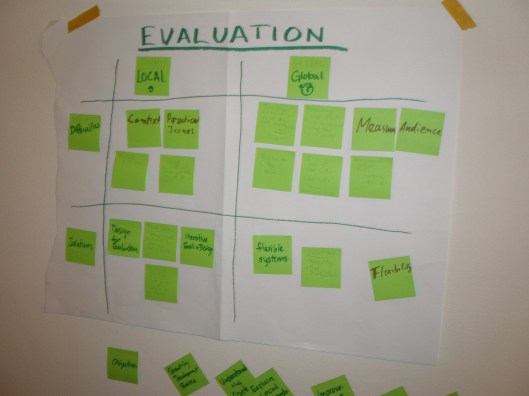
OLYMPUS DIGITAL CAMERA

Rating and Ranking.

Often a large number of ideas are generated but the resources available do not allow all of them to be pursued. Therefore, a variety of voting, ranking and rating systems have been developed so that the group as a whole has input into the direction taken.

Incremental Value. 

It is difficult for people, either as groups or individuals, to move from a current way of doing things to a new one. Almost invariably, people will find the old way of doing things more “comfortable.” The transition to a new way will be much easier if there are incremental improvements in performance along the way rather than the mere promise of some wondrous new state at the conclusion of a long process of change.

Jump Start. 

Sometimes, change in an organization or process needs to be “jump-started” by providing additional incentives or special organizational support in some way.

Active Reminders. 

As people are learning new methods, processes, and skills, it is helpful to have Active Reminders so that people are less likely to fall into old habits. For example, in attempting to do brainstorming, many people find it very difficult to withhold judgment and criticism from ideas that others put forth. It can be helpful in such cases to have the “Rules” of brainstorming prominent displayed or to have someone whose role is mainly to remind people to build on each other’s ideas when someone critiques an idea.

Controlling Growth. 

While people often want their company, non-profit, or movement to grow as quickly as possible, growth without restraint is often called “cancer.” Growth needs to be controlled so that unanticipated side-effects do not destroy the entire company, non-profit or movement. People Express Airlines, for instance, is often thought to have have tanked because their success led to such rapid growth that they could not sustain what made them successful in the first place.

Expressive Communication Builds Mutual Trust.

Studies of cooperation in games such as the “Prisoner’s Dilemma” show that when people communicate something personal and apart from the game such as sharing photos, backgrounds, hobbies, etc. it tends to increase the chances of cooperation.

These Patterns (or really, more accurately, hints of Patterns, are not meant to be exhaustive. But hopefully, there are enough Patterns in this post to give readers a better idea of the wide variety of Patterns than might cohere into a Socio-Technical Pattern Language for Collaboration and Teamwork.

References: 

https://socialworldsresearch.org/sites/default/files/j-ag.final-fmt.pdf

https://www.cc.gatech.edu/fac/Amy.Bruckman/thesis/

Fincher, S., Finlay, J., Green, S., Matchen, P., Jones, L., Thomas, J.C., Molina, P. (2004) Perspectives on HCI patterns: Concepts and tools.  Workshop at CHI 2004, ACM Conference on Human Factors and Computing Systems.

Pan, Y., Roedl, D., Blevis, E., & Thomas, J. (2015). Fashion Thinking: Fashion Practices and Sustainable Interaction Design. International Journal of Design, 9(1), 53-66.

http://www.it.bton.ac.uk/staff/lp22/HF2000.html

Schuler, D. (2008).  Liberating Voices: A Pattern Language for Social Change. Cambridge MA: MIT Press.

Thomas, J. C., Kellogg, W.A., and Erickson, T. (2001) The Knowledge Management puzzle: Human and social factors in knowledge management. IBM Systems Journal, 40(4), 863-884.

Thomas, J.C. and Carroll, J. (1978). The psychological study of design. Design Studies, 1 (1), pp. 5-11.

Thomas, J. C. (2012). Patterns for emergent global intelligence. In Creativity and Rationale: Enhancing Human Experience By Design J. Carroll (Ed.), New York: Springer.

Thomas, J. C. & Richards, J. T. (2012). Achieving psychological simplicity: Measures and methods to reduce cognitive complexity. In The Human-Computer Interaction Handbook. J. Jacko (Ed.) Boca Raton, FL: CRC Press.

Thomas, J.(2008).  Fun at work: Managing HCI from a Peopleware perspective. HCI Remixed. D. McDonald & T. Erickson (Eds.), Cambridge, MA: MIT Press.

Thomas, J.C. (2003), Social aspects of gerontechnology.  In Impact of technology on successful aging N. Charness & K. Warner Schaie (Eds.). New York: Springer.

Thomas, J. C. (2001). An HCI Agenda for the Next Millennium: Emergent Global Intelligence. In R. Earnshaw, R. Guedj, A. van Dam, and J. Vince (Eds.), Frontiers of human-centered computing, online communities, and virtual environments. London: Springer-Verlag.


Thomas, J.C. (1996). The long-term social implications of new information technology. In R. Dholakia, N. Mundorf, & N. Dholakia (Eds.), New Infotainment Technologies in the Home: Demand Side Perspectives. Hillsdale, New Jersey: Lawrence Erlbaum.

Thomas, J.C., Lee, A., & Danis, C (2002). “Who Speaks for Wolf?” IBM Research Report, RC-22644. Yorktown Heights, NY: IBM Corporation.

Thomas, J. C. (2017). Building Common Ground in a Wildly Webbed World: A Pattern Language Approach. PPDD Workshop, 5/25/2017, San Diego, CA.

Thomas, J. C. (2017). Old People and New Technology: What’s the Story? Presented at Northwestern University Symposium on the Future of On-Line Interactions, Evanston, Ill, 4/22/2017.

Build from Common Ground

25 Sunday Feb 2018

Posted by petersironwood in America, psychology, sports, Uncategorized

≈ 6 Comments

Tags

A Pattern Language., collaboration, Common Ground, family, innovation, life, music, religion, sports, teamwork

OLYMPUS DIGITAL CAMERA

CHI Workshop Activity: Working Together to Create World Map (Florence, 2008)

Build From Common Ground

Prolog/Acknowledgement: 

The idea for this Pattern comes from long personal experience trying in many contexts to get to solutions quickly without first bothering to try to find common ground. In addition, I am working on a project to provide a platform to support civil discussion, debate, Dialogue, and deliberations. One of the other founders has a long history with The Interactivity Foundation which also uses various methods to build from common ground.

Author, reviewer and revision dates: 

Created by John C. Thomas on February 20-25, 2018

IMG_2979

Synonyms: 

Abstract: 

Human beings share a large majority of their genes. Life on earth began 4.75 billion years ago. Only around 100,000 years ago people began migrating out of Africa, going to different places and evolving different cultures, religions, and languages. In addition to our long common history, people across the globe want many of the same things: freedom, food, water, safety, love, friendship, a space to be themselves, a life with some pleasure and a sense of meaning or higher purpose.

In the so-called developed world, there is an emphasis on doing things as quickly and efficiently as possible. To accomplish that, many people are extremely specialized in their education and profession in addition to whatever differences they have in culture and family background. Often, in a highly populated, highly interconnected world, people must collaborate and cooperate at a very large scale. Since some of the problems we face (e.g., preventing atomic war; preventing plagues; reducing global climate change) are vital, people are passionate about getting to solutions. They want to do this quickly. There is often a natural tendency to focus immediately on the problem as initially defined, and then to focus on differences and to resolve those differences as quickly and efficiently as possible. This does not generally work. People are invested in their own solutions which depend on their own background and experiences in their various cultures, families, education and training. Focusing from the onset on differences sets up a competitive mindset which then has everyone thinking how to “win” against their competitors. Unlike athletic competitions, people are unlikely even to agree initially on the “rules” for deliberations and debate, and often have pre-existing “positions” to sell to everyone else or force on everyone else.

Therefore, for any group trying to solve a problem collaboratively, it works better to first identify and build on common ground. Later, after some degree of trust is established, people may (or may not) find it useful to examine as well their differences as a source of ideas for how to solve the larger problem.  They may choose from a variety of methods to make progress. Starting with common ground can help everyone involved to see that they are all part of one big and quite similar “in-group” with a problem to solve rather than focusing on everyone else as being in an “out-group” that needs to be defended against.

IMG_3240

Problem:

Groups function better under a wide variety of circumstances if there is a high degree of internal mutual trust. If people work together over a long period of time, trust will usually develop if warranted. This is what happens in most (but not all) work groups, teams, standing committees, etc. However, it often happens that other problems need to be understood and solved by groups that span pre-existing organizations. For example, a town needs to collectively decide whether to sell a beautiful community park to a mall developer who promises tax revenue and convenient shopping for the town. A state needs to decide whether to legalize marijuana or to ban assault weapons. A nation needs to decide whether or not to work with other nations to reduce air and water pollution. People addressing such issues will often have to address them in combination with others that they do not already know well and may not trust.

Often such decisions as those mentioned above must be made under some time pressure. Some people will have vested interests in a “solution” that is particularly favorable to them regardless of how much it hurts others. When people begin by stating their own position and trying to “sell it” to others, an adversarial atmosphere is created so that “winning” rather than “solving” becomes the dominant tone of subsequent conversations and actions. This almost always results in sub-optimal solutions and, in addition, almost always results in reducing trust and social capital among the people deciding.

Even under the best of circumstances, with everyone committed to finding a “good” solution for all, people will tend to misunderstand each other simply because language is ambiguous and vague. People have different assumptions based on their experiences, culture, and training what process to follow as well as what constitutes acceptable rules and boundaries. If we add to these inherent difficulties the further (and avoidable) difficulty that people are focused on the ways people are different, it will tend to prevent mutual trust and prevent the emergence of new ways to find, formulate and solve the problems at hand.

IMG_5159

Context: 

Complex problems can often only be solved by groups. Even when the nature of the problem is simple enough for one person to solve, people want to feel that they or their representatives are engaged in the process if the outcome will impact them. For the group to work well together to solve problems, it is useful for them to understand each other’s situations and motivations. When in a hurry or under stress, people often perceive others and their motivations, not on the basis of inquiry into what those are but on group membership and the way that group differentiates itself from other groups.

Our nervous systems (and those of other animals) are constructed to be particularly sensitive to differences and changes. Our education and society teach us to differentiate as much as possible. We celebrate the wine connoisseur who can tell you the year and vineyard and scoff at the person who simply says, “I like all wine.” Sometimes, of course, fine differentiation is critical, particularly for an omnivore. We need, for instance, to be able to differentiate the three leaves of a wild strawberry from the three leaves of poison ivy. In biology class, we get high grades for correctly labeling 100 different parts of the earthworm and get no credit for simply saying, “Look! These are all parts of an earthworm! How cool! I had no idea it was that complex inside or that it has so many of the same parts we do!” In many contexts, being able to further differentiate things is a good thing. Even in group problem solving, there are situations where this is true. However, we typically do not ask ourselves whether this is one of those situations. We tend to dive unthinkingly into exploring differences.

Forces:

  • Our brains are not infinite but finite. We, along with other animals, generally focus on foreground while ignoring or presuming the background. Our nervous system is especially tuned to differences and changes, not to similarities and constancies.
  • Our educational systems typically focuses on teaching people to make even finer and further differentiations beyond what our senses immediately show.
  • Societies typically celebrate finding additional differences rather than finding additional similarities. Experts are typically defined by their ability to detect differences rather than their ability to see similarities.
  • People are quintessentially social animals. Therefore we tend to join groups. Each group coheres around a group identity which tends to define itself in terms of differences from other groups and seldom mentions similarities.
  • Each person only knows a small proportion of another person’s situation and individuality. Often, we treat each person according to their differentiating group membership(s) rather than their similarities to ourselves or according to the complexity of their individual selves.

Solution:

When a group begins to address a situation that impacts many people in various ways, and especially if people already have opinions and positions on the situation, begin by stressing, creating, or fostering their common ground before even starting any other problem solving activity.

OLYMPUS DIGITAL CAMERA

Sharing a Meal at CHI 2008 Workshop

Examples: 

1. At IBM Research, for several years, I managed a research project on the “business uses of stories and storytelling.” I worked with a small team of researchers & consultants to develop tools and techniques. One patent (Story-based organizational assessment and effect system) was originally inspired by trying to help companies involved in mergers and acquisitions deal with cultural differences between companies. The suggested technique essentially involved collecting stories from the two original companies, analyzing them for the underlying values that were expressed in the stories, finding common values in the stories from both original companies, creating new stories using the values and situations from the originals but making sure the new stories were constructed to be memorable and motivating; and finally re-introducing these stories to the people from both companies. The reason for this whole process was to stress common ground so that people from two companies could work better together.

StoryPatent

2. At a workshop at the 1992 ACM Conference on Human Factors in Computing Systems (CHI ’92), I co-organized and co-led a workshop on “Cross-cultural issues in HCI.” At the beginning of the workshop, the participants entered the assigned workshop room to find that it had been set up in a “classroom style” with one small table and two chairs at the front of the room and all the other chairs and desks set up for the “listeners.” We wanted the room set up as a large circle. Everyone pitched in to re-arrange the room into this large circle. This physical activity provided additional common ground for the team. One outcome of the Pattern “Small Successes Early” is to provide common ground. Having people work together to perform a physical task is one way to establish common ground.

We also played a game called “Barnga.” In my introduction to the game, I explained that it was much like Bridge, Whist, or Euchre. To my surprise, none of the participants attending from Asia had any idea how to play such games or what I meant by “tricks” or “following suit.” That experience illustrates how easy it is (at least for me!) to over-estimate how much common ground exists in a group.  (http://www.acadiau.ca/~dreid/games/Game_descriptions/Barnga1.htm)

In a later workshop (2008) on “Human Computer Interaction for International Development,” at the suggestion of Andy Dearden, we began by cooperatively building a map of the world from materials at hand (illustrated above) before delving into the details of the workshop. Starting with this as “common ground” we then explored some of our differences by standing on the representation of where we were from, a favorite place we had visited, a place we wanted to visit, etc.

3. Religions regularly practice rites and rituals. For practitioners of the religion, this provides common ground regardless of a host of differences among the adherents. Of course, it is a double-edged sword because differences among these rites and rituals can also separate people. One of the more brilliant scenes from West Wing cuts among scenes of people attending religions services that are variously Jewish, Muslim, and Christian while the viewer knows that there is an unsuccessful peace effort underway. In this case, the uncommented footage helps to illustrate the common ground among these three religions.

earthfromspace

4. The Family of Man was both an ambitious photography exhibit and a book (definitely worth buying) that portrays people across the world to illustrate precisely that we do have common ground.

https://en.wikipedia.org/wiki/The_Family_of_Man

5. In an earlier blog post, I showed with back of the envelope calculations just how “related” humanity is in terms of genetics, experience, ideas, and matter. In fact, all of life on earth is highly inter-related and it has been for its entire 4.75 billion years.

https://petersironwood.wordpress.com/2017/03/09/math-class-who-are-you/

6. In a recent episode of the TV series, Madam Secretary, the Secretary of State is trying to resolve a conflict between two nations A and B. The diplomats from A say they cannot trust B and the diplomats from B say that they cannot trust A. She suggests that they start from their mutual distrust as part of common ground. In other words, rather than treating the mistrust of A and B as two separate issues, she begins by suggesting that A and B both share two things in common: not only a desire for peace but also a difficulty in trusting the other side. Even mutual distrust can be framed as a basis for common ground. This is more than a linguistic trick. It is an important reframing. It may well turn out that a single event such as a soccer game with teams that have members from both nations may help reduce mistrust on both sides at the same time.

7. Holiday celebrations, the preparation and consumption of food, listening to music, or appreciating the beauty of nature may all provide additional ways of beginning with common ground. Of course, there are cultural differences in all of these as well so one must take some care to provide something that actually is common ground and not something that tends to emphasize the differences among people in these activities.
8. One of the plenary speakers at CHI 1989 in Austin Texas was an astronaut who had been in space. I spoke with him after and during our conversation, he claimed that all astronauts, whatever country they were from, shared the same experience of seeing earth from space; viz., that the national boundaries we typically think so much about were only political; most are not physical. He said all the astronauts were struck by how thin and fragile our atmosphere is and that the earth is the only place around that is capable of sustain the breadth and depth of life. Many of them found this realization of “common ground” the most transformative of all their experiences in the space program.

Resulting Context:

Once people experience common ground, they may still disagree, debate, discuss, or hopefully dialogue in order to identify issues and problems. Experiencing common ground makes it harder to “dehumanize” the other side. It decreases the chances that people will engage in counter-productive actions such as “name calling” or using propaganda techniques to “prove” that they are right and their “opponents” are wrong.

Rationale:

Actions are always better based on reality than on fantasy. Reality is that people share much in common. Reality is that there are also many remaining differences. The entire problem solving process (including problem finding, problem formulation all the way through to finding issues with solutions and re-solving, re-negotiating, re-designing, or re-developing a solution) is enhanced when it is based on a balanced view that includes both real similarities and real differences. We already have a culture and an educational system that focuses on differences. Focusing on common ground is a critical factor in balancing our view so that we do not try to solve problems based on the partial truth that we are all different.

Related Patterns: 

Reality Check, Check-In, Small Successes Early.

Metaphors: 

It is a windy day in San Diego as I write this. We have a set of wind chimes outside the bedroom. Whichever direction the wind blows; however windy it gets (within bounds); and even if the wind is quite chaotic, the sound that emerges is always harmonic and tuneful. This is because of the structure and relationships of the chimes. It would be nice if we could have a platform that encouraged and promoted civility. I think that could work because of the nature of the platform. One of the “chimes” could be Bohm Dialogue; another could be “Building from Common Ground.”

Another musical example is Jazz Improvisation. If a group of musicians who know each other get together, they can improvise some very nice music. If they’ve never met, they will almost certainly agree on a few boundaries before beginning such as style, time signature, key signature. They may well start by having the percussion set up a “beat” that everyone relates to.

Now, imagine instead that seven random people are thrown together from seven different cultures. Each has an instrument that none of the others has ever seen. They have completely different musical experiences and expectations. Does it not make sense that they will take more time to converge on anything good? Doesn’t it seem as though they first need to discover some kind of common ground in terms of scales, rhythms, degree of repetition before achieving a good result? Or, do you think they should argue about which kind of music is best first? Do you think any of the seven will be able to convince the other six that “their” kind of music is superior? Suppose instead of having as one mutual goal making good music, instead, they are in a contest and only one of them will “win” and go on to the next round. Surely, this will only further confound any possible teamwork. Add to this, that they only have two minutes. What kind of performance would you expect now? And, yet, we seem to expect people from very different backgrounds to get on-line and instantly “make good music together.” Whether it’s 140 characters, 280 characters or a whole paragraph, it seems unlikely you will be able to sway anyone to move from “their position” to “your position.”

IMG_3524

International sports competitions such as the Olympics provide a setting where people from around the world get together and compete. These are not random people; they are all immensely talented and skilled; however, they are also all highly competitive. Yet, the venue provides a framework for competition that provides a structure for competing within common ground. Despite being from different cultures and using different languages, the athletes push each other to amazing performances with a minimum of rancor. Every athlete realizes as well that every other athlete has also gone through a rigorous selection and training process involving many sacrifices to get where they are — more common ground. The Olympics might be thought of as a particularly interesting example of finding common ground despite people having different backgrounds, language, and goals. Sports may also be thought of as a compelling metaphor. When politics are reported in the media, they are most often treated as a sporting event. But it is a strange kind of sporting event in that such reporting seldom stresses common ground and instead focuses on strategy, polls, winning, losing, and differences. It almost never reports on common ground in politics. In reporting on actual sporting events, however, the reporting focus often does cover the common ground that athletes face; e.g., the training, the dedication, the sacrifices that families must make, the importance of coaching, etc.

References: 

https://www.goodreads.com/book/show/197193.The_Family_of_Man

https://www.johngraham.org/coach/17-finding-common-ground-negotiating-and-resolving-conflicts-part-i

http://www.tandfonline.com/doi/full/10.1080/03057267.2016.1206351

http://journals.sagepub.com/doi/abs/10.1177/1049732306289705

https://www.researchgate.net/publication/221517384_Video_Helps_Remote_Work_Speakers_Who_Need_to_Negotiate_Common_Ground_Benefit_from_Seeing_Each_Other

Thomas, J. C. (2017). Building Common Ground in a Wildly Webbed World: A Pattern Language Approach. PPDD Workshop, 5/25/2017, San Diego, CA.

Thomas, J.C. & Kellogg, W. (1993). Cross-cultural perspectives on human-computer interaction: report on the CHI ’92 workshop. SIGCHI Bulletin, 25 (2), 40-45.


← Older posts
Newer posts →

Subscribe

  • Entries (RSS)
  • Comments (RSS)

Archives

  • October 2026
  • September 2026
  • August 2026
  • July 2026
  • June 2026
  • May 2026
  • April 2026
  • March 2026
  • February 2026
  • January 2026
  • December 2025
  • November 2025
  • October 2025
  • September 2025
  • August 2025
  • July 2025
  • June 2025
  • May 2025
  • April 2025
  • March 2025
  • February 2025
  • January 2025
  • December 2024
  • November 2024
  • October 2024
  • September 2024
  • July 2024
  • April 2024
  • March 2024
  • February 2024
  • January 2024
  • December 2023
  • August 2023
  • July 2023
  • May 2023
  • April 2023
  • March 2023
  • February 2023
  • January 2023
  • December 2022
  • November 2022
  • October 2022
  • September 2022
  • August 2022
  • July 2022
  • June 2022
  • May 2022
  • April 2022
  • March 2022
  • February 2022
  • January 2022
  • December 2021
  • November 2021
  • October 2021
  • September 2021
  • August 2021
  • July 2021
  • June 2021
  • May 2021
  • April 2021
  • March 2021
  • February 2021
  • January 2021
  • December 2020
  • November 2020
  • October 2020
  • September 2020
  • August 2020
  • July 2020
  • June 2020
  • May 2020
  • April 2020
  • March 2020
  • February 2020
  • January 2020
  • December 2019
  • November 2019
  • October 2019
  • September 2019
  • August 2019
  • July 2019
  • June 2019
  • May 2019
  • April 2019
  • March 2019
  • February 2019
  • January 2019
  • December 2018
  • November 2018
  • October 2018
  • September 2018
  • August 2018
  • July 2018
  • June 2018
  • May 2018
  • April 2018
  • March 2018
  • February 2018
  • January 2018
  • December 2017
  • November 2017
  • October 2017
  • September 2017
  • August 2017
  • July 2017
  • June 2017
  • May 2017
  • April 2017
  • March 2017
  • February 2017
  • January 2017
  • December 2016
  • November 2016
  • October 2016
  • September 2016
  • August 2016
  • July 2016
  • June 2016
  • May 2016
  • April 2016
  • March 2016
  • February 2016
  • January 2016
  • December 2015
  • November 2015
  • October 2015
  • September 2015
  • August 2015
  • May 2015
  • January 2015
  • July 2014
  • January 2014
  • December 2013
  • November 2013

Categories

  • AI
  • America
  • apocalypse
  • cats
  • COVID-19
  • creativity
  • design rationale
  • dogs
  • driverless cars
  • essay
    • guns
  • family
  • fantasy
  • fiction
  • HCI
  • health
  • leadership
  • love
  • management
  • nature
  • pets
  • poetry
  • politics
  • psychology
  • Sadie
  • satire
  • science
  • sports
  • story
  • The Singularity
  • Travel
  • Uncategorized
  • user experience
  • Veritas
  • Walkabout Diaries

Meta

  • Create account
  • Log in

Blog at WordPress.com.

  • Subscribe Subscribed
    petersironwood
    Join 653 other subscribers

    Have a WordPress.com account? Log in now.

  • petersironwood
    View site in Reader
    Manage subscriptionsSign upLog in
    Report this content
    Collapse this bar
Loading Comments...