• About PeterSIronwood

petersironwood

~ Finding, formulating and solving life's frustrations.

petersironwood

Tag Archives: fairness

Travels with Sadie: 12 Taking Turns

20 Monday Oct 2025

Posted by petersironwood in essay, pets, Sadie, Uncategorized

≈ 1 Comment

Tags

books, cooperation, dogs, fairness, fiction, life, pets, Sadie, sharing, story, teamwork, trust, truth

Travels with Sadie 12: Taking Turns

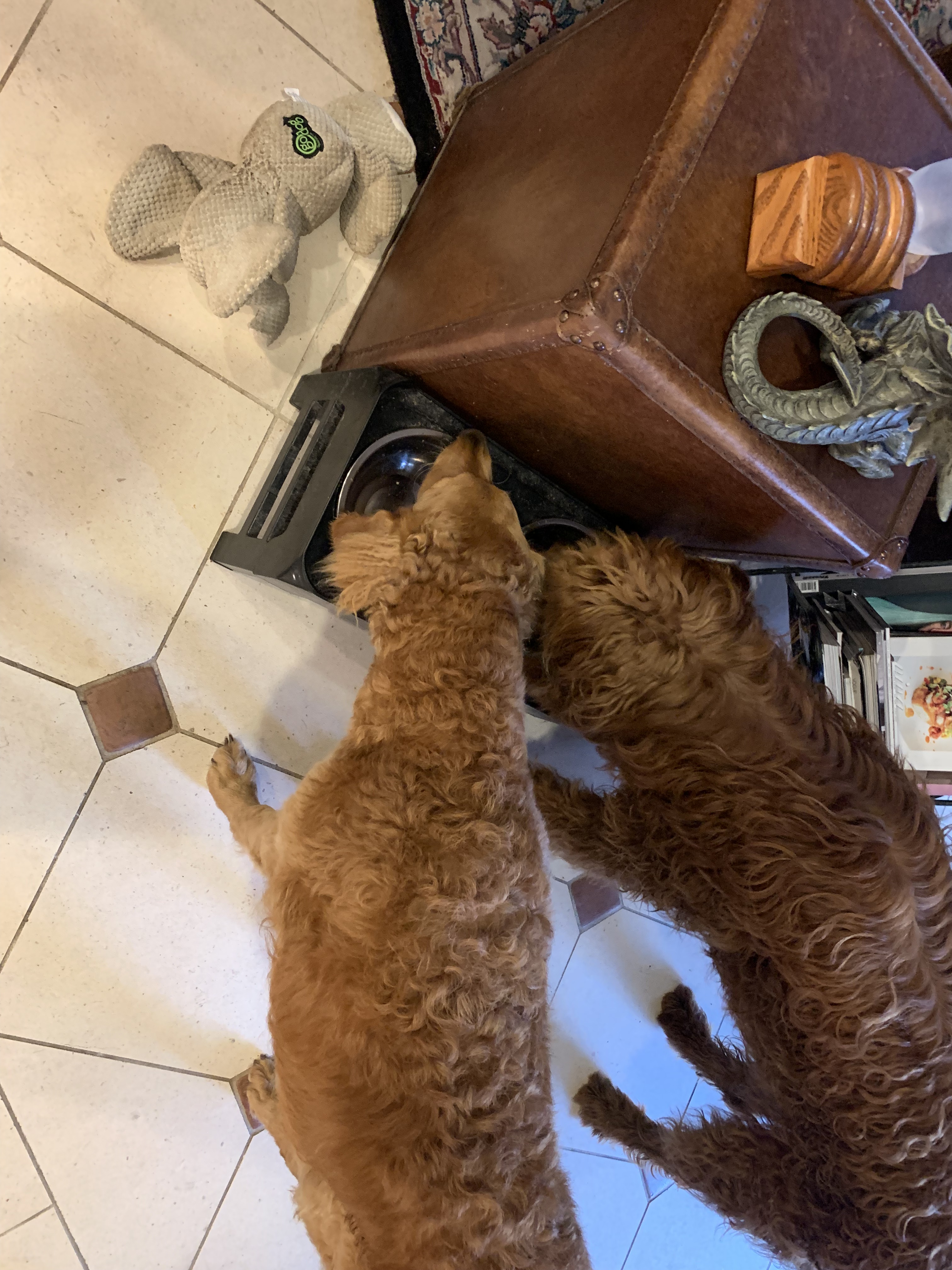
Bailey (L) and Sadie (R) in the garden.


If you’ve been reading any of these blog posts about my dogs, Sadie and Bailey, you must know by now that both of them are avid “ball players” — given the nature of dogs, especially ones that are half Golden Retrievers—this is probably not a big surprise. To further seal the deal, their “human dad” is also an avid “ball player.” 

Many human sports involve balls of one sort or another and I have, at various times, been “into” baseball, football, basketball, golf, tennis, ping-pong, softball, soccer, racquetball, volleyball, and even croquet. Looking back on my life, I realize there are many human sports that do not involve a ball; e.g., varieties of running, jumping, skating, diving, swimming, cycling, skiing, wrestling, boxing, and gymnastics. Although I have done all of these a little bit—mainly for fitness—I have historically been much more interested in sports that involve using a ball. The only one I enjoy as much as a ball-based sports is frisbee which is arguably much like throwing and catching a ball. A ball introduces an entire layer of complexity in tactics, strategy, and experience that I enjoy. For one thing, the ball can move faster and in modes quite different from those a human can perform. A ball can be in anywhere in large two (and often three) dimension-space. Furthermore, how the ball gets from one point in space to another can happen in a variety of ways. The ball generally has spin and spin alters the flight path of the ball as well as the way it reacts to the next thing it touches.

Sadie and Bailey, by the way, do a pretty good job of predicting what a tennis ball (or a squeaky ball) will do when it hits, say, concrete or dirt. They can, for instance, catch balls in the air that are angled rebound shots off the garage door at some fair speed. They also exhibit intelligent metacognition in their leaping and catching behavior. They have a mental model of their capabilities. It’s not perfect and Sadie’s is much better than Bailey’s, but even Bailey doesn’t mistake his own capabilities much. I wonder whether they too enjoy balls partly because they’re complex in their behavior. The only thing better would be a small animal like a lizard, squirrel, rabbit, etc. Of course, it is this hunting behavior that predisposes them to enjoy (and be good at) playing ball or frisbee.

My dogs have both nature and nurture leading them toward ball playing.

Sadie and I have spent many hours playing ball in jointly invented games. As I’ve explained elsewhere, it’s much more to my liking to let our games evolve than to “teach her how” to play ball a certain way that comes entirely from my own human imagination.

Most dogs, for example, learn to go fetch a ball and bring it back to the thrower and drop it at the thrower’s feet so that they may pick it up and throw it again. Sadie instead evolved a somewhat different style which was to incorporate a variant of “snatch the handkerchief” into our ball playing. She would typically bring the ball to me, drop it at my feet, watch me try to pick up the ball and then suddenly snatch it away just before I could pick it up. I quickly adapted to her style by using a “grabber” because I enjoy having all ten fingers. 

Since early puppyhood, Sadie has challenged herself by trying to catch or at least stop and touch multiple balls on the same turn.

She typically begins her version of ball playing by dropping a retrieved ball directly beneath her snout. I will try to grab the ball before she can snatch it again but she’s always too fast for me. Then, she will begin dropping the ball farther and farther from her rows of shiny canines until, at some point, I have a fighting chance of snatching the ball away with the grabber before she can grab it. Sadie and I played this game many times in the course of the first two years of her life. 

Then, we brought her little brother Bailey into the mix. Bailey learned many things from Sadie, and a few from me. He, like Sadie, loves to play ball. For a variety of reasons that I won’t recount just now, Bailey generally prefers to drop the ball so that I can more quickly throw it to him again. When he did this, however, Sadie would sometimes snatch the ball before I could and run off with it. 

Sadie (L) and Bailey (R) illustrating the type of “fighting” they do when Bailey tries to steal a ball from Sadie.

At first, I didn’t think much about this ball stealing, and, if Bailey objected, he did not yet know how to present a formal written complaint about it. Within a few months, however, Bailey was as large as his kid sister and their “play-fights” became pretty intense. Neither one has ever (so far as I know) injured the other, but to this human observer, it looks pretty rough. They take turns running at each other. Our “back yard” is mostly garden, but there was a small patch of grass which has been completely torn into a black dirt field. 

When it comes to humans, most of us learn to “take turns” in nursery school or, at the latest, Kindergarten. There are eight billion people on the planet and not everyone has access to their own object of every description that they want. We, as toddlers, teens, and adults, take it for granted that we will “take turns” and share various things. At a public pool, there may only be one diving board so people cue up and “take turns” diving off the board. At a playground, there may be only one sliding board so kids take turns sliding down. In tennis, we “take turns” serving games. In baseball, we “take turns” as individuals batting, and the whole team “takes turns” hitting versus fielding. In playing neighborhood poker, it’s quite common to “take turns” dealing, and, along with that, many people play “dealer’s choice” which means the dealer also chooses the specific game; e.g., five card draw with jokers wild. In chess, the two sides take turns. In Risk and Monopoly and many other board games, players take turns.

Ferris Wheel is just one of thousands of situations where we take turns.


We take turns for positive things, but also for chores. A couple may decide to “take turns” taking out the trash or doing the dishes. Or, if there are five kids in the family, the five may take turns doing the various chores. “Taking turns” is so ubiquitous that it blends into the background in most cases and we don’t even consciously think about it. Life works better in a thousand ways, large and small, when we take turns. 

Last night, my wife and I attended a birthday dinner at an Italian restaurant. When it was time to order, we “took turns” giving our orders to the waiter. Imagine how inefficient and contentious it would be instead if we all shouted are orders at the waiter at the same time! Less pleasant for everyone and far more likely to result in mistaken orders. When we drove home, we came to several stop signs where we took turns with other drivers. We took turns merging onto the highway. When we came home, we took turns coming through the door! Then, the dogs took turns going out for a walk with me. I often feed them treats and share by having them take turns. 

Nonetheless, I can’t seem to get Bailey to take turns when it comes to her “catching a ball”as her default behavior. I can throw one ball into the deep end of the pool while I say “This is for Bailey” and throw another one in the shallow end saying “This is for Sadie” and the dogs will swim to their respective balls and collect them, but then, Bailey will drop his ball and run over to Sadie and steal hers.

Similarly, I can gather up two balls in the garden and throw them in opposite directions and get them to run in different directions (though not always). Nonetheless, as soon as Bailey scores a catch of “his” ball, he drops it and rushes back to grab the ball out of Sadie’s mouth. 

Sadie (L) and Bailey (R) are both Golden Doodles. Here, Sadie is about 3 1/4 and Bailey’s about 1 1/4 years old.

Why is it apparently so hard for Bailey to learn to take turns? Partly, no doubt, there’s some inborn tendency to want things for himself. And partly, there are positive reinforcement structures at play that I haven’t yet figured out how to break or how to shape up incompatible behaviors. Sadie, for her part, sometimes fights to keep the ball. I suspect Bailey finds this positively reinforcing because the “fight” itself is fun. Most of the time, when she sees him approaching in a “ball-stealing” situation, she simply drops the ball and Bailey snatches it. Bailey also likely finds this positively reinforcing too. I try praising other behaviors that are more in the direction of better cooperation, but such opportunities are rare and difficult to read so far. 

Initially, when I fed the dogs side by side, Bailey would often try to steal some of Sadie’s food. But Sadie herself growled fairly intensely when this happened and I often intervened as well. Here, Bailey was somewhat positively reinforced by moving her attention back to her own bowl, because, after all there was food there too. Even if he has finished his own dinner, he gets enjoyment from licking the “empty” bowl. So, in contrast to the case of turn-taking with tennis balls, the eating situation itself makes it easier for cooperation to emerge. I don’t ever recall Sadie trying to steal some of Bailey’s food. 

I have been hoping that watching the dogs might give me some insight into the ultra-greedy behavior of many (though not all) of the ultra-wealthy billionaires. Just to review the general situation America now finds itself in, the productivity of labor has increased tremendously since the beginning of the industrial revolution. Until the mid-1970’s the increased wealth that came from the increased productivity was split between owners of the means of production and the workers. In other words, the rich got richer, but so did the workers. Since the mid-1970’s however, the rich generally, and especially the extremely wealthy, have taken almost all the increased wealth that has been created by increased productivity.

Part of the answer as to how they have done this is to use their wealth to buy power in the form of bribing politicians who make policy decisions. In some cases, they’ve done this through outright illegal bribes and in other cases, they’ve used slightly more subtle and sometimes legal methods but the result is the same. In addition—actually, I should say “in multiplication” because the impacts have been more than additive, they have largely taken over mass media and social media where they promulgate heroic cartoon versions of themselves and their desires while lying about and denigrating people who are not insanely wealthy. 

Much like Bailey’s behavior, there is not a huge mystery in how they have done it. But, there is a mystery in why they have done it. Studies show that once you have your basic necessities taken care of, additional income doesn’t raise your personal happiness. While this result seems true in terms of aggregate happiness, it ignores the little dopamine hit that the animal (human or dog) gets when they immediately grab a fourth yacht or steal another ball from their sister. It doesn’t last long, but apparently long enough to serve as a positive reinforcement.

In the larger scheme of things, it’s not to Bailey’s benefit to keep stealing the ball from his sister. It make the whole ball-playing scene less pleasurable for me and I play less often. I also play with Sadie by herself more often because I want her to have a chance to play too. In the larger scheme of things, it’s not really to the benefit of billionaires to have sick, tired, uneducated workers either, nor ones so desperate to feed their families that they’ll start eating the rich. But somehow, dogs and such are prone to overlook longer term consequences. Some of the extremely wealthy delude themselves into thinking that they can replace their workers with AI and protect themselves & their families with firearms. They’re not thinking things through any more than Bailey is. This human tendency for self-defeating greed has been recognized at least since the time that Aesop told his fables. Maybe the choice of a dog in the following fable was quite intentional. 
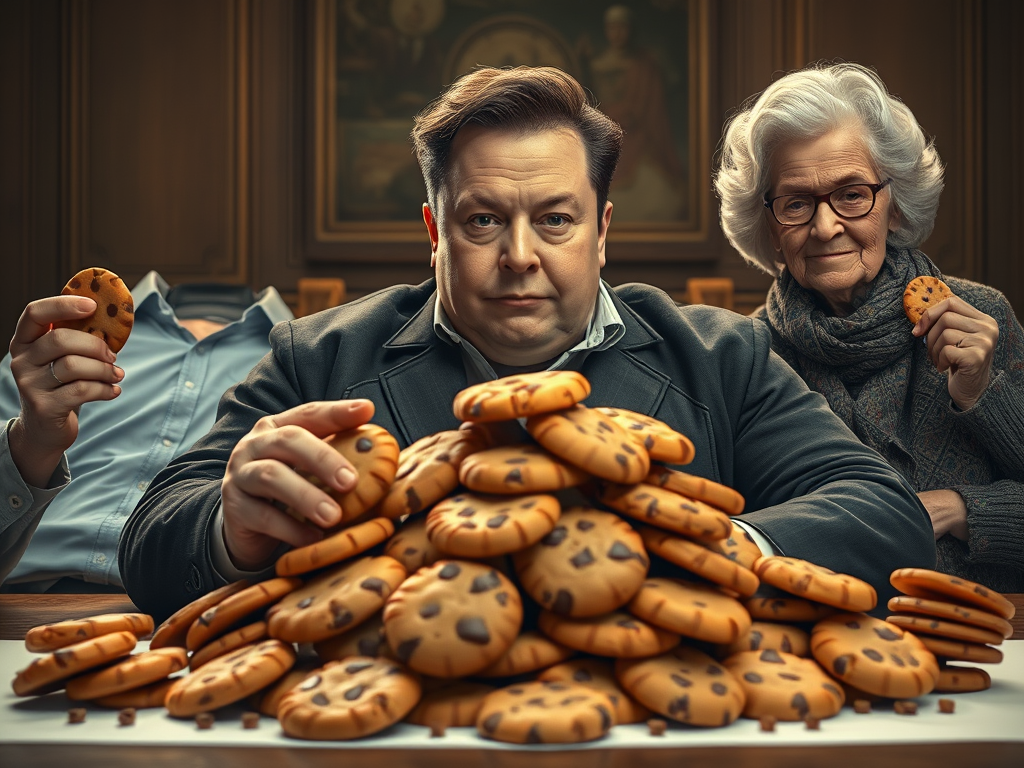
A dog found a bone and was happily trotting along with the bone in his mouth. He came to a bridge and began happily trotting over the bridge. He happened to look down at his own reflection and saw the image of a dog with a bone. He thought to himself that he wanted both bones so he growled at the dog in the pond, intending that he drop the bone so he could have two. But the dog in the pond just growled back! So, the dog on the bridge barked angrily to bully the other dog into dropping its bone. Of course, what happened was that the dog on the bridge dropped his own bone into the pond.

That’s from 2000 years ago. But now, we’re in a situation that warrants a third round of foolishness. Here’s my addition:

The dog was angry that he had lost both bones so he attacked the dog in the water. He promised himself he’d fight to the death to get both bones. Of course, there was only one bone and he ended up exhausted and drowned in the pond.


Unlike some of today’s ultra-wealthy, Bailey is much too smart for that third round. The ultra-greedy (not the same set as the ultra-wealthy but with lots of overlap) would like you to believe that they are SuperDogs or SuperHeroes or something…that they 100,000 times as much wealth as you because they are 100,000 smarter. They aren’t, of course. And they are willing to prove they aren’t by believing the promises of a cruel, demented, liar-con man. Also, they have a thousand experiences, if they reflect honestly, that having increased wealth over the first 100,000,000 hasn’t made them the least bit happier. There have been some accomplishments or events that were correlated with making more money. But the money itself and what it can buy doesn’t make them feel any happier. And some billionaires accomplish things—such as eradicating a disease—which make them feel happier but that are correlated with investing huge sums of money, not gaining them. Meanwhile, if things continue on their current path, it won’t be long before there are many more people in America who are not just hungry but who are starving to death. At that point, no-one will forget that some billionaires pay zero taxes but have bought politicians who give even more wealth to the few while millions starve or die from lack of medical care.

It is time to feed Bailey and Sadie who will, at least, eat beside each other happily and peacefully. I should mention, by the way, that Bailey’s disposition is very loving. She is not a mean angry dog. She’s not even a particularly stubborn one. She tries to please us and gets along with others. But she does sometimes have trouble taking turns. How about you?
https://www.amazon.com/author/truthtable

Turing’s Nightmares (Sci-Fi about the singularity)

Fit in Bits (Describes how to work more exercise into a busy schedule)

The Winning Weekend Warrior (the psychology of winning and enjoying sports)

Tales from an American Childhood (recounts early experiences from Ohio in the 1950’s and relates them to current events)

Travels with Sadie 1 Lampposts

Sadie is a Thief!

Hai-Ku-Dog-Ku

Sadie and the Lighty Ball (Describes game and play pattern co-development)

Math Class: Who are You? (Shows how related all life is)

Roar, Ocean, Roar (a poem about the power of the people)

Essays on America: The Game (hypothesis essay about why some are so greedy)

The Self-Made Man


Shooting the Moon

20 Sunday Dec 2020

Posted by petersironwood in Uncategorized

≈ 2 Comments

Tags

cards, courage, essay, fairness, moon shot, story, USA

Shooting the Moon

Photo by James Wheeler on Pexels.com

One of the first card games I ever learned to play was “Hearts.” It’s actually quite a fun game. Unlike bridge, which requires four people to play “normally”, Hearts, in my opinion, is even more fun with three. (If you like, you can read about the game before going on, but I don’t think it’s really necessary to understand the rest of this essay. The first link talks about the general rules and the second link gives some hints about “Shooting the Moon.”)

https://bicyclecards.com/how-to-play/hearts/

https://www.thesprucecrafts.com/how-to-shoot-the-moon-in-hearts-411727

Three was a good number (besides being prime, and a triangular number) because I was an only child for the first 11 years of my life. My parents taught me to play Hearts and Bridge at a fairly young age. I was young enough, for instance, that I looked carefully at each face card to try to understand the personalities of the people peering out! I liked the Jack of Diamonds and the Jack of Spades the best. I desperately wanted to meet them! (I wonder whether Roger Zelazny felt the same because in his rather wonderful “Amber” series…).

The back of the cards also fascinated me. I wondered what it would feel like to ride one of those bikes! I was particularly interested when one of the cards developed a flaw or bend mark. Even knowing the identity of one of your opponent’s hidden cards could be a tremendous advantage. 

Anyway, the game of hearts has an interesting payoff structure. You get a point counted against you for every heart that you take. You get 13 points against you if you end up taking a trick with the Queen of Spades in it. There’s a catch though. If you manage to take all thirteen hearts and the Queen of Spades, you get zero points against you. Your opponents each get twenty-six points against them. 

The player then is often faced with a dilemma: “Should I try to Shoot the Moon? If I do try, and fail, I will likely end up with many points scored against me. On the other hand, if I succeed, it is a huge advantage for me.” 

Photo by Andrea Piacquadio on Pexels.com

It isn’t only the points. At a young age, I could handle rules and strategy, but if I tried and just barely failed to “Shoot the Moon,” I would feel extremely frustrated. I didn’t initially try to hide it either! I would literally see red and the top of my head felt is though it were floating away. I would accuse my parents of cheating although I don’t think they ever did. I simply made a false assumption or miscounted or miscalculated. Often, I took a reasonable risk, but the cards just didn’t turn out the way I had hoped. At that point, my view of the world was still primitive: someone was at fault whenever I failed, and I desperately did not want it to be me who was at fault. 

Luckily for me, throwing temper tantrums at the outcome of a hand of Hearts was not the sort of nonsense up with which my parents put. I soon learned to hide my rage and eventually not to feel it at all unless there really was evidence of cheating. I didn’t “declare” cheating on my parents or friends just because I didn’t like the outcome — at least not past the age of 7 or 8.

In hearts, it often happens that the cards you are dealt will obviously not let you “Shoot the Moon.” In those cases, your strategy for the hand is clear. Avoid taking as many hearts as possible. However, if I weren’t careful, I could easily end up helping my Mom or Dad “Shoot the Moon.” Better to take one heart or even four hearts or even the dreaded Queen of Spades than to let them “Shoot the Moon” and end up with 26 points!

It is extremely rare, in my experience to be dealt a hand in Hearts that makes it obvious that you will Shoot the Moon so long as you don’t slip up. Generally, the most you can expect to get every round or two is a hand that might let you “Shoot the Moon.” In accomplishing this goal, it is important that you not let your opponents guess that you are trying to Shoot the Moon. The sooner they “catch on”, the lower your chances of succeeding. 

Original drawing by Pierce Morgan

At a very young age, I learned to “fake” my reactions to help my chances. For instance, the first time I took a trick in which someone laid a heart on me, I might grimace and growl and shoot the person with my dagger eyes. These ploys worked better against my friends than with my parents who quickly learned to read these fakes. Then, I learned to make them more subtle. Instead of grimacing and growling and shooting the person a nasty look, I would let the slightest hint of disappointment flash over my face quickly and then vanish like morning fog. It reminds me of toasting a marshmallow to perfection without letting it catch fire. 

I learned to judge more accurately whether I had a hand that would likely allow me to “Shoot the Moon” or a hand that would only allow me to “Shoot the Moon” if I were very lucky. If there was any chance at all, I would play for awhile and see how things went. After every trick I would “recalculate” my odds in some non-numeric kiddish way. I would often try and sometimes succeed. When I failed, I would try to learn from it. Sometimes, especially at the beginning, my parents would show me how I had messed up. For me, I discovered that it was more fun to try and fail than not to try at all, especially because I could learn from my failures. 

Photo by Jean van der Meulen on Pexels.com

———————————————

September 12, 1962: John F. Kennedy declared that “We choose to go to the moon.”

https://en.wikipedia.org/wiki/We_choose_to_go_to_the_Moon

On July 20, 1969, Neil Armstrong stepped onto the surface of the moon.

https://www.nasa.gov/audience/forstudents/k-4/stories/first-person-on-moon.html

The United States of America, literally decided to “Shoot for the Moon.” And succeeded.

During my working life, I have far more often heard so-called “leaders” in many different organizations encourage their workers to “Find the Low-hanging Fruit” than I have heard them encourage people to “Shoot the Moon.” What “leaders” will sometimes do is set a “stretch goal” for the workers to fulfill without any provision of the necessary time, resources, or personnel to achieve that goal. If the workers achieve the goal, the manager (not an actual leader) scores 26 points against his or her opponents. They shot the moon. But if, as a worker, you come up one heart short; if you fail to “Shoot the Moon”, then 25 points will be scored against the you the worker who failed. It is the worker who fails to “Shoot the Moon.”

Photo by Pixabay on Pexels.com


Since the late 1960’s, the real wages of workers have hardly moved at all. During that same time, because workers learned new methods, procedures, and technologies, productivity soared. In the past, the wealth created from increases in productivity had been split between the workers and the owners. Since, the 1960’s however, the increased wealth that accrued from increased productivity has gone completely to owners and virtually none of it has gone to the workers who increased their productivity. 

At the same time, and perhaps not coincidentally, most businesses, even pre-COVID, were not trying to “Shoot the Moon” — they were searching for “Low-Hanging Fruit.” 

What happened, America?

When do go for it again? 

When do we try to “Shoot the Moon” again?

When do we reshape our society to allocate windfall profits to the people who actually work for a living — and not just for the people who watch their wealth increase by simply owning stuff?

I do not think these two changes are unrelated. The people who actually do the work are willing to take risks to build something better. They are invested in the product or service they provide. They would like to be fairly paid, but it isn’t only about the money. It’s also about doing something really cool and providing value for the society as a whole.

Photo by Rakicevic Nenad on Pexels.com


The people who simply move money around from stock to stock to make money don’t want to take risks. They don’t really care whether their money is being spent to cure cancer or to develop a new toothpaste that comes out of the tube and whistles “Dixie” while it does so. They want a decent return on investment. They may be willing to invest some of their capital in a portfolio of high risk/high benefit investments but most of them will abandon backing the attempt to cure cancer to invest in the whistling toothpaste if that’s what the “numbers dictate.”

This is obviously not true of everyone who is rich, but it’s more often true than not. Those, like Bill Gates, or George Soros or Mike Bloomberg who do contribute enormous sums to good causes are pilloried. Is it by other billionaires because they don’t want to look bad by comparison?  Is it by foreign actors who simply want to sow dissent and distrust within America? I don’t really know. 

https://www.cnbc.com/2017/10/17/philanthropist-george-soros-donates-most-of-his-net-worth-to-charity.html

What about in your own life? Have you ever chosen to “Shoot the Moon?” Or, do you stick with picking the “Low-Hanging Fruit?” What do you encourage your family, friends, and co-workers to do? 

————————————

Poems, stories, and essays that touch on courage.

Roar, Ocean, Roar

Child Like? or Childish? 

Take a Glance; Join the Dance

Skirting the Turtle

Listen! You can Hear the Echos of your Actions.

John vs. Worrier

Process Re-engineering Moves to Baseball

Jennifer’s Invitation

Wilbur’s Story

The Touch of One Hand Clasping 

The Impossible 

Author Page on Amazon

Sports Fans Only

17 Sunday May 2020

Posted by petersironwood in America, apocalypse, COVID-19, politics, sports, Uncategorized

≈ 6 Comments

Tags

Corruption, Democracy, fairness, fascism, games, life, relationships, sports

Sports Fans Only

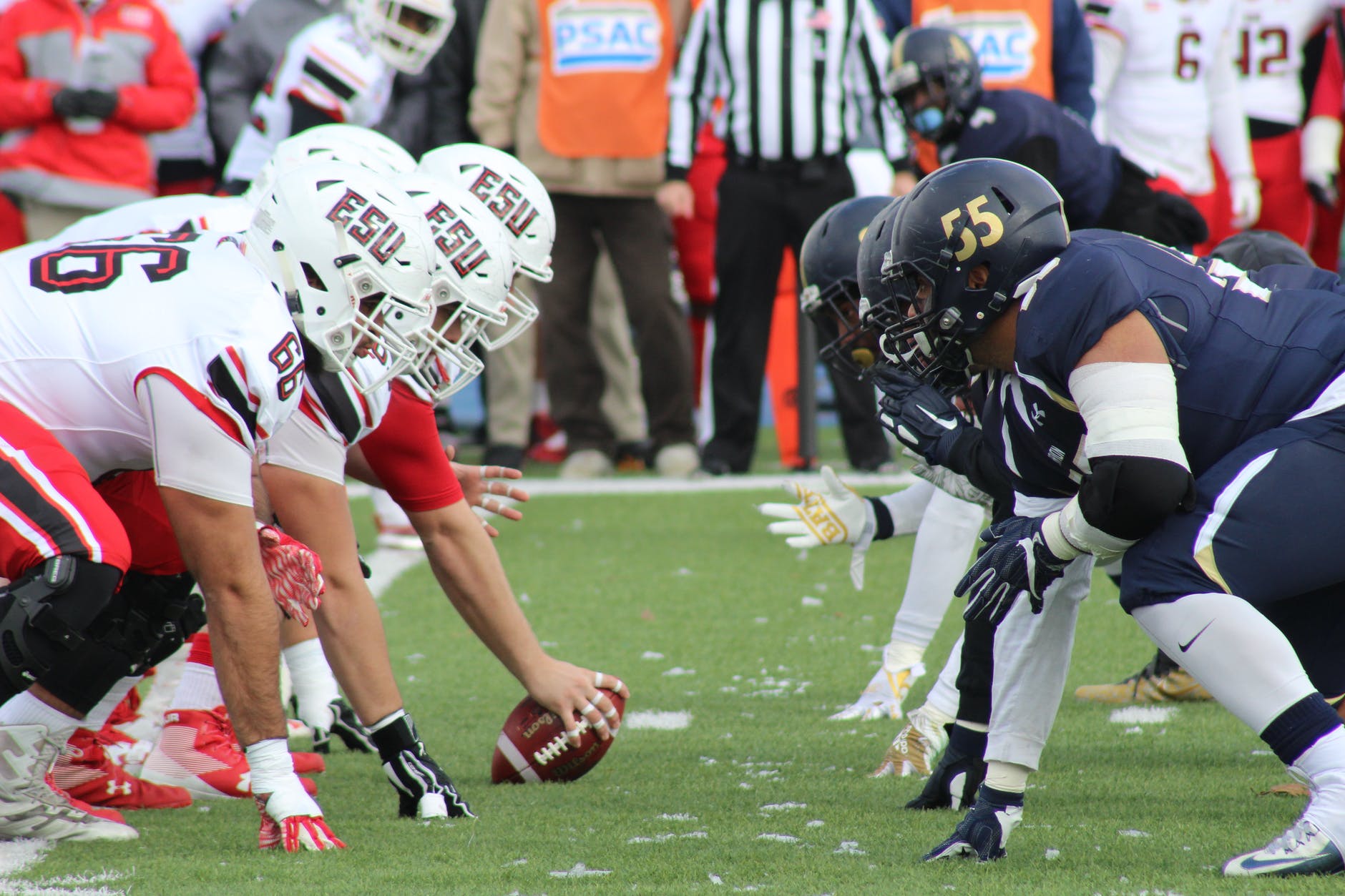
football game

Photo by football wife on Pexels.com


Many people in America, as well as many other parts of the world, miss watching sports during the pandemic, or participating. In many places, it is okay to play tennis and golf with special procedures in place. (e.g., no rakes in the golf bunkers; don’t take out the flagstick). Other, more full contact sports pose problems. But the biggest problem is the in-person audience when it comes to professional sports. 

If Trumputin is re-elected, we won’t have to worry about that — because there will be no sports — not in the true sense of the word. There may be acted-out charades of sports. But instead of actual competitions among people who are mainly on the “up and up” rather than “on the take.” At first, the replacement of honest sports with charades of sports, will only be sporadic and limited to the sports Trump happens to care about. But eventually, everyone in the administration will join in to wield their power and influence — not for the good of America — but for their own petty interests. The best athletes will simply quit. I can’t imagine the top tennis stars would participate in a scripted simulation of sports with the outcome known in advance so that money would flow from other people’s pockets, yet again, into the coffers of the Trump Crime Family. 

male bugs illness disease

Photo by Pixabay on Pexels.com

I’m reminded somehow of Lyme Disease and deer ticks. Deer ticks are the vector for spreading this disease to humans. It’s a nasty disease, and in some cases even crippling, but you don’t notice the worst effects for a long time. You get this little tick, barely visible, and it burrows into your skin. Then, it starts sucking your blood. You would think that if something started sucking your frigging blood out of your frigging body, you would bloody well notice! But the tick has a little trick. A tick trick. It squirts out a local sedative. Isn’t that sweet? You don’t feel the pincers pierce your skin. You don’t feel the barbed mouth parts drilling in to lap up your blood. You don’t feel a thing. You’ve been sedated. 

Getting back to organized but predetermined “sports,” when people realize that all of professional sports is simply a charade — a show put on for the rich and powerful and that it has nothing to do with skill, or experience, or tactics. It’s all about who already has the most wealth. It’s a table with no bet limit. It’s a table with no bet limit. Now — what does that mean? It means that whoever has the most wealth and power can determine the outcome every single time. Everyone else will lose on average.  

colosseum rome italy

Photo by Davi Pimentel on Pexels.com

At some point, the deer tick becomes completely engorged with your blood. Her body swells up grotesquely, but apart from looking gross and losing a bit of blood, she has likely left behind a little gift for you as well. That gift is a packet of bacteria that will now proceed to infect your entire body. As I said, it’s nasty for most people, and some never fully recover. 

At first, the corruption due to any infection is somewhat localized. But soon, sports at every level will be corrupt. And why shouldn’t it be? Isn’t school to prepare people for life? What kind of school would prepare children for a fair world when the actual world is completely unfair? So, the incentives will be for school to teach children — not actual physical skills and fair play — but instead, teach how to cheat, what to do when caught, how to bully, how to kiss ass. These are the skills they will need in sports or in any other endeavor.

I hope we do fully recover. The Class of 2020 gives me hope.

2343A3DD-FC22-4FBA-839D-8279677C514E

————————————————————-

Trumpism is a New Religion.

The Truth Train

The Anti-Academic Pandemic

You Bet Your Life!


The Pie of Life

24 Monday Feb 2020

Posted by petersironwood in America, apocalypse, management, politics, psychology, Uncategorized

≈ 4 Comments

Tags

Business, capitalism, Democracy, ethics, fairness, life, marketing, socialism

close up of tasty looking baked goods

Photo by Nishant Aneja on Pexels.com

There isn’t just the one pie, of course. A decent bakery will have quite a variety. Pecan pie, warm, with some vanilla ice cream — the warmth and richness of the pie while the creaminess of the melting ice cream! Key Lime pie — sweet, sour, and a hint of exotic bitterness. Chocolate cream pie — is it really more of a candy or a pie? On occasion, I’ve made pies from scratch that are filled with freshly picked blackberries or raspberries. If you’ve never had one fresh out of the oven — barely cool enough to eat — you should really treat yourself. The same goes for apple and cherry pie!

berry blueberries blueberry cake

Photo by Pixabay on Pexels.com


Most people in their daily lives are generous. They find it’s more fun to share a wonderful pie than secretly steal every piece for themselves. Most people you know and most people I know realize that in order to get anything significant done, they have to work with other people. And, while I, like many people, love to play competitive games and sports, all of life is not a competitive sport. It isn’t about taking the most pie you can regardless of consequences.  

In a zero-sum game, we imagine that there is only one pie. We have to split it and if you get more, I get less. 

But is everything in life like that? Is anything in life really like that? Even competitive sports like tennis where one person or team wins and the other loses is not truly a zero sum game. There is the benefit of fitness and improving your game and the sheer joy of playing. And most of life is like that — including pies. When we think about how to split the pie, we may want to consider other things such as: 

farm land during sunset

Photo by Pixabay on Pexels.com

How did the pie get there? What is the proper share for the people who grew the wheat? The miller who ground the flour? The truck driver who drove the flour truck to the store? How about the grocery clerk? The bagger? The person who cooked the pie? How about the person who tinkered around until she or he developed an excellent recipe? How about the people who had lived for thousands of years with the cinnamon trees and then had their villages and way of life destroyed so that the cinnamon trees could all be cut down? How about the people who cut the sugar cane? How about the policeman who protects the pie and the fireman who comes to save the bakery if it catches fire? How much should they all get? 

Trying to “determine the fair share” by measuring everything and “calculating” it by formula would be endlessly tedious. The inefficiency and waste and lack of innovation in the former Soviet Union demonstrated the futility of detailed central planning. In many places, society has developed a system of exchange based on money. The idea is to let the market “decide.” 

That system only works when people have approximately equal power and when they have equal justice under the law. When capitalism is combined with unequal justice, it quickly devolves into tyranny. Owners of corporations can get almost all of the pie for themselves and leave only enough crumbs for the workers to barely stay alive and eke out a living. To the extent that workers can be replaced by robots, it isn’t even necessary to give workers crumbs. 

Suppose your young child is deathly ill with pneumonia and needs penicillin. Suppose I am the only pharmacy in town and the roads are closed so that the only way for you to get the necessary penicillin is through me. As the pharmacist, I may have paid all of one thin dime for the medicine you need. But, assuming you love your child as much as most parents do, I can charge virtually any price. Any price. Think of that. I can not only gain your car, your house, and every dime you own. I can also make you an indebted servant. 

baby child close up crying

Photo by Pixabay on Pexels.com

Imagine a world in which there are many employers and many workers. Each worker has many possible jobs they could do and every company has a choice among many workers. In such a system, there is some balance of power. An employer who pays low wages or who provides bad working conditions will find themselves without enough workers to get the work done and go out of business. Similarly, a worker who goofs off or insists on very high wages will not be hired. But do we have a balance like that? In a land of many small companies and many small family farms, there is some balance. But today? In many cases, there are a small number of very large corporations who together hold almost all the power. 

If, in addition to the imbalance of workers versus owners, the rich owners have now bought much of the government. Legislation to protect workers and consumers is not even being brought to a vote in the Senate. The Trumputin administration is rolling back food safety regulations, air pollution regulations, water pollution regulations, and healthcare. The justice department and the US intelligence agencies — who used to be filled with nonpartisan experts — are being destroyed from within. Ultimately, it means that every penny of wealth created by workers can be stolen by the richest and most powerful people in the country. Even now, some of the richest corporations and people pay zero taxes.

woman in black dress holding balance scale

Photo by JJ Jordan on Pexels.com


Many of the corporations don’t really have competitors. They spend money on lobbying and advertising. They don’t want to spend money on innovation and invention because that changes the nature of the game and so — they could potentially lose their monopoly power. In other words, none of these people are spending much resource on inventing new types of pies. They are protecting the rules that give most of the pie to them. Similarly, companies buy start-ups of potentially disruptive innovations, not in order to integrate inventions into their product lines but to prevent those start-ups from becoming competitors. 

Since most of us in America will soon be paying our tax bill, it might be time to consider this:

If you work two full time jobs in America, you can barely make ends meet and you will pay taxes on your earned income — not a lot — but more than some billionaires. If you are a highly talented writer, actor, consultant, scientist, and you work 80 hours a week, you might earn $200,000 a year and you will pay a lot of taxes on that money. On the other hand, let’s suppose that you inherited $10,000,000 and you invest $4,000,000 in the stock market. You will easily make $200,000 a year on that money while doing nothing for the whole year. You can spend your time watching TV, playing golf, or dressing up lizards. But your tax rate on the $200,000 you got for nothing except being born rich will be less than the talented person who works full time. 

How we divide up the pie makes a big difference. And we are becoming less and less fair about that and — perhaps even worse — we are no longer putting as much resource into growing the pie and inventing new types of pies. Meritocracy is being replaced with cronyism and a “might makes right” mentality. 

close up photo of spider

Photo by Michael Willinger on Pexels.com

While competition is a part of life, it is not the whole of life. Life cooperates with other life all the time and at every level. In our bodies, if we are healthy, the cells of every organ work together to promote life for the whole. In cancer, a few cells decide to suck all the resources into themselves. And — that’s what happening here in America. 

How’s it going where you are?  

Do you invent new kinds of pies? Do you help improve the recipes? Do you get a fair share? Or, do you find yourself fighting all day just to get a very little bit of a very large pie? 

white and brown bird

Photo by Dominika Roseclay on Pexels.com

————————————

Author Page on Amazon

Index for a Pattern Language for Teamwork and Collaboration  

Essays on America: Wednesday

18 Thursday Jul 2019

Posted by petersironwood in America, creativity, politics, psychology, Uncategorized

≈ 101 Comments

Tags

advertising, bait and switch, economics, fairness, Feedback, flimflam, learning, politics, problem solving, truth, wealth

How you see where you are depends on how you got there.

It’s Wednesday. And that means, at least for most of us, that yesterday was Tuesday. Mundane, right? Obvious, right? 

C3B9202A-2605-4E21-90F8-1B78BA735C72

But suppose that it’s Wednesday for you but that yesterday was Thursday! 

Oh, my! You would be in quite a different “Wednesday” than the rest of us would. How could this happen? 

Many ways. You could be a character in a Sci-Fi movie. Maybe you were in a coma for six days. Or, you could have retrograde amnesia from a blow to the head. Or, maybe you have some weird form of temporal lobe epilepsy. No matter how you got from Thursday to Wednesday, you will treat the day quite differently from those of use who experienced yesterday as Tuesday. 

And this is generally true of human beings. 

How you experience your current reality depends a lot on how you got there. 

IMG_9724

It so happens that my dissertation studied human problem solving. I used a problem called the “Hobbits and Orcs problem.” You may have heard of it.

There are three Hobbits and three Orcs on one side of a river and you have to get them all over to the other side. The only way to cross the river is by use of a small boat. (No flying, swimming, catapulting, disapparating, etc. allowed). For the boat to operate and not simply float off downstream, it must have at least one creature in it. But the boat can only hold one or two creatures. It cannot hold more. Orcs, as you probably already know, are suspected of eating Hobbits. You cannot ever let more Orcs than Hobbits on either side of the river, even briefly. You can try the problem for yourself.  Remember though…you cannot let there be more Orcs than Hobbits on either side of the river — not even briefly. 

fullsizeoutput_120c

I compared how people solved this problem to an early AI system modestly called, “The General Problem Solver.” As you might expect, even though both humans and the AI system (GPS) can solve the problem, they behave quite differently. For instance, the places where humans have trouble (take more time; make more mistakes) are quite different from the places where GPS slows down. 

Start – HHHOOO (boat) {river}

Goal –                             {river} (boat) HHHOOO

Spoiler alert — now, I have to talk about the solution.

At one point, you will feel as though you’ve been making good progress and you have two hobbits and two orcs on the far side of the river along with the boat. Now, comes the sticking point (for humans). If an Orc brings back the boat, you’ll have two Orcs and one Hobbit on the near side. The two Orcs will gang up on the Hobbit and eat it. Fail! But if the Hobbit brings back the boat, the far side of the river will have two Orcs and one Hobbit so that Hobbit will get eaten. 

Here is the situation: 

HO {river} (boat) HHOO 

The “trick” is to use one Hobbit and one Orc to bring the boat back. Now, you use two Hobbits to take the boat to the far side, and it’s pretty easy to solve from there. The “trick” is only “tricky” because it feels as though you are undoing the progress you’ve already made! You took two over and you need to bring two back. In fact, many subjects wanted to “give up” rather than bring two creatures back over. They claimed it was “insoluble.” 

But wait. 

It gets even stranger. 

Half of my subjects began with a “half problem.” They started in this position. 

Start: HO {river} (boat) HHOO 

Goal:        {river} (boat) HHHOOO

These subjects had very little trouble solving the problem. They began by taking the boat to the left side by using one Hobbit and one Orc. They quickly solved the rest of the problem. 

Then I gave those same people, the entire problem again, but starting here: 

Start – HHHOOO (boat) {river}

Goal –                             {river} (boat) HHHOOO

They had little problem at the beginning. 

But when they got to the position shown below, many wanted to quit. Many said the problem was “impossible” once they got to this position: 

Now: HO {river} (boat) HHOO 

Goal:        {river} (boat) HHHOOO

Does that pattern look familiar to you? It should! 

This is exactly the problem that they themselves had just solved a few minutes earlier! When they started there, it was easy. But when they got there by arriving at it through their own effort, that same position was now daunting. They didn’t even recognize or realize that they had just been there. (None of this behavior was like that of the General Problem Solver, by the way). 

fullsizeoutput_124a

A number of economists were interested in this result. Why? Because “classic” economics operates like GPS. It looks at the Starting Point. It looks at the Goal. It looks at various possible moves. It doesn’t “care” how it got there. According to classical economics, if you buy IBM stock at $50 and I buy it at $150 and now it’s at $100, if we have the same knowledge, then we should make the same decision about whether to buy or sell. In reality, people do not. If you bought it at $50, you’ve made a huge profit and are happy to sell it. If I bought it at $150, I’m going to suffer a loss. How people view a situation is heavily dependent on how they got there. 

Now, let’s play another little “what if” game. 

What if you were an extremely rich person who also happened to be extremely selfish. In America, for instance, worker productivity has increased decade after decade. This meant that the wealthiest people in the country kept getting wealthier and wealthier. But the workers, who made a lot less than the owners, also benefited by getting wealthier. 

Until around 1974. Then, a strange thing happened. The productivity of American workers continued to grow. However, the increased wealth that accrued from all those people learning new technology, learning new methods, using the suggestion box, etc. — none of that increased wealth went to the workers. All of it went to the richest people in the country.  

https://economics.stackexchange.com/questions/15558/productivity-vs-real-earnings-in-the-us-what-happened-ca-1974

There had been a kind of partnership between owners and workers. The owners of large companies said, in effect: “if you keep being more productive by working harder, smarter, and faster, we will all benefit. We’ll have more profits and you’ll have higher wages.”

Then, the owners stopped living up to that implicit agreement. They took all the increased profits for themselves. Basically, that’s what happened in 1974. And it also happened in 1975, 1976, 1977, 1978, 1979, 1980, 1981, 1982, 1983, 1984, 1985, 1986, 1987, 1988, 1989, 1990, 1991, 1992, 1993, 1994, 1995, 1996, 1997, 1998, 1999, 2000, 2001, 2002, 2003, 2004, 2005, 2006, 2007, 2008, 2009, 2010, 2011, 2012, 2013, 2014, 2015, 2016, 2017, 2018. It varied, of course, somewhat from industry to industry, and month to month, and company to company but that is the big picture. 

People who had organized their lives and the lives of their families around their jobs found that they had no job. Their jobs were shipped overseas or given over to automation. They were pissed off. As they should have been. Notice that this trend continued unabated under both Republican administrations and under Democratic administrations. It’s hard to even see a difference in the divergence that occurred between the ever-increasing wealth that workers contributed through their increased productivity and the stagnation in their real wages. 

Then, we come to 2016 and someone said, “You can’t trust these politicians. They’re all the same. They are in cahoots with their rich donors. You know who you can trust? ME!” 

IMG_8380

The very worst fear of many of the wealthiest .001% of the country is that all workers will get together and demand their fair share! The workers are at least as responsible for the increased overall wealth as the owners. But while real wages for workers has been basically unchanged for decades, the compensation for owners has skyrocketed. Of course, they know it’s unfair! They don’t care if it is unfair. But they do care greatly that the yacht party of caviar and champagne continues unabated. 

How to deal with this? What can you do if you’re wealthy because of other people’s work and this becomes common knowledge? You divide and conquer. You shout long enough and hard enough in every possible medium of communication that it isn’t the greed of the wealthy that has kept your wages from going up. Oh, no, not at all. It’s the foreign competition. It’s the people of color. It’s the gays. It’s the Muslims. It’s the Jews. It’s the uppity women. It’s the video games. It’s violence on TV. It’s sunspots. It’s aliens from other planets hidden in area 51. It’s lack of ambition on your part. It’s because you haven’t taken responsibility. It’s because of liberals who want to take all your guns away and make you eat quiche or salad. 

IMG_6566

Those that want it all for themselves are terrified that you’ll catch on to their game. And, if you do catch on, you may just choose not to play any longer. So, they buy politicians. They buy air time for commercials. They indoctrinate you to hate workers that look different; that speak differently; that eat different foods; that wear different clothes; that worship in buildings with a different shape. They plant lies about all of these “other” people so that you will hate those “other” people — meanwhile trying to convince you that they are on your side; that they are just like you really. After all, you’re both “white” or “straight” or “Christian” or “Midwestern” or whatever. But the truth is — the lives they live are quite different. Despite being extremely wealthy, many of them pay far less tax than you do. If their kids goof off in high school or aren’t very bright — no problem! They’ll just bribe the way for their kids to get into a top university.  

So far, their little game has worked. By using the same methods that get you to buy skin products you don’t really need; the same methods that get you to buy sugared water at a high price; the same methods that get you hooked on sugar; the same methods that make you feel guilty about being overweight; the same methods that induce you to buy products and systems to help you lose weight; the same methods that fool you in a thousand ways — they get you to hate other people — people who are superficially different are “sold” as being fundamentally different. While the people whose lives really are fundamentally different from yours are being touted as living lives that are very similar to yours.  

IMG_3408

Once you begin voting for the folks who are paid for by these very wealthy people, you will tend to listen to them. You will tend to believe them. Not because you are stupid or gullible. You will do it because that’s what you’ve done in the past. The more you vote for them, the more you want to believe them. And, here’s the kicker: if they are outrageous  in behavior and speech, you will want to believe them even more. After a few years, it doesn’t matter how absurd or ridiculous what they say is. You’ll still believe them. It’s not your fault, really. But it does keep you, and all the rest of us, trapped in a vicious circle. 

You got to this Wednesday from yesterday. But your yesterday was Thursday. It’s comforting to know that there are millions of others who also got here from Thursday. 

You don’t have to keep choosing this way. But many of you will. And, that’s precisely the way that the wealthiest .001% like it. They don’t want to share with you the wealth that you created. They’d much rather keep things the way they are. They’d much rather keep that wealth for themselves. After all, caviar, champagne, yachts, and beautiful teen-agers are expensive. 

There is, of course, a much easier solution to the Hobbits and Orcs problem. Hobbits and Orcs could stop hating and mistrusting and killing each other. Then, crossing the river to the other side is easy. And that benefits everyone. 

Everyone, that is, except the .001%. 

—————————————————

Author Page on Amazon. 

Abstract of article in Cognitive Psychology


The Declaration of Interdependence

04 Thursday Jul 2019

Posted by petersironwood in America, Uncategorized

≈ 29 Comments

Tags

America, Democ, equality, fairness, Fourth of July, Independence, Interdependence, truth

The Declaration of Interdependence

0355AE9F-AF78-474F-A2D1-4034ED2D8DD0

The first fireworks I recall seeing: Camp Y-Noah, when I was about 7 or 8. Before, I had seen some from a distance — little sprays of colored lights in the sky followed by a distant boom. Even those distant booms terrified my dog Mel, a wonderful, loving, honey-colored Cocker Spaniel. 

Being right next to the action at Y-Noah was an entirely different experience. The sound thumped by chest! The spreading streamers of bright explosives filled the sky! The sparkling threads were red, white, and blue as well as gold, silver, green, and purple — all the colors of the rainbow and more besides!

I watched with one of the kids from my cabin. I cannot recall his name but I do recall that he had a blond crew cut and was a bit on the chubby side. At Camp Y-Noah, we slept in log cabins on bunk beds, about 10 kids to a cabin. Our days included swimming, archery, shooting 22 rifles, hiking, and various contests, including “morning inspection” pitting one cabin against another, or volleyball (pitting one cabin against another) or softball (pitting one cabin against another). We generally hung out with the other kids in our own cabin; they were on our “team” and the ones we spent most of our time with. 

For that reason, I was surprised when a kid we didn’t know came to watch the fireworks with us. This kid, whose name I also don’t recall, was an African-American with short curly hair.  After silently watching for a couple minutes, began commenting on every firework. But instead of saying “Oh, WOW!” as we were, he likened each firework to what he was going to do to one of the kids in his cabin. It seemed odd that he would dislike one of the boys from his own cabin and especially that he would passionately dislike him. 

743D831B-23CD-4BF5-ADE2-0AD57817259C

He soon solved that mystery for us. His cabin mate kept calling him the N-word. I grew up in a very segregated white neighborhood and school. Nonetheless, I knew from an early age that this was not a word to be used. I associated using the word with “bad people” and found the idea that one of the kids at Camp Y-Noah would use it rather amazing and a bit upsetting. I also found it amazing that this kid from another cabin would be so upset. 

Of course, kids being kids, I had lots of experience with kids calling each other names. While I didn’t typically start such insults, I would respond in kind and sometimes “pile on” when someone had a nasty nick-name applied to them. In the first grade though, these nasty nick-names never perseverated. And none of the names we came up with were associated with racism, hatred, and lynching.

The first time I recall an unlucky recipient keeping a nasty nick-name for more than a few days took place about four years later. We were studying American myths and legends at the time and one of these legendary figures was “Pecos Bill” who supposedly tried to jump over the Grand Canyon, got half-way over, realized it was too far and turned around in mid-jump and came back. (Don’t try this at home). For some reason, all the other boys in the class, and quite a few of the girls, dubbed “Bill” “Puke-us Bill.” He hated it and told us of his hatred of the name. That made it all the more fun for us as fifth graders. 

Although cruel, the name was unique. It had nothing to do with Bill’s race, religion, or country of origin. Though he hated it, and we teased him with it for the rest of the year, he still hadn’t reacted as passionately as the kid from camp had done to being called the N-word. 

And with good reason. Bill’s ancestors had not been enslaved whole-sale and stolen from their native land and torn apart from their families. The women had not been systematically raped. Men who tried to escape had not been castrated or had their foot chopped off. They had not endured centuries of oppression. Even after slavery was abolished, citizens of America descended from those slaves were tied up and tortured, lynched, and to this day are more likely to be shot dead for no better reason than complying with a police request by pulling out their wallets to show their ID’s or by not pulling out their wallets to show their ID’s. White people, in the year 2019, are calling 911 to report black people doing such dastardly deeds as having a picnic, or playing in their own yards. 

fullsizeoutput_193d.jpeg

Fireworks are explosives. They may look very pretty. But every year, thousands of Americans end up in the ER from fireworks. Fireworks are violent explosions. They need to be treated with great care. It’s very common for a fuse to be shorter than it seems. And explosions don’t always go as planned. 

And racist slurs? To people who are in a minority, a racial slur is nothing like a “nick name.” I really didn’t understand that when I was a seven year old camper. But I do now. What I also understand is that playing to racism or religious differences have led to millions of innocent people killed. And, the distance between freely using racial slurs and millions of innocent people killed is not as long as you might think it is. 

Today is a day for all Americans to celebrate our independence from tyranny. We should celebrate. The American colonists were taxed by the British government but had no vote and no representative in Parliament. The rationale for our declaring our independence was based on many grievances, and eventually some of those influenced the Bill of Rights. But having a vote is absolutely fundamental to having a democracy. If it isn’t a democracy for all of us, it isn’t a democracy. 

america ancient architecture art

Photo by Pixabay on Pexels.com

When it comes to measures to disenfranchise citizens, those are a blow to democracy itself. That should concern everyone, not just those who are not disenfranchised. And, so should applying racial slurs and killing innocent people. And, so should intentionally inflicted cruelty of any kind. We breathe the same air. We are all inter-connected. The Declaration of Independence speaks to independence from tyranny, but when it comes to defending those freedoms, we are all in it together. E pluribus unum. 

———————————

Ever stop to think about how much even commonplace things that you take for granted depend upon the efforts and knowledge of others across the globe — and millions of other people who lived in ages past? https://petersironwood.com/2019/05/06/corn-on-the-cob/ 

Still confused about how much you’ll be able to “recreate” modern conveniences based on your own hard work and knowledge? Maybe this video will help. https://www.ted.com/talks/thomas_thwaites_how_i_built_a_toaster_from_scratch?language=en

My title is hardly original, and here is a link to some of the earlier uses of the title. 

https://en.wikipedia.org/wiki/Declaration_of_Interdependence

Here’s another take on the fact that people around the world have developed slightly different skin colors and somewhat different cultures. https://petersironwood.com/2018/08/03/the-myths-of-the-veritas-the-forgotten-field/

Citizen Soldiers, Part Two: What Fathers can Learn from their Kids

16 Friday Jun 2017

Posted by petersironwood in America, family, psychology, sports, Uncategorized

≈ 4 Comments

Tags

baseball, childhood, civility, debate, dialogue, ethics, fairness, rules, school, sports

caution


Growing up in the semi-developed neighborhoods I did, we never had enough kids of the same age to play football, baseball, or even basketball with full teams. One upside of that was that we played modified games according to how many people showed up. For example, we often played basketball one on one or two on two. More rarely, we played three on three. One common variant of baseball we called “Three Dollars.” One person batted by throwing the ball in the air themselves, then quickly positioning that throwing hand onto the bat in order to hit the ball. The other two, three or four players were “fielders” and if they caught a fly ball, they would receive “$1.00.” If they caught it on the first hop, it was $.50 and a deftly caught a grounder netted you  $.25.  In effect, this was just a way to keep score. No money ever actually changed hands. Whoever earned at least three dollars, then got to take the batter’s position. In my experience, everyone would rather be the batter than one of the fielders. Anyway, fielders also lost this symbolic money. If you went for a fly ball and dropped it, you lost a dollar. Similarly, you would lose money for bobbling a one-bouncer or grounder. This game seemed to be pretty well-known throughout America so I’m sure we didn’t invent it.

https://en.wikipedia.org/wiki/Glossary_of_baseball

However, we did try tweaking the rules. For example, we sometimes played without the penalty clause. You gained but never lost “money.” But we decided to go back to the “original” rules. Then, another time, we decided to try it with a different goal, five dollars. After we tried that a few times, we all agreed it took too long to get a turn at bat. So, again, we returned to the original rules. Another slight variant that came up was that not all fly balls were equally difficult. On the one hand, a sharply curving rocket line drive is very difficult to grab! A blooper fly ball is easy; in fact, easier than many grounders. On the other hand, for us at least, a towering fly ball was again quite difficult. So, we experimented with awarding various amounts such as $.75 for an easy blooper but as much as $1.50 for a sharp line drive. It proved that there were too many “boundary cases” to make this a pleasant way to spend an afternoon. None of us really wanted to waste time arguing instead of playing baseball! That was the sort of nonsense that parents engaged in, but kids were smarter than that. On the other hand, each of us instinctively knew that we also had to “stick up for ourselves.” We could not just acquiesce in the face of injustice. Quite naturally, we would tend to see things a bit differently. Let’s say I am in the outfield and have $2.00. Now, you, as the batter, hit a looping fly ball/line drive which curves and sinks. I make a nice catch. Yay me. But now I start trotting up to the plate because $2.00 plus $1.50 for a line drive puts me at $3.50 and it’s my turn to swing that sweet honey colored bat and knock that little ball for a loop. But you say, “Whoa! Hang on there, John. You only have $2.75!” And I say, (and, please note that there is no baseball going on during this exchange) “No way. That was a line drive! That was a hard one too!” (And, I mean that in the sense that it curved and sank and it was actually quite a hard catch to make.) So, then, you say, “What? That wasn’t hard! I caught a lot of line drives that were harder than that one.” (And, what you mean by “hard” is that it was high velocity.) Generally speaking, we resolved these disputes but after 3 or four of them, we made a firm decision to revert to the original rules. In an entire season, under the “normal rules”, there might be one questionable call as to whether a ball was caught at the very end of the first bounce or just after the second bounce began. But the categories of fly ball, one bounce, two or more bounces — these withstood the test of time.

MikeandStatue

Learning by modeling; in this case by modeling something in the real world.

There are some interesting balancing acts inherent in the “design” of these rules. I am positive that this game was not invented by a single individual who used a mathematical algorithm to determine the appropriate “values” for the various fielding plays and what the stopping rule was and whether or not to extract penalties. Kids tried out various things and found out what “worked.” The rules and the consequences were simple enough (and easily reversible enough) for our small group to determine what worked for us. For example, if we make the changeover goal dollar amount too little; e.g., $1.50, the turnover is too fast. Too much time is spent running in to take the bat one minute and then running back out again later to field.  No-one gets to “warm up” in their position enough to play their best. To the batter, if feels like a real win to be able to hit the ball and, in a way control the game. Because, any half way decent batter, if they are hitting from their own toss can easily direct the ball to left, center or right field and can determine whether they are hitting a likely fly ball, one bouncer or grounder. So, for my own selfish reasons, I wanted the game to go as long as possible with me as batter. So, it made sense to hit more often to those players who had low amounts so as to “even up” the game. This also made it more exciting for the fielders because it made the game “closer” for them. An unwritten code however, also kept this from getting out of hand. For instance, if I began by hitting two hard line drives to the left fielder, and they made great catches, it wasn’t really okay to simply ignore them and never hit to them again until everyone had caught up.

IMG_9382

Many potential rule changes never even came up in conversation. For example, no-one ever said, “Hey, let’s count $.98 for a fly ball, $.56 for a one-hopper and $.33 for a grounder.” We wanted to spend the summer (or at least much of it) honing our baseball skills, not our arithmetic skills. And, while we soon discovered that we did not want to spend our time arguing about the boundary between a line drive and a fly ball, we knew without even trying that we definitely didn’t want to spend our time practicing mental arithmetic. And, we further instinctively knew that people would make errors of addition as well as memory. It was pretty easy for the batters and other fielders to keep track of what three people had when left fielder had $2.50, center fielder only had $1.50 and right fielder had $2.75. No way did anyone want to remember current scores such as, $2.29, $2.85 and $2.95. Then, the left fielder misses a grounder and you subtract $.33 to get to $1.96. No. Not happening.

We wanted rules. We never simply had one person bat as long as they felt like it. And, we definitely didn’t want to argue after every single strike of the ball whether it was time for someone else to bat and if so, who that might be. So, the rules were really helpful! They were simple. They were fair. And they minimized arguments. We experimented with rule changes but in every case, decided to go back to the original rules. And, there were many potential rules that we never even discussed because they would be silly, at least for my neighbors and friends.

IMG_2547

In addition to all the formal rules, unwritten and mostly unspoken codes of conduct also impinged upon our play. If someone “had to” bring their much younger sibling along, for example, we didn’t hit a line drive at them as hard as we could. We knew that that wasn’t “fair” even though it was within the rules. Fielders tended to “know” how far each batter could hit a fly ball and positioned themselves accordingly. Someone could have pretended not to be able to hit farther than 100 feet; keep drawing the fielders in and then bang it over their heads so they had no chance of getting a valuable fly ball. But no-one did that. It was understood that you hit the ball as far as you could. Fielders also positioned themselves far enough away from each other so that running into each other’s implicit “territory” proved rare. “Calling for” a ball occurred but not very often. We never had to say, as best I can recall, that you were not allowed to “interfere” with each other’s catches. Implicitly, even though the fielders were competing with each other to take the next turn at bat, the fielders were modeled after a real baseball game and so, in effect, the fielders were all on the “same team” just as they would be in a real outfield or infield.

A number of interesting phenomena occurred around this and similar games but the one I want to focus on now is that we experimented with the rules, we changed the rules, and if we didn’t like the new results or process, we changed the rules back to the way they were. And I find this relevant today because I find that many of my colleagues, classmates and friends seem to want to “return” to a set of conditions that no longer exist. I totally get that and in many ways can relate. It seems doable because many of us have had similar experiences both in sports and in other arenas where we try out a new way of doing things and then decide the old way is better. In my experience, this worked and with very little argument. I don’t recall spending time in my childhood screaming about whether a $5.00 limit or a $3.00 limit was better for the game. We started with a $3.00 limit, tried a $5.00 limit and then we all agreed $3.00 was better. There may well be places where the particular group of kids decided on $2.50 or $5.00 limits. But is there any group of kids who beat each other up over this? Is there even a group of kids who preferred the $2.50 limit who refused to play with the $5.00 kids? I don’t really know, but in my observations of kids whether parental, grandparental; whether familiar or professional; whether at camps I attended or ones where I was a counselor; whether in a psychiatric hospital or a school setting, I have never seen it. That doesn’t mean it doesn’t exist, but it can’t be very common.

In our small group of neighborhood kids, we were able to “roll back” rules pretty easily and smoothly. It seems as though we should be able to do this on a larger scale, but I just don’t think that is possible. It may or may not be desirable for various specific instances, but I don’t think for many situations, it is even possible; or, at the very least, the costs are far higher than we would be willing to pay.

Consider some examples from nutrition. When I was growing up, my parents and grandparents inculcated in me that I was supposed to eat “good” meals which included meat or fish every single day. At some point during my adult life, there came to be concern about cholesterol in the diet. The theory was that cholesterol contributed to heart disease and that you should avoid eating foods like beef, eggs, and shrimp which contained a relatively large amount of cholesterol. Now, we believe that refined sugar and artificial sweeteners are both far worse sources of calories than beef, eggs and shrimp. In fact, most of the cholesterol in your blood is made by you and only a little comes from your diet. But eating a lot of sugar causes you to store rather than burn body fat and also makes your cells eventually “immune” to the regulatory effects of insulin.

IMG_3071 - Version 2

Now, people have always had differing tastes when it comes to food. Some people have completely ignored every bit of nutritional advice that’s ever been put out there. They eat what they feel like eating. Others are willing to try any new fad that comes out. Most people are somewhere in between. But because there have always been people eating beef, eggs, and shrimp, repopulating these into my diet or your diet is pretty easy. It is one case where we really can roll back guidelines.

But imagine instead of having a change in nutritional guidelines, we all subscribed to a religion which made eating any birds or bird products strictly taboo for the last thousand years. And, let’s imagine that was true world-wide. Now, a revelation comes that actually, birds are quite good to eat and so are eggs. Now what? There are no chicken farms. There are no boxes made to carry eggs. There are no companies whose business is to provide eggs. There are no egg inspectors. There are no regulations about breeding chickens or gathering eggs. Indeed, it is a lost art. There are no recipes that use eggs or chicken. People don’t realize that some people are quite allergic to eggs. People don’t realize that eggs “spoil” if they are kept warm too long. The point is, that unlike my little coterie of kids deciding to go back to $3.00 instead of $5.00 (which was easy), the adjustment of adding chicken and eggs back into our diets will be a big deal. There will be many mistakes along the way. A few people will even die of food poisoning. Still, my guess is that it would prove possible. The benefits would outweigh the costs. Even so, there would be a lot of disruption. People who sell soy products, for instance, might well claim that the religious revelation was bogus and that eggs and chicken should still be banned. Even people who are persuaded that it is not a sin to eat eggs might still think they are pretty gross because they have been brought up that way. Family stories have been passed down over generations. Perhaps Aunt Sally once tried an egg when she was little and that’s why she grew up cross-eyed. (This isn’t the real reason, but it might be the reason in a family story).

The point is that we can “change” this way of doing things, but it will be much more disruptive than changing the rules of our ersatz baseball game. Other changes are even more difficult to pull off. Partly this is because in a complex interconnected society like ours, any change away from the status quo will hit some people harder than others. Just like our “soy producer” in the egg example, whoever is “hurt” by a reversion to something older will not like it and will struggle socially, politically, and legally to keep things they way they are now. They will not want to go back to how things were (or, for that matter, into a future which is different either).

IMG_3220

Most of our ways of doing things are now highly interconnected and global. For example, the computer I am writing on at this moment is far, far, more powerful than all the computing power worldwide that existed when I was ten. While I know something about how to use this computer, I do not know the details of how the hardware works, the operating system, the application that I am using, and so on. This computer was produced and delivered by means of an extremely complex global network and supply chain. The materials came from somewhere on the planet and probably no-one knows exactly where every part of the raw material even came from. The talent that conceived of the computer, designed it and built it was again from all over the world. Apple does business in at least 125 countries throughout the world. Other major companies are similar. The situation is nothing like having 125 separate companies in 125 different countries. These companies are all linked by reporting relationships, training programs, supply chains, communication links, personnel exchanges, and so on. If, for whatever reason, Apple decided to become 125 different independent companies — one for each country, they would, I believe, fail pretty quickly. It would be nearly as difficult (and as sensible) as if you decided that you would no longer be an integrated human person but instead your arms, your legs, your head and your trunk would now operate as six separate entities.

We are now vastly interconnected. Certainly, WWI and WWII were deadly global conflicts. Not only were these wars costly in money and human life, but they were horrendously disruptive as well. Families were broken apart, infrastructure was destroyed, supply chains were interrupted. New hatreds flared. But even as lethal and costly as these wars were, WWIII would be much worse even if no atomic, biological or chemical weapons were used. Why? Because nearly every country in the world is now tightly interconnected with every other country. Maybe that was a great idea. Maybe it was a horrible idea. Maybe it’s a good idea in general, but we should have been much more thoughtful and deliberate about the details of how we inter-relate. Regardless of how wise or unwise globalization has been, we cannot simply “change the rules” back to the way they were 100 years ago.

thumb_img_8068_1024

If we attempt to destroy globalization, and have each country “fend for itself,” it will be incredibly expensive both in dollars and in human lives lost. This genie, however much you hate it or love it, will not squeeze back into that bottle. If we attempt to go back 100 years, we will actually go back about 2000 years. Again, consider this computer I am using. I worked in the computing field for 50 years. And, I would be completely helpless to try to make anything like this computer from scratch. But the computer is far from the only example. Could I fix my car? Some things I could but the engine diagnostics now require a computer hook up. Could I fix my TV? Not much. My dad was an electrical engineer. The most common cause of problems with a TV in my youth was that a vacuum tube stopped operating properly. When the TV was “on the blink” we would take one or more tubes out of the TV and take them to a testing machine at the grocery, drug store, or hardware store and see which tube needed to be replaced and then buy that replacement, go back home, put in the new tube and *bingo* the TV worked again! Can I do that today? No. Can you? I doubt it. But it isn’t simply electronics and automotive industries that are global and complex. It is nearly ever aspect of life: financial, medical, informational, entertainment, sports, and so on. What about your local softball team? You know all those people personally just as I knew the folks I played $3.00 with. But where are you spikes made? How about your softballs? Bats? Mitts? The last bat I bought — a beautiful, heavy aluminum bat — it came sheathed in plastic. I think that was unneeded pollution, but there it was. Where was that plastic made? Where did the bat come from? Where was the metal mined? Where was it fashioned?

Personally, on the whole, I think the highly interconnected world we live in is more fun and interesting. In a typical week, I literally eat food inspired by Mexican, Japanese, Indian, and Thai recipes. In many cases, it is prepared by people originally from those countries. Books, plants for gardens, music, movies, games — these things are made worldwide and distributed worldwide. To me, it makes life much more interesting. If you don’t like globalization as much as I do, you can certainly stick to American authors and “traditional” American dishes (although almost all of them came originally from another country), American composers, etc. You’re missing out, but it’s your call. But no matter how you try, you cannot “disentangle” yourself completely from the larger world.

The inter-connectedness often wreaks havoc as well. Little bits of plastic micro-trash that come from the United States pollute oceans everywhere. Air pollution that originates in Asia comes across the Pacific to affect people in North America. If the Japanese kill too many whales, it affects the ecosystem world-wide. Pollutants that come from Belgium may kill bees in Argentina. A plague that begins in Thailand may kill people in New Jersey or Sweden. We cannot wish this interconnectedness away. Today’s “Citizen Soldier” needs to be smart as well as brave and loyal. You are not standing in a long line dressed in a red uniform facing a long line of soldiers dressed in blue (who are your enemy). You are going about your own business. But you must understand that how you treat people from every other country whether you are visiting a country or they are visiting your country — how you treat them will impact people globally. If you treat people badly it will impact you and your neighbors badly in the long run. We really have to think globally even while we act locally. I think it’s the “right” thing to do. It’s a little hard to imagine a serious world religion or world philosophy that justifies trying to get as much as possible for you or your tight-knit group of friends at everyone else’s expense. But even if you somehow convince yourself that it’s morally “okay” to be a complete isolationist, reality will not let you do it.

You can take your turn at bat. But you also have to go out in the field and take that turn. Kids who take their first turn at bat and then “go home” as soon as they have to go out in the field do not get called upon to play a second or third time. You might most enjoy being a bazooka shooter. But you are going to have to spend a fair amount of your time being “Claude the Radioman” (See earlier blog post) because with seven billion people on the planet, more coordination than ever is needed. It won’t work to have everyone be a “hunter-gatherer” any more. It won’t work for everyone to “do their own thing.” It won’t work to roll back the rules of the last 100 years and have every country do their own thing either. We cannot smoothly “undo” history. We cannot jam the genie of globalization back into the bottle. I have a much better chance of fitting into the pants of my first wedding suit (waist 29”).

IMG_6777

I mentioned that in my neighborhood, we typically did not have full teams. One day, however, while we were playing American football (five on five) in a vacant field two blocks down from my house, an older kid approached us explaining  that he wanted “his team” to play “our team.” We didn’t actually have a “team” at all. We would get together and chose captains who would then take turns picking kids for their (very temporary) “team” for that particular game. We had a football. That was pretty much the extent of our “equipment” though someone did occasionally bring a kicking tee. The vacant lot did not have any goal posts so there were no field goals. We generally played a variant of American football, wherein the defenders were not allowed to cross the line of scrimmage and tackle the quarterback until they had counted “One Chimpanzee, Two Chimpanzee, Three Chimpanzee, Four Chimpanzee, Five Chimpanzee” — and then, they could rush in and tackle the quarterback. In the five on five variant, the center was generally a blocker while the other three ran down the field and tried to “get open” so that the quarterback could hit them with a pass. Occasionally, a quarterback would try a run. If they could “fake” a pass and get the rusher (usually only one person) to jump up off the ground, the quarterback could generally sprint past them before they got back on the ground and gain a reasonable number of yards before the other defenders realized it was a run. (In case you aren’t familiar with American football, once the quarterback goes beyond the point where the ball was hiked from, they are no longer allowed to throw a forward pass).


http://www.understanding-american-football.com/football-rules.html

In any case, although five on five football was fun, it also seemed to us that it would be fun to play eleven on eleven like “real” American football. So, we agreed to come back the next day after school and face “his team.” Weather cooperated and we showed up the next day after school and so did the other team. In uniform. We didn’t have uniforms. But not only were they all wearing the same colors. These kids had helmets, shoulder pads, thigh pads, elbow pads and shin pads!  They were armored!  But we weren’t! Every time their center hiked the ball to the quarterback, a bunch of us would try to rush in to get the quarterback. No “one-chimpanzee”, “two-chimpanzee” business now. We were playing real football. And getting real bruises.

I can tell you from personal experience, that it hurt an unnatural amount to run into these other guys but we held our ground any way. It did seem unfair to us but they never wavered or offered to take off their pads or helmets. The first few times were not so bad, but once your body is already bruised, then it does hurt to run into someone with full body armor. I suppose it sometimes seemed equally unfair to Medieval peasants without armor who were attacked by armored knights. Hardly a “fair fight” as we would say. Nor does it seem a very “fair fight” for a little kid walking on some distant jungle path to suddenly have their leg blown off from a land mine. And, I suppose some would judge it an unfair fight for a village of unarmed farmers to have a rocket or drone smash their village to pieces along with many of the men, women, children and livestock. Just guessing, but that’s my sense of it.

This older kid who arranged our game did not actually play, as I recall, but served not only as coach for his team but also as the one and only referee for the game. That didn’t seem particularly fair either, but he was pretty impartial. As it began to get dark though and we were still tied, he did make something of an unfair call, at least in my opinion. Anyway, I think they won by only one touchdown. We did pretty well against these armored kids from another part of town. But we were a sore lot the next day. None of us suffered any major injury such as a broken bone though we were all pretty black and blue from the battering. None of us were very eager to have a rematch though. We talked briefly about the possibility of getting our own uniforms but we were way short of that financially. Even if we had actually collected all the pretend money we talked about in “$3.00” we couldn’t afford that kind of equipment.

Does it matter whether a game — or a war — is a “fair” fight? Or, does it only matter who “wins”? In sports, we generally have a lot of rules and regulations to insure fair play. We would consider it a gross misconduct of justice to have one NFL team denied equipment! Some readers may be old enough to recall the controversy over using fiberglass poles in the Olympics. See the link below for a fascinating story regarding the “fairness” of Olympic pole vaulting.

http://bleacherreport.com/articles/2335693-munich-olympics-1972-the-other-controversy-you-may-have-forgotten

I think it may matter more than many think as to whether a fight is a fair one. A fair loss leads most people to acceptance and adaptation; in many cases, it can serve as motivation to do better . But if they think the fight is unfair, resentment will often linger and eventually result in another fight. Chances are that this time, the party who feels they had been treated unfairly will no longer care about having a “fair fight” and do anything they can to win. Anything. So, it serves us well to think long and hard about winning an unfair fight. What will happen next?  It seems to me that when we win an unfair fight, there are many negative consequences and they almost always outweigh the benefits of the win.

IMG_9723

First of all, whoever loses the unfair fight will resent you. Second, people not involved at all in the unfair fight and who don’t even care about the outcome, will care about the process and the vast majority will dislike whoever behaves unfairly. Third, it makes it more likely that other people will be unfair in their own transactions.

In the days of childhood sports, we sometimes disagreed about what was fair. But we never disagreed about whether it was okay not to even try to be fair. We all assumed we were supposed to be “fair.” You must understand, this was unsupervised child’s play. We did not play baseball with parents around coaching, umping, and spectating. Of course, we had disagreements and sometimes we lost our tempers. On rare occasions, someone might walk off in a huff. But, there really weren’t that many huffs to go around back then, so it was rare. And, whoever did walk off in a huff was back the next day ready to play $3.00 again. Their huff dissolved in the cool night breezes. When they went to their closet the next day, no wearable huff remained. There may have been a few tattered huff-shreds in the bottom of the closet, but not even enough to wear as a bathing suit, let alone a three piece suit of huff complete with huff vest, huff pants, and a huff coat. I don’t think any of us even owned a huff tie.

I think part of the reason was that all of our disagreements and arguments were face to face. We never sent e-mail. And, we certainly never hired a lawyer to “represent” us. For some reason, when one person “represents” another, they feel it is more “okay” to do unfair things than the person themselves would feel comfortable with. We kids simply discovered that it was a lot more fun to play baseball, in any of the variants, wearing a shirt, sneakers and jeans. A huff suit was simply too confining and too easily torn. Kids all seem to know this instinctively, but as they grow up, they may begin to fill their closet with huffs and wear them on many occasions.

IMG_9452

Imagine a world in which adults all gave their huff suits to the Goodwill. In this world, they talked, solved problems, had some fun, and when they disagreed, tried to do what was fair for everyone. It sounds kind of crazy, I know. But we live in a world of miracles, don’t we? And, that world is embedded in a universe of miracles. Very slowly we are coming to understand more of it. Our understanding of this amazing universe grows and some of that understanding even sheds light on how our bodies and brains work as well as the fundamental characteristics of the universe. Maybe somewhere in this vast universe of miracles, there is a way to experiment with the rules of the game until we find a way that works for everyone who wants to play. Perhaps we could pay $.25 when someone can restate what you said to your satisfaction. If someone can think of another example of the same principle, they get $.50. And, if someone has a brand new sharable insight on the topic, they get $1.00. First one to $3.00 gets to direct the dialogue for awhile. Come dressed for serious play. No huff allowed.


(The story above and many cousins like it are compiled now in a book available on Amazon: Tales from an American Childhood: Recollection and Revelation. I recount early experiences and then related them to contemporary issues and challenges in society).

Author Page on Amazon

Subscribe

  • Entries (RSS)
  • Comments (RSS)

Archives

  • December 2025
  • November 2025
  • October 2025
  • September 2025
  • August 2025
  • July 2025
  • June 2025
  • May 2025
  • April 2025
  • March 2025
  • February 2025
  • January 2025
  • December 2024
  • November 2024
  • October 2024
  • September 2024
  • July 2024
  • April 2024
  • March 2024
  • February 2024
  • January 2024
  • December 2023
  • August 2023
  • July 2023
  • May 2023
  • April 2023
  • March 2023
  • February 2023
  • January 2023
  • December 2022
  • November 2022
  • October 2022
  • September 2022
  • August 2022
  • July 2022
  • June 2022
  • May 2022
  • April 2022
  • March 2022
  • February 2022
  • January 2022
  • December 2021
  • November 2021
  • October 2021
  • September 2021
  • August 2021
  • July 2021
  • June 2021
  • May 2021
  • April 2021
  • March 2021
  • February 2021
  • January 2021
  • December 2020
  • November 2020
  • October 2020
  • September 2020
  • August 2020
  • July 2020
  • June 2020
  • May 2020
  • April 2020
  • March 2020
  • February 2020
  • January 2020
  • December 2019
  • November 2019
  • October 2019
  • September 2019
  • August 2019
  • July 2019
  • June 2019
  • May 2019
  • April 2019
  • March 2019
  • February 2019
  • January 2019
  • December 2018
  • November 2018
  • October 2018
  • September 2018
  • August 2018
  • July 2018
  • June 2018
  • May 2018
  • April 2018
  • March 2018
  • February 2018
  • January 2018
  • December 2017
  • November 2017
  • October 2017
  • September 2017
  • August 2017
  • July 2017
  • June 2017
  • May 2017
  • April 2017
  • March 2017
  • February 2017
  • January 2017
  • December 2016
  • November 2016
  • October 2016
  • September 2016
  • August 2016
  • July 2016
  • June 2016
  • May 2016
  • April 2016
  • March 2016
  • February 2016
  • January 2016
  • December 2015
  • November 2015
  • October 2015
  • September 2015
  • August 2015
  • May 2015
  • January 2015
  • July 2014
  • January 2014
  • December 2013
  • November 2013

Categories

  • AI
  • America
  • apocalypse
  • cats
  • COVID-19
  • creativity
  • design rationale
  • driverless cars
  • essay
  • family
  • fantasy
  • fiction
  • HCI
  • health
  • management
  • nature
  • pets
  • poetry
  • politics
  • psychology
  • Sadie
  • satire
  • science
  • sports
  • story
  • The Singularity
  • Travel
  • Uncategorized
  • user experience
  • Veritas
  • Walkabout Diaries

Meta

  • Create account
  • Log in

Blog at WordPress.com.

  • Subscribe Subscribed
    • petersironwood
    • Join 664 other subscribers
    • Already have a WordPress.com account? Log in now.
    • petersironwood
    • Subscribe Subscribed
    • Sign up
    • Log in
    • Report this content
    • View site in Reader
    • Manage subscriptions
    • Collapse this bar
 

Loading Comments...