• About PeterSIronwood

petersironwood

~ Finding, formulating and solving life's frustrations.

petersironwood

Tag Archives: truth

Myths of the Veritas: The Fifth Ring of Empathy

01 Saturday Sep 2018

Posted by petersironwood in America, management, psychology, Uncategorized, Veritas

≈ Leave a comment

Tags

empathy, myth, politics, power, religion, story, truth, Veritas

IMG_4324

The day after the Prophesy Dream of She-Who-Saves-Many-Lives dawned clear and clean. The air smelled as sweet as ever and sweeter still to the shaman who had dreamt of a world of dirty air. The clear morning sun rainbowed on raindrops on every bush. Trees sported their first leaves of spring which are as various in colors as those of autumn but because the leaves are yet babies, She-Who-Saves-Many-Lives could see much more deeply into the land about her. It filled her heart with gladness even more deeply on this spring morn. She decided that she would share her dream with all of the Veritas, but only after she took the time to craft the telling so that each would receive the gift as she had — the gift of great gratitude. For she well knew that experiencing that dead white world as she had made her redouble her appreciation for the real world but that simply telling others about her dream would not be enough to gift them the same great gratitude. It would take time to decide how best to share her gift. 

Meanwhile, She-Who-Saves-Many-Lives walked to the main village to see who among “The Six Who See Through Animal Eyes” was already at work on their various tasks. The eyes of the shaman, though old, remained clear and her mind remained retentive so that as she passed through the village greeting this person and that person from among the Veritas, she observed many things both small and large. And, among the small things she noticed were a number of crushed ants. She looked around for Pond Mud but he was nowhere near. On a hunch, she decided to visit the place where she had shown Pond Mud the strength of ants. As always among the Veritas, and as she had been trained all her life, her footsteps were as silent as those of bobcat. Before she reached the clearing with the broken cabin, she could hear the angry voice of Pond Mud. And though the eyes of She-Who-Saves-Many-Lives were as clear as ever, she well knew that her hearing was not so good as that of a youth such as Pond Mud. As she approached, she could hear the tone of voice of Pond Mud become sweet and she greatly suspected that he had heard her coming despite her silent way of walking. 

He met her at the entrance to the clearing and spoke first, “Ah, She-Who-Saves-Many-Lives, it is good to see you. I am headed back to the village. I was just trying to learn more about ants though I well understand that I am no longer in contention for another ring of empathy. Such learning is still a good thing. Anyone can see that.” 

“I am glad to hear you say that. The statement is correct. Anyone can see that. Though some choose not to see. I hear that you have become still better friends with Alt-R. Is this so?” 

“Yes, She-Who-Saves-Many-Lives, we have been training together to become still better hunters. And, that skill, as you well know, also requires seeing through the eyes of animals. May I accompany you back to the village and I will tell you something of what I have learned?”

She-Who-Saves-Many-Lives wished to examine the clearing but decided it could be better done later while Pond Mud busied himself with other tasks. So, she returned to the village still feeling great gratitude for the fullness of the life around her. 

During this day, she observed the Six-Who-See-With-Animal-Eyes at their various tasks as well as much more. When Alt-R and Pond Mud, along with several other hunters, went to practice spear throwing, she returned to the clearing. Alas, her hunch had been correct. Pond Mud had not simply been observing ants; he had been systematically killing them. Even more disturbing, many had been tortured. And, even more disturbing than those actions, had been the dissembling of Pond Mud. He had known what she would like to have heard — that he had taken her lessons to heart. Her mood soured for this was the sort of deception that could destroy a village or indeed an entire tribe. It would have to be curbed very soon and most likely shared with the entire tribe. She held out some hope however, that the heart of Pond Mud could yet be turned to good. For if not, he would certainly be exiled, a rare and severe punishment which invariaby lead a short and lonely life. 

fullsizeoutput_192b

As the delicate beginnings of spring gave way to the fullness of another summer, the tasks of the Six-Who-See-With-Animal-Eyes gave way from planning to building. Soon, the time came for all to recount their learning. When She-Who-Saves-Many-Lives saw that this was so, she called each of The Six to her as one. She asked each pair in turn to describe their experiences for she wanted to judge not only the maker but also the mentor as well as how they recalled events differently, as people do, and how such differences were resolved. The shaman also knew that each of The Six could learn from all these experiments in trying to use the way of how-to of another.

The first to report on their experience together were the hammock-builder, Fleet-of-Foot and his mentor, Trunk-of-Tree. According to Trunk-of-Tree, he first tried to show Fleet-of-Foot how he would make a hammock with great thought as to its longevity and strength so that it would last against time and some misuse. Fleet-of-Foot had resisted such advice and had immediately begin building the hammock. Six such hammocks had Fleet-of-Foot constructed over three days time and each such hammock had collapsed.

photo of hammock

Photo by Voicu Oara on Pexels.com


Fleet-of-Foot admitted that these hammocks had broken but he claimed it was because Trunk-of-Tree had given him faulty materials and bad advice. At long last, in frustration, Fleet-of-Foot had challenged Trunk-of-Tree to show him how he would build a hammock and instead, Trunk-of-Tree had spent an entire morning making tools, and laying things out, and not even starting on the hammock. Fleet-of-Foot grew impatient because obviously, Trunk-of-Tree had had no intention of showing Fleet-of-Foot how to build a hammock. When Fleet-of-Foot came back a few hours later, the hammock was finished. This they agreed upon, and as to its sturdiness, but Fleet-of-Foot was sure that Trunk-of-Tree had cheated by getting others to help him make his hammock. Otherwise, argued Fleet-of-Foot, how could slow Trunk-of-Tree make a hammock in a day when fast Fleet-of-Foot finished no hammocks in three days? 

She-Who-Saves-Many-Lives had much to say about this experiment, but she held her tongue and first asked the others from among The Six what they thought. After some long silence, Shade Walker said this, “I have known both all my life and have never known Trunk-of-Tree to cheat or lie. Fleet-of-Foot is fast; of this, there is no question. But he also sometimes rushes into things so quickly that he ends up taking more time. I have myself only made three hammocks so I am not so expert as Trunk-of-Tree and perhaps mine are not quite so sturdy but they were all finished in one day.” 

She-of-Many-Paths spoke next. “I have never made a hammock. But I have been listening to many expert craftsman in our village and every such has cautioned me to take the time to plan the work carefully. Whether it is making spears, making spearheads, making pottery, or baking bread, it is critical to ensure that you have a good plan; that you have chosen your materials well; that you have prepared and tested at each step along the way. So, I can well believe that Too-Fleet-of-Foot could charge off along the wrong path six times in three days while Trunk-of-Tree could take a more deliberate path to create a hammock in one day.” 

Easy Tears knew it was his turn to speak but did not wish to offend anyone. “I cannot really tell because I was not a witness to these recounted events. I believe that each told us of their own experiences as they now recall them. And, ultimately, both were successful because now there is a hammock that was not there before and Trunk-of-Tree served as mentor and judge.” 

She-Who-Saves-Many-Lives nodded to Eyes-of-Eagle who spoke carefully, molding the shape of her argument and the shape of each sentence and each word. “I find that trying to create something in the way of another how-to is a difficult task. So, it was with Trunk-of-Tree and Fleet-of-Foot. Fleet-of-Foot grew too quickly impatient and rather than trying to build in the way of Trunk-of-Tree instead built in his own way of how-to which was not sufficient to the task. Rather than learn another, more careful way from someone who knows and uses the careful way, he insisted on sticking with his own way though that way did not work. However, Trunk-of-Tree, though he took his time with the hammock, was likewise impatient with Fleet-of-Foot and ended up building the hammock himself which was not his assigned task.”   

{Translator’s Note}: In the original, these recountings, have apparently been preserved in great detail. Though scholars differ, I tend to believe the details are correct despite their being passed down orally because the Veritas developed many methods to ensure the accuracy of their traditional learning stories and because the details of their skills were vital to their survival. Since most modern readers have little little experience weaving baskets or making a hide tent, I omit much of those details in my summaries. Instead, I focus on the lessons learned and the decisions of She-Who-Saves-Many-Lives. 

Now, as was her way, She-Who-Saves-Many-Lives asked Fleet-of-Foot and Trunk-of-Tree whether they had found any further learning while listening to the comments of his compatriots. 

Fleet-of-Foot immediately began, “Wonderful comments. I learned much. However, the important thing is that I was asked to produce a hammock in the way of how-to of Trunk-of-Tree and such a hammock was indeed constructed. I caused that to happen by my actions so I believe I completed my task. Fast is good. But sometimes, the fastest way to accomplish something is to have someone else who is even faster do the job. Either way, faster is better.” 

IMG_3510

She-Who-Saves-Many-Lives stared at Fleet-of-Foot and sighed. Still, she did not speak. Instead, she turned to Trunk-of-Tree. The latter’s face flushed as he said, “Fleet-of-Foot is indeed impatient, but so was I. My job was to mentor Fleet-of-Foot in the way of how-to for strength and longevity yet after three days, I gave up and made the hammock myself. I believed that if I demonstrated to him that I could make the hammock more quickly by being careful and planning each step that Fleet-of-Foot would learn the lesson. I made this judgement based on my own way of how-to. I would have learned the lesson this way. But this is not the way of learning of Fleet-of-Foot. He is too impatient to learn in this way. He left even before I finished; in fact, barely after I had made preparations for the work. He believes I encouraged or cajoled others to help me, which I did not do, because I failed to teach him the slow and methodical way of how-to. So, I too failed in my task.” 

She-Who-Saves-Many-Lives again turned to “Fleet of Foot” and prompted, “And…?” Fleet-of-Foot answered thusly, “Trunk-of-Tree may have failed but I did not. We should see who else besides me deserves the next ring of empathy.” 

She-Who-Saves-Many-Lives chuckled. “I have dreamed of such a one as you, Fleet-of-Foot, and when the time comes, I will indeed, shrink our group as is befitting, as well as sharing my dream. I would now observe, however, that Trunk-of-Tree has shared a great learning for all of us. What would have sufficed for him to have learned the lesson of patience did not work for you. On the other hand, you have shown no learning whatever. The tree of your learning has not added a single branch or leaf so far as I can see. Fleet-of-Foot, you wished to win a race; lost the race; then showed no interest in discovering how you could have won the race. This is the way of “Fast-at-First-and-Slow-at-Last.” 

So, in turn, did each of the pairs recount their experiences and learnings. 

girl s orange dried fruits

Photo by Min An on Pexels.com

Trunk-of-Tree made a basket very slowly and carefully. Yet, no-one wanted to trade very much for such a basket; not nearly enough to satisfy Trunk-of-Tree’s desire for compensation for so much time spent. Easy-Tears had been quite content to watch the strong hands of Trunk-of-Tree working the reeds over and under and through. It had been quite mesmerizing. She had said almost nothing during the making, but when Trunk-of-Tree found no-one willing to trade much for his basket, she showed Trunk-of-Tree how the addition of a some brightly colored dyes in a pleasing pattern changed such luck and how such additions made his sturdy basket much more desirable in the eyes of the clan. Trunk-of-Tree had been quite surprised at this common reaction. He had thought the purpose of a basket was to hold things and this goal he had accomplished quite well. However, Easy-Tears had shown him how just a little extra work, though not making the basket stronger or more functional, could greatly increase how badly others wanted such a useful basket. 

Shade-Walker and Eagle-Eyes recounted their adventures in jug making. At first, Shade Walker had mainly loved the feel of the wet clay spinning through his hands. With the hands of Eagle Eyes guiding his, however, he learned to enjoy the sight of the evolving shape as well. In the end, both had gone on to make a series of beautiful jugs. Eagle Eyes had ended up loving the feel of the wet clay, although what she had loved the most was the feel of Shade Walker’s fingers, she admitted. 

Eyes-of-Eagle explained that she found if very difficult to make a dream catcher under the tutelage of Fleet-of-Foot since she herself had wanted the end result to be beautiful and Fleet-of-Foot kept encouraging her to proceed more and more quickly. However, as Fleet-of-Foot at last perceived that his constant encouragement toward ever more speed made Eyes-of-Eagle both more error prone and more testy with him, he instead encouraged her by telling her that she was amazingly fast. Everyone could see that Fleet-of-Foot was again interested in speed; however, in this case, his interest had been more in speed of becoming more intimate with Eyes-of-Eagle than in the speed of making a dream catcher. 

background beautiful cloud clouds

Photo by Pixabay on Pexels.com

She-of-Many-Paths told of how she had wanted to make a tent for Shade Walker. Shade Walker had liked watching her and had asked if she were enjoying the process of making the tent. She had blushed — and had said that she was very much enjoying herself. After they get over their awkwardness, they had talked about the various ways of how-to and had decided together that being grounded and having a satisfying process are very much akin. Though these are different ways of how-to, one helps provide the other, they had surmised. This they shared with The Six and the shaman and all had agreed. 

Upon recounting and subsequent questioning, all learned that Easy-Tears had wanted the travois to be popular and had difficulty even understanding what She-of-Many-Paths meant by constructing a travois so that it encouraged a “grounded” view of life. Easy-Tears had been watching She-of-Many-Paths and Shade-Walker for some time however, and decided that what She-of-Many-Paths really wanted was Shade-Walker. Easy-Tears suggested that if She-of-Many-Paths wanted Shade-Walker, it would be best for everyone to be done quickly with the travois project so that She-of-Many-Paths could spend more time with Shade-Walker who had lately been spending much time with Eagle-Eyes, their long fingers inter-twined with those in the wet clay which they shaped together. In return, Easy-Tears had promised to teach She-of-Many-Paths the path to popularity and thereby to further increase the interest with which Shade-Walker would view She-of-Many-Paths. 

At the end of day, after every such recounting and dialogue, She-Who-Saves-Many-Lives quietly took out a small, folded deerskin. This deerskin held a number of rings of hemp woven into a complex, repeating, yet ever-changing pattern. “The time has come,” she began, “to chose which among all the Veritas is ready to take on the next challenge. All of you have done well and should now be more of a contributor than ever to the Veritas. I have challenged you in many ways to see and feel as others do. In this, you have all shown much skill in the ways of empathy.”

“As you know, each of us is a small leaf on the very large Tree of Life, a tree that has been growing and expanding through all of earth. We are all connected: the people who are the Veritas, other people, other animals, every bird, every plant. We are all connected. With empathy, you may be able to tune in to the tree itself. As you have observed, when we sing and play music and dance, the self-same beat is in everyone and every drum vibrates. If two strings are of the same length, and one is plucked the other may also vibrate. The life in all is in all.

“Learning to tune in to the music, to the beat of another person, or to the great Tree of Life is a great gift to be greatly encouraged. However, you must understand that this is the Tree of Life itself that you are tuning into in order to understand others. When you do such tuning in, you must do so for the good of others, for this great Tree of Life. If instead, you tune in only to serve your own ends, you are using the Tree of Life in a way that destroys the tree itself. Empathy is a way to make us whole. It should never be used to divide us. 

IMG_5295

“Fleet-of-Foot, you had some ability to understand the way of Trunk-of-Tree. This knowledge you used to subvert the task at hand. You therefore emerged from the womb of this great opportunity for you to have learned patient working instead unchanged. You also used your understanding of Eyes-of-Eagle, not to help her learn other ways, but to flatter her to try to get her to become closer to you. Ultimately, this way of using empathy always pushes others away. Some may understand quickly and some may take years. But ultimately, tuning in to the Tree of Life in order to bend it to your own purpose will fail for you. It may also, as shown in my dream, cause the Tree of Life itself to fail. 

“Easy-Tears, you were honest and helpful in your work with Trunk-of-Tree. You helped him to understand in a deep way that the surface beauty of something, while it may not be of much value to him, is nonetheless of value to others. In this, you did well. However, you tried to use your knowledge of the affection that She-of-Many-Paths has for Shade-Walker to try to get her to accept your lack of being able to understand the way of how-to of grounding every action. She-of-Many-Paths saw through this ruse and told us honestly of what happened. Yours was also a misuse of empathy. You were not primarily interested in helping She-of-Many-Paths as you claimed, but were more interested in getting your task finished. Moreover, if you really understood deeply Trunk-of-Tree and She-of-Many-Paths, you would see that a surface popularity is not what draws them together. Rather, they are being drawn together by the Tree of Life itself; e.g., their own future children.

“Please understand. Your own ways of how-to are each valuable. And you are all skilled in empathy. For now, I bestow the Fourth and Fifth Rings of Empathy on only those who tune in to the great Tree of Life to help the great Tree of Life. If I become convinced at some future time that others have also learned this great lesson, they too may receive the Fourth and Fifth Rings. For now, please come to me to receive your rings for you have earned them.”

Trunk-of-Tree, Shade-Walker, Eyes-of-Eagles, and She-of-Many-Paths each came in turn, knelt before the shaman and received their double rings. Each such person had much to think about and they walked back to their lodgings in silence.  

IMG_3518

  ——————————————————
Author Page on Amazon

Myths of the Veritas: The Third Ring of Empathy.

16 Thursday Aug 2018

Posted by petersironwood in America, psychology, story, Uncategorized

≈ 4 Comments

Tags

cooperation, emotional intelligence, empathy, learning, life, myth, truth

IMG_8089

When the full moon rose after the hottest days of summer had passed, She-Who-Saves-Many-Lives summoned the Eight-Who-Feel-Another’s-Hunger to a great council fire at their customary places. “You have served your tribe well and each of you has grown even since the first such trial. A new challenge awaits you. At your place, you will find a small piece of deerskin and upon that deerskin the picture of an animal. That animal you will observe, copy, learn from, speak too, listen too, come to love as one of your very own family. I want all those who live near you to understand your tasks as well so that they may not impede your study. 

“The full moon is here. There shall be another. And another. But on the third next full moon, we will reconvene our council fire. You shall indeed share your knowledge with all the tribe. And, then, I will question you separately to determine who shall win the Third Ring of Empathy and be so invited to the next trial.” The entire council including the Eight-Who-Feel-Another’s-Hunger left as well, all save Pond Mud, who politely asked the favor of a question. 

ant

“Oh, She-Who-Saves-Many, I fear that though my muscles may be strongest among my peers, my powers of perception are yet weak, for I looked upon this deerskin and it appears that it may be an elk, that it may be a deer, it may be bison, but it most looks to me like…like an ant.”

She-Who-Saves-Many-Lives laughed, “It is not your perception, my young friend; it is my lack of artistic skill, though you are indeed correct. It is an ant. Now, go forth and study her for three moons.” 

“But, but, they have nothing to teach; they have no power; they have no thinking; they are teeny insignificant things that are simply a pest.”

“My decision is final, Pond Mud. I only sought to aid you in removing your uncertainty. If you become Shaman, you may devise tests as you see fit.”

Pond Mud bit his lip and turned away though a slight shake of the head did not go unnoticed. 

The Shaman therefore spoke once more: “You are judging the ant, though you have not studied them. You know almost nothing about them. Spend three moons watching and then we will see whether I have given you something unworthy of study.” 

So it was that the Eight-Who-Can-Feel-Another’s-Hunger began their various studies of Ant, Eagle, Possum, Tiger, Snake, Squirrel, Horse, and Wolf. On the moonrise of the next month, She-Who-Saves-Many-Lives bestowed on each of the eight a mask suited for the animal that they were studying. She suggested that they may want to spend some time each day trying to imagine what life was like through the skin, nose, ears, and eyes of that creature and the using the mask might help in this endeavor. 

IMG_3192

So it was that on the third full moon, each of the eight was ready to give an account of what they had learned before the entire tribe. And, it was so. 

{Translator’s Note}: The actual legend is filled with minutia for every single one of the eight animals. It’s not surprising that such detail would be included for these specific details about each of these other creatures could spell the difference between life and death for themselves or possibly even the entire Veritas people. They took the time to find out about the world and pass on every detail they could to their offspring. Education was a serious business that everyone respected as crucial to their very survival. We live in a different world, however, and therefore I am only translating the first and most obvious thing or two about each animal. 

First to speak was Alt-R who spoke of some of the cleverness of the opossum such as keeping their unprotected ones close by, of hunting at night when they had less worry about those who might harm them, although on balance, they seemed quite stupid, concluded Alt-R. 

Next to speak was She-of-Many-Paths. She spoke with such passion and in such vivid detail that the children, and the youth, and the married, and the old of the tribe all listened in fascination and learned much about Wolf. Not just the Shaman but all could feel that indeed, she had come to love the wolves. She spoke of they way they hunted together and took turns chasing down prey until that prey was exhausted. She spoke of their social order and how they communicated and how they kept the peace among themselves. “And,” she concluded, “I’m just getting started! There is so much more to learn!” 

Eyes-of-Eagle had been assigned the Eagle. She spoke of how the eagle changed it very shape according to the task at hand. 

“When an Eagle wished to soar on the winds it spread its wings as far as possible and flattened its chest and tailfeathers. When it spotted prey below, after a few strong thrusts of its wings, it folded them tightly and made itself nearly into a teardrop. It fell like a rock, only shooting out its wings at the very last possible moment to arrest its fall and save its life and at the same time twisting just so onto the back of rabbit or squirrel or mouse!” This much was known by the adults of the tribe, but Eyes-of-Eagle had many more  details to share on the subject. It was clear to all in the council that she had been aptly named. 

IMG_5663

Shade-Walker spoke next of his observations of snakes. Like he himself, he had noted, the activity of a snake is much determined by the heat of the sun. But Shade-Walker then said, quite unexpectedly, that he believed that snakes could feel the heat of their prey just as we can feel the heat of a fire or the heat of another’s skin if it’s quite close. Shade-Walker noted that a snake too can change its shape. Some can unhinge their jaw and some who swallow their prey whole because they can make that change. 

Initiates also spoke of their many observations of Tiger, Squirrel, and Horse. 

Last to speak was Pond Mud. He still viewed ants as unworthy of study because they were weak enough to be crushed in his fingertips. However, he had noticed a kind of war between black ants and red ants. 

“Somehow, an anteater became aware and filled his belly on the fighting ants. Normally, ants are keen to sense a nearby enemy, but in the heat of battle, they didn’t seem to see the anteater at all! He seemed the only beneficiary of the ant war.” 

Most of the adults in the council were quite convinced that two more would-be inheritors of Shaman-ship would be dropped from consideration and that these would almost certainly be POND MUD and ALT-R. Sadly, they seemed not to understand the value of creature so different from themselves. 

Indeed, it was so ordered and came to pass. 

The next day, She-Who-Saves-Many-Lives summoned Alt-R to see her. “I have a game for you to try your luck at. Do you accept this challenge?”

“Is this part of the test? Everyone seems to think I lost. Is this a chance to redeem myself?”

“Do you accept this challenge?” 

Alt-R said, “Yes, I accept. What am I to do?”

“I have three cups. You choose one of the three. You will have 100 chances to guess and we will see how many acorns you acquire,” explained She-Who-Saves-Many-Lives.   

So, the game began, and every time Alt-R thought he had at last figured out the rule, he proved wrong on the next guess or the one after that. At long last, the 100 chances had all been used up. Alt-R had managed to obtain 11 acorns and felt very frustrated. Alt-R searched the face of She-Who-Saves-Many-Lives but saw no hint of the rule. 

“Has anyone figured out your rule? Has anyone done better?” asked Alt-R as politely as he could in his state of frustration.

“Yes, indeed, I’m must say, that someone did indeed do much better. In particular, one of my friends was able to gather 34.” 

Alt-R was taken aback, but he was still curious. “But then no-one has gotten all 100? No-one has really figured out the rule?” 

She-Who-Saves-Many-Lives cocked her head to the side and her endless brown eyes looked into the heart of Alt-R. “Who said there was a rule?” 

“Who…? I mean, there has to be a rule, right? How did you know how to switch the acorn each time and mostly fool me?”

She-Who-Saves-Many-Lives lowered her voice and looked down. “Who said there was an acorn every time?” 

“But…! You said…I don’t understand? How did someone gather 34 then? Who was this one who outguessed me three to one?”

She-Who-Saves-Many-Lives looked at him long and hard watching him go through the possibilities in his head. Some he gave voice to. Was it this young man? Was it this young woman? Was it this elder? At last, he ran out of likely possibilities.

“None of those, Alt-R, it was the very creature I asked you to study. The possum.” 

“WHAT?” shouted Alt-R, against all protocol. “I was outsmarted by a possum? That’s impossible!”

“Not at all impossible, Alt-R. It happened. The reason is quite simple. You looked at this as a test of how smart you were or how much empathy you had. You assumed there was one acorn per trial. You assumed that there was a rule. And then you spent all your time trying to determine the rule. What did possum do?”

Alt-R frowned, “What did possum do? How could I possibly know?”

black brown and white animal

Photo by Pixabay on Pexels.com

“You couldn’t. Because you didn’t follow my advice and learn to know possum and how he felt about things, what he smelled about things, what he saw, how he loved, and feared, and died.”

Alt-R hung his head. This had not really been a test. This had been another teaching – a teaching that taught him that he should have followed the first teaching. “You are right, She-Who-Saves-Many-Lives, but I still don’t see how possum could have done better than I did.”

The Shaman explained, “You came in here and made assumptions. You were trying to find the acorn each time assuming that there was one. You were trying to figure out the rule. I put one acorn always in the one left-most cup to you and to possum 1/3 of the time not according to any rule. After two acorns from the left cup, the possum always chose the left cup, most often being wrong but 1/3 of the time being right. You came in hungry for rules and assumptions. The possum came in hungry for acorns.” 

“Thank you, She-Who-Saves-Many-Lives.”

“Please return tomorrow night, Alt-R, for I have one further lesson.”

The next morning, She-Who-Saves-Many-Lives summoned Pond Mud, for Pond Mud, like Alt-R, had another few lessons to learn. 

“Come, Pond Mud, I have a simple task for you. You are one of the strongest young men in the village. Is that not so?”

“Well, She-Who-Saves-Many-Lives, I do not know but I have overheard some say that, yes.”

“So, Pond Mud, you value physical strength. Is that so?”

“Yes, indeed, She-Who-Saves-Many-Lives! That is why the ant…well, we will not speak of that.  Anyway, yes, I am strong and I value physical strength.” 

“Good, Pond Mud, then you will have no trouble with this small task. I would like you push over that old cabin. I wish to build a new one.” 

“Well, She-Who-Saves-Many-Lives, I am strong but … I mean the cabin is well-built…it is meant to withstand snow and wind and you want me to try to push it down?” queried Pond Mud. 

“No, I want you to actually push it down, not try to push it down. Proceed.” 

Pond Mud walked over the cabin and walked around it looking for a possible flaw or weak point but found nothing. He braced himself and pushed with both hands but nothing moved. He turned his shoulder to the edge and pushed but nothing moved. He lay on his back and pushed with his legs but that slid him backwards. He found two giant boulders and rolled them near the cabin and used the boulders to brace himself and pushed with both legs. He could not budge the cabin. He looked at the boulders and began to hatch an elaborate plan to smash the cabin with the boulders. 

“Pond Mud, you failed to push over the cabin. Please follow me. I want to show you a larger, stronger cabin that someone did push over. It is near. Follow.”

They soon came to a small clearing where the collapsed remains of a large cabin lay scattered about. “Pond Mud, what would you say regarding the strength of the creature who pushed this cabin down?”

“Gigantic. Perhaps a great cave bear. Or perhaps a bison? But it’s in the woods. A giant moose perhaps?”

“Pond Mud, look closely at that log and tell me what you see.” 

Pond Mud strode quickly to the indicated spot. “It’s just a log. I mean it’s filled with … it’s filled with … carpenter ants. It’s filled with carpenter ants.” 

“I see you studied the ants enough at least to recognize one when you see one. Let us return now to my cabin because your friend Alt-R is about to appear.”

They strode in silence back to the cabin of She-Who-Saves-Many-Lives. Indeed, Alt-R had just arrived. 

She-Who-Saves-Many-Lives looked at each of them and said quietly, “I am sure by now you both realize that you will not be getting the Third Ring of Empathy. However, I am giving you each two other gifts. And each such gift, I can assure you, is worth far more than a ring with a pretty stone affixed.”

“The first gift is that you now realize not to dismiss a human or any creature because it seems they are not so smart nor so strong as you. And, now that you understand this, you may choose to become better and better at seeing things through another’s eyes. And, if you so choose, you will have a much better life and help those around you to also have a much better life. If you so choose, you can instead ignore this lesson and disdain those who are not like you. It’s your choice.”

“But if I learn the lesson, then why cannot I not be yet in contention to be your replacement?”  wondered Pond Mud & Alt-R aloud and almost in unison.

“Because,” said the Shaman, “it was not your first instinct to do so. Under stress or duress, you will be prone to revert to your first instinct and stressful situations are precisely such times that your empathy is most needed. Over time, over many wanderings of the stars back to their homes, your first instinct will change and you will be just as able to see through the eyes of another as any of the initiates. But if I die tomorrow, it would not be well for you or for the tribe or even for all the other creatures that share this world with the Veritas.”

The silence grew at first and the crickets decided it was their turn to talk. And so it was. But after a time, Pond Mud spoke again.

“What was then the second gift?” asked Pond Mud. 

“The second gift is that now you know that you are not always the best at everything though you, Alt-R are well the smartest among all the Veritas. And that knowledge that you are not the most able at everything can save you an ocean of pain if you choose to keep learning from those around you who know things you do not or those who are able to perceive things you cannot. And you, Pond Mud, though you are strong, you are not therefore to demand special privilege because of it. To the sun and the moon and the mountain, your strength is as like to the ants only less so. Keep about you the humility that befits being strongest.” 

IMG_9136

Alt-R spoke then, “Thank you, She-Who-Saves-Many-Lives. It is well. And, I take your teaching as my learning kept close to heart. I will choose to follow the path of the greater wisdom.” 

Pond Mud spoke next, saying, “Thank you,” She-Who-Saves-Many-Lives. I too shall now look at such strength as I may sometimes have as a treasure not for myself alone but for all of the Veritas. 

{Translator’s Note}: The reader may well wonder why so much of this myth revolves around the two who lost the contest rather than those who won. This focus on continually trying to teach the entire tribe to learn from failures rather than simply be shamed by it, is typical of the Veritas. The Veritas, insofar as I can tell from such a distance in time, space, and culture, not only cared for the lessons of those who won the contest, but also in those who lost the contest, for among the Veritas, every leaf on the tree got sustenance from the rest of the tree and provided loving sustenance from the sun itself to the rest of the tree. 

———————————————————-

Magic Portal to Four Completely Different Universes


Myths of the Veritas: The Second Ring of Empathy. 

11 Saturday Aug 2018

Posted by petersironwood in America, management, psychology, story, Uncategorized

≈ 2 Comments

Tags

Bohm Dialogue, collaboration, competition, cooperation, empathy, learning, life, myth, politics, trial, truth, Veritas

Myths of the Veritas: The Second Ring of Empathy. 

IMG_9409

[My photo of masks created by Sarah Morgan].

“She Who Saves Many Lives” began the very next dawn to craft ten of The Second Ring of Empathy. This she fashioned from bronze as well but each ring sported a small but fiery opal. Each was beautiful and ever-changing yet each was different from each of its kin. 

After caressing the final touches on the first such ring, she summoned that one of “The Ten Who Can Count Mountaintops with the Eyes of Others” who was known among the Veritas as “She of Many Paths.” She had been named this because of her penchant for trying many paths before settling on the way to take. 

The instructions to this first such were to immediately begin fasting. On the dawn of the fourth day, “She of Many Paths” was instructed to travel to the twisted oak near the waterfall that sings and to sit quietly by the dark pool at the bottom of the falls and notice all that she saw. When the sun was high she was to return to “She Who Saves Many Lives” and tell all that he had observed. And, it was so. And so she did.

MythofVeritas-2-1

{Translator’s Note}: It isn’t said in this part of the legend that the initiates were explicitly told to be silent, but those familiar with the Veritas will see that such secrecy was indeed implicitly assume. Naturally, the young Veritas were sorely tempted to share their experiences with each other. However, they most probably did not. If they did, the narrative below makes it clear that any such sharing was well disguised. 

“She Who Saves Many Lives” had not been idle. While “She of Many Paths” had been fasting and observing, the shaman had been crafting another opal ring set in bronze. After “She of Many Paths” shared her observations, “She Who Saves Many Lives” summoned another of “The Ten Who Can Count Mountaintops with the Eyes of Others.” The girl was called “Eyes of Eagle” for her superior eyesight. “She Who Saves Many Lives” told “Eyes of Eagle” that she was to drink nothing and eat nothing for the whole next day. When the dawn of the next day came, she was to travel to the twisted oak, rest, reflect, and observe. When the sun was high, she was to return to “She Who Saves Many Lives” and tell all that she had observed. And, it was so. And so she did. 

MythofVeritas-2-2

From the time of the crescent moon to the first quarter, no more were called from among “The Ten Who Can Count Mountaintops with the Eyes of Others.” It happened then, that a day became hotter than any could remember. No-one wanted to do anything besides sleep and swim. At noon, “She Who Saves Many Lives” summoned another of “The Ten Who Can Count Mountaintops with the Eyes of Others.” He was called by the Veritas “Shade Walker” for his definite preference to stalk, walk, and sit in the shade. “She Who Saves Many Lives” instructed “Shade Walker” to trek the journey to the twisted oak; to sit by the dark pool (but not partake of its refreshing waters); instead to observe and reflect and then relate it all back to “She Who Saves Many Lives.” And, it was so. And so he did. 

{Translator’s Note}: In the recounting of the next part of the narrative, I have slightly shortened the repetitive structure of the original since the modern reader is much more impatient than were the Veritas.

One by one, “She Who Saves Many Lives” called each of the remaining from among “The Ten Who Can Count Mountaintops with the Eyes of the Others” and gave them a task. Each such task, “She Who Saves Many Lives” constructed to be especially apt for that particular person. Each such task was different. Each such task was designed quite deliberately to put each particular person in a different frame of mind. Just as the first three had been hungry, thirsty and unbearably hot, so too were the successive candidates from “The Ten Who Can Count Mountaintops with the Eyes of Others” variously exhausted from physical labor, desirously aroused by tales, angry, fearful, over-filled with food, in pain, and in a happy and hilarious mood. “She Who Saves Many Lives” knew well that each person would see, smell, hear, feel, and recall different things because of these different states of mind. And, as she heard their various recountings, her judgment on this was confirmed. 

IMG_9136

On the day when Winter and Summer balance each to each and Summer promises to give way to Winter, since all had now accomplished their tasks, “She Who Saves Many Lives” invited all them to a council fire. They were now asked to dialogue about their observations of the deep pool, the spraying cataract, the twisted oak and the nearby surrounds. “She Who Saves Many Lives” did not speak but listened carefully to all that was said.

{Translator’s Note}: Here the word “dialogue” is used to convey a process much like Bohm Dialogue. The English word “dialogue” is often erroneously thought to connote a two-sided debate because of the apparent Latin root “di” meaning “two.” However, the English word “dialog” actually comes from the Greek roots, “dia” meaning “through” and “logos” meaning “meaning.” A dialogue is not properly a debate with two sides. Rather it refers to a process of developing meaning through the processes of the group: recounting experiences, listening respectfully, and reflecting upon what was said. No-one “wins” and on-one “loses.” It is much like group problem solving except that there is no specified problem to solve. More on Bohm Dialogue can be found here. Again, with a nod to the great impatience of the modern people, I have taken the liberty to summarize much of what was actually related.

“She of Many Paths” spoke first of the many frogs, rabbits, and insects she had seen by the dark pool. She spoke of how tasty they would be and what manner one could cook frog, rabbit, and dragonfly but she had been instructed only to observe and thus had not eaten any though she was quite hungry. She also observed how frogs lay just beneath the surface of the water jutting their quick tongues out to capture fly or mosquito. She had also observed rabbits eating the large ripe blackberries she would have rather had for herself. 

IMG_9659

“Eyes of Eagle” said she had not noticed any rabbits at all though she had seen a few dragonflies skimming the water eating mosquitos. There may also have been frogs but mainly, she had noticed that the water falling over the cataract fell mainly into the deep pool but many drops also hit upon the rocks at the sides of the waterfall and that such drops splattered high into the air. At some times of the day, these made rainbows. Several times, wonderful cool breezes wafted mist onto her thirsty tongue. 

IMG_2889

“Shade Walker” had also noticed such lucky sprays. He recounted that when he first arrived beside the deep pool, he could think of little else than how wonderful it would be to dive into the depths of that cooling pool. Five fish jumped into the air from the pool and then dove back in. “Shade Walker” had imagined five times that he had been such a lucky fish. He had thought he might go mad with the heat and began silently cursing his ancestors for ever leaving the water. As the sun continued its sky journey however, he noticed the shadow of the twisted oak approaching him. Soon, his knees and feet were in the cool shade of the twisted oak. Soon, his torso and finally his face and head were also in shade. Still the water splattered off the rocks making a cooling mist. When the sun was half-way between its high point and sunset, a cool breeze flitted through the glade. 

desert under yellow sunset

Photo by Fabio Partenheimer on Pexels.com

So in turn, did each of “The Ten Who Can Count Mountaintops with the Eyes of Others” recount to the others their observations. Each of “The Ten Who Can Count Mountaintops with the Eyes of Others” listened respectfully. Occasionally, one would make a brief comment. “She Who Saves Many Lives” sat in silence, neither speaking word, nor gesture, nor grin nor grimace.

IMG_2540

Now it came to pass that each of the ten sat silently reflecting a long while on the experiences of the others. At last, “Shade Walker” spoke: “It seems that perhaps the same place seems quite different depending on whether it was day or night.” All nodded. 

“Eyes of Eagles” spoke next. “As well, the hungry see food; the thirsty see water; the hot, see shade; the fearful hear enemies; the exhausted see little but ways to rest.

The one known as “Bent Finger” claimed that his observations had been the best and encompassed the whole of what everyone else had seen. 

“She of Many Paths” asked whether he had noticed dragonflies catching mosquitos or rabbits eating blackberries. 

“Bent Finger” scoffed, “I meant important things. I saw all the important things.” 

“She of Many Paths” then proceeded to tell a story about her own experiences the point of which was that it is sometimes difficult to know at the time what is an important observation.

“Many Muscles” opined that he had had the most difficult task for “She Who Saves Many Lives” had sent him exhausted from three day’s worth of hard labor to sit and observe. “In such a state, it is very difficult to observe anything.” 

“She of Many Paths” observed that she had probably never been so exhausted as “Many Muscles” had been and therefore it would be difficult for her to know exactly how “Many Muscles” had been feeling just as it would be difficult for someone without three days hunger to know just how she had felt. 

“That’s my point exactly!” added “Bent-Finger.” I was probably the only one in a good mood and that’s why I saw the most.

Their dialog continued for many hours until at last “She Who Saves Many Lives” spoke. 

“I thank you each for your many observations and as well for your thoughtful reflections each to each on what each of you said. I think the future generations of the tribe will be well served by such as you. Indeed, no one person can feel and see and hear what many can. Hopefully, you will now be in a slightly better position to know what it’s like to be hungry, thirsty, hot, tired, aroused, angry, fearful, over-sated, in pain, or happy. I have made my decision.” 

IMG_3316

At this, “She Who Saves Many Lives” stood and began walking around the outside of the circle, handing each of eight among “The Ten Who Can Count Mountaintops with the Eyes of Others” one of the rings of opal. “Many Muscles” and “Bent-Finger” received no such ring. For 

“She Who Saves Many Lives” waved her hand and extinguished the remaining embers. She spoke thus: “Arise now, rest, and further contemplate the teachings that each of you has provided to the others. And, know that it is hard to know what someone else is feeling be they hungry, thirsty, hot, tired, aroused, angry, fearful, over-sated, in pain, or over-happy. Soon, there will be another task for you who would earn the Third Ring of Empathy.” 

———————————–

Magic Portal: Touch this and you may then cause a book to be delivered to your door should you so wish it. 


Myth of the Veritas: The First Ring of Empathy. 

07 Tuesday Aug 2018

Posted by petersironwood in management, psychology, Uncategorized, Veritas

≈ 208 Comments

Tags

competition, contest, empathy, environment, myth, politics, truth, Veritas

Myth of the Veritas: The First Ring of Empathy. 

fullsizeoutput_1a4c

In the heyday of the Veritas, when the people had prospered and spread far beyond the lake of reeds and bubbling streams, yet long before they forgot the field of flowers, there lived among them many who dedicated their lives to learning and teaching. The people of the Veritas sometimes variously called them “Shaman,” or “Wise One,” or “Great Leader.” And among these, one in particular they called, “She Who Saves Many Lives.” They devised this name because of many wise insights she had but also because she literally saved individual lives with her knowledge of healing herbs and ways but also because she helped to save even the lowliest creatures in the forest, field, and stream. Of course, none of the Veritas chose to kill any of the creatures wantonly but only for need. For all of the Veritas saw that the lives of the Veritas all depended on the prosperity of all of life. “She Who Saves Many Lives” went beyond this and developed ways to encourage many of the creatures of forest, field, and stream to be healthy and fruitful. In this way, the Veritas themselves were also healthy and fruitful. 

{Translator’s Note}: Try as I might, I find this part difficult to translate into modern English. I seem hamstrung by our modern notions of “agency” and “responsibility” and “choice.” It wasn’t that the Veritas “decided” it would be in their “long term interests” not to kill creatures for no purpose other than to show that they could. Such actions were out of harmony and out of character with their very existence. Consider the following modern metaphor. People who are gifted musically spend much of their lives improving their skill. The very best of them may be able to play in a symphony orchestra. The whole point of their playing is to be part of the creation/recreation of beautiful music. A flautist in such an orchestra does not “decide” not to make horrid screeching noises rather than participate in making beauty. Theoretically, of course, they could. Or, they could bring fire-crackers and set them off in the middle of the symphony. But why would a person who dedicates their life to making beautiful music do such a thing? In a similar way, insofar as I can tell from artifacts, scholarship, and the entire mythic structure of the Veritas, these people did not consciously “decide” not to wantonly kill their cousins in other parts of the Great Tree of Life for no reason. Any person of the Veritas would gladly want to help the forests, fields, and streams to flourish. However, one of the talents of “She Who Saves Many Lives” was that she apparently saw many new ways to facilitate such flourishing. 

sparks of firecracker

Photo by Suvan Chowdhury on Pexels.com

The other phrase I’m not entirely satisfied with is the name of the Shaman herself. A more literal and more accurate translation of her name would be: “She Who Fosters the Entire Tree of Life with a Focus on Her People but Who is Ever Mindful of the Music of the Entire Tree” I think you can see why I chose the shorter name!

“She Who Saves Many Lives,” though strong and healthy and young, yet foresaw that while the Great Tree of Life would grow and prosper for many, many moons, her individual life would, at some point, come to that same end that awaits all individual lives. Thus it was that she wished to help choose and prepare the next Great Shaman. And thus it was that she devised a series of seven tests. The tests would be carried out in public and any who thought they would like to dedicate their lives to learning and teaching and healing could try their hand at these tests. 

“She Who Saves Many Lives” crafted seven types of beautiful rings. Each type of ring was studded with a different type of beautiful polished stone. Each such ring would be given as a prize to those who passed the tests she devised. Each such type of ring, “She Who Saves Many Lives” called a “Ring of Empathy.” The first type of such rings were known to be made of bronze and each bronze ring sported a crystal of clear calcite. These she made openly and all could see her exquisite craftsmanship. Those who wished to try their skill at the trials came to her before the spring rains began and let her know their intention. Each time another initiate wished to be admitted to the trials, she made another ring. However, she said nothing whatever about the nature of the first trial, nor indeed any of the trials. She created them all in her own mind. When various would-be contestants came to her to watch her work, they tried a number of clever ploys to try to learn the nature of the trial so that they might better prepare themselves. “She Who Saves Many Lives” merely smiled at each such person and wished them good luck. 

IMG_6737

At last the spring rains came and spring flowers bloomed all around the end of the lake of reeds where “She Who Saves Many Lives” made her home when she was not traveling amongst the many villages of the Veritas. At last, the spring rains gave way to the hot dry period. When the new moon first began to show its crescent, it signaled the appointed day of the trial. A dozen came to try their skill in the trial but many more from all the lands of the Veritas came as well in order to see who would prevail. “She Who Saves Many Lives” gave each contestant a small piece of deer hide with a rough map of the area. On each map, the symbol of each of the contestants was designated at a particular nearby and noteworthy place. Each of the participants knew each of these symbols and recognized the places as well, for all people in those days made it their business to know the location of every tree, path, stream, and boulder. 

{Translator’s Note}: The Veritas, so far as I can tell, did not at this point have what we would call a “written language” but they did make maps, some of which have survived to this day. Many (but by no means all) of the symbols on these maps would be interpretable by modern humans of most cultures. In addition, everyone not only had one or more spoken names, but also had at least one unique symbol. Such symbols typically reflected something of the physical or behavioral aspects of that person and were therefore much easier to remember than most modern names are for us to remember. 

Each contestant was well aware of the symbol for each of the others. Each of the twelve maps were identical and showed the location that each of the twelve contestants was to go to as quickly as possible. Once there, further instructions would be sent by drumbeat. Having the final instructions sent in this way was not only the most practical method of distant communication; it also increased the drama for everyone. 

brown wooden percussion instruments

Photo by Pixabay on Pexels.com

{Translator’s Note}: No-one knows the precise coding for the drumbeat language of the Veritas. I can, however, say with a high degree of certainty that it was nothing like Morse Code. The drumbeats were more like a hierarchical description of the instructions and each series of beats further refined the instructions. In what follows, I try to give some sense of that, but it’s largely a guess as to specifics though the details are unimportant as to the outcome for the participants. The only necessary point is that each contestant understood what the instructions meant.   

Welcome. Contest. Be smart. Be accurate. Be quick. Mark on the map. Numbers. How many do you see? How many do each of you see? Mountaintops. Begin! Run back with your map. Filled with 12 sets of marks. 

In this way, the first contest of the Veritas began. As you can see, although “She Who Saves Many Lives” called this an empathy test, it really required a number of skills in addition to empathy. It required a knowledge of the terrain, good eyesight, the ability to understand a new task quickly, good spatial visualization, and good foot speed.

Within ten minutes of the end of the drumbeats, some of the contestants could be seen entering the outermost ring of the sacred circle, running swiftly with their maps. Soon, all twelve of the contestants had breathlessly handed their maps to “She Who Saves Many Lives” who had so far given no hint as to how many contestants would be entered into the next phase of the contest. All the contestants gathered in a semi-circle around “She Who Saves Many Lives” and at her instruction, everyone in the crowd sang a song of praise for all who had attempted the task. Then, without a word, “She Who Saves Many Lives” bestowed bronze rings adorned with a calcite crystal on the ring fingers of those she deemed worthy to continue on to the next contest. There were ten, who collectively came to be known by the Veritas as “Those Who May See Through the Eyes of Others.” All ten had correctly and perfectly counted, not only the mountaintops that they themselves could see from their own assigned positions, but had also accurately counted how many each of the others could see.

landscape nature night relaxation

Photo by Pixabay on Pexels.com

“She Who Saves Many Lives” did not herself use that designation for the ten. For this had only been the first, and easiest of all the tasks she had devised for being able to see through the eyes of others. When she thought of them collectively, she privately called them, “The Ten Who Can Count Mountaintops with the Eyes of Others.”  

————————————————-

Now, dear reader, you may now see that I have included these translations of the Myths of the Veritas because they very much relate to the fields of “User Experience”, “Human Factors,” or “Human-Computer Interaction” despite the fact that these tales quite apparently predate modern technology! To the Veritas, choosing a new leader for their people was never a matter to be left to chance, or visions, or a contest to see who could lift the most or lie the most. A leader of all the people should be able to see the world through the eyes of any of the people. How else might such a leader help insure a decision was for all the people and not just a few? 

—————————————————

Magic Portal that Allows Books to be Delivered to Your Porch! 

The Myths of the Veritas: The Forgotten Field

03 Friday Aug 2018

Posted by petersironwood in America, management, psychology, story, Uncategorized

≈ 74 Comments

Tags

collaboration, competition, cooperation, experiment, life, peace, politics, religion, science, truth, war

The Myths of the Veritas: The Forgotten Field

{Translator’s Note}: I should have made it clear that I am not so much creating these stories as translating them from the original language family known by pseudo-linguistic scholars as the Veritas language; a language remarkable mainly in the mythical nature of their myths. This is quite different from every other set of creation myths because so many (though not all) of the people of every other religion know that their story is the “correct” one. There is no way to tell which myth is true, because they are all myths. However, there is a way to tell whether the sun is still in the sky. Go out and look. And say what you see. And if you disagree, solve the problem together. Fighting it out is completely stupid. What you need to do together is uncover the truth. But I diverge from the task. Back to the translation: 

fullsizeoutput_136c

The people of Micah’s tribe lived long and prospered untold generations in many camps on all sides of the lake of reeds and bubbling streams. Using their gifts of sounds, made whole into the patterns of language by the careful work of the story-weavers, they prospered greatly. In a nearby valley, the people soon found the field of flowers. Whenever someone felt sick at heart as sometimes happened, the wise would walk with the world-weary to the field of flowers. Here they would sit together talking quietly among the buzzing bees about this and that. Sometimes, the wise would spin tales to help the weary once again see the unity of life; the essential oneness of all things; the long view; the broad view. The weary grew weary no longer and the pair returned to the nearby village, both renewed as to purpose. Now, the brick-makers made bricks with love in their heart for they could see that their bricks were part of a pattern that made life better for everyone in the village and their children and their children’s children and their children’s children’s children. The bread-makers baked bread with love in their heart for they could see that their bread was part of a pattern that made life better for everyone in the village and as well, for their offspring for all generations. The bead-makers polished beads with love in their hearts for they knew they were making the world more beautiful with each passing day and that they could teach their children and their children’s children to do the same. 

shallow focus photography of sliced brownies

Photo by Craig Dennis on Pexels.com

As the people prospered, some explored well beyond the shores of the lake and settled on the sides of mountains while others journeyed to edges of deserts. Still others moved to the depths of the forests. Over time, the people began to build different buildings that were suitable for different locales. Over time, the people began to weave different kinds of clothing as appropriate to different climates. Over time, the people learned to hunt different game and to gather different plants. Over time, they began to weave different sorts of baskets. Over time, they began to weave different sorts of stories as well. 

{Translator’s Note}: Is this surprising? Would you expect anything else? Doesn’t this seem to comport precisely with your own experience in life? Oh, well. Back to the story. 

Yet, the people did not fight battles over whose stories were correct. If the were stories about things that could no longer be seen or heard, and had no impact on one’s actual life, everyone agreed that everyone could have their view. 

OLYMPUS DIGITAL CAMERA

When it came to things that could be proven, one way or another, all the people worked together in a spirit of curiosity because all wanted to know the way of things. Some of every tribe went together as friends into the field of flowers. And, here they thought, and they spoke and they listened. And they agreed on ways to test that which they did not know. And, the people checked each other’s logic and it happened many times that new ideas came from their speakings and listenings and thinkings. 

All the people worked together, though they built different sorts of buildings. All the people worked together, though they wove different kinds of clothing. All the people worked together, though they hunted and gathered differently. All the people worked together, though they wove different sorts of baskets. All the people worked together, though they wove different stories. 

abundance agriculture bananas batch

Photo by Pixabay on Pexels.com

And the people saw that the very fact that there were now so many tribes and so many ways of building and so many ways of weaving and so many different ways of hunting and so many different stories was a testament to their strength as a people. If they had not flourished and expanded and become different, they would be but a tiny tribe with one kind of building and one kind of clothing and one kind of hunting and one kind of story. Far from being reasons to fight, these were reasons to celebrate. And whenever they sought to settle a disagreement, they began with a recognition of their common ancestry and acknowledged that it was only because of their tribe’s success that they spread out to different situations and that these situations led quite naturally to different ways of doing things. This is what the people did every single time. 

Until, they forgot. They forgot to go to the field of flowers. And they forgot to go in a spirit of love. And they forgot to begin by acknowledging their common ancestry and they forgot to acknowledge that their differences were a testament of their mutual success. This was something to celebrate! But they forgot.  

{Translator’s Note}: You can see in the primitive pattern of repetition the kind of immature thought process that a culture like this is prone to. In our modern societies, we have obviously moved far beyond that to systems that exaggerate the differences among people (for profit, mainly but sometimes just out of hate) and cause arguments and prevent common resolutions and instead make more profit out of sending other people’s kids off to be maimed or killed in wars and also, by the way, to maim and kill people that they don’t really know from Adam. And, how much do the surviving soldiers really gain from all that compared with the destruction of lives and property that they do on orders? But I digress. Yes, I was simply making the point that we are so much more evolved now than were the Veritas. Now, we do not only build buildings; we bomb them down. Now, we do not only weave baskets, we shred them to pieces. Now, we do not only weave stories to entertain or to teach the truth but we weave stories to deceive. Oh, incidentally, How and Why they Forgot is a different myth to be translated soon.

IMG_5572——————————–

Magic Gateway to the Delivery of Books right to your door

Myths of the Veritas: The Orange Man

31 Tuesday Jul 2018

Posted by petersironwood in America, psychology, story, Uncategorized

≈ 172 Comments

Tags

deception, falsehood, greed, legend, liar, lie, life, myth, politics, religion, truth

(A continuation of the thread: the myths of the Veritas. The immediately preceding myth describes the creation of humans).

pile of gold round coins

Photo by Pixabay on Pexels.com

In this age, each person had enough. But one day, a man, who happened to be astoundingly fat and orange had an astounding idea. Enough was not enough. He had plenty to eat. But it occurred to him that he would feel even more satisfied if other people had less. So he decided to steal some of the food of others to test whether this would indeed make him feel even more satisfied. It worked! On the second day, he again went to steal from his neighbors, but they objected. Still, he tried to steal their food so they would be hungry and in their hunger he might again feel even fuller and more satisfied than ever before. 

His neighbors grew impatient and when the one they called Orange Man continued to try to steal his neighbors’ food, they eventually beat him with their fists and drove him away. He sat alone in a barren cleft of rock and out of the sunlight and thought long and hard. “True, I am satisfied with enough food. But I felt so much better when I had more. Perhaps I will go in the night when everyone else is asleep and steal their food. Because when they are hungry, I will feel so much better when I am fat and full.” 

IMG_9666

That night, when everyone was asleep, Orange Man snuck into the camp of his neighbors and began to steal their food. But Orange Man was quite fat and graceless and soon woke his neighbors who quickly surmised what he was up to and again drove him out of the camp. Now, the people were genuinely angry with him and told him that from now on, he would have to gather his own nuts and catch his own fish. None wanted to share with the greedy Orange Man. 

That night, Orange Man went hungry. He had had enough all his life. He tried to steal more than his share and now he was hungry. From this experience, many might learn the value of sharing. But not Orange Man. Instead, he plotted and schemed; schemed and plotted. How could he steal from people when they were all on the lookout for him? That was the question that obsessed him. 

He had never learned to make a fire on his own, so he was cold as well as hungry that night. He at last cried himself to sleep and began to dream. In his dream, he saw all the people sitting around their campfire talking and laughing. They were not only sharing their food. They were sharing stories. This was not a strange dream, for indeed, this is exactly what they did every night in good weather. They shared their food. They shared their fire. And they shared their stories so that they could work together better; make better houses; find game more easily. 

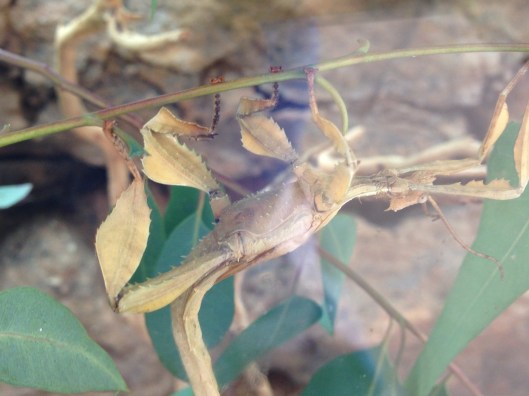
The next morning, Orange Man awoke more hungry than ever and very very angry. He was angry with his neighbors for not letting him steal more than his share. He was angry with the gods for making them too smart to give away all their food to him. Surprisingly, he wasn’t even a little bit angry with himself for being so greedy. Nonetheless, he was too hungry to mope all day. He needed to find some food. So, he went foraging for insects. Some of the bugs were much too fast to catch, but many were not. Of course, while searching for bugs, the Orange Man saw many weeds and twigs but he had never bothered to learn which ones were edible and which ones were poison. He happened to be staring at a twig trying to see whether there were any bugs under it, when all at once the twig walked. It was not really a twig at all! It was just another bug that looked like a twig. Once he realized it was a bug, the Orange Man grabbed at it to eat it straight away.

walkingstick

Before he could snatch it up, however, the bug waved one of its little insect claws back and forth and stared into the little insect eyes of the Orange Man with its little insect eyes. Weird, thought the Orange Man just as he gobbled it up.  It wasn’t very tasty compared to some bugs, but it gave him pleasure to eat it because he was angry at the bug. He didn’t know why he was angry. Indeed, it never occurred to Orange Man to wonder why he was angry but if he had thought about it, he might have realized it was because the bug made Orange Man change his mind. First, he thought it was a twig and then he had to change his mind and realize it was a bug. And, then the little bug had seemed to wave to him in that annoying way that other people seemed to wave at friends. Of course, as a child, Orange Man may have felt love, but he worked hard all his life to kill love within himself and eventually he succeeded. 

After another afternoon of eating bugs, Orange Man at last grew thirsty and he knelt down to drink from a nearby lake. As he did so, he could see his reflection in the water. There he was, fat, ugly, and orange. Orange Man ate up many more bugs that afternoon and was less hungry than the night before. He fell into a fitful sleep and dreamt that night of returning to the lake for a drink of water. Again in his dream, as he had done in real life, he knelt down to drink. But in his dream, he heard frogs creaking and croaking. They seemed to be saying, “Greenie, greenie, greenie” and this time, when he looked at his reflection, instead of being fat, ugly, and orange, he appeared to be fat, ugly, and green. How could this be, Orange Man wondered. Even in his dream, he remembered that he was orange. This weirdness wakened him with a start, the sound of the frogs reverberating in his ears: “Greenie, greenie, greenie.” Is it possible that he saw himself as green because the frogs were saying the word “green” the whole time he was looking? 

fullsizeoutput_2509

The next day, the Orange Man had much to think about. So far, words and stories had been used by the people mainly to work together by sharing knowledge. On a few occasions though, people told stories for entertainment. They made up stories about the stars and how mountains came to be, and how deer grew antlers. Everyone knew that they were simply made up stories. But now, the Orange Man thought of the bug that looked like a twig and how the frogs made him look green even though he was orange. What if I told people a story about where to find game but it was really just a made-up story to get people to go hunting and leave their things where I can steal them? 

The next morning, the Orange Man decided to test his plan. He went to the village and told everyone that he had seen a giant mammoth just over the layered ridge at the edge of the village. Most were skeptical, but a few argued that it might be worth a look since felling a mammoth could help feed the village through many moons. The Orange Man jumped up and down and yelled and screamed telling them that they should all go because a mammoth is a huge animal and they would need everyone to hunt it. One young boy named Micah pointed out that it wouldn’t be a good idea for everyone to leave the village. “Rats may come and eat all our food,” the youngster argued. 

“I’ll stay here and protect the food,” offered the Orange Man. Try as he might, twisting the truth this way and that, he was unable to convince everyone to go on the mammoth hunt. A few braves went off and returned at dusk. They were, of course, empty-handed but they also reported to the tribe that they had seen no evidence of a mammoth. There were no tracks, no spoor, not so much as a toppled sapling to indicate a mammoth. The eyes of the tribe turned toward the little insect eyes of the Orange Man. He yelled and screamed and jumped up and down and said they were blind or liars or both.  

It was hard to get a word in edge-wise because the Orange Man screamed continuously, but at last when he stopped to take a break, Micah asked, “What is this word that you used? What is a ‘liar.’?” 

That stopped the Orange Man. He had called them liars because that’s what he was doing. None of the people in the tribe had ever used language to intentionally mislead others for their own gain so they were unfamiliar with the word as well as the concept. In a flash, the Orange Man realized he had made a mistake to use such a word. “Oh, Micah, you must have mis-heard me. I said, ‘They must be blind as briars.’ or something like that.” But Micah knew he had heard a new and different word. Several others chimed in as well. But the Orange Man would hear none of it. 

“Look, I saw a mammoth. I have very good eyes. The best eyes, in fact. If you hunters can’t find it, you’re not very good hunters. But I don’t really care. Go hungry. Don’t find the mammoth. I don’t care. More mammoth for me. I’ll go get it myself. I’ll bring the mammoth back here single-handedly and show it to you big as life! Good-bye.” 

No sooner had the Orange Man uttered these words than he realized he had made a big mistake. Before people started questioning him, he strode off, refusing to engage in any questions and answers about how he would kill a mammoth all his own. Day after day, the Orange Man ate bugs, planned lies aimed at convincing the villagers to leave their village while he and he alone guarded it. And each day, he tried to be more and more convincing about his lies. But each day, the villagers became harder and harder to convince. The Orange Man was careful never to use the word, “liar” again, but people discounted what he said nonetheless. 

At long last, The Orange Man decided that it would be easier to convince another tribe of his lies. So, off he trudged across the plains to find another tribe. IMG_1224From a mesa, he observed the tribe from afar and watched them come and go, waiting for a time when the village was unguarded so that he could go in unseen and steal everything for himself. But people always hung out in the village, grinding corn, drying skins, or sitting around campfires talking. All in all, he found it quite disgusting. Why wouldn’t they leave so he could steal their stuff?


Then, one day, he had a wonderful inspiration. Buffalo! He would tell the people in the village that a great herd of buffalo was coming to destroy their village. They would all have to leave immediately and leave everything behind because there was no time! He too was fleeing from the buffalo but, he would caution them not to wait for him but to save themselves running as fast as they could to the next bluff to save themselves from trampling. He went into the village at dusk, yelling and screaming and waving his arms. He told them that a great herd of buffalo were coming to destroy the village and that they should save themselves and run to the bluff and clamber up it as best they could. Some of the villagers indeed panicked and began to gather up their children. But some of the villagers put their ears to the ground and heard no such stampede coming. Several of the villagers did not wait to see the outcome, however, and ran off as fast as they could. In their haste, a few fell and one woman dropped her baby on a rock which broke its soft head and killed it. But not everyone left the village and so Orange Man was not able to steal anything. He claimed that he had a potion back at his camp which would bring the broken baby back to life and he hobbled off to get it, or so he claimed. Of course, when he saw that everyone was not leaving the village, Orange Man realized he needed to leave before it became obvious that no giant herd of bison was coming.  

Several days went by before the Orange Man ventured to try again. He was heartened by the fact that his lie about the bison herd had almost worked. Several people did flee the village and at least one person died and several were injured. This, he chuckled at, but it wasn’t really the full scale all-out panic he was aiming for. 

That night a great thunderstorm flashed all about him. Atop the mesa, a bush was struck by lightening and it smoldered and flamed. He took some of the smoldering branches and made a little fire in a crook of rocks, feeding it dry firewood he had stashed nearby for just such a lucky occasion. Finally, he had found fire to keep him warm. Then, he had a great inspiration: Fire! “That’s it!” he thought. He would tell people a great fire was coming to destroy their village. Surely, that would cause panic and this time, everyone will leave the village and I can steal everything. 

night fire flame fire pit

Photo by Bob Clark on Pexels.com

The next morning just as the sun rose, the Orange Man walked toward the village, rehearsing his lies in his head to make them more convincing. When he came in sight of the village, he trot-wobbled up the path waving his arms and yelling at the top of his lungs, “FIRE! FIRE! Run for your LIVES!” Sure enough, the villagers were worried. But they all recognized the Orange Man and although they did not yet realize that he was simply lying to steal all their stuff for himself, they did realize that his judgement was not sound. So, instead of immediately racing out of the village, they instead scanned the horizon for signs of smoke. There were none. Indeed, the ground was still damp from last night’s rain. While lightning sometimes did cause prairie fires, this seemed unlikely in the present circumstances, and no-one believed him. He shouted and screamed and waved his hands but no-one believed him. There was no smoke. At last, realizing that he would again leave empty-handed, he headed back to his mesa to gather some bugs and grubs. Well, he thought, as he trudged back. At least I have my fire now. 

The days grew hot and dry. The Orange Man grew still fatter on his diet of grubs and bugs. Then, at last, he reckoned that perhaps the people would have forgotten his lies and be willing to believe him again. This time, however, he would be smarter about his lies. He waited for a dry windy day and took a torch from his fire with him. He descended the path at the edge of the mesa and walked toward the village. He again planned to trot-wobble into the village while waving his arms and screaming about a fire, but this time, he would be smarter! He laid his lighted torch into some of the brush and grass near the edge of the village. This time the villagers would see smoke and maybe even see flames. This time, they would all panic as he hoped. After setting several small fires, the Orange Man trot-wobbled down the path to the village. As he approached, he began shouting, yelling, and waving his hands wildly. “Run!” he yelled. “There’s fire coming! FIRE! RUN!” Oh, yes! At last, this time, his lies were working! He could see that indeed, this time, people were grabbing things at hand and running away. It’s the smoke, he thought! I’m so smart! And, they are so stupid! Everything in the village will be mine. He smiled a broad smile at the stupidity of people who would fall for such a lie. The Orange Man turned back to glance at his little smoke trick to see what it looked like. What he saw, however, pounded his heart right through his chest and out the other side. Rather than clouds of smoke, what he saw was a wall of fire behind him. Now, the Orange Man trot-wobbled in earnest. He immediately fell over his own feet. He crawled back to his feet, but the cuffs of his pants were already on fire. He frantically waved and twisted but the fire burned his pants and soon the flames engulfed him. His last thought was, “It’s not fair! I’m so much smarter than everyone else. I deserve it all.” 

IMG_3123

Indeed, it wasn’t fair. Everyone from the village also perished in the flames. No food was left to plunder had there been anyone nearby to plunder it. Many miles away, it happened that Micah looked up from chipping an arrowhead to see plumes of black smoke on the horizon. For some reason, the thick, ugly, black smoke reminded him of the Orange Man. He wondered what had become of him. Once again, Micah wondered what that word had meant. An odd word: Liar. Liar. 

It seemed to Micah that everything the Orange Man said had been for the sole purpose of getting the villagers to leave so that the Orange Man could steal everything. But why would someone do that? After all, the Orange Man had not been starving. Far from it! He was the fattest person Micah had ever seen. Perhaps he had wanted just some of the things in the village; things he had no way to craft himself. But if that were the case, why not just trade for one? The Orange Man could have traded something he was good at for something he wanted whether it was blankets, spears, or baskets. Theft was extremely rare among Micah’s tribe. Perhaps the Orange Man had come from a tribe where everyone stole from each other rather than making and trading things. Micah shuddered to think how terrible it must be to belong to such a tribe as that. The rest of the day, as he gathered acorns, Micah contemplated what “Liar” meant and he concluded that a liar was a kind of thief. If you said something that you knew was not true, it must be to steal something. 

IMG_4098

It occurred to Micah that while the Orange Man might have wanted to steal blankets or baskets or food, he would have stolen much more than that. He would have stolen the soul of the tribe. As they worked together, loved together, hunted together, ate together, sang together, the words of the tribe were a bond that held them together, each to each. This was so because everyone was doing it together and each word spoke, carefully measured, acted like an arrow aimed at a larger prey. Together these arrows could bring down a mammoth. But the Orange Man would use these words like arrows aimed at other Humans. A liar could destroy the entire tribe! Micah did not then know that the Orange Man had literally destroyed a tribe with fire in order to make one of his lies more credible, but Micah foresaw that if people in a tribe lied to each other, it would ultimately destroy the working togetherness of the tribe and therefore the tribe. 

If someone said that they would watch a toddler and then they didn’t, the toddler might wonder into the river and be drowned. If a hunter said they would be ready with a large boulder up above to smash the prey that someone below was luring into a narrow canyon but then never showed up or never dropped the boulder, the person luring below would be eaten or trampled. Just as the mortar held their bricks together to make a house, the truth held the tribe together as a whole; a whole who could survive long winters and floods and dry spells and fend off predators. A tribe of liars would destroy themselves. Micah shuddered at such a prospect. He tied the ends of the great blanket filled with acorns he had gathered, for a chill and a fog lay heavy in the air. He trudged back to the village and heard the distant voices of his tribe, the Veritas singing together sharing their food and their love and their songs of true talk. 

truthtable


Magic Gateway to the books I authored!

The Creation Myth of the Veritas: Part I

29 Sunday Jul 2018

Posted by petersironwood in America, apocalypse, psychology, Uncategorized

≈ 36 Comments

Tags

cheating, collaboration, cooperation, creation, lies, myth, social capital, Storytelling, trust, truth

The Creation Myth of the Veritas: Part I 

IMG_3320

The gods grew bored and decided to hold a kind of maker fest. Using the wet clay by the River of Life, they fashioned all sorts of strange and wonderful life forms including whales that swam in the seas, giraffes, tigers with strength and speed, cunning and claws, They created birds that soared in the skies and tiny worms that squirmed in the dirt. After many eons, all of creation was done and the world was filled with wondrous creatures of all sorts. All the gods had participated and each admired the work of all the others. Only Dionysius had failed to participate. As usual, he had been roaring drunk the night before, and as usual, arrived late to the party. 

Ever the bon vivant, Dionysius after glancing around at all the beautiful creatures, said, “Hey! Cool! I want to play too!” 

Zeus shook his head for no matter how many times Dionysius missed out by being drunk, he never seemed to learn. “Well, Dionysius, had you been here on time, you could have played. But all the materials are gone. All the best fangs, the sharpest claws, the keenest eyes and ears, the strongest bones are all gone. You can see that all that’s left is a tiny pile of clay by the estuary and that little cluster of the very most pathetic weapons, over by that mesa. 

“Oh, crap,” opined Dionysius. “No matter, I’ll make something cool.” Unfortunately, Dionysius was not a morning person. In fact, when he was this badly hungover, his design skills were, if anything, even worse than when he was besotted. Worse, he rushed everything and today was no exception. He hastily slung together the remaining wet clay in a kind of rough approximation of a bear or an ape. He threw in a few bits of bone, teeth, and claws and was ready to call it a day and then try to locate the next party. But the result was so pitiable that it didn’t even meet his own low standards. 

Zeus, not for the first time, considered banning Dionysius from Olympus. “My god, Dionysius, could you make it any uglier?” 

Dionysius felt a twinge of guilt at his shoddy work. No sooner had he felt this than he decided to show Zeus a thing or two. “Indeed I can!” The only saving grace of the poor design of Dionysius had been the luxurious silver and black fur that covered the poor creature head to foot but, out of spite, he now hastily stripped it all off, save for a few odd hanks here and there. “There! That’s better!” 

IMG_3192

The other gods simply shook their heads in disgust. Dionysius was Dionysius after all. Without comment they walked off. “I’ll show them,” he thought. While their backs were turned to him, Dionysius took a tiny spark of creative curiosity out of his own heart and imbued his creation with it. He dubbed the result “Human” but it held little interest for the other gods. He placed “Humanity” on the earth and gave it no more thought, caring nothing for how it might or might not survive. 

When the other nearby animals saw the featherless, scaleless, nearly furless monstrosity, they chuckled to themselves. Some, such as Lion, Tiger, and Bear were hoping it would prove tasty despite its looks. Zeus however, felt some pity for the poor creature and asked the other animals if any would be willing to give Human something to help it survive. Lion and Tiger did not want to give up their speed, their claws, or their fangs. Eagle would not give up his superior eyesight. Elephant had no desire to give up his trunk, his great strength or his amazing hearing. Mammoth loved his thick coat of fur. Even the lowly chameleon would not give up his camouflage. Without knowing about the strictly illegal spark of creativity that Dionysius had bestowed, Zeus took pity and added just a small spark of intelligence. 

Those first years were very hard on Human. His only gifts were creative curiosity, some small intelligence, and, like all life, love. (For love, was not a gift bestowed by the gods, but inherent in the very stuff of Life itself). Upon seeing how hard life was for Human, Zeus again asked whether any of the other animals would give up any of their gifts. None really wanted to give up their great gifts, but one by one, they gave some small gifts out of pity for poor Human. 

IMG_3193

Snake, for example, allowed Human to borrow the sound of his hissing sizzle and thus did Human receive “ssss.” Crow, not to be outdone, allowed Human to share his cursing “Caw! Caw!” Mourning Dove shared his “Cooo. Cooo.” Chattering squirrel offered up “t-t-t-t.” Sheep let Human borrow, “aaaa – aaaa!” Horse let Human use “Neigh! Neigh!” Eagle, ever jealous of his keen eyesight allowed human the use of “Eeee.  eeee.” Busy buzzing bee bestowed a “zzzz” for Human’s use. 

In this way, Human was able to make the sound of many animals. Though the animals did not realize it at the time they bestowed these gifts, they were actually quite useful. Making these sounds helped disguise Human as he went about hunting and gathering. Because Human, like all the other animals, had the gift of love, they also began using these sounds to share their treasures with others. If a Human found some honey, they would make the buzzing sounds of a bee and point to the direction of the honey. 

Humans lived in small tribes and it happened that some particularly smart Humans fell in love with other smart Humans and produced a Very Smart Human. Very Smart Human saw how spider spun a strong web made in a pattern and learned how to weave baskets of reeds. 

agriculture basket close up colorful

Photo by Pixabay on Pexels.com

Then, Very Smart Human saw how the sounds of the beasts could be woven into words and the words could be woven into statements and the statements woven into stories. And these stories could be shared. Over time, leaders learned to weave stories into a shared vision so that many people could have their purposes woven into a strong fabric of purpose to make projects to help all the people. They told a story of making dams to catch fish. And it was so.They told of making rooms to hold corn. And it was so. They told of traps and plans to corner prey. Working together, people could plan and build for all the people. And Humanity prospered.


Author’s Note: The first three pictures above are original artworks by Pierce Morgan.


Author Page on Amazon


Newer posts →

Subscribe

  • Entries (RSS)
  • Comments (RSS)

Archives

  • June 2026
  • May 2026
  • April 2026
  • March 2026
  • February 2026
  • January 2026
  • December 2025
  • November 2025
  • October 2025
  • September 2025
  • August 2025
  • July 2025
  • June 2025
  • May 2025
  • April 2025
  • March 2025
  • February 2025
  • January 2025
  • December 2024
  • November 2024
  • October 2024
  • September 2024
  • July 2024
  • April 2024
  • March 2024
  • February 2024
  • January 2024
  • December 2023
  • August 2023
  • July 2023
  • May 2023
  • April 2023
  • March 2023
  • February 2023
  • January 2023
  • December 2022
  • November 2022
  • October 2022
  • September 2022
  • August 2022
  • July 2022
  • June 2022
  • May 2022
  • April 2022
  • March 2022
  • February 2022
  • January 2022
  • December 2021
  • November 2021
  • October 2021
  • September 2021
  • August 2021
  • July 2021
  • June 2021
  • May 2021
  • April 2021
  • March 2021
  • February 2021
  • January 2021
  • December 2020
  • November 2020
  • October 2020
  • September 2020
  • August 2020
  • July 2020
  • June 2020
  • May 2020
  • April 2020
  • March 2020
  • February 2020
  • January 2020
  • December 2019
  • November 2019
  • October 2019
  • September 2019
  • August 2019
  • July 2019
  • June 2019
  • May 2019
  • April 2019
  • March 2019
  • February 2019
  • January 2019
  • December 2018
  • November 2018
  • October 2018
  • September 2018
  • August 2018
  • July 2018
  • June 2018
  • May 2018
  • April 2018
  • March 2018
  • February 2018
  • January 2018
  • December 2017
  • November 2017
  • October 2017
  • September 2017
  • August 2017
  • July 2017
  • June 2017
  • May 2017
  • April 2017
  • March 2017
  • February 2017
  • January 2017
  • December 2016
  • November 2016
  • October 2016
  • September 2016
  • August 2016
  • July 2016
  • June 2016
  • May 2016
  • April 2016
  • March 2016
  • February 2016
  • January 2016
  • December 2015
  • November 2015
  • October 2015
  • September 2015
  • August 2015
  • May 2015
  • January 2015
  • July 2014
  • January 2014
  • December 2013
  • November 2013

Categories

  • AI
  • America
  • apocalypse
  • cats
  • COVID-19
  • creativity
  • design rationale
  • dogs
  • driverless cars
  • essay
  • family
  • fantasy
  • fiction
  • HCI
  • health
  • leadership
  • management
  • nature
  • pets
  • poetry
  • politics
  • psychology
  • Sadie
  • satire
  • science
  • sports
  • story
  • The Singularity
  • Travel
  • Uncategorized
  • user experience
  • Veritas
  • Walkabout Diaries

Meta

  • Create account
  • Log in

Blog at WordPress.com.

  • Subscribe Subscribed
    • petersironwood
    • Join 648 other subscribers
    • Already have a WordPress.com account? Log in now.
    • petersironwood
    • Subscribe Subscribed
    • Sign up
    • Log in
    • Report this content
    • View site in Reader
    • Manage subscriptions
    • Collapse this bar

Loading Comments...