• About PeterSIronwood

petersironwood

~ Finding, formulating and solving life's frustrations.

petersironwood

Tag Archives: painting

Negative Space

02 Friday Jan 2026

Posted by petersironwood in creativity, management, psychology, sports, Uncategorized

≈ Leave a comment

Tags

AI, art, creativity, Design, HCI, illustration, music, negative space, painting, poetry, problem formulation, problem framing, sports, thinking, thought, UX, writing

Negative Space

When you look at a scene, it is natural to concentrate on the objects in the scene. So too, when one begins to design, it is natural to concentrate your attention on the things you intentionally put into the design whether those are menus, icons, images, banners, buttons and so on. You tend to give little thought to what is not there because, after all, there’s nothing there! 

IMG_9815

As your expertise grows, you will find it useful to spend some time and resources thinking about what is not there; the “negative space” if you will. In art, the “negative space” refers to the space around and between the objects. Often, paying attention to the “negative space” can result in a much more interesting and aesthetically pleasing composition. It is a concept that has applications far beyond artistic visual composition however. 

Consider music for a moment, or better yet, listen to some and you will note that the silence is just as important as are the notes. Increase or decrease the silence in a tune by a factor of two and it becomes a different, and in most cases much worse, tune. 

printed musical note page

Photo by Pixabay on Pexels.com

The same can be said of great acting whether on stage or in a movie. The silence while we wait for the actor’s response to some news — while they are saying nothing and possibly even showing nothing or very little on their face, can often be the most poignant and moving parts of the picture. If the actor reacts “too quickly” with no space, we can tell that the stimulus presented is something that they “trigger” on because they are upset about it or trying to deny it. The leading man, for instance, asks a seemingly innocent question on a first date, such as, “So, do you like French Cuis…” “NO!” she cuts in. The audience’s attention is immediately drawn to see what comes next. The response that is too fast indicates a “sore spot.” Did the leading lady want to become a French chef? Did she just end a love affair with a Frenchman? What is going on here? 

IMG_6022

On the other hand, imagine the leading man, says, “So, do you like French Cuisine?” One beat, two beats go by. No answer. A long pause. The leading lady’s face shows nothing. Perhaps she tightens her lips ever so slightly or frowns to the slightest possible extent. The pause continues. The leading man tilts his head as though to ask whether she’s okay. Finally, we come to expect a tirade about the French or French Cuisine or French wine or … something. Instead, after this long pause, the leading lady says nothing but punctuates her silence with something that sounds like a cross between a humorless laugh and a karate grunt. There are probably no words she could have said which would have intrigued us more than the non-response. We think, “What the hell is going on with her and French Cuisine?”  

IMG_9504

Speaking of French Cuisine, when you go to a fine restaurant, your focus is on the food. So too is the focus on the chef and the server. But the space is important as well. It is annoying when you are paying good money to have a nice dining experience and you are shown to your table, given menus and then ignored for the next twenty-five minutes. On the other hand, it is equally annoying when your server comes back every 30 seconds and asks, “Are you ready to order yet or do you need more time?” The optimal time to wait between courses is not always obvious either. Some people need or want much more time between courses. Maybe this nice dinner is all they have planned for the evening. The patrons are having a nice quiet dinner with good conversation. They are in no hurry. Just as one of the diners launches into a complex story or joke, the server comes over and interrupts to tell about the specials. Conversely, another foursome may be planning on attending a play and long pauses between courses may mean missing the first act. 

The negative space in dining is not just about the timing of events. It is also about the spatial arrangement of the food, the spacing between textures and colors. Often, the artistic arrangement is as much about the negative space as the objects on the plate. 

Sometimes, the food itself has positive and negative elements. In a meal with varied and complex and contrasting tastes, for instance, the rice or the bread can provide a kind of “negative space” between the tastier and more salient constituents. These neutral or negative elements allow more contrast among the salient elements than if the more salient elements were enjoyed right after each other. I’m reminded of a line from Kahil Gibran’s The Prophet:

“Let there be spaces in your togetherness.”

Negative space is important in architecture, painting, typography, cinematography, the design of user interfaces, culinary arts, music, and the design of other stimuli. It is also important in activity.
IMG_2769


One of the first popular video games was called “Asteroids.” In this black and white vector graphics game, you controlled a small space ship that shut bullets in the direction the space ship was aimed. All you could control was the speed and direction of the space ship and whether it was shooting. The screen also showed a number of large, irregular “asteroids” that you were meant to hit. When you hit one of these large asteroids with a bullet, it split into two moderate asteroids. When you hit a moderately sized asteroid with a bullet, it split into two small asteroids. When you hit a small asteroid with a bullet, it disappeared. If you got hit by an asteroid, you would die. There was also a flying saucer who came to hassle you. Anyway, I found that if I focused on all these floating asteroids and trying to not to get hit by one, it was a difficult game. For me, at least, it was much better to visualize a path among the asteroids and try to follow that path. In a way, concentrating on the negative space, helped. 

action athletes ball blur

Photo by Pixabay on Pexels.com

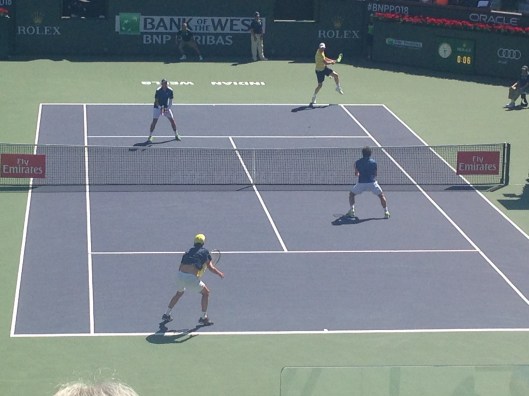
The importance of negative space in sports can hardly be over-emphasized. In American football, the back tries to find the holes to run through. In soccer, players seek paths between. In baseball, the hitter wants to “hit it where they ain’t.” In tennis, beginners often play only during half a point. Their attention is focused on the ball and the opposing player(s). They choose a target on the other side of the court and watch to see how well they hit that target. Just as their opponent begins to hit the ball they shift their attention to their opponent and watch where that opponent hits the ball, scurrying there as quickly as possible so as to hit the next shot. What does such a player do between the time they hit the ball and their opponent hits the ball? They watch! They want to see where the next ball goes. If you are young and fast and your opponent is not well skilled, you can often get away with this process. However, what higher level players do is something quite different though it may look similar. The good player has a target in mind but watches the ball while their mind has the target clearly in mind. By watching the ball, they are much less likely to mis-hit the ball. Furthermore, they are not giving away their intended target with their body language. Perhaps most importantly, long before their opponent hits a return shot, the good player thinks about the open spaces on their side of the court and go to cover the most likely of those spaces. 

Many otherwise well-skilled athletes only focus on the game during play. For example, many hitters on amateur softball teams, pay little or no attention to the game while their team is batting until they are “on deck” (almost ready for a turn at bat). This is absurd in the majors, but it’s even more absurd in amateur games. You should be taking this time to learn about the opposing pitcher and about the weaknesses in the opponent team’s fielders. Just because you’re not in the batter’s box doesn’t mean you can’t improve your play. Similarly, in tennis, you can use the time between points to think about tactics and strategy, as well as to mentally “reset” yourself if necessary. Some players wave their hands in front of their face after a point as a reminder/trigger to forget about what just happened and focus on the next point. Some will even turn away from the play, seemingly to talk with their “imaginary friend.” 

To close, a very short, short story based on true events in my first trip to Japan. 

tokyo tower behind black and white dojo building during daytime

Photo by Pixabay on Pexels.com

The Touch of One Hand Clasping

Japan, Tokyo, 1977. I walk crowded streets and beautiful gardens where care is taken for spaces as well as things that grow. I struggle — try to speak Japanese language but usually mispronounce “Key-Ray-Ee-Des” (It is beautiful) as “Key-Rah-Ee-Des” (It is dirty). I tip-toe through minefields of culture steeped in subtlety; lose huge chunks of flesh and karma with my thunderous, blunderous New York strides.

Shin-Ju-Ku: lights dim Times Square into grandmother’s fruit cellar. Row on countless row of Japanese stare hypnotized at small vertical pin-ball game called Pah-Chinn-Koe. This bright hustle bustle hassle hides deeper subtlety, deeper calm, inside, beneath, where foreign eyes can peer not.

I enter Tokyo subway. Then — she enters — total stranger, totally beautiful, black hair, endless eyes. I, of course, having learned small little in my many minefield walks, look everywhere but at her. Better, she looks everywhere but at me. We ride, totally not looking at each other. She stands in middle — nowhere to hold on to — unprotected, beautiful, vulnerable.

Suddenly, train lurches. Simultaneously: she shoots hand out to only spot I can possibly reach while I shoot hand out to only spot she can reach. Our hands clasp strongly for instant and I save her from fall. 

Slowly, we release.

Next stop, she rushes out. But — just before the doors bang shut, she turns — looks straight into my eyes. “Kohn-bahn-wah” she says (“Good Evening”).

Thus, Japanese beauty touches beyond body into very soul of clumsy Westerner.

———————————-

woman holding pink petaled flower

Photo by Đàm Tướng Quân on Pexels.com

Negative space….

———————————————-
Author Page on Amazon 

The Void

After All

It was in his Nature

Life is a Dance

Take a Glance; Join the Dance

Life Will Find a Way

At Least he’s Our Monster

What About the Butter Dish?

The Gods of Old

The Truth about Clouds and Gods

The Bubble People

Comes the Dawn

Is a Dream?

Good Morning!

Camelot is in your Heart

The Tree of Life

Inventing a New Color

30 Wednesday Nov 2016

Posted by petersironwood in Uncategorized

≈ 2 Comments

Tags

colors, invention, painting, short story

Inventing A New Color — A Chapter from Tales from an American Childhood

PicturesfromiPhoneChinaParisPrinceton 271

After my dad returned from World War II, he married my mom and nine months later, I was born. We lived in a number of places, but when I was about three and a half, we moved to Portugal. My dad headed up a tire factory there. I don’t remember much about Portugal, but I do recall going with him to some of his fancy dinners. For reasons I did not understand at the time, when I was five, my mother and I took the long ocean liner ride back to America without my dad. Mom and I lived with grandpa and grandma at their house. I attended a kindergarten in Firestone Park and had a very nice teacher. I loved kindergarten.

I missed my dad but liked grandpa and grandma. She told me “Old Pete” stories and we listened to radio shows such as Roy Rogers, Hop-along Cassidy, and Tom Corbett and the Space Cadets. “Little Grandma” lived there too. She was my grandpa’s mom and stooped over very tiny, very old, and looked like a Native American. Much later, I learned that that was because she was Native American or perhaps half Native American. I loved “Little Grandma.”

Grandpa worked as an engineer and designed airplane wings, among other things. Grandpa was also a painter and his beautiful and detailed oils hung in large wooden frames throughout his house. Mostly, these were landscapes but there were also portraits and my personal favorite depicted two warships firing cannons at each other while being tossed on giant waves. Grandpa taught me many things. Naturally, I wanted to return the favor. When I was about five, I overheard him saying that it was impossible to invent a new color. Well, I could definitely teach him something about that! I loved the idea of being an inventor.

In the middle of kindergarten, my dad returned from Portugal and re-united with my mom. He bought a house and we moved away to a different neighborhood from grandpa & grandma. I had to start school in a new kindergarten with all strange kids. The very first day, my new teacher decided that I would lead the parade and draped the rope of a large drum around my neck. I didn’t want to play the drum and I made that about as clear as I could to her, but nonetheless, I ended up marching around the room with the heavy drum around my neck. I hated kindergarten.

My dad worked as an engineer and my mom was a teacher so both of them were gone all day. They hired a housekeeper to take care of me. And, somehow, after the first day, I convinced my housekeeper that I did not need to go to kindergarten any more. This was fine with me because she was nice enough to give me my favorite lunch every day — a jar of maraschino cherries!  They were so sweet and such a pretty red. And, not only were the cherries themselves delicious. The jars proved to be perfect for my experiments! So, in the second half of kindergarten, I stayed home and instead spent my time inventing a new color to show grandpa. I had a paint set and I water and I had lots of empty cherry jars. It was all a matter of time and careful work. At last, I would be able to teach grandpa something. I love teaching.

After many weeks of careful work, I finally created a new color! When grandpa and grandma came to visit, I was ready. Under my bed were about 40 little jars of diluted paint. Thirty-nine of them were failed attempts. But one of them contained the prize. I carefully crawled under the bed and located my invention, pulled it out, and scampered into the living room where the adults practiced their buzz-talk.

Buzz-talk sounded serious and low but didn’t actually mean anything so far as I could tell. Surely, no-one could mind if I interrupted buzz-talk by announcing my invention. I proudly held out my prize to grandpa. Grandpa was very smart, so the fact that he did not immediately catch the significance of this jar surprised me. He merely glanced at the watery liquid in the maraschino cherry jar without comment.

I decided that I’d better clue him in. “Grandpa! It’s a new color!” He glanced at it again and said, “I’ve seen it before.” And just like that, he went back to buzz-talk!  Crest-fallen, I wandered back to my bedroom and placed the prize beneath my bed with all the failed experiments. Apparently, this was just another one. Despite this terrible turn of events, I hardly gave up. I just redoubled my efforts. I knew there was a new color out there somewhere and I would find the perfect mix and next time be successful! I loved the challenge.

Grandpa had already taught me that red and yellow paint made orange; that yellow and blue paint made green; and that red and blue paint made purple. So, obviously, most of my experiments involved various proportions of red and green, purple and yellow or orange and blue. Most of them ended up as fairly similar shades of gray-brown. But if I mixed very carefully, I produced not dull gray-brown but something with a slight tinge of something…new! I somehow found other jars because I needed more than just the supply offered by one a day lunch-time maraschino cherry jars. I didn’t think bigger jars would have anything to do with inventing a new color, but it was possible. After a few weeks, grandpa and grandma came over to visit again. And again, I interrupted their dull living room buzz talk by showing off my latest creation. This time, I was more apprehensive. The first time, after all, I had known for sure I had a new color. This time, I was uncertain. I waited for the right opportunity — that slight pause in the buzz-talk — to display my new creation.

“I’ve seen that,” Grandpa said and turned back to buzz-talk. I wasn’t yet old enough to argue. And, even now, years later, if someone claims they have seen a color and you think they have not seen the color, I am still not sure how to argue. Convincing other people is seldom an easy task and convincing them that their own perception is limited — that is extremely difficult. Many times, I have heard the old saw, “In the land of the blind, the one-eyed man is king.” I actually doubt that. I suspect in the land of the blind, the one-eyed man is more likely to be declared in league with Satan and end up being stoned to death.

Let’s think about this. Suppose you are the one-eyed person in the land of the blind. Say everyone is hungry and you see a berry bush a couple hundred yards away. Now what? Well, you could say, “Hey, everyone! I see a berry bush over there (uselessly pointing). Let’s go pick some berries.” Everyone else says, “What berry bush? I don’t feel one. I don’t hear one. I don’t smell one. There’s no berry bush. Be quiet and stop talking non-sense.” Alternatively, you could just quietly walk over to the berry bush and bring back a small quantity for everyone to share. Of course, if everyone went, you could bring back a lot more, but no-one wants to follow you. You bring back some berries but people would be suspicious. They might well think you had been hiding these and had many more you failed to share.

Similarly, if you saw a pack of hyenas headed your way and warned people, the blind might well think you were in league with the hyenas. After all, you were the first one to know about them. You must have told the hyenas where everyone was. At long last, if you were the one-eyed person, you might be pretty tempted to put out that other eye. Life would run a lot smoother for you. Alternatively, you could leave the tribe and live on your own. And, many people do make this choice, essentially. But it’s a pretty lonely life. You could try to patiently explain that just as sometimes they could smell things they could not feel and feel things they could not smell, and hear things they could not yet feel or smell, that you could “see”…ah, that’s the sticky bit.  How do you explain sight to the unsighted?

Of course, my grandfather was not blind. Far from it. He was not only an adult, with more power and experience and knowledge than a five year old kid. He was, in fact, an artist. He was an expert on color. I could see evidence of his expertise everywhere. His paintings adorned our house and his own. So, he probably was right about the particular colors I had shown him so far.  But that didn’t mean that I couldn’t invent one next time that was truly new. So, back to the lab, I went. I failed a few more times and eventually gave up. Inventing a new color really was impossible.

Or was it?

Many years later, I attended an art exhibit in Pittsburg. It featured many kinds of “modern art” including a very cool kinesthetic art exhibit. In one exhibit, I simply stood on a platform in front of a large rotating disk. I watched the disk rotate until quite unexpectedly, the disk was quite still and I was rotating the other direction!

Of particular interest were some extremely large extremely brightly colored canvasses which featured huge swaths of complementary colors. If I stared for a good long time at the super bright red and then moved my eyes over to the super bright green, the combination of temporal and spatial contrast produced an unearthly bright green, a “supersaturated” color impossible to produce by merely using one pigment. While I had not invented this, at least I now had experienced a color it was likely my grandpa never had. I could not really check this out though because he was long dead. Of course, I have met him in dreams many times and in the dreams he’s not really dead. It was all a big mistake. And, in my dreams, there are often landscapes painted in supersaturated colors that even he has to admit are new inventions. I love it when even the wisdom of elders may be mistaken and changes over time.

My grandpa knew that we humans are all mortal but he also knew that we still had some fragmentary art that was thousands of years old. Perhaps art provides a kind of immortality. When I was about ten, grandpa visited Europe and saw many of the oil paintings of the “Old Masters” that he had admired so much. He saw with his own eyes that, over time, the oil that they used turned yellow and the colors that they had used were transformed. Father Time himself invented new colors for these artists. When, he returned from Europe, he switched from oil painting to water colors. Beyond that, he limited himself to using only three pigments all of which were oxides of metals. He was also very careful in his choice of canvas for the same reason. He stuck to these constraints so that his paintings, unlike those of the “Old Masters”, would not yellow or fade with time.

Grandpa’s paintings were designed by an artist/engineer to be stable and unchanging over time. When Grandpa died, I inherited quite a few of my favorite water colors and I can testify that the colors were extremely stable over time. They remained stable, that is, up until the time we moved to California and almost everything we owned was burned up in a moving van fire. What was burned up included all our furniture, electronics, papers, and almost all clothing and paintings. All the carefully laid pigments of metals were altered forever. All of the work and effort were now white ash floating somewhere in the sky near Continental Divide Arizona. A little carelessness on the part of a trucker in too much of a hurry, perhaps, to check the lubrication and the whole truck went up in flames. Robert Burns comes to mind.

It seems to me that our country once comprised a long-standing collaborative work of art involving many artists and many colors. This was a painting of scale and magnificence, though not yet completed. Every shade of the rainbow and more besides swept from sea to shining sea. The painting combined portraiture and landscape, scenes of war and peace, city, country, rivers, lakes, deep woods, and shining plains. Yet, somehow, people became impatient with the progress of the painting. Maybe, they thought, the work would go faster if we just painted the whole canvas white. They no longer cared what the end result looked like. They just wanted to get done so we could move on to the next project. We really couldn’t take the time to make sure the bearings were lubricated. And, now, the transport burned up along with the painting. What’s left are scattered white flakes snowing down on the countryside. I love irony, but I loved the paintings more.

At some point, grandpa said something else to me about color. He said that most people look at color in the light but that there is also color in the shadow. And, so, despite the deepening, darkening shadows, I am trying to see the color hidden there in those shadows. It is too soon to know whether I am inventing a new color, inventing a new way to look at color, or just seeing what is actually an after-image — beautiful for now, but sure to soon fade to the dull white gray of old and sooted snow. Maybe one of us can invent a new color or a new way of painting or a new way of looking or a new way of helping people be less impatient with the slow careful progress required for a timeless, collaborative work of art. Inventing new colors is not easy work; that I can say for sure, as is restoring true color that has faded to a uniform and pasty gray.

Perhaps I’ll buy a jar of maraschino cherries.

author page on Amazon

Subscribe

  • Entries (RSS)
  • Comments (RSS)

Archives

  • January 2026
  • December 2025
  • November 2025
  • October 2025
  • September 2025
  • August 2025
  • July 2025
  • June 2025
  • May 2025
  • April 2025
  • March 2025
  • February 2025
  • January 2025
  • December 2024
  • November 2024
  • October 2024
  • September 2024
  • July 2024
  • April 2024
  • March 2024
  • February 2024
  • January 2024
  • December 2023
  • August 2023
  • July 2023
  • May 2023
  • April 2023
  • March 2023
  • February 2023
  • January 2023
  • December 2022
  • November 2022
  • October 2022
  • September 2022
  • August 2022
  • July 2022
  • June 2022
  • May 2022
  • April 2022
  • March 2022
  • February 2022
  • January 2022
  • December 2021
  • November 2021
  • October 2021
  • September 2021
  • August 2021
  • July 2021
  • June 2021
  • May 2021
  • April 2021
  • March 2021
  • February 2021
  • January 2021
  • December 2020
  • November 2020
  • October 2020
  • September 2020
  • August 2020
  • July 2020
  • June 2020
  • May 2020
  • April 2020
  • March 2020
  • February 2020
  • January 2020
  • December 2019
  • November 2019
  • October 2019
  • September 2019
  • August 2019
  • July 2019
  • June 2019
  • May 2019
  • April 2019
  • March 2019
  • February 2019
  • January 2019
  • December 2018
  • November 2018
  • October 2018
  • September 2018
  • August 2018
  • July 2018
  • June 2018
  • May 2018
  • April 2018
  • March 2018
  • February 2018
  • January 2018
  • December 2017
  • November 2017
  • October 2017
  • September 2017
  • August 2017
  • July 2017
  • June 2017
  • May 2017
  • April 2017
  • March 2017
  • February 2017
  • January 2017
  • December 2016
  • November 2016
  • October 2016
  • September 2016
  • August 2016
  • July 2016
  • June 2016
  • May 2016
  • April 2016
  • March 2016
  • February 2016
  • January 2016
  • December 2015
  • November 2015
  • October 2015
  • September 2015
  • August 2015
  • May 2015
  • January 2015
  • July 2014
  • January 2014
  • December 2013
  • November 2013

Categories

  • AI
  • America
  • apocalypse
  • cats
  • COVID-19
  • creativity
  • design rationale
  • driverless cars
  • essay
  • family
  • fantasy
  • fiction
  • HCI
  • health
  • management
  • nature
  • pets
  • poetry
  • politics
  • psychology
  • Sadie
  • satire
  • science
  • sports
  • story
  • The Singularity
  • Travel
  • Uncategorized
  • user experience
  • Veritas
  • Walkabout Diaries

Meta

  • Create account
  • Log in

Blog at WordPress.com.

  • Subscribe Subscribed
    • petersironwood
    • Join 661 other subscribers
    • Already have a WordPress.com account? Log in now.
    • petersironwood
    • Subscribe Subscribed
    • Sign up
    • Log in
    • Report this content
    • View site in Reader
    • Manage subscriptions
    • Collapse this bar
 

Loading Comments...