• About PeterSIronwood

petersironwood

~ Finding, formulating and solving life's frustrations.

petersironwood

Tag Archives: life

Special Spaces & Wonderful Places

07 Sunday Jan 2018

Posted by petersironwood in America, apocalypse, psychology, Uncategorized

≈ 24 Comments

Tags

Design, environment, learning, life, pattern language, politics, school

IMG_4695

When you think back to your childhood, no matter how luxurious, dilapidated, or war-torn that  childhood might have been, I’m guessing that like me, you had some particular places that you loved. Perhaps they stayed secret to you; perhaps you shared only with one or two chums. Somehow, those specific places held a kind of magic for you as they did for me. I will just point out a few examples from my own childhood.

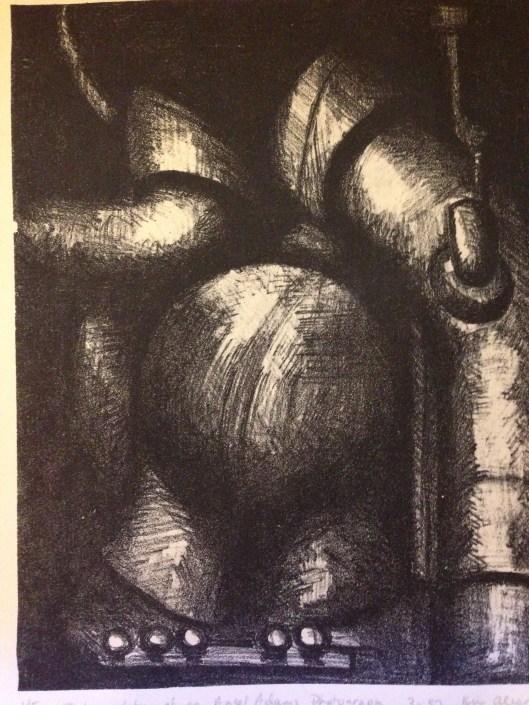
Grandpa’s basement, for instance, though dark and dank, held a printing press made of cast iron. Although he cautioned me not to play with it because, he insisted, it was not a plaything but an important tool, I nonetheless found opportunity to move the gigantic heavy four handled wheel, having first carefully noted the exact position in order to return it just as I had found it. In some way beyond my comprehension as a child, I knew this press was something magical. It was, after all, involved in printing. I recall years later seeing a picture of Benjamin Franklin with just such a printing press. And, even as a very young child, I knew that printing held great power. Beyond that, the object itself loomed and commandeered that entire corner of the basement. I knew it was heavy beyond imagining, and not just in the epistemological sense. I could judge the weight of the entire machine from how hard it was to turn the wheel which, though heavy, comprised only a small fraction of the entire press. Cast iron also has this magical texture which seems to inhale light out of the surrounding region like a giant beast. Perhaps best of all, and what appealed to the engineer in me, the machine’s form and function flowed beautifully together. Compare that with a modern automobile, for instance. What it actually does is largely hidden in the design. This goes along with branding, and advertising, and customer loyalty and so on. A modern car does not typically marry form and function nearly so nicely as did that printing press.
IMG_5135

On the “side yard” of our house on North Firestone Boulevard, three tulips shot up every spring, so colorful and perfect, not to mention mysterious. Where did they come from every year? How could this rounded plant of petals have a three pointed star inside!? On more than one occasion, I caught sight of a butterfly feasting on the pollen within. This place was cool patly just because adults always seemed hell-bent on the next task or chore. So, while this tiny patch of ground technically belonged to the whole family, in fact, I’m the only one who enjoyed it for more than a casual glance. I smelled and touched and explored every vein in that tulip. I watched butterflies do their drunken dance and tried (and largely failed) to predict when and where they would next alight.

IMG_7660

At David Hill Elementary School, the sandstone retaining wall provided another special place. With a lot of work, kids like me could turn sandstone into sand. And we did. With work, we even made tunnels. At one point, we stuffed a grasshopper into a tunnel, covered the entrance,  and watched for him until he eventually hopped out ten feet away! For a long time, none of the adults seemed to pay much attention to the fact that we were slowly but quite assuredly destroying the retaining wall which kept our school and its landscaping from falling into the playground below. Sadly, at some point, the gravely voice of the principal, which always seemed to be enveloped in the black death robes of a priest at a funeral, informed us that we were now forbidden to play in or on the wall.

When we moved to Ellet, these special places disappeared from consideration but were immediately replaced by a much grander array of them. Right behind our house lay a forest! That forest sported a spring of fresh water coming right out of the ground, two gigantic elm trees wrapped in thick hair cables of poison ivy vines, an oak with a swinging grape vine and a creek. Eventually, I came to know the special places of the creek where you could put in bark “boats” and have the longest races ad the places where you could cross with the least chance slipping on a loose stepping stone and dousing your entire body. Depending on the temperature, that might or might not be all that uncomfortable, but it would inevitably be followed by something that was definitely uncomfortable — being punished by your parents for getting your clothes all wet. Now, it must be said, that when I had done this terrible deed of getting my clothes all wet, the first thing they did with those clothes was to put them in the washer where, yes, they would get wet. Hmm. Part of what makes these some of these special places special is that they radiate event streams outward into your lives. And, the feeling or inspiration or information or decisions that come from these special places need not be confined there. We draw comfort from them, even if we know we will never visit them again.

We all know that some places “feel right” – there is something about them that seems mysterious, beautiful, awe-insipring, calming, or exotic. But what makes a place “good” or “special”? Partly it is individual experience, no doubt, but partly it is the environment itself. So what is it about form and texture and organization that makes a place special? That is an interesting question that seems to have intrigued Christopher Alexander as well. Alexander and a team of collaborators looked at places that “worked” from around the world. The result was a book called “A Pattern Language.” They formalized, to a large extent, intuitions of what makes a place “special”; what makes it “work.”
OLYMPUS DIGITAL CAMERA

OLYMPUS DIGITAL CAMERA

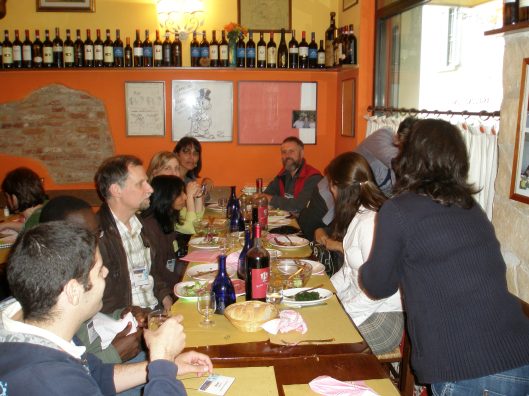
Each actual pattern is pretty elaborate, but I can give a few examples to illustrate the point. One of the Patterns is called “European Pub” which has activity around the edges and large tables. This helps people socialize. The activity around the edges gives people an excuse to circumnavigate the room. The large tables mean that there is room for “legitimate peripheral participation.” If I’m new in town, I can sit somewhat away from everyone but still within earshot. When someone says something I can relate to, I jump into the conversation. This arrangement is much more conducive to socialization than many American bars which feature stools all facing a TV. This does not encourage interaction.

Another Pattern points out that a small town near a big city should put its “center” placed eccentrically toward the city. This makes it more convenient for a larger number of commuters to stop at local stores on their way to the city and back.

These are both gross over-simplifications of the actual patterns, but I think they convey something of what is being aimed at. There is a belief that these patterns would generally “work” in any religious, cultural, geographic, or political context. These patterns are really meant to focus on the invariants across a large number of details. In that way, they make design problem solving more effective. You will be less likely, so goes the claim, to be exploring parts of the design space that are far removed from optimal if you think about things in terms of these patterns.

A “Pattern Language” purports to take a useful middle ground. The patterns are abstract enough to be widely useful but narrow enough not to be meaningless. A “Pattern” is the named solution to a recurring problem. A “Pattern Language” is a lattice or web of Patterns that largely covers a field. Christopher Alexander coined the term after he and his colleagues went around the world to see what “worked” in terms of city planning, house design, building design, neighborhood design, the building process and so on. I think nearly everyone will find “A Pattern Language” a fascinating book.

The impact of A Pattern Language, however, extends far beyond architecture and urban planning. People have found the concept of a “Pattern Language” useful in many other domains. Perhaps the best known such domain is in Object-Oriented Programming with the so-called “Gang of Four” authoring many of the original books on the subject. Other domains which have been addressed with “A Pattern Language” include pedagogy, human-computer interaction, change management, e-business, sustainability, and how society might evolve.

I became interested in Pattern Languages at least 20 years ago and have since co-organized and co-led a number of workshops on patterns in “Computer Human Interaction” as well as “Socio-technical Patterns” including working on patterns for “Liberating Voices: A Pattern Language for Communication Revolution” and chapter 19 in John Carroll’s book on design rationale, “Patterns for Emergent Global Intelligence.”


In 2017, I recounted in this blog  childhood memories and how they relate to what is happening in today’s world. To summarize briefly, we have great opportunities as a species but we are also in a train wreck of trouble! We seem trapped in a nightmare of a comic farce, but one which has tragic consequences of potentially epic proportions; e.g., atomic war or having the USA walk away from the Paris accords on climate change. Is anything to be done?

IMG_1245

What I want to accomplish in the first half of 2018 is to generate interest in the beginnings of a socio-technical “Pattern Language” that can help us get back on track again. I’ll post some of the ones I know about, but I’d be very interested to work with people on other suggestions.  In most cases, even when I post patterns it will be the case that I did not “invent” the patterns from first principles or construct them myself. In the same way that Christopher Alexander and his team main observed what worked and only then attempted to codify generic best practices into a “Pattern Language,” I also found many of these from observation or reading other sources or both. For example, the patterns, “Who Speaks for Wolf?” and “The Iroquois Rule of Six” are not by any means my inventions. I learned about them from the works of Paula Underwood. She was the “designated storyteller” of her branch of the Iroquois and provided an English transcription of the oral history of that branch in The Walking People. Indeed, I have argued that the “Walking People” basically developed a kind of pattern language in their oral history.

https://www.amazon.com/Walking-People-Native-American-History/dp/1879678101

https://www.slideshare.net/John_C_Thomas/the-walkingpeople

https://www.slideshare.net/John_C_Thomas/walking-people-analysis

A Pattern Language is a difficult business.  For maximum utility, each pattern has considerable thought behind it and is written into a specific form. In fact, at one CHI workshop, we developed an XML specification for patterns in Human Computer Interaction called (Pattern Language Markup Language) PLML (pronounced “pell mell”). I will not be quite this formal with the form of my patterns but will adhere as closely to it as practical. I do think that the form of the Patterns within a Pattern Language is important. Each of the parts serves a purpose and it is handy to know what role each part plays. For example, each Pattern has at least these parts: A Title,  (possibly subtitled), synonyms, a Version history, one or more Authors, an Abstract, a statement of the problem, a statement of the context in which the problem and solution arise and are appropriate, an analysis of the “Forces” at play, the Solution, Examples, the Resulting Context, Known Uses, Related Patterns, and References. For many people, having such a complex structure seems to be too much “baggage” but we must remember that design problems are themselves inherently complex. In addition to textual elements, the Patterns of Christopher Alexander include both photographic images to “set the mood” and, typically, at least one diagram to illustrate the general nature of the pattern.

The domain I am most interested in developing a Pattern Language for is perhaps most often labelled as a “Socio-technical Pattern Language.” These would be a collection of patterns that would help people cooperate, collaborate and solve problems together. Although the fabric and texture, perhaps even the scent, of endeavors would depend on culture, the field, current events and a host of other factors; however, the form of these solutions to recurring problems would remain roughly constant.

Next up: An Example. “Who Speaks for Wolf?”

—————————————————————————

https://petersironwood.wordpress.com

Happy New Year!

01 Monday Jan 2018

Posted by petersironwood in America, apocalypse

≈ Leave a comment

Tags

advertising, civility, cooperation, greed, innovation, life, media, religion, social media

PicturesfromiPhoneChinaParisPrinceton 174

It’s not really the champagne or the fireworks that make New Year’s special.

Many people around the world, in their own time zones, celebrate New Year’s. Precisely when depends on where you live and to a large extent, the major religion in your area. Some people tend to celebrate in the Spring; others in the Autumn; many around the winter solstice; and a few traditional cultures celebrate the new year in the summer. Some of the traditional calendars are based on 12 lunar cycles which does not make a full year so their “New Year’s Day” shifts over time relative to the Gregorian calendar.

It’s easy to get lost in the details of the differences among traditions, cultures, and religions. But what I find remarkable about New Year’s is not the fact that there are differences across the world. What I find both remarkable and heartening is that many different cultures in many different countries have some kind of “New Year” celebration; that people across the globe recognize that time has a cyclical as well as a linear aspect; that people everywhere recognize the importance of new beginning and that special events are “marked” in some way and that these celebrations are shared by scores, thousands or millions of people across the planet.

earthfromspace

What I find even more wonderful is that people across the globe are able to learn something about other people and cultures. Right now, at the beginning of 2018, there are some few extremely greedy people who want to play on your hate and fear of anyone and anything that is different. They want to enhance your ignorance and play on your negative emotions for one and only one reason — to cheat you out of your freedom and therefore your life. Make no mistake about it. There really are dangers in the world and for best results, you really do want protection from those dangers — protection for you and for your family. Some of those people who threaten you do speak different languages or do practice or profess different religions.  But some don’t. Some people who are threats may dress differently or eat different kinds of foods. But some don’t. Basically, all those people across the globe are very much like you. And, just like you, they too need to understand that some of their leaders are also trying to steal things away from them and in order to do that, they want to make their followers believe that you and your kind are the threats and dangers.

Chances are much greater than 50-50 that if you were suddenly set down in the middle of a completely different culture, you would eventually be accepted and even welcomed. Why? Because people are fundamentally similar. However, people “getting along” is not in everyone’s interest; it’s only in the interest of the vast majority of human beings on the planet. Those who have positions of power and no real leadership skills to help “grow the common pie” will instead try to arouse your feelings that other people are trying to steal your piece of pie. If you cede your freedom to such power brokers, they promise they will protect you from these “others” who are trying to steal your pie. Instead, it is these very people in power who are out to steal your pie and add it to their considerable stack of pies — more than they could ever possibly eat.

IMG_9803

Here’s a secret though. The people who are inventing new pies; the people who are sowing wheat to make new flour for pies; the people growing the berries; the people actually baking pies — we are all very similar regardless of dress, language, religion, or customs. People in power are absolutely terrified that the rest of us will all discover the extent of the emperor’s nakedness and call it out for all to see. Those in power would hate to see a true meritocracy because they have very little skill when it comes to any aspect of actually making pies. By and large, their only skill is to make you fear that others are out to steal your pie. If everyone else becomes friends and colleagues across the globe, there is no more reason for the power-hungry to rule you.

Meanwhile, people across the planet collectively have a huge amount of power. In some places, there are still free elections and those can be one way to change the world and exercise your own power. But it is not the only way. Whatever wealth you have, you will have some choice about where to spend it. What if everyone rewarded companies that are ethical and punished companies that do unethical things by refusing to spend money on their product and services? What if people refuse to give up the hours of their lives for working for companies that act unethically? Would you be willing to take a 5% pay cut to pay for a company that believes “ethics” is not just a training exercise for underlings but also applies to the top executives of the company as well? How about 25%? Would you be willing to blow a whistle on corporate crime? Would you be willing to buy local product and support local services unless and until large multi-nationals behaved like good citizens? Are you willing to refuse further increases in productivity until there is a plan in place to share the gains in productivity between workers and those who own the companies? A world-wide or national strike would cause people to take notice and eventually change business practices.

IMG_7660

Last year, I wrote a long series of blogs about some of the root causes of divisiveness in America — though much of it applies equally to other countries in the world. There can be changes to social media, for instance, that could make it more of a force for unity and good and less a force for maximizing advertising dollars. Yet, none of the three social media companies I use most: LinkedIn, Facebook, or Twitter have asked me (or, so far as I know, any other user or citizens in general) what I would like to see different about their policies, procedures, and principles. We don’t have to wait for them to ask though. We are their users and their customers. Right now, they mainly care about their advertisers because advertisers are very vocal about policies if it affects their pocketbooks. But you and I can be just as vocal about policies that impact our society as are the advertisers. Ultimately, the advertising dollars depend on you and I using these social media.

For instance, check out the “Terms of Service” for these social media. It’s not always clear what constitutes a violation, but it does seem very clear that these social media are free to use the content you created for their own profit and that includes any clever things you say, photos, videos and music tracks. On the other hand, if you post something that you don’t have legal rights to, you and you alone are responsible. The terms of service are not “negotiated” with you; they are a “take it or leave it” affair and they are aimed at protecting the company, not at protected our democracy or humanity in general.

https://twitter.com/en/tos

https://www.facebook.com/legal/terms?_rdr=

https://www.linkedin.com/legal/user-agreement

But we can change that. We can collectively pressure social media to make changes that we feel are in the best interests of humanity. And this does not just apply to social media companies. It also applies to Walmart and Apple and Amazon and every other large multinational. We don’t have to be purely passive recipients of what others deem is the most profitable way for them to do business. We can change the commercial world so that products and services work better, are safer, and that the profits of productivity do not just accrue to owners but to workers as well. Yes, we can.

And that would indeed be a Happy New Year.

IMG_3071 - Version 2


Author Page on Amazon

The Blog in Review

28 Thursday Dec 2017

Posted by petersironwood in America, family, Uncategorized

≈ 1 Comment

Tags

competition, environment, history, index, innovation, life, military, politics

IMG_0005

Year End Summary (2017) and Index of Peter S Ironwood Blog. (Several readers mentioned that the wordpress navigation structure may leave something to be desired. Hopefully, for some readers, the following index may be helpful). Many of these blog posts are not meant as the “final word” on these subjects. I am hoping people can use them as a “jumping off place” for conversation with their neighbors, students, and colleagues.

Trumpism is a New Religion. 

Astounded that more than 15 people voted for Trump, the year began with my attempts to understand my error(s). It was about this time that I saw more and more evidence that many Trump supporters were impervious to his most outrageous, incompatible, or nonsensical acts, tweets, and pronouncements. My explanation is that for some, Trumpism is really more of a religion than a political movement. This still seems correct to me. Others, have completely different reasons for voting for Trump. For some, for instance, I really think they have seen zero change in their lives regardless of who is President and they have seen promises never kept by both parties. As a result, for them, the President is seen as “Chief Entertainment Officer” and Trump provides plenty of that. In terms of a religion, Trumpism is much more compatible with the values inherent in modern day business than is Christianity. In essence, in fact, Christianity is incompatible with business values. So, it’s quite understandable that Trumpism has become popular.

https://petersironwood.wordpress.com/2017/01/09/trumpism-is-a-new-religion/

The Crabs are Biting. 

The next blog post returns to a retrospective look at some of my childhood experiences and thoughts about how these experiences shed light on current events. In this case, I recount various “fishing” experiences and how seriously children think about the world. Are fish the only animals that can be caught with bait?

https://petersironwood.wordpress.com/2017/01/17/the-crabs-are-biting/

Parametric Recipes and American Democracy. 

A parametric recipe is my term for recipes that allow for a variety of ingredients. I like to make omelets, for instance. There are many different vegetables and cheeses that can be incorporated. The exact ingredients and proportions don’t matter. But there are things you would never want in any omelet – toxins, poisons, and things that simply make you sick to your stomach. Have we forgotten what is unacceptable in a democracy?

https://petersironwood.wordpress.com/2017/02/11/parametric-recipes-and-american-democracy/

Big Zig-Zag Canyon. 

This post begins with a recounting of a hike on Mt. Hood, near Portland, Oregon (which coincidentally is one of my favorite cities). The post is about how one’s expectations can be wrong about just how hard things can get — over and over.

https://petersironwood.wordpress.com/2017/02/20/big-zig-zag-canyon/

The Invisibility Cloak of Habit.

With experience we learn. That’s the good news. In some cases though, our previous experience leads us astray. In fact, in some cases, our previous experience just about blinds us to what is going on right before our eyes.

https://petersironwood.wordpress.com/2017/02/25/the-invisibility-cloak-of-habit/

City Mouse and Country Mouse.

At least in the USA, I know that a spectrum of political opinions occurs everywhere but that one of the greatest correlates of differences is whether a person lives in a rural or urban area. I don’t believe one of these venues is, in every way, superior to the other, but it does seem that the different situations should logically lead to different values that work well in that venue. 

https://petersironwood.wordpress.com/2017/03/04/city-mouse-and-country-mouse/

Math Class: Who Are You?

It strikes me that part of what feeds pathological greed — and perhaps as well the greed that we all fall prey too — is partly the result of a serious misconception about who we are and our relationship to the rest of the living earth.  Here are some back of the envelope calculations to put things in a more reasonable perspective.

https://petersironwood.wordpress.com/2017/03/09/math-class-who-are-you/

The Great Race to the Finish!

Every human activity has both an instrumental/extrinsic value and an experiential/intrinsic value. In most cases, doing something as quickly as possible reduces its intrinsic value. It may or may not increase its extrinsic value although the financial interest behind the “Captains of Industry” always assume it does. Most of us are in something of a hurry most of the time. Why? Does it really make our lives more pleasurable? And, where are we rushing to?

https://petersironwood.wordpress.com/2017/03/24/the-great-race-to-the-finish/

Ripples.

Our decisions have long-lasting, perhaps eternal, consequences. Even mechanical ripples last a long time, but another human can multiply the input given a hundred fold so that the effect of any action can increase over time. Individual decisions can actually impact the evolution of the species as well.

https://petersironwood.wordpress.com/2017/04/11/ripples/

 Family Matters: Parts One, Two and Three.

A three part series exploring how the happenstance of our birthplace (over which we obviously have no control) has a huge and lasting influence on our lives.

https://petersironwood.wordpress.com/2017/04/30/family-matters-part-one/

https://petersironwood.wordpress.com/2017/05/11/family-matters-part-two-garlic-cloves-and-puffer-fish/

https://petersironwood.wordpress.com/2017/05/27/family-matters-part-3-the-whole-is-greater-than-the-sum-of-its-parts/

Claude the Radioman.

Claude refers to a toy soldier whose function was communication. As a small child, it was my least favorite because it had no weapon. As an adult, I think he has the most powerful one of all.

https://petersironwood.wordpress.com/2017/05/28/claude-the-radio-man/

Citizen Soldiers: Parts 1, 2, and 3. 

A three part series on the premise that, like it or not, we are all soldiers. Of course, it’s different to be in the actual military and be at a front. But, we are soldiers in the sense that we are at risk pretty much everywhere mainly from other human beings. We are soldiers as well in the sense that our actions are important determiners of the outcome. We need to be smart as well as loyal.

https://petersironwood.wordpress.com/2017/06/07/citizen-soldiers-1-early-enlistment-no-retirement/

https://petersironwood.wordpress.com/2017/06/16/citizen-soldiers-part-two-boot-camp/

https://petersironwood.wordpress.com/2017/06/24/citizen-soldiers-3-galoshes-in-the-gutters/

Pies on Offer: Rhubarb & Mincemeat.

Are you focused on grabbing the biggest piece of pie you can? Or, are you more interested in baking more pies and inventing new kinds of pies?

https://petersironwood.wordpress.com/2017/07/20/pies-on-offer-rhubarb-mincemeat/

What if … ?

A speculation that in reality, Americans have much much more in common with each other than they think they do. The politicians and the media both have a vested interest in making people think they are farther apart on more issues than they really are.

https://petersironwood.wordpress.com/2017/07/21/what-if/

If Only…

This is a work of “pure fiction” however — the protagonists and their “back stories” are true. This is a story that takes place in a nearby but parallel universe.

https://petersironwood.wordpress.com/2017/07/28/if-only/

Only You…

An examination of our responsibilities and the impact of our actions.

https://petersironwood.wordpress.com/2017/08/08/only-you/

You Fool!

A recounting of some of the many ways in which we humans are subject to being fooled.


https://petersironwood.wordpress.com/2017/08/15/you-fool/

Fool Me!

Mainly, this post focuses on the power of stories. There is an ethical difference, at least to me, between presenting a fascinating or inspiring story and presenting the same story as fact.

https://petersironwood.wordpress.com/2017/08/24/fool-me/

Me Too. 

This post is about the natural tendency of people to want to be part of a larger social action. Most people drive in stop-and-go traffic in a non-optimal way. This offers a better method.

https://petersironwood.wordpress.com/2017/08/27/me-too/

Too Much!

Human productivity does not go up monotonically with increasing stress. Studies have been around for decades showing that people are more productive working 30 hours a week than 50. Why do so many companies then push for 50 or more hours a week?

https://petersironwood.com/2017/09/03/too-much/

Much Lost.

Why do we grieve at the loss of another? Why do we even get attached to objects?

https://petersironwood.wordpress.com/2017/09/10/much-lost/

Lost Horizons. 

Have we modern humans lost our ability to make decisions based on a very broad, very long-term look? Doesn’t it seem natural for every generation of every species to try to make life better for the next?

https://petersironwood.wordpress.com/2017/09/17/lost-horizon/

Horizons University. 

What would it be like to build a University that focused on expanding a person’s horizons in every dimension they would be interested in? What if it focused on finding, and formulating as well as solving problems using existing knowledge and procedures?

https://petersironwood.wordpress.com/2017/09/25/horizons-university/

You Know. 

Which wolf do you feed? The “bad” wolf or the “good” wolf. Of course, sometimes, decisions involved complex trade-offs, but sometimes we “know” what the right thing to do is and instead do the convenient or selfish thing.

https://petersironwood.wordpress.com/2017/10/02/you-know/

Know What? 

The first of a series of blogs that considers how various aspects of social media, combined with anonymity, not having face to face communication (with its abundant affordances), the concentration of much of the media control in a few very large multi-nationals, the filtering and bandwagon algorithms of social media, and other factors all conspire to further divide people.

https://petersironwood.wordpress.com/2017/10/08/know-what/

https://petersironwood.wordpress.com/2017/10/16/whats-new/

https://petersironwood.wordpress.com/2017/10/23/new-fools/

https://petersironwood.wordpress.com/2017/10/31/fools-gold/

Gold Standard.

Every age has its pluses and minuses. Some folks today seem to feel we’ve moved too far too fast and that we should “rewind” to a better time. Interesting, but there hasn’t been a better time. The world today is hugely complex and inter-dependent. That’s the way it is. If we try to obviate all that interdependence, we will not go back to 1950 or 1890 but back to 5000 BC. Instead, what can we do to encourage civility and to distinguish news versus fake news?

https://petersironwood.wordpress.com/2017/11/07/gold-standard/

Standard Issue. 

What are some ways that social media could be changed to encourage greater civility?

https://petersironwood.wordpress.com/2017/11/13/standard-issue/

Issue Resolution.

Perhaps the experience of others was different, but I learned very little in formal school classrooms about ways to resolve conflicts. Yet, much is known beyond simple compromise, using external authority or force of arms. This posts focuses on some of those with pointers to longer descriptions of the techniques.

https://petersironwood.wordpress.com/2017/11/19/issue-resolution/

Resolution: Create! 

This post encourages a more creative look at issue resolution. I believe that more progress can be made by people working together than by even a 10x increase in Facebook posts to convince everyone else that they are wrong.

https://petersironwood.wordpress.com/2017/11/26/resolution-create/

Create Peace.

First of a series of blogs about the pros and cons of war and peace. Spoiler alert: war is a horrible option. We really need to get our act together to do better. People sometimes have trouble reaching agreement, but that process should be facilitate by diplomatic experts and leaders who are looking at the big picture. Some so-called “leaders” are intent on consolidating and extending their own power. Historically, that’s when power-hungry people declare war. Some might label such people SHRUGS – Super-Hyper Really Ultra Greedy Swindlers.

https://petersironwood.wordpress.com/2017/12/05/create-peace/

https://petersironwood.wordpress.com/2017/12/13/peace-love-part-one-casualty-count/

https://petersironwood.wordpress.com/2017/12/14/peace-and-love-part-2-shrugs-shills/

https://petersironwood.wordpress.com/2017/12/16/peace-love-3-shrugging-off-the-shrugs/

https://petersironwood.wordpress.com/2017/12/20/love-all/

All…what? 

Where are we headed? Is there any hope? I would say yes though we are in dark times. The light will return, if not today or tomorrow, some day.

https://petersironwood.wordpress.com/2017/12/25/all-what/


author page on Amazon

IMG_0561

All…what?

25 Monday Dec 2017

Posted by petersironwood in America, apocalypse, psychology, Uncategorized

≈ 1 Comment

Tags

collaboration, competition, cooperation, fascism, fear, greed, hate, learning, life, love, science

IMG_9070

Humanity finds itself in a new place. In evolutionary terms, we could say humanity suddenly finds itself in this new place. Life on earth, by best estimates is 4.75 billion years old. It’s easy to imagine, as a person, that the whole point of evolution is us. I don’t really see any reason to believe that. To the dolphin, deer, dog, dodo, and dinosaur, every one of their lives are every bit as precious to them as ours are to us. I do not even think humans are the “smartest” species on earth, at least, not in any absolute sense. We are the smartest in the directions of thought and behavior that humans find useful. So far as we know, we are the only species who has the information to know that our collective behavior can destroy us along with a lot of the other limbs on the giant, diverse tree of life and yet, here we still are, with atomic weapons, not pointed out defensively against invasions from outer space but pointed at other people on the planet. How could we possibly think we are the smartest species? Even if we avoid that kind of catastrophe, we still face dangers from over-polluting the planet, over-heating it, over-populating it, over-fishing and being over-hating. Indeed, this is nearly the darkest day in the darkest year. Is there reason to celebrate?

I think there is. In the blink of an eye, in evolutionary terms, we’ve managed to migrate across the entire planet. People live in tropical jungles, hot desserts, and in the frozen tundra. We’ve developed tools of thought and tools of trade and ways of dividing labor and communicating. And, now, although many people still do not have access, we have a communication network that spans the globe and we can communicate to some degree with people of different religions, cultures, languages, and experiences. We have vast networks of trade. We’ve come a long way.

OLYMPUS DIGITAL CAMERA

OLYMPUS DIGITAL CAMERA

Yes, there are a few greedy people who, like Voldemort, cannot or will not experience love or its benefits. Instead, they have convinced themselves that everyone is out to get as much as they can for themselves (or, if some people aren’t on that program, they’re just stupid, in the view of the greedy). In reality, only a few people are completely hooked on greed and power. They do not see other human beings as partners, or colleagues, or fellow explorers in this vast world before us — a world that still has billions of unfound discoveries. Indeed, we have even built machines to help us make new discoveries. And, if we don’t change trajectories, we may make far fewer discoveries than we might. Of course, it isn’t just the people completely hooked on greed that are accomplices in humanity’s direction toward greed. The alternative is to think quite consciously about our decisions in terms of who we invest in, what product we buy, how we talk with our neighbor, how we ourselves do business. We ourselves can make choices that move us toward greater cooperation rather than necessarily choosing only on the basis of immediate cost/benefit analyses. Then, and only then, can we turn the world to kindness and discovery.

Despite our many advances, we have yet, for instance, to have conquered cancer; we have yet to conquer war; we have yet to conquer hate and fear. You see how easily, in fact, the metaphors of war pervade our thinking. It is possible that we don’t need to “conquer” cancer, war, hate or fear. Maybe, we just need to let them go. Maybe if we understand these things sufficiently, they will dissipate. Maybe these four things all required quite different approaches from anything that has yet been tried, and possibly all require a different approach from each other. But my reflexive approach is to state this in terms of “conquering” – that is, winning over an enemy rather than winning over an enemy.

OLYMPUS DIGITAL CAMERA

OLYMPUS DIGITAL CAMERA

Perhaps, instead, the right approach to conquering cancer is not to “destroy” cancer cells but to re-integrate them into the society of the body. Perhaps they have been disillusioned that being part of the whole (body) is working for them. Maybe there is a way to “convince” them not to be cancer cells but to revert to what they were before cancer began.

Or, maybe we put something on an edge of the human body that has more of what the cancer cells “want” then anyplace within the body and let them “migrate” to the edge (and out of the human body — the “Pied Piper Approach”).

Or, perhaps, apart from pollution, a huge reason for cancer is that people are so busy so much of the time that they are not “noticing” teeny cancers within them. Perhaps people can be trained from birth to notice cancer cells and to send an overwhelming immune response before its too late. It sounds a bit absurd, but is it really? People can learn to “turn on” a single neuron in their brains with proper feedback. Is it really so far beyond the pale to imagine we could train ourselves to mount a targeted immune response?

IMG_9333

Perhaps all of these approaches might work and perhaps none of these approaches would work. The point is, that we need not reflexively think that “armed conflict” and “destruction” are the only methods that work to change the world. Many biologists think that the “nucleus” of our cells as well as our “mitochondria” were originally different organisms that started living symbiotically inside our cells. Is it too much to imagine that we could some day control the process of cells mutating and do it for our benefit? It seems absurd and ridiculous from the perspective of our knowledge today. And, yet — what would have our common ancestors on the African Savannah have thought 1,000,000 years ago if we could have explained to them that someday we would have machines that fly us around the globe — and to the moon? Or, how would they have reacted to the idea that we would have a network allowing us to communicate around the globe; that we would build machines that enable us to look into the workings of cells or the far reaches of the galaxy; that we would build fantastically beautiful musical instruments and that we could share music and ideas and stories across this earth; or that many people in our world die from having too much to eat!? 

It is quite possible that a century from now, people will very seldom die from cancer — or any other disease. In a similar fashion, we may well be able to set aside, recommission, redesign, or simply let go of war, hate, and irrational fear.

But none of that will happen unless we collectively decide what we want to be when we grow up. Because, as a species, despite wonderful achievements, we are still adolescents, at best. There are many tyrants in the world. Tyrants, as I’ve explained in prior postings, hate love and hate the truth. They really need war for cover in order to stay in power. Love complicates things. It’s just too unpredictable for people who want to be in control of everything. People’s reactions to absolute power wielded without ethics are much more predictable. Under enough painful torture, anyone will say anything 99% of the time. Of course, nothing positive and growth oriented ever comes from hate and fear alone. Only love moves life forward. Only love creates a more beautiful earth for our descendants. Only love discovers new beginnings, offers new ideas and new approaches. Beyond love’s instrumental value, more importantly, a world run by love is a world that feels good most of the time while it is happening, moment to moment. Of course, even in a world run largely by love, you will stub your toe or lose a friend, but most of every day’s activities you spend doing something because you feel as though you are making a contribution to something beyond yourself.

OLYMPUS DIGITAL CAMERA

OLYMPUS DIGITAL CAMERA

On the other hand, in a world run largely by hate and fear, the momentary experience of almost everyone almost all of the time is miserable. You are basically snarling or sniveling with every communication. Naturally, even so, there will be moments of joy, but it will never be unmarred because joy will either fall prey to guilt, or even worse, spend so much resources defending against guilt that life will become gray and pointless. Every day, most of the time you are doing what you’re going because you feel as though you’ll be badly punished if you don’t.

Does it make any sense then, to have a society run by the very greediest people among us? What if the only reason they are so greedy is because they don’t experience the full spectrum of human emotion that the rest of us do? What if a huge part of their greed is actually specifically and quite consciously designing and demanding a society run by hate and fear?

Why? Because they themselves don’t feel love and they don’t want others to be able to in an unrestricted way either. They are jealous and the only way they see to avoid being faced with their own shortcomings is to reshape the world so that no-one can express love openly and fully. I am not talking only about restrictions on sexual partners. I am talking as well about artistic expression, a free press, scientific exploration, and education. Everything is subject to restriction in a dictatorial society. Love is the source of exploration. It cannot be fully functioning under a dictatorship.

And what about Christmas? What about the solstice? What about the light and the dark? I do believe we now live in much, much darker times than most people realize. We are, in one of three states: 1) we are like one of the beginning scenes of the Star Trek prequel where Kirk speeds a stolen car towards that he does not realize is a deadly chasm. At the last moment, he tries to skid sideways to a stop, leaps from the car, begins to totter over the side and holds on by his fingernails — then clambers back up. 2) we in the same scene but this time, our foot hits the door an inch to the left and we don’t quite make it. 3) we are like the road-runner cartoon character who has just run straight off a deadly cliff but his legs are still windmilling and for a short time — he appears to be running, and does not fall until he looks down and realizes he is no longer on solid ground.

OLYMPUS DIGITAL CAMERA

OLYMPUS DIGITAL CAMERA

Well, it’s Christmas Day for me. And, the winter solstice has passed. The darkness really is receding and the daylight is encroaching on that darkness, minute by minute. We humans have had some dire times before and gotten through them. That doesn’t prove we’ll survive this Age of Greed, but I think it possible, perhaps even likely. But we must put the brakes on now. We must jump very carefully. And we must hold on for dear life.

We must hold on to each other. We must hold on to ethics as something that matters. We must hold on to the thought that, ultimately, we are all in this together. We must hold on to the thought that we are much more alike than we are different regardless of what customs, clothes, and food we prefer. We must hold on to the realization that a few greedy people cannot really rule the world, unless we participate with our own greed, fear, and hate.

We can pull this off. Instead of being the despoilers of the planet, we will make it ever more beautiful. Eventually, we will be “in tune” again, with nature and each other. How precisely to make this happen isn’t clear and no two people would probably approach it precisely the same way. Nonetheless, if we work together as best we can, keep discussing our differences in a civil way, and make as many decisions as we possibly can with at least a thought to the greater good, we will make it.

IMG_3071 - Version 2

Merry Christmas.


Author Page on Amazon


Love All.

20 Wednesday Dec 2017

Posted by petersironwood in America, psychology, Uncategorized

≈ 1 Comment

Tags

competition, creativity, innovation, learning, life, military, politics, science


IMG_5197

Love All. Hmm.

I don’t feel very loving toward people who are SHRUGS and pretending to be SHILLS, especially when they are using the trust we gave them as being public officials not to betray their country’s interest. Is there really a way to love all?

I think it is quite possible to love the totality of something without loving each and every part. A person might, for example, love their body but hate that big mole. They might really like their car but hate its squeaky rattle. They might love all of humanity yet hate so much of what one person does it is impossible to feel love for that part of it. At least I feel that way. I love the forest but hate deer flies, though it is a qualified hate. Once I’m back indoors, I don’t dwell on the fact that they’re still out there sucking blood from deer or hikers. There is a bit of humor and even admiration for the damned things. You would think it would be pretty easy for humans to outsmart them and yet…they are very hard to catch. The one trick I did develop was to wait till they landed on the back of my neck and then smack them quickly with my hand, stunning them. When they awoke, I would explain to them that if they didn’t immediately cease and desist, I would crush them. But they never responded so I crushed them anyway.

There are several aspects of love and one is understanding. They are not equivalent of course, but understanding seems good in any case. I can reach the point of trying to understand deer flies or SHRUGS. Beyond that, I cannot go.

IMG_3193

Teddy Roosevelt is famously purported to have said, “Speak softly and carry a big stick.” Let’s examine this a little further in the context of contemporary international relations. The United States is, or at least was until recently, the “world’s only remaining superpower.” That’s what we told ourselves. We certainly spend the most of any country on the military. Our military strength is also built on having a well-educated populace, superior technology, excellent training, and, considering that the military has a “military culture,” it is fact-based. After operations, initiatives, mistakes, successes, the military conducts “after action reviews.” In other words, there are mechanisms in place, to realize that human beings make errors and the important things are to try to avoid them and then to learn from them. The military, like much of American culture, strives to be a meritocracy.

How on earth does it make sense to “shout loudly and carry a teeny stick.”? But at least some of the SHRUGS seem hell-bent on just such a course. There is certainly a lot of “shout loudly” but isn’t there a promise to spend more on the military? Yes, but — superior military depends on many things besides money. It depends on having superior technology. Having superior technology depends on, among other things, attracting the best minds from around the world to a country they find attractive and accepting. Executive orders already made many people feel less welcome. This was followed by a Congressional-sponsored Theft Bill which made it virtually impossible for anyone but the richest to attend graduate school.

IMG_7320

Strike One. Notice, I did not say the most able, or creative, or hardest working. No, the richest. Well, apart from the mind-numbing unfairness and transparent self-interest, it is a death sentence to the USA having a long term lead in biotechnology, computer science including cryptography and cybersecurity, nanotechnology, and artificial intelligence. Breakthroughs in any one of these fields could render our nuclear arms useless or worse (e.g., our systems “think” they are launching to other targets when in fact they are all aimed at other cities in the US). That’s Strike One.

Strike Two. And in every other branchlet of the executive, the message has gone out loud and clear that promotions and possibly even firings will depend more on loyalty and less on merit. These government agencies will necessarily be less effective and as the general quality of the career public servants plummets, the few remaining effective people will become more and more frustrated and also leave making the race to the bottom of quality all the faster. These other branches of the executive include many that have a direct impact on the quality of the military.

IMG_9136

Strike Three Believe it or not, it matters what people feel they are fighting for. If all of what America “stands for” is unbridled greed so that more and more of the world’s resources can be funneled without objection into the pockets of the world’s richest, the soldiers don’t really care to go the extra mile. Why should they?

So the combination of these three factors: damaging science, making government inefficient, and destroying morale will weaken the military in its effectiveness but increase the chances of a world-destroying mistake.

So, yeah, I can’t quite get there yet with the “Love All.”


Author Page on Amazon


Peace & Love 3: Shrugging off the SHRUGS

16 Saturday Dec 2017

Posted by petersironwood in America, apocalypse, psychology, Uncategorized

≈ 9 Comments

Tags

competition, greed, life, peace, politics, war

IMG_5572

It might seem as though the answer is easy and obvious. But I don’t think it is. It might be nice if the SHRUGS disappeared from the earth one day. Getting rid of them through violence however, is not a particularly good idea. Violence against individuals is no more effective than war. It may well be true that SHRUGS “deserve” to die. On the other hand, they exhibit a tendency that the vast majority of us have — to look out for ourselves first. Equally rare are those altruistic heroes who fall on a grenade to save their buddies. Most of us have both tendencies in us, but SHRUGS have completely killed within themselves any tendency to empathize or care about others. There may be inborn differences as to the balance of altruism and selfishness that we are born with. In addition, the way people are brought up probably also has a lot to do with how this balance plays out. People who experience unconditional love are more likely to grow up so that their natural connectedness to others prevails over greed, at least most of the time. Indeed, empirical studies show that people who are completely altruistic or completely greedy are rare. Most of us are somewhere in between and our behavior is much influenced by the situation that we find ourselves in, both in the short term and in the long term. That is why it is important, not only to raise children with unconditional love and teach them right from wrong, but also to have a society that encourages and rewards cooperative behavior over complete selfishness.

SHRUGS are, to a large extent, the product of being raised by other SHRUGS who will demean a child and try to dominate them in order to induce shame. The child grows up physically but not emotionally. They will in turn, tend to raise more SHRUGS and treat others, not as individual human beings with their own rights but as tools to be used with no more thought than you would care how a hammer “feels” when it hits a nail or how the nail “feels” when it is hit by a hammer. It is indeed, a very sad thing when a person (or even a dog or cat) is so mistreated that is lashes out whenever it can. SHRUGS need therapy; perhaps even love. But don’t expect to “fix” them. They also need to be contained. Your two year old might have a temper tantrum in the grocery store when they are denied a piece of candy they see. It is not a good idea to give in to them thereby reinforcing the display of immaturity. But it doesn’t mean you need to shame them, humiliate them, beat them, or stop loving them. But you are the adult. You need to make sure they understand that screaming, crying, and smacking anyone around is not going to result in their getting their way. The very worst thing to do is to tell them they can’t have the candy; let them continue their temper tantrum; and then finally give in. This teaches them that they can always get their way if they are persistent enough.

IMG_8483

As the SHRUG gets older, they may find that they enjoy bullying other children regardless of whether they actually succeed in reaching any goal other than making the other person feel bad. This is much like a kind of “reverse empathy.” The more they make someone else feel bad, the better they feel. Sometimes people like this become skilled in athletics but never learn true sportsmanship. They never respect, but only disrespect their opponents. They never seem to understand that without a worthy opponent, there is literally no sport and no-one would pay to see them. On other occasions, the SHRUG may become a law enforcement officer. And, by the way, most police officers are not at all like this and actually want to help the public. A few, however, will enjoy beating the “truth” out of a suspect or forcing them to assume humiliating positions or actions, such as crawling. If the suspect fails to comply, they may be shot dead on the spot. Other SHRUGS will simply become accountants, sales people, or doctors. But they are not really all that interested in accounting, sales or doctoring. What they really want to do is move up the hierarchy so they can “lord it over others.” You seldom see a SHRUG working as a single stand-alone contractor, accountant, sales person, or doctor. If they do, they will have limited success because they will simply alienate their potential customers. Most people do not really like interacting with a SHRUG. A few people, however, like being dominated by another because it is clear what they are supposed to do; namely, whatever the SHRUG says. Giving in to a SHRUG simply makes them all the more SHRUGish and set in their ways. Nonetheless, in a society where a sense of fair play is very common and where love prevails, a SHRUG will not get to far unless they manage to become perceived as a SHILL by others. (The SHRUGS themselves always see themselves as SHILLS, but for the most part, others do not see them that way. Most people “see right through” most SHRUGS.

SeaMonkeys


For people who judge others, not on the basis of actual behavior, but on the basis of superficial markers, however, SHRUGS may tend to be perceived as SHILLS. If a SHRUG is particularly popular, or beautiful, or athletic, or rich, or powerful, or wears extremely expensive clothes people who would like to have those things for themselves will tend to view the SHRUG as a SHILL. In times of war, we are often bend over backwards to perceive SHRUGS as SHILLS. But even in times of peace, it is possible, as explained below. Since truth is the first casualty of war, however, it is particularly in times of war that we may sometimes consider SHRUGS as SHILLS. Such folk often end up, for instance, arguing that torture is justified in order to find out vital truths to save the lives of “good people” at the expense of the pain of the “bad people.” Torture is actually quite effective, but not at getting at the truth. It is quite effective at getting people to say what you want them to say. This makes it especially valuable for SHRUGS trying to convince people that they are actually SHILLS. They will ensure that whoever is tortured will add evidence to the narrative that makes SHRUGS appear as SHILLS or even Heroes. In a similar vein, SHRUGS do not particularly care for the rule of law. In the same way that they believe that sweeping away all the chess pieces and declaring themselves the winner is just fine, they also believe sweeping away all sense of fair play and justice is just fine too.

Perpetrating violence and breaking the law in order to destroy SHRUGS is therefore, in effect, playing the same “game” as the SHRUGS. So, here is the crux of a dilemma. If you allow the SHRUG to have their way, they will simply take more and more over time and come more and more tyrannical over time. However, if you destroy the SHRUG by violence, you simply replace one SHRUG with another. Thus, the violent overthrow of the Czars in Russia led fairly quickly to Lenin and then to Stalin. The violent overthrow of the corrupt Chinese government that perpetuated vast inequality in China led to Mao. The French Revolution led, at least initially, to a bloodbath that went far beyond actual SHRUGS to anyone even associated with the so-called Noble class. Eventually, all of these regimes became more democratic though in varying degrees.

IMG_7660

In the case of so-called Western Democracies, people must work to depose whatever SHRUGS are in power, not through violence, but through whatever legitimate channels still exist in that particular democracy. This is hard work and needs to be smart work as well. It involves communication, and it involves understanding. One must understand both the SHRUGS and their supporters. The grievances that underly their supporters must be addressed. That does not mean that if workers are convinced that the only way to insure that they get a good job is through misogyny or racism that everyone else gives in to misogyny or racism. But everyone needs to look beyond the misogyny and racism and understand the disappointment, failure and frustration that lead to these dehumanizing beliefs.

In short, if you try to take the quick path and unseat a SHRUG by violence and hatred, you’ll only succeed in spawning the conditions for even more SHRUGS to arise. It’s much like trying to fix a broken arm by amputation rather than setting the broken bone and allowing it to heal. Once again, the path to lasting peace and love is through the clever and judicious use of peace and love and not by war and hate, even if undertaken to ensure that the society be run in a just and cooperative way. A key component is to communicate fully and effectively.

SHRUGS can be voted out of political positions. This is an important power to exercise, but it is not your only one. You can choose how to spend your money. You can choose to whom you give your labor. You can choose which products you buy. You can choose what you say to your friends and family. You can model kind behavior. Once you think about it, just as there are millions of cells working together to shrug your shoulders, so too, millions of people working together can SHRUG off the SHRUGS.

IMG_3066

—————————————

Author Page on Amazon

Peace and Love, Part 2: SHRUGS & SHILLS

14 Thursday Dec 2017

Posted by petersironwood in America, apocalypse, psychology, Uncategorized

≈ 2 Comments

Tags

Business, competition, family, greed, life, peace, politics, religion, war

(This is the second in a series of blog posts about Peace, Love, and the pros and cons of war and peace).

fullsizeoutput_11fd

Two trillion dollar wars with little to show but dead bodies. But at least America learned its lesson. We will never again elect someone with a financial and political interest in having the nation go into a needless war. Whew! Finally. But wait a moment. We already are in a war. A cold war. And by a “cold” war, I mean a war that is not being waged against an enemy on our borders ready to cross over with warm bodies. I mean, we are in a war in which the enemy without is in cahoots with an enemy within. And, it is a cold, long, and calculating war. America, or what’s left of it, is fighting a war on two fronts. (Silly, silly Napoleon; silly, silly Hitler). On the one hand, we are being attacked from the outside by Russian leaders who would like to divide and weaken Western democracies of every stripe. Main targets are the UK, American, and Germany, but others will have their turns as well. Their goal is to consolidate their power within and to strive once more toward world domination.  I’ve already addressed the divisiveness that arises from the way social media work combined with outside influences pushing on leverage points. This might be a moderately effective method of waging war with pretty much zero Russian casualties and only moderate expense. However the war is made much more effective by having a second and internal front. We have far right “parties” within Western democracies that are aiding and abetting these enemies by dividing the countries with hate speech, fanning the flames of fear, executive orders, laws and, at least in America, the infestation of the federal government with incompetent administrators who will do everything in their power to ruin all that is good with the federal government including public education, research, fair-minded judges, public lands, and so on.

In the short term, most of these internal allies of the external enemies are not really doing it to “Make America Grovel Again” but are doing it to satisfy a few extremely wealthy donors. The extremely wealthy donors want your wealth and my wealth. This is not a recent phenomenon. Extremely greedy people are never satisfied. If you are like most people and you see that there are ten people at the table and ten donuts, you would take one for yourself and leave nine for the other nine. But extremely greedy people would be inclined to take all ten. Then, there are the ultra-greedy and they would not take all ten. They would convince you that they have 100 donuts for each of you. Unfortunately, they need to eat all ten of the first batch of donuts themselves for right now. Then, they need you to go out and make 1000 donuts. They will give you all the equipment you need to make 1000 donuts. When you spend a week of your time making 1000 donuts and then bring back the 1000 donuts to split, they will actually take 910 for themselves and give you 90 donuts to split among the other nine people. It seems a little unfair, but you are still better off, right? Before, you would have only gotten ONE donut. Now, you get 10 donuts. A definite improvement! And that is what capitalism is all about. Until lately. (The article below tends to blame the growing inequality of wealth on new technology, but I believe that is secondary to the new (im)morality.

https://www.huffingtonpost.com/nathan-newman/great-decoupling-of-wages_b_7451212.html

Now, we have a small number of hyper-ultra greedy people. They will make the same deal and take all ten of the original donuts for themselves. After getting you to use their equipment to make 1000 donuts, they will give you only half a donut each. They will tell you that if you want a whole donut, you’ll have to figure out a way to make 2000 donuts first. So, you and your nine co-workers put your heads together and figure out a way to make 2000 donuts instead of 1000. Now, when you come back with the 2000 donuts, you will get 1/9 donut each. The hyper-ultra greedy will take 1999 of the donuts and let you and your coworkers split the one remaining donut. If you happen to be a female donut-maker, he might promise to give you a donut but only if you have sex with him first. You must understand one thing. They don’t feel bad about doing this. They just think it is their right by virtue of their being “smarter” than you are. They think they deserve all the donuts, and they are actually being quite wonderful to let you have a whole donut in return for sex.

IMG_9845

In America, until around 1970, productivity gains were split between — on the one hand, the workers who largely invented new technologies, techniques and methods; learned the new techniques and skills — and on the other hand, the people who owned the means of production. Since 1970, the greedy have been, through mergers and acquisitions, mostly replaced by the hyper-ultra greedy. Unions, environmental safeguards, safety regulations, inspections, and the right to vote are now all under attack. The hyper-ultra-greedy are now being replaced by the super-hyper-really-ultra greedy who not only will take every last frigging donut you produce, but they have no qualms whatever about making you do it in a way that makes you burn every last one of your fingers off. They have absolutely no qualms about making sure that you have no time or energy left to learn a new trade. They have absolutely no qualms about making sure that your children will also be making donuts for nothing and getting your “chicks” for free, even if those particular “chicks” are only 13 or 14 years old.

IMG_1245

Most of us do not actually meet these people face to face and our experience is with other people like us so we find it hard to believe that someone would be that greedy. Of course, making donuts is not their only business. They also hire people to put on their make up, write speeches for them, handle publicity, write up fake stories about them, broadcast for them and otherwise make you think that they are just ordinary folks like you but more successful because they are smarter. They aren’t smarter. They just refuse to play the game by the rules. They don’t really view what they are doing as “lying” because for them, truth doesn’t matter. While most of us are involved in a giant cooperative enterprise of trying to find more truth about the universe and tell each other so we can all collectively make better decisions about how to make more and better donuts for everyone, they are only concerned with themselves. They do not think of you as “another human being” but as a tool to be used in whatever way is most efficient to meet their ends. While they don’t care about the truth, they do care about “communicating” which for them means manipulating you into doing what they want. (By the way, please realize that not all extremely wealthy people are SHRUGS and not all SHRUGS are necessarily wealthy. It isn’t the amount of owned wealth that defines SHRUGS; rather what defines SHRUGS is their attitude toward ethics and particularly their base belief that stealing everything from others while claiming to be working for the good of all or doing “God’s work” is perfectly natural.)

IMG_9803

These are deeply flawed human beings. Why? Because without you, they are, for the most part, completely unable to make or find even a single donut on their own. They are ultimately so greedy that they are killing “the goose that lays the golden egg.” Currently, they are doing everything in their power to divide (at least) America according to race, religion, national origin, sexual orientation, etc. Their goal is to redirect the anger you quite naturally feel at working harder and getting nowhere toward women, minorities, foreigners, etc. and away from the SHRUGS themselves. These super-hyper-ultra greedy people are unable to function without your active cooperation. So, it’s really important for you not to realize just how much you are being taken for a ride. Some of them may realize that their actions are also greatly helpful to the destruction of America as a world leader. But mostly they don’t really care much about that because they are convinced they will have even more power under, say, Russian rule.

IMG_5159

This is actually quite a humorous miscalculation. As soon as America’s role in the world is sufficiently diminished, the super-hyper-really-ultra greedy (SHRUGs for short) will be the first to go. They will be the victims of the first Putsch. Why would the super-hyper-ultra greedy among the Russians not replace the American super-hyper-ultra greedy with their own? Of course they will. If American SHRUGS took as long as two minutes to actually think about it, the American SHRUGs would realize this is exactly what they would do if they took over Russia (or any other country). In point of fact, when banana Republic dictators do not go along with American orders, they are eliminated in the same way. So, all the facts and history are there, but you need to understand that the power and position and privilege that American SHRUGS enjoy ultimately gives them an extremely warped view of their own abilities. They come to believe that they are not SHRUGS but a different species altogether: SHILLS (Super-Hyper Intelligent Lovely Leaders). SHRUGS, in fact, need not be particularly intelligent at all, but they do gain that illusion. It’s easy to see why. You play a game of chess with a SHRUG. You play by the rules. You are about to win when the SHRUG knocks all the pieces on the floor and yells, “I win!” When they do this enough times, they come to think that they actually are a very very shrewd chess player. It sounds crazy and it actually is in the sense that their perception of reality is completely divorced from it.

The second to go will be those unwilling or unable to be slaves to the new set of masters. If you care to live a long life, you might want to start learning Russian now. In the meantime, we might yet be able to prevent the SHRUGS from taking over America. But if the control of the SHRUGS persists even for another year, they will disenfranchise enough Americans so that there will never be another fair election. They will make many more things illegal and exact horrific penalties for minor crimes. They will put in place judges who will exact punishments depending on people’s political views. They will prevent more than a few more people from coming to America – particularly those who might not already be brainwashed into thinking the SHRUGS are really SHILLS.

What do we do about that? We begin to explore this topic in the next blog post.

(By the way, I do not believe that Russian people or the Russian nation is particularly prone to SHRUGS any more than America is. Trying to blame all Russians for the actions of the Russian SHRUGS is as unfair as blaming all the sins of American SHRUGS on America as a whole. Most of us would not approve many of the “dirty tricks” we end up playing on other nations in order to placate our own SHRUGS.)


Author Page on Amazon

Peace & Love, Part One: Casualty Count.

13 Wednesday Dec 2017

Posted by petersironwood in America, apocalypse, psychology, Uncategorized

≈ 3 Comments

Tags

environment, hate, learning, life, love, peace, war

Peace and Love: Part One (War Casualties).

(In response to suggestions from a few readers, I am trying a slightly new format of much shorter and more frequent posts; we’ll see how that works, for me and for readers.  Feedback welcome on that or anything else.)

IMG_5197

To some readers, “Peace and Love” reminds you, as it does me, of slogans from the 1960’s. It arose in response to the war in Vietnam which President Johnson led us into full-bore with a lie about the Gulf of Tonkin. That war produced over 58,000 American deaths.

https://www.archives.gov/research/military/vietnam-war/casualty-statistics.html

There were also more than a few American citizens who were wounded physically and a great many who were wounded mentally as well as their families.  It also resulted in millions of Vietnamese casualties.

https://www.britannica.com/event/Vietnam-War

However, the loss of lives did allow Vietnam to remain a free and democratic nation. Wait. Wait. No it didn’t. Vietnam became communist and sadly Vietnam was only the first “domino to fall.” Now, all of Asia is communist. Oh, wait. No it isn’t. I’m sorry. I’m confused. How could “the greatest” nation on earth spend nearly a trillion dollars (in current dollars) and kill so many lives and end up losing the war?

How Much Did The Vietnam War Cost?

mandibles

And how could the fall of Vietnam not result in Japan and South Korea and Singapore and India becoming communist once this first domino nation fell? What happened to the other dominos?  I’ll tell you how. In war, truth is the first casualty.

https://www.theguardian.com/notesandqueries/query/0,5753,-21510,00.html

We were lied to in order to get enough support to get us into the war and we were lied to continuously about the likely consequences of losing the war and about the progress of the war. What would our lives be like now in America, let alone Vietnam, if all the money we poured into the war had instead gone into advances in science, medicine, technology, infrastructure and education?

iPhoneDownloadJan152013 1150

Not only were there many protests about the war in America; there were actually candidates who ran mainly on a platform to end the war. Some may recall the names of Eugene McCarthy and George McGovern who ran on peace platforms. You may also recall that Hubert Humphrey, who had been Johnson’s Vice President obtained the nomination of the Democratic Party via shenanigans at the convention in Chicago. Meanwhile, the Chicago police beat up peaceful demonstrators outside the convention. Humphrey would have won the nomination, most likely, even if the people in charge of the Democratic Party had allowed the McGovern camp to speak their piece. I was so pissed off at the senseless violence perpetrated by the police against peaceful demonstrators that I found myself sorely tempted to vote for the Republican candidate in protest. He had a “secret plan” so he claimed, to end the war in Vietnam.

Richard Nixon did get voted in as President and I did vote for him even though I was skeptical that he actually had a secret plan. But he did! He did have a secret plan to end the war. The plan was to give up. Yeah, there were more deaths and more lies along the way, but basically his secret plan was to give up. Well, that and rely on “dirty tricks” to secure his power. I was mistaken to vote for Nixon. He was impeached and he was a liar and he was, despite his protestations to the contrary, a crook. (My “revenge” vote against the establishment of the Democratic Party didn’t really work.) However, whatever faults Nixon might have had, he was a paragon of virtue compared with #45.

David's DreamDeeply

At least America learned a good lesson. Before going into a costly war, we now make sure we know the real facts. And so, before Bush got us into the second Iraq war, Republicans and Democrats worked together to make absolutely positively sure that the Iraqis really did have “weapons of mass destruction.” Oh wait. I am so sorry. I got confused again! No, we didn’t. We had a Vice President with financial interests in having a war in the Middle East. We had rich old men who had cheated their ways to fortunes who hoped to cash in on even more oil money through the war. And so they did. A small price to pay — a few tens of thousands of American deaths and a few hundreds of thousands of Iraqis killed and maimed. There seems to be no consensus on the exact numbers.

https://en.wikipedia.org/wiki/Casualties_of_the_Iraq_War

https://www.reuters.com/article/us-iraq-war-anniversary/iraq-war-costs-u-s-more-than-2-trillion-study-idUSBRE92D0PG20130314

At least now, there is finally a unified and peaceful Iraq though so maybe it was worth it. Oh, wait. Damn! Something in the water must be muddying my memory because, no, there isn’t a peaceful, democratic and unified Iraq. How could the “greatest nation on earth” spend two trillion dollars on a war and end up gaining nothing from it? I guess we just sacrificed all that money that we could have spent on education, keeping our bridges and roads from collapsing, researching cures to cancer and other diseases for the benefit of Iraqis. That is really quite remarkably altruistic of us. But I guess it was worth it because now, as everyone knows, the middle east is at last at peace. Democracy everywhere! Or, at least everywhere except Iran, Iraq, Saudi Arabia, Egypt, Syria and maybe a dozen other places. Apart from the lack of success in meeting our objectives…which were what exactly? Anyway, apart from meeting our objectives, it wasn’t that big of a deal because all we lost were wealth and human lives and limbs and a working infrastructure for Iraq. Oh, there is the continuing cost of medical and psychiatric care for Gulf War vets and the impact the war had on their families and our national debt, but hey. Every success requires sacrifice, right? Or, to put it in slightly more exact terms, every success for the transfer of wealth from the middle class and poor to a few extremely wealthy people requires sacrifice on the part of ordinary citizens who don’t really count for much anyway because, well, if they really counted for anything, they’d already be wealthy! If they really counted for anything, they sure as hell wouldn’t be off fighting a war where other people were shooting at them! They’d be in the National Guard doing nothing. Or, they’d be excused from military service because of a severe medical problem such as heel spur which might, luckily enough, heal later.

fullsizeoutput_120c


Author Page on Amazon

Create Peace!

05 Tuesday Dec 2017

Posted by petersironwood in America, apocalypse, family, Uncategorized

≈ 9 Comments

Tags

civil discource, Democracy, history, innovation, learning, life, politics

IMG_9452

Monday, I had so-called secondary cataracts lasered off the back of the membrane that holds in my clear plastic lens. I now feel that my vision, in terms of acuity, is the best it has been in my entire life. Just let that sink in for a moment. I’m 72 years old and experiencing the best my vision has ever been in terms of detail. My grandfather was an artist. When in his 60’s, he developed cataracts. He had surgery but his results were disappointing; the results are far better today. I am not sure he was even checked for secondary cataracts. His vision at 72 was frighteningly bad — especially when he drove. Wednesday, I played tennis for the first time since the laser treatment. The little fuzz hairs on the chartreuse ball, the grimace on the opponent’s face, the serve that misses the mark by a half inch and I can call it out because I am 100% certain it’s out- this is the joy of good vision, or at least a tiny sampling thereof. The result of Monday’s surgery is a moment to moment miracle for me personally, but it is also a miracle in cooperation across many kinds of borders.

It so happens one of my former colleagues at IBM Research, Jim Wynne was one of the co-inventors of laser surgery. People that do this procedure, or any other avant-garde medical procedure, typically share information around the world. They do this to benefit everyone, themselves included. Progress works best when information is shared. Over time, a very complex process has been developed in science to help insure that only truthful information is shared and that the most important information is more widely distributed (not necessarily the most sensational information). The system also provides a nice balance of tools for the researcher to find the information most relevant to what he is doing and tools for the publishers of information to guide it in directions likely to find interested consumers/reactors to that information.

People sometimes disagree in the scientific community about something, but violence rarely breaks out! Why? Because everyone values the truth? Well, that is part of it. Most people in the scientific community do respect the truth pretty much above all else. But not everyone feels that way all the time. So, just as the American Constitution is designed to provide good governance despite selfish or evil intentions of particular individuals, so too, the scientific community has processes and procedures to resolve differences and, for the most part, those processes and procedures work very well even if a particular scientist fakes data, say. He or she will be found out. And they will be held accountable. Even if they are not fired, their reputation is forever sullied in their scientific community.

fullsizeoutput_1379

There is a downside to settling differences the way the scientific community does. It can take time. In fact, almost every method of settling differences takes time. This should not be surprising. But let’s just make sure it’s front of mind. The only method that can resolve things extremely quickly is total power hierarchical chain of command. That’s its rep at least. But does it really work? Let’s just take another look at that. Imagine two hypothetical countries, let’s arbitrarily call them Russia and America just for fun. Let’s imagine that one of these countries — let’s say Russia — is essentially headed by a dictator who wants to exert personal control over the country. The dictator has an advantage of being able to decide things quickly and exert power over the press. Now, imagine that there are nuclear disasters in both countries. How are these handled?

In a dictatorship, it might take time for the truth to even be known that there was a nuclear disaster. People in charge of a nuclear plant will not want to let anyone else know. Eventually, of course, the truth will out. Eventually, the dictator will know. But the dictator will lie about it and then try to minimize what happened. This is really evil. People world-wide and probably even within Russia will fail to take adequate steps to minimize injury and will also fail to learn how to prevent such accidents in the future; they will fail to have the information available to make intelligent trade-offs about safety versus having a renewable energy source. If the Russian government lies about where and how much radiation leaked, then it also means people’s health will continue to be worse than it otherwise could be. People will be led to believe certain places are safe to live even though they are not. Mutations in the genes will cause medical problems for generations to come. The total cost of attempting to hide and obscure information about the nuclear accident will outweigh the initial cost of the disaster.

finalpanel1

In a democratic country with a free press such as America still has, it will be much more difficult for the government to hide and obscure information. People in America will learn far faster about the proper tradeoffs between safety and renewable energy. More will be learned about how to recover from nuclear accidents as well as how to prevent them. Having a free society doesn’t mean there won’t be mistakes. Of course, there will be. But we can all learn from them much more easily than we can in a fascist state.

Dictatorships almost always promulgate wars and violence. By getting everyone in a country to see enemies “out there”, and by being at war, anyone who disagrees or tries to work against the war is jailed for the excuse of being a “traitor.” The populace may be bombed, taxed, and conscripted — but they are brainwashed into believing it is all for a good cause. Meanwhile, people are too busy scrambling to stay alive to ask themselves who actually benefits from the war. In most cases, only a very small percentage of the population of a state benefits from war. But everyone in the nation feels it’s time for celebration when a major victory is “won” even though that “win” probably costs hundreds, thousands or even millions of innocent human lives.

IMG_8483

In the long run, I have no doubt whatever that democracy will prevail over autocracy. Though not the main topic of this post, I’ll outline the argument briefly. Dictatorships bring out the worst in people and especially where novelty and creativity are necessary. Yes, you can build pyramids with slave labor but you cannot really invent the transistor with it. When people are stressed to deliver exactly what is required on a short fuse, they will tend to stick to the tried and true. It isn’t just technological innovation that lags behind under dictatorship; it is also learning about every craft, every process, every art. Since income and privilege are so unevenly distributed in a dictatorship, it will always be the case that the dictator is inches from being mobbed and killed. In order to secure their position, they see their chief enemy as a free press and dictators will do just about anything to destroy truth. While this may keep them on their throne longer, it has the unfortunate side-effect of making it much more difficult for everyone in the society to learn from their mistakes or to make good decisions about anything. Being fed false information over a long period of time ruins people’s intuitions about what’s what. Although dictatorships claim to have the advantage of efficiency because of speed of decision making and centralized coordination, in point of fact, the dictatorship becomes more inefficient over time, both due to a lessened creativity but also just the general incompetence implied by “might makes right.” At every point in the hierarchy, there will be a growing likelihood of that position being filled by a power-hungry individual rather than one interested in getting the job done. Of course, these two goals are not always in direct conflict, but generally speaking they lead in somewhat different directions. Bureaucracies come to be more and more staffed with incompetents who have “powerful friends” rather than people who are more competent. Almost all decisions are better when the input of all who have knowledge are consulted. But the bully in power doesn’t want to do this. In his mind, gathering the opinions of experts just reinforces the fact that the bully is not an expert. Knowing how petty and egomaniacal the tyrant is, on rare occasions when he does ask for opinions, most of his underlings will try to guess what the tyrant wants to do (or, when possible, what will enhance their own position) and state that. So, first of all the type of social interaction that predominates in these two governmental forms is quite different. In the democratic case, people are focused primarily on how to identify and solve problems. In the autocratic case, people’s attention will be on kissing ass, figuring out how to advance their position, how to avoid making a mistake, how to pin the blame on someone else if they do make a mistake. Of course, both types of thinking take place in both a meritocracy and an autocracy, but how can there not be a correlation between prevalence of type of action and what is valued in the society? For these reasons, whatever initial advantage a particular autocratic nation may have had will soon be lost and that nation will tend to be surpassed by democratic ones.

OLYMPUS DIGITAL CAMERA

Autocratic nations at that point (or slightly before once losing position becomes clear) will decide  under the autocrat’s authority that it’s time to go to war. All sorts of reasons may be given to try to rationalize why there needs to be war but the real reason is always the same: to maintain or consolidate the power of the autocrat. There may have been a time when kings and queens physically led their troops in battle but that is not happening today. The autocrat knows he will be safe as long as possible. Lots of other people will die, but who cares?

So, therein lies the puzzle. Let’s posit that other things being equal, most people would rather live in peace than war. Most people would prefer not having their friends and neighbors shot dead in front of them. Most people would prefer not having their homes and fields destroyed by bombs and flames. Most people would prefer not having to give up their own dreams and ambitions in order to fulfill a military goal. But even if we assume peace is more desirable than war, what can be done to avoid war when autocratic nations are determined to go to war?

twinsthreemonthbirthday

There may be alternative answers to this question but one answer seems obvious: the international community — the entire population of the planet —  should work to ensure that all nations are ruled by some variant of democracy. If that happens, it won’t necessarily put an end to all wars, but two democratic nations at least have the possibility of talking through their disagreements because they both value truth over power. Autocratic nations, on the other hand, will eventually fall behind economically and in pretty much every other way because of the inherent inefficiency of dictatorships. So, those countries will necessarily go to war because that will be the only way a dictator sees to keep power.

In some cases, a deal might be made between many democracies and a dictator. Essentially, the democracies might say, “Hey, we’ll help keep you in power but don’t go to war (or at lest, not too much, and definitely not with us) or otherwise thwart our interests. Because if you do, we will crush you.” So, the dictator who is a successful bully in his country cannot pull that off on the international stage. The bully/dictator will probably make a condition of his being propped up and beholden to the democracies that that fact not be made known to the people of his own country. The bully/dictator will posture and speechify (and more recently tweet) that he is in control and has everyone else over a barrel. The only thing that the dictator (and its supporters) really value is power. So, the bully/dictator must keep up the illusion that he has power. Otherwise, his supporters will simply dessert him or her.

So we have a somewhat uneasy peace between dictators and the democratic countries of the world. The democratic countries typically don’t want war. Unless they are able to lie convincingly about the war and/or keep domestic casualties to a minimum, they’ll be voted out of office. This is why the US, for instance, engages in bombing, drones, or small strike forces rather than sending thousands of people out to die in a ground war. Those moves prove very unpopular. Most people don’t like seeing their friends and relatives come back in body bags.

fullsizeoutput_11fd

Dictators don’t really care how many civilians are killed so long as there are sufficient protections and compensations for them and their supporters. They can’t be voted out of office by the population as a whole. Democratic countries realize that having a dictator in charge of any country is a potential threat to them because the dictator has far less to lose in a war, other things being equal. Of course, they are not equal and collectively, the democracies of the world enjoy a higher standard of living. The dictators don’t really care because they can always steal enough from their own people to keep themselves and their handful of supporters happy. But if any dictatorship creates a hazard for democracies, why let them survive? Why don’t all the democracies simply get together and eliminate all the dictatorships by force? Although non-peaceful and destructive in the short terms, wouldn’t there be more peace in the long term?

Not necessarily. It is possible for a democracy to become a dictatorship. The way that works is fairly simple. A candidate in a democracy appears or pretends to be an ordinary candidate who is “playing the game” of democracy. If such a candidate comes to power however, they will immediately wage a campaign that has absolutely nothing to do with improving their country (though they may claim that) but has everything to do with consolidating their power; i.e., making them a dictator. For example, they will see which people in the democracy are statistically likely to vote for them. These people will be favored over people who are statistically unlikely to vote for them. The latter will be disadvantaged economically and various roadblocks will be enacted to prevent them from voting. Government positions will not be filled by those most experienced or most able to fill the roles. Instead, government positions will be filled by those most willing to forgo a sense of duty to the common good of the citizens and instead to subjugate such motives to absolute loyalty to the would-be dictator. In many cases, the dictator will fill important roles with family and personal friends regardless of how incompetent such people are to fill the post they are supposed to be assigned to.

The free press will come under attack at the same time the would-be dictator spews forth a string of “big lies.” Political opponents will come under attack; in many cases, they will be accused of crimes. However absurd such charges will be, the loyal backers of the would-be dictator will join the chorus of accusers. The would-be dictator will also try to fill courts with people whose decisions are based only loosely on the law or the facts of particular cases, but who are willing to hand down decisions based on what will help the dictator consolidate their power. In some cases, this means putting political opponents in jail. In other cases, it means handing down decisions that simply make life extremely difficult for those who would vote the dictator out of power. For example, let’s imagine a country where there are people of different colors. (It doesn’t really matter much what the difference is; it could be religion, region, origin, color, style of walking, education level or all of the above). What matters is that there is a statistical difference in voting patterns. Suppose, people whose skin is colored green vote for the dictator while people whose skin is colored purple do not typically vote for the dictator. Then, people who are colored purple will be vilified, lied about, and, thanks to the courts, incarcerated much more often and for much longer than green people. The lies about purple people will be initially seen as absurd and ridiculous. But after constant repetition for years and years, even gray people and pink people will begin to wonder. (And of course, the would be dictator’s supporters — largely green folk — will immediately take it on faith that purple people all deserve to be in prison).

IMG_5572

I’ve already mentioned that such dictatorships are ultimately inefficient and don’t really work very well from a practical standpoint. Beyond that, they are much more horrible to live under for most people than are democracies. And, beyond that, they almost always will end up in wars. Dictatorships kill. Often, democracies do as well. But it isn’t a requirement for a democracy to get into a war. Dictatorships will always strive toward war. So, part of creating “Peace on Earth” is to prevent dictatorships from arising from democracies. This is apparently harder than it would seem. Part of the reason is that most people who have grown up in a democracy have been taught to “play by the rules” and to cooperate. They tend to assume that others will do the same. The would be dictator pretends to play by the rules, but in fact, will break absolutely any rule to consolidate power for themselves. In most cases, there are plenty of signs that the would be dictator is just that. In today’s world, there are many public records of behavior from tweets to tax records that give insights into the character of a candidate. No dictator, no matter how clever, or well-connected can possibly come to power without the willing support of a substantial fraction of people in the democracy. Remember that Hitler was initially voted into power and so were many other dictators.

We must therefore ask ourselves the question why people would vote in someone who wants to be a dictator. Why would people give up democracy for autocracy? There are many possible reasons; these reasons need not be the same for everyone. Some people in a democracy may feel that they are “losers.” Since democracy is not “working for them,” they are willing to try anything else if it might mean they will now be “winners.” This is not completely irrational. After all, if someone has voted for various seemingly different stripes of competent candidates who are playing the “democracy game” and yet, the voter’s real purchasing power continues to fall, why not try someone playing some other game? Maybe things will be better. Of course, the would-be dictator plays into this and tells such voters that their lives will be so much better once the dictator is in charge. In some cases, the would be dictator will blame other groups of people; in Hitler’s case, for instance, he mainly railed against Jews. In our hypothetical case, recall that it was the purple people who are responsible for all the bad in the world.

I think some people don’t believe anything the would-be dictator says. They actually see right through the childish lies. However, some believe that once a dictator is in charge, they too can literally get away with murder. Such a supporter can become a corrupt judge, police officer, petty bureaucrat and then kiss ass and lie and manipulate until they reach a position of personal power that allows them to force sexual favors, destroy lives, demand respect etc. While everyone probably has an element of this nastiness in them, most people work against it and try to feed “the good wolf” within them. A few people, however, just say, in effect, “Hell with it! I’m going to feed the bad wolf!” And so they do. In many cases, their fantasy never actually materializes. All it takes, after all, is one misstep and they piss off their superior. In fact, they might not even make any missteps. All that happens is that they are a handy scape-goat for their superior.

Some people who support the would be dictator do not feel as though they are losers at all. They are already rich and powerful. They literally have everything they need and nearly everything they could even imagine wanting. However, they may have gotten all this and feel immensely lucky. But luck can change. And, it is a normal human tendency, if you have 435 pies and your neighbor has zero pies to feel as though you should share some of the 435 pies. Most of us would normally do that. But some people instead keep all 435 pies and instead come up with a rationalization for keeping them all. “Well, you know, that next door neighbor of mine is purple and we know that once they get one pie, they will want more!” Or, “My next door neighbor doesn’t have any pies because he never learned to make any! Why should I give him mine?” Or, “My next door neighbor isn’t really a Christian. He doesn’t deserve any pies.” Or…well, you are probably just as good at making up bogus excuses as the next person. This kind of supporter of the would be dictator wants a system in which keeping the 435 pies is seen as the “right thing to do” rather than the rather selfish and cowardly act that it actually is.

A variety of other rationales, excuses, reasons etc. help prop up an unpopular dictator among his or her supporters. But how can we help prevent democracy from devolving into dictatorship? There will never be world-wide peace until we can solve that puzzle. We certainly cannot expect that the would be dictators will simply wake up one morning and say to themselves, “Gee. I’ve been focused way too much on enhancing my own power. I need to think about what I can really do to help my country.” Or, “Gee. It just occurs to me that if everyone acted as I do, we humans would never have invented the wheel or controlled fire. We’d be little more than chimps throwing feces at each other. I’d better change.” No, that kind of insight is not going to happen. It might be, as Socrates purportedly said, that the unexamined life is not worth living. But the would-be dictator just uses that as motivation to make as sure as possible that no-one else’s life is worth living either.

IMG_3193

In order to solve problems, people tend to focus their attention on what is different. We ask ourselves how this situation is different or how that person is different or which car has more horsepower or which stock will likely have a better ROI. We seldom think about how people are the same or what cars, in general, do to us and the environment or why we have a stock market. So too, when it comes to people we immediately gravitate toward what is different among people. When it comes to collective decisions, we tend to focus on how we differ. What would happen if, instead, we focused first on how we were the same? What if we went through a process that helped us identify what is similar or even identical in what we wanted and then worked together on ways to make those things more likely to become true? In other words, what if we identified and solved problems rather than characterizing each other in unflattering and overblown terms? On some items, maybe we would not agree. But to me, it seems exceedingly likely that any two people would find things that they did agree were desirable states of affair.

If that hypothesis is true, then, what would happen if these two people worked together to try to bring those states of affair into existence? It seems to me likely that they would make some progress toward their mutual goals. In the process, they would come to trust each other more. If they saw the world in different ways, or had different ideas how to proceed, could they not find a peaceful way to resolve those differences and continue to make progress? Wouldn’t they continue to learn from each other? If they worked together using a peaceful process on a problem — however large or small — it seems to me that they would be likely to plant seeds of peace on a small scale that could contribute to peace on a much, much larger scale.

We can do this. I see it quite clearly now.


Author Page on Amazon

IMG_7660

Standard Issue

13 Monday Nov 2017

Posted by petersironwood in America, apocalypse, psychology, Uncategorized

≈ 2 Comments

Tags

advertising, civics, life, marketing, politics, social media

IMG_4127


Most of the suburban neighborhoods of my home town were quite similar. They typically had a long row of very similar houses and each house had a yard. That yard was filled with neatly mowed grass. Around the house were bushes. The size of the house varied from neighborhood to neighborhood but lets go back to the part where all the houses “decided” to landscape their yard in a very similar way. No-one, so far as I know, ever threatened a person whose lawn was not well-mowed. For the most part, people voluntarily kept their yards looking “nice” although within very narrow bands of taste. Having the neighborhood embody variations on a theme actually made the neighborhood as a whole look nice. Neighborhoods would have had a quite different look and feel if everyone competed on how high they could grow the bushes and trees throughout their entire property!

Sensationalism

And, at a larger level, that’s how I feel about the rampant sensationalism in advertising. I visited a small college town once for a job interview and the only signs were moderately sized wooden signs that said, “Post Office” or “USABank” or “Barber Shop” — and it all worked for everyone in that small locale. But when there’s enough money to “go national” businesses get into an arms race to grab your attention with all bold type and much worse tricks. But it all just becomes harder to read. It makes buying and selling actually more random as people need to filter out all that crap that they are exposed to nearly every waking moment.So, I actually think these huge ad budgets are exactly a kind of tragedy of the commons. All the companies would be better off with more low key and quieter ads and so would we. And, consumers could make more intelligent choices because they would be exposed to little enough information to make some sense of it.

IMG_8581


Is there a way for advertisers, regulators, the public, to unwind toward less sensationalistic advertising? I don’t know whether it’s possible or even desirable. But it’s worth considering.

It’s also worth considering experimenting with a different set of algorithms for social media. In their current instantiation, social media are a bad alternative to face to face meetings. In real physical space when people meet face to face, for a number of reasons, they generally act civilly. This doesn’t always happen obviously, but it generally does even if people do not agree. Actual fights at school board meetings, Congress, state legislatures, town hall meetings, high school debates, bowling leagues, assemblies, work meetings occur rarely.

Filtering and Bandwagon Effects

The social media that I know of have algorithms to filter what is shown to you. These algorithms work behind the scenes showing you and me just those things that are meant to maximize profits for the social media company. Yes, true enough, there is an intermediate goal of pleasing the user. But rest assured, if there were a way to displease the user and make more money, that’s what would be done. It’s important to keep in mind the intermediate as opposed to the ultimate goal. Of course, you realize that the social media company is out to make money. And, you also know from your own experience, that the social media company suggests things to you and shows you ads. In some cases, you also directly pay the social media company, perhaps for enhanced capabilities.

Despite not knowing the details of these unknown algorithms, I can make some educated guesses. For instance, on Facebook, we are presented with a scroll of posts. Generally, these originate from people you are “friends” with on Facebook. Ads and sponsored pages (=Ads that don’t look like ads) weasel there way in there as well. But I have hundreds of friends on Facebook.  Which ones actually appear in the feed? Likely inputs to that decision are: how many times I hesitated and for how long on previous posts for that person. Most likely, that weighting function is moderated by a recency & frequency metric. In addition, choosing an emoticon, would give that person a bigger bump and a still larger bump would come from commenting on a post. The biggest bump of all would come from a “Share.” It’s possible, but seems to me unlikely, that Facebook might actually do some natural language processing on the comment contents to see whether the reaction text is positive or negative about the post. I think it likely that Facebook may also assign some indirect positive weight. If many of my friends, especially those highly “valued” according to FB algorithm, like a post, then I am more likely to see it as well.

Let’s assume for the purposes of argument that the above speculations are more or less accurate. Clearly, there are unintended consequences if these are the only measures that the algorithm considers. For example, say I am friends with people Claude and Carol. I play tennis frequently with Claude and met him about a year ago. Carol, on the other hand, I’ve known for fifty years and I find everything she reads, thinks, etc. fascinating. As it turns out, Claude posts about 30 times a day and a lot of the stuff is rather cute. So if I see it, I may click a “Like.” Carol, on the other hand, posts maybe once every week or two. Whatever it is, it is interesting and I often comment or share it. Because Carol posts so infrequently, I don’t even notice that I haven’t seen her on FB for the last three weeks. Meanwhile, at long last Carol posts: “Hey guys. Recovering from accident. More later.” But do I see it? I haven’t paused on, liked, commented on or shared any of Carol’s posts because she hasn’t had any. It’s quite possible that Carol’s post will never get to the top of my queue. If I then fail to see this post, Carol’s “rank” will go down even further. Having a post get high in your queue probably depends to some extent on the content as well as the accompanying media. I like videos in general, and perhaps I like posts about “Human Computer Interaction.” This so happens to be what Carol typically posts on. Her most recent post, however, has nothing topic-wise to recommend it to me. The keywords that may be looked at “guys” “accident” “recovering” are not generally topics that interest me. So, because of the unusual and “uninteresting” post, I’m even less likely to see the post about my good friend, Carol.

IMG_7188

In any case, I can pretty much guarantee that whether these algorithms are good or bad for society as a whole has not been a top priority in design meetings. Perhaps there is a way for the user to be able to push and pull the priorities in various ways to achieve a panoply of different results. In fact, one can imagine an open system environment in which dispersed and diverse groups offer up various add-on capabilities. This is an alternative to having one giant company control how we see and react to each other.

Bandwagon Alternatives.

The “Bandwagon Effect” refers to social media algorithms putting high priority to show those items that already have more pauses, likes, comments and shares in the case of FaceBook. In Twitter terms, it would be likes and retweets. Thought of in terms of viewing humanity as a giant neural net, the bandwagon effect is a sharpening to the first stimulus that pops up. This is less than the intelligence of an earthworm! We should be able to arrange a multi-layer, highly interconnected network of people to have a more intelligent and nuanced reaction than “WOW!” And, yet, every time one of these idiotic tsunamis of insanity gone viral, it interferes in a very real sense with your ability to keep up with the people whom you actually know.

IMG_1285

Anonymity Alternatives. 

Companies need to carefully consider ways to insure people’s identities are broadly consistent with reality. I do not think it would be okay for me to have an account on twitter, for instance, that has a name like “Donald_Trump” or “Barack_Obama” if I have no official relationship to the real people who are most likely referenced by these labels. This is even more serious if I am really using a moniker to get people to see my posts when my real goal is to trash these political figures.

My FB profile says I worked at IBM Research and Verizon and studied at the University of Michigan. Does FB do any work to verify these claims? After all, if I make a comment about IBM, people may reasonably put a little more credence on that comment if they know I worked at IBM Research than if I just made that up out of whole cloth. As we have recently discovered, some “fake” accounts that claimed to be US citizens concerned about our country were actually the accounts of Russians who were intentionally trying to foment discontent in America. Things of a similar nature are being used to disrupt and divide other Western democracies.

Similarly, my LinkedIn profile is even more detailed with degrees, work experiences, and other details. But suppose I present myself (falsely) as a highly experienced diplomat with widespread middle east experience. Won’t people who read my various posts and comments about the middle east put more weight on my opinion if I claim to know something about it? The question is, however, does LinkedIn do anything to verify the claims a person makes about their experience and background?

IMG_9845

I am not picking on these specific social media platforms. They are among the most popular and are three I happen to be active on. That’s the only reason I chose them. But do any of them make attempts to verify the information? Sure, you could argue it’s up to the individual to do this kind of checking but that’s insane. My name, for example, John Thomas, is an extremely common name. It’s not that trivial, even with google, to distinguish my actual publications, background, etc. from others with the same name, even for me. Wouldn’t it be a lot more efficient for, say, LinkedIn to at least lightly verify that I worked at IBM than for every one of my 3000 connections on LinkedIn to do it themselves? Part of the value of the social media platforms is in the profiles that people create. Is it to much to ask for the social media people to do any checking? Don’t we expect the FDA to at least spot check that things labelled as “beef” actually contain healthy cow meat and not rotted horse meat? We don’t allow people to get away with fake credit cards or driver’s licenses and with good reason. Who makes sure these social media profiles contain reasonably accurate information? Who should? It would be one thing if these media were simply used as occasional sources of entertainment. But that’s not the case! People rely on FB, for instance, for their news! 

In the absence of any checking, most people, me included, are putting up “real” information about ourselves, but others are completely lying perhaps as part of a small personal scam, but more crucially as part of an international attempt to divide America and other western democracies. True enough, FB terms of service ask for the help of users to put up real information about themselves. But we have learned that some accounts were not even telling the truth about their country of origin. This is not okay, folks. This is not okay.

Enforced Civility. 

Could or should social media do more to enforce some kind of civility in the content? This may admittedly be difficult to implement. Currently, social media do have various “Terms of Service” meant to move people toward civility but real civility is much more than simply avoiding swear words. It is easy to avoid being blocked and still “say” the swear word in a number of ways such as embedding or substituting other characters. You know I mean a**hole and I know I mean it. No one thinks it is short for a parameter “a” raised to the power “hole.”  But even if smarter algorithms detected and deleted disguised swear words, it would only address a small part of the problem.

As I have blogged on many occasions, another part of the problem is likely due to society’s rush and that, in turn, is reflected by limits such as (until recently) Twitter’s limit of 140 characters. I personally like the restriction since it provides a creative opportunity. However, even in my most creative mood, I find it very difficult, in 140 (or even 280) characters to acknowledge your point, restate it, and then move forward some kind of reasoned dialogue about an issue we disagree on.


Research and suggestions about how to make on-line environments more constructive have been published for awhile. For example, lac, of anonymity and human moderation appear to be critical. One can also create better communities, perhaps by using levels of intimacy and trust. In the physical architecture of a home, for example, Christopher Alexander points out that most homes have a gradient from public to private space. The front porch, for instance, is somewhat public. Your vestibule or entry is somewhat private but you may let in the pizza delivery man. People would have to be further vetted to be allowed into your living room. Traditionally, the bedroom and inner garden would be still more private and reserved for fewer people.

IMG_0806

In some cases, people may type something that is unintentionally uncivil. When you speak face to face, you can see the reactions of the other person immediately. This allows you to get feedback in real time and discover immediately that you may be causing an emotional reaction in the other person. You may choose to moderate your speech accordingly. In addition, when you speak, you say things in a particular tone of voice with a particular prosody. I might say, “Wow. That is a really interesting dress.” I could say this and sincerely mean precisely that. If I type those words, however, you do not actually hear my voice. Instead, you “hear” these words mentally with the intonation you put on them. You may hear me say it sarcastically even though it was not intended that way. Alternatively, you could “hear” me say those words suggestively, as a come on, even though I intended nothing of the sort.

In couples therapy, people are often encouraged to use “I talk” instead of “You talk.” What this means is that it works more productively for me to talk about how I feel about you and what you do than about what you do and how you should change. It also works better to be specific and to seek a solution rather than to be general. For example, let’s suppose I find my socks scattered all about the house. It works better to say, “This evening, after a hard day at work, I felt a sense of eager anticipation as I opened the front door. Then, when I saw socks strewn about the living room, my heart sank. I would be really happy if I saw no scattered sox.” than to say, “You are such a slob! You don’t care about my sox. You always strew them everywhere!” Your spouse is much more likely to react favorably to the first statement than the second. Of course, in our case, the real culprits are the cats. And no amount of coaxing or coaching, however lovingly I couch it, will convince the cats from strewing my sox about. If I want them to quit, I will have to put the sox out of reach. Similarly, people being what they are, one cannot simply ask them to behave well. The situation must include guidance and enforced penalties for misbehavior as well as perceived benefits for good behavior. Should companies provide (optional?) guidelines on rules of discourse such as being specific and using I-Talk?

While the formal properties and terms of service of the social media may be a strong force in influencing behavior, they are not determinative. For example, in the early days of AOL, there were “chat rooms” which allowed up to 21 or 22 people to enter. People could only input a couple lines at a time. Most chat rooms that I explored were largely filled with “age sex location checks” and trivial talk. I tried on several occasions to engage people in more serious debate and discussion on issues of importance to the future of civilization. My wife made similar attempts. Generally these attempts failed. But on some occasions, we both entered the same chat room and began more serious discussion. On these occasions, people were much more likely to move to that type of interaction than if just one of us tried it alone.

At this time, there were several “Native American” chat rooms. These chat rooms were completely different from the “typical ones.” I could “tell a story” — a long story — two lines at a time and no-one would interrupt. When I finished a story, people would comment. After that, someone else would “tell” a long story — again without interruption for perhaps a half hour or more. At the end of that, people would comment on the story. So, the formal characteristics of the medium could prove adequate for several quite different modes of communication depending on how people acted.

If you read the “Terms of Service” of various social media, you may quickly come to the conclusion that their main motivation is to make money. After all, they are for-profit corporations. However, it seems clear that some thought has been given to safety and privacy concerns. It’s less clear that much consideration has been given to how these social media may be shaping (or misshaping?) society as a whole.

We drive our private cars on public roads. We have considerable freedom in how we drive and when we drive and how we drive. But we are not allowed to drive north on a one-way, southbound street. We are not allowed to weave in and out of traffic or speed recklessly nor block traffic by sitting still in the middle of the road. The car manufacturers do not control these laws. They are enacted for the benefit of society as a whole. Safety is a large consideration, but not the only one. (If it were, we might have a world-wide speed limit of 35 or 40 mph). The rules recognize that safety is important but so is “reasonable” speed. We tolerate a fair number of deaths every year in order to accommodate speed. But if we were killing half the population, we would insist on changing the rules. Perhaps it is time to start considering changing the rules about how we use social media. Perhaps the Terms of Service should not be the sole province of the company’s who provide the platform any more than the construction companies that build our roads are the sole determiner of traffic laws, fines, and penalties.

mandibles

There are many other thoughts on media, its impact on society, and how to make it a better force for good. Here is just a small sample.

https://www.amazon.com/Community-Building-Web-Strategies-Communities/dp/0201874849

https://www.cc.gatech.edu/fac/Amy.Bruckman/papers.html

https://medium.com/hci-design-at-uw/information-wars-a-window-into-the-alternative-media-ecosystem-a1347f32fd8f

http://epic.cs.colorado.edu

——————————————–

https://www.amazon.com/author/truthtable

← Older posts
Newer posts →

Subscribe

  • Entries (RSS)
  • Comments (RSS)

Archives

  • February 2026
  • January 2026
  • December 2025
  • November 2025
  • October 2025
  • September 2025
  • August 2025
  • July 2025
  • June 2025
  • May 2025
  • April 2025
  • March 2025
  • February 2025
  • January 2025
  • December 2024
  • November 2024
  • October 2024
  • September 2024
  • July 2024
  • April 2024
  • March 2024
  • February 2024
  • January 2024
  • December 2023
  • August 2023
  • July 2023
  • May 2023
  • April 2023
  • March 2023
  • February 2023
  • January 2023
  • December 2022
  • November 2022
  • October 2022
  • September 2022
  • August 2022
  • July 2022
  • June 2022
  • May 2022
  • April 2022
  • March 2022
  • February 2022
  • January 2022
  • December 2021
  • November 2021
  • October 2021
  • September 2021
  • August 2021
  • July 2021
  • June 2021
  • May 2021
  • April 2021
  • March 2021
  • February 2021
  • January 2021
  • December 2020
  • November 2020
  • October 2020
  • September 2020
  • August 2020
  • July 2020
  • June 2020
  • May 2020
  • April 2020
  • March 2020
  • February 2020
  • January 2020
  • December 2019
  • November 2019
  • October 2019
  • September 2019
  • August 2019
  • July 2019
  • June 2019
  • May 2019
  • April 2019
  • March 2019
  • February 2019
  • January 2019
  • December 2018
  • November 2018
  • October 2018
  • September 2018
  • August 2018
  • July 2018
  • June 2018
  • May 2018
  • April 2018
  • March 2018
  • February 2018
  • January 2018
  • December 2017
  • November 2017
  • October 2017
  • September 2017
  • August 2017
  • July 2017
  • June 2017
  • May 2017
  • April 2017
  • March 2017
  • February 2017
  • January 2017
  • December 2016
  • November 2016
  • October 2016
  • September 2016
  • August 2016
  • July 2016
  • June 2016
  • May 2016
  • April 2016
  • March 2016
  • February 2016
  • January 2016
  • December 2015
  • November 2015
  • October 2015
  • September 2015
  • August 2015
  • May 2015
  • January 2015
  • July 2014
  • January 2014
  • December 2013
  • November 2013

Categories

  • AI
  • America
  • apocalypse
  • cats
  • COVID-19
  • creativity
  • design rationale
  • dogs
  • driverless cars
  • essay
  • family
  • fantasy
  • fiction
  • HCI
  • health
  • management
  • nature
  • pets
  • poetry
  • politics
  • psychology
  • Sadie
  • satire
  • science
  • sports
  • story
  • The Singularity
  • Travel
  • Uncategorized
  • user experience
  • Veritas
  • Walkabout Diaries

Meta

  • Create account
  • Log in

Blog at WordPress.com.

  • Subscribe Subscribed
    • petersironwood
    • Join 661 other subscribers
    • Already have a WordPress.com account? Log in now.
    • petersironwood
    • Subscribe Subscribed
    • Sign up
    • Log in
    • Report this content
    • View site in Reader
    • Manage subscriptions
    • Collapse this bar
 

Loading Comments...