• About PeterSIronwood

petersironwood

~ Finding, formulating and solving life's frustrations.

petersironwood

Tag Archives: competition

Pattern Language Overview

02 Friday Mar 2018

Posted by petersironwood in management, psychology, Uncategorized

≈ 5 Comments

Tags

Business, collaboratoin, competition, cooperation, innovation, pattern language, teamwork

Pattern Language Overview 

Prolog/Acknowledgement: 

An old story recounts a person walking down a path and noticing two workers laying stones and cementing them into place. The walker noticed that one of the workers walked with a bounce in their step and a whistle on their lips. The other worker, however, trudged from stone pile to wall with a scowl. The walker imagined that perhaps the disgruntled worker was being paid less or was ill or had suffered a recent tragedy. Because the walker was familiar with the “Iroquois Rule of Six” however, they knew that it would be better to test their hypotheses than make assumptions about the reasons. He asked the disgruntled worker what they were doing. “Isn’t it obvious? I have to take these stones from the pile over there and lay them in that wall over there and cement them in place.” When asked the same question, the worker with the sunny disposition answered, “Isn’t it obvious? I’m building a cathedral!”

IMG_6052

Many years ago, I read in IBM’s company magazine, Think, about a training program that IBM had provided in Kingston for people working in their chip fabrication plant. Management had decided to give an overview of the entire process to the assembly line workers. According to the story, one older worker jumped up in class and yelled, “Oh, NO! I’ve been doing it wrong! All these years!” Upon questioning, it turned out that the worker’s career had been in inspecting masks. Each mask was, in turn, used to make tens or hundreds of thousands of chips. Since so much effort went into the making of a mask, the worker had always thought it would be counter-productive to toss out masks that only had one or two flaws in them.

Astronauts who see the earth from space see things in a new and different perspective. In some cases, it causes them to better see the inter-relatedness of all nations and the desperate necessity of working together to ensure the ecological viability of the earth.

earthfromspace

These stories illustrate that an overview, map, or vision can serve two important purposes in collaboration and coordination. First, it can serve as a motivation. Who wouldn’t rather be building a cathedral rather than merely moving stones? Second, an overview can inform people about how their work interacts with the work of others and thereby allow them to make choices that positively impact the project, product, or campaign as a whole.

I’m talking a pause from posting specific Patterns to provide a preview/overview of the proposed Pattern Language on “best practices” for teamwork, collaboration, coordination, and cooperation. There are many things that have caused me to believe we need such a Pattern Language. Among them, the most important reason for me is the recent up-tick in uncivil communication and in turning nearly every single human activity into a “competition.” I’ve also seen a continued misuse of the biological metaphor that evolution proceeds by fierce competition. Of course, competition is important in evolution. So is cooperation. So, I argue, is individual choice (See blog post: “Ripples”.)

This Pattern Language is still a “Work in Progress” so I cannot yet give a highly coherent and motivating overview, but I hope this list will at least give some better notion of where this project might be heading. I briefly summarize the Patterns for the first two months of 2018 and to preview some upcoming Patterns by presenting only their essence. Providing this overview is itself attempting to make use of a Pattern – “Provide a Motivating Map.” As you read through a larger number quickly, I am hoping that you will begin to see that these Patterns are not a set of independent disconnected parts but more like an inter-connected web of ideas. There are, I believe, a number of different ways to organize this web for particular purposes. More on that later, but so far, I have thought of at least two ways to categorize the Patterns.

First, the Patterns could be categorized into four basic classes of human needs; 1) to acquire new things or experiences, 2) to defend, 3) to bond, 4) to learn. Often a large scale human activity may have 2, 3 or even all 4 of these as goals. But, at least in terms of the focus of current activity, one of these predominates. I would argue that when having a Synectics session (a kind of structured brainstorming), the primary goal is to acquire new ideas or solutions. It may result in a product that “defends” a company’s position in the marketplace; it may well increase social bonding in the group; and participants will almost certainly learn something. But, the most relevant Patterns to the situation at hand are those whose primary purpose is to better acquire things. The primary purpose of Meaningful Initiation, however is social bonding.

A second way of categorizing the Pattern is in terms of the current stage of development of a product, service, or work one is currently in. If you are engaged in problem finding, or problem formulation, Bohm Dialogue is particularly well-suited to the current task at hand. After Action Review, however, is better suited to looking back at or near the end of a project, development, construction, or campaign. There are no hard and fast boundaries implied. These are heuristics meant to help deal with the complexity of an entire Pattern Language. One could use a slightly altered After Action Review as a jumping off place for new product idea generation. Instead of asking, “What could we do better next time to avoid making error X?” you could ask instead, “How could a mobile phone app be used to help make sure people would avoid making error X?”

A third thing to note about Patterns, is that they form an inter-connected lattice. They are not a strict hierarchy, but some Patterns are higher level than others. A higher level Pattern may have lower level Patterns as components or as alternatives. Two high level Patterns are: Special Processes for Special Purposes and Special Roles for Special Functions. Some alternatives for special purposes are Synectics for generating alternatives and stimulating divergent thinking, the K-J Method of Clustering, and Voting Schemes for prioritizing ideas to pursue. Some examples of various alternative roles include Moderator, Facilitator, and Authority Figure.

Author, reviewer and revision dates: 

Created by John C. Thomas on First of March, 2018

Already Published in January – February.  

Who Speaks for Wolf? 

Make sure to hear from all relevant stakeholders and areas of expertise (or their able proxies).

Reality Check. 

For convenience, we often use an ersatz measure that’s somewhat correlated with what we are really interested in because it’s easier. In such cases, you must check to insure the correlation is still valid.

Small Successes Early. 

We like to jump right into large, complex tasks. When this is done with a large group of people meant to work smoothly on a large project, it is counter-productive. Instead, begin with a task that is fairly easy, fun and/or relevant and fairly assured of success.

Radical Collocation. 

When problems are complex and the sub-parts heavily interact in unpredictable ways, it is worth having the entire group work in very close proximity.

Meaningful Initiation. 

When done properly and meaningfully in the right context and controlled by appropriate Authority Figures, initiations may increase group cohesiveness.

The Iroquois Rule of Six. 

Human behavior is very tricky to interpret. When you observe behavior, and generate a reason for that behavior, before acting, generate at least five more plausible reasons.

Greater Gathering. 

Periodically and/or on special occasions, everyone should have a chance to get together with all of their work colleagues(and in some contexts, their families) and have some fun.

Context-Setting Entrance. 

It really helps social interaction if people know what is expected of them. The entrance, metaphorical or physical, can serve a vital role in setting the mood, tone, and formality of the upcoming social interaction.

Bohm Dialogue. 

Let someone speak. Listen to what they say without rehearsing your own answer. Reflect on what they say. Share your reflection. A Dialogue seeks to create some shared truth without setting into “sides” or “camps” or judging each statement made on the basis of what it means for me.

Build from Common Ground. 

People all share tremendous common ground even across the entire globe. Yet, we often try to jump into resolving our “differences” without first re-affirming what our common ground is. That’s a mistake. Start with discovering common ground and build from that.

To Be Elaborated On:

Use an Appropriate Pattern of Criticism.

For example: first, ask the person for positives and how they could improve; then, ask their peers for the same; then, the Authority Figure adds their feedback in the same order.

Negotiate from Needs, not Positions. 

Win/win solutions are much more likely if people negotiate from their needs than from positions. Example: Two sisters fight over the single orange. They both say they want it. At last they compromise and split the orange in half. Neither one is completely satisfied nor dissatisfied. Had they been honest about their real needs, they would have discovered that one wanted the peel for a cake flavoring and the other wanted to eat the fruit inside.

https://en.wikipedia.org/wiki/Harvard_Negotiation_Project

Give a Sympathetic Read. 

Natural language is incredibly ambiguous and vague. A reader should take a “sympathetic” stance toward what they read (or hear or feel). Instead of trying to find the “holes” in someone else’s arguments, first try to interpret it so that it does make sense to you.   

After Action Review. 

After a significant event takes place, parties who were involved in the decision making, should all get together with appropriate facilitators to see what can be learned from the situation. This is neither a “witch hunt” nor a “finger-pointing exercise” but an opportunity to see how to improve the organization over time.

Positive Deviance. 

(From book by the same title). The idea is that in any complex situation that you might want to “improve” or “fix” there are some who are in that situation and have already figured out how to succeed. Instead of designing and imposing a solution, you can find out who the success stories are, observe what they are doing, get feedback from the observed and then encourage the success stories to share what they do with the larger community.

https://en.wikipedia.org/wiki/Positive_deviance

Provide a Motivating Map. 

Everyone would rather help build a cathedral than simply lay stones atop each other. It’s more motivating to see that you are building something greater than the sum of its parts.

Provide an Overview Map. 

The purpose of this map is to let people understand how their particular tasks fit into the grand scheme. This proves useful in many situations. Sometimes, the same Map can serve both as an Overview and Motivating Map.

Collaborating Music. 

There is value to be gained in terms of social capital with listening to common music, more in dancing to common music and more still in the creation of common music. Of course, many collaborative activities can create social capital, but music seems to be one of the most “whole-brain” experiences we have and is particularly well-suited to building social capital.

IMG_2185

Making Music Together

Narrative Insight Method. 

People exchange and build on each other’s stories in specified ways to create and organize insights and lessons learned.

Elicit from Cultural Diversity. 

Empirical research shows that more diverse groups can produce more creative and innovative outcomes. Even if such a group cannot work together always, at least use this during divergent thinking, though there is value in diversity for convergent thinking as well. Below is a (badly distorted) map of the world showing the nations from which readers of this blog hailed so far. (Invite your friends from all over the world!)

Map of Readers of Blog

Help Desk Feeds Design. 

(I really want a more general title.) People who work at “help desks” are under time pressure but there should be mechanisms in place for what they learn about customers, tasks, contexts, pain points, to be fed back to development. In a similar fashion, in any domain, whatever information is garnered from interacting face to face with uses, customers, stakeholders, friends, enemies should be fed back to people who design systems, services, products, or governance.

Queue of Communicating Peers.

In many instances, people in queue, whether physical or electronic, share certain concerns in common. (There is always common ground). Rather than have them “stand in line” staring at the back of someone else’s head, encourage them to help enhance mutual understanding among the group.

Palaver Tree. 

This name comes from some places in sub-Saharan Africa where people from a village gather to respectfully discuss what concerns the whole village. Generally, this is near a big tree that can provide shade during dry seasons. In colder climates, a communal fire can serve as the focal point. There may be other special places that are conducive to this kind of Dialogue.

Click to access jbe-thesis.pdf

Talking Stick. 

Often, when confronting a problem that is pressing, complex, or anxiety-provoking, everyone wants to talk at once. No progress is made because people cannot even hear what is being said in the resulting din and no-one is paying attention to anything but getting their own point heard. A Talking Stick provides a visible cue as to who “has the floor.” Only one person at a time can hold the Talking Stick and only they can talk.

Round Robin Turn Taking.

In a group, it often happens that a small group of people tend to “monopolize” the discussion if it is held in a free-wheeling manner. An alternative is to have an Authority Figure or Moderator or Facilitator make sure that every person gets a chance to speak and that every person, including the shiest are encouraged to give their perspectives.

Mentoring Circle. 

It is often easiest for us to learn from people who have recently faced and solved the same problems that we are now facing. A Mentoring Circle provides a way for people to learn from other individuals and from the group.

iPhoneDownloadJan152013 533

Levels of Authority.

As one becomes more experienced and more trusted by a group, it is normal to grant more authority to that person to act on behalf of the group and to have more access to its resources.

Anonymous Stories for Organizational Learning

Often individuals make errors that can provide a learning experience, not only for them, but for others as well. Unfortunately, the competitive nature of many organizations makes admitting to errors costly for the person who made the mistake. An anonymized story can provide a way for the organization as a whole to learn from individuals without their accruing blame and ridicule.  

iPhoneDownloadJan152013 955

Registered Anonymity.

In Amy Bruckman’s MIT dissertation (Moose Crossing), she provided a space for middle school kids to teach each other object-oriented programming. She wanted to make sure the kids “behaved” appropriately despite their being anonymous and on-line despite the fact that these conditions often spawn inappropriate and even mean-spirited comments. While using real identities could help prevent that, it could also lead to even worse behavior. Instead, she used Registered Anonymity. That is, she knew everyone’s real identity and made it clear that inappropriate behavior would not be tolerated. But the child participants were not allowed to share their real identities.

Answer Garden. 

People are busy and don’t want to answer the same simple question over and over. In Answer Garden, developed by Mark Ackerman for his MIT dissertation, people with expertise claimed a part of the tree of knowledge that they were familiar with and agreed to answer questions about that specific subject area. Once the question was answered however, newcomers were expect to first look through the tree for the answer they needed. If there are no appropriate answer, they would post their question at the nearest node to the requested answer. The expert would come by and answer that question, not only for the person who initially asked it, but the tree would grow with that newly posted answer as well.

fullsizeoutput_1a5a

Community of Communities. 

Complex wide-ranging problems such as ensuring that the world economy is organized to sustain the ecosystem require many people to address various problems. While a very large group of people may be concerned that they leave a livable planet for their descendants, everyone cannot work on every aspect. Better is to have communities work on those aspects for which they have particular interest and expertise. In Sweden, for example, Karl-Henrik Robert (https://en.wikipedia.org/wiki/Karl-Henrik_Robèrt) developed a program called “The Natural Step.” This led to the development of specific communities aiding in the way they best could; e.g., lawyers for a sustainable Sweden might concentrate on legislation and regulation, psychologists for a sustainable Sweden might concentrate on methods to raise public awareness; traffic engineers for a sustainable Sweden might concentrate on making more efficient kinds of roundabouts.

Special Roles for Special Purposes. 

Every culture seems to have developed this notion. There are many specific roles that have been developed for specific purposes. Below are just a few.

Master of Ceremonies. 

This is literally someone in charge of a ceremony, ritual, or rite. It has come to include an entertainer who serves to welcome guests and introduce them. A closely related concept is the “Session Chair” who introduces speakers, makes sure they have what they need, keeps track of time, and moderates audience participation.

Storyteller

In many oral cultures, one person, often chosen because of interest or ability, is chosen to memorize and repeat the oral history. In such cases, the role typically lasts a lifetime, not just a project.

Stake Warrior

The idea of a “stake warrior” is that they literally pound a stake into the ground and then tether themselves to that stake during battle. They can advance, go laterally or retreat, but only so far. Conceptually, a stake warrior shows some flexibility in discussion or negotiation, but there are boundaries beyond which they refuse to go.

DeBono’s Colored Hats. 

Edward DeBono has written a number of books about creativity and innovation. One of his ideas is to use colored hats either physically or conceptually to signal which role a person is speaking in. For example, a person wearing a Black Hat is judging ideas while a Green Hat is more for creativity and provocation. More empirical research is needed to validate whether using hats (even metaphorically) actually improves performance.

Moderator

A Moderator’s main job is to make sure that a group actually follows whatever rules it has set out for itself about time limits, civility, taking turns, etc. A Moderator may also adjudicate disputes between two sides.

Facilitator

A Facilitator’s main job is to keep the group moving forward. They might, for instance, suggest a different way of looking at a topic, or try to invoke a metaphor or to draw out less forthcoming group members.

Setting Expectations. 

Promise a person five dollars and give them ten. They will be very happy. Promise another person twenty and give them ten. The will be unhappy about it. What’s different? They both get ten dollars. Many books on developing projects will recommend “under-promising and over delivering.” In some cases, because of science fiction, TV programs, and the popular press, people may come to think anything is possible.

Support Flow and Breakdown. 

When designing a new system, there is an anticipated way for it to work, whether it’s traffic flow in a city, water flow in the plumbing or information flow in an organization. However, eventually, there will be breakdowns in any of these systems. Breakdowns are always a hassle, but they will be far less so if the possibility of a breakdown has been anticipated ahead of time and then planned for.

Ratchet Social Change with Infrastructure. 

Social changes are initially subject to falling back into previous patterns. In some cases, it may help make a social change more permanent by creating an infrastructure that supports the new system. For instance, if you want to improve relations between two countries, you could fund projects jointly that have a long completion time. Or, if you wanted to divide people, you could make it harder for people to see news and information from people across that divide.

Authority Figure. 

Sometimes, a decision needs to be made quickly. Or, perhaps consensus will never be reached. In such cases, it is sometimes useful to have an agreed upon Authority Figure who can be trusted to make an informed decision that takes into account all the relevant interests. Naturally, Authority Figure who makes decisions from a position of ignorance or self-interest must be removed as quickly as possible.

IMG_5935

Celebrate Local Successes Globally. 

Often a very large-scale collaboration project such as developing a new product or service, governing a country, or trying to manage a cross-cultural non-profit stands to lose coherence and motivation when compared with a small co-located team. One way to help both with organizational learning and with encouraging high spirits is to celebrate local successes with the global team. If done correctly, this can be motivating for both the successful team members and the larger team.

Special Processes for Special Purposes. 

This is another high level Pattern. People have developed numerous special purpose processes. Below I review a few. The reason for having different processes for different purposes is that a process can take into account the number of people, the type of goal, the time constraints, and other conditions so that a process is particularly likely to help insure success. A process can fail if it is badly executed but it can also fail simply because it is not appropriate to the task at hand.

Synectics. 

Originally, the term derived from the work of Prince and Gordon as a way to describe a suite of techniques for creative problem solving. It is similar to brainstorming in that the emphasis is on generating many ideas quickly and without taking time out of idea generation in order to evaluate and debate each idea. Also like brainstorming, people are encouraged to build on each other’s ideas. In addition, they describe various clever ways to incorporate metaphorical thinking into the process. They also allow each person to work on the “Problem As Understood” and this can be slightly different for each person. I have personally found synectics to be extremely useful. It “works” in generating many ideas, some of which can be quite useful and novel. For example, many years ago, I facilitated such a session and the foreign equivalent of the American IRS decided that increasing tax revenue was their goal but that to achieve that, there were other methods than increasing tax rates and increasing compliance.

https://en.wikipedia.org/wiki/Synectics

Speed Dating. 

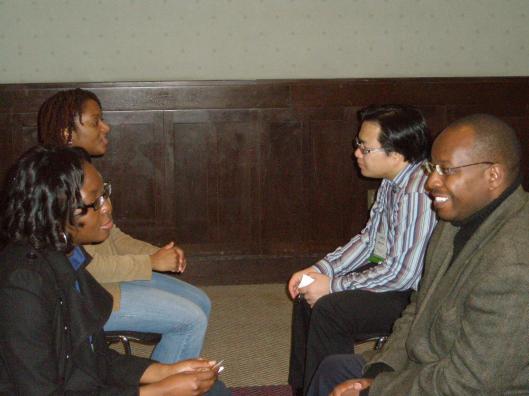
Although there are actual speed dating venues, here this term refers to a way for a moderate sized group of people to get to know each other quickly by spending two minutes with one other person in the group quickly recounting their backgrounds and interests and then moving on to form new pairs.
OLYMPUS DIGITAL CAMERA

KJ Method. 

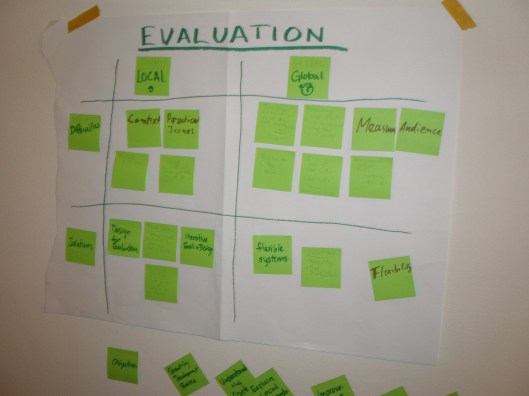
This is a way to cluster ideas. Many people are now familiar with this as a way of clustering ideas from a brainstorming or synectics session or for clustering ethnographic observations in order to later address product features and functions to address them. Basically, a large number of post-in notes are put on a wall and re-arranged by the group, some of whom may focus on a particular area of the overall cognitive map that is being build or spend their time thinking more about the whole. This method is often used, for example, in CHI Program Committee meetings to take a first pass at developing sessions. There have also been attempts to automate such processes.
OLYMPUS DIGITAL CAMERA

Rating and Ranking.

Often a large number of ideas are generated but the resources available do not allow all of them to be pursued. Therefore, a variety of voting, ranking and rating systems have been developed so that the group as a whole has input into the direction taken.

Incremental Value. 

It is difficult for people, either as groups or individuals, to move from a current way of doing things to a new one. Almost invariably, people will find the old way of doing things more “comfortable.” The transition to a new way will be much easier if there are incremental improvements in performance along the way rather than the mere promise of some wondrous new state at the conclusion of a long process of change.

Jump Start. 

Sometimes, change in an organization or process needs to be “jump-started” by providing additional incentives or special organizational support in some way.

Active Reminders. 

As people are learning new methods, processes, and skills, it is helpful to have Active Reminders so that people are less likely to fall into old habits. For example, in attempting to do brainstorming, many people find it very difficult to withhold judgment and criticism from ideas that others put forth. It can be helpful in such cases to have the “Rules” of brainstorming prominent displayed or to have someone whose role is mainly to remind people to build on each other’s ideas when someone critiques an idea.

Controlling Growth. 

While people often want their company, non-profit, or movement to grow as quickly as possible, growth without restraint is often called “cancer.” Growth needs to be controlled so that unanticipated side-effects do not destroy the entire company, non-profit or movement. People Express Airlines, for instance, is often thought to have have tanked because their success led to such rapid growth that they could not sustain what made them successful in the first place.

Expressive Communication Builds Mutual Trust.

Studies of cooperation in games such as the “Prisoner’s Dilemma” show that when people communicate something personal and apart from the game such as sharing photos, backgrounds, hobbies, etc. it tends to increase the chances of cooperation.

These Patterns (or really, more accurately, hints of Patterns, are not meant to be exhaustive. But hopefully, there are enough Patterns in this post to give readers a better idea of the wide variety of Patterns than might cohere into a Socio-Technical Pattern Language for Collaboration and Teamwork.

References: 

https://socialworldsresearch.org/sites/default/files/j-ag.final-fmt.pdf

https://www.cc.gatech.edu/fac/Amy.Bruckman/thesis/

Fincher, S., Finlay, J., Green, S., Matchen, P., Jones, L., Thomas, J.C., Molina, P. (2004) Perspectives on HCI patterns: Concepts and tools.  Workshop at CHI 2004, ACM Conference on Human Factors and Computing Systems.

Pan, Y., Roedl, D., Blevis, E., & Thomas, J. (2015). Fashion Thinking: Fashion Practices and Sustainable Interaction Design. International Journal of Design, 9(1), 53-66.

http://www.it.bton.ac.uk/staff/lp22/HF2000.html

Schuler, D. (2008).  Liberating Voices: A Pattern Language for Social Change. Cambridge MA: MIT Press.

Thomas, J. C., Kellogg, W.A., and Erickson, T. (2001) The Knowledge Management puzzle: Human and social factors in knowledge management. IBM Systems Journal, 40(4), 863-884.

Thomas, J.C. and Carroll, J. (1978). The psychological study of design. Design Studies, 1 (1), pp. 5-11.

Thomas, J. C. (2012). Patterns for emergent global intelligence. In Creativity and Rationale: Enhancing Human Experience By Design J. Carroll (Ed.), New York: Springer.

Thomas, J. C. & Richards, J. T. (2012). Achieving psychological simplicity: Measures and methods to reduce cognitive complexity. In The Human-Computer Interaction Handbook. J. Jacko (Ed.) Boca Raton, FL: CRC Press.

Thomas, J.(2008).  Fun at work: Managing HCI from a Peopleware perspective. HCI Remixed. D. McDonald & T. Erickson (Eds.), Cambridge, MA: MIT Press.

Thomas, J.C. (2003), Social aspects of gerontechnology.  In Impact of technology on successful aging N. Charness & K. Warner Schaie (Eds.). New York: Springer.

Thomas, J. C. (2001). An HCI Agenda for the Next Millennium: Emergent Global Intelligence. In R. Earnshaw, R. Guedj, A. van Dam, and J. Vince (Eds.), Frontiers of human-centered computing, online communities, and virtual environments. London: Springer-Verlag.


Thomas, J.C. (1996). The long-term social implications of new information technology. In R. Dholakia, N. Mundorf, & N. Dholakia (Eds.), New Infotainment Technologies in the Home: Demand Side Perspectives. Hillsdale, New Jersey: Lawrence Erlbaum.

Thomas, J.C., Lee, A., & Danis, C (2002). “Who Speaks for Wolf?” IBM Research Report, RC-22644. Yorktown Heights, NY: IBM Corporation.

Thomas, J. C. (2017). Building Common Ground in a Wildly Webbed World: A Pattern Language Approach. PPDD Workshop, 5/25/2017, San Diego, CA.

Thomas, J. C. (2017). Old People and New Technology: What’s the Story? Presented at Northwestern University Symposium on the Future of On-Line Interactions, Evanston, Ill, 4/22/2017.

Bohm Dialogue

21 Wednesday Feb 2018

Posted by petersironwood in America, management, psychology, Uncategorized

≈ 2 Comments

Tags

A Pattern Language., Bohm Dialogue, Business, competition, dialogue, innovation, learning, politics


IMG_0706Bohm Dialogue

Prolog/Acknowledgement: 

The idea for this Pattern comes from the work of David Bohm. Bohm was a quantum physicist who, later in life, became interested in human communication. He would not say he “invented” dialogue; rather, he felt it was common in so-called “primitive” societies. Indeed, it seems to have been a common occurrence in the recounting of Paula Underwood in The Walking People. I learned more about Dialogue from Peter Senge and Bill Isaacs while working in “Knowledge Management” at NYNEX and IBM.

Author, reviewer and revision dates: 

Created by John C. Thomas on February 21, 2018


OLYMPUS DIGITAL CAMERA

Synonyms: 

Campfire Reflections. Quaker meeting.

Abstract: 

In a hyper-competitive society, conversations that might be related to actions that affect more than one person are framed as contests with winners and losers, much like a sporting event or a court case. Sometimes, this might be appropriate, but it is not generally a good method. An alternative method to debate and discussion is Dialogue. In discussion and debate, as soon as one person begins saying something in favor of X, others decide whether they are for or against X. Then, based on a superficial hearing of what the person is saying, they determine how to best add weight to X or detract from it. They typically want to be able to “jump in” as soon as there is the slightest gap in the conversation. As a result, they are typically rehearsing their own upcoming argument and not even listening to the other person beyond the first few words. By contrast, in Bohm Dialogue, one person says something and everyone else listens to them respectfully. After listening, everyone reflects on what has been said. Then, they might or might not make a comment. This comment does not have to be an argument pro or con. It can be an analogy, a story, a reflection, a question, an example, or an observation. Rather than dividing into “camps” or “teams” and trying to “win” an argument about whether X or ~X is better, everyone works collaboratively and cooperatively to understand the space of possibilities and consequences. In such cases, the group might end up doing X, ~X, or .5X. Or, they may decide to gather more data; they may invent Y; they might decide to experiment in a small way with X. It is a joint construction process.

Problem:

Groups consists of individuals who never have precisely the same interests or the same experiences. In some cases, people simply make their own choices. It isn’t necessary for everyone to eat the same food or read the same books. But in some cases, appropriate action requires that people agree. Do we drive on the left side of the road or the right side? Do we penalize companies for polluting the environment or not? Do we have daylight savings time or not?

In a competitive society, it is easy to fall into the trap of framing problems in terms of who will benefit and who will lose. Everyone on the “losing side” will tend to find arguments to support their position even before understanding the other side. Such a process rarely results in innovation or breakthrough thinking. In a rush to win, people tend to ignore subtleties and interactions so even the framing of the problem becomes over-simplified. If people become angry or fearful, their ability to process information deteriorates and they most often stick with something they already know. In extreme cases, people will literally “freeze” with fear and be unable to perform even a simple yet critical action such as pulling the ripcord on their parachute.

In addition, if group action is decided through a process that is framed in terms of winning and losing, those on the losing side may not fully cooperate with the group decision. Consciously or unconsciously, they may even act to thwart the implementation of the group decision.

In the rush to “win,” those on the winning side may not even listen to important concerns from the other “side” and even if the “correct” decision “wins out,” important implementational details are overlooked. In this way, the implementation of the group decision will be flawed even if everyone tries to cooperate.

By framing the group decision process in terms of “winners” and “losers,” group cohesion and mutual trust can often be lost. This is particularly true if the group process is so contentious that people use propaganda or outright lies to try to “win” the debate. This not only makes this particular problem solving exercise less than optimal; it also means that future interactions will be less cordial, less civil, and less likely to result in what is best for the group as a whole.

Context: 

Complex problems and large problems can often only be solved by groups. In addition, sometimes, decisions must necessarily impact the entire group. Groups may be as small as a couple deciding where to go on vacation or tennis doubles team deciding on an effective approach to their next match or as large as all of humanity deciding on how to deal with population growth and pollution.

Groups must not only decide on a collective course of action; generally, they must also implement that decision.

Forces:

  • Everyone wants to protect their “own interests.”
  • People may think of their “own interests” at varying levels; e.g., their own body, their own belief system, their own family, their own tribe, their own party, their own nation, all of humanity, or even all of life.
  • The expectations of any one person are primarily based on their own experiences.
  • The behavior of any other person is largely based on that person’s experiences.
  • If one person acts uncivilly or hyper-competitively, it tends to increase the chances that others will do the same.
  • In some societies, competition has become the default way to interact.
  • Competition tends to induce high stress levels in people.
  • High stress levels tend to make people less willing to listen, change, or think creatively.

* Everyone is an expert when it comes to their own experience.

Solution:

Instead of having a group debate or discuss two or a few alternatives to determine which one is the winner, instead use Bohm Dialogue to cooperatively, cooly, and calmly have the group examine a situation using everyone’s experience together. Have people listen respectfully to everyone’s contribution. Have everyone reflect on what they say. It helps if people frame their contribution in terms of their own experience rather than abstract and sweeping generalities and pronouncements. Let the group cooperatively build a joint understanding of the problem. This often results in an emergent solution. Even when it does not and, in the end, a vote on X or ~X must be taken, everyone feels respected by everyone else and people are much more likely to help implement the solution.

IMG_5216

Example: 

Imagine a tribe of people sitting around a fire at the end of the day. They reflect on their experiences. One says, “I gathered acorns today. There were very few though. This is not like the other years.” Everyone listens. They reflect.

Another says, “It would be nice if we could eat the acorns as the squirrels do, without having to wait.”

Another says, “Yes, though even they do not eat them all right away.”

Another: “Are there fewer oak trees? Or, is each tree making fewer acorns?”

The first says, “I am not sure. Let me think back. Each tree has fewer than in years past.”

Another says, “Speaking of fewer, I only caught two fish today in my favorite fishing spot. And the water was shallower.”

Another adds: “This spring I gathered fiddlehead ferns. There were only a few. Odd.”

Another: “There were so many nice sunny days this spring and summer. I guess there was a lot less rain.”

Another: “It would be nice if we could make it rain more.”

An older woman adds, “It has been raining less as I’ve grown older. Less and less each year.”

Another: “How can we make it rain more?”

Another: “I don’t know how we can make it rain more. But we could save the water when it does rain.”

Another: “I like water. Sometimes the small raindrops join together to make larger ones.”

Another: “Indeed, it is the nature of water to like the company of others.” Laughter.

Another, “Perhaps we can encourage water from the big river to visit us. We can dig a trench. If we encourage some water to go into that trench, other drops may follow into our stream.”

Another: “More water in our stream would encourage fish as well as fiddleheads and oaks to visit us more often.”

To the typical “modern person,” this dialogue seems needlessly random and inefficient. But is it really?

Sure, the typical business meeting has an agenda and it seems as though it’s efficient. The meeting below is pure fiction — but it is precisely in line with my typical experiences from a lifetime of meetings in “efficient corporate America.”

IMG_3898

10:10- 10:30 Discuss ways to get more acorns.

Chairperson: “We need more acorns. How can we get them?”

Person 1: “I need help. They are hard to find.”

Person 2: “Well, I can’t do it. I’m having enough trouble getting fish. That takes all my time.”

Person 3: “You think you’ve got troubles? I can’t find enough fiddleheads either, so I can’t help.”

Person 4 – speaking directly to Person 1: “You sure you’re really hunting acorns and not just ogling the women? Just kidding.”

Person 1: “You come gather the acorns then. You’ll see.”

Person 4: “I said I was just kidding.”

Person 2: “When can we talk about getting more help fishing? Can we put that on the agenda for next week?”

Chairperson: “It’s next on the agenda.”

Person 5: “The real solution is incentives. I hate to say it, but I just don’t think everyone is really pulling their own weight around here.”

Person 6: “The key is better metrics. Words like ‘fewer’ are very fuzzy. We need an accounting of all the acorns. And fish. And fiddleheads. Then, we will be able to quantify the extent of the problem.”

Person 1: “Who is going to count the acorns? You? I know I got fewer and it isn’t from not trying.”

Chairperson: “Hey, we’re almost out of time. Let’s table this discussion for now and put it on the agenda for next week. It seems to me, in the meantime, Person 1, you’re going to have to get up a little earlier in the morning and gather more acorns that way. Let’s vote. All in favor of Person 1 getting up earlier to gather more acorns, raise your hands.”

[Everyone raises their hands except Person 1].

Chairperson: “OK, motion carried. Person 1, give us a report next week on exactly how many acorns you got every day.”

Person 1: “Look, the acorns are largely gone now. Getting up earlier isn’t going to help.”

Chairperson: “Sorry, Person 1. Do the best you can. We need to move to the next item on the agenda which concerns fishing.”

Person 1: “I always do the best I can. But I’m telling you that there will still be fewer acorns next week.”

Chairperson: “OK, we need to take this off-line and talk about fishing. If you can’t gather acorns, we’ll find someone who can. Enough.”

What are the likely outcomes from this “efficient” meeting? First, it is quite likely that Person 1 is pretty pissed off. Second, the group is unlikely to ever realize that there is a problem with the acorn supply rather than the extent or manner in which Person 1 is gathering them. Third, the group is way far away from realizing the systemic nature of the problem and the fact that the “real problem” is a diminishing source of water, let alone making any progress toward solving that actual problem.

Resulting Context:

Generally speaking, using dialogue will be more not less efficient for finding and implementing solutions to root problems than will competitive debates or discussions. The solutions arising from Dialogue will be “owned” by the entire group and it is more likely that everyone will be working together to make sure the solution actually works. In addition, the long term effect on the group is to increase mutual trust and cooperation.

Rationale:

Actions are always better based on reality than on fantasy. Yet, humans often latch onto a particular interpretation of events very quickly and with insufficient data. As a consequence, people often work within the constraints of their own limited thought patterns. Treating what is essentially and quintessentially group problem solving as a competition between people for which of two or three solutions most often results in solving the wrong problem or at best only solving a sub-problem. In addition, “solutions” arrived at in this competitive way often result in decreased effectiveness of a group over time because of growing envy, resentment and mistrust.

By contrast, Bohm Dialogue encourages people to work together with respect and to understand a problematic situation from many angles. In this way, the real or more basic problem is understood as well as how it impacts everyone present.
As Bohm points out, many people mistakenly believe the word “Dialogue” comes from the Greek word logos for truth and the Latin root di for two implying that a dialogue is a two-sided debate.  Instead, “Dialogue” comes from the Greek logos and the Greek root dia which does not mean two but through. It is coming to the truth through interaction.

IMG_5400

Related Patterns: 

“Who Speaks for Wolf.” Reality Check.

Known Uses: (See the Incarnations section of the Wikipedia article on 2014)David Bohm referenced below). I have also had personal success running Dialogue sessions as Executive Director of the NYNEX AI lab and in SIGCHI meetings. If you explain the “rules of the game” people can fairly easily learn to Dialogue.

Quaker meetings are often run in this same fashion and the group does not “vote” to choose among a couple possible actions but instead reflects as a group until a consensus is reached.

Metaphors: 

Bohm, as I mentioned, was a quantum physicists and he likened what happens in dialogue to having people be in a “super-cooled” and therefore “super-conductive” state. When people are “agitated” to “win,” they are bouncing around like hot molecules and conducting information among them is difficult. The more you heat up a wire, the less well it conducts current or information. Near absolute zero, the wire instead becomes “superconductive.” When people relax and do not have an “axe to grind” and are not ego-invested in a predetermined outcome, they behave quite intelligently in discovering truths.

References: 

https://en.wikipedia.org/wiki/Bohm_Dialogue

 Bohm, D. (1996). On dialogue. New York: Routledge.

Holman, P & Devane,T. (1999). The change handbook: Group methods for shaping the future. San Francisco: Berrett-Koehler Publishers.

Isaacs, W. (1999). Dialogue and the Art of Thinking Together: A Pioneering Approach to Communicating in Business and in Life. Bantam Doubleday Dell Publishing Group.

Krishnamurti, J. and Bohm, D. (2014). The ending of time: Where philosophy and physics meet. New York: Harper/Collins.

Senge, P. M. (2006). The fifth discipline: the art and practice of the learning organization. Doubleday.

Shaw, P. (2002). Changing Conversations in Organizations. A complexity approach to change. London: Routledge.


Author Page on Amazon

Small Successes Early

20 Saturday Jan 2018

Posted by petersironwood in management, psychology, Uncategorized

≈ 4 Comments

Tags

Business, competition, Design, innovation, pattern language, politics

IMG_5159

This is the third “Pattern” in a proposed “Socio-technical Pattern Language” that aims to capture best practices in collaboration and coordination at various levels of organization from having a civil society to having small groups work in ways that are: 1) enjoyable in the moment, 2) productive in terms of the end-product, and 3) build skills in the participants. The notions of “Patterns” a “Pattern Language” are described in more detail in the first of this series, “Special Spaces and Wonderful Places.” The idea for the pattern, Small Successes Early, crystalized from reading DeMarco & Lister’s excellent book, Peopleware.

Small Successes Early. 

Author, reviewer and revision dates:

Created by John C. Thomas, December 2001.

Reviewed in early 2002 by Alison Lee and Catalina Danis.

Revised and extended, January, 2018.

Synonyms: 

Start Small.

Abstract:

Many problems in a modern industrialized society require very large teams of relative strangers to work together cooperatively in order to design and build an adequate system or solution or to solve the overall problem. Yet, because of the sense of urgency and artificial “deadlines,” in many settings, people fail to take the time to learn to trust one another as well as to learn one another’s strengths and weaknesses and preferred styles of working. Plunging a large group of strangers immediately into a complex task often results in non-productive jockeying for position, failure, blaming, finger-pointing, etc. Therefore, insure that the team or community first undertakes a task that is likely to bring some small success before engaging in a complex effort.

Context: 

A complex undertaking often requires the interaction of many people with various backgrounds, skills, and temperaments. Often, whether in an industrial setting, a community building effort, or in political life, many of these people have not worked together before. The group wants to get started and wants to be successful. Although their diversity is a potential source of strength, at first, there is likely to be natural confusion about how to proceed because people will have different experiences about the best way to organize and proceed.

As the pace of change in society increases, a greater and greater proportion of the work that people do cannot be done in a routine or top-down way. Such a “command and control” style can work well under some circumstances; for example, when the solution is knowable before starting and everyone can be counted on to know their exact function and to be motivated toward an outcome agreed upon by all. Even in such extreme cases, it can still be worthwhile for people to learn about each other before attempting a larger effort. Most teams, even when hierarchically controlled and doing repetitive tasks, will improve over time as they gain experience with each other. In complex tasks with emergent solutions, the effect of practice will be even greater.

Forces: 

  • Problems are often too complex for all aspects to be addressed simultaneously.
  • If a problem is understood, it is logically better to deal with the hardest constraints first.
  • The structure of complex problems often becomes more clear as people try to solve the problem.
  • A part of any complex problem solving process requiring more than one person is the interaction and relationship among the people.
  • People in a new team need to learn about each other’s skills, working styles, and trustworthiness.
  • When people get frustrated because of non-success, they tend to blame each other.
  • As people work toward a goal, the goal tends to become viewed as more valuable and therefore people are willing to work harder to reach it.

Solution: 

Therefore, when bringing new teams or organizations together, it is useful to begin with a small success. In this way, people begin to learn about each other and trust each other. People learn more about the nature of the problem domain. This makes tackling more difficult problems later relatively easier.

OLYMPUS DIGITAL CAMERA

CHI Workshop On HCI for Development Began with Map-Making

Example: 

At the kick-off to a new software development project, rather than having the people be invited to “attend” an event that is “thrown” for them, which might typically include a mind-numbing series of powerpoint presentations from executives about how much money the company will earn if the project is successful, instead, encourage the workers themselves to organize a party, cook-out, pot-luck, song-fest, or storytelling event among themselves. In the process of organizing and carrying out this activity, they will learn about each other’s styles, learn about the trustworthiness of others, and be encouraged by having a success.

Alternatively, the team might simply work on one small aspect of the problem to be solved, provided it is something fairly clear that will result in “success” quickly. For instance, the team might initially work profitably on short presentations about the project, posters, or scenarios but not immediately jump into working on a systems design or a requirements document.

At a workshop on “Human-Computer Interaction for Development” held in Florence (at CHI 2007), we began by having the group make a “map of the world” (shown above) with stones and other materials at hands. Although everyone who signed up was presumably interested in the topic, people were mainly strangers from many parts of the world and had not worked together before. We not only jointly created the map but then had people engage in simple tasks that made use of the map; e.g., stand somewhere close to where you were born; stand somewhere you’d really like to visit but never have; stand somewhere representing a wonderful experience. In an earlier workshop on “Cross-cultural issues in Human Computer Interaction” (CHI 1992 in Monterey), the workshop room was set up like a classroom so our first task was to work together to jointly re-arrange the furniture in the room into a kind of “circle.”

Rationale: 

As people experience team success, they tend to view the others in the team more positively. Teamwork is often hard under the best of circumstances. In highly complex problems, when people come together from different cultures, backgrounds, or agendas, it often becomes so difficult as to seem impossible. Rather than having people simultaneously attempt to solve a complex problem and at the same time learn to work together as a team, it is often more effective to separate the otherwise tangled problems.

First, have the people solve a tractable problem where it is clear to everyone that they have a common agenda. A successful experience working together to solve that simple problem will help people learn each other’s styles, strengths, weaknesses and so on. With this knowledge and trust, they can now move on to try to solve more difficult problems.

Examples: 

The human factors psychologist James Welford was called in as a consultant to deal with what appeared to be a very large age effect. People over 35 were having a tremendous difficulty learning new hand weaves. The difficulty, as Welford discovered, was in having older people try to solve two tangled problems. On the one hand, it was hard for older workers to see the actual threads and second, it was hard to learn the weave patterns. What Welford did was introduce a short training segment with very large, quite visible cords. Once people had mastered the weave patterns with these large cords, they were then transferred to the much smaller production size. This eliminated the so-called “age effect” and in fact, both older and younger people learned much more effectively and efficiently.

In similar fashion, trying to solve a complex problem with virtual strangers, especially when there is reason to believe there may be a difference in agendas, is a “tangled problem.” Untangling the “getting to know people” aspect from the complex production or design task will help insure ultimate success.

Some care should be given to the task and setting. The “small successes early” task should allow some degree of give and take, some opportunity for expressive (not just instrumental) communication. People should have the opportunity and space for doing something creative, for sharing stories, for physical interaction. Ideally, it should either be somewhat task related, domain related, or be something nearly everyone enjoys (e.g., eating, playing music, dancing, hiking).

IMG_3240

References: 

DeMarco, T. and Lister, T. ( 1999) Peopleware: Productive Projects and Teams. (2nd Edition). Upper Saddle River, NJ. : Addison-Wesley.

Schuler, D. (2008). Liberating Voices: A Pattern Language for Communication Revolution. Cambridge, MA: MIT Press.

Thomas, J. C. (2012). Patterns for emergent global intelligence. In Creativity and Rationale: Enhancing Human Experience By Design J. Carroll (Ed.), New York: Springer.


Author Page on Amazon

Special Spaces & Wonderful Places

The Blog in Review

28 Thursday Dec 2017

Posted by petersironwood in America, family, Uncategorized

≈ 1 Comment

Tags

competition, environment, history, index, innovation, life, military, politics

IMG_0005

Year End Summary (2017) and Index of Peter S Ironwood Blog. (Several readers mentioned that the wordpress navigation structure may leave something to be desired. Hopefully, for some readers, the following index may be helpful). Many of these blog posts are not meant as the “final word” on these subjects. I am hoping people can use them as a “jumping off place” for conversation with their neighbors, students, and colleagues.

Trumpism is a New Religion. 

Astounded that more than 15 people voted for Trump, the year began with my attempts to understand my error(s). It was about this time that I saw more and more evidence that many Trump supporters were impervious to his most outrageous, incompatible, or nonsensical acts, tweets, and pronouncements. My explanation is that for some, Trumpism is really more of a religion than a political movement. This still seems correct to me. Others, have completely different reasons for voting for Trump. For some, for instance, I really think they have seen zero change in their lives regardless of who is President and they have seen promises never kept by both parties. As a result, for them, the President is seen as “Chief Entertainment Officer” and Trump provides plenty of that. In terms of a religion, Trumpism is much more compatible with the values inherent in modern day business than is Christianity. In essence, in fact, Christianity is incompatible with business values. So, it’s quite understandable that Trumpism has become popular.

https://petersironwood.wordpress.com/2017/01/09/trumpism-is-a-new-religion/

The Crabs are Biting. 

The next blog post returns to a retrospective look at some of my childhood experiences and thoughts about how these experiences shed light on current events. In this case, I recount various “fishing” experiences and how seriously children think about the world. Are fish the only animals that can be caught with bait?

https://petersironwood.wordpress.com/2017/01/17/the-crabs-are-biting/

Parametric Recipes and American Democracy. 

A parametric recipe is my term for recipes that allow for a variety of ingredients. I like to make omelets, for instance. There are many different vegetables and cheeses that can be incorporated. The exact ingredients and proportions don’t matter. But there are things you would never want in any omelet – toxins, poisons, and things that simply make you sick to your stomach. Have we forgotten what is unacceptable in a democracy?

https://petersironwood.wordpress.com/2017/02/11/parametric-recipes-and-american-democracy/

Big Zig-Zag Canyon. 

This post begins with a recounting of a hike on Mt. Hood, near Portland, Oregon (which coincidentally is one of my favorite cities). The post is about how one’s expectations can be wrong about just how hard things can get — over and over.

https://petersironwood.wordpress.com/2017/02/20/big-zig-zag-canyon/

The Invisibility Cloak of Habit.

With experience we learn. That’s the good news. In some cases though, our previous experience leads us astray. In fact, in some cases, our previous experience just about blinds us to what is going on right before our eyes.

https://petersironwood.wordpress.com/2017/02/25/the-invisibility-cloak-of-habit/

City Mouse and Country Mouse.

At least in the USA, I know that a spectrum of political opinions occurs everywhere but that one of the greatest correlates of differences is whether a person lives in a rural or urban area. I don’t believe one of these venues is, in every way, superior to the other, but it does seem that the different situations should logically lead to different values that work well in that venue. 

https://petersironwood.wordpress.com/2017/03/04/city-mouse-and-country-mouse/

Math Class: Who Are You?

It strikes me that part of what feeds pathological greed — and perhaps as well the greed that we all fall prey too — is partly the result of a serious misconception about who we are and our relationship to the rest of the living earth.  Here are some back of the envelope calculations to put things in a more reasonable perspective.

https://petersironwood.wordpress.com/2017/03/09/math-class-who-are-you/

The Great Race to the Finish!

Every human activity has both an instrumental/extrinsic value and an experiential/intrinsic value. In most cases, doing something as quickly as possible reduces its intrinsic value. It may or may not increase its extrinsic value although the financial interest behind the “Captains of Industry” always assume it does. Most of us are in something of a hurry most of the time. Why? Does it really make our lives more pleasurable? And, where are we rushing to?

https://petersironwood.wordpress.com/2017/03/24/the-great-race-to-the-finish/

Ripples.

Our decisions have long-lasting, perhaps eternal, consequences. Even mechanical ripples last a long time, but another human can multiply the input given a hundred fold so that the effect of any action can increase over time. Individual decisions can actually impact the evolution of the species as well.

https://petersironwood.wordpress.com/2017/04/11/ripples/

 Family Matters: Parts One, Two and Three.

A three part series exploring how the happenstance of our birthplace (over which we obviously have no control) has a huge and lasting influence on our lives.

https://petersironwood.wordpress.com/2017/04/30/family-matters-part-one/

https://petersironwood.wordpress.com/2017/05/11/family-matters-part-two-garlic-cloves-and-puffer-fish/

https://petersironwood.wordpress.com/2017/05/27/family-matters-part-3-the-whole-is-greater-than-the-sum-of-its-parts/

Claude the Radioman.

Claude refers to a toy soldier whose function was communication. As a small child, it was my least favorite because it had no weapon. As an adult, I think he has the most powerful one of all.

https://petersironwood.wordpress.com/2017/05/28/claude-the-radio-man/

Citizen Soldiers: Parts 1, 2, and 3. 

A three part series on the premise that, like it or not, we are all soldiers. Of course, it’s different to be in the actual military and be at a front. But, we are soldiers in the sense that we are at risk pretty much everywhere mainly from other human beings. We are soldiers as well in the sense that our actions are important determiners of the outcome. We need to be smart as well as loyal.

https://petersironwood.wordpress.com/2017/06/07/citizen-soldiers-1-early-enlistment-no-retirement/

https://petersironwood.wordpress.com/2017/06/16/citizen-soldiers-part-two-boot-camp/

https://petersironwood.wordpress.com/2017/06/24/citizen-soldiers-3-galoshes-in-the-gutters/

Pies on Offer: Rhubarb & Mincemeat.

Are you focused on grabbing the biggest piece of pie you can? Or, are you more interested in baking more pies and inventing new kinds of pies?

https://petersironwood.wordpress.com/2017/07/20/pies-on-offer-rhubarb-mincemeat/

What if … ?

A speculation that in reality, Americans have much much more in common with each other than they think they do. The politicians and the media both have a vested interest in making people think they are farther apart on more issues than they really are.

https://petersironwood.wordpress.com/2017/07/21/what-if/

If Only…

This is a work of “pure fiction” however — the protagonists and their “back stories” are true. This is a story that takes place in a nearby but parallel universe.

https://petersironwood.wordpress.com/2017/07/28/if-only/

Only You…

An examination of our responsibilities and the impact of our actions.

https://petersironwood.wordpress.com/2017/08/08/only-you/

You Fool!

A recounting of some of the many ways in which we humans are subject to being fooled.


https://petersironwood.wordpress.com/2017/08/15/you-fool/

Fool Me!

Mainly, this post focuses on the power of stories. There is an ethical difference, at least to me, between presenting a fascinating or inspiring story and presenting the same story as fact.

https://petersironwood.wordpress.com/2017/08/24/fool-me/

Me Too. 

This post is about the natural tendency of people to want to be part of a larger social action. Most people drive in stop-and-go traffic in a non-optimal way. This offers a better method.

https://petersironwood.wordpress.com/2017/08/27/me-too/

Too Much!

Human productivity does not go up monotonically with increasing stress. Studies have been around for decades showing that people are more productive working 30 hours a week than 50. Why do so many companies then push for 50 or more hours a week?

https://petersironwood.com/2017/09/03/too-much/

Much Lost.

Why do we grieve at the loss of another? Why do we even get attached to objects?

https://petersironwood.wordpress.com/2017/09/10/much-lost/

Lost Horizons. 

Have we modern humans lost our ability to make decisions based on a very broad, very long-term look? Doesn’t it seem natural for every generation of every species to try to make life better for the next?

https://petersironwood.wordpress.com/2017/09/17/lost-horizon/

Horizons University. 

What would it be like to build a University that focused on expanding a person’s horizons in every dimension they would be interested in? What if it focused on finding, and formulating as well as solving problems using existing knowledge and procedures?

https://petersironwood.wordpress.com/2017/09/25/horizons-university/

You Know. 

Which wolf do you feed? The “bad” wolf or the “good” wolf. Of course, sometimes, decisions involved complex trade-offs, but sometimes we “know” what the right thing to do is and instead do the convenient or selfish thing.

https://petersironwood.wordpress.com/2017/10/02/you-know/

Know What? 

The first of a series of blogs that considers how various aspects of social media, combined with anonymity, not having face to face communication (with its abundant affordances), the concentration of much of the media control in a few very large multi-nationals, the filtering and bandwagon algorithms of social media, and other factors all conspire to further divide people.

https://petersironwood.wordpress.com/2017/10/08/know-what/

https://petersironwood.wordpress.com/2017/10/16/whats-new/

https://petersironwood.wordpress.com/2017/10/23/new-fools/

https://petersironwood.wordpress.com/2017/10/31/fools-gold/

Gold Standard.

Every age has its pluses and minuses. Some folks today seem to feel we’ve moved too far too fast and that we should “rewind” to a better time. Interesting, but there hasn’t been a better time. The world today is hugely complex and inter-dependent. That’s the way it is. If we try to obviate all that interdependence, we will not go back to 1950 or 1890 but back to 5000 BC. Instead, what can we do to encourage civility and to distinguish news versus fake news?

https://petersironwood.wordpress.com/2017/11/07/gold-standard/

Standard Issue. 

What are some ways that social media could be changed to encourage greater civility?

https://petersironwood.wordpress.com/2017/11/13/standard-issue/

Issue Resolution.

Perhaps the experience of others was different, but I learned very little in formal school classrooms about ways to resolve conflicts. Yet, much is known beyond simple compromise, using external authority or force of arms. This posts focuses on some of those with pointers to longer descriptions of the techniques.

https://petersironwood.wordpress.com/2017/11/19/issue-resolution/

Resolution: Create! 

This post encourages a more creative look at issue resolution. I believe that more progress can be made by people working together than by even a 10x increase in Facebook posts to convince everyone else that they are wrong.

https://petersironwood.wordpress.com/2017/11/26/resolution-create/

Create Peace.

First of a series of blogs about the pros and cons of war and peace. Spoiler alert: war is a horrible option. We really need to get our act together to do better. People sometimes have trouble reaching agreement, but that process should be facilitate by diplomatic experts and leaders who are looking at the big picture. Some so-called “leaders” are intent on consolidating and extending their own power. Historically, that’s when power-hungry people declare war. Some might label such people SHRUGS – Super-Hyper Really Ultra Greedy Swindlers.

https://petersironwood.wordpress.com/2017/12/05/create-peace/

https://petersironwood.wordpress.com/2017/12/13/peace-love-part-one-casualty-count/

https://petersironwood.wordpress.com/2017/12/14/peace-and-love-part-2-shrugs-shills/

https://petersironwood.wordpress.com/2017/12/16/peace-love-3-shrugging-off-the-shrugs/

https://petersironwood.wordpress.com/2017/12/20/love-all/

All…what? 

Where are we headed? Is there any hope? I would say yes though we are in dark times. The light will return, if not today or tomorrow, some day.

https://petersironwood.wordpress.com/2017/12/25/all-what/


author page on Amazon

IMG_0561

All…what?

25 Monday Dec 2017

Posted by petersironwood in America, apocalypse, psychology, Uncategorized

≈ 1 Comment

Tags

collaboration, competition, cooperation, fascism, fear, greed, hate, learning, life, love, science

IMG_9070

Humanity finds itself in a new place. In evolutionary terms, we could say humanity suddenly finds itself in this new place. Life on earth, by best estimates is 4.75 billion years old. It’s easy to imagine, as a person, that the whole point of evolution is us. I don’t really see any reason to believe that. To the dolphin, deer, dog, dodo, and dinosaur, every one of their lives are every bit as precious to them as ours are to us. I do not even think humans are the “smartest” species on earth, at least, not in any absolute sense. We are the smartest in the directions of thought and behavior that humans find useful. So far as we know, we are the only species who has the information to know that our collective behavior can destroy us along with a lot of the other limbs on the giant, diverse tree of life and yet, here we still are, with atomic weapons, not pointed out defensively against invasions from outer space but pointed at other people on the planet. How could we possibly think we are the smartest species? Even if we avoid that kind of catastrophe, we still face dangers from over-polluting the planet, over-heating it, over-populating it, over-fishing and being over-hating. Indeed, this is nearly the darkest day in the darkest year. Is there reason to celebrate?

I think there is. In the blink of an eye, in evolutionary terms, we’ve managed to migrate across the entire planet. People live in tropical jungles, hot desserts, and in the frozen tundra. We’ve developed tools of thought and tools of trade and ways of dividing labor and communicating. And, now, although many people still do not have access, we have a communication network that spans the globe and we can communicate to some degree with people of different religions, cultures, languages, and experiences. We have vast networks of trade. We’ve come a long way.

OLYMPUS DIGITAL CAMERA

OLYMPUS DIGITAL CAMERA

Yes, there are a few greedy people who, like Voldemort, cannot or will not experience love or its benefits. Instead, they have convinced themselves that everyone is out to get as much as they can for themselves (or, if some people aren’t on that program, they’re just stupid, in the view of the greedy). In reality, only a few people are completely hooked on greed and power. They do not see other human beings as partners, or colleagues, or fellow explorers in this vast world before us — a world that still has billions of unfound discoveries. Indeed, we have even built machines to help us make new discoveries. And, if we don’t change trajectories, we may make far fewer discoveries than we might. Of course, it isn’t just the people completely hooked on greed that are accomplices in humanity’s direction toward greed. The alternative is to think quite consciously about our decisions in terms of who we invest in, what product we buy, how we talk with our neighbor, how we ourselves do business. We ourselves can make choices that move us toward greater cooperation rather than necessarily choosing only on the basis of immediate cost/benefit analyses. Then, and only then, can we turn the world to kindness and discovery.

Despite our many advances, we have yet, for instance, to have conquered cancer; we have yet to conquer war; we have yet to conquer hate and fear. You see how easily, in fact, the metaphors of war pervade our thinking. It is possible that we don’t need to “conquer” cancer, war, hate or fear. Maybe, we just need to let them go. Maybe if we understand these things sufficiently, they will dissipate. Maybe these four things all required quite different approaches from anything that has yet been tried, and possibly all require a different approach from each other. But my reflexive approach is to state this in terms of “conquering” – that is, winning over an enemy rather than winning over an enemy.

OLYMPUS DIGITAL CAMERA

OLYMPUS DIGITAL CAMERA

Perhaps, instead, the right approach to conquering cancer is not to “destroy” cancer cells but to re-integrate them into the society of the body. Perhaps they have been disillusioned that being part of the whole (body) is working for them. Maybe there is a way to “convince” them not to be cancer cells but to revert to what they were before cancer began.

Or, maybe we put something on an edge of the human body that has more of what the cancer cells “want” then anyplace within the body and let them “migrate” to the edge (and out of the human body — the “Pied Piper Approach”).

Or, perhaps, apart from pollution, a huge reason for cancer is that people are so busy so much of the time that they are not “noticing” teeny cancers within them. Perhaps people can be trained from birth to notice cancer cells and to send an overwhelming immune response before its too late. It sounds a bit absurd, but is it really? People can learn to “turn on” a single neuron in their brains with proper feedback. Is it really so far beyond the pale to imagine we could train ourselves to mount a targeted immune response?

IMG_9333

Perhaps all of these approaches might work and perhaps none of these approaches would work. The point is, that we need not reflexively think that “armed conflict” and “destruction” are the only methods that work to change the world. Many biologists think that the “nucleus” of our cells as well as our “mitochondria” were originally different organisms that started living symbiotically inside our cells. Is it too much to imagine that we could some day control the process of cells mutating and do it for our benefit? It seems absurd and ridiculous from the perspective of our knowledge today. And, yet — what would have our common ancestors on the African Savannah have thought 1,000,000 years ago if we could have explained to them that someday we would have machines that fly us around the globe — and to the moon? Or, how would they have reacted to the idea that we would have a network allowing us to communicate around the globe; that we would build machines that enable us to look into the workings of cells or the far reaches of the galaxy; that we would build fantastically beautiful musical instruments and that we could share music and ideas and stories across this earth; or that many people in our world die from having too much to eat!? 

It is quite possible that a century from now, people will very seldom die from cancer — or any other disease. In a similar fashion, we may well be able to set aside, recommission, redesign, or simply let go of war, hate, and irrational fear.

But none of that will happen unless we collectively decide what we want to be when we grow up. Because, as a species, despite wonderful achievements, we are still adolescents, at best. There are many tyrants in the world. Tyrants, as I’ve explained in prior postings, hate love and hate the truth. They really need war for cover in order to stay in power. Love complicates things. It’s just too unpredictable for people who want to be in control of everything. People’s reactions to absolute power wielded without ethics are much more predictable. Under enough painful torture, anyone will say anything 99% of the time. Of course, nothing positive and growth oriented ever comes from hate and fear alone. Only love moves life forward. Only love creates a more beautiful earth for our descendants. Only love discovers new beginnings, offers new ideas and new approaches. Beyond love’s instrumental value, more importantly, a world run by love is a world that feels good most of the time while it is happening, moment to moment. Of course, even in a world run largely by love, you will stub your toe or lose a friend, but most of every day’s activities you spend doing something because you feel as though you are making a contribution to something beyond yourself.

OLYMPUS DIGITAL CAMERA

OLYMPUS DIGITAL CAMERA

On the other hand, in a world run largely by hate and fear, the momentary experience of almost everyone almost all of the time is miserable. You are basically snarling or sniveling with every communication. Naturally, even so, there will be moments of joy, but it will never be unmarred because joy will either fall prey to guilt, or even worse, spend so much resources defending against guilt that life will become gray and pointless. Every day, most of the time you are doing what you’re going because you feel as though you’ll be badly punished if you don’t.

Does it make any sense then, to have a society run by the very greediest people among us? What if the only reason they are so greedy is because they don’t experience the full spectrum of human emotion that the rest of us do? What if a huge part of their greed is actually specifically and quite consciously designing and demanding a society run by hate and fear?

Why? Because they themselves don’t feel love and they don’t want others to be able to in an unrestricted way either. They are jealous and the only way they see to avoid being faced with their own shortcomings is to reshape the world so that no-one can express love openly and fully. I am not talking only about restrictions on sexual partners. I am talking as well about artistic expression, a free press, scientific exploration, and education. Everything is subject to restriction in a dictatorial society. Love is the source of exploration. It cannot be fully functioning under a dictatorship.

And what about Christmas? What about the solstice? What about the light and the dark? I do believe we now live in much, much darker times than most people realize. We are, in one of three states: 1) we are like one of the beginning scenes of the Star Trek prequel where Kirk speeds a stolen car towards that he does not realize is a deadly chasm. At the last moment, he tries to skid sideways to a stop, leaps from the car, begins to totter over the side and holds on by his fingernails — then clambers back up. 2) we in the same scene but this time, our foot hits the door an inch to the left and we don’t quite make it. 3) we are like the road-runner cartoon character who has just run straight off a deadly cliff but his legs are still windmilling and for a short time — he appears to be running, and does not fall until he looks down and realizes he is no longer on solid ground.

OLYMPUS DIGITAL CAMERA

OLYMPUS DIGITAL CAMERA

Well, it’s Christmas Day for me. And, the winter solstice has passed. The darkness really is receding and the daylight is encroaching on that darkness, minute by minute. We humans have had some dire times before and gotten through them. That doesn’t prove we’ll survive this Age of Greed, but I think it possible, perhaps even likely. But we must put the brakes on now. We must jump very carefully. And we must hold on for dear life.

We must hold on to each other. We must hold on to ethics as something that matters. We must hold on to the thought that, ultimately, we are all in this together. We must hold on to the thought that we are much more alike than we are different regardless of what customs, clothes, and food we prefer. We must hold on to the realization that a few greedy people cannot really rule the world, unless we participate with our own greed, fear, and hate.

We can pull this off. Instead of being the despoilers of the planet, we will make it ever more beautiful. Eventually, we will be “in tune” again, with nature and each other. How precisely to make this happen isn’t clear and no two people would probably approach it precisely the same way. Nonetheless, if we work together as best we can, keep discussing our differences in a civil way, and make as many decisions as we possibly can with at least a thought to the greater good, we will make it.

IMG_3071 - Version 2

Merry Christmas.


Author Page on Amazon


Love All.

20 Wednesday Dec 2017

Posted by petersironwood in America, psychology, Uncategorized

≈ 1 Comment

Tags

competition, creativity, innovation, learning, life, military, politics, science


IMG_5197

Love All. Hmm.

I don’t feel very loving toward people who are SHRUGS and pretending to be SHILLS, especially when they are using the trust we gave them as being public officials not to betray their country’s interest. Is there really a way to love all?

I think it is quite possible to love the totality of something without loving each and every part. A person might, for example, love their body but hate that big mole. They might really like their car but hate its squeaky rattle. They might love all of humanity yet hate so much of what one person does it is impossible to feel love for that part of it. At least I feel that way. I love the forest but hate deer flies, though it is a qualified hate. Once I’m back indoors, I don’t dwell on the fact that they’re still out there sucking blood from deer or hikers. There is a bit of humor and even admiration for the damned things. You would think it would be pretty easy for humans to outsmart them and yet…they are very hard to catch. The one trick I did develop was to wait till they landed on the back of my neck and then smack them quickly with my hand, stunning them. When they awoke, I would explain to them that if they didn’t immediately cease and desist, I would crush them. But they never responded so I crushed them anyway.

There are several aspects of love and one is understanding. They are not equivalent of course, but understanding seems good in any case. I can reach the point of trying to understand deer flies or SHRUGS. Beyond that, I cannot go.

IMG_3193

Teddy Roosevelt is famously purported to have said, “Speak softly and carry a big stick.” Let’s examine this a little further in the context of contemporary international relations. The United States is, or at least was until recently, the “world’s only remaining superpower.” That’s what we told ourselves. We certainly spend the most of any country on the military. Our military strength is also built on having a well-educated populace, superior technology, excellent training, and, considering that the military has a “military culture,” it is fact-based. After operations, initiatives, mistakes, successes, the military conducts “after action reviews.” In other words, there are mechanisms in place, to realize that human beings make errors and the important things are to try to avoid them and then to learn from them. The military, like much of American culture, strives to be a meritocracy.

How on earth does it make sense to “shout loudly and carry a teeny stick.”? But at least some of the SHRUGS seem hell-bent on just such a course. There is certainly a lot of “shout loudly” but isn’t there a promise to spend more on the military? Yes, but — superior military depends on many things besides money. It depends on having superior technology. Having superior technology depends on, among other things, attracting the best minds from around the world to a country they find attractive and accepting. Executive orders already made many people feel less welcome. This was followed by a Congressional-sponsored Theft Bill which made it virtually impossible for anyone but the richest to attend graduate school.

IMG_7320

Strike One. Notice, I did not say the most able, or creative, or hardest working. No, the richest. Well, apart from the mind-numbing unfairness and transparent self-interest, it is a death sentence to the USA having a long term lead in biotechnology, computer science including cryptography and cybersecurity, nanotechnology, and artificial intelligence. Breakthroughs in any one of these fields could render our nuclear arms useless or worse (e.g., our systems “think” they are launching to other targets when in fact they are all aimed at other cities in the US). That’s Strike One.

Strike Two. And in every other branchlet of the executive, the message has gone out loud and clear that promotions and possibly even firings will depend more on loyalty and less on merit. These government agencies will necessarily be less effective and as the general quality of the career public servants plummets, the few remaining effective people will become more and more frustrated and also leave making the race to the bottom of quality all the faster. These other branches of the executive include many that have a direct impact on the quality of the military.

IMG_9136

Strike Three Believe it or not, it matters what people feel they are fighting for. If all of what America “stands for” is unbridled greed so that more and more of the world’s resources can be funneled without objection into the pockets of the world’s richest, the soldiers don’t really care to go the extra mile. Why should they?

So the combination of these three factors: damaging science, making government inefficient, and destroying morale will weaken the military in its effectiveness but increase the chances of a world-destroying mistake.

So, yeah, I can’t quite get there yet with the “Love All.”


Author Page on Amazon


Peace & Love 3: Shrugging off the SHRUGS

16 Saturday Dec 2017

Posted by petersironwood in America, apocalypse, psychology, Uncategorized

≈ 9 Comments

Tags

competition, greed, life, peace, politics, war

IMG_5572

It might seem as though the answer is easy and obvious. But I don’t think it is. It might be nice if the SHRUGS disappeared from the earth one day. Getting rid of them through violence however, is not a particularly good idea. Violence against individuals is no more effective than war. It may well be true that SHRUGS “deserve” to die. On the other hand, they exhibit a tendency that the vast majority of us have — to look out for ourselves first. Equally rare are those altruistic heroes who fall on a grenade to save their buddies. Most of us have both tendencies in us, but SHRUGS have completely killed within themselves any tendency to empathize or care about others. There may be inborn differences as to the balance of altruism and selfishness that we are born with. In addition, the way people are brought up probably also has a lot to do with how this balance plays out. People who experience unconditional love are more likely to grow up so that their natural connectedness to others prevails over greed, at least most of the time. Indeed, empirical studies show that people who are completely altruistic or completely greedy are rare. Most of us are somewhere in between and our behavior is much influenced by the situation that we find ourselves in, both in the short term and in the long term. That is why it is important, not only to raise children with unconditional love and teach them right from wrong, but also to have a society that encourages and rewards cooperative behavior over complete selfishness.

SHRUGS are, to a large extent, the product of being raised by other SHRUGS who will demean a child and try to dominate them in order to induce shame. The child grows up physically but not emotionally. They will in turn, tend to raise more SHRUGS and treat others, not as individual human beings with their own rights but as tools to be used with no more thought than you would care how a hammer “feels” when it hits a nail or how the nail “feels” when it is hit by a hammer. It is indeed, a very sad thing when a person (or even a dog or cat) is so mistreated that is lashes out whenever it can. SHRUGS need therapy; perhaps even love. But don’t expect to “fix” them. They also need to be contained. Your two year old might have a temper tantrum in the grocery store when they are denied a piece of candy they see. It is not a good idea to give in to them thereby reinforcing the display of immaturity. But it doesn’t mean you need to shame them, humiliate them, beat them, or stop loving them. But you are the adult. You need to make sure they understand that screaming, crying, and smacking anyone around is not going to result in their getting their way. The very worst thing to do is to tell them they can’t have the candy; let them continue their temper tantrum; and then finally give in. This teaches them that they can always get their way if they are persistent enough.

IMG_8483

As the SHRUG gets older, they may find that they enjoy bullying other children regardless of whether they actually succeed in reaching any goal other than making the other person feel bad. This is much like a kind of “reverse empathy.” The more they make someone else feel bad, the better they feel. Sometimes people like this become skilled in athletics but never learn true sportsmanship. They never respect, but only disrespect their opponents. They never seem to understand that without a worthy opponent, there is literally no sport and no-one would pay to see them. On other occasions, the SHRUG may become a law enforcement officer. And, by the way, most police officers are not at all like this and actually want to help the public. A few, however, will enjoy beating the “truth” out of a suspect or forcing them to assume humiliating positions or actions, such as crawling. If the suspect fails to comply, they may be shot dead on the spot. Other SHRUGS will simply become accountants, sales people, or doctors. But they are not really all that interested in accounting, sales or doctoring. What they really want to do is move up the hierarchy so they can “lord it over others.” You seldom see a SHRUG working as a single stand-alone contractor, accountant, sales person, or doctor. If they do, they will have limited success because they will simply alienate their potential customers. Most people do not really like interacting with a SHRUG. A few people, however, like being dominated by another because it is clear what they are supposed to do; namely, whatever the SHRUG says. Giving in to a SHRUG simply makes them all the more SHRUGish and set in their ways. Nonetheless, in a society where a sense of fair play is very common and where love prevails, a SHRUG will not get to far unless they manage to become perceived as a SHILL by others. (The SHRUGS themselves always see themselves as SHILLS, but for the most part, others do not see them that way. Most people “see right through” most SHRUGS.

SeaMonkeys


For people who judge others, not on the basis of actual behavior, but on the basis of superficial markers, however, SHRUGS may tend to be perceived as SHILLS. If a SHRUG is particularly popular, or beautiful, or athletic, or rich, or powerful, or wears extremely expensive clothes people who would like to have those things for themselves will tend to view the SHRUG as a SHILL. In times of war, we are often bend over backwards to perceive SHRUGS as SHILLS. But even in times of peace, it is possible, as explained below. Since truth is the first casualty of war, however, it is particularly in times of war that we may sometimes consider SHRUGS as SHILLS. Such folk often end up, for instance, arguing that torture is justified in order to find out vital truths to save the lives of “good people” at the expense of the pain of the “bad people.” Torture is actually quite effective, but not at getting at the truth. It is quite effective at getting people to say what you want them to say. This makes it especially valuable for SHRUGS trying to convince people that they are actually SHILLS. They will ensure that whoever is tortured will add evidence to the narrative that makes SHRUGS appear as SHILLS or even Heroes. In a similar vein, SHRUGS do not particularly care for the rule of law. In the same way that they believe that sweeping away all the chess pieces and declaring themselves the winner is just fine, they also believe sweeping away all sense of fair play and justice is just fine too.

Perpetrating violence and breaking the law in order to destroy SHRUGS is therefore, in effect, playing the same “game” as the SHRUGS. So, here is the crux of a dilemma. If you allow the SHRUG to have their way, they will simply take more and more over time and come more and more tyrannical over time. However, if you destroy the SHRUG by violence, you simply replace one SHRUG with another. Thus, the violent overthrow of the Czars in Russia led fairly quickly to Lenin and then to Stalin. The violent overthrow of the corrupt Chinese government that perpetuated vast inequality in China led to Mao. The French Revolution led, at least initially, to a bloodbath that went far beyond actual SHRUGS to anyone even associated with the so-called Noble class. Eventually, all of these regimes became more democratic though in varying degrees.

IMG_7660

In the case of so-called Western Democracies, people must work to depose whatever SHRUGS are in power, not through violence, but through whatever legitimate channels still exist in that particular democracy. This is hard work and needs to be smart work as well. It involves communication, and it involves understanding. One must understand both the SHRUGS and their supporters. The grievances that underly their supporters must be addressed. That does not mean that if workers are convinced that the only way to insure that they get a good job is through misogyny or racism that everyone else gives in to misogyny or racism. But everyone needs to look beyond the misogyny and racism and understand the disappointment, failure and frustration that lead to these dehumanizing beliefs.

In short, if you try to take the quick path and unseat a SHRUG by violence and hatred, you’ll only succeed in spawning the conditions for even more SHRUGS to arise. It’s much like trying to fix a broken arm by amputation rather than setting the broken bone and allowing it to heal. Once again, the path to lasting peace and love is through the clever and judicious use of peace and love and not by war and hate, even if undertaken to ensure that the society be run in a just and cooperative way. A key component is to communicate fully and effectively.

SHRUGS can be voted out of political positions. This is an important power to exercise, but it is not your only one. You can choose how to spend your money. You can choose to whom you give your labor. You can choose which products you buy. You can choose what you say to your friends and family. You can model kind behavior. Once you think about it, just as there are millions of cells working together to shrug your shoulders, so too, millions of people working together can SHRUG off the SHRUGS.

IMG_3066

—————————————

Author Page on Amazon

Peace and Love, Part 2: SHRUGS & SHILLS

14 Thursday Dec 2017

Posted by petersironwood in America, apocalypse, psychology, Uncategorized

≈ 2 Comments

Tags

Business, competition, family, greed, life, peace, politics, religion, war

(This is the second in a series of blog posts about Peace, Love, and the pros and cons of war and peace).

fullsizeoutput_11fd

Two trillion dollar wars with little to show but dead bodies. But at least America learned its lesson. We will never again elect someone with a financial and political interest in having the nation go into a needless war. Whew! Finally. But wait a moment. We already are in a war. A cold war. And by a “cold” war, I mean a war that is not being waged against an enemy on our borders ready to cross over with warm bodies. I mean, we are in a war in which the enemy without is in cahoots with an enemy within. And, it is a cold, long, and calculating war. America, or what’s left of it, is fighting a war on two fronts. (Silly, silly Napoleon; silly, silly Hitler). On the one hand, we are being attacked from the outside by Russian leaders who would like to divide and weaken Western democracies of every stripe. Main targets are the UK, American, and Germany, but others will have their turns as well. Their goal is to consolidate their power within and to strive once more toward world domination.  I’ve already addressed the divisiveness that arises from the way social media work combined with outside influences pushing on leverage points. This might be a moderately effective method of waging war with pretty much zero Russian casualties and only moderate expense. However the war is made much more effective by having a second and internal front. We have far right “parties” within Western democracies that are aiding and abetting these enemies by dividing the countries with hate speech, fanning the flames of fear, executive orders, laws and, at least in America, the infestation of the federal government with incompetent administrators who will do everything in their power to ruin all that is good with the federal government including public education, research, fair-minded judges, public lands, and so on.

In the short term, most of these internal allies of the external enemies are not really doing it to “Make America Grovel Again” but are doing it to satisfy a few extremely wealthy donors. The extremely wealthy donors want your wealth and my wealth. This is not a recent phenomenon. Extremely greedy people are never satisfied. If you are like most people and you see that there are ten people at the table and ten donuts, you would take one for yourself and leave nine for the other nine. But extremely greedy people would be inclined to take all ten. Then, there are the ultra-greedy and they would not take all ten. They would convince you that they have 100 donuts for each of you. Unfortunately, they need to eat all ten of the first batch of donuts themselves for right now. Then, they need you to go out and make 1000 donuts. They will give you all the equipment you need to make 1000 donuts. When you spend a week of your time making 1000 donuts and then bring back the 1000 donuts to split, they will actually take 910 for themselves and give you 90 donuts to split among the other nine people. It seems a little unfair, but you are still better off, right? Before, you would have only gotten ONE donut. Now, you get 10 donuts. A definite improvement! And that is what capitalism is all about. Until lately. (The article below tends to blame the growing inequality of wealth on new technology, but I believe that is secondary to the new (im)morality.

https://www.huffingtonpost.com/nathan-newman/great-decoupling-of-wages_b_7451212.html

Now, we have a small number of hyper-ultra greedy people. They will make the same deal and take all ten of the original donuts for themselves. After getting you to use their equipment to make 1000 donuts, they will give you only half a donut each. They will tell you that if you want a whole donut, you’ll have to figure out a way to make 2000 donuts first. So, you and your nine co-workers put your heads together and figure out a way to make 2000 donuts instead of 1000. Now, when you come back with the 2000 donuts, you will get 1/9 donut each. The hyper-ultra greedy will take 1999 of the donuts and let you and your coworkers split the one remaining donut. If you happen to be a female donut-maker, he might promise to give you a donut but only if you have sex with him first. You must understand one thing. They don’t feel bad about doing this. They just think it is their right by virtue of their being “smarter” than you are. They think they deserve all the donuts, and they are actually being quite wonderful to let you have a whole donut in return for sex.

IMG_9845

In America, until around 1970, productivity gains were split between — on the one hand, the workers who largely invented new technologies, techniques and methods; learned the new techniques and skills — and on the other hand, the people who owned the means of production. Since 1970, the greedy have been, through mergers and acquisitions, mostly replaced by the hyper-ultra greedy. Unions, environmental safeguards, safety regulations, inspections, and the right to vote are now all under attack. The hyper-ultra-greedy are now being replaced by the super-hyper-really-ultra greedy who not only will take every last frigging donut you produce, but they have no qualms whatever about making you do it in a way that makes you burn every last one of your fingers off. They have absolutely no qualms about making sure that you have no time or energy left to learn a new trade. They have absolutely no qualms about making sure that your children will also be making donuts for nothing and getting your “chicks” for free, even if those particular “chicks” are only 13 or 14 years old.

IMG_1245

Most of us do not actually meet these people face to face and our experience is with other people like us so we find it hard to believe that someone would be that greedy. Of course, making donuts is not their only business. They also hire people to put on their make up, write speeches for them, handle publicity, write up fake stories about them, broadcast for them and otherwise make you think that they are just ordinary folks like you but more successful because they are smarter. They aren’t smarter. They just refuse to play the game by the rules. They don’t really view what they are doing as “lying” because for them, truth doesn’t matter. While most of us are involved in a giant cooperative enterprise of trying to find more truth about the universe and tell each other so we can all collectively make better decisions about how to make more and better donuts for everyone, they are only concerned with themselves. They do not think of you as “another human being” but as a tool to be used in whatever way is most efficient to meet their ends. While they don’t care about the truth, they do care about “communicating” which for them means manipulating you into doing what they want. (By the way, please realize that not all extremely wealthy people are SHRUGS and not all SHRUGS are necessarily wealthy. It isn’t the amount of owned wealth that defines SHRUGS; rather what defines SHRUGS is their attitude toward ethics and particularly their base belief that stealing everything from others while claiming to be working for the good of all or doing “God’s work” is perfectly natural.)

IMG_9803

These are deeply flawed human beings. Why? Because without you, they are, for the most part, completely unable to make or find even a single donut on their own. They are ultimately so greedy that they are killing “the goose that lays the golden egg.” Currently, they are doing everything in their power to divide (at least) America according to race, religion, national origin, sexual orientation, etc. Their goal is to redirect the anger you quite naturally feel at working harder and getting nowhere toward women, minorities, foreigners, etc. and away from the SHRUGS themselves. These super-hyper-ultra greedy people are unable to function without your active cooperation. So, it’s really important for you not to realize just how much you are being taken for a ride. Some of them may realize that their actions are also greatly helpful to the destruction of America as a world leader. But mostly they don’t really care much about that because they are convinced they will have even more power under, say, Russian rule.

IMG_5159

This is actually quite a humorous miscalculation. As soon as America’s role in the world is sufficiently diminished, the super-hyper-really-ultra greedy (SHRUGs for short) will be the first to go. They will be the victims of the first Putsch. Why would the super-hyper-ultra greedy among the Russians not replace the American super-hyper-ultra greedy with their own? Of course they will. If American SHRUGS took as long as two minutes to actually think about it, the American SHRUGs would realize this is exactly what they would do if they took over Russia (or any other country). In point of fact, when banana Republic dictators do not go along with American orders, they are eliminated in the same way. So, all the facts and history are there, but you need to understand that the power and position and privilege that American SHRUGS enjoy ultimately gives them an extremely warped view of their own abilities. They come to believe that they are not SHRUGS but a different species altogether: SHILLS (Super-Hyper Intelligent Lovely Leaders). SHRUGS, in fact, need not be particularly intelligent at all, but they do gain that illusion. It’s easy to see why. You play a game of chess with a SHRUG. You play by the rules. You are about to win when the SHRUG knocks all the pieces on the floor and yells, “I win!” When they do this enough times, they come to think that they actually are a very very shrewd chess player. It sounds crazy and it actually is in the sense that their perception of reality is completely divorced from it.

The second to go will be those unwilling or unable to be slaves to the new set of masters. If you care to live a long life, you might want to start learning Russian now. In the meantime, we might yet be able to prevent the SHRUGS from taking over America. But if the control of the SHRUGS persists even for another year, they will disenfranchise enough Americans so that there will never be another fair election. They will make many more things illegal and exact horrific penalties for minor crimes. They will put in place judges who will exact punishments depending on people’s political views. They will prevent more than a few more people from coming to America – particularly those who might not already be brainwashed into thinking the SHRUGS are really SHILLS.

What do we do about that? We begin to explore this topic in the next blog post.

(By the way, I do not believe that Russian people or the Russian nation is particularly prone to SHRUGS any more than America is. Trying to blame all Russians for the actions of the Russian SHRUGS is as unfair as blaming all the sins of American SHRUGS on America as a whole. Most of us would not approve many of the “dirty tricks” we end up playing on other nations in order to placate our own SHRUGS.)


Author Page on Amazon

Resolution: Create!

26 Sunday Nov 2017

Posted by petersironwood in America, psychology, Uncategorized

≈ 2 Comments

Tags

advertising, competition, creativity, innovation, issue resolution, negotiation, politics

IMG_0706

When most of us think of the word “Create” we tend to associate it with particular pursuits and professions; e.g., artist, writer, actor, scientist, engineer, photographer, choreographer or chef. However, every single human being — indeed, every living thing must be “creative.” To live is to create. It is not something relegated to particular human professions or past-times. In particular, when you and someone else disagree, instead of hunkering down into a straight-laced no-holds barred negotiation about who gets the biggest slice of a given pie, there is an alternative. That alternative is to dig into that natural creative streak that you have — and that the person you are disagreeing with has — and to create!

Let’s take a simple example. A good metaphor for life, as we know from Forrest Gump, is a box of chocolates. Let’s say there is only one box of chocolates. I want the chocolates. You want the chocolates. What to do? As you already know (but have not yet forgotten) if you are a kid, there are some simple standard ways to deal with such a situation.

You could use a game of luck or a game of skill to determine who gets the box of chocolates. We could split the box in two. If there are 64 chocolates, you get 32 and I get 32. Of course, since I am not a kid, but an adult who is “skilled” in zero-sum game negotiations, I might not settle for just 32. I’ll feel as though I’ve lost by only getting half. I’ll likely hire a lawyer. Which will tend to induce you to hire a lawyer as well. We may go to court and the judge will award 40 chocolates to me and only 24 to you. Victory for me! Of course, I will now have to pay my lawyer 20 chocolates so I only end up with 20 instead of 32, but I’m still better off that you! You have to pay your lawyer 20 chocolates and you end up with only 4! Loser! You won’t be very happy with this outcome so you may appeal to a higher court. In the end, I will be lucky to end up with ONE chocolate, but hey, if you have zero chocolates, I can still call myself a “winner.” Yeah. That’s the “adult” way. Remember those days when you were just a silly little kid and you would have ended up with a mere 32?

Instead of using our adult knowledge and intelligence to end up with less than a naive kid, we could use our adult knowledge and intelligence to end up with more. Here’s one simple way. Typically, all chocolates are not the same. I actually only like solid chocolates with nuts. I prefer dark chocolate, but milk chocolate with nuts is okay too. I don’t even really like the ones with caramel or creamy fillings. I would rather have all ten with nuts than five with nuts and 27 with fillings. If it turns out that you like the ones with fillings better than or equally to the nutty ones, we will both be better off by taking these preferences into account. Of course, it might turn out that both of us hate the creamy ones and love only the nut-filled chocolates. In this case, we have to find a way to split the nut ones and forget about the rest. Right?

Wrong! Of course not. Although it is really greed that makes you blind, in reality, the world does not begin and end with you, me, and a box of chocolates. We could find a third party who loves creamy chocolates; get them to pay us for those and go buy some chocolates with the money — the yummy crunchy chocolates with nuts that we both love. If we play our cards right, we could each end up with 32 nut-filled chocolates. We could each end up with even more if we find someone who really really loves the creamy ones.

Once you relinquish your greed-filtered view of the world, you will see that there is much more to the world than you, me, and chocolate. While it’s true that I really do love chocolate covered nuts, I am in the process of losing weight so even the chocolate covered ones that I love are a kind of double-edged sword. I might find some way to trade my share of the chocolates for something that I value even more. For instance, I might trade my presumptive half of the chocolates for ten apples since you have a surfeit of apples and don’t really like them. Or, since my tangerine tree is still going strong, I might take your half of the chocolates and give you ten seedless tangerines. These are actually, now that I think about it, even better than chocolates. Each seedless tangerine offers the pleasure of how it feels, how it smells, the activity of peeling it, the knowledge comes to mind that the white slightly bitter material between the fleshy segments is filled with rutin which is an important nutrient though the word is apparently not in the spell-checker. When you eat a tangerine, you get to break it into segments. This in itself is a satisfying process. If a friend happens by, you can have the pleasure of offering them a tangerine as well. If you happen to leave one of those tangerines in a sunny car for a few minutes, it will not be ruined. Nor will your car upholstery.

IMG_4382

But wait. There’s more! The world as it is, plus the world of my imagination, plus the world of your imagination, plus the emergent world of our collective imagination extends beyond even a world of you, me, chocolates, apples, and tangerines. You might actually not like tangerines, but you could learn from me how to like them, provided you are open to it. It might turn out that the only reason you currently dislike tangerines is that you tried some very small seedy ones when you were a kid. You found them bothersome to peel and deseed with your clumsy five-year old fingers. Then, when you got your hands all sticky, you sticky-fied your mom’s fine tablecloth at the Holiday dinner. She yelled at you in front of the whole family and now you hate tangerines. It’s not your fault. It’s not your fault. It’s not your fault! Nor is it the fault of tangerines in general. Really. These tangerines in the here and now are not those tangerines at all. My tangerines are large, juicy, seedless, and easy to peel. Your fingers are likely far less clumsy than they were at five. Your mom is not here to yell at you for getting your fingers sticky. So, what you could learn from me about the joys of tangerines and the more general fact that you yourself are limiting your current pleasure in life based on a gross over-generalization of specific childhood experiences — that, my friend, is a lot more valuable than a box of chocolates.

IMG_0561

I might similarly be currently disinclined to see the value in ten of your apples because I had a bad experience with apples once. Perhaps it was one of those apples that looks all fresh and shiny in the store but once home, one bite tells you this apple is yucky, granular and brown inside. Quite possibly it got frozen in transport or terribly bruised. If you like apples, you can teach me to like apples (again). You and I might even decide to chuck the whole box of chocolates, trading it for money to buy more fruit, or even sending it jointly as a gift to a family for whom a box of chocolates would be far more meaningful than it would be to either of us. The gift of good feelings that we would get by being generous to others could totally outweigh the pleasure of 32 chocolates.

IMG_5197

We could take that box of 64 chocolates into the kitchen and so some joint experimenting in terms of a culinary challenge. It might work like this. We take turns choosing one chocolate either by the index (which any chocolatier who is not devil’s spawn will provide) or by appearance alone. Let’s say we flip and let me go first. I choose a chocolate and my challenge is to find something in the kitchen that will enhance the flavor or at least give it an interesting and different context. So, I pick a solid dark chocolate piece. I toast a piece of Dave’s Killer Bread and split it in two. I spread Laura Scudder’s crunchy peanut butter on each half. I melt the chocolate and spread that on top. Now, we taste the result. How does the chocolate add (or detract) from the overall concoction? Would more chocolate make it better? More peanut butter? Should I have added cinnamon? The fun of this and the knowledge we gained and the resulting bonds of friendship could easily be far more valuable than the chocolates themselves. Who knows? Maybe we could go into business with a line of chocolates not meant to be eaten alone but to be used as accoutrements to numerous side-dishes. Our explorations could lead to guidelines about which kind of chocolate goes best with which kind of other ingredients.

volleyballvictory

Alternatively, we could each take 32 random chocolates and make an advent calendar. Perhaps, each chocolate comes with a picture and story about one of the ingredients or an interesting story about it. When did people first make chocolate? Who? When did people first begin “refining” sugar? Who first boxed chocolate? Do you know the story of “Mother’s Day” by the way? What is the current thinking on the dietary impact of chocolate? Is it good for you? Bad for you? Both? We could turn a simple box of chocolate into a thoughtful and interesting gift of value far beyond the box of chocolates itself. Yeah, it would definitely be a lot of work to make this into a multi-dimensional gift. But it would also be a lot of fun. Who knows? We might even make a multi-million dollar business out of it.

There’s nothing particularly “special” about tangerines, apples, or chocolate in this regard. Anything of value can be made more valuable by the addition of other ingredients, contexts, knowledge, love, caring, gaming, and by changing your stance or attitude toward it. You can continue to negotiate like a little kid. That’s not horrible. At least you’ll get half a box of chocolate out of the deal (or a fair chance for the whole box). Or, you could negotiate like a “real winner” type A go-get-um up-and-coming ladder-climbing dynamo of flash and dazzle. You can then brag to your friends (if you have any) that you ended up with one chocolate while I ended up owing three chocolates. Yes, you could brag that you “won.” Congrats.

Your third alternative: approach every negotiation as an exercise in creativity and creation. Every party to a negotiation brings something to the table tangibly (or why are they there?). But beyond that, each party also brings their unique perspective, values, and life experiences. Working together, we could almost certainly create something of more value than what we are negotiating about. Despite my best efforts, you might just not like tangerines. But maybe you do like oranges. Why? I mean, why do you like oranges but not tangerines? We might discover something of great interest to tangerine growers or the advertisers for oranges. You might like creamy chocolates but you don’t like chocolates with nuts although you like both chocolates and nuts. Why? We might discover something of great interest to chocolatiers. Or, in the process of trying to discover why you don’t like chocolate covered nuts though you like both ingredients, we might discover something about what makes some people allergic to nuts or something about you. Every disagreement need not devolve into a zero-sum game unless you decide or believe that’s all there is. Instead, you could treat every disagreement as an opportunity to work together jointly and create value beyond what comes to the table.

As explained in “The Winning Weekend Warrior” sports are not zero sum games. If you take me on in tennis, one of us will “win” the match and one of us will “lose” the match. But the winning is but a small part of the overall value. I improve, hone, or broaden your skills and you do the same for mine (provided we are somewhat evenly matched). We are both exercising which means we are improving the body, mind, and spirit of each of us. True zero sum games are largely a fiction. More accurately, they are zero-sum only in terms of a very limited view of the context of your experience. Be creative! When there is an issue of disagreement, create!

snowfall


Comments welcome! My computer is deathly ill and this was created on a borrowed computer so it may take a while to respond, but I will respond to comments when I can.


Author Page on Amazon

Issue Resolution.

19 Sunday Nov 2017

Posted by petersironwood in America, apocalypse, psychology, Uncategorized

≈ 2 Comments

Tags

civility, competition, compromise, debate, dialogue, discussion, innovation, issue resolution, learning, politics

finalpanel1

You have different experiences than I do. Yes, this is completely obvious. And yet, somehow when people like you and I are faced with a complex situation, we are initially surprised (if not amazed or stunned) that everyone doesn’t see it the same way or instantly agree on a course of action. Why would that happen when we have such vastly different experiences? It wouldn’t. It couldn’t. Even my five cats have completely different reactions to most situations.

We also have different real and imagined interests in various outcomes. If I am rich and would benefit from a tax break for the wealthy, I might be more inclined to think it’s a good idea than if I stood to lose. For some people, self-interest plays the largest part. For some, it plays the only role. But for others, it plays very little role. They are more motivated by something else; e.g., what they think of as “fair” or “best for economic growth” or “most likely to reduce crime.”

You and I won’t even go to the grocery store and pick out the same box of cereal (at least, not usually). Why on earth would be expect to agree on everything when we have different experiences and different interests? We even have different priorities about what even counts as our interest. For example, I look at the past primarily as a vast storehouse of things to learn from. I appreciate that change takes time and that people are able to adapt to change at different rates. But I don’t really care much about preserving a law, custom, or method “for its own sake” or “just because we’ve done it that way” unless there is a current or future benefit or unless the change is likely to produce an avalanche of unwanted side-effects. For instance, I’m happy to try out new computer technologies, but more reluctant to try out some new drug.

IMG_9503

On the other hand, I care a great deal about how the future turns out for my family, my nation, my species and for life on the planet. You, on the other hand, may love all things retro and think of the future as something that is completely unknowable and that any action you take in order to make X occur is just as likely to make ~X occur. You might care about only your own country, or your own species, or your nation. Or, you might care a lot about some specific other species such as whales or polar bears.

So, if we agreed on every issue, it would be astounding. You and I are going to differ, at least on some issues. You and your neighbor are also going to disagree on some issues. You and your boss will disagree; you and your spouse will disagree; you and your son will disagree; you and your daughter will disagree. That isn’t a bad thing. It is an inevitable thing. It has always happened; is happening; will always happen.

There nothing new in disagreement. Humanity, however, seems lately to have forgotten most of the ways of handling disagreements and how to accomplish intelligent issue resolution. 

IMG_9895

Currently, many of the popular social media are not, at least in the current way they are being used, very productive in creating issue resolution. They may be quite useful in energizing people who feel the same way you do about at issue. Perhaps we can create something to do a better job of issue resolution electronically.  For now, social media proved useful in the Arab Spring and the Ukrainian ouster of Putin’s puppet but have proven not so useful in resolving where America wants to go as a country.

Face to face negotiations are a better venue in which to manage issue resolution. Let us delve into why a bit later. But first, let’s review some of the general strategies for issue resolution. In the most general case, I want X and you want Y. Now, what do we do about it?

I, for one, do not expect everyone to agree with me on every issue. I am however, more than a little disappointed that our current society does not seem so mature at issue resolution as my friends and I were as pre-teens.

When I attended Junior High School, our neighborhood featured many brand new homes in various stages of construction. This afforded opportunities to hang out indoors without prying parental eyes. One of the things we did was play penny-ante poker. Different people preferred different poker variations. So, what did we do? Did we argue all day and go home mad? No, we played “dealer’s choice.” In many card games, one person, “the dealer,” shuffles the cards. Typically, someone else “cuts” the cards at a random place. Then, the dealer deals out the cards. The next round, the deal passes and it’s someone else’s turn to deal and to specify which game is to be played for that round. Some of my compatriots liked naming lots of “wild cards.” Others didn’t. Personally, I liked five card draw, nothing wild and seven card stud. We sometimes tried to convince the dealer to pick something other than their first choice. But we never quit because of their choice or tried to “beat them up” until they picked the same thing we would. We knew that preserving the integrity of the game was better than wrecking the game in an ill-advised attempt to get our own way.

IMG_6833

For the same reason, we didn’t cheat. I can assure you that if someone cheated more than once, he would have been ostracized and not invited to play again. We would not have tolerated cheaters or bullies. And, if that person lied about their behavior, it wouldn’t have helped their case at all. Taking turns is one general strategy for dealing with disagreements. Of course, it cannot be applied to everything. It makes sense to let the dealer chose the game for a hand of cards. It makes no sense to have one administration build bridges and have the next administration tear them down and then have the next administration build them up again.

When we played pick-up baseball, basketball or American football or soccer, the two “captains” typically took turns choosing players. We chose the captains through a voice vote. One of the captains chose first from the remaining players. Which captain? Sometimes we flipped a coin, or saw which captain could roll a baseball closest to a bat that was about twenty feet away. Most often, the captains played a game of taking turns placing their hands on a bat. Whoever got to the “top” won first choice. So, as a general rule, on some occasions, luck or skill determined a small issue resolution.

IMG_5187

Later in high school, I joined a “debate team.” We prepared for these debates by structuring arguments and also by doing research to gather facts, stories, arguments, statistics. We wrote perhaps 100-200 hundred cards and organized them. It never occurred to me to fill one of these cards with lies; e.g., exaggerated statistics. I never thought about why we didn’t make up statistics to prove our points. It simply wasn’t done. So far as I know, we all recognized at some level that this would be cheating and that cheating would spoil the game for everyone. What possible honor would their be in a ribbon, medal or trophy that won by cheating? I suppose, if asked, I might have also pointed out that being caught making up facts, quotes, or statistics would be humiliating. I suspect our teacher coaches would have also extracted some penalty beyond that, but I never had one of my debate team mates even suggest such ploys.

These debates were run by rules. No-one in these debates used ad hominem arguments or belittled their opponents. We were sixteen years old. By the way, we debated “real” topics. One topic I recall was federal aid to education. Another topic involved free trade agreements among the Americas. The topics were non-trivial. The debates followed rules of turns and timing as well as conventions about what was an acceptable line of argument. Debaters cited facts; used metaphors. We argued as persuasively as we could. But I never despised or even disliked my opponents. If someone came up with a novel clever argument, I would be appreciative just as I am today if my tennis opponent hits a particularly good shot. Before the debate began, we introduced ourselves and shook hands. Did I mention that we were sixteen years old? At sixteen, my brain was not fully mature, and my hormones were pouring into my veins. I could literally get angry in one second. Yet, we always debated with civility and sportsmanship. How on earth have we come to a place where national leaders behave more like children than sixteen year old debaters or twelve year old boys playing baseball or poker?

It wasn’t just me. By the age of 16, everyone I went to school with knew about resolving issues by luck, by skill, by taking turns, and by debate according to rules and based on facts. 

IMG_5507

Two additional methods we were fully aware of were physical power plays and decision by authority. On very rare occasions, and generally at a much younger age, a kid might try to get their own way by physical intimidation. This worked for them in the short term, but never in the long run. Bullies were quickly ostracized. Of course, parents and teachers were authority figures and sometimes they would insist on resolving an issue “their way” simply because they were the authority. This method seems a close kin to bullying. On some occasions, we would protest the decision of a teacher, administrator, referee or debate judge. If we pushed that too far, we could get ejected from the class or the game. That was rare. In some instances, I managed to change an authority’s mind. Most of them were invested more in doing the right thing and making the right decision than in simply demonstrating their superior position. We expected them to be fair even though we didn’t always agree with their decisions.

I recall on one occasion that we won a debate. As my teammate and I were leaving the room after the debate was over, the debate judge continued to argue with the other team over the subject matter of the debate! The evident bias of our judge ruined the victory retroactively. It ruined the experience for the losers but it also ruined the experience for my teammate and me.

IMG_6012

It astounds me that many Americans seem to have forgotten even these simple methods of issue resolution that I knew as a teenager. Since then, I’ve learned four additional techniques that probably each deserve their own blog post to describe in some detail. I will list them briefly before returning to catalogue some of the reasons why issue resolution is generally best done face to face.

The first method I first discovered when I got married the first time in a Quaker meeting. The branch of Quaker that I married into did not vote to resolve disagreements. They talked about it until there was a consensus! I was incredulous to learn of this. I asked, “What do you do when people don’t agree?” The answer was, “We keep talking.” The style of these Quaker meetings was for people to simply stand up and say things that came to mind. It was definitely not a structured debate. In fact, sometimes a person’s comments left no clue as to whether they were “pro” or “con” on an issue under discussion. Many years later, I discovered the work of the quantum physicist David Bohm on “Dialogue” which has a very similar flavor. He does not claim to have invented “Dialogue.” Instead, he says that many so-called primitive tribes including Native Americans, naturally engage in the practice. Basically, one person says something. Everyone listens with respect. Everyone then reflects silently on what was said. If they now have something to contribute, they do. It doesn’t have to be an argument “pro” or “con.” It can simply be an observation or question.

https://www.amazon.com/Dialogue-Routledge-Classics-76/dp/0415336414

https://en.wikipedia.org/wiki/Bohm_Dialogue

The next method for issue resolution comes from the work of Christopher Alexander and his colleagues who developed a “Pattern Language” for building. A Pattern is the named repeated outline of a solution to a common problem. A Pattern Language is a lattice of inter-related patterns that covers at least a large part of a domain. Initially, Christopher Alexander and his colleagues developed a Pattern Language that covered city planning, public buildings, and homes. Each pattern has a number of parts, including a listing of opposing forces. The opposing forces tend to push solutions in various and often opposite directions. The Pattern that forms the solution involves either a useful point of compromise, or more wonderfully, a transcendent solution to the (apparently) opposing forces.

https://en.wikipedia.org/wiki/A_Pattern_Language

https://www.amazon.com/Pattern-Language-Buildings-Construction-Environmental/dp/0195019199

https://www.slideshare.net/John_C_Thomas/toward-a-sociotechnical-pattern-language?qid=dd8c7ab3-fca0-41f3-9aa4-d460827b2409&v=&b=&from_search=3

While at the NYNEX AI lab, I commissioned someone to teach a three day workshop based on the Harvard Negotiation project. The basic concept of this approach is to negotiate according to your needs and wants rather than your positions. In a simple example, two sisters each want the only orange they have. Eventually, they decide to split the orange in half as the only fair compromise. As it turned out, however, one of the sisters really wanted the peel in order to use the zest for a cake while the other sister wanted to eat the flesh of the orange. Rather than settle for half of their actual desires, they could have each had it all — if only they had honestly talked about what they needed and why. For more information, see the link below.

https://www.pon.harvard.edu/blog/

Still more recently, while working at IBM Research on knowledge management, I helped start a monthly meeting of people from several companies who were all interested in knowledge management. One of the participants, I believe from United Technologies, told us about TRIZ. TRIZ was developed by a Russian, Genrich Altshuller. He was a Russian inventor who wrote a letter to Stalin suggesting it was important for Russia to become more creative. For what was seen as an implied criticism, he was sent to prison where he connected with other very intelligent and highly educated Russians who had also been sent to Siberian prison camps. By talking with experts in a wide variety of domains, he developed a general way of solving engineering problems. The method gives general ways of resolving apparently opposing demands. For example, an auto axle needs to be light to reduce gas consumption and materials costs so this would lead to an axle of minimum diameter. But an auto axle also needs to be strong. Having your axle break when you hit a bump at 60 miles per hour can ruin your day. So, you want the axle to be of maximum diameter for strength. The lowest level “solution” is a linear compromise. You want the axle to be sufficiently thin to be economical but not so thin as to be easily breakable. A more “transcendent” solution is to make the axle hollow. Such an axle is nearly as strong as a solid one but much lighter. A still more “transcendent” solution is to lose the axle altogether. Four independently operating wheels are too tricky for most humans to handle, but I suspect that when autos are all self-driving, we will eventually see axle-less autos as well. Under the proper algorithmic control, four independent wheels could be lighter and safer.

https://en.wikipedia.org/wiki/TRIZ

All of these methods are worth considering in more depth. However, let’s return to the notion that Issue Resolution is best done face to face. Is that true? If so, why? What is it about face to face communication that makes it better for Issue Resolution?

IMG_5159

During my career in IT and telecommunications, the bandwidth for remote communications has increased tremendously. I recall as a young child that my mother was tremendously excited to see the coronation of Elizabeth II live on TV. The black and white picture was extremely grainy and the content, at least to a young child was snoringly boring. We watch the live high definition TV events of today broadcast in much more fidelity and color. Likewise, teleconferencing often includes picture phone and/or screen sharing. An engineering view suggests that we can make teleconferencing work as well as face to face meetings by increasing bandwidth until it is indistinguishable from face to face.

To a psychologist like me, however, simply increasing bandwidth will never be enough to make teleconferencing equivalent to face to face meetings. Let me illustrate by example. For two years, in the early 1980’s, I worked in IBM’s Office of the Chief Scientist. My main objective was to get the IBM company to pay more attention to the usability of its products. In this regard, I visited the majority of IBM development labs, programming centers, and scientific centers. By traveling there, I could not only see people but experience what they were experiencing. At one meeting, for instance, a Danish doctor came to a meeting of European IBM executives and product managers. He began his talk by placing a metal box on the table in front of him and turning a switch. The box emitted a horrible noise! He began talking and showing slides and his audience immediately objected and asked that the box be turned off. He calmly said, “Oh, just ignore it” and he continued with his talk. The protests grew more vehement. He remained calm. “Oh, that? The noise? Just ignore it. That’s what you ask your users to do. This is only 60 Decibels, the same as your acceptable and actual noise levels on your new terminals.” Had this meeting been a teleconference, this demonstration would have been far less effective. On a teleconference, many would have simply turned down the volume or even turned to other tasks until the noise ceased. The participants would not have been able to sense the tension in the room or seen the dawning comprehension on the faces of their colleagues.

Face to face meetings allow the possibility of doing each other direct, immediate physical harm. Of course, most of the time, we don’t actually do that, but the fact that we could cause harm but refrain, builds trust. Remote participants cannot punch you. So, the fact that they don’t punch you doesn’t build trust. It just reinforces your understanding of physical reality.

Beyond the meetings themselves, traveling to a remote location allows you to understand at a much deeper level that you are in another location. You experience the food, the physical context, the restrooms, the transportation system, the language, at least to some extent, the culture. For instance, at the lab I visited in Sweden, some people brought their kids to work. Every person in that lab had a window. It is one thing to read about these things and a completely different thing to experience it first hand. I began learning even before arriving at the airport in Stockholm. I sat next to a Swede on the plane and, in the normal course of events (neither of us having an iPhone at the time), he told me interesting and important details about their culture. For instance, no matter how much land someone owned, travelers were allowed on that land up to about 200 yards of the owner’s house. They were allowed to forage and to use fallen wood as firewood. The people at the top of companies were only paid about 20 times what the lowest paid person was paid.

IMG_5197

In another case, I drove the spectacular and extremely scary road from Nice to the IBM lab in La Gaud. Once there, I spoke to their “usability” person. He showed me their “usability lab.” It became clear upon my questioning that this was essentially a “Potemkin Village” usability lab. It had never been used or even completely set up. It was a ruse to show that they were in compliance with orders from headquarters. After being unable to answer a number of my pointed questions, the “usability person” admitted to the scam as well as his own lack of qualification to run a usability lab. He could have easily fooled me via teleconference.

One of the potentially important factors about face to face meetings is the high degree of time synchrony. It turns out that people can sense and interrupt each other and move in rhythm much more easily with essentially zero lag. There is also always the possibility of shared experiences beyond what is necessary for business. For example, when I travelled for IBM to Zurich in the summer of 2000 to meet about knowledge management with ABB group, there happened to be a solar eclipse “visible” from Zurich. Unfortunately, the day was quite overcast. Nonetheless, our host provided everyone at the meeting with safe viewing equipment and we all left the meeting to view the eclipse. All we saw were clouds. After a few minutes, however, the clouds parted and we all got a good look (through the smoked glasses) of the eclipse for a few minutes before resuming the meeting indoors. If you and I are in the same physical space, there is a chance, however remote, that I might save your life, you might save mine, or we might work together to save someone else. It seldom happens but it could happen. This means that you and I might have to depend on each other. We might have to trust each other. This possibility may well make us more prone to be civil.

If you think back on your personal experience, you will probably come to a similar conclusions. Some things are best done face to face, regardless of bandwidth. However, you don’t have to rely on your own experience or mine. There is an entire empirical literature on this. Here are some good places to start.

http://mail.shireroth.org/misc/Distance_Matters_Gary_M._Olson_and_Ju.pdf

https://www.microsoft.com/en-us/research/publication/what-still-matters-about-distance/

https://link.springer.com/chapter/10.1007/978-3-319-21536-5_4

http://content.time.com/time/health/article/0,8599,1998396,00.html

My wife Wendy and I were among the co-organizers of a CHI workshop on “cross-cultural issues in HCI” that took place in Monterey in 1992. At that workshop, we had participants from many countries. We began the workshop by having all the participants cooperate to physically rearrange the space so that we were in a large circle rather than in rows (as though listening to a lecture).

OLYMPUS DIGITAL CAMERA

Another CHI Workshop begins with a physical task

So, we began working together on something physical that we were all familiar with (but not something we were expert in). What happened is that we sensed that the other people were pretty much like us. On the other hand, if your first encounter is with words, you will immediately notice an accent and in many cases, it will be difficult even to understand what they say. After working together to successfully re-arrange the room, now when one of those people speaks, there is already a tiny bit of a bond. As a result, each person tries a little harder to understand accented speech. If you don’t understand something, you are slightly more apt to speak up and ask what was said. Perhaps, the initial common ground of a successful physical task made the entire two day workshop go more smoothly. I wonder whether others have experienced anything similar. Comments welcome.

IMG_3067

—————————————-

https://www.amazon.com/author/truthtable

← Older posts
Newer posts →

Subscribe

  • Entries (RSS)
  • Comments (RSS)

Archives

  • February 2026
  • January 2026
  • December 2025
  • November 2025
  • October 2025
  • September 2025
  • August 2025
  • July 2025
  • June 2025
  • May 2025
  • April 2025
  • March 2025
  • February 2025
  • January 2025
  • December 2024
  • November 2024
  • October 2024
  • September 2024
  • July 2024
  • April 2024
  • March 2024
  • February 2024
  • January 2024
  • December 2023
  • August 2023
  • July 2023
  • May 2023
  • April 2023
  • March 2023
  • February 2023
  • January 2023
  • December 2022
  • November 2022
  • October 2022
  • September 2022
  • August 2022
  • July 2022
  • June 2022
  • May 2022
  • April 2022
  • March 2022
  • February 2022
  • January 2022
  • December 2021
  • November 2021
  • October 2021
  • September 2021
  • August 2021
  • July 2021
  • June 2021
  • May 2021
  • April 2021
  • March 2021
  • February 2021
  • January 2021
  • December 2020
  • November 2020
  • October 2020
  • September 2020
  • August 2020
  • July 2020
  • June 2020
  • May 2020
  • April 2020
  • March 2020
  • February 2020
  • January 2020
  • December 2019
  • November 2019
  • October 2019
  • September 2019
  • August 2019
  • July 2019
  • June 2019
  • May 2019
  • April 2019
  • March 2019
  • February 2019
  • January 2019
  • December 2018
  • November 2018
  • October 2018
  • September 2018
  • August 2018
  • July 2018
  • June 2018
  • May 2018
  • April 2018
  • March 2018
  • February 2018
  • January 2018
  • December 2017
  • November 2017
  • October 2017
  • September 2017
  • August 2017
  • July 2017
  • June 2017
  • May 2017
  • April 2017
  • March 2017
  • February 2017
  • January 2017
  • December 2016
  • November 2016
  • October 2016
  • September 2016
  • August 2016
  • July 2016
  • June 2016
  • May 2016
  • April 2016
  • March 2016
  • February 2016
  • January 2016
  • December 2015
  • November 2015
  • October 2015
  • September 2015
  • August 2015
  • May 2015
  • January 2015
  • July 2014
  • January 2014
  • December 2013
  • November 2013

Categories

  • AI
  • America
  • apocalypse
  • cats
  • COVID-19
  • creativity
  • design rationale
  • dogs
  • driverless cars
  • essay
  • family
  • fantasy
  • fiction
  • HCI
  • health
  • management
  • nature
  • pets
  • poetry
  • politics
  • psychology
  • Sadie
  • satire
  • science
  • sports
  • story
  • The Singularity
  • Travel
  • Uncategorized
  • user experience
  • Veritas
  • Walkabout Diaries

Meta

  • Create account
  • Log in

Blog at WordPress.com.

  • Subscribe Subscribed
    • petersironwood
    • Join 661 other subscribers
    • Already have a WordPress.com account? Log in now.
    • petersironwood
    • Subscribe Subscribed
    • Sign up
    • Log in
    • Report this content
    • View site in Reader
    • Manage subscriptions
    • Collapse this bar
 

Loading Comments...