• About PeterSIronwood

petersironwood

~ Finding, formulating and solving life's frustrations.

petersironwood

Tag Archives: competition

Peace and Love, Part 2: SHRUGS & SHILLS

14 Thursday Dec 2017

Posted by petersironwood in America, apocalypse, psychology, Uncategorized

≈ 2 Comments

Tags

Business, competition, family, greed, life, peace, politics, religion, war

(This is the second in a series of blog posts about Peace, Love, and the pros and cons of war and peace).

fullsizeoutput_11fd

Two trillion dollar wars with little to show but dead bodies. But at least America learned its lesson. We will never again elect someone with a financial and political interest in having the nation go into a needless war. Whew! Finally. But wait a moment. We already are in a war. A cold war. And by a “cold” war, I mean a war that is not being waged against an enemy on our borders ready to cross over with warm bodies. I mean, we are in a war in which the enemy without is in cahoots with an enemy within. And, it is a cold, long, and calculating war. America, or what’s left of it, is fighting a war on two fronts. (Silly, silly Napoleon; silly, silly Hitler). On the one hand, we are being attacked from the outside by Russian leaders who would like to divide and weaken Western democracies of every stripe. Main targets are the UK, American, and Germany, but others will have their turns as well. Their goal is to consolidate their power within and to strive once more toward world domination.  I’ve already addressed the divisiveness that arises from the way social media work combined with outside influences pushing on leverage points. This might be a moderately effective method of waging war with pretty much zero Russian casualties and only moderate expense. However the war is made much more effective by having a second and internal front. We have far right “parties” within Western democracies that are aiding and abetting these enemies by dividing the countries with hate speech, fanning the flames of fear, executive orders, laws and, at least in America, the infestation of the federal government with incompetent administrators who will do everything in their power to ruin all that is good with the federal government including public education, research, fair-minded judges, public lands, and so on.

In the short term, most of these internal allies of the external enemies are not really doing it to “Make America Grovel Again” but are doing it to satisfy a few extremely wealthy donors. The extremely wealthy donors want your wealth and my wealth. This is not a recent phenomenon. Extremely greedy people are never satisfied. If you are like most people and you see that there are ten people at the table and ten donuts, you would take one for yourself and leave nine for the other nine. But extremely greedy people would be inclined to take all ten. Then, there are the ultra-greedy and they would not take all ten. They would convince you that they have 100 donuts for each of you. Unfortunately, they need to eat all ten of the first batch of donuts themselves for right now. Then, they need you to go out and make 1000 donuts. They will give you all the equipment you need to make 1000 donuts. When you spend a week of your time making 1000 donuts and then bring back the 1000 donuts to split, they will actually take 910 for themselves and give you 90 donuts to split among the other nine people. It seems a little unfair, but you are still better off, right? Before, you would have only gotten ONE donut. Now, you get 10 donuts. A definite improvement! And that is what capitalism is all about. Until lately. (The article below tends to blame the growing inequality of wealth on new technology, but I believe that is secondary to the new (im)morality.

https://www.huffingtonpost.com/nathan-newman/great-decoupling-of-wages_b_7451212.html

Now, we have a small number of hyper-ultra greedy people. They will make the same deal and take all ten of the original donuts for themselves. After getting you to use their equipment to make 1000 donuts, they will give you only half a donut each. They will tell you that if you want a whole donut, you’ll have to figure out a way to make 2000 donuts first. So, you and your nine co-workers put your heads together and figure out a way to make 2000 donuts instead of 1000. Now, when you come back with the 2000 donuts, you will get 1/9 donut each. The hyper-ultra greedy will take 1999 of the donuts and let you and your coworkers split the one remaining donut. If you happen to be a female donut-maker, he might promise to give you a donut but only if you have sex with him first. You must understand one thing. They don’t feel bad about doing this. They just think it is their right by virtue of their being “smarter” than you are. They think they deserve all the donuts, and they are actually being quite wonderful to let you have a whole donut in return for sex.
IMG_9845

In America, until around 1970, productivity gains were split between — on the one hand, the workers who largely invented new technologies, techniques and methods; learned the new techniques and skills — and on the other hand, the people who owned the means of production. Since 1970, the greedy have been, through mergers and acquisitions, mostly replaced by the hyper-ultra greedy. Unions, environmental safeguards, safety regulations, inspections, and the right to vote are now all under attack. The hyper-ultra-greedy are now being replaced by the super-hyper-really-ultra greedy who not only will take every last frigging donut you produce, but they have no qualms whatever about making you do it in a way that makes you burn every last one of your fingers off. They have absolutely no qualms about making sure that you have no time or energy left to learn a new trade. They have absolutely no qualms about making sure that your children will also be making donuts for nothing and getting your “chicks” for free, even if those particular “chicks” are only 13 or 14 years old.

IMG_1245

Most of us do not actually meet these people face to face and our experience is with other people like us so we find it hard to believe that someone would be that greedy. Of course, making donuts is not their only business. They also hire people to put on their make up, write speeches for them, handle publicity, write up fake stories about them, broadcast for them and otherwise make you think that they are just ordinary folks like you but more successful because they are smarter. They aren’t smarter. They just refuse to play the game by the rules. They don’t really view what they are doing as “lying” because for them, truth doesn’t matter. While most of us are involved in a giant cooperative enterprise of trying to find more truth about the universe and tell each other so we can all collectively make better decisions about how to make more and better donuts for everyone, they are only concerned with themselves. They do not think of you as “another human being” but as a tool to be used in whatever way is most efficient to meet their ends. While they don’t care about the truth, they do care about “communicating” which for them means manipulating you into doing what they want. (By the way, please realize that not all extremely wealthy people are SHRUGS and not all SHRUGS are necessarily wealthy. It isn’t the amount of owned wealth that defines SHRUGS; rather what defines SHRUGS is their attitude toward ethics and particularly their base belief that stealing everything from others while claiming to be working for the good of all or doing “God’s work” is perfectly natural.)

IMG_9803

These are deeply flawed human beings. Why? Because without you, they are, for the most part, completely unable to make or find even a single donut on their own. They are ultimately so greedy that they are killing “the goose that lays the golden egg.” Currently, they are doing everything in their power to divide (at least) America according to race, religion, national origin, sexual orientation, etc. Their goal is to redirect the anger you quite naturally feel at working harder and getting nowhere toward women, minorities, foreigners, etc. and away from the SHRUGS themselves. These super-hyper-ultra greedy people are unable to function without your active cooperation. So, it’s really important for you not to realize just how much you are being taken for a ride. Some of them may realize that their actions are also greatly helpful to the destruction of America as a world leader. But mostly they don’t really care much about that because they are convinced they will have even more power under, say, Russian rule.

IMG_5159

This is actually quite a humorous miscalculation. As soon as America’s role in the world is sufficiently diminished, the super-hyper-really-ultra greedy (SHRUGs for short) will be the first to go. They will be the victims of the first Putsch. Why would the super-hyper-ultra greedy among the Russians not replace the American super-hyper-ultra greedy with their own? Of course they will. If American SHRUGS took as long as two minutes to actually think about it, the American SHRUGs would realize this is exactly what they would do if they took over Russia (or any other country). In point of fact, when banana Republic dictators do not go along with American orders, they are eliminated in the same way. So, all the facts and history are there, but you need to understand that the power and position and privilege that American SHRUGS enjoy ultimately gives them an extremely warped view of their own abilities. They come to believe that they are not SHRUGS but a different species altogether: SHILLS (Super-Hyper Intelligent Lovely Leaders). SHRUGS, in fact, need not be particularly intelligent at all, but they do gain that illusion. It’s easy to see why. You play a game of chess with a SHRUG. You play by the rules. You are about to win when the SHRUG knocks all the pieces on the floor and yells, “I win!” When they do this enough times, they come to think that they actually are a very very shrewd chess player. It sounds crazy and it actually is in the sense that their perception of reality is completely divorced from it.

The second to go will be those unwilling or unable to be slaves to the new set of masters. If you care to live a long life, you might want to start learning Russian now. In the meantime, we might yet be able to prevent the SHRUGS from taking over America. But if the control of the SHRUGS persists even for another year, they will disenfranchise enough Americans so that there will never be another fair election. They will make many more things illegal and exact horrific penalties for minor crimes. They will put in place judges who will exact punishments depending on people’s political views. They will prevent more than a few more people from coming to America – particularly those who might not already be brainwashed into thinking the SHRUGS are really SHILLS.

What do we do about that? We begin to explore this topic in the next blog post.

(By the way, I do not believe that Russian people or the Russian nation is particularly prone to SHRUGS any more than America is. Trying to blame all Russians for the actions of the Russian SHRUGS is as unfair as blaming all the sins of American SHRUGS on America as a whole. Most of us would not approve many of the “dirty tricks” we end up playing on other nations in order to placate our own SHRUGS.)

Author Page on Amazon

Resolution: Create!

26 Sunday Nov 2017

Posted by petersironwood in America, psychology, Uncategorized

≈ 2 Comments

Tags

advertising, competition, creativity, innovation, issue resolution, negotiation, politics

IMG_0706

When most of us think of the word “Create” we tend to associate it with particular pursuits and professions; e.g., artist, writer, actor, scientist, engineer, photographer, choreographer or chef. However, every single human being — indeed, every living thing must be “creative.” To live is to create. It is not something relegated to particular human professions or past-times. In particular, when you and someone else disagree, instead of hunkering down into a straight-laced no-holds barred negotiation about who gets the biggest slice of a given pie, there is an alternative. That alternative is to dig into that natural creative streak that you have — and that the person you are disagreeing with has — and to create!

Let’s take a simple example. A good metaphor for life, as we know from Forrest Gump, is a box of chocolates. Let’s say there is only one box of chocolates. I want the chocolates. You want the chocolates. What to do? As you already know (but have not yet forgotten) if you are a kid, there are some simple standard ways to deal with such a situation.

You could use a game of luck or a game of skill to determine who gets the box of chocolates. We could split the box in two. If there are 64 chocolates, you get 32 and I get 32. Of course, since I am not a kid, but an adult who is “skilled” in zero-sum game negotiations, I might not settle for just 32. I’ll feel as though I’ve lost by only getting half. I’ll likely hire a lawyer. Which will tend to induce you to hire a lawyer as well. We may go to court and the judge will award 40 chocolates to me and only 24 to you. Victory for me! Of course, I will now have to pay my lawyer 20 chocolates so I only end up with 20 instead of 32, but I’m still better off that you! You have to pay your lawyer 20 chocolates and you end up with only 4! Loser! You won’t be very happy with this outcome so you may appeal to a higher court. In the end, I will be lucky to end up with ONE chocolate, but hey, if you have zero chocolates, I can still call myself a “winner.” Yeah. That’s the “adult” way. Remember those days when you were just a silly little kid and you would have ended up with a mere 32?

Instead of using our adult knowledge and intelligence to end up with less than a naive kid, we could use our adult knowledge and intelligence to end up with more. Here’s one simple way. Typically, all chocolates are not the same. I actually only like solid chocolates with nuts. I prefer dark chocolate, but milk chocolate with nuts is okay too. I don’t even really like the ones with caramel or creamy fillings. I would rather have all ten with nuts than five with nuts and 27 with fillings. If it turns out that you like the ones with fillings better than or equally to the nutty ones, we will both be better off by taking these preferences into account. Of course, it might turn out that both of us hate the creamy ones and love only the nut-filled chocolates. In this case, we have to find a way to split the nut ones and forget about the rest. Right?

Wrong! Of course not. Although it is really greed that makes you blind, in reality, the world does not begin and end with you, me, and a box of chocolates. We could find a third party who loves creamy chocolates; get them to pay us for those and go buy some chocolates with the money — the yummy crunchy chocolates with nuts that we both love. If we play our cards right, we could each end up with 32 nut-filled chocolates. We could each end up with even more if we find someone who really really loves the creamy ones.

Once you relinquish your greed-filtered view of the world, you will see that there is much more to the world than you, me, and chocolate. While it’s true that I really do love chocolate covered nuts, I am in the process of losing weight so even the chocolate covered ones that I love are a kind of double-edged sword. I might find some way to trade my share of the chocolates for something that I value even more. For instance, I might trade my presumptive half of the chocolates for ten apples since you have a surfeit of apples and don’t really like them. Or, since my tangerine tree is still going strong, I might take your half of the chocolates and give you ten seedless tangerines. These are actually, now that I think about it, even better than chocolates. Each seedless tangerine offers the pleasure of how it feels, how it smells, the activity of peeling it, the knowledge comes to mind that the white slightly bitter material between the fleshy segments is filled with rutin which is an important nutrient though the word is apparently not in the spell-checker. When you eat a tangerine, you get to break it into segments. This in itself is a satisfying process. If a friend happens by, you can have the pleasure of offering them a tangerine as well. If you happen to leave one of those tangerines in a sunny car for a few minutes, it will not be ruined. Nor will your car upholstery.

IMG_4382

But wait. There’s more! The world as it is, plus the world of my imagination, plus the world of your imagination, plus the emergent world of our collective imagination extends beyond even a world of you, me, chocolates, apples, and tangerines. You might actually not like tangerines, but you could learn from me how to like them, provided you are open to it. It might turn out that the only reason you currently dislike tangerines is that you tried some very small seedy ones when you were a kid. You found them bothersome to peel and deseed with your clumsy five-year old fingers. Then, when you got your hands all sticky, you sticky-fied your mom’s fine tablecloth at the Holiday dinner. She yelled at you in front of the whole family and now you hate tangerines. It’s not your fault. It’s not your fault. It’s not your fault! Nor is it the fault of tangerines in general. Really. These tangerines in the here and now are not those tangerines at all. My tangerines are large, juicy, seedless, and easy to peel. Your fingers are likely far less clumsy than they were at five. Your mom is not here to yell at you for getting your fingers sticky. So, what you could learn from me about the joys of tangerines and the more general fact that you yourself are limiting your current pleasure in life based on a gross over-generalization of specific childhood experiences — that, my friend, is a lot more valuable than a box of chocolates.

IMG_0561

I might similarly be currently disinclined to see the value in ten of your apples because I had a bad experience with apples once. Perhaps it was one of those apples that looks all fresh and shiny in the store but once home, one bite tells you this apple is yucky, granular and brown inside. Quite possibly it got frozen in transport or terribly bruised. If you like apples, you can teach me to like apples (again). You and I might even decide to chuck the whole box of chocolates, trading it for money to buy more fruit, or even sending it jointly as a gift to a family for whom a box of chocolates would be far more meaningful than it would be to either of us. The gift of good feelings that we would get by being generous to others could totally outweigh the pleasure of 32 chocolates.

IMG_5197

We could take that box of 64 chocolates into the kitchen and so some joint experimenting in terms of a culinary challenge. It might work like this. We take turns choosing one chocolate either by the index (which any chocolatier who is not devil’s spawn will provide) or by appearance alone. Let’s say we flip and let me go first. I choose a chocolate and my challenge is to find something in the kitchen that will enhance the flavor or at least give it an interesting and different context. So, I pick a solid dark chocolate piece. I toast a piece of Dave’s Killer Bread and split it in two. I spread Laura Scudder’s crunchy peanut butter on each half. I melt the chocolate and spread that on top. Now, we taste the result. How does the chocolate add (or detract) from the overall concoction? Would more chocolate make it better? More peanut butter? Should I have added cinnamon? The fun of this and the knowledge we gained and the resulting bonds of friendship could easily be far more valuable than the chocolates themselves. Who knows? Maybe we could go into business with a line of chocolates not meant to be eaten alone but to be used as accoutrements to numerous side-dishes. Our explorations could lead to guidelines about which kind of chocolate goes best with which kind of other ingredients.

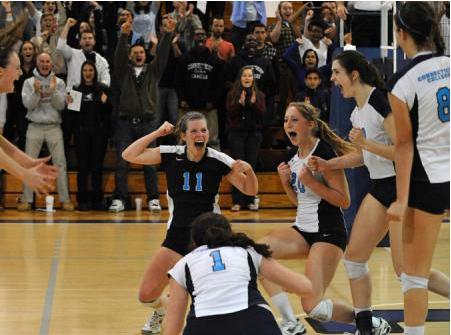
volleyballvictory

Alternatively, we could each take 32 random chocolates and make an advent calendar. Perhaps, each chocolate comes with a picture and story about one of the ingredients or an interesting story about it. When did people first make chocolate? Who? When did people first begin “refining” sugar? Who first boxed chocolate? Do you know the story of “Mother’s Day” by the way? What is the current thinking on the dietary impact of chocolate? Is it good for you? Bad for you? Both? We could turn a simple box of chocolate into a thoughtful and interesting gift of value far beyond the box of chocolates itself. Yeah, it would definitely be a lot of work to make this into a multi-dimensional gift. But it would also be a lot of fun. Who knows? We might even make a multi-million dollar business out of it.

There’s nothing particularly “special” about tangerines, apples, or chocolate in this regard. Anything of value can be made more valuable by the addition of other ingredients, contexts, knowledge, love, caring, gaming, and by changing your stance or attitude toward it. You can continue to negotiate like a little kid. That’s not horrible. At least you’ll get half a box of chocolate out of the deal (or a fair chance for the whole box). Or, you could negotiate like a “real winner” type A go-get-um up-and-coming ladder-climbing dynamo of flash and dazzle. You can then brag to your friends (if you have any) that you ended up with one chocolate while I ended up owing three chocolates. Yes, you could brag that you “won.” Congrats.

Your third alternative: approach every negotiation as an exercise in creativity and creation. Every party to a negotiation brings something to the table tangibly (or why are they there?). But beyond that, each party also brings their unique perspective, values, and life experiences. Working together, we could almost certainly create something of more value than what we are negotiating about. Despite my best efforts, you might just not like tangerines. But maybe you do like oranges. Why? I mean, why do you like oranges but not tangerines? We might discover something of great interest to tangerine growers or the advertisers for oranges. You might like creamy chocolates but you don’t like chocolates with nuts although you like both chocolates and nuts. Why? We might discover something of great interest to chocolatiers. Or, in the process of trying to discover why you don’t like chocolate covered nuts though you like both ingredients, we might discover something about what makes some people allergic to nuts or something about you. Every disagreement need not devolve into a zero-sum game unless you decide or believe that’s all there is. Instead, you could treat every disagreement as an opportunity to work together jointly and create value beyond what comes to the table.

As explained in “The Winning Weekend Warrior” sports are not zero sum games. If you take me on in tennis, one of us will “win” the match and one of us will “lose” the match. But the winning is but a small part of the overall value. I improve, hone, or broaden your skills and you do the same for mine (provided we are somewhat evenly matched). We are both exercising which means we are improving the body, mind, and spirit of each of us. True zero sum games are largely a fiction. More accurately, they are zero-sum only in terms of a very limited view of the context of your experience. Be creative! When there is an issue of disagreement, create!

snowfall


Comments welcome! My computer is deathly ill and this was created on a borrowed computer so it may take a while to respond, but I will respond to comments when I can.


Author Page on Amazon

Issue Resolution.

19 Sunday Nov 2017

Posted by petersironwood in America, apocalypse, psychology, Uncategorized

≈ 2 Comments

Tags

civility, competition, compromise, debate, dialogue, discussion, innovation, issue resolution, learning, politics

finalpanel1

You have different experiences than I do. Yes, this is completely obvious. And yet, somehow when people like you and I are faced with a complex situation, we are initially surprised (if not amazed or stunned) that everyone doesn’t see it the same way or instantly agree on a course of action. Why would that happen when we have such vastly different experiences? It wouldn’t. It couldn’t. Even my five cats have completely different reactions to most situations.

We also have different real and imagined interests in various outcomes. If I am rich and would benefit from a tax break for the wealthy, I might be more inclined to think it’s a good idea than if I stood to lose. For some people, self-interest plays the largest part. For some, it plays the only role. But for others, it plays very little role. They are more motivated by something else; e.g., what they think of as “fair” or “best for economic growth” or “most likely to reduce crime.”

You and I won’t even go to the grocery store and pick out the same box of cereal (at least, not usually). Why on earth would be expect to agree on everything when we have different experiences and different interests? We even have different priorities about what even counts as our interest. For example, I look at the past primarily as a vast storehouse of things to learn from. I appreciate that change takes time and that people are able to adapt to change at different rates. But I don’t really care much about preserving a law, custom, or method “for its own sake” or “just because we’ve done it that way” unless there is a current or future benefit or unless the change is likely to produce an avalanche of unwanted side-effects. For instance, I’m happy to try out new computer technologies, but more reluctant to try out some new drug.

IMG_9503

On the other hand, I care a great deal about how the future turns out for my family, my nation, my species and for life on the planet. You, on the other hand, may love all things retro and think of the future as something that is completely unknowable and that any action you take in order to make X occur is just as likely to make ~X occur. You might care about only your own country, or your own species, or your nation. Or, you might care a lot about some specific other species such as whales or polar bears.

So, if we agreed on every issue, it would be astounding. You and I are going to differ, at least on some issues. You and your neighbor are also going to disagree on some issues. You and your boss will disagree; you and your spouse will disagree; you and your son will disagree; you and your daughter will disagree. That isn’t a bad thing. It is an inevitable thing. It has always happened; is happening; will always happen.

There nothing new in disagreement. Humanity, however, seems lately to have forgotten most of the ways of handling disagreements and how to accomplish intelligent issue resolution. 

IMG_9895

Currently, many of the popular social media are not, at least in the current way they are being used, very productive in creating issue resolution. They may be quite useful in energizing people who feel the same way you do about at issue. Perhaps we can create something to do a better job of issue resolution electronically.  For now, social media proved useful in the Arab Spring and the Ukrainian ouster of Putin’s puppet but have proven not so useful in resolving where America wants to go as a country.

Face to face negotiations are a better venue in which to manage issue resolution. Let us delve into why a bit later. But first, let’s review some of the general strategies for issue resolution. In the most general case, I want X and you want Y. Now, what do we do about it?

I, for one, do not expect everyone to agree with me on every issue. I am however, more than a little disappointed that our current society does not seem so mature at issue resolution as my friends and I were as pre-teens.

When I attended Junior High School, our neighborhood featured many brand new homes in various stages of construction. This afforded opportunities to hang out indoors without prying parental eyes. One of the things we did was play penny-ante poker. Different people preferred different poker variations. So, what did we do? Did we argue all day and go home mad? No, we played “dealer’s choice.” In many card games, one person, “the dealer,” shuffles the cards. Typically, someone else “cuts” the cards at a random place. Then, the dealer deals out the cards. The next round, the deal passes and it’s someone else’s turn to deal and to specify which game is to be played for that round. Some of my compatriots liked naming lots of “wild cards.” Others didn’t. Personally, I liked five card draw, nothing wild and seven card stud. We sometimes tried to convince the dealer to pick something other than their first choice. But we never quit because of their choice or tried to “beat them up” until they picked the same thing we would. We knew that preserving the integrity of the game was better than wrecking the game in an ill-advised attempt to get our own way.

IMG_6833

For the same reason, we didn’t cheat. I can assure you that if someone cheated more than once, he would have been ostracized and not invited to play again. We would not have tolerated cheaters or bullies. And, if that person lied about their behavior, it wouldn’t have helped their case at all. Taking turns is one general strategy for dealing with disagreements. Of course, it cannot be applied to everything. It makes sense to let the dealer chose the game for a hand of cards. It makes no sense to have one administration build bridges and have the next administration tear them down and then have the next administration build them up again.

When we played pick-up baseball, basketball or American football or soccer, the two “captains” typically took turns choosing players. We chose the captains through a voice vote. One of the captains chose first from the remaining players. Which captain? Sometimes we flipped a coin, or saw which captain could roll a baseball closest to a bat that was about twenty feet away. Most often, the captains played a game of taking turns placing their hands on a bat. Whoever got to the “top” won first choice. So, as a general rule, on some occasions, luck or skill determined a small issue resolution.

IMG_5187

Later in high school, I joined a “debate team.” We prepared for these debates by structuring arguments and also by doing research to gather facts, stories, arguments, statistics. We wrote perhaps 100-200 hundred cards and organized them. It never occurred to me to fill one of these cards with lies; e.g., exaggerated statistics. I never thought about why we didn’t make up statistics to prove our points. It simply wasn’t done. So far as I know, we all recognized at some level that this would be cheating and that cheating would spoil the game for everyone. What possible honor would their be in a ribbon, medal or trophy that won by cheating? I suppose, if asked, I might have also pointed out that being caught making up facts, quotes, or statistics would be humiliating. I suspect our teacher coaches would have also extracted some penalty beyond that, but I never had one of my debate team mates even suggest such ploys.

These debates were run by rules. No-one in these debates used ad hominem arguments or belittled their opponents. We were sixteen years old. By the way, we debated “real” topics. One topic I recall was federal aid to education. Another topic involved free trade agreements among the Americas. The topics were non-trivial. The debates followed rules of turns and timing as well as conventions about what was an acceptable line of argument. Debaters cited facts; used metaphors. We argued as persuasively as we could. But I never despised or even disliked my opponents. If someone came up with a novel clever argument, I would be appreciative just as I am today if my tennis opponent hits a particularly good shot. Before the debate began, we introduced ourselves and shook hands. Did I mention that we were sixteen years old? At sixteen, my brain was not fully mature, and my hormones were pouring into my veins. I could literally get angry in one second. Yet, we always debated with civility and sportsmanship. How on earth have we come to a place where national leaders behave more like children than sixteen year old debaters or twelve year old boys playing baseball or poker?

It wasn’t just me. By the age of 16, everyone I went to school with knew about resolving issues by luck, by skill, by taking turns, and by debate according to rules and based on facts. 

IMG_5507

Two additional methods we were fully aware of were physical power plays and decision by authority. On very rare occasions, and generally at a much younger age, a kid might try to get their own way by physical intimidation. This worked for them in the short term, but never in the long run. Bullies were quickly ostracized. Of course, parents and teachers were authority figures and sometimes they would insist on resolving an issue “their way” simply because they were the authority. This method seems a close kin to bullying. On some occasions, we would protest the decision of a teacher, administrator, referee or debate judge. If we pushed that too far, we could get ejected from the class or the game. That was rare. In some instances, I managed to change an authority’s mind. Most of them were invested more in doing the right thing and making the right decision than in simply demonstrating their superior position. We expected them to be fair even though we didn’t always agree with their decisions.

I recall on one occasion that we won a debate. As my teammate and I were leaving the room after the debate was over, the debate judge continued to argue with the other team over the subject matter of the debate! The evident bias of our judge ruined the victory retroactively. It ruined the experience for the losers but it also ruined the experience for my teammate and me.

IMG_6012

It astounds me that many Americans seem to have forgotten even these simple methods of issue resolution that I knew as a teenager. Since then, I’ve learned four additional techniques that probably each deserve their own blog post to describe in some detail. I will list them briefly before returning to catalogue some of the reasons why issue resolution is generally best done face to face.

The first method I first discovered when I got married the first time in a Quaker meeting. The branch of Quaker that I married into did not vote to resolve disagreements. They talked about it until there was a consensus! I was incredulous to learn of this. I asked, “What do you do when people don’t agree?” The answer was, “We keep talking.” The style of these Quaker meetings was for people to simply stand up and say things that came to mind. It was definitely not a structured debate. In fact, sometimes a person’s comments left no clue as to whether they were “pro” or “con” on an issue under discussion. Many years later, I discovered the work of the quantum physicist David Bohm on “Dialogue” which has a very similar flavor. He does not claim to have invented “Dialogue.” Instead, he says that many so-called primitive tribes including Native Americans, naturally engage in the practice. Basically, one person says something. Everyone listens with respect. Everyone then reflects silently on what was said. If they now have something to contribute, they do. It doesn’t have to be an argument “pro” or “con.” It can simply be an observation or question.

https://www.amazon.com/Dialogue-Routledge-Classics-76/dp/0415336414

https://en.wikipedia.org/wiki/Bohm_Dialogue

The next method for issue resolution comes from the work of Christopher Alexander and his colleagues who developed a “Pattern Language” for building. A Pattern is the named repeated outline of a solution to a common problem. A Pattern Language is a lattice of inter-related patterns that covers at least a large part of a domain. Initially, Christopher Alexander and his colleagues developed a Pattern Language that covered city planning, public buildings, and homes. Each pattern has a number of parts, including a listing of opposing forces. The opposing forces tend to push solutions in various and often opposite directions. The Pattern that forms the solution involves either a useful point of compromise, or more wonderfully, a transcendent solution to the (apparently) opposing forces.

https://en.wikipedia.org/wiki/A_Pattern_Language

https://www.amazon.com/Pattern-Language-Buildings-Construction-Environmental/dp/0195019199

https://www.slideshare.net/John_C_Thomas/toward-a-sociotechnical-pattern-language?qid=dd8c7ab3-fca0-41f3-9aa4-d460827b2409&v=&b=&from_search=3

While at the NYNEX AI lab, I commissioned someone to teach a three day workshop based on the Harvard Negotiation project. The basic concept of this approach is to negotiate according to your needs and wants rather than your positions. In a simple example, two sisters each want the only orange they have. Eventually, they decide to split the orange in half as the only fair compromise. As it turned out, however, one of the sisters really wanted the peel in order to use the zest for a cake while the other sister wanted to eat the flesh of the orange. Rather than settle for half of their actual desires, they could have each had it all — if only they had honestly talked about what they needed and why. For more information, see the link below.

https://www.pon.harvard.edu/blog/

Still more recently, while working at IBM Research on knowledge management, I helped start a monthly meeting of people from several companies who were all interested in knowledge management. One of the participants, I believe from United Technologies, told us about TRIZ. TRIZ was developed by a Russian, Genrich Altshuller. He was a Russian inventor who wrote a letter to Stalin suggesting it was important for Russia to become more creative. For what was seen as an implied criticism, he was sent to prison where he connected with other very intelligent and highly educated Russians who had also been sent to Siberian prison camps. By talking with experts in a wide variety of domains, he developed a general way of solving engineering problems. The method gives general ways of resolving apparently opposing demands. For example, an auto axle needs to be light to reduce gas consumption and materials costs so this would lead to an axle of minimum diameter. But an auto axle also needs to be strong. Having your axle break when you hit a bump at 60 miles per hour can ruin your day. So, you want the axle to be of maximum diameter for strength. The lowest level “solution” is a linear compromise. You want the axle to be sufficiently thin to be economical but not so thin as to be easily breakable. A more “transcendent” solution is to make the axle hollow. Such an axle is nearly as strong as a solid one but much lighter. A still more “transcendent” solution is to lose the axle altogether. Four independently operating wheels are too tricky for most humans to handle, but I suspect that when autos are all self-driving, we will eventually see axle-less autos as well. Under the proper algorithmic control, four independent wheels could be lighter and safer.

https://en.wikipedia.org/wiki/TRIZ

All of these methods are worth considering in more depth. However, let’s return to the notion that Issue Resolution is best done face to face. Is that true? If so, why? What is it about face to face communication that makes it better for Issue Resolution?

IMG_5159

During my career in IT and telecommunications, the bandwidth for remote communications has increased tremendously. I recall as a young child that my mother was tremendously excited to see the coronation of Elizabeth II live on TV. The black and white picture was extremely grainy and the content, at least to a young child was snoringly boring. We watch the live high definition TV events of today broadcast in much more fidelity and color. Likewise, teleconferencing often includes picture phone and/or screen sharing. An engineering view suggests that we can make teleconferencing work as well as face to face meetings by increasing bandwidth until it is indistinguishable from face to face.

To a psychologist like me, however, simply increasing bandwidth will never be enough to make teleconferencing equivalent to face to face meetings. Let me illustrate by example. For two years, in the early 1980’s, I worked in IBM’s Office of the Chief Scientist. My main objective was to get the IBM company to pay more attention to the usability of its products. In this regard, I visited the majority of IBM development labs, programming centers, and scientific centers. By traveling there, I could not only see people but experience what they were experiencing. At one meeting, for instance, a Danish doctor came to a meeting of European IBM executives and product managers. He began his talk by placing a metal box on the table in front of him and turning a switch. The box emitted a horrible noise! He began talking and showing slides and his audience immediately objected and asked that the box be turned off. He calmly said, “Oh, just ignore it” and he continued with his talk. The protests grew more vehement. He remained calm. “Oh, that? The noise? Just ignore it. That’s what you ask your users to do. This is only 60 Decibels, the same as your acceptable and actual noise levels on your new terminals.” Had this meeting been a teleconference, this demonstration would have been far less effective. On a teleconference, many would have simply turned down the volume or even turned to other tasks until the noise ceased. The participants would not have been able to sense the tension in the room or seen the dawning comprehension on the faces of their colleagues.

Face to face meetings allow the possibility of doing each other direct, immediate physical harm. Of course, most of the time, we don’t actually do that, but the fact that we could cause harm but refrain, builds trust. Remote participants cannot punch you. So, the fact that they don’t punch you doesn’t build trust. It just reinforces your understanding of physical reality.

Beyond the meetings themselves, traveling to a remote location allows you to understand at a much deeper level that you are in another location. You experience the food, the physical context, the restrooms, the transportation system, the language, at least to some extent, the culture. For instance, at the lab I visited in Sweden, some people brought their kids to work. Every person in that lab had a window. It is one thing to read about these things and a completely different thing to experience it first hand. I began learning even before arriving at the airport in Stockholm. I sat next to a Swede on the plane and, in the normal course of events (neither of us having an iPhone at the time), he told me interesting and important details about their culture. For instance, no matter how much land someone owned, travelers were allowed on that land up to about 200 yards of the owner’s house. They were allowed to forage and to use fallen wood as firewood. The people at the top of companies were only paid about 20 times what the lowest paid person was paid.

IMG_5197

In another case, I drove the spectacular and extremely scary road from Nice to the IBM lab in La Gaud. Once there, I spoke to their “usability” person. He showed me their “usability lab.” It became clear upon my questioning that this was essentially a “Potemkin Village” usability lab. It had never been used or even completely set up. It was a ruse to show that they were in compliance with orders from headquarters. After being unable to answer a number of my pointed questions, the “usability person” admitted to the scam as well as his own lack of qualification to run a usability lab. He could have easily fooled me via teleconference.

One of the potentially important factors about face to face meetings is the high degree of time synchrony. It turns out that people can sense and interrupt each other and move in rhythm much more easily with essentially zero lag. There is also always the possibility of shared experiences beyond what is necessary for business. For example, when I travelled for IBM to Zurich in the summer of 2000 to meet about knowledge management with ABB group, there happened to be a solar eclipse “visible” from Zurich. Unfortunately, the day was quite overcast. Nonetheless, our host provided everyone at the meeting with safe viewing equipment and we all left the meeting to view the eclipse. All we saw were clouds. After a few minutes, however, the clouds parted and we all got a good look (through the smoked glasses) of the eclipse for a few minutes before resuming the meeting indoors. If you and I are in the same physical space, there is a chance, however remote, that I might save your life, you might save mine, or we might work together to save someone else. It seldom happens but it could happen. This means that you and I might have to depend on each other. We might have to trust each other. This possibility may well make us more prone to be civil.

If you think back on your personal experience, you will probably come to a similar conclusions. Some things are best done face to face, regardless of bandwidth. However, you don’t have to rely on your own experience or mine. There is an entire empirical literature on this. Here are some good places to start.

http://mail.shireroth.org/misc/Distance_Matters_Gary_M._Olson_and_Ju.pdf

https://www.microsoft.com/en-us/research/publication/what-still-matters-about-distance/

https://link.springer.com/chapter/10.1007/978-3-319-21536-5_4

http://content.time.com/time/health/article/0,8599,1998396,00.html

My wife Wendy and I were among the co-organizers of a CHI workshop on “cross-cultural issues in HCI” that took place in Monterey in 1992. At that workshop, we had participants from many countries. We began the workshop by having all the participants cooperate to physically rearrange the space so that we were in a large circle rather than in rows (as though listening to a lecture).

OLYMPUS DIGITAL CAMERA

Another CHI Workshop begins with a physical task

So, we began working together on something physical that we were all familiar with (but not something we were expert in). What happened is that we sensed that the other people were pretty much like us. On the other hand, if your first encounter is with words, you will immediately notice an accent and in many cases, it will be difficult even to understand what they say. After working together to successfully re-arrange the room, now when one of those people speaks, there is already a tiny bit of a bond. As a result, each person tries a little harder to understand accented speech. If you don’t understand something, you are slightly more apt to speak up and ask what was said. Perhaps, the initial common ground of a successful physical task made the entire two day workshop go more smoothly. I wonder whether others have experienced anything similar. Comments welcome.

IMG_3067

—————————————-

https://www.amazon.com/author/truthtable

Fool’s Gold

31 Tuesday Oct 2017

Posted by petersironwood in America, apocalypse, psychology, Uncategorized

≈ 4 Comments

Tags

commercialism, competition, environment, ethics, family, life, morality, values

IMG_5126

Fools Gold

The Lost Sapphire

(Appeared summer 1997 in the e-zine, The Empty Shelf, slightly re-edited, here).

I can’t recall how that giant blue sapphire first veered into the orbit of my life. Of course, even at five years, I knew it might not be a real sapphire; at least, that’s what my parents insisted. They called it “just glass.” But, they might just possibly be wrong, I secretly thought. After all, I could look into it forever. And, if I looked real hard, I could see the dim, midnight blue outline of things beyond and through the stone, transformed by the magic of the stone into something quite out of the ordinary; something heavenly, mysterious, almost certainly good rather than evil. Almost. And, so far as I could tell, my parents never actually saw the stone; certainly they never looked through it. They’d just glance at it and say, “Oh, yeah, it’s blue glass.”

Well, it seemed to me that it could very well be a real sapphire. Besides making things look beautiful, there was something else — something mom and dad never even tried to understand. It was this. If something happened I didn’t like; if I were sad because my dog was “put to sleep” or scared of getting a shot, I could look at this sapphire and it made me feel better! It made it all, “Okay.” If I listened carefully, it spoke wordless tales of wisdom and comfort. It was obviously worth a lot, lot more than my parents knew.

True, there was a tiny chunk broken out of one corner. But that didn’t really matter. The stone was still perfect…perfect: something to be kept forever.

Forever, that is, until Jimmy moved next door. Jimmy was ten years old and had a two-wheeled bike. Jimmy towered up nearly as thick and high as an adult. But Jimmy was still young enough to see the powerful magic in the sapphire. One bright Saturday morning, on the green grass of the “devil strip” between the white sidewalk and the forbidden black street where the deadly cars zoomed, I sat in the grass watching the magic sapphire, listening for its words of wisdom. Jimmy rode up and tossed his bike onto the devil strip and hopped off in one smooth move. He plopped down beside me. He flashed the red reflector from his bike in the sunlight. Oh, how it sparkled into my eyes!

“Do you want this ruby?” asked Jimmy innocently.

“Oh! Okay. Thanks!”

Jimmy handed it to me and let me flash it in the sun. It was so much brighter than the sapphire! It sparkled fire!

“Great,” said Jimmy, “Let me have the sapphire.”

He snatched it from the grass where I had lain it, jumped up sped away on his bike.

I stared dumbly at his vanishing figure, then back down at the red reflector in my hand. Maybe this was a good trade after all, I thought. It was really bright all right. And when you moved it in the sun, it made different starburst patterns. After all, it had come from a full-sized two-wheeler. But still…something was missing. Then, a buzzing filled my ears. I suddenly realized that the reflector was just pretty glass! There was no magic to it. It didn’t speak; it just buzzed its foolish empty buzz. I couldn’t look through it to other things. It had no depth. And worst of all, it could never make anyone feel better, not even a little bit. “I thought you meant…for a minute…” I said to the big kid now behind his own front door.

I considered telling my mom and dad. Maybe they could get the sapphire back! I hated telling them. You just don’t tell parents about kid troubles; it’s against the main unwritten law of being a kid. But maybe they could get my sapphire back! When I finally told them what had happened, they said, “Well, you made a trade.” I tried to get Jimmy to trade back, but he had none of it. Jimmy soon moved away, never to be seen again. But I kept the red reflector — not to look at — because that would seem somehow unfaithful to the spirit of the sapphire — but just in case Jimmy came by one day wanting to trade back.

And later, much later, I used my allowance to buy special clear marbles — called “Peeries” — emerald green and dark blue with bubbles in them, and my dad got me a cool science kit with a clear rainbow prism that threw color into everything, and then one day I looked into the deep, sparking blue eyes of a blond girl named Jennifer and later into the sparkling blue eyes of a beautiful woman named Wendy and then into real diamonds and computer screens and experimental results and statistical analyses and conclusions, insights, and science fiction. And all of those things were good and all of these spoke to me.

Still, I wonder where the blue sapphire is and how to get it back. How to get it back? The magic. Not clever illusion, not something made to look nice, but true magic. Are you out there, Jimmy? Because I still have your red reflector if you want to trade back.

——————————————————————

I don’t know whether society can trade back either. We used to have some kind of balance between competition and the other valuable things about life. We seem mainly to have traded it in on a newer model. In the new model, money is the only thing that matters. Winning is the only thing that matters. Math definitely does not matter. People who are rich and powerful can pretty much get away with anything. The only exception would be someone like Bernie Madoff who was silly enough to include some wealthy people among those he bamboozled. But the Bernie Madoffs of Wall Street that sunk the economy in 2008 walked away scot free.

“All that glitters is not gold.” The normal interpretation of this means that not everything that glitters (like gold) really is gold. Normally, this is meant in a metaphorical way but based on the real phenomenon of “Fool’s Gold” (Iron Pyrite) which does glitter like polished gold but is of far less conventional value.

IMG_4695

I like to consider a different interpretation: What if all gold is “Fool’s Gold”? Naturally, I’m not denying the existence of metallic gold. I’m wearing a (mostly) gold wedding ring. So, I believe in real gold. What is meant is that striving after gold is itself a foolish thing to do. If that’s true, then, it’s all “Fool’s Gold” whether or not it’s Iron Pyrite or Real Gold.

How could this possibly be so? Isn’t life a contest to see who can make the most money? Isn’t money (and before that gold) an easier way to exchange goods and services that having to strike each deal uniquely? It is indeed easier. Does that necessarily mean it’s better?

Society is growing more and more differentiated. We do vastly different jobs from each other. For example, for many centuries, farming was a common occupation. In the USA in 1900, for example, about a third of the entire workforce were still farmers.  Now, that percentage of farmers is about a tenth that. It isn’t only that there are now many different fields such as computer science and forestry. Even within a field such as computer science or forestry, there are more and more subspecialties. It’s as though the tree of humanity is growing larger and larger and branching out farther and farther.

IMG_9489

At the same time, this entire enterprise called “society” is not stable. It is spinning; spinning faster and faster. This means that this whole enterprise will eventually fly apart — unless, the cohesive strength of the whole enterprise continues to increase. Unfortunately, it seems that just when we need to increase that bonding strength, it is weakening.

What is the real gold? Anything that strengthens the ties is real gold. Anything that weakens the ties will tend to cause the entire enterprise to disintegrate. Even if some bars of heavy shiny metal accrue to those who strive to break us apart, they are causing overwhelming harm to others, including generations and generations of their own offspring.  The last time, the European Dark Ages occurred, it last centuries. Science, engineering, agriculture, learning, medicine — all these things were worse for a half millennium before they started to get better again. Meanwhile, the toll in terms of human misery was immense. And for what?

IMG_6881

Our fall from the advanced civilization to the next Dark Ages will be a much harder fall than what much of Europe experienced after the fall of Rome. People in a Roman society were closer to the land and to the world of real things than many people are today. Many moderns in the so-called Global North have no idea how to live off the land, plant a garden, hunt or fish. Even if they did, we wouldn’t be close to being able to feed 7 billion people without modern agriculture, distribution, knowledge of crops, irrigation systems.

My history lessons focused on Western Europe and the United States, so when I think of the “Dark Ages”, I think in terms of Western Europe. But we should remember that that minimal impact, for instance, on most of the people of the planet at that time including North and South America, Australia, most of Africa, and most of Asia. This time, it would be different. Such a catastrophic Dark Ages would today be global. No-one would really escape.

IMG_7168

No-one would escape the new Dark Ages and that includes extremely rich and powerful people. Yes, they could have more absolute power over other people as a Newmedieval Tyrant than as the leader of a democracy. And, granted, that may be the most important thing in the life of that kind of person. But it isn’t the only thing. They have no idea how inconvenienced every other aspect of their life would be if civilization fell.

We, as a species, are not “set up” for the Dark Ages. There are way, way too many to feed without the science and engineering behind today’s agricultural processes. There are way too many to obtain fresh water without modern infrastructure. Of course, it isn’t just that we are physically unable to deal with this kind of downfall. We are nowise prepared mentally either. Most of the knowledge we currently have for living in a complex, technological society would be completely useless and we’d know very little of what we should actually know in order to survive.

Maybe hell is not the punishment for one person’s life of sin, but the collective punishment wreaked upon all of our descendants for the collective current sins of humanity. After all, isn’t extinction a kind of hell for the species? We wouldn’t be the first extinguished species. Not by a long shot. Most of them were “hit without warning” by the after-effects of a meteor or a met by a human-powered bulldozer clearing away amazing rain forests for a few more bars of fools gold.

I know one thing for certain. Jimmy’s not coming back to trade you back what you really care about for that shiny red reflector that caught your momentary eye.


Author Page on Amazon

If Only…

28 Friday Jul 2017

Posted by petersironwood in psychology, story, Uncategorized

≈ 21 Comments

Tags

competition, crime, history, insanity, London

If only…

Henry slung off the down comforter and swung his well-muscled legs over the edge of the four-poster. “Screw it” he muttered. “Nothing for it.” He padded over to the dresser and began pulling out some clothes for late night walking.

As usual, he made no attempt to direct his thoughts but watched to see where they would flow on their own. While his dextrous hands dressed himself, he listened attentively to the voices vying for attention in the theater of his brain.

Tick, tick, tick. I hate clocks, Henry’s relentless flow began. Tick. Tick. Tick. They’re everywhere. Why? All they do is remind people that they’re going to die. So what’s the point? There must be somewhere in this God-forsaken city that a guy can go and get some peace from their incessant — and even worse than their damned tickery  — that clanging gonging earsplitting racket! It drives me to — but more of that later. I need to exit this rat-trap of a hotel and walk the river, no matter how late it is or how foggy the night. Head ready to explode and all this place offers me is noise. Did you ever notice how the tick tick tick of clocks is like the sounds those insect — what do they call them — mandibles I think — yeah, like their jaws only sideways. That’s the sound. Only magnified. Louder. Sharper. More painful.mandibles

He snatched his Macintosh, and crammed himself into the elevator thinking as he slammed the grate shut, here I am again in this absurdly teeny cage of an elevator. All these European hotels are the same. Can’t spring for a real elevator. Just these little metal cages. Not even enough room for two people. Especially if one of them blobs on the floor uselessly. Damn. It would be so much nicer if I could take them up to my room after. Dragging dead weight up three flights of stairs though? No way.

Maybe I’ll buy myself a small cottage instead. Secluded. If I can save the money. I’ll get there. Or my own damned hotel. Why not? Think big. Not teeny like this damned elevator. And, why does this lift — as they call it — take so blasted long? Like everything here. Too ancient. Like they never got over losing their favorite colony. Not sure why so many people swoon over London. Everything’s old or broken or most likely both. Although, that torture museum on the south bank. I have to say, that is pretty cool. For the first time in a long while, Henry’s eyes sparkled and the right corner of his mouth even turned up. “Even the frigging elevator goes tick tick tick,” he muttered.

Charles, the night clerk pretended to be shuffling important papers on the well-polished mahogany counter he considered his rightful domain.

“Good evening, Mr. Holmes. I trust all is well with you? Out for another evening stroll, are we?”

IMG_6084

Henry’s inner voices continued, Good God, the Brits are annoying. I’ve got to get back to city of big shoulders. Do they learn this crap at their homo boarding schools? Suspicion drips like black blood from his pupils. And that voice. Almost worse than the ticking. He acts like he’s in the Globe, playing Hamlet. Fine. I can join this little charade.

Aloud, Henry intoned his lines like Maurice Barrymore: “Indeed, my good chap. You surmise correctly. And, if you can hold the key till my return, that would be capital.”

Henry half placed, half slammed the key with its heavy awkward metal tag down on the wooden counter. Not so hard that he expected Claude to raise a fuss, which he calculated he wouldn’t have the rocks to do anyway. But not so soft that he isn’t going to wonder what’s going on. Let him wonder, the prig, thought Henry, noticing with pleasure the slight wince that flickered across Claude’s stoic face.

“Yes, I should return around twenty-two hundred latest. A pint of bitters should do me nicely. And, kidney pie of course.”

“Yes, sir. I will still be on duty when you return.”

In an aside to his audience of one, Henry silently added, Of course you will, you little prick. What else is there to do in your pathetic little life? Kidney pie! Lord. Does he think I’ve sunk so low I’d eat the garbage they do? Tastes like pee. No pub for me. No siree…I have other plans.

“Cheerio then, Clyde.” Or whatever your real name is. They can’t even be bothered to wear name tags like they do in modern countries like the states. 

Even the frigging front door isn’t like a real hotel door. Doesn’t open automagically. You have to turn the little faux crystal handle like you’re about to visit His Majesty in Buckingham Palace. When I get my own hotel, there will be an entirely different set of amenities. Oh, yes. 

Henry slid out into the damp London fog thinking: And bloody good I brought this bloody armored raincoat. Chilly and damp. Is there any other kind of London weather? Is it too cold for other Londoners to be out and about? No way. If they wait for decent weather, they’d never get out of the house. Or, bed. They’ll be someone. I just have to be patient. Tower Bridge, Tooly Street. Some lonely heart American there maybe. Or, just someone too jet-lagged to turn in early. They’ll be happy to hear my midwestern accent in this sea of ‘raaaaathaaa good.’ Or the scarier: ‘Eh goo lay-ee, needin’ spot a compny, are we?’ Morceau de gateau as the frogs would say. 

Well, there’s one good thing about London at night, Henry told himself. All these lights, each wearing its own halo. One good thing about the fog. Yeah. I love the halos. I admit it. So what?That doesn’t make me a fag. But these people. Acting like they’re all pristine and godly. Have these Londoners even visited their own Torture Museum? Get the truth you want. Yeah, no matter what. No matter who. I learned that on both sides. Toes still can’t really work right. Especially in this endless cold damp weather.

Henry began sizing up possible targets. Too many. And walking too fast. Nope. Don’t like three on one — though I could no doubt take all three. But it might get messy. They’re young. Better to bide my time. Maybe this couple? Not far enough away from the others. I’ll just go hang out on the bridge. Stare at the Thames like I’m lost in thought. Wait for the right one. Stare into the murky dark of the river. I can barely see that relentless tidal flow. It carries everything with it. Everything. Every year, some dozen idiots think they can out swim the power of the tide. Not to mention the cold. What fools. But aren’t we all fools. Crap it’s cold up here as well. Hey, now, here’s a cutie. What’s she doing out alone? Decent clothes. Some kind of glinty choker around her neck. Be cool, Henry. Be cool. I’ll start by complaining about the weather.

But to his surprise, she spoke first.

“Excuse me, sir. Do you happen to know if there’s a pub around here? I’m freezing.”

Jackpot. American.  At least I’m pretty sure. Maybe a touch of accent.  “I sure do. I can’t even begin to tell you how nice it is to hear another American ‘accent’ as they call it. Am I right? Anyway, I do know a pub, well, two actually, just down there maybe 200 yards. I’m done staring into the black water and asking myself why I came to London in January. I’m headed there myself. I can show you.” Play it cool. Play it cool, Henry. Nothing pushy. “I’d be happy to buy you a drink, but no obligation. You pick your pub and if you don’t want company, I’ll take the one across the street.”

The woman smiled, “Oh, sure. A drink together sounds great. But you needn’t pay. Let me treat you.”

Like shooting fish in a barrel, smirked Henry. “By the way, I’m Henry. Henry Howard Holmes. From Chicago.”

“Pleased to meet you! I’m Belle. Belle Gunness from Indiana.”

She stuck out her gloved hand.

Henry could see the bumps of two substantial rings beneath the tight white silk.  “Nice to meet you Miss Gunness. Or, shall I say, ‘Mrs. Gunness’?”

What’s that? I see a flash of — regret — then she smiles warmly? What — Henry’s mind still searched wordlessly as Belle supplied the answer.

“Well, I’m sorry to say my poor husband is dead,” she said matter-of-factly. I still go by Mrs. Gunness though, out of respect. He was a very proud man. You know. Handsome and strong like you.”

Henry intentionally slowed his breathing as he thought: This is shooting fish in a barrel after they swim into the barrel on their own! “I’m so sorry about your loss, Mrs. Gunness.”

“Oh, it was awhile ago. I thought that leaving our farm for a time, taking a trip abroad, would cure my loneliness, but it really hasn’t. No, not at all.” Here she sighed and looked full into Henry’s eyes.

“Well, Mrs. Gunness, I am sorry to say I have some idea of how you feel. My poor wife Agatha died a few months ago. I too thought a change of scenery would do me well. Chicago can be brutally cold in the winter. Alas, perhaps we should have chosen Nice instead?”

“Mr. Holmes, I am equally sorry to hear of your loss. Life is often merely the fruit for the seeds of death, isn’t it?  Ah, well, anyway, the pub it is! A warmer place and then on to a happier topic of conversation. Shall we?”

“All right, Mrs. Gunness, let’s go arm in arm like comrades facing this lonely world together.”

TowerBridge

Out of the cold night and into the surprisingly bright and crowded tavern they walked, locating a booth that looked a little less noisy that most, probably empty due to its proximity to the flight path of a spirited dart game. Henry didn’t mind a little danger, nor apparently did Belle.

“So,” began Henry, “What shall it be then? A pint of bitters, Mrs. Gunness?”

“That sounds lovely. And, please call me Belle.”

“Okay, Belle. And, please call me Henry. That’s what my friends back in the states call me.” Henry chuckled inwardly. Friends? Bah. As unreal as my made-up wife Agatha. But Henry had long ago learned to lie much more convincingly than most people can utter the truth. “And, remember, I’m paying.”  Henry trudged up to the bar to score a couple pints and skirted the lurching and somewhat over-intoxicated patrons. He set the pints back down on the small table between them along with a small ramekin of salted cashews.

“Thanks, Henry, that’s very generous of you. And, by the way, just out of curiosity, if you’ll excuse my question, what brings you to London? Is it only to escape sad memories or do you do business here as well?”

Henry eyed her carefully as she removed her coat and gloves revealing a number of interesting pieces of jewelry which his practiced eye judged to be quite real and quite dear. A bit dangerous to wear all this late on a London eve, especially in this part of town. Basically, Henry thought, not for the first time, these people get what they deserve. 

Henry chuckled again inwardly but let no humor reflect on his practiced mask, “As a matter of fact, I do manage to earn my keep when I travel to London. Belle,” he added. “How about you?”

IMG_5135

Belle smiled her full-lipped and open-eyed smile. “Me too. But what is it you do here? Isn’t it hard for an American to go into business here?”

Henry took a nice long suck on his pint as he considered this question. “You know, Belle…you’re sure it’s okay to call you that? Well, it’s very difficult to reveal — I mean explain. There is no one source of income. My sources are extremely diversified and even somewhat random. Yet, somehow, I succeed each time. It is really as though wealth seeks me out rather than the other way around. Just lucky I guess.”

Belle laughed, “Oh, Henry, you’re so mysterious. I saw you eyeing my rings. You aren’t a thief are you?”

Henry let his face betray nothing, half hiding it behind another long sip. “Oh, no, don’t worry. I’m not a thief, at least no more than any other businessman, and I’m certainly not out to steal your jewelry, which by the way, I did notice. You’re quite right about that. Very beautiful. Especially the star sapphire ring. But don’t worry. You won’t be calling the Bobbies to complain about me stealing it. That I can promise you.” Henry looked into her eyes quite openly now because he was telling the truth. He had no plans whatsoever for her to be complaining to the Bobbies or anyone else about his actions for the night.

“And how does a lovely widow such as yourself manage business here?”Henry asked with unfeigned interest. He really was curious.

“Well, Henry, tit for tat. Tit for tat. Although you didn’t give me a very clear answer. Anyway, my husbands happily did provide for me after death. I’m fine for now. But it won’t last forever, so I’m spending his fortune over here finding what might be the basis of an import business. Buy things here inexpensively and then back stateside, charge a premium. How does that sound?”

“That could work. Yes. By the way, did you say ‘husbands’? Did you lose more than one?”

“Oh, no. Just the one. Well, I mean, it is a bit loud in here, isn’t it? People do tend to get louder in direct proportion to the amount of alcohol they consume.”

As though on cue, the sharp clatter of a heavily laden tray declared its undying love for the third law of thermodynamics.

Henry snorted. “I see what you mean, Belle. It is loud. Perhaps I should have suggested a quieter place for a quieter meal and conversation.”

“Oh, Henry. This is fine. I’ve already suppered in any case. Just a pint or two and I’ll be off to bed. I just wasn’t ready to face sleep alone. Not yet.”

“Okay. Well, pardon me for saying so, but it does seem a shame that one so charming and intelligent as yourself should have to travel London unaccompanied. What sorts of items are you looking for? Jewelry? Antiques? Handbags, perhaps? I notice yours is rather unique.”

“Oh, this old thing. Yes, I suppose. It is a Hermes. But I’m more into what is inside. Can I show you?” With practiced skill, she glanced to see that they remained as unobserved as possible in such a public place and unclasped the bag. She drew out a small pearl-handled dagger, presenting it to Henry much as a Michelin three star chef might present the piece de resistance. She placed it toward him but not where he could reach without effort.

IMG_9691

Henry found himself admiring this woman. Of course, that was exactly how they all worked. Draw you in one way or another so they can sting. Just like a black widow. He was sure she had said “husbands.” But the dagger — that really is beautiful. Henry moved his hands toward hers. “May, I, Belle?”

Henry laid the blade carefully in his hand admiring the workmanship as well as the sharpness. “It is indeed a beautiful blade. But don’t they make such daggers in the US?”

Belle laughed. “Well, Henry, yes, you can get a right nice dagger in America, but not one like this. This you see, has history. This dagger was supposedly owned by Mary, Queen of Scots. That’s what I’m after. Artifacts with history attached. That’s what some will pay top dollar for back in the states. Of course, I will have to move to a larger city for that kind of market. New York would be ideal. Or, perhaps Chicago.”

“Hey, Belle. Move to Chicago! We could be neighbors. I want to open up a hotel there, in time to catch people for the Columbian exposition. Which by the way, would also be a fine opportunity to let people know about your line of — are they all daggers?”

Belle smiled. “No, not at all. Here. Give me back the dagger and I’ll show you another fine item.” She gently took back the dagger and placed it carefully back into the depths of her handbag and then placed another item on the table. “Do you know what this is, Henry?”

“Well, bless my heart. I do believe that’s a thumbscrew. Of all things! So, they are all … weapons of some sort?” Be cool, Henry, he told himself. Don’t fall for this dame.

“Not exactly. I haven’t really decided on the exact scope. They are all — they all claim to be — of some historical significance. I think you might like this one.” She scooped up the thumbscrews and replaced it with an awkward assemblage on the table but kept it half-covered by her hands. “Do you recognize this, Henry?”

“It’s…a…chastity belt? Are you serious? I mean … whose?”

“Well, it’s not mine! I’ve been married. Not clear whose, but from the 1500’s. Imagine this may have prevented the birth of a King or a maniac or another De Vinci. Anyway, that’s why people like these artifacts to have a history. And, they will pay good money for them. They were common among the nobility in the Middle Ages. It wasn’t only jealousy. That was obviously one thing. But they were also for protection. And to prevent uprisings over claims to royal blood. Anyway, I suspect it will raise a good price back in the states. I’d never wear one. Or, I mean, is that the sort of thing that would…?”

“Oh, Belle, believe me, you have all the equipment any man would desire.”

“Henry, desire is not a word I have thought much about lately. But now that you mention it, the nights are lonely here. And cold. I don’t mean to seem forward, but I do have a very nice room. Perhaps you would be kind enough and brave enough to accompany me home to insure my safe arrival? Or, are you hungry? We haven’t had anything to eat and now I see our bitters are out.”

IMG_0530

Just then a waiter appeared to pick up the empty glasses. “So, would you two fancy something to eat? Or, another pint?”

Henry glanced at Belle but he had not yet learned to read her and she gave no hint of what she wanted, at least not in terms of food and drink.

“All right. No dinner. I think for us tonight, how about just desserts? Anything good?”

“Well, I’d recommend the blackberry trifle myself.”

“Okay,” said Henry, “We’ll take two. And two brandies as well, please.” He glanced again at Belle, waiting for her to assent or object or something. But she just stared at him pleasantly, Madonna like.

She smiled and yet seemed strangely distant as they awaited their desserts. However, when the trifles arrived, she once again became animated, tasting both the brandy and her trifle with obvious, if somewhat salacious, relish. She kept flicking her tongue over her lips.

Despite his best intentions to keep cool, Henry found himself aroused and drawn to this mysterious woman. He wanted to get a conversation going. He needed now, more than ever to keep his wits about him. “Have you heard about the Electric Chair? Do you think it will replace hanging?”

As soon as these words slipped out, he regretted it. Damned alcohol! Woman’s making me stupid. 

But Belle seemed completely unperturbed. “Oh, yes. I know about the Electric Chair. Yes, I suspect it will replace hanging. So long as they have a large enough place for the gallery. I do think it very important for people to be able to see the price of crime up close and personal. Otherwise, we’d all be doing the most sinful things, wouldn’t we? And vengeance of course, is not to be denied, is it? If I kill someone’s wife, the husband wants revenge doesn’t he? If he doesn’t get it, then he’s likely to kill me and my whole family. And, when that happens, the next thing is my village attacks that man and kills his whole village. And it escalates. Hang the person who did it. Have everyone watch. They feel their revenge. And, all the other bystanders? It makes them refrain from crime.”

“Indeed. Or do a damned good job of covering it up.”

Belle laughed. “Oh, Henry, you are too much! Yes, I guess another good outcome of hanging — or the electric chair — is that it makes people just that much cleverer. Speaking of clever, this trifle is delicious! Thank you so much. I see you’re finished as well. Shall we?”

IMG_9154

“Indeed, we shall, my lady. Indeed we shall.” He laid down the proper coinage on the bill and helped her on with her coat, ever the perfect gentleman. Then, he donned his own. Out into the cold night air they went. He offered his elbow once again, ever the perfect gentleman. He spoke in his Barrymore voice again, “All right, Mrs. Gunness, let’s go arm in arm like comrades facing this lonely world together.”

They walked back to Tower Bridge which was now considerably more deserted than it had been on their initial encounter. Henry’s heart raced. He briefly considered going back to her hotel room with her for a pleasurable encounter beforehand. But now, that makes for complications. Someone could easily spot him coming in. Better here on this now deserted bridge. With his free hand, Henry surreptitiously worked his knife into his hand.

“I know it’s cold, but can we just take one look at the Thames? Just for a moment?”

“Certainly, Henry. I’m no longer cold with you beside me.” Henry tried to make out her expression but to no avail.

“Actually, let’s duck down here for a moment, Belle. We can get a bit closer to the water.”

Off they went on a side path to an even more deserted path. Yes. Here. Henry’s heart raced like a whipped horse now. So close. Revenge at last. Revenge for all those women who…

Henry heard a blood curdling scream and wondered where on earth it was coming from. Me, thought Henry in panic. It’s me! What? He realized that sweet Belle had stabbed him and badly. Over the initial shock, he tore free and stabbed her with his own knife. She crumbled, mortally wounded, so he thought.

IMG_6059

Damn! Thought Henry, I’m losing consciousness. He grabbed her to throw  her into the black water and with his last strength hurled her into the Thames. She held tight however and they both plunged into the water. Don’t gasp! he told himself, but he did and they fell apart both struggling uselessly in the icy water, laden as they were with soaked heavy clothes. But my beautiful hotel, Henry thought. It would have been so delicious. The Exposition. Belle, he thought. Belle. Blood. Cold. Oh, God, I really am dying. Supposed to take her life, not have her take mine. Damn you, Belle. And why kill me? What did I…?  


Author Page on Amazon

Readers might find the following links also interesting.

Henry Holmes – Wikipedia

Belle Gunness – Wikipedia

What if…?

21 Friday Jul 2017

Posted by petersironwood in America, family, health, Uncategorized

≈ 4 Comments

Tags

competition, creativity, culture, family, life, politics, stories

IMG_8651

This is a kind of print medium, backed-up electronically. So, it will still be here in a few minutes, hours, and days. Here’s my suggestion. Read through once while your inner “Yeah-but”-ite chorus is otherwise occupied. You know the “Yeah-but”-ites. We all do. “Yeah but, You can’t possibly afford that.”  “Yeah but, you aren’t smart enough to do that.” “Yeah but, no-one would be that kind.” “Yeah but, yeah but, yeah but.” Give the Yeah-but chorus a TV show to watch, knock em out with whiskey — whatever it takes. Read the following once and see where the train of thought takes you. I have been thinking about this in terms of “America” because that’s where I happen to have been born and where I live now. But I suspect you can read what is below and substitute the name of your own country wherever it says “America.” If you do that, can you see these suppositions as equally applicable to your own?

You can always go back and rip my suppositions to shreds when you go through it a second time. In fact, knock yourself out. Read it fifty times and find fifty things wrong every time. First, read it once though, without doing that. Just flow along with the story. I realize it’s a story. I’m not trying to steal your pocketbook or convince you of tax reform or against it or any of that. It’s simply a “what-if” train of thought. I don’t know exactly where it will lead and neither will you, although the “Yeah-but”-ite chorus would insist after line one, that they knew exactly what I am going to say and why it would never work. By the way, if you do go back and read it a second time and find some better alternative, unstated assumption, another line of speculation, etc., I really would like to know. Anyway, here goes…

What if…

The vast majority of Americans actually wanted pretty much the same things for the country?

What if…

The vast majority of Americans wanted the basics for everyone and a few luxuries and a better life for their kids?

What if…

There actually is enough wealth for everyone to have the basics and a few luxuries and build a better life for their kids?

What if…

That were true regardless of political party, religion, region of the country, education level, gender, race, generation, or occupation?

IMG_9291

What if…

Agreements and Cooperation actually occur across every boundary in this country far far more often than acts of crime, or even nastiness?

What if…

Acts of crime or violence or scandal are reported far, far more often than the much more numerous cooperative actions?

What if…

Media have discovered that they make a lot more money if they report on sensational rather than inspirational or informational content.

What if…

The politicians, in order to gather our contributions, tend to exaggerate the negative attributes of their opponents and minimize their own while meanwhile exaggerating their own positive qualities and down-playing those of their opponents.

What if…

There were a vast number of improvements that could be made that everyone would agree on?

riverrushing

What if…

Our roads, bridges, and schools could be repaired and rebuilt?

What if…

We discovered that whether buildings and bridges stood or fell depended on physics and not on the political persuasions of the architects?

What if…

We made education a higher priority and spent more money on it than on cosmetics?

IMG_9489

What if…

We worked together to improve health in the country by encouraging everyone, male and female, young and old, to exercise more, eat healthier meals, and spend more time interacting with each other than watching TV?

What if…

We forced politicians to do what was best for their constituents rather than what was best for their wealthiest donors (when those are in conflict — they are not always in conflict)?

What if…

We focused on working together to accomplish what we agree on while we have a full and open debate on those things we don’t agree on?

IMG_9595

What if…

We took it upon ourselves every day to give each other the benefit of the doubt?

What if…

The next time we are stuck in bumper to bumper traffic, instead of weaving frantically in and out to “save” a few seconds, we kept up as smooth and steady a pace as possible while minimizing lane changes, accelerations, and breaking?

What if…

When we disagree about ends or means, we first recount what we have in common and how we want to deal with disagreements rather than rushing to resolve things once and for all immediately.

IMG_3066

What if…

We thought that life itself was a pretty cool gift to be enjoyed and that many human activities such as gardening, dancing, reading, making love, making music, teaching, participating in sports, walking, eating — that they are all pleasurable in and of themselves and not means to some other end like making more money?

What if…

It were possible for people to get together in neighborhoods, cities, states, nations, and world-wide to find, formulate, and solve problems even without governments?

What if…

We saw every human being to be an individual with their own desires, talents, ideas, issues, that to them were just as important as our own are to us?

IMG_5452

What if…

The successes, failures, short-comings and talents of each individual were partly based on luck and individual effort, but were also largely based on the actions of their parents, grandparents, neighbors, great-grandparents, uncles, aunts, strangers, teachers, doctors, Founding Fathers, explorers, scientists, artists, writers, bakers, truck drivers, fire fighters, police officers, farmers…?

What if…

A major way to reduce abortions would be to educate women better and to give them economic opportunity, and if they did get pregnant without wanting to, they had a much wider variety of choices than: 1. carry to term and give them up for adoption and never see them again or 2. carry to term and then struggle to make ends meat while trying to take care of a a kid on their own or 3. abortion?

What if…

Everyone promised to take care of every child born and make sure any mother who wanted to had the economic, social, and educational resources to give that child an opportunity for a full happy life with the mother being as involved as she wanted to be?

What if…

People viewed jury duty as a civic responsibility rather than something idiotic to be avoided so they can concentrate on more important things?

IMG_9428

What if…

People cared as much for the looks of their neighborhood and yard as much as they cared for the appearance of their clothes and hair?

What if…

Every American realized that people from other countries had just as much pride and hope for their own country as we do for ours?

What if…

People who made millions of dollars despite not producing any tangible work product or useful service were not viewed as some higher form of life, but as a kind of parasite on society?

What if…

In other words, actually providing direct value by building, discovering, cooking, growing, teaching, for instance, were viewed as much more valuable than redistributing money that was created by primary work.

What if…

We all realized that we are someplace we’ve never been before and no-one knows for sure what the path forward is, but that whatever the correct path is, it cannot be based on mutual fear and hate but must be based on love and trust?

IMG_2644

What if…

Realizing that, we collectively tried to determine how to follow or build paths of love and trust and found ways to overcome hate and fear?

What if…

We used our choices of media to watch and products to buy, not just on how much momentary pleasure they gave us, but also on how they were impacting the world and its people?

What if…

By working together we can build a better world for everyone?

hubble3

What if…

By respecting everyone, we can come to a better appreciation for the complexity that we live in?

What if…

Things are just a means to ends while life is an end in itself?

What if…

People came to see that everyone on earth is closely related?

What if…

People saw life on earth as something precious and worth saving and that that was even more important even than getting a new pair of sneakers?

What if…?

earthfromspace


Author Page on Amazon.

Pies on Offer: Rhubarb & Mincemeat

20 Thursday Jul 2017

Posted by petersironwood in America, Uncategorized

≈ 6 Comments

Tags

competition, creativity, ethics, life, politics, sports, stories

So, here we all are, somewhere on earth, each of us is unique; a product of our evolutionary, cultural, and personal histories. I am convinced that the vast majority of us are trying to do their best regardless of country, party, religion, race, or background. And, before launching into a discussion of anything else, it is worth at least a few moments of reflection on the fact that we have changed our world tremendously even in the space of my personal lifetime. I was born in 1945, the year the atomic bomb first devastated human lives. Since Hiroshima and Nagasaki, seventy two more years have passed and we have not had an atomic war. Of course, there is no guarantee that we won’t ever have one but we have survived decades when we might have wreaked this kind of heartless havoc on each other. And, we haven’t.

Another thing that impresses me is that we regularly communicate and cooperate with people across the world. Countries share ideas, products, services, and people. True enough, war persists. Yet, generally, people today enjoy the lowest death rate by violence at any time in our history. (Of course, if you or a loved one is a casualty, there is little comfort in knowing that “in general” people aren’t killed as much by violence as they used to be). But the general decrease is fairly remarkable when you consider a few vital accompanying changes. First, we have far deadlier weapons than ever before. Don’t get me wrong, if you smash someone’s skull with a large rock they are every bit as “dead” as if you drop a bomb on them or poison them. But, today we can kill a great many people at a very great distance. And whereas the strongest and healthiest and best-trained knights may have had a much better chance of survival than weaker or less able cousins, today it does not matter how well-trained you are or how much you can bench press. You will not survive in close proximity to an all-out attack whether by atomic weapons, chemical weapons, or biological ones. Second, we have far more people on earth than we ever have before. More people have been born since I was born than were born from the beginning of history until my birth. We evolved to be hunter-gatherers. We lived in small tribes. Now, we have 7 billion people on this planet.

IMG_1285

Imagine that there is only one large pie and four people all must satiate their appetites from that one pie. They might discuss things a bit. Maybe one person would claim to be famished while another does not really care that much for pie but would like to taste it. I would not foresee much trouble with four people. Would you?

Now, imagine that instead of four people, you had four hundred people and they only had one pie to stem their hunger. Wouldn’t you expect a much louder level of argument if not actual fighting to break out? Now, imagine that instead of four hundred people, there were 40,000 people and the only thing to eat was that one pie? Of course, there is a good chance for violence. However, it might also be possible that they would realize one pie split 40,000 ways is not much improvement over nothing. Why fight? It might be better to do a lottery and have the winner lay claim to the whole pie. If they liked, they could share with their friends and family. This may not be great, but it is probably still better than having everyone fight for the pie. Or, people might decide that they will have a contest based on what they value most. If they value physical strength more than any other human attribute, they might have a shot put contest or a wrestling match. The winner of the contest would get the whole pie and would be free to wolf it down themselves or share as they see fit.

twinsthreemonthbirthday

Suppose that everyone agreed to a wrestling contest and as the semi-finalists entered the ring, many were shocked at the discrepancy between their apparent physical abilities. Odysseus, let’s call him, sported legs like tree trunks, arms thick with banded muscles. Despite his giant proportions, he walked like a lion displaying a quick, easy grace. By contrast, Cassius, say, appears a bit on the thin side. His gait impresses the crowd as someone who might stumble or fall frequently. How can they both be one match away from champion?

Here’s how. Cassius isn’t using his strength at all. He’s using poison. As in ancient Greece, contestants wear gloves and Cassius, for each of his previous matches, has put a nearly undetectable ointment on the outside of his gloves. He touches his opponent, and they begin to get weary; they nearly fall asleep. But before they are so clearly drugged that foul play would be obvious, Cassius headlocks his disabled and wobbly opponent. The crowd mainly attributes his success to having, despite appearances, a terrifically effective headlock. Why do they do this? They are prone to give Cassius the benefit of the doubt. They do not assume or presume that when someone is successful despite a rather obvious lack of relevant talent, that every one of his previous matches was due to nastiness and breaking the rules.

Now at last, it has become clear. Cassius has succeeded only by some foul means even though the precise nature of that means is not yet clear. The crowd grows restless. Cassius was supposed to embody what the crowd agreed was the most important, best defining characteristic of their hero: physical strength. Instead, Cassius does embody a trait — treachery — a willingness to say one thing and do another; a willingness to break any and all rules in order to win the entire pie for himself to then further dole out as he wishes.

It would be wrong to say that treachery is never a good trait and it would be equally incorrect to say that immense physical strength is always a good thing. For example, what if you appear to agree to be a spy for space aliens but meanwhile tipped off the humans and thus saved humanity from certain annihilation? It seems to me that an ability to be that “treacherous” would be good. On the other side, imagine  two people get extremely frustrated trying to level a door. The weaker one pounds the side of his fist on the door twice to vent their frustration then goes back to leveling the door. The stronger one, however, whams the door with his fist hard enough to break the door and embed his hand into the splintered wood. He becomes trapped there and bleeds out through his shredded brachial artery.

IMG_9333

However…

It needs to be noted that everyone agreed that the they wanted their hero to be the one with the most physical strength, not the one most willing and able to be treacherous. Odysseus played the agreed upon game and stood poised to win. Cassius on the other hand, did not argue with the crowd and try to convince them that treachery trumped strength and therefore they should have a treachery contest. No. Cassius pretended to agree to play the game of “who is stronger than whom” but what he really played was the treachery game all along. In a way, this is not all that surprising because that is the game he is best at. Cassius isn’t so deluded as to think that he is better at actual wrestling than Odysseus.

The thing that I find surprising about this scenario is that people didn’t catch on much sooner that Cassius was not winning his matches through ability but through treachery. As I said, I believe one reason for this is simply that most people are willing to give others the benefit of the doubt. Second, while many might have admired Odysseus, others may have been secretly resentful. They realized that they could never be as agile, as strong, as skilled as Odysseus. On the other hand, when they looked at Cassius, they might think, “Hey. Here’s a regular guy like me. If he can win the pie, it’ll be almost as good as if I get the pie! Anyway, he promised to distribute ten of these pies to everyone if he wins, so maybe, just maybe, I won’t think about other possible ways he could have ousted bigger, stronger, faster opponents.” Of course, once more and more people come to recognize the fundamental treachery of Cassius, the ones who knew the longest become more and more vested not to admit that they knew all along. They keep on cheering for Cassius: “Look at those biceps! No wonder he beat all those others! Killer headlock! Go Cassius!” Others in the crowd look at the biceps of Cassius and what they see is pretty damned ordinary arms; if anything, a bit on the puny side. There is nothing to their eyes, that trumpets: “Look out! Killer headlock!”

IMG_9373

So, here we find a divided crowd. Those people who believe ability is most important believe basically this: “This is insane. Has the rest of the crowd gone blind? How can they speak of the ability of Cassius as being the cause of his success. It’s poison and we will prove it. And people guilty of treachery will be punished.”

The Cassiusists, on the other hand, believe: “…that treachery wins the day and, in fact, that it is a kind of wily intelligence. The human race didn’t get where it is because of strength. We aren’t anywhere near the strongest. But we may well be the wiliest. We set traps for other animals. We learn their habits and hunt them down. We bait hooks for fish. We domesticate other animals for our purpose. All of it hinges on a kind of treachery. As they say, hunting is the only sporting event where only one side knows it’s playing. Anyway, there’s always been treachery in politics, hasn’t there? It’s smart to win any way you can.”

Yes, I agree it is smart to win any way you can. Under the following two conditions: 

  1. What counts as “you” winning is only what happens to the protoplasm inside your skin. This attitude is off by orders of magnitude. As discussed in an earlier blog post, most of you is outside the boundaries of your own skin. Most of what is in the interest of Cassius is not within the boundaries of his own skin but in everyone else in the entire crowd and therefore how his actions impact them, is on the whole, hugely more important than the impact on himself, even from the standpoint of self-interest. 
  2. One note does not make a symphony. The pie splitting contests are not a one-time deal. People play over and over and over again. If you use treachery, you encourage treachery in others. Yes, if everyone else is trusting, you will gain a lot in the very short term. But in the long term, you will be punished right back. And your descendants will live in world that much more ruled by treachery than ability. It’s actually a long-term lose for everyone, including those who are “best” at treachery and that is true regardless of whether you are “found out.”

Meanwhile, of course, what is even more important is what is not happening to the extent it could while people argue about how the pie should be split and who should get to decide. Diseases are not being cured to the extent and rapidity to which they could. People are not getting the education to the extent they could. Better international cooperation and mutual respect is not being accomplished. Better roads are not being built. Crumbling bridges are not being repaired. Scientific discoveries are not expanding our knowledge of the universe as quickly as they could. Affordable healthcare and wellness are not improving in the country.

IMG_9136

What this all amounts to is that we are not creating more pies. We are too busy fighting about who should be awarded the pie we have. This is the other reason why treachery is not a reasonable value for a society to hold dear, let alone primary. Treachery leads to treachery. And, although it is true that those in power can do a lot of dictating, no matter how heavy-handed a reign of terror becomes, it is always subject to overthrow and revolution. And, during such a struggle, we are essentially fighting over who gets how much of the pie and — oh, by the way — killing each other in the process. We are not during tyranny or revolution making all that many pies. That’s why, to me, it is antithetical to the whole idea of any society whatsoever; any form of cooperation; to reward treachery.

There is room for legitimate debate about which qualities are most important for someone who gets to decide who gets how much pie. If that same person also gets to decide how much energy we put into making which additional pies, this adds another set of important qualifications. If splitting pies is the hero’s only job, being fair-minded, open-minded, generous, would seem to be good qualities. If the hero also had a large role in determining how many and what kinds of new pies to create, then, being vastly knowledgeable and intelligent would be vital; being able to communicate across disciplines and interests in order to make difficult tradeoffs would be important. In the best case scenario, this person would take in good ideas from all angles and help produce even better ones on output.

IMG_1245

The only scenario that makes sense for me to have a treacherous leader would be to imagine that we live in a completely treacherous world internationally and in that sense, there is a “fixed pie” model of the world economy. What France gains, I necessarily lose and vice versa. This is, by the way, an insanely incorrect model of the world. It is far more cooperative than competitive. Of course, this is not to say that countries do not sometimes compete for Olympic venues or airline contracts. But this is overwhelmingly accomplished without treachery by staying within agreed upon rules of the game. People don’t always agree with every specific rule; they may try to change them, but for now, everyone’s agreed to play by them.

Yes, under the incorrect scenario of a treacherous world, having a treacherous leader would make some sense, but only provided treacherousness was “maxed out” because otherwise it is still in someone’s best interest not to be treacherous. Of course, the other critical proviso is that we would have to completely trust that the person would be treacherous to other countries but honest and above-board with its own crowd or citizens. A Medieval king or queen may have been able to pull this off. I submit it’s impossible today except for a few dictatorships where news from the outside world is heavily censored. When people have access to the internet and social media, for example, you cannot say one thing to one nation or group or crowd and a completely different thing to a different crowd or nation or reporter. So, it seems completely paradoxical to have a leader who is maximally “treacherous” to be of any long-term value. You couldn’t trust him on a long-term basis and neither could any other nation. Once trust is completely gone, it takes a long time to win it back. As a strategy, treachery seems a really out-dated one. If you really love treachery, I can see why you would want to cut back on education, quash any dissenting views and so on. Without that, you couldn’t get it to work against your own citizens more than once or twice. But if you prevent people from ever finding out, it will take longer. It won’t take forever. But it will take awhile. And meanwhile, treachery metastasizes throughout the land. I like to think the immune system of the crowd is sufficiently strong to treat the tumor successfully or isolating it from the rest of the body. These are the best ways.

(The story above and many cousins like it are compiled now in a book available on Amazon: Tales from an American Childhood: Recollection and Revelation. I recount early experiences and then related them to contemporary issues and challenges in society).

Author Page

Turing’s Nightmares: Seven

13 Sunday Mar 2016

Posted by petersironwood in The Singularity, Uncategorized

≈ Leave a comment

Tags

AI, Artificial Intelligence, cognitive computing, competition, cooperation, ethics, the singularity, Turing

Axes to Grind.

finalpanel1

Why the obsession with building a smarter machine? Of course, there are particular areas where being “smarter” really means being able to come up with more efficient solutions. Better logistics means you can deliver items to more people more quickly with fewer mistakes and with a lower carbon footprint. That seems good. Building a better Chess player or a better Go player might have small practical benefit, but it provides a nice objective benchmark for developing methods that are useful in other domains as well. But is smarter the only goal of artificial intelligence?

What would or could it mean to build a more “ethical” machine? Can a machine even have ethics? What about building a nicer machine or a wiser machine or a more enlightened one? These are all related concepts but somewhat different. A wiser machine, to take one example, might be a system that not only solves problems that are given to it more quickly. It might also mean that it looks for different ways to formulate the problem; it looks for the “question behind the question” or even looks for problems. Problem formulation and problem finding are two essential skills that are seldom even taught in schools for humans. What about the prospect of machines that do this? If its intelligence is very different from ours, it may seek out, formulate, and solve problems that are hard for us to fathom.

For example, outside my window is a hummingbird who appears to be searching the stone pine for something. It is completely unclear to me what he is searching for. There are plenty of flowers that the hummingbirds like and many are in bloom right now. Surely they have no trouble finding these. Recall that a hummingbird has an incredibly fast metabolism and needs to spend a lot of energy finding food. Yet, this one spent five minutes unsuccessfully scanning the stone pine for … ? Dead straw to build a nest? A mate? A place to hide? A very wise machine with freedom to choose problems may well pick problems to solve for which we cannot divine the motivation. Then what?

In this chapter, one of the major programmers decides to “insure” that the AI system has the motivation and means to protect itself. Protection. Isn’t this the major and main rationalization for most of the evil and aggression in the world? Perhaps a super intelligent machine would be able to manipulate us into making sure it was protected. It might not need violence. On the other hand, from the machine’s perspective, it might be a lot simpler to use violence and move on to more important items on its agenda.

This chapter also raises issues about the relationship between intelligence and ethics. Are intelligent people, even on average, more ethical? Intelligence certainly allows people to make more elaborate rationalizations for their unethical behavior. But does it correlate with good or evil? Lack of intelligence or education may sometimes lead people to do harmful things unknowingly. But lots of intelligence and education may sometimes lead people to do harmful things knowingly — but with an excellent rationalization. Is that better?

Even highly intelligent people may yet have significant blind spots and errors in logic. Would we expect that highly intelligent machines would have none? In the scenario in chapter seven, the presumably intelligent John makes two egregious and overt errors in logic. First, he says that if we don’t know how to do something, it’s a meaningless goal. Second, he claims (essentially) that if empathy is not sufficient for ethical behavior, then it cannot be part of ethical behavior. Both are logically flawed positions. But the third and most telling “error” John is making is implicit — that he is not trying to dialogue with Don to solve some thorny problems. Rather, he is using his “intelligence” to try to win the argument. John already has his mind made up that intelligence is the ultimate goal and he has no intention of jointly revisiting this goal with his colleague. Because, at least in the US, we live in a hyper-competitive society where even dancing and cooking and dating have been turned into competitive sports, most people use their intelligence to win better, not to cooperate better. 

If humanity can learn to cooperate better, perhaps with the help of intelligent computer agents, we can probably solve most of the most pressing problems we have even without super-intelligent machines. Will this happen? I don’t know. Could this happen? Yes. Unfortunately, Roger is not on board with that program toward better cooperation and in this scenario, he has apparently ensured the AI’s capacity for “self-preservation through violent action” without consulting his colleagues ahead of time. We can speculate that he was afraid that they might try to prevent him from doing so either by talking him out of it or appealing to a higher authority. But Roger imagined he “knew better” and only told them when it was a fait accompli. So it goes.

Turing’s Nightmares

Newer posts →

Subscribe

  • Entries (RSS)
  • Comments (RSS)

Archives

  • November 2026
  • October 2026
  • September 2026
  • August 2026
  • July 2026
  • June 2026
  • May 2026
  • April 2026
  • March 2026
  • February 2026
  • January 2026
  • December 2025
  • November 2025
  • October 2025
  • September 2025
  • August 2025
  • July 2025
  • June 2025
  • May 2025
  • April 2025
  • March 2025
  • February 2025
  • January 2025
  • December 2024
  • November 2024
  • October 2024
  • September 2024
  • July 2024
  • April 2024
  • March 2024
  • February 2024
  • January 2024
  • December 2023
  • August 2023
  • July 2023
  • May 2023
  • April 2023
  • March 2023
  • February 2023
  • January 2023
  • December 2022
  • November 2022
  • October 2022
  • September 2022
  • August 2022
  • July 2022
  • June 2022
  • May 2022
  • April 2022
  • March 2022
  • February 2022
  • January 2022
  • December 2021
  • November 2021
  • October 2021
  • September 2021
  • August 2021
  • July 2021
  • June 2021
  • May 2021
  • April 2021
  • March 2021
  • February 2021
  • January 2021
  • December 2020
  • November 2020
  • October 2020
  • September 2020
  • August 2020
  • July 2020
  • June 2020
  • May 2020
  • April 2020
  • March 2020
  • February 2020
  • January 2020
  • December 2019
  • November 2019
  • October 2019
  • September 2019
  • August 2019
  • July 2019
  • June 2019
  • May 2019
  • April 2019
  • March 2019
  • February 2019
  • January 2019
  • December 2018
  • November 2018
  • October 2018
  • September 2018
  • August 2018
  • July 2018
  • June 2018
  • May 2018
  • April 2018
  • March 2018
  • February 2018
  • January 2018
  • December 2017
  • November 2017
  • October 2017
  • September 2017
  • August 2017
  • July 2017
  • June 2017
  • May 2017
  • April 2017
  • March 2017
  • February 2017
  • January 2017
  • December 2016
  • November 2016
  • October 2016
  • September 2016
  • August 2016
  • July 2016
  • June 2016
  • May 2016
  • April 2016
  • March 2016
  • February 2016
  • January 2016
  • December 2015
  • November 2015
  • October 2015
  • September 2015
  • August 2015
  • May 2015
  • January 2015
  • July 2014
  • January 2014
  • December 2013
  • November 2013

Categories

  • AI
  • America
  • apocalypse
  • cats
  • COVID-19
  • creativity
  • design rationale
  • dogs
  • driverless cars
  • essay
    • guns
  • family
  • fantasy
  • fiction
  • HCI
  • health
  • leadership
  • love
  • management
  • nature
  • pets
  • poetry
  • politics
  • psychology
  • Sadie
  • satire
  • science
  • sports
  • story
  • The Singularity
  • Travel
  • Uncategorized
  • user experience
  • Veritas
  • Walkabout Diaries

Meta

  • Create account
  • Log in

Blog at WordPress.com.

  • Subscribe Subscribed
    petersironwood
    Join 644 other subscribers

    Have a WordPress.com account? Log in now.

  • petersironwood
    View site in Reader
    Manage subscriptionsSign upLog in
    Report this content
    Collapse this bar
Loading Comments...