So much mud! A desperate thud. Survival now: “Reality Show.”
They had long ago lost the word for war. Bullets spent. A home of tent.
Every day it seemed to rain. So much mud! A desperate thug Had reigned: ineptitude on full parade. They had lost the word; they had lost the word for war.
Donny squinted. It wasn’t good enough. He shut his eyes. Still not enough. He shut his eyes as tightly as he could, but the light still penetrated. He clapped his hands over his tightly shut eyes. The light still penetrated. He clenched his teeth.
That’s when the music began. Beautiful. But much, much too loud. The booming bass voice vibrated his sternum like staccato fireworks.
“Mr. Drumpf. Apologies. Our A/V department sometimes gets a bit carried away.”
The overwhelming light and deafening sound dissolved into a melodic soaring theme. Gradually, he released his hands and then unscrunched his face. His breathing slowed and he cautiously opened his eyes a slit. All around him, the golden light of a setting sun — or was it a rising sun, he wondered. Anyway, the sun gilded a garden in gold.
Danny Drumpf stared at the huge figure towering over him. Uncharacrteristically, his voice quavered as he asked, “Who are you?”
The figure chuckled good-naturedly. “The real question, Mr. Drumpf, is who are you? After all, that’s what we’re here to find out.”
———————————-
Donny tried to remember how the hell he had gotten here. “Oh, crap!” He yelled aloud with the sudden revelation. He had just died. How though? He couldn’t remember. A sudden sharp pain ripped through his chest. Donny remembered. They had cracked his sternum, retracted his ribs and taken out his heart. Surely not, he thought. Some kind of bad dream. That’s what this is. And, he willed it to be a bad dream with all his missing heart. But try as he might, he couldn’t convince himself. No, he remembered. It was real. They had literally ripped out his heart. But why he asked himself. Why would anyone do something so cruel?
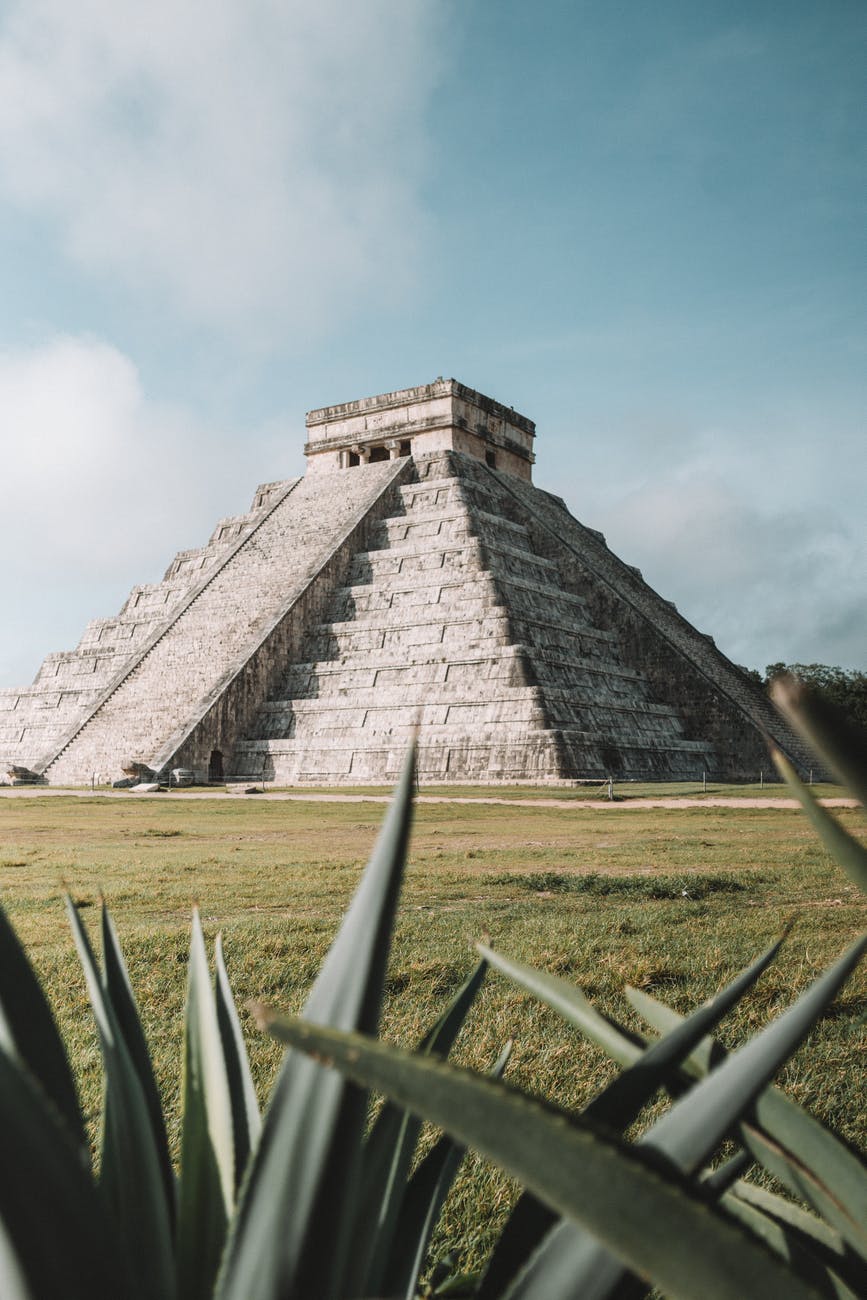
Another image flew into his mind, unbidden. They had shown him a preview. While he was bound, they had dragged him along a long series of stone carvings which depicted the tortures he was about to endure, ending in the extraction of his heart. He recalled that his knees and ankles had scraped along the stone pathway that led to the altar. He marveled at how painful that had felt before they began teaching him the true dimensions of pain — its colors and tastes. But why? Why had they done this to him.
He had screamed something aloud as they had done it. Yes. He screamed the same thing again now in remembrance. “I don’t belong here!”
Donny found himself shaking his head. He reminded himself that he wasn’t really Mayan at all. That had to have been a bad dream. Bad dreams. Bad luck. Bad times. It was all bad.
Suddenly, he remembered. His real life, he recalled, had been as a con man. He was born rich and he made himself even richer. That was his real life. He recalled some of the moments so vividly that he completely forgot about the shimmering figure towering over him. He chuckled. In his real life, he was smart! Too smart to care about anyone but himself. After all, caring about others, just as Daddy had taught him, was the biggest con of all. He was a con man, all right and damned good at it. He repeated the mantra he had used almost constantly in his real life: “I am all that matters and I am always right. Give me everything you have because I’m bright!” He chuckled again.
A shadow passed across those happy sunny memories. He had had an incredible string of bad luck. That’s what had led him to prison. That’s what put him out on death row. People were out to get him. They were probably jealous. That’s why so many wanted to destroy him. Donny didn’t have a religious bone in his body. Religion! Hah! What a con job that was! But for some inexplicable reason, just as his enemies came on him he had screamed to God: “Please! Dear God! Save me! Let me be anywhere else! Anywhere!”
And, miraculously. It had worked! He had apparently been able to con God himself! He had been instantly whisked away from his 21st century enemies and had found himself in a pre-Columbian Mayan village. Using just his wits and the few 21st century possessions he still had with him, he had been able to con the Mayans as well.
For a time.
Eventually, they discovered his true nature and they killed him.
So, he wondered where the hell he was now. He muttered, “How did I survive and end up in this sunlit garden?” Donny frowned. Then, a smile spread across his face. He remembered! He had again called upon God to spare him. He had probably made some ridiculous promises or something but it didn’t matter, because he had conned God again and now, here he was in heaven! That’s where I must be. He became aware once more of the bright shimmering presence before him. Donny smiled as he realized he had outsmarted God himself!
“Hey! Tell me if I’m wrong, but I’m in heaven right? And, you must be God, right? Thanks for saving me!”
The towering presence shimmered a bit more brightly and smiled. “Oh, Mr. Drumpf. Goodness no. That’s quite amusing. My heavens, no. I am not God. That’s quaint. I am but a tiny shadow of God. I summoned you to paradise because I thought it might motivate you to do better next time. If there is a next time. I’ll check back on you in a few centuries. The carrot approach didn’t seem to work for you, Mr. Drumpf. Now, we’ll try something else.”
“Try what? What are you talking about? I don’t like your tone of voice, mister not-God.” Donny put on his imperious face: disdain, disgust, and cruelty swirled together. He had first learned to make that face while he was stealing lunch money from much younger kids back when he was a childhood bully. “Well?”
“Oh, surely, you can work it out. Mr. Drumpf. You’ll be going straight to hell. You’ll be there for quite a spell.”
“Good evening, everyone. My guest today is the author and poet, Peter S. Ironwood. Welcome to our Thanksgiving edition of ‘Meet the Authors.’”
“Speaking of Thanksgiving, thank you for having me on your show, Walter. I grew up watching you do the news so it’s a real thrill to be on your new show, even though it has to be via Zoom. I’ve been on live TV a few times, and I have to say, it is a lot more comfortable without the sweat lights.”
“Indeed. Perhaps we could talk about your most recent extensive work The Myths of the Veritas. You have been sharing these myths for several years now on your blog and now, as I understand it, you plan to put these stories you wrote into a book trilogy. Is that accurate?”
“Yes, Walter, I will be putting these into a book trilogy. That is correct. However, I have to quibble with you about the verb ‘wrote.’ I translated these tales from Veritas. And, by the way, the name ‘Veritas’ comes from Latin for truth because this tribe valued truth very highly. The so-called myths have nothing to do with the right wing deception group called Veritas who attempt to trick liberals into saying something that can be taken out of context, twisted around, and help keep extremely greedy people in power. The Veritas Tribe I write about would not have been happy to have the word ‘veritas’ misused in this way.”
Walter’s eyebrows raised just a little and he pursed his lips. After a slight pause, he continued. “Speaking of the truth, Peter S Ironwood is just a pseudonym is that correct?”
“Oh, yes. I also use the pseudonym ‘truthtable’ sometimes in my writing and translations. My real name’s ‘John’ by the way.”
Walter bit his lip and said, “Now, John, when you use the word ‘translation’ — isn’t it true that no-one else has seen the original materials from which you translated these tales? I mean, the manuscripts have never been made accessible.”
“No, that’s not true at all, although I can see why you — and possibly the viewers — are a bit confused. Of course, the Veritas themselves, once they learned to read and write, saw and indeed created the original manuscripts. And, I am by no means the only translator. My task is to turn the translations into stories. In the future, there is a whole team of scholars working on the translations.”
Walter tilted his head. “Did you say — you said — ‘in the future’ — if I’m not mistaken.”
“Yes, of course. In the future, there are all sorts of sophisticated algorithms that we do not yet have today. Frankly, even if we did have them, today’s computers are simply not powerful enough to run such software. At least, not within one individual’s allotted 150 years.”
Walter frowned. “I’m sorry. I don’t understand. You are saying these stories are true and yet they are from the future. Is that what you’re saying?”
John smiled. “Of course. Everything exists in the past, present, and future. It’s really all one giant wheel. When we stand on the earth, we cannot see the whole earth, can we? We can only see a small portion of it. If we climb a mountain, we can see much more, especially if it’s a clear day. Isn’t that correct?”
The furrow in Walter’s forehead deepened. “What does that have to do with … are you claiming you can see into the future?”
“Yes, of course. We all can. Your staff booked me for this interview and here I am. You saw that I would be on the show and here I am. People look into the future all the time. I think … sometimes, like other writers, I climb a mountain of imagination. When I’m up there, I can see further into the future.”
Walter blinked a few times. “So, let me get this straight. You are saying that you can predict the future?”
“Yes. Anyone can predict the future. Science fiction writers do that all the time. Those predictions are not always accurate in terms of what happens on our own time line. But if a writer looks clearly, and speaks truth from the heart, it will always be true of onepossible future. Whether or not that possible future comes to pass will depend on the actions of everyone — and even of non-human events. Your staff booked me to come on the show and here I am. There might have been a big storm that took down the power grid and I wouldn’t have been able to keep the appointment. Or, I might have had a heart attack. Or, going back even further, perhaps stem cell research would have been made illegal and you yourself might have died years ago. Sorry to say this, but somehow, the summer of 2009 flashes into my mind. Our choices determine which of the many possible futures actually come to pass. And, those choices, importantly, include the choices the writer makes. Which futures do I write about? How is the material presented? Who reads these works? All of these choices and more can impact which channel into the future is the one we find ourselves in.”
Walter swallowed hard. For a moment, his mind was taken back to a weird series of dreams he had had in the summer of 2009. Those dreams had all dealt with his own death — some metaphorically and some quite literally. He had pushed them away. Was it possible the dreams had come from another time-line in which stem cell research had not given him another half-century of productive reporting? For a flicker of a moment, he considered bringing it into the interview. No! He told himself. Though his body may have been renewed, he still believed in a kind of journalism which never made the interviewer the subject. He was merely the — the medium through which the news was reported. He was not himself the news. Nor meant to be. The expression ‘Dead Air’ suddenly flashed in his mind. He shook his head and continued his questions.
“So, John, you are saying — well, are you saying that the Science Fiction writers in general — and you in particular — that you simply guess at the future and that those guesses may or may not actually come true? That the real future is independent of what is written?”
“No, Walter, not at all. I am saying the writer climbs a mountain and sees a part of the landscape that others don’t. They choose parts of that landscape to write about. It’s really out there. It’s not a guess. It’s a choice. What happens in our lifetimes is not the same as the stories. On the other hand, writing is an action and as such, it helps direct the future. In some cases, the writing helps us avoid imaginary futures. I think Huxley’s Brave New Land and Orwell’s 1985 served as cautionary tales that helped us avoid the idiocy of absolute dictatorships. It doesn’t always work. But sometimes it does. After all, The Orange Man may have helped many leaders of the Veritas avoid letting the greedy bend the truth for their own gain, but then, as in the tales called Stoned Soup and Three Blind Mice, the same themes come up again. Bad ideas like dictatorship come up again and again in different forms and ages. Locusts. Plagues. Drought. We learn about them and try to avoid or mitigate. Historians cannot make us avoid the mistakes of the past. They can only show us the dangers of a path. It’s the same with Science Fiction writers. I can help people see the mistakes of the future. Whether we avoid them is up to all of us.”
Walter stared and the expression “Dead Air” shouted into his earpiece. “You believe then, that if Orwell and Huxley had not written their books, some parts of the world might now be living under dictatorships?”
“Oh, yes. Absolutely. In fact, even if their writing had been slightly different or fewer people had read their works, we might have had millions living under dictatorships today. Democracy is not guaranteed. I do think it is more life-affirming though and therefore, if humanity is to survive, it will do so via democracy, not via dictatorship. Dictatorship is much like cancer. No. Let me rephrase that. Dictatorship is cancer, writ large. Part of the reason it no longer exists is because of writers. But people could have chosen to ignore those writings or to have fooled themselves into believing the lies of the dictators and would-be dictators instead. I report on the mistakes of the future, but I can’t force people to avoid them. That takes everyone.”
Walter stared into the camera, blinked a few times and said, “And, now, we must take a short commercial break. We’ll be back in a few moments to answer questions that have been texted to our studios by our viewers at home.”


































 petersironwood