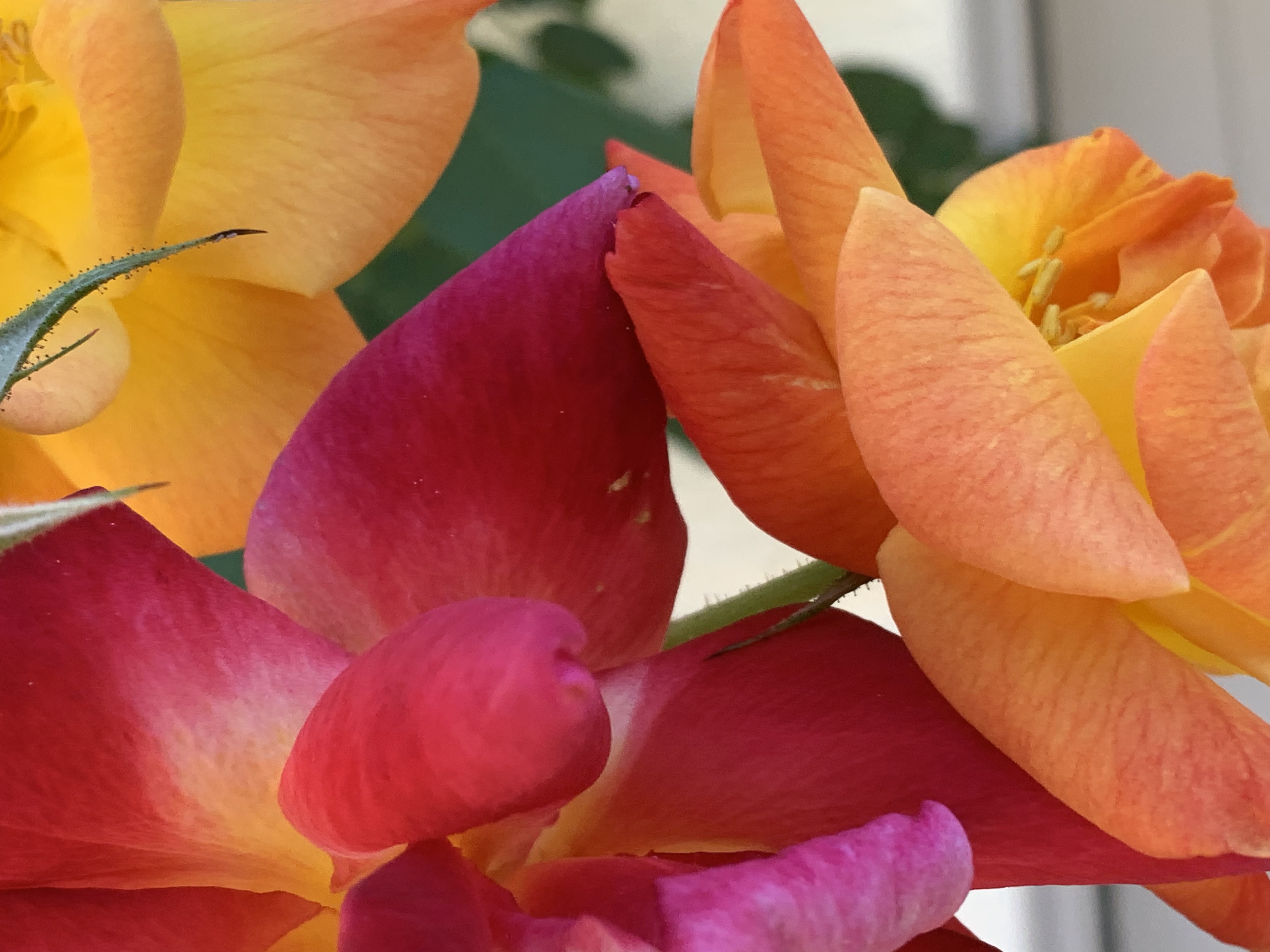
Christopher Alexander was an architect who wrote much about architecture, including the well-known book, A Pattern Language. Later, he also wrote about “The Nature of Order.” He posits 15 properties of natural beauty and good design, the first of which is “Levels of Scale.” I was thinking about that today as I admired our Jacob’s Coat Rose bush which blooms about 3-4 times a year here in San Diego.
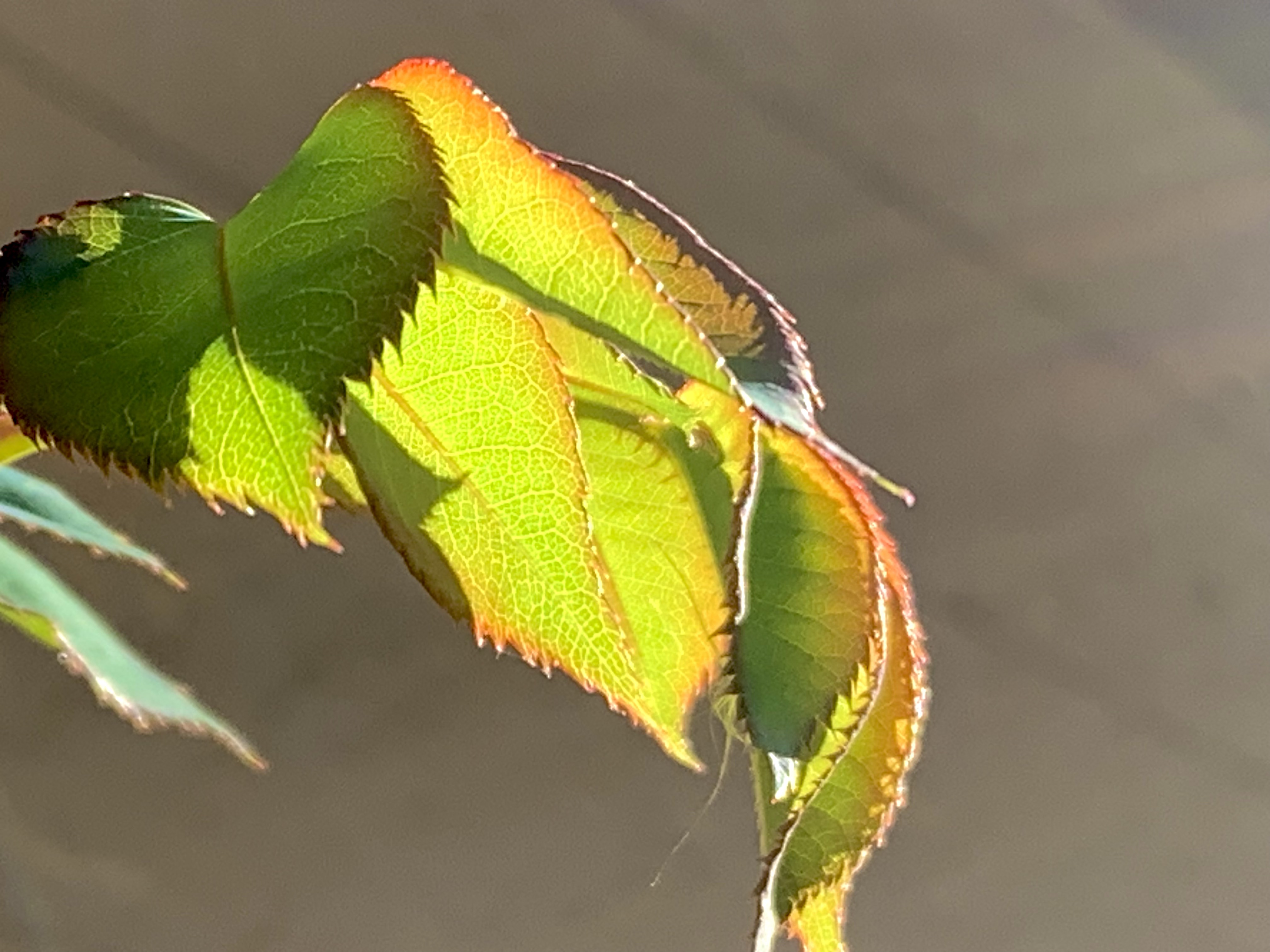
Most of us see the flowers of the rose as beautiful. And indeed they are. They are beautiful from afar. They are beautiful up close. But so too are the other parts of the rose plant. At least, sometimes, the leaves are also quite beautiful.
Even the thorns are beautiful.
Beyond this surface level, the rose, like all living things, is beautiful inside. Like all living things, it’s survived four billion years of evolutionary time. The way cells are arranged and the way they work–this is beautiful as well. Moreover, the relationship that roses have to humans and bees are also beautiful. Imagine having the faith and hope to depend on a completely different species to reproduce. Imagine being so beautiful that human being across the globe spend their time and money to keep you thriving.
Did I mention that, like other green plants, roses remove carbon dioxide from the atmosphere and provide oxygen for animals like us?
Roses are so famous that they play a part in history and pageantry. The War of the Roses. The White House Rose garden. Destroying part of the Rose Garden is also symbolic. The Rose Parade. Individuals give each other roses. They are variously symbols of love, friendship, and peace. Roses appear in poetry, songs, paintings, and both first and last names.
She sensed that she was surrounded by others — some very like her and many very unlike her. Yet — she couldn’t shake the feeling that something was not right.
She felt — bound up. She wasn’t free to grow in the way she really wanted to. And now she was moving in a most peculiar way. Her ancestors had seldom moved in such a way as this except in times of great catastrophe such as an earthquake. Suddenly, she found herself completely disconnected from the nourishing earth. Beneath her was nothing but cold hard metal and a whirring vibration.
Now the warming sun disappeared, not as a gentle sunset. No. This was a sudden and violent transition from warm noon sun to complete and utter darkness. She sensed that she was not alone in this sunless prison. All of her fellow prisoners were also in a panic. Again, she sensed the cold hard metal beneath her and a deeper rumble of whirring vibration.
Then, and completely without warning, the sunlight again began to beat upon her with its full force.
Soon, she felt herself unbound. She struggled to understand. She tried to stretch her roots out, tentatively at first, as you might begin to wiggle your toes after waking from a deep coma. She felt an unslakable thirst, Then, she sensed moisture nearby and minerals.
She still felt as though she were in a very strange place. Had she formed her thoughts into words, she might have thought: “I have no idea why they would place me here of all places.” If rose had been human, that would have bothered her a great deal. But among her many distant aunts, uncles, and cousins, those who spent their energy decrying their placement, few survived. Her strategy, like those of her successful ancestors, was rather to spend her energy being as beautiful and varied as possible.
Her faith was strong. Had she had a verbal creed, it might have been something like this:
“I believe in the bees and the breeze.
I believe in my own heritage.
Like all other living things on earth today, my ancestry is 4.5 billion years old.
I believe in the power of my roots to seek out and find the nourishment I need; to keep in mind my goals of water and minerals. I push and push, and when I reach the impenetrable, I seek a way around. I dance the dance of life. I don’t avoid the strife. I relish it.”
In the next few days, visiting bees told her that there was plenty of sunshine around even though Rose herself was mainly in shade. That bee-speak was enough to give Rose all the hope she needed to grow tall and wide. She explored in every direction.
The bees that buzzed near Rose told her, in their own way, of the vibrant and varied colors of her many other neighbors. She found their descriptions exotic and evocative. From time to time, she attempted to emulate those neighbors. The buzzing bees would pause in their busyness on occasion to give her feedback on how well she matched the colors of her unseen neighbors.
Over time, she sensed the vibrations of other beings besides the bees. Feathering beings and furry beings, some large and some small. Mainly, they were friendly beings who admired her artwork. But there were also those who cared little for her artwork and instead simply came to feast upon her. Rose’s body became sustenance for mites and snails and aphids. Sometimes, other creatures came to protect her. She liked that. Sometimes, they failed to protect her and the pain became unbearable. But bear it she did.
Rose resolved to use the pain to make her creations more beautiful still.






 petersironwood