• About PeterSIronwood

petersironwood

~ Finding, formulating and solving life's frustrations.

petersironwood

Tag Archives: life

Anti-Pattern: Cascading Betrayal

23 Saturday Jun 2018

Posted by petersironwood in America, management, sports, Uncategorized

≈ 1 Comment

Tags

authoritarianism, Business, competition, Democracy, ethics, Facism, life, pattern language, politics, religion, Totalitarianism

Cascading Betrayal

IMG_5916

A very interesting little book that I recommend is Jane Jacobs’s Systems of Survival. In it she argues that there are two systems of ethics and morality: an older one, the “Guardian Syndrome” whose values include: Shun trading; exert prowess; be obedient and disciplined; adhering to tradition, respecting hierarchy, being loyal, deceiving for the sake of the task, making rich use of leisure; being ostentatious; and taking vengeance. Most of us might recognize these from history and stories about the Middle Ages in Europe but many other kingdoms and empires of earlier times also valued such things more than most of us do today. On the other hand, a newer system of values has been developing since the Renaissance. In the “Commerce Syndrome,” people tend to value things such as shunning force, competing, being efficient, being open to inventiveness and novelty, being honest, collaborating easily with strangers and aliens, dissenting for the sake of the task, respecting contracts, investing for productive purposes. 

fullsizeoutput_139d

In modern societies worldwide, both systems are at play and they can often be in conflict. For instance, you have friends that you feel loyalty to (Guardian Syndrome) and you work for a corporation which asks you to sign a contract that says you will not steal from the corporation and that you will report anyone who does (Commerce Syndrome). You observe your good friend taking supplies from the company storeroom for personal use. You ask the friend to return the goods but they say, “Oh, come on. The company makes billions. They can afford it. It’s just our little secret.” You can’t dissuade your friend. Now, the conflict in values causes you a conflict. Do you “betray” your friend and honor your contract? Or do you betray your contract and collude with your friend? 

person holding queen chess piece

Photo by rawpixel.com on Pexels.com

Within American society (the one I happen to be most familiar with), these values are not evenly distributed. For instance, Silicon Valley seems quite centered on the “Commerce Syndrome” while small towns, sports teams, and the Catholic Church, for example, seem more centered on the “Guardian Syndrome.” 

People whose values are almost totally aligned with the “Guardian Syndrome” will tend to stay loyal to their boss, leader, team, political party, even when the boss, leader, team or political party does something stupid, cruel, unethical, or illegal. For a time, people in positions of great power can keep their power through, for example, the dispensing of favors, defining agreed upon untruths, or taking vengeance on the disloyal. 

abandoned architecture auschwitz auschwitz concentration camp

Photo by Pixabay on Pexels.com

Such a system is always somewhat fragile as demonstrated by the constant stream of rebellions, crusades, and wars in the Middle Ages. A state or organization based purely on the “Guardian Syndrome” is even more difficult today. If one tries to keep to a pure “Guardian System” in the midst of a highly interconnected and interdependent world, it will fail sooner and more spectacularly. 

One issue is that it is no longer possible for people not to be exposed to the actual truth. Lying to a populace in which only 1% of the population could read and write was fairly easy. Trying to do it in the computerized and recorded world of today is nearly impossible. Some people will remain loyal and refuse to call out the Emperor for having no clothes. But someone will. And, it will be caught on tape. And, the tape will be shown to vast numbers of other people who have no loyalty to the Emperor. They will all see he’s naked and have no compunction about saying so. 

rattlesnake-toxic-snake-dangerous-38438.jpeg

As a result, a modern “Emperor” will find it difficult to keep all but the most fanatic fans from dismissing his attempts to control through politics and pageantry. The Medieval mechanisms of dispensing favors and wreaking havoc via vengeance will largely prove ineffective. Once such an Emperor begins to lose power, more and more people will begin to realize that they are much better off to “play by the rules” of the Commerce Syndrome. As a result, people who might have stayed loyal to the death to the Emperor will instead begin to defect. As more and more people defect, this will further weaken the Emperor’s power base and make it more likely for even more people to defect. 

IMG_9628

Naturally, the Emperor will attempt to use whatever power they have left to prevent defections, but in our modern interdependent and interconnected world, this is increasingly difficult. Most modern countries — and their leaders — realize that material prosperity in the 21st Century depends on many of the values of the Commerce Syndrome. A society that tries to remain “closed” like North Korea, for instance, will find themselves at a distinct disadvantage when it comes to invention, comfort, prosperity, and the happiness of its citizens. What little resources such a country does have will be increasingly funneled toward weapons of war, security, police, prisons, and the suppression of truth. While these measures may serve to consolidate the power of a modern emperor in the short term, in the long term, too many people will have too little physical comforts to feel much loyalty to the emperor. Support will continue to erode and eventually everyone will see beneath the invisible clothes. An early signal of such a collapse will be a cascade of betrayals. 

By contrast, in a modern state, loyalty is earned through such virtues as fairness, competence, innovation, and collaboration. In other words, people dispense loyalty on the basis of what people do, not because of what they promise to do and not on the basis of some bogus claim to royalty based on how and where they were born. Cascading betrayal is typically a symptom of an attempt to revert to an earlier state of human social evolution. It is another descriptive short-hand Anti-Pattern. It can be avoided by allowing feelings of loyalty to grow naturally from watching someone in a role of power make and keep promises over time and by watching them do what is in the best interest of the State; not by watching them take actions which mainly enrich the emperor. 

pexels-photo-210703.jpeg

Photo by Pixabay on Pexels.com

———————-

https://en.wikipedia.org/wiki/Systems_of_Survival

My Author Page on Amazon

Fostering Group Cohesion through Common Narratives

28 Saturday Apr 2018

Posted by petersironwood in family, management, psychology, Uncategorized

≈ 1 Comment

Tags

collaboration, cooperation, learning, life, marketing, pattern language, politics, religion, teamwork

Fostering Group Cohesion through Common Narratives

IMG_3611

Prolog/Acknowledgement: 

The idea for this Pattern emerged from work done around 2000 with colleagues at IBM Research (including Cynthia Kurtz, Carl Tait, Frank Elio, Debbie Lawrence, Neil Keller, Andrew Gordon), Lotus (including Dan Gruen, Paul Moody, Michael Muller), and at the IBM Knowledge Institute(including Dave Snowden, Larry Prusak, Sharon Darwent & Fiona Incledon) on the business uses of stories and storytelling. Of course, stories have long been used by leaders to motivate groups and to help foster group cohesion.

Author, reviewer and revision dates: 

Created by John C. Thomas April, 2018.

fullsizeoutput_176c

Abstract: 

Stories that we tell ourselves help define who we are and frame our experience, both individually and collectively. In relatively stable cultures, a number of common stories are usually shared by everyone. What makes storytelling challenging in modern life is that group boundaries are continually shifting and changing. It often happens that groups which used to be separate must learn to work together; e.g., because of a peace treaty, corporate merger or acquisition, or even a marriage involving extended families. In these cases, it helps to find within the stories of these groups, common values among the previously disparate groups and then make compelling versions of stories that express these values and tell them back to the entire newly formed team, family, group, company, or nation.

Context: 

Groups across many contemporary cultures and throughout history have tended to tell, learn, and repeat stories as a way of codifying what is desirable and acceptable behavior, understanding the world, and communicating important lessons learned across generations. Such stories often include “creation myths” but also include stories about the “hero’s journey.”

In most cultures, these stories are transmitted orally regardless of whether such “cultures” are based on geography, company, religions, or even families. It’s true that some important stories have been put into written form. For example, many company founders have their own stories of founding the company put into written form. Religions often have sacred texts. However, both corporate cultures and religious sects and even congregations transmit the “proper interpretation” of these written documents orally. The written texts are modified very slowly while the oral interpretations can possibly change much more quickly. Nonetheless, the stories often persistently encode modes of behavior over centuries and even millennia.

When groups are stable over a long period of time and have minimal interaction, the fact that diverse groups have quite different stories seldom causes difficulties. As these diverse groups began to interact more frequently, it often happened that one group (typically the one with superior weapons) used violence to impose their stories on the other group. More recently, the world has become highly interconnected through inventions and developments in communications such as telegraphy, telephony, and the internet. Physical travel is also faster via rail, cars, and airplanes. People with different stories now come in contact of one sort or another very frequently indeed. Many of the most pressing problems that the world now faces including overpopulation, pandemics, and the destruction of the ecosystem require global cooperation.

Problem:

The very different stories of different groups are not simply just a matter of preference or taste. They are much more crucial and central than that. The stories portray how people should act; they specify good and bad values. When cultures collide, the fact that their very different stories encapsulate very different preferred modes of behavior often fosters suspicion, fear, hatred and disgust. People do not simply observe that others behave differently in terms of speech, dress, food, rituals, and so on. They perceive that the others are doing things, not just differently, but wrongly. The stories of the “in-group” can be used to rationalize exploitation, enslavement, or even genocide.

fullsizeoutput_1351

Forces:

  • Life is too complex, changing, and chaotic to describe completely in empirically falsifiable scientific statements.
  • Learning from others who have relevant experience can shorten learning time.
  • Humans are social creatures who can feel empathy for others.
  • Cultures use stories as memorable and succinct ways to encapsulate lessons learned and inculcate the proper values in the young.
  • Because stories encapsulate much of a culture’s knowledge, members of the culture habitually do what is prescribed by stories and avoid what the stories proscribe. In this way, they can focus decision making among a much smaller set of possibilities and not be perpetually at a loss as to what to do.
  • Because stories are valuable guides for the individual, they are reluctant to change those stories. If learned early, contradictory evidence is then particularly ineffective at altering or discarding stories.
  • When people in the “in-group” perceive those in the “out-group” as behaving “badly” (not doing what the stories say they should), trust is ruined and cooperative action is nearly impossible.

Solution:

Whenever two or more groups with different stories must work cooperatively for mutual benefit, create and promulgate new stories that stress the commonalities among the groups rather than stressing differences. In more detail, one way to do this is to collect important, value-laden stories from each group; find the common values expressed; generate stories that stress these common values; and then re-introduce these common values in the form of compelling, memorable common stories.

pexels-photo-874207.jpeg

Examples: 

  1. Two people from very different cultures fall in love. Individually, they find that their love supersedes any feelings of disrespect for the way the other eats, dresses, speaks, etc. In fact, the difference may even be part of the attraction. However, the two families each experience discomfort when confronted with someone who is so different from what they are used to. In some cases, the couple may simply convince their families to accept their choice of mate. In other cases, as in Romeo and Juliet or West Side Story, love ends in tragedy. In other cases, they would work together by each learning more of the stories of their partner’s culture and find, among those stories, common values. They may find or create stories that stress these common values and relate those back to their families. A nice illustration of this is in the movie, The Hundred-Foot Journey in which two families from very different cultures come together over their skills and love of fine cooking.

2. In a corporate reorganization, both the Marketing and the R&D Departments are put under one executive whose job is to speed to market a stream of innovative new products. Among the factors that make this a difficult task is the fact that Marketing and R&D have different values, culture, and success stories. Of course, it will help if they are rewarded only for mutual success. But even this may not be enough. It will help to find and promulgate common stories that stress common, rather than different, values. Marketing people may typically dress more sharply than R&D people and put more emphasis on flash and dazzle. But stressing that will hardly encourage better cooperation. Instead, it will work better to stress, for example, persistence, originality and being willing to change based on feedback. These are values that are important for success in R&D and for success in Marketing. The story of Thomas Edison (light bulb; lead storage battery) and Ray Kroc (McDonald’s franchise) for instance, both show that success comes with persistence in the face of repeated failure.

3. Two companies merge. Let’s say one (a sports-focused media company) has a corporate culture that stresses work hard/play hard while the other (a sports-focused engineering company) culture stresses work hard/family time. If it’s really important for the two cultures to merge and then work together, promoting stories about the outrageous parties and wild orgies that the first company participates in will not be helpful. Instead, it will be good to find stories from both companies that stress the “work hard” part. Since both companies are concerned with sports, the settings and characters from stories can both utilize sports. But the values that are stressed should relate to working hard and the resultant rewards.

pexels-photo-139681.jpeg

4. Many nations in an entire region of the world; e.g., Europe, are sick of centuries of war and counter-productive bickering and the inefficiency that comes of contradictory rules and regulations on transportation, environmental protections and so on. Despite different cuisines, traditional dress, and languages, they wish to be able to cooperate more effectively. In furtherance of that goal, they form a “European Union” which promotes the freer interchange of products, ideas, and people. Together, they constitute a formidable trading block and military force. It is important in such an effort to find stories that stress commonalities and then make sure these are prominently communicated among all the members. By contrast, an agent who wants to weaken or divide such a union would promulgate stories, even false stories, that stress differences.

Resulting Context:

Once a newly merged group shares a common story or set of stories stressing common values, they are much more likely to experience a higher degree of trust. This will make interactions more pleasant in terms of the on-going experiences but will also result in more effective action in meeting common or overlapping goals.

Related Patterns: 

Build from Common Ground.

References: 

Thomas, J. C. (2012). Patterns for emergent global intelligence. In Creativity and Rationale: Enhancing Human Experience By Design J. Carroll (Ed.), New York: Springer.

Darwent, S., Incledon, F., Keller, N., Kurtz, C., Snowden, D., Thomas, J.(2002) YOR920000749US2 Story-based organizational assessment and effect system (granted).

Thomas, J. C., Kellogg, W.A., and Erickson, T. (2001) The Knowledge Management puzzle: Human and social factors in knowledge management. IBM Systems Journal, 40(4), 863-884.

Thomas, J. C. (2001). An HCI Agenda for the Next Millennium: Emergent Global Intelligence. In R. Earnshaw, R. Guedj, A. van Dam, and J. Vince (Eds.), Frontiers of human-centered computing, online communities, and virtual environments. London: Springer-Verlag.

Thomas, J. C. (1999) Narrative technology and the new millennium. Knowledge Management Journal, 2(9), 14-17.


Author Page on Amazon:

Author Page

Music

12 Thursday Apr 2018

Posted by petersironwood in America, management, psychology, Uncategorized

≈ 2 Comments

Tags

A Pattern Language., cooperation, coordination, family, feelings, life, media, music, politics, teamwork

pexels-photo-730588.jpeg


Music

Prolog/Acknowledgement: 

This “Pattern” most likely can be decomposed into various sub-patterns. It seems so obvious that music has historically played a huge role in fostering social cohesion across centuries and cultures that it is tempting not to bother arguing the case or bother to put it as a Pattern. However, music does not always seem to be a positive force for social cohesion. Parents arguing with their kids about music for example; bands famously “breaking up” despite spending hours of time playing music together and listening to low quality Muzak while on hold seem to indicate that the mere presence of music is not enough; some kind of analysis of the effects of music on teamwork, cooperation and coordination seems appropriate.

pexels-photo-325811.jpeg

Societies have traditionally engaged in drumming, singing, dancing and making music both “for fun” and as accompaniment to rites and rituals. In my own cultural upbringing in the Midwestern United States, music has been part of every church service, wedding, and funeral. Songs were sung in every camp where I worked. Singing, dancing, and the staging of musicals was a large part of the high school experience. For example, most of the high school yearbook pictures of activities involve either sports or music. Music has been such an integral part of my cultural tradition that I cannot point to specific origins of its use. Indeed, rhythm, tune and dance are not even limited to humanity but also play vital roles in social coordination among numerous species of insects and birds.

Author, reviewer and revision dates: 

Created by John C. Thomas April 11-12, 2018

Abstract: 

People typically enjoy listening to music and making music. Music can influence mood. If people listen to the same music, it can influence mood similarly across individuals as shown by the background music in cinema. There is ample evidence that music can be therapeutic in numerous ways across the lifespan (see references). Use appropriate music to help increase social cohesion. This can take the form of people listening to music or participating in its creation. In order for group music to “work,” whether classical symphony, jazz improvisation, a work song, military band, or caroling, it is necessary to pay attention to the larger group. Most cultures have developed music to help group coordination and cooperation. Most likely music has both an immediate, “in the moment” effect as well as a longer term positive effect on social capital.

IMG_2901

Context: 

Every person has their own concerns. We have our own individual bodies; our own friends and family; our own possessions; our own preferences; our unique education and personal experiences. Yet, people are happiest and most productive when they work together. In a highly complex and highly differentiated society in which people have very different roles and expertise, common experiences in the “workplace” have become less common. Hunting, gathering and agriculture often require people to work together on very similar tasks in the same place at the same time. In an “information economy” a person’s actual work may often be mainly solitary. Only the “results” need be communicated to someone else. In such circumstances, using music for the whole group is probably more important than ever.

Not everyone has precisely the same “tastes” in music. Some people prefer to do intellectual work without music while others find it useful. For this reason, it is not uncommon to see people at their individual work listening to their music privately via headphones. Similarly, on a family car trip, people may find it less argumentative to have everyone listen to “their own” favorite music rather than communicate, play a game or listen to or create common music. We may be missing opportunities for social cohesion though when music becomes only a vehicle for private enjoyment rather than a shared experience.

pexels-photo-210887.jpeg

Problem:

Because humanity lives in a highly inter-connected world, in many cases in close proximity to many others, we need to agree on how to allocate scarce shared resources and otherwise communicate and coordinate. Often, the interconnections of people in complex social and work situations are too complex and varied to “specify” in detail. It is vital to have a high degree of mutual trust and to collaborate and coordinate, not just through well-defined and precise set of rules and regulations, but through a sense of being part of a larger group.

In addition, people often have different professions, roles, backgrounds, experiences, educations, etc. This makes both communication and trust more challenging. Many of today’s communications are done remotely and in many cases, communication is limited to writing and reading text or the exchange of other purely instrumental communications; e.g., through forms, data, formulae, or signals. While such communication can be “efficient,” it is only effective when the situation being communicated about has been well-anticipated. In novel situations, it might not work at all and that is when people need to rely on each other in informal ways. In addition, while storytelling and conversing may seem “inefficient,” they are intrinsically more engaging and richer experiences for most people as compared with filling out forms.

Communication that is purely instrumental does little to encourage cooperation and build trust. Yet, because of the wide disparity in people’s backgrounds and experiences, as alluded to above, we need that cooperation and trust more than ever.

pexels-photo-784707.jpeg

Forces:

  • Groups of groups must sometimes work together to achieve common goals.
  • Subgroups may disagree with each other about the best use of resources to achieve those common goals.
  • In a drive to improve “efficiency,” rather than simply letting people talk, many business transactions are formalized and leave no room for expressive communication.
  • When the actual problem at hand requires people to work outside of the formalized transactions for a solution, it helps to have mutual trust.
  • Music that is shared, whether listened to, danced to, or created together, provides an opportunity to be expressive and build mutual trust.
  • Higher levels of mutual trust lead to better outcomes and provide more     pleasant experiences for all.


pexels-photo-738926.jpeg

Solution:

When possible encourage groups to engage in listening to or creating music together as a means to increase trust.

Examples: 

1. Early in the days of IBM, at the beginning of the day, employees sang company songs in unison.

2. Many high schools, colleges, and nations have songs that everyone in the group sings together. Many couples also agree on one song that is “theirs.”

3. In basic training, the military uses cadenced marching “songs” to help keep the group literally “in step” and encourage esprit de corp.

4. When multiple people row a boat, it is more efficient when the oars all hit the water at the same time. Most cultures that use rowers, also use songs to help coordinate the effort. Song is also used when a group of people has to pull or push something heavy.

IMG_5245

Resulting Context:

When people sing together, play music together or dance together; even when people listen to the same music, they are literally more “in synch.” Each person is individually in a better mood. The group as a whole identifies more with the whole group. Trust in increased.

A community, team, or group that regularly shares music together also experiences a longer term effect of increased mutual trust. Robert Putnam and his collaborators, Robert Leonardi and Raffaella Nanetti, in Making Democracy Work: Civic Traditions in Modern Italy found that the best predictor of both how people felt about various communities in Italy and how effective they were economically was best predicted by how many chorale societies they had.

IMG_7154

Related Patterns: 

Small Successes Early, Build from Common Ground.

Metaphors: 

In the vertebrate body, there is a heartbeat. The pulsing heart serves as a coordination event for the rhythm of the body. In the brain, there are various frequencies of “waves” and although the exact evolutionary advantage is not known, we may speculate that these help coordinate the overall response.

pexels-photo-357316.jpeg

References: 

https://www.ncbi.nlm.nih.gov/pubmed/20175359

https://www.sciencedirect.com/science/article/pii/S1744388114000516

https://www.ncbi.nlm.nih.gov/pmc/articles/PMC4021113/

https://link.springer.com/chapter/10.1007%2F978-94-017-8920-2_3

https://press.princeton.edu/titles/5105.html

———————————

IMG_1282

Author Page on Amazon –

https://www.amazon.com/author/truthtable

——————————————————–

Piano

Strike! the keys then smoothly skim along.
Strike! piano then sing your song.
Strike! down harder as the music flies.
Strike! once more as the music dies.

Murmur so softly to the moonbeams of blue;
Whisper quiet to the desert night.
Rolling, caroling, dancing, whirling,
Murmur down to nothingness and silence long.

Triumphantly, the snow falls now,
Majestically were love’s enow.
Chord full rich. Chord weird whines.
Empty fifths flow futilely along.

The rhythm picks up in a waltzing gate
And all the dancers can hardly wait.
The melody’s thinking, “All is great!”
This orgy of music will satiate.

Mellow and sadly, slowly going,
Seeds of sorrow steadily sowing,
From painful pathos fire growing,
Mood and madness never slowing.

Strike! the keys both loud and strong.
Strike! piano then live your song.
Strike! down harder as the music flies
Strike! once more as the music dies.


Positive Deviance

07 Saturday Apr 2018

Posted by petersironwood in health, management, psychology, sports, Uncategorized

≈ 1 Comment

Tags

cooperation, family, Feedback, innovation, life, pattern language, Peer Learning, sports

IMG_9659

Positive Deviance

Prolog/Acknowledgement: 

The idea for this Pattern comes from a book of that title.

I am continuing in the style of trying to write something that explains the Pattern and why it works along the lines of Christopher Alexander’s original book. For this particular suggested Pattern, it seems important to point out some of the caveats and challenges. I may be that this is important for all Patterns but I’m still puzzling over how much these should be a specific part of each Pattern.

Author, reviewer and revision dates: 

Created by John C. Thomas March 23-April 7, 2018

Abstract: 

In any complex situation that you might want to “improve” or “fix,” there are some who are in that situation and have already figured out how to succeed. Instead of designing and imposing a solution, you can find out who the success stories are, observe what they are doing, get feedback from the observed and then encourage those involved in the success stories to share what they do with their larger community. 

https://en.wikipedia.org/wiki/Positive_deviance

Context: 

Complex problems can often only be solved by groups. In some cases, a problem seems overwhelming, impossible, or insoluble.  People from the “Global North” for example, see a situation such as illiteracy or malnutrition and wish to use their resources and knowledge to solve a problem for others who are experiencing the problem. It is certainly worthy to want to help others and to share abundant resources. However, even when one is careful, it is easy to intervene in such a way that the problem is not really solved but only temporarily ameliorated. In other cases, the problem is actually made worse or the problem that is focused on is solved, but other even more severe problems result.

For example, a so-called primitive society may rely on hunting and gathering for its existence. The people are okay under normal circumstances but have no extra resources to “better” their life. Instead, they are taught by well-meaning people in the “Global North” to grow a cash crop that brings in enough money that they can buy a variety of foods as well as more clothing, medical supplies, and housing. This all works fine until the monoculture crop gets a disease. If the “primitive society” is lucky, this happens fairly quickly while the tribe still retains the necessary hunting, fishing, and gathering skills to survive. In worse cases, perhaps the skills or the lands needed no longer exist and the people are much worse off than they were before the intervention by the “Global North.”

Of course, not every such intervention is well-intentioned. In some cases, the real goal of the interveners is to make a lot of money off a crop of tea, coffee, opium, or cocaine. In other cases, the natives become miners for diamonds or precious metals. It might or might not also be an intention to destroy any possibility that the natives in the land can still live off that land in the way that they and their ancestors have done for millennia.

Even in the best of circumstances, there will be unknown and often deleterious side-effects of interventions. For example, perhaps the women of a particular tribe used to spend considerable time together in the village center pounding roots and talking with each other. Because they were doing this in the center of the village, they also easily helped each other watch all the village’s children and to watch for predators. During this time, all sorts of other “work” might also have been done. The women as a group may have solved many budding feuds within the tribe, or done gentle match-making, or experimented with different shaped tools and so on. Because they bonded with each other, they may have also made family break-ups due to infidelity less likely. The point is that an outside look at the culture may only see “inefficiency” in what is actually an effective social and economic system.

fullsizeoutput_11a7

Regardless of how it came to be, the fact of today is that many people in various parts of the world are in dire need of clean water, food, shelter, or medical care. Within the so-called “developed” world or Global North, there are other widespread problems such as the opioid crisis, obesity, vast wealth inequalities, and, in the United States, mass shootings. We tend to think of such large scale problems, regardless of the geography, as being both general and systemic. And we typically look to use analytical tools to diagnose problems and generate solutions to be imposed by the government or NGO. Such imposed solutions will almost always have unintended consequences, some of which will be negative.

Problem:

There are many problems in the world and the most severe have to do with people’s basic needs not being met. If one tries to solve a problem and then impose that solution, there is a good chance that the solution will be wrong. Even if it’s “correct” in solving the given problem, there’s a good chance that it will have negative side-effects that may be worse than the original problem. Moreover, even if the solution is “perfect” and avoids negative side-effects, it may still fail to be adopted because the people necessary for implementing the solution were insufficiently involved initially in finding, formulating, and solving the problem.

When it comes to problems in logic and mathematics, there can be some reasonable notion of the “goodness” of a solution which people will agree on, given enough background and training. However, problems in real world settings are generally too complex to allow of legitimate “proof.” People will have different values, preferences, and experiences so that they will tend not to agree unless everyone involved at least has a chance to feel as though they have been involved throughout the process.

IMG_3524

Forces:

  • Real world problems dealing with basic needs are likely to be complex. (If there were “simple” solutions, they would already have been found).
  • An outside group may have knowledge or perspective that allows them to see possible solutions that the people experiencing the problem may not know about or see.
  • Sometimes, people intentionally mislead others; they claim to have a solution to a problem based on superior knowledge or technology but actually, they are just manipulating others.
  • Even when operating with the best of intentions, outside problem solvers may not understand enough about the context, values, and culture to design solutions that will work.
  • People generally want to be consulted on decisions that impact their lives.

* Typically, people within a community are more trusted than outsiders.

  • When feedback loops are slow, delayed, or noisy, people may not know when they have solved a problem or made progress on it.
  • Most solutions to complex problems require the active cooperation of the people most affected in order to be implemented and maintained.
  • A proposed solution is more likely to be adopted if the solution comes from community members.

* In complex problems in the real world, there will often be a large variation in how well people are solving these on their own.

Solution:

When facing a complex, real world problematic situation, instead of having an outside group find, formulate and solve a problem and then try  to implement that solution, instead, seek to find people within the community who have already solved it or partially solved it. Help to understand the nature of the solution and facilitate the communication so that those who have solved it are aware of how they solved the problem and communicate it to the larger community.

Examples: 

1. The idea of “positive deviance” is similar to the progress in “best practices” that is often achieved in sports, arts, and crafts. For instance, in tennis, hitting the ball harder means your opponent has less time to get to the ball and more trouble judging how to hit their own shot. However, if a player hits the ball too hard, it will tend to go out of bounds. Some tennis players have experimented with hitting the ball with a huge amount of topspin. This allows the ball to be hit fast but with a trajectory that allows it to clear the net but still dive down into the court. Because such tennis players have tended to be successful, newer players try to copy these techniques.  Similarly, good weavers, painters, and writers try to understand how those who are “best” at the particular craft achieve the results that they do.

IMG_2562

2. In the opening example in Positive Deviance, aid workers are concerned about malnutrition among rural children in Viet Nam.  Various charities have, in the past, handed out additional foodstuffs to families and the children do better…for a time. Once the charity moves on or runs out of money, however, the nutritional needs stop being met and kids are just as bad off as they were before.

Instead, the authors of Positive Deviance discovered that among a large number of extremely poor rural families in Viet Nam, there were a few who had kids who were not suffering from malnutrition. In order to to find out why, they initially interviewed both these families and the (much larger) group of families whose kids did have malnutrition. These interviews revealed no differences. Of course, there are many possible explanations including luck of getting or not getting diseases or parasites or possibly genetic factors.

When the authors investigated by careful observation, however, they discovered three crucial differences between the numerous underweight kids and the few normal weight kids. First, the families of the normal weight kids included an older relative who fed the kids a noon meal every day. Most of the families fed the kids in the morning before going out to work in the rice fields all day and again upon coming home. The kids could only eat so much during two meals; though hungry, their stomachs were small capacity. The kids ate more total during three meals. Second, the families with healthier kids included in the daily soup, not only rice, but tiny crustaceans and bitter herbs that grew among the rice stalks. Third, the parents of healthier kids were more rigorous about hand-washing. All the kids were supposed to wash their hands before eating, but in the case of the healthier kids, if the family dog came up and the kid petted the dog during a meal, that kid would have to go wash their hands again.

After these discoveries were made, the authors of Positive Deviance did not “explain” to the villagers what the solution was. Instead, the kids were publicly weighed each week. The families of those who were of “normal” weight explained what they were doing. Some families adopted these practices and everyone could see that, over time, these kids began to thrive too. The community became convinced on the basis of what worked for others within the community and as explained by others in the community and they altered their behavior to match those in the community who had a better solution.

3. Of course, in some sense, having the whole species “learn” from the cases of “positive deviance” is more or less how major mechanisms of evolution work. There is always variation along many dimensions among the individuals of a species. In any given environment, there are some variations which will confer a relative advantage compared with others. Those with an “advantage” will tend to prosper and have more offspring that those who do not have this advantage. Over time, most of the members of the species will come to have the advantageous trait.

tennisinstruction

Resulting Context:

Once people participate in a community-wide effort to see who and what is being successful and then understand what they need to change in their own behavior. The cohesion and self-efficacy of the community is increased. The solution tends to have fewer “side-effects” and is necessarily respectful of the community culture.

Related Patterns: 

Reality Check, Small Successes Early, Build from Common Ground.

Caveats and Limitations: 

There were no reported bad side-effects to implementing the nutrition and lifestyle changes suggested by the observations in the study. However, we must realize that there could be. For instance, it might have been the case that when everyone started harvesting the bitter herbs and crustaceans, those species might have been killed off. As a result, it could have turned out that none of the kids would now have that advantage.

In general, a solution that “works” for a small minority might not work if everyone does it. We can easily imagine a situation where a few people in a village of farmers are rich while most people are not. A thorough investigation might reveal that the few who are rich got that way because they cheated when they weighed their produce and stole from the church collection plate. This is obviously not a “solution” that will work when everyone does it!

References: 

Pascale, Richards & Sternin, Jerry. (2010). The Power of Positive Deviance: How Unlikely Innovators Solve the World’s Toughest Problems. Cambridge, MA: Harvard Business Press.

http://www.betterevaluation.org/en/plan/approach/positive_deviance

—————————————————-

Author Page on Amazon:

https://www.amazon.com/author/truthtable

Indian Wells Tennis Tournament

19 Monday Mar 2018

Posted by petersironwood in management, sports, Uncategorized

≈ 6 Comments

Tags

Business, collaboration, competition, cooperation, Indian Wells, life, pattern language, sports, teamwork, Tennis

IMG_2778

This blog post is a short break from my attempts to build a “Pattern Language” of best practices for teamwork, collaboration, coordination, and cooperation. I wish to re-iterate why I feel the enterprise is important. I have been attending the  Indian Wells tennis tournament and watched some amazing matches. While it’s tempting to write about the matches, I will leave that aside. What struck me about the tournament, aside from the athleticism and grit of the players, was the widespread and effective teamwork, collaboration, coordination, and cooperation that the tournament represents. This is obviously related to the Pattern Language because it gives an example of what can result from excellent teamwork and cooperation. In other words, this tennis tournament is just one illustration of why it matters.

IMG_2764

It’s nicer in some ways to sit in your living room and watch sporting events on TV. You don’t have to deal with glaring hot sun at noon or chilly winds in the evening. You can get up to hit the bathroom any time you want and snacks are right there in the kitchen. However, you do not get a feel for just how incredible is the athletic ability of the players nor the velocity and precision of the shots when you watch on TV. More important in the context of cooperation is that when you watch on TV, every time there is a break in the action, you are treated to commercials. When you are at the actual venue, however, there is also ample opportunity for observing a little bit of the incredible collaboration and teamwork that an event like this requires. Even at the venue, all you see is the snow that dusts the surface of that tenth of the iceberg that rises above the ocean. With a little imagination, you can get an inkling of how much more collaboration must be required that you do not see.

IMG_2773

The reason I want to dwell on this for just a little is that collaboration and cooperation permeate a healthy society. Indeed, widespread collaboration and cooperation are critical for society’s existence. Yet, it is easy to take cooperation for granted like the air we breathe. People like me, who have lived almost their lives in peaceful and kind circumstances, may easily forget that it need not be so. People have lived in circumstances of war, oppression, and slavery. We should never take cooperation for granted. Even in a very peaceful circumstances, there are many screw-ups in collaboration and while we notice the screw-ups when they affect us directly, we tend not to realize the vast interconnected threads of collaboration and cooperation that we rely on every day.

IMG_2823

Let’s return then to the Indian Wells tennis tournament and examine just a few of the many collaborative aspects. First, there are the professional athletes, of course. Let’s return to this later, to understand a little of the massive cooperation required for there to be professional athletes in general and what’s required in cooperation to make any particular athlete operate at their amazing level of skill. What other roles are there? Possibly coaches, trainers, officials, and the ball boys and ball girls come to mind. It’s quite likely that if you watch tennis (or any other sport) on TV, one of the most salient roles is that of the TV announcers. They are a major part of most people’s experience of pro sports. Yet, when you are actually at the venue, they are relatively invisible. If we watch TV, we are cooperating in making the TV announcer a major part of our sports experience.

IMG_2810

At the venue itself, there are many other obvious roles. There are police assigned to the area. There are hundreds of volunteers who help people park, answer questions, check bags and check tickets. There are vendors selling various wares as well as offering up a variety of food items. This is all much more obvious when you attend a sports event in person. But the cooperation doesn’t stop there. How do the clothing and food get to the venue? How are we able to eat food that is grown far away and sometimes packaged? Where did the recipes come from? Why do people share recipes? At this point in our cultural evolution, you can attend an event in Southern California and enjoy some excellent Japanese food at Nobu. Japanese speak Japanese. And Japan is more than 5000 miles away. So, somehow, through a giant network of collaborative and cooperative relationships, people in Southern California are able to produce delicious meals that reflect a cuisine developed in a different culture with a different language. Of course, Japanese is not the only cuisine represented at the venue. There are hundreds of options that originated elsewhere.

There is also clothing on offer, much of it designed in one place, manufactured in another place, and shipped via complex supply chains. You can buy it with a credit card. But how does that work? You guessed it. It works because of other giant networks of cooperation and trust. Yes, it’s true that some people steal credit cards and there are elaborate systems to minimize losses but even those elaborate systems work on trust.

IMG_2791

The venue comprises parking, stadiums, parks, practice courts, with running water and electricity, working toilets, wheelchair access, and gates for crowd control. Again, the existence of the venue requires widespread cooperation among various levels of government, financial institutions, tennis organizations, volunteer organizations, and fans. But it isn’t even just contemporary cooperation that’s involved. These kinds of large scale venues go back in our history thousands of years. We’ve been collaboratively building best practices in city planning, architecture, crowd control, with many idea exchanges across cultures. We must remember that, by and large, the fans also cooperate. They don’t simply mob the gates to crash in without paying. The vast majority of fans are quiet during actual play, sit in their assigned seats, get up to allow others to pass and so on. This kind of cooperation also depends, in part, on widespread public education in how to be civil.

IMG_2811

Let’s return for a moment now to consider that our society has professional athletes. Some people make a career out of playing a sport extremely well. But playing the game extremely well does not, in and of itself, enable professional athletics to exist. There have to be fans both at the venue and watching TV who pay, either with dollars or with taxes or with their attention to commercials. There are organizations who administer the sport. There are, in this example, thousands of coaches and tennis venues to develop the sport and spot prodigies early who then receive additional coaching and training. There are ranking systems and systems to seed players in tournaments. There are manufacturers who make tennis balls and tennis racquets which have evolved over time to allow more elegant play which pushes the game toward more extremes of human performance. This kind of evolution of artifacts does not happen “automatically.” It too requires communication and cooperation.

IMG_2787

Indian Wells is just one event in one sport. If you dig beneath the surface just a little, you will see that nearly everything on the planet is the result of thousands of years of mainly cooperative enterprise. Of course, the players compete. They try their hardest to win. But they try to win within an agreed upon set of rules and regulations. If no-one followed the rules, there would be nothing very interesting to watch. If you’ve seen one bar fight, you’ve seen them all. There is no elegance and no beauty in watching thugs slug it out and waste time and resources. I dwell on this because it is critical to keep in mind that having a decent society that helps people thrive depends on having cooperation, teamwork, collaboration, and coordination. The individual human brain may be relatively large compared to an ape’s. But what really sets us apart is not our individual intelligence. Abandon a baby with a perfectly good brain into a forest by themselves and, if they survive at all, they will not behave much differently from an ape or a raccoon. They may scrabble for food and water, but they will not end up building a tennis court or constructing a tennis racquet.

IMG_2816

It’s not turtles all the way down. It’s trust. It’s cooperation. That’s what makes us human. If we just grab everything for ourselves and lie about it, it subverts the very foundation of human life. Our human nature is to control our competition to acting within agreed upon boundaries for the good of all. If we forget that, we are not “lowering ourselves” to the level of wild animals. We are way below that. We are like a wild cat who refuses to use its hearing and fast reflexes to hunt. We are like a redwood tree who refuses to use the sun’s rays. We are like a deer in the forest who refuses to forage but instead expects other deer to bring them food. Willfully ignoring that we are a social species; intentionally lying in order to gain advantage to ourselves will never help create a bigger pie. In the short term, it can get you a bigger piece. But the cost is that you despoil what it means to be human. Grabbing all you can for yourself subverts the very essence of what makes humanity such a successful species. This has always been true throughout human history. Now, however, cooperation is more vital than ever both because we are on the brink of destroying the ecosystem we depend on for life itself and because we have even more brutally destructive weapons than ever before. We have cooperated through much of our human history. Now, we need to do it even more intelligently and more consistently — or face extinction. The earth doesn’t need us. But we need the earth. And, each other.

IMG_2818———————————————————

Author Page on Amazon: https://www.amazon.com/author/truthtable

Build from Common Ground

25 Sunday Feb 2018

Posted by petersironwood in America, psychology, sports, Uncategorized

≈ 6 Comments

Tags

A Pattern Language., collaboration, Common Ground, family, innovation, life, music, religion, sports, teamwork

OLYMPUS DIGITAL CAMERA

CHI Workshop Activity: Working Together to Create World Map (Florence, 2008)

Build From Common Ground

Prolog/Acknowledgement: 

The idea for this Pattern comes from long personal experience trying in many contexts to get to solutions quickly without first bothering to try to find common ground. In addition, I am working on a project to provide a platform to support civil discussion, debate, Dialogue, and deliberations. One of the other founders has a long history with The Interactivity Foundation which also uses various methods to build from common ground.

Author, reviewer and revision dates: 

Created by John C. Thomas on February 20-25, 2018

IMG_2979

Synonyms: 

Abstract: 

Human beings share a large majority of their genes. Life on earth began 4.75 billion years ago. Only around 100,000 years ago people began migrating out of Africa, going to different places and evolving different cultures, religions, and languages. In addition to our long common history, people across the globe want many of the same things: freedom, food, water, safety, love, friendship, a space to be themselves, a life with some pleasure and a sense of meaning or higher purpose.

In the so-called developed world, there is an emphasis on doing things as quickly and efficiently as possible. To accomplish that, many people are extremely specialized in their education and profession in addition to whatever differences they have in culture and family background. Often, in a highly populated, highly interconnected world, people must collaborate and cooperate at a very large scale. Since some of the problems we face (e.g., preventing atomic war; preventing plagues; reducing global climate change) are vital, people are passionate about getting to solutions. They want to do this quickly. There is often a natural tendency to focus immediately on the problem as initially defined, and then to focus on differences and to resolve those differences as quickly and efficiently as possible. This does not generally work. People are invested in their own solutions which depend on their own background and experiences in their various cultures, families, education and training. Focusing from the onset on differences sets up a competitive mindset which then has everyone thinking how to “win” against their competitors. Unlike athletic competitions, people are unlikely even to agree initially on the “rules” for deliberations and debate, and often have pre-existing “positions” to sell to everyone else or force on everyone else.

Therefore, for any group trying to solve a problem collaboratively, it works better to first identify and build on common ground. Later, after some degree of trust is established, people may (or may not) find it useful to examine as well their differences as a source of ideas for how to solve the larger problem.  They may choose from a variety of methods to make progress. Starting with common ground can help everyone involved to see that they are all part of one big and quite similar “in-group” with a problem to solve rather than focusing on everyone else as being in an “out-group” that needs to be defended against.

IMG_3240

Problem:

Groups function better under a wide variety of circumstances if there is a high degree of internal mutual trust. If people work together over a long period of time, trust will usually develop if warranted. This is what happens in most (but not all) work groups, teams, standing committees, etc. However, it often happens that other problems need to be understood and solved by groups that span pre-existing organizations. For example, a town needs to collectively decide whether to sell a beautiful community park to a mall developer who promises tax revenue and convenient shopping for the town. A state needs to decide whether to legalize marijuana or to ban assault weapons. A nation needs to decide whether or not to work with other nations to reduce air and water pollution. People addressing such issues will often have to address them in combination with others that they do not already know well and may not trust.

Often such decisions as those mentioned above must be made under some time pressure. Some people will have vested interests in a “solution” that is particularly favorable to them regardless of how much it hurts others. When people begin by stating their own position and trying to “sell it” to others, an adversarial atmosphere is created so that “winning” rather than “solving” becomes the dominant tone of subsequent conversations and actions. This almost always results in sub-optimal solutions and, in addition, almost always results in reducing trust and social capital among the people deciding.

Even under the best of circumstances, with everyone committed to finding a “good” solution for all, people will tend to misunderstand each other simply because language is ambiguous and vague. People have different assumptions based on their experiences, culture, and training what process to follow as well as what constitutes acceptable rules and boundaries. If we add to these inherent difficulties the further (and avoidable) difficulty that people are focused on the ways people are different, it will tend to prevent mutual trust and prevent the emergence of new ways to find, formulate and solve the problems at hand.

IMG_5159

Context: 

Complex problems can often only be solved by groups. Even when the nature of the problem is simple enough for one person to solve, people want to feel that they or their representatives are engaged in the process if the outcome will impact them. For the group to work well together to solve problems, it is useful for them to understand each other’s situations and motivations. When in a hurry or under stress, people often perceive others and their motivations, not on the basis of inquiry into what those are but on group membership and the way that group differentiates itself from other groups.

Our nervous systems (and those of other animals) are constructed to be particularly sensitive to differences and changes. Our education and society teach us to differentiate as much as possible. We celebrate the wine connoisseur who can tell you the year and vineyard and scoff at the person who simply says, “I like all wine.” Sometimes, of course, fine differentiation is critical, particularly for an omnivore. We need, for instance, to be able to differentiate the three leaves of a wild strawberry from the three leaves of poison ivy. In biology class, we get high grades for correctly labeling 100 different parts of the earthworm and get no credit for simply saying, “Look! These are all parts of an earthworm! How cool! I had no idea it was that complex inside or that it has so many of the same parts we do!” In many contexts, being able to further differentiate things is a good thing. Even in group problem solving, there are situations where this is true. However, we typically do not ask ourselves whether this is one of those situations. We tend to dive unthinkingly into exploring differences.

Forces:

  • Our brains are not infinite but finite. We, along with other animals, generally focus on foreground while ignoring or presuming the background. Our nervous system is especially tuned to differences and changes, not to similarities and constancies.
  • Our educational systems typically focuses on teaching people to make even finer and further differentiations beyond what our senses immediately show.
  • Societies typically celebrate finding additional differences rather than finding additional similarities. Experts are typically defined by their ability to detect differences rather than their ability to see similarities.
  • People are quintessentially social animals. Therefore we tend to join groups. Each group coheres around a group identity which tends to define itself in terms of differences from other groups and seldom mentions similarities.
  • Each person only knows a small proportion of another person’s situation and individuality. Often, we treat each person according to their differentiating group membership(s) rather than their similarities to ourselves or according to the complexity of their individual selves.

Solution:

When a group begins to address a situation that impacts many people in various ways, and especially if people already have opinions and positions on the situation, begin by stressing, creating, or fostering their common ground before even starting any other problem solving activity.
OLYMPUS DIGITAL CAMERA

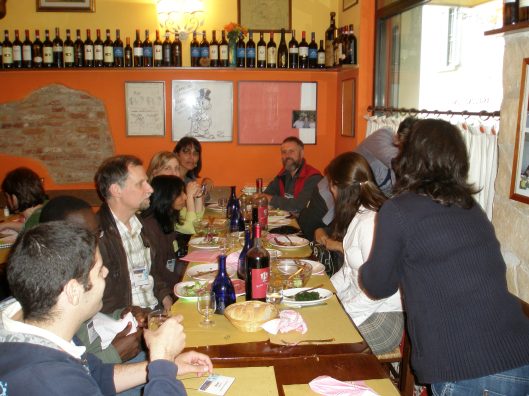
Sharing a Meal at CHI 2008 Workshop

Examples: 

1. At IBM Research, for several years, I managed a research project on the “business uses of stories and storytelling.” I worked with a small team of researchers & consultants to develop tools and techniques. One patent (Story-based organizational assessment and effect system) was originally inspired by trying to help companies involved in mergers and acquisitions deal with cultural differences between companies. The suggested technique essentially involved collecting stories from the two original companies, analyzing them for the underlying values that were expressed in the stories, finding common values in the stories from both original companies, creating new stories using the values and situations from the originals but making sure the new stories were constructed to be memorable and motivating; and finally re-introducing these stories to the people from both companies. The reason for this whole process was to stress common ground so that people from two companies could work better together.

StoryPatent

2. At a workshop at the 1992 ACM Conference on Human Factors in Computing Systems (CHI ’92), I co-organized and co-led a workshop on “Cross-cultural issues in HCI.” At the beginning of the workshop, the participants entered the assigned workshop room to find that it had been set up in a “classroom style” with one small table and two chairs at the front of the room and all the other chairs and desks set up for the “listeners.” We wanted the room set up as a large circle. Everyone pitched in to re-arrange the room into this large circle. This physical activity provided additional common ground for the team. One outcome of the Pattern “Small Successes Early” is to provide common ground. Having people work together to perform a physical task is one way to establish common ground.

We also played a game called “Barnga.” In my introduction to the game, I explained that it was much like Bridge, Whist, or Euchre. To my surprise, none of the participants attending from Asia had any idea how to play such games or what I meant by “tricks” or “following suit.” That experience illustrates how easy it is (at least for me!) to over-estimate how much common ground exists in a group.  (http://www.acadiau.ca/~dreid/games/Game_descriptions/Barnga1.htm)

In a later workshop (2008) on “Human Computer Interaction for International Development,” at the suggestion of Andy Dearden, we began by cooperatively building a map of the world from materials at hand (illustrated above) before delving into the details of the workshop. Starting with this as “common ground” we then explored some of our differences by standing on the representation of where we were from, a favorite place we had visited, a place we wanted to visit, etc.

3. Religions regularly practice rites and rituals. For practitioners of the religion, this provides common ground regardless of a host of differences among the adherents. Of course, it is a double-edged sword because differences among these rites and rituals can also separate people. One of the more brilliant scenes from West Wing cuts among scenes of people attending religions services that are variously Jewish, Muslim, and Christian while the viewer knows that there is an unsuccessful peace effort underway. In this case, the uncommented footage helps to illustrate the common ground among these three religions.

earthfromspace

4. The Family of Man was both an ambitious photography exhibit and a book (definitely worth buying) that portrays people across the world to illustrate precisely that we do have common ground.

https://en.wikipedia.org/wiki/The_Family_of_Man

5. In an earlier blog post, I showed with back of the envelope calculations just how “related” humanity is in terms of genetics, experience, ideas, and matter. In fact, all of life on earth is highly inter-related and it has been for its entire 4.75 billion years.

https://petersironwood.wordpress.com/2017/03/09/math-class-who-are-you/

6. In a recent episode of the TV series, Madam Secretary, the Secretary of State is trying to resolve a conflict between two nations A and B. The diplomats from A say they cannot trust B and the diplomats from B say that they cannot trust A. She suggests that they start from their mutual distrust as part of common ground. In other words, rather than treating the mistrust of A and B as two separate issues, she begins by suggesting that A and B both share two things in common: not only a desire for peace but also a difficulty in trusting the other side. Even mutual distrust can be framed as a basis for common ground. This is more than a linguistic trick. It is an important reframing. It may well turn out that a single event such as a soccer game with teams that have members from both nations may help reduce mistrust on both sides at the same time.

7. Holiday celebrations, the preparation and consumption of food, listening to music, or appreciating the beauty of nature may all provide additional ways of beginning with common ground. Of course, there are cultural differences in all of these as well so one must take some care to provide something that actually is common ground and not something that tends to emphasize the differences among people in these activities.

8. One of the plenary speakers at CHI 1989 in Austin Texas was an astronaut who had been in space. I spoke with him after and during our conversation, he claimed that all astronauts, whatever country they were from, shared the same experience of seeing earth from space; viz., that the national boundaries we typically think so much about were only political; most are not physical. He said all the astronauts were struck by how thin and fragile our atmosphere is and that the earth is the only place around that is capable of sustain the breadth and depth of life. Many of them found this realization of “common ground” the most transformative of all their experiences in the space program.

Resulting Context:

Once people experience common ground, they may still disagree, debate, discuss, or hopefully dialogue in order to identify issues and problems. Experiencing common ground makes it harder to “dehumanize” the other side. It decreases the chances that people will engage in counter-productive actions such as “name calling” or using propaganda techniques to “prove” that they are right and their “opponents” are wrong.

Rationale:

Actions are always better based on reality than on fantasy. Reality is that people share much in common. Reality is that there are also many remaining differences. The entire problem solving process (including problem finding, problem formulation all the way through to finding issues with solutions and re-solving, re-negotiating, re-designing, or re-developing a solution) is enhanced when it is based on a balanced view that includes both real similarities and real differences. We already have a culture and an educational system that focuses on differences. Focusing on common ground is a critical factor in balancing our view so that we do not try to solve problems based on the partial truth that we are all different.

Related Patterns: 

Reality Check, Check-In, Small Successes Early.

Metaphors: 

It is a windy day in San Diego as I write this. We have a set of wind chimes outside the bedroom. Whichever direction the wind blows; however windy it gets (within bounds); and even if the wind is quite chaotic, the sound that emerges is always harmonic and tuneful. This is because of the structure and relationships of the chimes. It would be nice if we could have a platform that encouraged and promoted civility. I think that could work because of the nature of the platform. One of the “chimes” could be Bohm Dialogue; another could be “Building from Common Ground.”

Another musical example is Jazz Improvisation. If a group of musicians who know each other get together, they can improvise some very nice music. If they’ve never met, they will almost certainly agree on a few boundaries before beginning such as style, time signature, key signature. They may well start by having the percussion set up a “beat” that everyone relates to.

Now, imagine instead that seven random people are thrown together from seven different cultures. Each has an instrument that none of the others has ever seen. They have completely different musical experiences and expectations. Does it not make sense that they will take more time to converge on anything good? Doesn’t it seem as though they first need to discover some kind of common ground in terms of scales, rhythms, degree of repetition before achieving a good result? Or, do you think they should argue about which kind of music is best first? Do you think any of the seven will be able to convince the other six that “their” kind of music is superior? Suppose instead of having as one mutual goal making good music, instead, they are in a contest and only one of them will “win” and go on to the next round. Surely, this will only further confound any possible teamwork. Add to this, that they only have two minutes. What kind of performance would you expect now? And, yet, we seem to expect people from very different backgrounds to get on-line and instantly “make good music together.” Whether it’s 140 characters, 280 characters or a whole paragraph, it seems unlikely you will be able to sway anyone to move from “their position” to “your position.”

IMG_3524

International sports competitions such as the Olympics provide a setting where people from around the world get together and compete. These are not random people; they are all immensely talented and skilled; however, they are also all highly competitive. Yet, the venue provides a framework for competition that provides a structure for competing within common ground. Despite being from different cultures and using different languages, the athletes push each other to amazing performances with a minimum of rancor. Every athlete realizes as well that every other athlete has also gone through a rigorous selection and training process involving many sacrifices to get where they are — more common ground. The Olympics might be thought of as a particularly interesting example of finding common ground despite people having different backgrounds, language, and goals. Sports may also be thought of as a compelling metaphor. When politics are reported in the media, they are most often treated as a sporting event. But it is a strange kind of sporting event in that such reporting seldom stresses common ground and instead focuses on strategy, polls, winning, losing, and differences. It almost never reports on common ground in politics. In reporting on actual sporting events, however, the reporting focus often does cover the common ground that athletes face; e.g., the training, the dedication, the sacrifices that families must make, the importance of coaching, etc.

References: 

https://www.goodreads.com/book/show/197193.The_Family_of_Man

https://www.johngraham.org/coach/17-finding-common-ground-negotiating-and-resolving-conflicts-part-i

http://www.tandfonline.com/doi/full/10.1080/03057267.2016.1206351

http://journals.sagepub.com/doi/abs/10.1177/1049732306289705

https://www.researchgate.net/publication/221517384_Video_Helps_Remote_Work_Speakers_Who_Need_to_Negotiate_Common_Ground_Benefit_from_Seeing_Each_Other

Thomas, J. C. (2017). Building Common Ground in a Wildly Webbed World: A Pattern Language Approach. PPDD Workshop, 5/25/2017, San Diego, CA.

Thomas, J.C. & Kellogg, W. (1993). Cross-cultural perspectives on human-computer interaction: report on the CHI ’92 workshop. SIGCHI Bulletin, 25 (2), 40-45.


 

Meaningful Initiation

29 Monday Jan 2018

Posted by petersironwood in America, management, psychology, sports, Uncategorized

≈ 2 Comments

Tags

Business, collaboration, coming of age, cooperation, coordination, Design, initiation, life, pattern language, ritual

Meaningful Initiation

Prolog: 

I have mixed feelings about the phenomenon of “initiation.” I’d be very interested to hear about other people’s experiences, intuitions, and studies related to this very common social phenomenon.

IMG_1033

Author, reviewer and revision dates: 

Created by John C. Thomas on January 29, 2018


Synonyms: 

Appropriate Initiation

Abstract: 

Persistent social groups typically require people who want to join the group to pass an initiation ceremony, rite, or test. Some of these “initiations” include meaningful tests of skill, knowledge, or loyalty. Such initiations prevent people who are deemed unworthy or not ready from joining the group. This has several additional effects. People who pass the initiation, especially if it is severe, value the group more. The initiation also tends to prevent people who do not really value the group enough (or even seek to subvert it) from joining. In addition, people who have no interest in joining the group may also value it more highly if they know it is difficult to join. Initiations may be severe by virtue of having the test of skill itself be difficult, or by requiring endurance, pain, or embarrassment on the part of the would-be joiner.

Problem:

Groups function better under a wide variety of circumstances if there is a high degree of internal mutual trust. If people work together over a long period of time, trust will develop if warranted. However, often even a newcomer to a group can cause chaos and mistrust due to lack of experience, competence, or in some cases, intentionally. Groups therefore need some way to ensure that everyone in the group is minimally competent, values the group and works for the group’s benefit, not just their individual benefit. It’s important for the group work that everyone value the group and trust each other.

Context: 

Complex problems and large problems can often only be solved by groups. For the group to work well together to solve ill-defined or wicked problems, they need to have a common way of communicating, have knowledge of what each other knows, and have a high degree of trust. At the other extreme, consider slaves chained to their oars, slaves picking cotton, or even volunteers, each of whom scans a very small pre-assigned segment of the night sky. In these cases, someone outside the group is typically “in charge” and the cooperation and coordination required among the members of the group is determined, not by the group, but by an overseer. As the problem space becomes more complex however, it becomes more and more necessary for the group to be able to re-prioritize, re-arrange how they work together, and even for fundamental values and goals to evolve. In these latter contexts, it is very important for the group members to share common experiences and trust each other.

In some cases, the normal progression of education, joining a sports league or becoming a full-fledged member of a profession has an initiation aspect even if its accidental. For instance, becoming a tennis professional will require submitting to the requests of coaches and doing a lot of repetition of the fundamentals. It may also require many hours of working out for flexibility, strength, balance, and cardio fitness. In addition, as the person gains skill, their opponents and the venues will tend to produce more and more stressful situations that must be mastered in order to progress to the next level. Similarly, to become a medical doctor requires hundreds of hours of study as well as practical, hands on experiences which will typically require higher and higher levels of skill and stress. Sometimes there are actual specific ritual initiations in addition, but sometimes the structure of the profession itself serves an initiative function.

fullsizeoutput_1164

Forces:

  • If someone works harder, or suffers more pain or embarrassment to be accepted into a group, they will tend to value the group more (though this findings has not always been replicated).
  • For groups to work well together, they need common ways to communicate.
  • Common experiences tend to increase mutual trust.
  • For many groups, it is vital that the members of the group are selected so as to have adequate speed, strength, vision, courage, training, skill, or other characteristics.
  • Groups which are perceived to be very difficult to join may be viewed as being higher prestige than those which are easy to join.
  • Groups with higher prestige may enjoy more benefits from the larger society such as special laws, exceptions to general regulations, or a better pool of candidates.
  • Some people may use the excuse of an initiation in order to satisfy their own need to inflict cruelty on others regardless of the impact of that cruelty on the individual being initiated or on the effectiveness and cohesion of the group.

Solution:

Before someone is allowed to join a group, they have to “prove themselves” by undergoing an initiation. This insures they have some minimal qualifications. It also increases the strength of loyalty, social capital, and trust within the group. It may also increase the “cachet” of the group among others.

Examples: 

As Royal Dutch Petroleum was nearing its hundredth year of existence, they commissioned Aries de Gues to find out whether corporations ever existed as long as a century and if so, what were the characteristics. He found that indeed, there were companies that old and they had four common characteristics. One was a high degree of mutual trust. A second was “strong boundaries.” This latter characteristic meant that it was difficult to join such companies and people tended to stay for a long time. Both these characteristics are logically related to having meaningful initiations. (The other two are not strongly related to this Pattern; Tolerance for Exploration at the Edges and Financial Conservatism).

IMG_3898

See link for examples of religious initiations: https://en.wikipedia.org/wiki/Religious_initiation_rites

Many so-called “primitive” cultures had initiations and rites of passage. Here are a few references.

https://www.artofmanliness.com/2015/09/30/lessons-from-the-sioux-in-how-to-turn-a-boy-into-a-man/

https://mightywrites.wordpress.com/2012/02/21/maori-ta-moko-a-ritual-of-passage-a-study-of-tattoing/

http://www.maasai-association.org/ceremonies.html

https://video.nationalgeographic.com/video/us-apachegirl-pp

Resulting Context:

Presumably and hopefully, the resulting context is a self-sustaining group over time whose members trust each other, communicate well, and highly value their group membership.

Rationale:

Initiations are supposed to have these benefits: 1) The initiation screens out anyone who is incapable or not sufficiently interested to undergo bad things in order to join the group. 2) The initiation causes members of the group to value the group more highly. 3) The initiation provides a common experience that all group members can share. 4) The initiation may make the group seem more “selective” to people outside.

Related Patterns: 

Special Roles; Strong Boundaries; Levels of Trust; Bell, Book, and Candle; Apprenticeships; Official Sanctions of Competency.

Known Uses:

College fraternities and sororities, clubs, sports teams, commercial groups in many settings, military groups, religious groups, and professional societies among others, all require tests and/or initiations before one becomes a full-fledged member. In some cases, such as a Ph.D. dissertation and defense, the “initiation” is mainly a test and an educational experience, but there is often an “endurance” aspect as well. While college fraternity initiations may include tests of knowledge of the participants; e.g., about the fraternity, it’s origins and members; it seems mainly to require the pledge to endure humiliation, discomfort, endurance and sometimes physical danger.

Known Misuses:

(Note: This is not a standard section in the Patterns of a Pattern Language. In this case, I think it’s important. While I do think this overall Pattern can be a useful one, it is particularly prone to misuse as well. I’d like to hear other people’s thoughts and experiences of initiations and what could be done to insure that this is a positive pattern.)

College fraternities in particular are known for so-called “hazing” that sometimes results in deaths. The most common cause of death is from drinking too much alcohol in too short a period of time.

Although part of what internships for medicine do is teaching and testing the ability of doctors to handle pressure, the schedules and attitudes often seem to include an element of cruelty and possibly even danger to the health and well-being of both interns and patients. Many professionals in other fields as well have experienced abuse of one sort or another from superiors during or associated with such tests.

In the movie, A Few Good Men, a commander orders a “Code Red” on a recruit who has repeatedly fallen short in various physical tests. The recruit dies. It turns out that his inability to perform some of the physical requirements of Marine training were because of an undiagnosed heart problem. This is at least arguably an example (albeit fictional) of initiation gone horribly wrong. Even though the fallen soldier was “in” the Marines, he was still in basic training which consists of a combination of skills training, conditioning, and repeated “initiation rituals.”

IMG_5348

When I was a Boy Scout, my “initiation” consisted of supposedly being branded by a hot poker. Three of us were to be initiated during a week-end long camp outing. The kids who were already in the troop were in the main common room and we three were told to wait our turn in another, smaller room. The main room had a roaring fire and fireplace tools including a poker. I volunteered to go first. I was blindfolded and led into the main room where I had to lay down on a bench next to the fire. My shirt was pulled up and after a few minutes, when my torso felt hot from the fire, an ice cube was laid on my stomach. As you can easily verify for yourself, if you sense both hot and cold at the same time, it produces a burning sensation. I was instructed to scream bloody murder for the benefit of the guys still in the other room. As best I can recall at the time, I had been fairly well convinced that I was not actually going to be branded. (But either way, I thought it better to go first). For one thing, I had been swimming with all these guys and never noticed any kind of a scar that would be consistent with being branded with a hot poker. The second guy went through a similar procedure and was also told to scream bloody murder. After his “branding” the troop members took a towel and put ketchup on it to simulate blood. They took this in to show the third and last one of tonight’s “initiates.” The two of us who had already been initiated still moaned mournfully as though in pain, as per our instructions. When the boys went to blindfold and bring the last initiate in however, he completely freaked out. He not only refused; he fought as though his life depended on it, punching, kicking, biting, and otherwise wreaking mayhem on the older and larger boys who were trying to subdue him for the initiation. Realizing how extreme was his fear, they tried to intimate that he was not really going to be branded but this last boy was far too wound up to pay attention to what was being “intimated.” The troop eventually gave up on his initiation. That boy was seriously traumatized. I can’t really say whether he ever believed us that no-one really meant him physical damage, but he never looked any of us in the eye again or spoke much during the remainder of the camping trip. He never asked for another go at an initiation and, to the best of my recollection, everyone else in the troop felt very bad. Rather than increase social cohesion in the group, this misadventure backfired completely. Whatever the reason, this particular troop soon disbanded. This example serves as a cautionary tale about “initiations” because none of the people involved foresaw this particular outcome or were operating out of conscious cruelty.

Early in high school, I got a volunteer job as a “Y leader” at the local YMCA. I basically taught and supervised younger kids in basketball and various fitness tests. My manager was a young man probably in college. He said I would have to pass a “test” first which consisted, basically, of doing a chore for him; I was supposed to go to a nearby department store and pick up a shade that he had bought and paid for. I went to the department store but no-one in the drapery department had the least knowledge of this guy and the shade he had supposedly bought. I had to return empty handed and figured I had failed my “test.” He explained, however, that he hadn’t bought window shades but lamp shades. Back to the store I trudged and returned with his lamp shades. It all struck me as weird and irrelevant to my job as a Y-leader. But there was more to come.

In order to be fully admitted into this little “club” of the Y-leaders we had to go through an initiation. We had several weeks to memorize every athletic record of that local Y, as well as their times or weights or distances. There was also additional material about the procedures and the hierarchy of the YMCA and so on. Then, we came to the initiation night. I think there were four of us who were initiates. We initiates took turns and had to answer questions given by this same manager mentioned above. While doing this, we stared into a very bright light. He was behind the light so that I could only see a slight shadow of the outline of his head. He and the rest of the Y leaders called us “worms” during this little ritual. On the other hand, the initiates were supposed to begin and end each of our utterances with “sir.” Well, I hadn’t really cared much about the material and quickly got three wrong. Now, I was given a choice: I could either delay being initiated and try again next month, or I could take 40 whacks with a wooden paddle. I opted for the 40 whacks. I had been paddled before with wooden paddles, but never more than a few times.

As I soon discovered, there was another crucial difference. My other paddling had been by teachers. Although they certainly wanted to make the paddling punishment hurt, they also certainly wanted to avoid a lawsuit. Although back then, lawsuits were not so plentiful as raindrops, there were some. In any case, I don’t think any of them actually wanted to physically injure us. This paddling was done by all the boys who were already Y leaders. This paddling was done by my peers. They were not adults but young teen-aged boys. As they took their turns, a few went easy on me and most hit fairly hard — around “teacher” velocity. Two brothers, however, had some kind of sadistic streak. They took several steps forward during the “wind-up” and swung the paddle with both hands like a baseball bat. Anyway, I “passed” the initiation. My backside was black and blue however, not just on my buttocks, which I would have been capable of hiding, but also on the back of my thighs. Two of my co-initiates also received 40 whacks. The last guy had taken the task very seriously and knew an incredible amount of trivia about a bunch of local athletes. But as he answered question after question, the manager simply made the questions more and more obscure, venturing well outside the scope of what we had been told we needed to learn. I realized that the point of the whole exercise was not to have us learn anything but to get to have us paddled. At last, the last boy got three wrong, but to my surprise, when it came to the question, he said he would study again for next month.

Eventually, my parents found out (because the bruising was visible, not just on my buttocks but all the way down the back of my legs) and complained to the Y about this whole initiation. Again, this “initiation” seems to have backfired in every sense. One has to wonder whether overly powerful initiation rituals are also part of why sexual abuse and child abuse often go unreported when it occurs in certain tightly knit groups. Initiation is a tool that needs to be used appropriately, carefully, and protected from the misuse of those who are really interested in inflicting cruelty to others merely under the ruse of carrying out an “initiation.” Need initiations be “secret”? They often are and this increases the tendency for them to be subject to perversion from being what is potentially good for the group into a private exercise in cruelty.

Metaphor:

A sperm cell, whether human animal or flowering plant, must be healthy enough to traverse some distance before getting to an egg. It then has to penetrate the cell wall of the egg. While we do not expect the sperm to therefore “value” the joining with the egg, this process does perform a kind of screening function.

In some team competitions, there are a series of “rounds” before the final round. One could think of these earlier rounds as a kind of trial that has some aspects of initiation. Only the best teams continue on in further into the tournament. In addition, it probably also has the effect of increasing social capital within the team.

Apprenticeship programs often require new apprentices to perform the most menial tasks. This process of gradually assigning more responsibility as the initiate gains more skill is necessary for safe and productive work, but it also may partly serve an initiation function as well.

IMG_0327

References: 

Aronson, E., & Mills, J. (1959). The effect of severity of initiation on liking for a group. The Journal of Abnormal and Social Psychology, 59(2), 177-181.

http://dx.doi.org/10.1037/h0047195

https://en.wikipedia.org/wiki/List_of_hazing_deaths_in_the_United_States

De Gues, Arie. (1997), The Living Company. London: Nicholas Brealy.

Gerard, H. & Matthewson, G. (1966),  The effect of severity of initiation on liking for a group: a replication, Journal of Experimental Social Psychology, 2(3), 278-287.

Walsh, A. (1990). Becoming an American and liking it as a function of social distance and severity of initiation. Sociological Inquiry, 60(2), 177-189.

Small Successes Early: Metaphor & Fable

20 Saturday Jan 2018

Posted by petersironwood in America, apocalypse, Uncategorized

≈ 4 Comments

Tags

Business, Design, iterative development, life, pattern language, politics

IMG_9849

This post is an extension to the Pattern —   Small Successes Early — and trials the addition of two more sections to the traditional form of a Pattern: Metaphor and Fable.

Metaphor:

(This section is a departure from the traditional form of Patterns. It’s intent is to show how the same general principles that are embodied in the pattern also apply in other domains).

Life on earth, according to current estimates, has been around for 4.75 billion years. Evolution has had a long time to “learn” effective ways to do things. Have you ever seen an oak tree decide to migrate to a new place in the forest? Have you noticed it getting grumpy and yanking itself up by the roots and walking 30 meters to richer soil or closer to a stream and stabbing its roots back into the dirt in order to settle in its new place? (I mean apart from Tolkien’s Ents?) No, and neither have I. What does an oak tree do? It puts some energy into making acorns. Each acorn costs the tree (a tiny bit) in terms of water, soil nutrients, and sugar that it made from photosynthesis in its leaves. But it does not bet the farm on a better place. Some acorns will be scattered by squirrels onto new and better ground. If the conditions are just right the acorn will germinate and send up a small shoot and send down a primary root. Over time that acorn may grow into a mighty oak. Small successes early. Similar strategies are taken by other plants whether they propagate by runners, by seeds, or by spores. Animals typically also “start small.”

What can we learn from human practices that have evolved over millennia? For example, people have been building things for a long time. What are the practices around making a new building? People don’t just dig into a huge building project. They draw up plans; they discuss it; they typically build small scale models. If they see no problems with these models, they begin construction on the real thing. We think of these plans and models as being ways to coordinate the work and so they are. But they also serve a critical social purpose. Various stakeholders can look at the plans and models and question various decisions before there is a huge sunk cost.

IMG_5684

What do people do when they want to put on a stage play? They don’t typically write a play and then immediately spend a huge amount of money advertising it, building scenery, making costumes and then sell tickets for the Broadway opening. No. People write a play and then do a “reading” with a small group of people. Many issues get ironed out. Eventually, people may cast the play and have people rehearse. Again, they need not do this with full costumes, make-up, and scenery. Instead, they “work out the kinks” in the play, occasionally changing lines, but very often changing the manner in which lines are said. In later stages, the blocking or lighting may change. Eventually, people have what are called “dress rehearsals” to make sure everything is working right. The producers want to insure that the scenery doesn’t fall down; that the costumes don’t rip; that people know their lines. In many cases, people open off-Broadway to give them a further chance for improvement before a Broadway opening with its potential for roasting by drama critics.

One of the longest running continuous institutions is the Catholic Church. Would you like to be elected Pope? Good luck with that. The Pope isn’t chosen by an open lottery or elected by the general populace who pick anyone they like. If you want to be Pope, you have to first pass through all sorts of “tests” to prove yourself as a Catholic; then, prove yourself as a Priest; after a long successful career, you may be eventually become a Bishop. Many professions that have had a long history developed similar though perhaps less elaborate hierarchies based on expertise and experience. They start with small successes. If you can handle lower level duties successfully, you move up the hierarchy from apprentice, to journeyman to master.

So, when it comes to biology, which has had billions of years of evolution, the tendency is overwhelmingly to use “Small Successes Early” and when it comes to human cultural evolution of roles and large scale processes that have been around for thousands of years, people use “Small Successes Early.” It is only some modern business managers who feel there is no need for such prudence because, after all, they are smart enough to foresee all consequences and therefore have no need for “Small Successes Early.”

Fable: 

(This section is another addition and departure from the form of a typical Pattern. It tries to encapsulate the basic idea of the Pattern into a fable similar to those of Aesop).

fullsizeoutput_1a5a

Rarin’ Rabbit hated the farmers who kept chasing him and his brethren from the gardens. The whole hutch spent as much energy going from their warren to the garden and getting chased back as they did from the occasional tasty morsel they managed to steal.

One bright day, Rarin’ Rabbit happened upon a dry creek bed filled with clover, purslane, and plantain. He immediately went back to the warren and convinced all his fellow rabbits to move their warren into the sides of the dry creek bed. Now, all they had to do for a great meal was step outside their front door! No farmers chasing them! It really did seem as though Rarin’ Rabbit had led his entire tribe to the promised land!

Rarin’ Rabbit grew immensely popular. One hot and humid day in late summer, Rarin’ Rabbit and his compatriots were munching on some wild roses that grew on the sides of the arroyo  when they heard thunder in the distant hills. Some of the rabbits got nervous and began wondering if the rain drops would come down on them. Some suggested perhaps that it was prudent to stop snacking and head back to the shelter of their warren. “Nonsense!” Rarin’ Rabbit protested. “There’s no rain here! Let’s keep eating till we’re as big as elephants! You have to dream greatly if you want to succeed greatly!” Most of the rabbits stayed for Rarin’ Rabbit was indeed quite popular — right up until the flash flood came hurtling down the canyon sweeping away Rarin’ Rabbit, all his companions, and the rabbit warren. Every last one drowned.

IMG_7249

The moral of the story is: “Dream greatly. But test out your great dreams by first trying to find small successes early.”


Author Page on Amazon

“Reality Check”

16 Tuesday Jan 2018

Posted by petersironwood in America, apocalypse, management, Uncategorized

≈ 6 Comments

Tags

advertising, Business, creativity, Design, epistomology, innovation, learning, life, pattern language, politics

IMG_9660

This is the second in a series of blogs that present Patterns in a Socio-technical Pattern Language of best practices for collaboration and coordination in complex societies. I intend to organize these in multiple ways (e.g., type of goal; where in a typical development process the pattern is most applicable; how large a collection of people the pattern is most applicable to, etc.).  I am entering them in this blog in an order that reflects current events. For example, there seems to be a movement to deny reality outright and insist everyone simply believe what the leaders promulgate. This, to me, is outright evil. But even when people are acting with the best of intentions, it is natural to take short cuts. Those short cuts can make life seem more efficient in the short run, but it can also lead to serious issues in the longer term.

Reality Check

Author, reviewer and revision dates:

Created by John C. Thomas on 4 September, 2001

Revised, JCT, 17 December, 2001

Revised, JCT, 15 January, 2018

Synonyms: 

Abstract:

In developing complex systems, it is often expedient to develop feedback loops based on ersatz measures of what we are really interested in assessing and controlling. While this seems expedient in the short term, it often leads to serious problems and distortions, particularly in times of crisis or transition when the correlation between ersatz measures and actuality substantially drifts or even suddenly disconnects. Actions can be based on these measures or models of reality rather than on reality(or more complete measures) and result in negative consequences. The solution is to perform regular “reality checks” to insure that measures or indicators of reality continue to reflect that reality.

Problem:

In developing complex systems, it is often expedient to develop feedback loops based on ersatz measures of what we are really interested in assessing and controlling. While this may seem expedient in the short term, it often leads to serious problems and distortions, particularly in times of crisis or transition when the correlation between ersatz measures and actuality substantially drifts or even suddenly disconnects. Actions can be based on these measures or models of reality rather than on reality. This can result in negative, even deadly, consequences.

IMG_4382

Context:

Many problems were partly responsible for the disaster at the Three Mile Island. One crucial problem, in particular, arose from the design of a feedback loop. A switch was supposed to close a valve. Beside the switch was a light that was supposed to show that the valve was closed. In fact, rather than having the light go on as the result of actual feedback from the valve closure itself, the signal light was merely a collateral circuit to the switch. All it actually showed was that the switch had moved position (Wickens, 1984). Under normal operation; that is, when the valve was operating properly, these two events were perfectly correlated. At a critical point in the meltdown, however, the valve was not operating properly. Yet, the human operator believed that the valve was closed even though it had failed to close in reality. His resulting actions, taken on the basis of the assumption that the valve was closed, exacerbated the subsequent problems. My colleague, Scott Robertson, has recently posted an analysis of the recent error that resulted in the nuclear missile scare in Hawaii. (See link).

View at Medium.com

In running an application program several years ago, I was given a feedback message that a file was posted. In fact, it wasn’t. The programming team of the application, rather than checking to see whether the file was actually posted, merely relied on the completion of an internal loop.

In advertising campaigns, it is difficult to measure the impact on sales. Instead, companies typically measure the “recall” and “recognition” rates of ads. This may often be correlated with sales changes, but in some cases, the ad may be very memorable but give the customer a very negative impression of the company and decrease the chances of actually selling a product.

Historically, monarchs and dictators (and even would-be dictators) often surrounded themselves only with people who gave them good reports and support no matter how their decisions impacted the reality of their realm. Eventually, the performance of such people tends to deteriorate severely because their behavior is shaped by this ersatz feedback rather than by reality.

IMG_5245

During the “oil crisis” in the seventies, oil companies relied on mathematical models of continually increasing demand. Year after year, for seven years, they relied on these models to predict demand despite the fact that, for all seven years, demand actually went down. The results are purported to have cost them tens of billions of dollars (Van der Heijden, 1996).

In some cases, the known existence of ersatz measures directly contributes to the destruction of the utility of these very measures. For example, if management decides the “easy way” to measure programmer productivity is “Lines Of Code,” once programmers discover this, the code base may grow quickly in terms of that measure, but not in terms of actual functionality.

IMG_7683

In America @2018, many people view money as the only legitimate value of interest for countries, companies, or individuals. Measures such as the GDP and the stock market index are taken as adequate and complete measures of the economic well-being of the society. There is a sense that, since we spend the most on weapons and health care, we must perforce be the “safest” and “healthiest” nation on the planet. This is clearly not the case. Similarly, ads talk about a person’s “net worth” when what they are really talking about is merely a person’s net financial worth. “Worth” is not the same as “financial worth.”

A large research organization that I am familiar with used to have a large number of administrative assistants who helped arrange meetings, send in expense reports, and answer telephones. At some point, most of these administrative assistants were laid off and the tasks were now done by the researchers themselves who were typically not nearly so efficient at them. The researchers took at least as long to do them as had the administrative assistants. Accountants looked favorably at all the “money they had saved” because they could easily see that the line item for administrative assistants was far less costly than it had been. Not visible, of course, was the fact that the much more highly paid researchers were now doing the same work that had been done before by the administrative assistants, but they were doing it less efficiently and at a far higher cost.

Forces: 

* Organizations are often hierarchically decomposed and bureaucratic. Therefore, it is often simplest to communicate with those close to us in the hierarchy and to build systems that rely for their model of reality only on things within the immediate control span of our small part of the organization.

* While more comfortable to limit system design and development to those things within one’s own team or department, it is often precisely the work necessary to capture more reality-based measures that will reveal additional challenges and opportunities in business process coherence.

*A more direct measure of reality is often more time-consuming, more costly, or more difficult than the measure of something more proximal that is often highly correlated with those aspects of reality of real interest.

*It is likely to be exactly at times of crisis and transition that the correlation be-tween proximal ersatz measures and their referent in reality will be destroyed.

*It is likely to be exactly under times of crisis and transition that people will tend to simplify their cognitive models of the world and, among other things, forget that the proximal measure is only ersatz.

Solution: 

Therefore:

Whenever feasible, feedback should ideally be based on reality checks, not solely on ersatz measures. When this is too costly (as opposed to merely inconvenient or uncomfortable), then at least design systems so that the correlation between proximal measures and their referent in reality is double-checked periodically.

IMG_0396

Examples:

Rather than rely solely on a circle of politically minded advisors, Peter the Great disguised himself and checked out various situations in Russia in person.

As reported by Paula Underwood (who was the designated storyteller for her branch of the Iroquois), her ancestors at one point felled giant trees for long houses in the Pacific Northwest. Later, when the tribe lived in the “Great Plains”, there were no trees of that size. The tribe began to doubt the existence of trees as large as what their oral history portrayed. In order to check on this, one brave spent many years walking back to that area and seeing with his own eyes that there were indeed trees as tall as had been portrayed in the oral history and then returning to the tribe to report back.

Resulting Context:

Ideally, over time, people who actually double-check reality will come to better understand when and how these reality checks will be necessary. They may also invent methods of making a check-in closer to what is really of interest more convenient or cheaper.

Related Patterns:

System as a Whole

Convergent Measures

Drawing the Line

Who Speaks for Wolf

Known Uses:

Richard Feynman, during the Manhattan project, noticed that the bureaucracy was worried about the possibility of accidentally stockpiling a critical mass of uranium. To prevent this, each section chief was required to insure that their section did not have a critical mass. To insure this, each section chief instructed each sub-section chief to insure that their subsection didn’t have a critical mass and so on, down to the smallest level of the bureaucracy. Upon hearing this plan, Feynman observed that neutrons probably didn’t much care whose subsection they reported to!

In another incident reported by Feynman, various bureaucrats were each trying to prove that they had better security than their peers. In order to prove this, they escalated the buying of bigger and thicker safes. The bigger and thicker the safe, the more bureaucrats felt that they had made their secrets secure. Feynman discovered that more than half of the super-safe safes had been left with the factory installed combinations of 50-50-50 and were therefore trivially easy to break into!

IMG_8585

References: 

Wickens, C. (1983). Engineering psychology and human performance. Columbus: Merrill, (p.1).

Van der Heijden, K. (1996). Scenarios: The art of strategic conversation. Chichester: Wiley.

Hutchings, E., Leighton, R., Feynman, R., and Hibbs, A. (1997). Surely, you’re joking Mr. Feynman. New York: Norton.

Underwood, P. (1993). The Walking People: A Native American oral history. San Anselmo, CA: Tribe of Two Press.

————————————

https://petersironwood.wordpress.com/2017/02/25/the-invisibility-cloak-of-habit/

https://www.amazon.com/author/truthtable

“Who Speaks for Wolf?”

09 Tuesday Jan 2018

Posted by petersironwood in America, psychology, Uncategorized

≈ 9 Comments

Tags

Business, Design, environment, family, innovation, learning, life, marketing, Native American, pattern language, politics

IMG_0727

This is the first of many socio-technical “Patterns” in a socio-technical Pattern Language meant to encapsulate best practices for collaboration and coordination. The common “parts” of every Pattern are displayed below in bold. A brief discussion follows the Pattern.

Who Speaks for Wolf?

Author, reviewer and revision dates: 

Created by John C. Thomas on December 17, 2001

A shorter version is included in Liberating Voices by Douglas Schuler.

A longer version was published as an IBM Research Report, 2002.

Reviewed by <John C. Thomas> on <January 9, 2018>

Revised by <John C. Thomas> on <January 9, 2018>


Synonyms 

Engage all the Stakeholders

Abstract: 

A lot of effort and thought goes into decision making and design. Nonetheless, it is often the case that bad decisions are made and bad designs conceived and implemented primarily because some critical and relevant perspective has not been brought to bear. This is especially often true if the relevant perspective is that of a stakeholder in the outcome. Therefore, make sure that every relevant stakeholder’s perspective is brought to bear early.

Problem:

Problem solving or design that proceeds down the wrong path can be costly or impossible to correct later. As the inconvenience and cost of a major change in direction mount, cognitive dissonance makes it likely that the new information will be ignored or devalued so that continuance along the wrong path is likely.

Context: 

Complex problems such as the construction of new social institutions or the design of complex interactive systems require that a multitude of viewpoints be brought to bear. Unfortunately, this is all too often not the case. One group builds a “solution” for another group without fulling understanding the culture, the user needs, the extreme cases, and so on. The result is often a “system” whether technical or social, that creates as many problems as it solves.

The inspiration for this pattern comes from a Native American story transcribed into English by Paula Underwood.

In brief, the story goes as follows. The tribe had as one of its members, a man who took it upon himself to learn all that he could about wolves. He became such an expert, that his fellow tribespeople called him “Wolf.” While Wolf and several other braves were out on a long hunting expedition, it became clear to the tribe that they would have to move to a new location. After various reconnaissance missions, a new site was selected and the tribe moved to the new location.

Shortly thereafter, it became clear that a mistake had been made. The new location was in the middle of the spring breeding ground of the wolves. The wolves were threatening the children and stealing the drying meat. Now, the tribe was faced with a hard decision. Should they move again? Should they post guards around the clock? Or, should they destroy the wolves? And, did they even want to be the sort of people who would kill off another species for their own convenience?

At last it was decided they would move to yet another new location. But as was their custom, they also asked themselves, “What did we learn from this? How can we prevent making such mistakes in the future.” Someone said, “Well, if Wolf would have been at our first council meeting, he would have prevented this mistake.”

“True enough,” they all agreed. “Therefore, from now on, whenever we meet to make a decision, we shall ask ourselves, ‘Who speaks for Wolf’ to remind us that someone must be capable and delegated to bring to bear the knowledge of any missing stakeholders.

Forces:

  • Gaps in requirements are most cheaply repaired early in development; it is important for this and for reasons of acceptance (as well as ethics!) by all parties that all stakeholders have a say throughout any development or change process.
  • Logistical difficulties make the representation of all stakeholder groups at every meeting difficult.
  • A new social institution or design will be both better in quality and more easily accepted if all relevant parties have input. Once a wrong path is chosen, both social forces and individual cognitive dissonance make it difficult to begin over, change direction or retrace steps.

Solution:

Provide a way to remind everyone of stakeholders who are not present. These could be procedural (certain Native Americans always ask, “Who Speaks for Wolf” to remind them) or visual or auditory with technological support.

Examples: 

In “A behavioral analysis of the Hobbit-Orcs problem,” I discovered that people find it difficult to solve a simple puzzle because it appears that they must “undo” progress that has already been made.

As a positive case, some groups make it a practice to “check in” at the beginning of any meeting to see whether any group members have an issue that they would like to have discussed. In “User Centered Design”, and “Contextual Design” methodologies, an attempt is made to get input from the intended users of the system early on in the design process.

In a negative case, we developed a system to help automate “intercept calls” for a telecommunications company. We tested the end users to make sure it was workable. When we went to install the system, however, we learned that the folks in charge of central offices, would not allow our software to be installed until we provided documentation in the same format that they were used to from AT&T. So, we redid all the documentation to put it into the AT&T format. At that point, our lawyers, however informed us that that format was “copyrighted” so we could not simply use it. In this case, although many stakeholders were consulted, we had left out two important constituencies. (Eventually, the system was deployed — the first in the US that incorporated speech recognition into an application on the Public Service Network.

Resulting Context:

When every stakeholder’s views are taken into account, the solution will be improved in quality and in addition, there will be less resistance to implementing the solution.

Rationale:

Much of the failure of “process re-engineering” can be attributed to the fact that “models” of the “is” process were developed based on some executive’s notion of how things were done rather than a study of how they were actually done or asking the people who actually did the work how they were done. A “should be” process was designed to be a more efficient version of the “is” process and then implementation was pushed down on workers. However, since the original “is” model was not based on reality, the “more efficient” solution often left out vital elements.

Technological and sociological “imperialism” provide many additional examples where the input of all the stakeholders is not taken into account. Of course, much of the history of the US government’s treatment of the Native Americans was an avoidance of truly including all the stakeholders.

A challenge in applying the “Who Speaks for Wolf” pattern is to judge honestly and correctly whether, indeed, someone does have the knowledge and delegation to “speak for Wolf.” If such a person is not present, we may do well to put off design or decision until such a person, or better, “Wolf” can be present.

Related Patterns: 

Radical Co-location (Provided all stakeholders are physically present in the radical co-location, this tends to insure that their input will be given at appropriate times).

Known Uses:

As a variant of this, a prototype creativity tool was been created at IBM Watson Research Center. The idea was to have a virtual “Board of Directors” consisting of famous people. When you have a problem to solve, you are supposed to be reminded of, and think about, how various people would approach this problem. Ask yourself, “What would Einstein have said?” “How would Gandhi have approached this problem?” And so on. The original prototype consisted of simple animations. Today’s technology would allow one to develop a raft of chat-bots instead.

References: 

Thomas, J. C. (1974). An analysis of behavior in the hobbits-orcs problem. Cognitive Psychology, 6(2), 257-269.

Thomas, J.C. (1996). The long-term social implications of new information technology. In R. Dholakia, N. Mundorf, & N. Dholakia (Eds.), New Infotainment Technologies in the Home: Demand Side Perspectives. Hillsdale, New Jersey: Lawrence Erlbaum.

Thomas, J.C., Lee, A., & Danis, C (2002). “Who Speaks for Wolf?” IBM Research Report, RC-22644. Yorktown Heights, NY: IBM Corporation.

Thomas, J.C. (2003), Social aspects of gerontechnology.  In Impact of technology on successful aging N. Charness & K. Warner Schaie (Eds.). New York: Springer.

Underwood, Paula. (1983). Who speaks for Wolf: A Native American Learning Story. Georgetown TX (now San Anselmo, CA): A Tribe of Two Press.

IMG_5572

Discussion. 

I have personally found this pattern to extremely useful in a variety of social and business situations. In some ways, it seems like “common sense” to get the input of everyone touched by a decision. But we live in a very “hurried” society as I earlier examined in the Blog Post “Too Much.” I’ve seen many projects hurried through design and development without taking a sufficient look at the possible implications for various stakeholders. There is currently what I consider a reasonable concern over what the impact of AI will be. But other technologies on the horizon such as biotechnology and nanotechnology also need to be thought about. As we examined in a whole series of blog posts in the fall of 2017, social media have had huge unintended (and negative) consequences.

I’ve also been involved in “cross-cultural issues” in Human-Computer Interaction (HCI) and in how HCI impacts people and societies in other cultures. Even relatively simple technologies like dishwashers, microwaves, and cars often have considerable unanticipated social consequences. It is not only the “fair” thing to involve everyone who will be seriously impacted; it will ultimately result in faster progress with less strife.

I’m very interested in other people’s experiences relevant to this Pattern.

IMG_9829


“Turing’s Nightmares” – scenarios of possible AI futures.

← Older posts
Newer posts →

Subscribe

  • Entries (RSS)
  • Comments (RSS)

Archives

  • February 2026
  • January 2026
  • December 2025
  • November 2025
  • October 2025
  • September 2025
  • August 2025
  • July 2025
  • June 2025
  • May 2025
  • April 2025
  • March 2025
  • February 2025
  • January 2025
  • December 2024
  • November 2024
  • October 2024
  • September 2024
  • July 2024
  • April 2024
  • March 2024
  • February 2024
  • January 2024
  • December 2023
  • August 2023
  • July 2023
  • May 2023
  • April 2023
  • March 2023
  • February 2023
  • January 2023
  • December 2022
  • November 2022
  • October 2022
  • September 2022
  • August 2022
  • July 2022
  • June 2022
  • May 2022
  • April 2022
  • March 2022
  • February 2022
  • January 2022
  • December 2021
  • November 2021
  • October 2021
  • September 2021
  • August 2021
  • July 2021
  • June 2021
  • May 2021
  • April 2021
  • March 2021
  • February 2021
  • January 2021
  • December 2020
  • November 2020
  • October 2020
  • September 2020
  • August 2020
  • July 2020
  • June 2020
  • May 2020
  • April 2020
  • March 2020
  • February 2020
  • January 2020
  • December 2019
  • November 2019
  • October 2019
  • September 2019
  • August 2019
  • July 2019
  • June 2019
  • May 2019
  • April 2019
  • March 2019
  • February 2019
  • January 2019
  • December 2018
  • November 2018
  • October 2018
  • September 2018
  • August 2018
  • July 2018
  • June 2018
  • May 2018
  • April 2018
  • March 2018
  • February 2018
  • January 2018
  • December 2017
  • November 2017
  • October 2017
  • September 2017
  • August 2017
  • July 2017
  • June 2017
  • May 2017
  • April 2017
  • March 2017
  • February 2017
  • January 2017
  • December 2016
  • November 2016
  • October 2016
  • September 2016
  • August 2016
  • July 2016
  • June 2016
  • May 2016
  • April 2016
  • March 2016
  • February 2016
  • January 2016
  • December 2015
  • November 2015
  • October 2015
  • September 2015
  • August 2015
  • May 2015
  • January 2015
  • July 2014
  • January 2014
  • December 2013
  • November 2013

Categories

  • AI
  • America
  • apocalypse
  • cats
  • COVID-19
  • creativity
  • design rationale
  • dogs
  • driverless cars
  • essay
  • family
  • fantasy
  • fiction
  • HCI
  • health
  • management
  • nature
  • pets
  • poetry
  • politics
  • psychology
  • Sadie
  • satire
  • science
  • sports
  • story
  • The Singularity
  • Travel
  • Uncategorized
  • user experience
  • Veritas
  • Walkabout Diaries

Meta

  • Create account
  • Log in

Blog at WordPress.com.

  • Subscribe Subscribed
    • petersironwood
    • Join 661 other subscribers
    • Already have a WordPress.com account? Log in now.
    • petersironwood
    • Subscribe Subscribed
    • Sign up
    • Log in
    • Report this content
    • View site in Reader
    • Manage subscriptions
    • Collapse this bar
 

Loading Comments...