• About PeterSIronwood

petersironwood

~ Finding, formulating and solving life's frustrations.

petersironwood

Tag Archives: greed

Myths of the Veritas: The Orange Man

31 Tuesday Jul 2018

Posted by petersironwood in America, psychology, story, Uncategorized

≈ 159 Comments

Tags

deception, falsehood, greed, legend, liar, lie, life, myth, politics, religion, truth

(A continuation of the thread: the myths of the Veritas. The immediately preceding myth describes the creation of humans).

pile of gold round coins

Photo by Pixabay on Pexels.com

In this age, each person had enough. But one day, a man, who happened to be astoundingly fat and orange had an astounding idea. Enough was not enough. He had plenty to eat. But it occurred to him that he would feel even more satisfied if other people had less. So he decided to steal some of the food of others to test whether this would indeed make him feel even more satisfied. It worked! On the second day, he again went to steal from his neighbors, but they objected. Still, he tried to steal their food so they would be hungry and in their hunger he might again feel even fuller and more satisfied than ever before. 

His neighbors grew impatient and when the one they called Orange Man continued to try to steal his neighbors’ food, they eventually beat him with their fists and drove him away. He sat alone in a barren cleft of rock and out of the sunlight and thought long and hard. “True, I am satisfied with enough food. But I felt so much better when I had more. Perhaps I will go in the night when everyone else is asleep and steal their food. Because when they are hungry, I will feel so much better when I am fat and full.” 
IMG_9666

That night, when everyone was asleep, Orange Man snuck into the camp of his neighbors and began to steal their food. But Orange Man was quite fat and graceless and soon woke his neighbors who quickly surmised what he was up to and again drove him out of the camp. Now, the people were genuinely angry with him and told him that from now on, he would have to gather his own nuts and catch his own fish. None wanted to share with the greedy Orange Man. 

That night, Orange Man went hungry. He had had enough all his life. He tried to steal more than his share and now he was hungry. From this experience, many might learn the value of sharing. But not Orange Man. Instead, he plotted and schemed; schemed and plotted. How could he steal from people when they were all on the lookout for him? That was the question that obsessed him. 

He had never learned to make a fire on his own, so he was cold as well as hungry that night. He at last cried himself to sleep and began to dream. In his dream, he saw all the people sitting around their campfire talking and laughing. They were not only sharing their food. They were sharing stories. This was not a strange dream, for indeed, this is exactly what they did every night in good weather. They shared their food. They shared their fire. And they shared their stories so that they could work together better; make better houses; find game more easily. 

The next morning, Orange Man awoke more hungry than ever and very very angry. He was angry with his neighbors for not letting him steal more than his share. He was angry with the gods for making them too smart to give away all their food to him. Surprisingly, he wasn’t even a little bit angry with himself for being so greedy. Nonetheless, he was too hungry to mope all day. He needed to find some food. So, he went foraging for insects. Some of the bugs were much too fast to catch, but many were not. Of course, while searching for bugs, the Orange Man saw many weeds and twigs but he had never bothered to learn which ones were edible and which ones were poison. He happened to be staring at a twig trying to see whether there were any bugs under it, when all at once the twig walked. It was not really a twig at all! It was just another bug that looked like a twig. Once he realized it was a bug, the Orange Man grabbed at it to eat it straight away.

walkingstick

Before he could snatch it up, however, the bug waved one of its little insect claws back and forth and stared into the little insect eyes of the Orange Man with its little insect eyes. Weird, thought the Orange Man just as he gobbled it up.  It wasn’t very tasty compared to some bugs, but it gave him pleasure to eat it because he was angry at the bug. He didn’t know why he was angry. Indeed, it never occurred to Orange Man to wonder why he was angry but if he had thought about it, he might have realized it was because the bug made Orange Man change his mind. First, he thought it was a twig and then he had to change his mind and realize it was a bug. And, then the little bug had seemed to wave to him in that annoying way that other people seemed to wave at friends. Of course, as a child, Orange Man may have felt love, but he worked hard all his life to kill love within himself and eventually he succeeded. 

After another afternoon of eating bugs, Orange Man at last grew thirsty and he knelt down to drink from a nearby lake. As he did so, he could see his reflection in the water. There he was, fat, ugly, and orange. Orange Man ate up many more bugs that afternoon and was less hungry than the night before. He fell into a fitful sleep and dreamt that night of returning to the lake for a drink of water. Again in his dream, as he had done in real life, he knelt down to drink. But in his dream, he heard frogs creaking and croaking. They seemed to be saying, “Greenie, greenie, greenie” and this time, when he looked at his reflection, instead of being fat, ugly, and orange, he appeared to be fat, ugly, and green. How could this be, Orange Man wondered. Even in his dream, he remembered that he was orange. This weirdness wakened him with a start, the sound of the frogs reverberating in his ears: “Greenie, greenie, greenie.” Is it possible that he saw himself as green because the frogs were saying the word “green” the whole time he was looking? 

fullsizeoutput_2509

The next day, the Orange Man had much to think about. So far, words and stories had been used by the people mainly to work together by sharing knowledge. On a few occasions though, people told stories for entertainment. They made up stories about the stars and how mountains came to be, and how deer grew antlers. Everyone knew that they were simply made up stories. But now, the Orange Man thought of the bug that looked like a twig and how the frogs made him look green even though he was orange. What if I told people a story about where to find game but it was really just a made-up story to get people to go hunting and leave their things where I can steal them? 

The next morning, the Orange Man decided to test his plan. He went to the village and told everyone that he had seen a giant mammoth just over the layered ridge at the edge of the village. Most were skeptical, but a few argued that it might be worth a look since felling a mammoth could help feed the village through many moons. The Orange Man jumped up and down and yelled and screamed telling them that they should all go because a mammoth is a huge animal and they would need everyone to hunt it. One young boy named Micah pointed out that it wouldn’t be a good idea for everyone to leave the village. “Rats may come and eat all our food,” the youngster argued. 

“I’ll stay here and protect the food,” offered the Orange Man. Try as he might, twisting the truth this way and that, he was unable to convince everyone to go on the mammoth hunt. A few braves went off and returned at dusk. They were, of course, empty-handed but they also reported to the tribe that they had seen no evidence of a mammoth. There were no tracks, no spoor, not so much as a toppled sapling to indicate a mammoth. The eyes of the tribe turned toward the little insect eyes of the Orange Man. He yelled and screamed and jumped up and down and said they were blind or liars or both.  

It was hard to get a word in edge-wise because the Orange Man screamed continuously, but at last when he stopped to take a break, Micah asked, “What is this word that you used? What is a ‘liar.’?” 

That stopped the Orange Man. He had called them liars because that’s what he was doing. None of the people in the tribe had ever used language to intentionally mislead others for their own gain so they were unfamiliar with the word as well as the concept. In a flash, the Orange Man realized he had made a mistake to use such a word. “Oh, Micah, you must have mis-heard me. I said, ‘They must be blind as briars.’ or something like that.” But Micah knew he had heard a new and different word. Several others chimed in as well. But the Orange Man would hear none of it. 

“Look, I saw a mammoth. I have very good eyes. The best eyes, in fact. If you hunters can’t find it, you’re not very good hunters. But I don’t really care. Go hungry. Don’t find the mammoth. I don’t care. More mammoth for me. I’ll go get it myself. I’ll bring the mammoth back here single-handedly and show it to you big as life! Good-bye.” 

No sooner had the Orange Man uttered these words than he realized he had made a big mistake. Before people started questioning him, he strode off, refusing to engage in any questions and answers about how he would kill a mammoth all his own. Day after day, the Orange Man ate bugs, planned lies aimed at convincing the villagers to leave their village while he and he alone guarded it. And each day, he tried to be more and more convincing about his lies. But each day, the villagers became harder and harder to convince. The Orange Man was careful never to use the word, “liar” again, but people discounted what he said nonetheless. 

At long last, The Orange Man decided that it would be easier to convince another tribe of his lies. So, off he trudged across the plains to find another tribe. IMG_1224From a mesa, he observed the tribe from afar and watched them come and go, waiting for a time when the village was unguarded so that he could go in unseen and steal everything for himself. But people always hung out in the village, grinding corn, drying skins, or sitting around campfires talking. All in all, he found it quite disgusting. Why wouldn’t they leave so he could steal their stuff?

Then, one day, he had a wonderful inspiration. Buffalo! He would tell the people in the village that a great herd of buffalo was coming to destroy their village. They would all have to leave immediately and leave everything behind because there was no time! He too was fleeing from the buffalo but, he would caution them not to wait for him but to save themselves running as fast as they could to the next bluff to save themselves from trampling. He went into the village at dusk, yelling and screaming and waving his arms. He told them that a great herd of buffalo were coming to destroy the village and that they should save themselves and run to the bluff and clamber up it as best they could. Some of the villagers indeed panicked and began to gather up their children. But some of the villagers put their ears to the ground and heard no such stampede coming. Several of the villagers did not wait to see the outcome, however, and ran off as fast as they could. In their haste, a few fell and one woman dropped her baby on a rock which broke its soft head and killed it. But not everyone left the village and so Orange Man was not able to steal anything. He claimed that he had a potion back at his camp which would bring the broken baby back to life and he hobbled off to get it, or so he claimed. Of course, when he saw that everyone was not leaving the village, Orange Man realized he needed to leave before it became obvious that no giant herd of bison was coming.  

Several days went by before the Orange Man ventured to try again. He was heartened by the fact that his lie about the bison herd had almost worked. Several people did flee the village and at least one person died and several were injured. This, he chuckled at, but it wasn’t really the full scale all-out panic he was aiming for. 

That night a great thunderstorm flashed all about him. Atop the mesa, a bush was struck by lightening and it smoldered and flamed. He took some of the smoldering branches and made a little fire in a crook of rocks, feeding it dry firewood he had stashed nearby for just such a lucky occasion. Finally, he had found fire to keep him warm. Then, he had a great inspiration: Fire! “That’s it!” he thought. He would tell people a great fire was coming to destroy their village. Surely, that would cause panic and this time, everyone will leave the village and I can steal everything. 
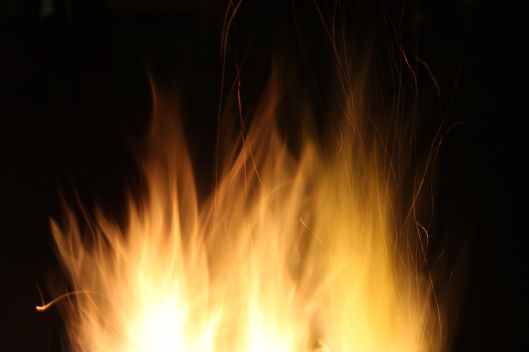
night fire flame fire pit

Photo by Bob Clark on Pexels.com

The next morning just as the sun rose, the Orange Man walked toward the village, rehearsing his lies in his head to make them more convincing. When he came in sight of the village, he trot-wobbled up the path waving his arms and yelling at the top of his lungs, “FIRE! FIRE! Run for your LIVES!” Sure enough, the villagers were worried. But they all recognized the Orange Man and although they did not yet realize that he was simply lying to steal all their stuff for himself, they did realize that his judgement was not sound. So, instead of immediately racing out of the village, they instead scanned the horizon for signs of smoke. There were none. Indeed, the ground was still damp from last night’s rain. While lightning sometimes did cause prairie fires, this seemed unlikely in the present circumstances, and no-one believed him. He shouted and screamed and waved his hands but no-one believed him. There was no smoke. At last, realizing that he would again leave empty-handed, he headed back to his mesa to gather some bugs and grubs. Well, he thought, as he trudged back. At least I have my fire now. 

The days grew hot and dry. The Orange Man grew still fatter on his diet of grubs and bugs. Then, at last, he reckoned that perhaps the people would have forgotten his lies and be willing to believe him again. This time, however, he would be smarter about his lies. He waited for a dry windy day and took a torch from his fire with him. He descended the path at the edge of the mesa and walked toward the village. He again planned to trot-wobble into the village while waving his arms and screaming about a fire, but this time, he would be smarter! He laid his lighted torch into some of the brush and grass near the edge of the village. This time the villagers would see smoke and maybe even see flames. This time, they would all panic as he hoped. After setting several small fires, the Orange Man trot-wobbled down the path to the village. As he approached, he began shouting, yelling, and waving his hands wildly. “Run!” he yelled. “There’s fire coming! FIRE! RUN!” Oh, yes! At last, this time, his lies were working! He could see that indeed, this time, people were grabbing things at hand and running away. It’s the smoke, he thought! I’m so smart! And, they are so stupid! Everything in the village will be mine. He smiled a broad smile at the stupidity of people who would fall for such a lie. The Orange Man turned back to glance at his little smoke trick to see what it looked like. What he saw, however, pounded his heart right through his chest and out the other side. Rather than clouds of smoke, what he saw was a wall of fire behind him. Now, the Orange Man trot-wobbled in earnest. He immediately fell over his own feet. He crawled back to his feet, but the cuffs of his pants were already on fire. He frantically waved and twisted but the fire burned his pants and soon the flames engulfed him. His last thought was, “It’s not fair! I’m so much smarter than everyone else. I deserve it all.” 

IMG_3123

Indeed, it wasn’t fair. Everyone from the village also perished in the flames. No food was left to plunder had there been anyone nearby to plunder it. Many miles away, it happened that Micah looked up from chipping an arrowhead to see plumes of black smoke on the horizon. For some reason, the thick, ugly, black smoke reminded him of the Orange Man. He wondered what had become of him. Once again, Micah wondered what that word had meant. An odd word: Liar. Liar. 

It seemed to Micah that everything the Orange Man said had been for the sole purpose of getting the villagers to leave so that the Orange Man could steal everything. But why would someone do that? After all, the Orange Man had not been starving. Far from it! He was the fattest person Micah had ever seen. Perhaps he had wanted just some of the things in the village; things he had no way to craft himself. But if that were the case, why not just trade for one? The Orange Man could have traded something he was good at for something he wanted whether it was blankets, spears, or baskets. Theft was extremely rare among Micah’s tribe. Perhaps the Orange Man had come from a tribe where everyone stole from each other rather than making and trading things. Micah shuddered to think how terrible it must be to belong to such a tribe as that. The rest of the day, as he gathered acorns, Micah contemplated what “Liar” meant and he concluded that a liar was a kind of thief. If you said something that you knew was not true, it must be to steal something. 
IMG_4098

It occurred to Micah that while the Orange Man might have wanted to steal blankets or baskets or food, he would have stolen much more than that. He would have stolen the soul of the tribe. As they worked together, loved together, hunted together, ate together, sang together, the words of the tribe were a bond that held them together, each to each. This was so because everyone was doing it together and each word spoke, carefully measured, acted like an arrow aimed at a larger prey. Together these arrows could bring down a mammoth. But the Orange Man would use these words like arrows aimed at other Humans. A liar could destroy the entire tribe! Micah did not then know that the Orange Man had literally destroyed a tribe with fire in order to make one of his lies more credible, but Micah foresaw that if people in a tribe lied to each other, it would ultimately destroy the working togetherness of the tribe and therefore the tribe. 

If someone said that they would watch a toddler and then they didn’t, the toddler might wonder into the river and be drowned. If a hunter said they would be ready with a large boulder up above to smash the prey that someone below was luring into a narrow canyon but then never showed up or never dropped the boulder, the person luring below would be eaten or trampled. Just as the mortar held their bricks together to make a house, the truth held the tribe together as a whole; a whole who could survive long winters and floods and dry spells and fend off predators. A tribe of liars would destroy themselves. Micah shuddered at such a prospect. He tied the ends of the great blanket filled with acorns he had gathered, for a chill and a fog lay heavy in the air. He trudged back to the village and heard the distant voices of his tribe, the Veritas singing together sharing their food and their love and their songs of true talk. 

truthtable


Magic Gateway to the books I authored!

Happy New Year!

01 Monday Jan 2018

Posted by petersironwood in America, apocalypse

≈ Leave a comment

Tags

advertising, civility, cooperation, greed, innovation, life, media, religion, social media

PicturesfromiPhoneChinaParisPrinceton 174

It’s not really the champagne or the fireworks that make New Year’s special.

Many people around the world, in their own time zones, celebrate New Year’s. Precisely when depends on where you live and to a large extent, the major religion in your area. Some people tend to celebrate in the Spring; others in the Autumn; many around the winter solstice; and a few traditional cultures celebrate the new year in the summer. Some of the traditional calendars are based on 12 lunar cycles which does not make a full year so their “New Year’s Day” shifts over time relative to the Gregorian calendar.

It’s easy to get lost in the details of the differences among traditions, cultures, and religions. But what I find remarkable about New Year’s is not the fact that there are differences across the world. What I find both remarkable and heartening is that many different cultures in many different countries have some kind of “New Year” celebration; that people across the globe recognize that time has a cyclical as well as a linear aspect; that people everywhere recognize the importance of new beginning and that special events are “marked” in some way and that these celebrations are shared by scores, thousands or millions of people across the planet.

earthfromspace

What I find even more wonderful is that people across the globe are able to learn something about other people and cultures. Right now, at the beginning of 2018, there are some few extremely greedy people who want to play on your hate and fear of anyone and anything that is different. They want to enhance your ignorance and play on your negative emotions for one and only one reason — to cheat you out of your freedom and therefore your life. Make no mistake about it. There really are dangers in the world and for best results, you really do want protection from those dangers — protection for you and for your family. Some of those people who threaten you do speak different languages or do practice or profess different religions.  But some don’t. Some people who are threats may dress differently or eat different kinds of foods. But some don’t. Basically, all those people across the globe are very much like you. And, just like you, they too need to understand that some of their leaders are also trying to steal things away from them and in order to do that, they want to make their followers believe that you and your kind are the threats and dangers.

Chances are much greater than 50-50 that if you were suddenly set down in the middle of a completely different culture, you would eventually be accepted and even welcomed. Why? Because people are fundamentally similar. However, people “getting along” is not in everyone’s interest; it’s only in the interest of the vast majority of human beings on the planet. Those who have positions of power and no real leadership skills to help “grow the common pie” will instead try to arouse your feelings that other people are trying to steal your piece of pie. If you cede your freedom to such power brokers, they promise they will protect you from these “others” who are trying to steal your pie. Instead, it is these very people in power who are out to steal your pie and add it to their considerable stack of pies — more than they could ever possibly eat.

IMG_9803

Here’s a secret though. The people who are inventing new pies; the people who are sowing wheat to make new flour for pies; the people growing the berries; the people actually baking pies — we are all very similar regardless of dress, language, religion, or customs. People in power are absolutely terrified that the rest of us will all discover the extent of the emperor’s nakedness and call it out for all to see. Those in power would hate to see a true meritocracy because they have very little skill when it comes to any aspect of actually making pies. By and large, their only skill is to make you fear that others are out to steal your pie. If everyone else becomes friends and colleagues across the globe, there is no more reason for the power-hungry to rule you.

Meanwhile, people across the planet collectively have a huge amount of power. In some places, there are still free elections and those can be one way to change the world and exercise your own power. But it is not the only way. Whatever wealth you have, you will have some choice about where to spend it. What if everyone rewarded companies that are ethical and punished companies that do unethical things by refusing to spend money on their product and services? What if people refuse to give up the hours of their lives for working for companies that act unethically? Would you be willing to take a 5% pay cut to pay for a company that believes “ethics” is not just a training exercise for underlings but also applies to the top executives of the company as well? How about 25%? Would you be willing to blow a whistle on corporate crime? Would you be willing to buy local product and support local services unless and until large multi-nationals behaved like good citizens? Are you willing to refuse further increases in productivity until there is a plan in place to share the gains in productivity between workers and those who own the companies? A world-wide or national strike would cause people to take notice and eventually change business practices.

IMG_7660

Last year, I wrote a long series of blogs about some of the root causes of divisiveness in America — though much of it applies equally to other countries in the world. There can be changes to social media, for instance, that could make it more of a force for unity and good and less a force for maximizing advertising dollars. Yet, none of the three social media companies I use most: LinkedIn, Facebook, or Twitter have asked me (or, so far as I know, any other user or citizens in general) what I would like to see different about their policies, procedures, and principles. We don’t have to wait for them to ask though. We are their users and their customers. Right now, they mainly care about their advertisers because advertisers are very vocal about policies if it affects their pocketbooks. But you and I can be just as vocal about policies that impact our society as are the advertisers. Ultimately, the advertising dollars depend on you and I using these social media.

For instance, check out the “Terms of Service” for these social media. It’s not always clear what constitutes a violation, but it does seem very clear that these social media are free to use the content you created for their own profit and that includes any clever things you say, photos, videos and music tracks. On the other hand, if you post something that you don’t have legal rights to, you and you alone are responsible. The terms of service are not “negotiated” with you; they are a “take it or leave it” affair and they are aimed at protecting the company, not at protected our democracy or humanity in general.

https://twitter.com/en/tos

https://www.facebook.com/legal/terms?_rdr=

https://www.linkedin.com/legal/user-agreement

But we can change that. We can collectively pressure social media to make changes that we feel are in the best interests of humanity. And this does not just apply to social media companies. It also applies to Walmart and Apple and Amazon and every other large multinational. We don’t have to be purely passive recipients of what others deem is the most profitable way for them to do business. We can change the commercial world so that products and services work better, are safer, and that the profits of productivity do not just accrue to owners but to workers as well. Yes, we can.

And that would indeed be a Happy New Year.

IMG_3071 - Version 2


Author Page on Amazon

All…what?

25 Monday Dec 2017

Posted by petersironwood in America, apocalypse, psychology, Uncategorized

≈ 1 Comment

Tags

collaboration, competition, cooperation, fascism, fear, greed, hate, learning, life, love, science

IMG_9070

Humanity finds itself in a new place. In evolutionary terms, we could say humanity suddenly finds itself in this new place. Life on earth, by best estimates is 4.75 billion years old. It’s easy to imagine, as a person, that the whole point of evolution is us. I don’t really see any reason to believe that. To the dolphin, deer, dog, dodo, and dinosaur, every one of their lives are every bit as precious to them as ours are to us. I do not even think humans are the “smartest” species on earth, at least, not in any absolute sense. We are the smartest in the directions of thought and behavior that humans find useful. So far as we know, we are the only species who has the information to know that our collective behavior can destroy us along with a lot of the other limbs on the giant, diverse tree of life and yet, here we still are, with atomic weapons, not pointed out defensively against invasions from outer space but pointed at other people on the planet. How could we possibly think we are the smartest species? Even if we avoid that kind of catastrophe, we still face dangers from over-polluting the planet, over-heating it, over-populating it, over-fishing and being over-hating. Indeed, this is nearly the darkest day in the darkest year. Is there reason to celebrate?

I think there is. In the blink of an eye, in evolutionary terms, we’ve managed to migrate across the entire planet. People live in tropical jungles, hot desserts, and in the frozen tundra. We’ve developed tools of thought and tools of trade and ways of dividing labor and communicating. And, now, although many people still do not have access, we have a communication network that spans the globe and we can communicate to some degree with people of different religions, cultures, languages, and experiences. We have vast networks of trade. We’ve come a long way.

OLYMPUS DIGITAL CAMERA

OLYMPUS DIGITAL CAMERA

Yes, there are a few greedy people who, like Voldemort, cannot or will not experience love or its benefits. Instead, they have convinced themselves that everyone is out to get as much as they can for themselves (or, if some people aren’t on that program, they’re just stupid, in the view of the greedy). In reality, only a few people are completely hooked on greed and power. They do not see other human beings as partners, or colleagues, or fellow explorers in this vast world before us — a world that still has billions of unfound discoveries. Indeed, we have even built machines to help us make new discoveries. And, if we don’t change trajectories, we may make far fewer discoveries than we might. Of course, it isn’t just the people completely hooked on greed that are accomplices in humanity’s direction toward greed. The alternative is to think quite consciously about our decisions in terms of who we invest in, what product we buy, how we talk with our neighbor, how we ourselves do business. We ourselves can make choices that move us toward greater cooperation rather than necessarily choosing only on the basis of immediate cost/benefit analyses. Then, and only then, can we turn the world to kindness and discovery.

Despite our many advances, we have yet, for instance, to have conquered cancer; we have yet to conquer war; we have yet to conquer hate and fear. You see how easily, in fact, the metaphors of war pervade our thinking. It is possible that we don’t need to “conquer” cancer, war, hate or fear. Maybe, we just need to let them go. Maybe if we understand these things sufficiently, they will dissipate. Maybe these four things all required quite different approaches from anything that has yet been tried, and possibly all require a different approach from each other. But my reflexive approach is to state this in terms of “conquering” – that is, winning over an enemy rather than winning over an enemy.

OLYMPUS DIGITAL CAMERA

OLYMPUS DIGITAL CAMERA

Perhaps, instead, the right approach to conquering cancer is not to “destroy” cancer cells but to re-integrate them into the society of the body. Perhaps they have been disillusioned that being part of the whole (body) is working for them. Maybe there is a way to “convince” them not to be cancer cells but to revert to what they were before cancer began.

Or, maybe we put something on an edge of the human body that has more of what the cancer cells “want” then anyplace within the body and let them “migrate” to the edge (and out of the human body — the “Pied Piper Approach”).

Or, perhaps, apart from pollution, a huge reason for cancer is that people are so busy so much of the time that they are not “noticing” teeny cancers within them. Perhaps people can be trained from birth to notice cancer cells and to send an overwhelming immune response before its too late. It sounds a bit absurd, but is it really? People can learn to “turn on” a single neuron in their brains with proper feedback. Is it really so far beyond the pale to imagine we could train ourselves to mount a targeted immune response?

IMG_9333

Perhaps all of these approaches might work and perhaps none of these approaches would work. The point is, that we need not reflexively think that “armed conflict” and “destruction” are the only methods that work to change the world. Many biologists think that the “nucleus” of our cells as well as our “mitochondria” were originally different organisms that started living symbiotically inside our cells. Is it too much to imagine that we could some day control the process of cells mutating and do it for our benefit? It seems absurd and ridiculous from the perspective of our knowledge today. And, yet — what would have our common ancestors on the African Savannah have thought 1,000,000 years ago if we could have explained to them that someday we would have machines that fly us around the globe — and to the moon? Or, how would they have reacted to the idea that we would have a network allowing us to communicate around the globe; that we would build machines that enable us to look into the workings of cells or the far reaches of the galaxy; that we would build fantastically beautiful musical instruments and that we could share music and ideas and stories across this earth; or that many people in our world die from having too much to eat!? 

It is quite possible that a century from now, people will very seldom die from cancer — or any other disease. In a similar fashion, we may well be able to set aside, recommission, redesign, or simply let go of war, hate, and irrational fear.

But none of that will happen unless we collectively decide what we want to be when we grow up. Because, as a species, despite wonderful achievements, we are still adolescents, at best. There are many tyrants in the world. Tyrants, as I’ve explained in prior postings, hate love and hate the truth. They really need war for cover in order to stay in power. Love complicates things. It’s just too unpredictable for people who want to be in control of everything. People’s reactions to absolute power wielded without ethics are much more predictable. Under enough painful torture, anyone will say anything 99% of the time. Of course, nothing positive and growth oriented ever comes from hate and fear alone. Only love moves life forward. Only love creates a more beautiful earth for our descendants. Only love discovers new beginnings, offers new ideas and new approaches. Beyond love’s instrumental value, more importantly, a world run by love is a world that feels good most of the time while it is happening, moment to moment. Of course, even in a world run largely by love, you will stub your toe or lose a friend, but most of every day’s activities you spend doing something because you feel as though you are making a contribution to something beyond yourself.

OLYMPUS DIGITAL CAMERA

OLYMPUS DIGITAL CAMERA

On the other hand, in a world run largely by hate and fear, the momentary experience of almost everyone almost all of the time is miserable. You are basically snarling or sniveling with every communication. Naturally, even so, there will be moments of joy, but it will never be unmarred because joy will either fall prey to guilt, or even worse, spend so much resources defending against guilt that life will become gray and pointless. Every day, most of the time you are doing what you’re going because you feel as though you’ll be badly punished if you don’t.

Does it make any sense then, to have a society run by the very greediest people among us? What if the only reason they are so greedy is because they don’t experience the full spectrum of human emotion that the rest of us do? What if a huge part of their greed is actually specifically and quite consciously designing and demanding a society run by hate and fear?

Why? Because they themselves don’t feel love and they don’t want others to be able to in an unrestricted way either. They are jealous and the only way they see to avoid being faced with their own shortcomings is to reshape the world so that no-one can express love openly and fully. I am not talking only about restrictions on sexual partners. I am talking as well about artistic expression, a free press, scientific exploration, and education. Everything is subject to restriction in a dictatorial society. Love is the source of exploration. It cannot be fully functioning under a dictatorship.

And what about Christmas? What about the solstice? What about the light and the dark? I do believe we now live in much, much darker times than most people realize. We are, in one of three states: 1) we are like one of the beginning scenes of the Star Trek prequel where Kirk speeds a stolen car towards that he does not realize is a deadly chasm. At the last moment, he tries to skid sideways to a stop, leaps from the car, begins to totter over the side and holds on by his fingernails — then clambers back up. 2) we in the same scene but this time, our foot hits the door an inch to the left and we don’t quite make it. 3) we are like the road-runner cartoon character who has just run straight off a deadly cliff but his legs are still windmilling and for a short time — he appears to be running, and does not fall until he looks down and realizes he is no longer on solid ground.

OLYMPUS DIGITAL CAMERA

OLYMPUS DIGITAL CAMERA

Well, it’s Christmas Day for me. And, the winter solstice has passed. The darkness really is receding and the daylight is encroaching on that darkness, minute by minute. We humans have had some dire times before and gotten through them. That doesn’t prove we’ll survive this Age of Greed, but I think it possible, perhaps even likely. But we must put the brakes on now. We must jump very carefully. And we must hold on for dear life.

We must hold on to each other. We must hold on to ethics as something that matters. We must hold on to the thought that, ultimately, we are all in this together. We must hold on to the thought that we are much more alike than we are different regardless of what customs, clothes, and food we prefer. We must hold on to the realization that a few greedy people cannot really rule the world, unless we participate with our own greed, fear, and hate.

We can pull this off. Instead of being the despoilers of the planet, we will make it ever more beautiful. Eventually, we will be “in tune” again, with nature and each other. How precisely to make this happen isn’t clear and no two people would probably approach it precisely the same way. Nonetheless, if we work together as best we can, keep discussing our differences in a civil way, and make as many decisions as we possibly can with at least a thought to the greater good, we will make it.

IMG_3071 - Version 2

Merry Christmas.


Author Page on Amazon


Peace & Love 3: Shrugging off the SHRUGS

16 Saturday Dec 2017

Posted by petersironwood in America, apocalypse, psychology, Uncategorized

≈ 9 Comments

Tags

competition, greed, life, peace, politics, war

IMG_5572

It might seem as though the answer is easy and obvious. But I don’t think it is. It might be nice if the SHRUGS disappeared from the earth one day. Getting rid of them through violence however, is not a particularly good idea. Violence against individuals is no more effective than war. It may well be true that SHRUGS “deserve” to die. On the other hand, they exhibit a tendency that the vast majority of us have — to look out for ourselves first. Equally rare are those altruistic heroes who fall on a grenade to save their buddies. Most of us have both tendencies in us, but SHRUGS have completely killed within themselves any tendency to empathize or care about others. There may be inborn differences as to the balance of altruism and selfishness that we are born with. In addition, the way people are brought up probably also has a lot to do with how this balance plays out. People who experience unconditional love are more likely to grow up so that their natural connectedness to others prevails over greed, at least most of the time. Indeed, empirical studies show that people who are completely altruistic or completely greedy are rare. Most of us are somewhere in between and our behavior is much influenced by the situation that we find ourselves in, both in the short term and in the long term. That is why it is important, not only to raise children with unconditional love and teach them right from wrong, but also to have a society that encourages and rewards cooperative behavior over complete selfishness.

SHRUGS are, to a large extent, the product of being raised by other SHRUGS who will demean a child and try to dominate them in order to induce shame. The child grows up physically but not emotionally. They will in turn, tend to raise more SHRUGS and treat others, not as individual human beings with their own rights but as tools to be used with no more thought than you would care how a hammer “feels” when it hits a nail or how the nail “feels” when it is hit by a hammer. It is indeed, a very sad thing when a person (or even a dog or cat) is so mistreated that is lashes out whenever it can. SHRUGS need therapy; perhaps even love. But don’t expect to “fix” them. They also need to be contained. Your two year old might have a temper tantrum in the grocery store when they are denied a piece of candy they see. It is not a good idea to give in to them thereby reinforcing the display of immaturity. But it doesn’t mean you need to shame them, humiliate them, beat them, or stop loving them. But you are the adult. You need to make sure they understand that screaming, crying, and smacking anyone around is not going to result in their getting their way. The very worst thing to do is to tell them they can’t have the candy; let them continue their temper tantrum; and then finally give in. This teaches them that they can always get their way if they are persistent enough.

IMG_8483

As the SHRUG gets older, they may find that they enjoy bullying other children regardless of whether they actually succeed in reaching any goal other than making the other person feel bad. This is much like a kind of “reverse empathy.” The more they make someone else feel bad, the better they feel. Sometimes people like this become skilled in athletics but never learn true sportsmanship. They never respect, but only disrespect their opponents. They never seem to understand that without a worthy opponent, there is literally no sport and no-one would pay to see them. On other occasions, the SHRUG may become a law enforcement officer. And, by the way, most police officers are not at all like this and actually want to help the public. A few, however, will enjoy beating the “truth” out of a suspect or forcing them to assume humiliating positions or actions, such as crawling. If the suspect fails to comply, they may be shot dead on the spot. Other SHRUGS will simply become accountants, sales people, or doctors. But they are not really all that interested in accounting, sales or doctoring. What they really want to do is move up the hierarchy so they can “lord it over others.” You seldom see a SHRUG working as a single stand-alone contractor, accountant, sales person, or doctor. If they do, they will have limited success because they will simply alienate their potential customers. Most people do not really like interacting with a SHRUG. A few people, however, like being dominated by another because it is clear what they are supposed to do; namely, whatever the SHRUG says. Giving in to a SHRUG simply makes them all the more SHRUGish and set in their ways. Nonetheless, in a society where a sense of fair play is very common and where love prevails, a SHRUG will not get to far unless they manage to become perceived as a SHILL by others. (The SHRUGS themselves always see themselves as SHILLS, but for the most part, others do not see them that way. Most people “see right through” most SHRUGS.

SeaMonkeys


For people who judge others, not on the basis of actual behavior, but on the basis of superficial markers, however, SHRUGS may tend to be perceived as SHILLS. If a SHRUG is particularly popular, or beautiful, or athletic, or rich, or powerful, or wears extremely expensive clothes people who would like to have those things for themselves will tend to view the SHRUG as a SHILL. In times of war, we are often bend over backwards to perceive SHRUGS as SHILLS. But even in times of peace, it is possible, as explained below. Since truth is the first casualty of war, however, it is particularly in times of war that we may sometimes consider SHRUGS as SHILLS. Such folk often end up, for instance, arguing that torture is justified in order to find out vital truths to save the lives of “good people” at the expense of the pain of the “bad people.” Torture is actually quite effective, but not at getting at the truth. It is quite effective at getting people to say what you want them to say. This makes it especially valuable for SHRUGS trying to convince people that they are actually SHILLS. They will ensure that whoever is tortured will add evidence to the narrative that makes SHRUGS appear as SHILLS or even Heroes. In a similar vein, SHRUGS do not particularly care for the rule of law. In the same way that they believe that sweeping away all the chess pieces and declaring themselves the winner is just fine, they also believe sweeping away all sense of fair play and justice is just fine too.

Perpetrating violence and breaking the law in order to destroy SHRUGS is therefore, in effect, playing the same “game” as the SHRUGS. So, here is the crux of a dilemma. If you allow the SHRUG to have their way, they will simply take more and more over time and come more and more tyrannical over time. However, if you destroy the SHRUG by violence, you simply replace one SHRUG with another. Thus, the violent overthrow of the Czars in Russia led fairly quickly to Lenin and then to Stalin. The violent overthrow of the corrupt Chinese government that perpetuated vast inequality in China led to Mao. The French Revolution led, at least initially, to a bloodbath that went far beyond actual SHRUGS to anyone even associated with the so-called Noble class. Eventually, all of these regimes became more democratic though in varying degrees.

IMG_7660

In the case of so-called Western Democracies, people must work to depose whatever SHRUGS are in power, not through violence, but through whatever legitimate channels still exist in that particular democracy. This is hard work and needs to be smart work as well. It involves communication, and it involves understanding. One must understand both the SHRUGS and their supporters. The grievances that underly their supporters must be addressed. That does not mean that if workers are convinced that the only way to insure that they get a good job is through misogyny or racism that everyone else gives in to misogyny or racism. But everyone needs to look beyond the misogyny and racism and understand the disappointment, failure and frustration that lead to these dehumanizing beliefs.

In short, if you try to take the quick path and unseat a SHRUG by violence and hatred, you’ll only succeed in spawning the conditions for even more SHRUGS to arise. It’s much like trying to fix a broken arm by amputation rather than setting the broken bone and allowing it to heal. Once again, the path to lasting peace and love is through the clever and judicious use of peace and love and not by war and hate, even if undertaken to ensure that the society be run in a just and cooperative way. A key component is to communicate fully and effectively.

SHRUGS can be voted out of political positions. This is an important power to exercise, but it is not your only one. You can choose how to spend your money. You can choose to whom you give your labor. You can choose which products you buy. You can choose what you say to your friends and family. You can model kind behavior. Once you think about it, just as there are millions of cells working together to shrug your shoulders, so too, millions of people working together can SHRUG off the SHRUGS.

IMG_3066

—————————————

Author Page on Amazon

Peace and Love, Part 2: SHRUGS & SHILLS

14 Thursday Dec 2017

Posted by petersironwood in America, apocalypse, psychology, Uncategorized

≈ 2 Comments

Tags

Business, competition, family, greed, life, peace, politics, religion, war

(This is the second in a series of blog posts about Peace, Love, and the pros and cons of war and peace).

fullsizeoutput_11fd

Two trillion dollar wars with little to show but dead bodies. But at least America learned its lesson. We will never again elect someone with a financial and political interest in having the nation go into a needless war. Whew! Finally. But wait a moment. We already are in a war. A cold war. And by a “cold” war, I mean a war that is not being waged against an enemy on our borders ready to cross over with warm bodies. I mean, we are in a war in which the enemy without is in cahoots with an enemy within. And, it is a cold, long, and calculating war. America, or what’s left of it, is fighting a war on two fronts. (Silly, silly Napoleon; silly, silly Hitler). On the one hand, we are being attacked from the outside by Russian leaders who would like to divide and weaken Western democracies of every stripe. Main targets are the UK, American, and Germany, but others will have their turns as well. Their goal is to consolidate their power within and to strive once more toward world domination.  I’ve already addressed the divisiveness that arises from the way social media work combined with outside influences pushing on leverage points. This might be a moderately effective method of waging war with pretty much zero Russian casualties and only moderate expense. However the war is made much more effective by having a second and internal front. We have far right “parties” within Western democracies that are aiding and abetting these enemies by dividing the countries with hate speech, fanning the flames of fear, executive orders, laws and, at least in America, the infestation of the federal government with incompetent administrators who will do everything in their power to ruin all that is good with the federal government including public education, research, fair-minded judges, public lands, and so on.

In the short term, most of these internal allies of the external enemies are not really doing it to “Make America Grovel Again” but are doing it to satisfy a few extremely wealthy donors. The extremely wealthy donors want your wealth and my wealth. This is not a recent phenomenon. Extremely greedy people are never satisfied. If you are like most people and you see that there are ten people at the table and ten donuts, you would take one for yourself and leave nine for the other nine. But extremely greedy people would be inclined to take all ten. Then, there are the ultra-greedy and they would not take all ten. They would convince you that they have 100 donuts for each of you. Unfortunately, they need to eat all ten of the first batch of donuts themselves for right now. Then, they need you to go out and make 1000 donuts. They will give you all the equipment you need to make 1000 donuts. When you spend a week of your time making 1000 donuts and then bring back the 1000 donuts to split, they will actually take 910 for themselves and give you 90 donuts to split among the other nine people. It seems a little unfair, but you are still better off, right? Before, you would have only gotten ONE donut. Now, you get 10 donuts. A definite improvement! And that is what capitalism is all about. Until lately. (The article below tends to blame the growing inequality of wealth on new technology, but I believe that is secondary to the new (im)morality.

https://www.huffingtonpost.com/nathan-newman/great-decoupling-of-wages_b_7451212.html

Now, we have a small number of hyper-ultra greedy people. They will make the same deal and take all ten of the original donuts for themselves. After getting you to use their equipment to make 1000 donuts, they will give you only half a donut each. They will tell you that if you want a whole donut, you’ll have to figure out a way to make 2000 donuts first. So, you and your nine co-workers put your heads together and figure out a way to make 2000 donuts instead of 1000. Now, when you come back with the 2000 donuts, you will get 1/9 donut each. The hyper-ultra greedy will take 1999 of the donuts and let you and your coworkers split the one remaining donut. If you happen to be a female donut-maker, he might promise to give you a donut but only if you have sex with him first. You must understand one thing. They don’t feel bad about doing this. They just think it is their right by virtue of their being “smarter” than you are. They think they deserve all the donuts, and they are actually being quite wonderful to let you have a whole donut in return for sex.

IMG_9845

In America, until around 1970, productivity gains were split between — on the one hand, the workers who largely invented new technologies, techniques and methods; learned the new techniques and skills — and on the other hand, the people who owned the means of production. Since 1970, the greedy have been, through mergers and acquisitions, mostly replaced by the hyper-ultra greedy. Unions, environmental safeguards, safety regulations, inspections, and the right to vote are now all under attack. The hyper-ultra-greedy are now being replaced by the super-hyper-really-ultra greedy who not only will take every last frigging donut you produce, but they have no qualms whatever about making you do it in a way that makes you burn every last one of your fingers off. They have absolutely no qualms about making sure that you have no time or energy left to learn a new trade. They have absolutely no qualms about making sure that your children will also be making donuts for nothing and getting your “chicks” for free, even if those particular “chicks” are only 13 or 14 years old.

IMG_1245

Most of us do not actually meet these people face to face and our experience is with other people like us so we find it hard to believe that someone would be that greedy. Of course, making donuts is not their only business. They also hire people to put on their make up, write speeches for them, handle publicity, write up fake stories about them, broadcast for them and otherwise make you think that they are just ordinary folks like you but more successful because they are smarter. They aren’t smarter. They just refuse to play the game by the rules. They don’t really view what they are doing as “lying” because for them, truth doesn’t matter. While most of us are involved in a giant cooperative enterprise of trying to find more truth about the universe and tell each other so we can all collectively make better decisions about how to make more and better donuts for everyone, they are only concerned with themselves. They do not think of you as “another human being” but as a tool to be used in whatever way is most efficient to meet their ends. While they don’t care about the truth, they do care about “communicating” which for them means manipulating you into doing what they want. (By the way, please realize that not all extremely wealthy people are SHRUGS and not all SHRUGS are necessarily wealthy. It isn’t the amount of owned wealth that defines SHRUGS; rather what defines SHRUGS is their attitude toward ethics and particularly their base belief that stealing everything from others while claiming to be working for the good of all or doing “God’s work” is perfectly natural.)

IMG_9803

These are deeply flawed human beings. Why? Because without you, they are, for the most part, completely unable to make or find even a single donut on their own. They are ultimately so greedy that they are killing “the goose that lays the golden egg.” Currently, they are doing everything in their power to divide (at least) America according to race, religion, national origin, sexual orientation, etc. Their goal is to redirect the anger you quite naturally feel at working harder and getting nowhere toward women, minorities, foreigners, etc. and away from the SHRUGS themselves. These super-hyper-ultra greedy people are unable to function without your active cooperation. So, it’s really important for you not to realize just how much you are being taken for a ride. Some of them may realize that their actions are also greatly helpful to the destruction of America as a world leader. But mostly they don’t really care much about that because they are convinced they will have even more power under, say, Russian rule.

IMG_5159

This is actually quite a humorous miscalculation. As soon as America’s role in the world is sufficiently diminished, the super-hyper-really-ultra greedy (SHRUGs for short) will be the first to go. They will be the victims of the first Putsch. Why would the super-hyper-ultra greedy among the Russians not replace the American super-hyper-ultra greedy with their own? Of course they will. If American SHRUGS took as long as two minutes to actually think about it, the American SHRUGs would realize this is exactly what they would do if they took over Russia (or any other country). In point of fact, when banana Republic dictators do not go along with American orders, they are eliminated in the same way. So, all the facts and history are there, but you need to understand that the power and position and privilege that American SHRUGS enjoy ultimately gives them an extremely warped view of their own abilities. They come to believe that they are not SHRUGS but a different species altogether: SHILLS (Super-Hyper Intelligent Lovely Leaders). SHRUGS, in fact, need not be particularly intelligent at all, but they do gain that illusion. It’s easy to see why. You play a game of chess with a SHRUG. You play by the rules. You are about to win when the SHRUG knocks all the pieces on the floor and yells, “I win!” When they do this enough times, they come to think that they actually are a very very shrewd chess player. It sounds crazy and it actually is in the sense that their perception of reality is completely divorced from it.

The second to go will be those unwilling or unable to be slaves to the new set of masters. If you care to live a long life, you might want to start learning Russian now. In the meantime, we might yet be able to prevent the SHRUGS from taking over America. But if the control of the SHRUGS persists even for another year, they will disenfranchise enough Americans so that there will never be another fair election. They will make many more things illegal and exact horrific penalties for minor crimes. They will put in place judges who will exact punishments depending on people’s political views. They will prevent more than a few more people from coming to America – particularly those who might not already be brainwashed into thinking the SHRUGS are really SHILLS.

What do we do about that? We begin to explore this topic in the next blog post.

(By the way, I do not believe that Russian people or the Russian nation is particularly prone to SHRUGS any more than America is. Trying to blame all Russians for the actions of the Russian SHRUGS is as unfair as blaming all the sins of American SHRUGS on America as a whole. Most of us would not approve many of the “dirty tricks” we end up playing on other nations in order to placate our own SHRUGS.)


Author Page on Amazon

Math Class: Who are You?

09 Thursday Mar 2017

Posted by petersironwood in America, Uncategorized

≈ 63 Comments

Tags

genetics, greed, life, math, religion

David's DreamDeeply

What better way to drive traffic to your blog than title the entry “Math Class.” As most of you probably recall, math was your favorite class?! All kidding aside, I actually found math fun but that’s probably because I learned a lot of it outside of regular classes which can admittedly be pretty boring. Rest assured, the “math” in this entry does not require integral calculus, differential equations, trigonometry, or even algebra. In fact, if you prefer, you can call the post “Christianity” or “Buddhism” because you would reach the same conclusions but from a very different pathway.

Part of the inspiration for this post came from visiting the Smithsonian Institute about 20 years ago. They displayed a large graph with the population of the earth plotted against the year. I looked at my birth year and could easily see that more than half the total earth’s population came after my birth year. And, that was 20 years ago.

Another inspiration comes from having led the artificial intelligence lab at NYNEX. I worked for an ex-Bell Labs engineer, Ed Thomas. People were always asking me whether we were “related.” I found this question extremely amusing. Why? Because we are all related! In fact, we share about 40% of our genes with crayfish and 90% with horses. We’re closely related to chimps and bonobos though we did not “descend” directly from apes.  Yet, in our society, we chose to “draw the line” between being “related” and “not related” way over at one end of the scale. Ed Thomas and I only share about 99.9% of our genes so we are called “unrelated” while my brother and I share 99.95% and so we are (closely) related. Most people would say they are “unrelated” to a horse even though you share 90% of your genes. Weird.

A few days ago, I read that new fossils indicate life on earth is at least 4.75 billion years old. When I was a kid, starting around age 7, I became (like many others) fascinated by dinosaurs. At that point, the best guesses were that life was somewhere between 500 million years and 1 billion years. In the course of my lifetime, that estimate has increased a lot.

Who cares and why does all this matter? Apart from curiosity, it matters because it allows us to put in perspective our own individual lives in the context of life on planet earth.

Most people, most of the time, love their children and generally put the welfare of their kids even above their own. This is how life progresses. So far as we know, individuals never live forever, at least in this physical world. However, life as a whole continues to live and our direct descendants and relatives continue to live after our death. So, how much of your genetic material is actually in you versus all your cousins?

To simplify, let’s start with just other human beings. There are currently 7 billion people on the planet. You are one of them. You share 99.9% of your genes with those folks.

How much do we share genes?

So, let’s see. There’s you. And there are 7 billion relatives. Some are slightly more related than 99.9% identical genes, but let’s just say 99.9%. That means the total genome of your genes is in one person (you) who has 100% of your genes and 7 billion others who “only” have 99.9% of your genes. 99.9% of 7 billion is 6,993,000,000 while 100% of 1 is 1.000. In other words, the total amount of “your” genes that is in other people is 6,993,000,000 as much lies within the physical boundaries of your own skin. Not an equal amount. Not 10x as much. Not 100x as much. Not even a million times as much. No. Nearly seven billion times as much.

From the standpoint of genes, this vastly understates the case because there are 7-10 million species on earth besides humans. All of these share some of your genes and many of them share a lot of your genes. Of course, we humans are relatively big and while there are some plants and animals much bigger than we are, there is more mass of life in bacteria than blue whales or redwoods. In principle, one can calculate a better number by taking into account, for each of 7-10 million species how many cells are in each; how populous they are, and what percentage of genes are in common between humans (and therefore you) and each of these species. It’s straightforward but tedious. I gave up after 100,000 species. No, I didn’t. I never started because I knew I would give up way before I got to 100,000. In many cases, we don’t even have a very good estimate of the populations. Given all the trees, grasses, bacteria, insects, fish, plankton, etc. I would guesstimate that adding all the genes in all the other plants and animals would mean the genes in your body represent at most about one in a trillion of all the copies of those genes on earth. So, from the standpoint of ensuring the propagation of your genes, caring about your own physical life represents about 1/1000000000000 of the total.

life on earth

I grant you that genes are not all that matters in human life. And, I want to explore some of the other aspects of the interconnectedness of life apart from a common genetic heritage. However, first, it is really worth taking a moment to let that fraction sink in.

It isn’t as though the “you” inside your skin weighs, say, 150 pounds while the “you” that is outside your skin is, say, the size of a blue whale. No. In fact, even 1000 blue whales compared with your physical body is not so lop-sided a comparison. Imagine thirty galactic clusters of stars. Each of those thirty clusters has 100 stars. Each of those stars has 10 planets to support life. Each of those planets has 100 oceans and each of those oceans has 1000 blue whales. Versus you.

Another way to think about is that when you physically die, it is a little like “trimming” or “pruning” the “Tree of Life.” But your dying would not be like cutting off a branch. Or a twig. Or a leaf. It would be like shaving an invisible razor thin strip off one needle of one twig of one branch of a huge Redwood.

redwoods

It is understood that life is partly (and by no means wholly) about competition. Each and every one of those bits of “you” that is in other life-forms is not necessarily your best bud. You may share a lot of DNA with a great white shark but you might not wish him well. Or, you might not much like your cousins the mosquitoes and deer flies and pneumonia germs. The problem is that we are not collectively anywhere near to being smart enough to understand the effects of deleting certain species and not others. Perhaps, some day in a hundred years or so, we might understand enough to intelligently redesign an ecosystem. Don’t hold your breath though. Despite the fact that some of those individual species and some individuals within a species are annoying, we really have no idea how to extract some one thing. It is not a set of legos. Every species is connected with a variety of chemical and mechanical connections to hundreds of others. It is more like trying to extract your iPhone adapter from your backpack which also contains headphones, power cords, adapters for five other devices and, for good measure, a couple stray shoelaces.

You could also point out, quite rightly, that not all genes are as “fundamental” to making you you as are other genes. There are genes, perhaps, that make your eyes blue or brown. Does that seem fundamental to you? Or, perhaps there’s a gene that makes your thumb fingerprints whorls or loops. Does that seem fundamental to who you are and to your life? On the other hand, there are genes that make you want to live and find love and raise a family and contribute and play and learn. To me, those are the genes that are fundamental and guess what? Those are the very genes that you share with millions of other species. Naturally, we humans like to think of ourselves as fundamentally different from other species on the planet and in some ways we are. As discussed below, being able to communicate so many messages with other people across time and space and even after death indeed makes people “different” but when it comes the things you are likely to care the most about: staying alive, avoiding pain, keeping your family healthy, fighting off disease — those are pretty common across animals and even plants and bacteria, at least in rudimentary form. Just because an ant doesn’t do calculus doesn’t mean it doesn’t work to stay alive and help it’s colony do the same.  See video links below and you will hopefully see how similar other animals at least are to us.

https://www.youtube.com/results?search_query=animals+helping+each+other

And, speaking of math classes, let us turn to some of the other aspects of how our own individual life fits with the larger web of life. Let us think about learning. Pretty much all life is able learn.  Humans, however, are able to communicate through speech, writing, and pictures. This means that we can learn across continents and generation. Eventually, communications affect behavior. Everyone ends up getting exposed to unique information and delivered under different circumstances so that people also end up acting very differently and even perceiving things differently. So, when it comes to human beings, many of the differences we think important are in terms of the ideas and attitudes various people have as well as their actual behavioral differences. To put it simplistically, we largely feel akin to others on the basis of how we think and feel. Many of the labels that we put on people — in fact, the vast majority of them — focus on differences among people. For example, we have: extrovert, introvert, flirt, workaholic, physicist, physician, psychologist, psychic, pscyho, Republican, Democrat, liberal, heterosexual, homosexual, creative, drudge. But what percentage is different and what percentage is the same and how fundamental are the behaviors and ideas?

How much of the total knowledge and how fundamental is that knowledge? Perhaps people learned approximately linearly through time. We’ve had spoken language for, let us say, 100,000 years although it could be much longer.  At best, people learn about four “chunks” per second. A “chunk” is basically a new configuration of things you already know. We measure the information in a computer in terms of “bits” but this turns out not to be a very good measure for people (or other animals). If you have to learn “A CAD” it is pretty easy. It is essentially only one “chunk.” If you know how to read hexadecimal then “ACAD” is equal to 10-12-10-13. It is easier to remember “a cad” than to remember “10-12-10-13.” That in turn is easier than the binary string: “1010110010101101” though they have the same bits. In the same way, it is much easier to recall the password: “Thistooshallpass” than the password: “ooassllapsTsthih.” That is the basic concept behind “chunks” as a measure. How easily we learn new things depends heavily on what we already know. One major problem with trying to learn a new language is that we keep thinking of it (and even hearing it) in terms of the language we already know. In fact, studies with infants show that by a few weeks of age, they are already less able to distinguish sounds that make no difference in their native language than they were at birth.

Psychology is endlessly fascinating! But let’s return to our calculations. If you are awake, on average for 16 hours a day for your lifetime of 100 years, you would have an opportunity to learn 4 chunks/second x 60 seconds/minute x 60 minutes/hour x 16 hours/day x 365 days/year x 100 years for a total of 12,600,000,000 chunks! That is a lot! Of course, that is rather an ideal case. If you don’t read and instead every week, watch the same TV shows and hang out with the same people you may not get your full 12 billion chunks worth of learning, but it’s still going to be a lot. 

We humans have been communicating and learning through speech though for at least 100,000 years. That is more than 1000 times as long as you’ve been alive. For a long time, the population of the earth was far less than today, but sill likely over a million people for most of that time. Since each person grows up in a different environment, they learn different things. Leaving aside the fact that the population of the earth is now about 7 billion and just using the very conservative 1 million figure, you know about 1/1000000000 or a billionth of what humans collectively have learned.  (For a more in-depth estimate, check out the link below).

http://www.livescience.com/54094-how-big-is-the-internet.html

Of course, a more direct way to think about this is that collectively today, on average, you know about 1/7000000000 of the knowledge of humanity since you are only one person and there are seven billion on the planet. If you’ve been learning for about 70 years (as I have) then you may know a slightly higher fraction of the total knowledge. Let’s just take the conservative estimate that your knowledge is one billionth. But how much is a billion?

One way to think about it is this. You, as an individual, have one “book” of knowledge in your head. (It’s a rather large one, but all of the books in this example will also be large). Now, let’s consider that the whole world of knowledge exists on ten continents. Each continent has 25 countries for a total of 250 countries. Each of these countries has 40 cities. Each of these cities has 10 libraries. Each of these libraries has 10 rooms and each room has 1000 books each of which is every bit as complete and weighty as your own.

IMG_7320

Much of your knowledge is common, but a lot of it is unique. No-one has lived the life you have and so your “book” will contain a lot that is just about your own experience. And that’s true as well for each of the other 7 billion people on earth. So, while the biological stuff that makes you you, is hugely outside your own skin, the knowledge that humanity has collectively has a teeny fraction inside your own skull. Best to share what you know before you die at which point it will become inaccessible. Aside from that sage advice, you might reflect that indeed, none of us knows very much at all compared with what we know as a species.

The other major way that we interact with each other and with every living thing on the planet is through our chemical exchanges. People, such as you and me, for example, inhale air that contains oxygen. We cannot live without it. Where does the oxygen come from? Green plants. To many people, “tree hugger” is a slam, an insult, a term that is meant to be demeaning. Okay, I grant you, actually hugging a tree is probably something that doesn’t mean much to the tree. However, without green plants and the oxygen they produce, people (and other animals) would die off. Not only do plants produce oxygen but they also get rid of carbon dioxide. Of course, without green plants, there would be few foods from plants and we would have to “eat” mostly animals for the short time the supply lasted. A lack of green plants would really have four ways to end humanity: greatly increased carbon dioxide causing global warming, lack of sufficient food, lack of sufficient oxygen, too much carbon dioxide to survive. Probably, the lack of food would do us in first. You could actually hug much worse things than trees.

In any case, the oxygen – carbon dioxide and food cycles are two of the important ways that we are chemically interconnected with the entire web of life on the planet. Another important cycle is the nitrogen cycle. While plants are ultimately at the root of what we eat, the bodies of humans and other animals eventually provide important nitrogen for plants. Most plants are quite patient about waiting passively for us to die before partaking of our bodies. But there are some much pluckier plants such as the pitcher plant, sundew, and Venus flytrap which actually trap animals such as insects and small frogs in order to “feed” their nitrogen needs.

trapped bee

These cycles have been going on for a very long time. What’s new that humans bring to the party is not a nice cabernet or chardonnay, but rather a toxic cocktail of chemicals that never existed before. Some of these are intentionally produced and others are side-effects of other things. But rest assured, these “new” chemicals are overwhelmingly bad for everything in the biosphere. They are bad for you, for your kids, for your grandchildren, for frogs, redwoods, and honeybees. They are bad for almost everybody. For instance, you may find it convenient to buy “air fresheners.” These do not actually “freshen” the air. They have three important classes of chemicals: something that screws up your hormones; something that is a known carcinogen; something that destroys your sense of smell. “Air freshener” indeed.

http://www.toxipedia.org/display/toxipedia/Air+Fresheners

It strikes me as odd that adults in many parts of the world are “not allowed” to buy “street drugs” while any seven year old can walk in and buy “air freshener” which could cause numerous problems. Of course, the other problem is that even though you exercise your freedom to buy air freshener, eventually those chemicals end up in my lungs and the lungs of my descendants as well as monkeys, parrots and rabbits. The polluting chemicals eventually end up pretty well scattered throughout the world. China’s air pollution eventually gets to Americans and American air pollution gets to China. Speaking of math, here’s an interesting calculation to show how much we exchange air molecules with others.

Have you breathed air molecules from Jesus?

To make an overly long story overly short, we are all highly interconnected and most of what makes you, you is not inside the confines of your own body.  For me, this puts unfettered greed in the category of just being plain silly.


(The story above and many cousins like it are compiled now in a book available on Amazon: Tales from an American Childhood: Recollection and Revelation. I recount early experiences and then related them to contemporary issues and challenges in society).

Author Page on Amazon

Newer posts →

Subscribe

  • Entries (RSS)
  • Comments (RSS)

Archives

  • April 2026
  • March 2026
  • February 2026
  • January 2026
  • December 2025
  • November 2025
  • October 2025
  • September 2025
  • August 2025
  • July 2025
  • June 2025
  • May 2025
  • April 2025
  • March 2025
  • February 2025
  • January 2025
  • December 2024
  • November 2024
  • October 2024
  • September 2024
  • July 2024
  • April 2024
  • March 2024
  • February 2024
  • January 2024
  • December 2023
  • August 2023
  • July 2023
  • May 2023
  • April 2023
  • March 2023
  • February 2023
  • January 2023
  • December 2022
  • November 2022
  • October 2022
  • September 2022
  • August 2022
  • July 2022
  • June 2022
  • May 2022
  • April 2022
  • March 2022
  • February 2022
  • January 2022
  • December 2021
  • November 2021
  • October 2021
  • September 2021
  • August 2021
  • July 2021
  • June 2021
  • May 2021
  • April 2021
  • March 2021
  • February 2021
  • January 2021
  • December 2020
  • November 2020
  • October 2020
  • September 2020
  • August 2020
  • July 2020
  • June 2020
  • May 2020
  • April 2020
  • March 2020
  • February 2020
  • January 2020
  • December 2019
  • November 2019
  • October 2019
  • September 2019
  • August 2019
  • July 2019
  • June 2019
  • May 2019
  • April 2019
  • March 2019
  • February 2019
  • January 2019
  • December 2018
  • November 2018
  • October 2018
  • September 2018
  • August 2018
  • July 2018
  • June 2018
  • May 2018
  • April 2018
  • March 2018
  • February 2018
  • January 2018
  • December 2017
  • November 2017
  • October 2017
  • September 2017
  • August 2017
  • July 2017
  • June 2017
  • May 2017
  • April 2017
  • March 2017
  • February 2017
  • January 2017
  • December 2016
  • November 2016
  • October 2016
  • September 2016
  • August 2016
  • July 2016
  • June 2016
  • May 2016
  • April 2016
  • March 2016
  • February 2016
  • January 2016
  • December 2015
  • November 2015
  • October 2015
  • September 2015
  • August 2015
  • May 2015
  • January 2015
  • July 2014
  • January 2014
  • December 2013
  • November 2013

Categories

  • AI
  • America
  • apocalypse
  • cats
  • COVID-19
  • creativity
  • design rationale
  • dogs
  • driverless cars
  • essay
  • family
  • fantasy
  • fiction
  • HCI
  • health
  • management
  • nature
  • pets
  • poetry
  • politics
  • psychology
  • Sadie
  • satire
  • science
  • sports
  • story
  • The Singularity
  • Travel
  • Uncategorized
  • user experience
  • Veritas
  • Walkabout Diaries

Meta

  • Create account
  • Log in

Blog at WordPress.com.

  • Subscribe Subscribed
    • petersironwood
    • Join 662 other subscribers
    • Already have a WordPress.com account? Log in now.
    • petersironwood
    • Subscribe Subscribed
    • Sign up
    • Log in
    • Report this content
    • View site in Reader
    • Manage subscriptions
    • Collapse this bar
 

Loading Comments...