• About PeterSIronwood

petersironwood

~ Finding, formulating and solving life's frustrations.

petersironwood

Tag Archives: family

Only You…

08 Tuesday Aug 2017

Posted by petersironwood in America, apocalypse, psychology, story, Uncategorized

≈ 1 Comment

Tags

creativity, family, feelings, life, school, stories

Only You….

IMG_3256

Perhaps, like me, you recall “Smokey the Bear” from your childhood along with his famous slogan, “Only you can prevent forest fires.” In English, we seem to have stuck with the completely unmarked and ambiguous second person pronoun. “You” could refer to one single individual or to two people or to everyone on the planet! And, at least in English, the verb form doesn’t help you much either. Of course, verb forms don’t typically help much in English in any case, but you would think, since the pronoun is ambiguous, there would be some other clue in the syntax, but there isn’t. “I can, you can, he/she/it can; we can, you can, they can.” Brilliant. Although many verbs do mark for singular third person with an “s” for the verb which, come to think of it, also makes little sense. If anything, “s” on an English verb should mark for plural. Whatever. I am not bringing this up to criticize English syntax to start a revolution in order to make it more consistent and logical. I learned my lesson from George Bernard Shaw who left his fortune to at least make English spelling phonetic. He sponsored a contest resulting in a beautiful “Shavian alphabet” but his will was contested. He died in 1950 and now, 67 years later, English is just as difficult to spell as ever. Sigh.

https://en.wikipedia.org/wiki/Shavian_alphabet

So, no, I am not going to try to convince you to start saying, “you can” for singular you and “you cans” for the plural. In the South, some feel that “y’all” or “you-all” marks for plural but that is not a universally held belief. In any case, when I first heard, “Only you can prevent forest fires” I thought Smokey the Bear was talking about me personally. This was no doubt reinforced by the posters which clearly showed Smokey pointing his “fingers” at me. He wasn’t gesturing to a crowd. He was pointing at me. I had already seen the Disney movie Bambi which graphically portrays the flaming horror of a forest fire so I really did want to prevent them. But how? Smokey went on to offer some helpful rules such as not dropping my cigarettes carelessly on the ground and putting out my campfires completely. I was only about five so I didn’t have much of a nicotine habit. And, several more years would pass before I went to YMCA camp or Boy Scout camp. At five, I didn’t really have much chance to make sure my campfires were out because I didn’t have any campfires. My parents didn’t let me play with matches. Yet, forest fires persisted. Smokey must have been leaving out some crucial steps as to how I was supposed to prevent forest fires.

https://en.wikipedia.org/wiki/Smokey_Bear

I generally tried to work out such puzzles for myself, but eventually I gave up and asked my grandpa how I could prevent forest fires. He patiently explained that Smokey was talking about people in general, not just me in particular. I don’t think I totally “bought” this explanation, but it did assuage my guilt somewhat. “People in general” is an odd concept anyway. It was weird for a five year old, but it remains weird to this day. People are very diverse in their abilities, motives, goals, backgrounds — so how can you possibly make sure “people in general” do anything at all? It wasn’t till many years later that I learned that some people set fires intentionally while a larger number are criminally careless.

OLYMPUS DIGITAL CAMERA

Of course, it isn’t just forest fires that need to be prevented. Parents caution kids in a thousand ways and perhaps 900 of those are actually valid concerns. “Don’t run with scissors!” “Look both ways before crossing!” “Don’t stick anything in your nose!” “Don’t stick anything in your ears!” You may have heard the expression, “It takes all kinds.” It basically means that our world needs different kinds of people in it. I agree! But I must confess, I had no understanding of why my parents would say to me, “Don’t stick anything up your nose!” “Don’t stick anything in your ear!” What!? By this time in my life, I had experienced things stuck in my nose and ears (to name two places doctors like to jam things into you). Every doctor’s visit required that Dr. Miller jam some ice cold metal thing up my nose and when that was done, into my ears! I hated it! But apparently, some kids loved that so much that they wanted to recreate the experience. A few times, playing, hiking or just hanging out a bug flew into my eyes, nose, or ears. I hated that. True, they weren’t ice cold but they moved and buzzed making it even more terrifying. So, now my parents caution me not to stick something up my nose? Of course, once the idea is planted….No, I did not partake.  Once they cautioned me, of course, I did consider it for the first time. But I couldn’t get over the horror. I actually seriously considered two possibilities as to why they would give such advice. 1. They were insane. 2. They knew something I didn’t. Hidden just beyond my view loomed an alternate universe in which things behaved quite differently. And, apparently, a person — even a five year old person like me — could accidentally slip into this alternative universe. In this alternative “up is down” “left is right” universe, it actually would be totally cool to stuff a crayon up your nose and not be able to breathe out of one side of your nose like you had the worst most disgusting bugger ever invented stuck and you could not sneeze it out. And, then, you would have a horde of grown ups hovering around you in a panic like you were going to die, and very soon, unless extreme measures were taken. So, off you went to the “Emergency Room” and some sleep-deprived intern whose mind swam with images of the cute nurse in pediatrics, stuck some cold instrument up your nose and spread your nose tissue like it was going to explode. Whether she needed to do that or enjoyed the movie about the nurse in pediatrics so much, she wasn’t paying attention, I don’t know. But either way, horrible is horrible. So, yeah, I considered it. And I considered it stupid to stick a crayon up my nose.

However, a few years later, I learned that there really were kids who stuck crayons up their nose. What!? This meant that my parents weren’t insane after all. Instead, there really hovered some alternative universe in which it made perfect sense to stick a crayon up your nose. Yeah, sure. Good times. But it isn’t a universe I particularly want to slip into. At least not ahead of schedule. I figure, if I’m lucky enough to live long enough, I may end up with quite a few tubes stuck in me various places. I might not, but I might. In that case, I guess I will have to change my attitude. I wonder whether kids who did stick crayons up their noses have an easier time with this?  In any case, please remember: “Don’t stick crayons up your nose.”

Well, okay, I can think of a scenario where it would make sense to stick crayons up your nose. Let’s say that you’re James Bond and have been issued a very special crayon; when snuffed up your nose, it provides an instant antidote to the poison you are about to release by clicking your heels together three times. BANG. Fog. Your assailants all crumble to the ground. You remove their weapons, tie them together, and waltz back to the hotel to order a double martini, two olives, shaken not stirred. Under those circumstances, I probably would do the nasty.

Sadly, a much more common set of circumstances also exist. In my real life, I had the luck to be born into a loving family. From birth on, like most kids, I was surrounded by love. And, although I wasn’t always the center of attention, as I secretly knew I should be, I had plenty of attention. My parents had their times they didn’t want me to butt in but I also had plenty of time that I wanted to be alone or with my own friends. Live and let live. But what if, instead, I had been unlucky enough to be born into a family that provided very little if any love or attention? Under those circumstances, I might have been desperate enough to try putting a crayon up my nose or even playing with fire.

Just as I never felt compelled to stick crayons up my nose, I never understood kids who enjoyed “playing with fire.” I personally don’t like getting burned, not even a little bit. I recall accidentally touching my thumb to a hot soldering iron my dad was using. Oh, my god that hurt! I didn’t want to admit to anyone that I had burned myself. How I discovered this, I have no idea, but I discovered that if I lay down on the living room rug and vigorously rubbed the burned part back and forth on the rug, the pain went away. But when I stopped, the pain returned even worse than before. So, naturally, I did the only sensible thing a six year old would do. I resumed rubbing the burn on the rug. Ah. Relief. Of course, from today’s perspective, rubbing the burned part screams of stupidity. At the time though, I eventually confessed when my parents asked me why I kept making persistent thumb love to the rug. Whatever they did to treat the pain, I can tell you it wasn’t as effective in the short term as rubbing it on the rug. But they were adults. They were interested in what is best in the long run. And, I just bring that up because it seems somewhere along the line, we seem to have forgotten that.

OLYMPUS DIGITAL CAMERA

In the universe where I grew up, the adults had responsibilities. Top most among all those responsibilities was to provide for future generations. At least most parents are overjoyed when their kids are born. It doesn’t seem too much of a stretch of the imagination to realize that your kids will also be overjoyed when they have kids and so on down the line. If adults are collectively unable to put off their own pleasures for the good of future generations, this particular branch of the tree of life is about to be pruned.

The idea that we adults should squeeze every ounce of earth’s resources and leave future generations far worse off in terms of the beauty of the earth, the healthfulness of the air, water, and food supply — no way! That’s what little kids might do. And, lying about it to avoid any consequences? That’s what you expect a little kid to do. Not an adult. Only a child would play with fire. It might burn far far beyond any original intention. You know, Smokey was right:

“Only you can prevent forest fires!”


Author Page

What if…?

21 Friday Jul 2017

Posted by petersironwood in America, family, health, Uncategorized

≈ 4 Comments

Tags

competition, creativity, culture, family, life, politics, stories

IMG_8651

This is a kind of print medium, backed-up electronically. So, it will still be here in a few minutes, hours, and days. Here’s my suggestion. Read through once while your inner “Yeah-but”-ite chorus is otherwise occupied. You know the “Yeah-but”-ites. We all do. “Yeah but, You can’t possibly afford that.”  “Yeah but, you aren’t smart enough to do that.” “Yeah but, no-one would be that kind.” “Yeah but, yeah but, yeah but.” Give the Yeah-but chorus a TV show to watch, knock em out with whiskey — whatever it takes. Read the following once and see where the train of thought takes you. I have been thinking about this in terms of “America” because that’s where I happen to have been born and where I live now. But I suspect you can read what is below and substitute the name of your own country wherever it says “America.” If you do that, can you see these suppositions as equally applicable to your own?

You can always go back and rip my suppositions to shreds when you go through it a second time. In fact, knock yourself out. Read it fifty times and find fifty things wrong every time. First, read it once though, without doing that. Just flow along with the story. I realize it’s a story. I’m not trying to steal your pocketbook or convince you of tax reform or against it or any of that. It’s simply a “what-if” train of thought. I don’t know exactly where it will lead and neither will you, although the “Yeah-but”-ite chorus would insist after line one, that they knew exactly what I am going to say and why it would never work. By the way, if you do go back and read it a second time and find some better alternative, unstated assumption, another line of speculation, etc., I really would like to know. Anyway, here goes…

What if…

The vast majority of Americans actually wanted pretty much the same things for the country?

What if…

The vast majority of Americans wanted the basics for everyone and a few luxuries and a better life for their kids?

What if…

There actually is enough wealth for everyone to have the basics and a few luxuries and build a better life for their kids?

What if…

That were true regardless of political party, religion, region of the country, education level, gender, race, generation, or occupation?

IMG_9291

What if…

Agreements and Cooperation actually occur across every boundary in this country far far more often than acts of crime, or even nastiness?

What if…

Acts of crime or violence or scandal are reported far, far more often than the much more numerous cooperative actions?

What if…

Media have discovered that they make a lot more money if they report on sensational rather than inspirational or informational content.

What if…

The politicians, in order to gather our contributions, tend to exaggerate the negative attributes of their opponents and minimize their own while meanwhile exaggerating their own positive qualities and down-playing those of their opponents.

What if…

There were a vast number of improvements that could be made that everyone would agree on?

riverrushing

What if…

Our roads, bridges, and schools could be repaired and rebuilt?

What if…

We discovered that whether buildings and bridges stood or fell depended on physics and not on the political persuasions of the architects?

What if…

We made education a higher priority and spent more money on it than on cosmetics?

IMG_9489

What if…

We worked together to improve health in the country by encouraging everyone, male and female, young and old, to exercise more, eat healthier meals, and spend more time interacting with each other than watching TV?

What if…

We forced politicians to do what was best for their constituents rather than what was best for their wealthiest donors (when those are in conflict — they are not always in conflict)?

What if…

We focused on working together to accomplish what we agree on while we have a full and open debate on those things we don’t agree on?

IMG_9595

What if…

We took it upon ourselves every day to give each other the benefit of the doubt?

What if…

The next time we are stuck in bumper to bumper traffic, instead of weaving frantically in and out to “save” a few seconds, we kept up as smooth and steady a pace as possible while minimizing lane changes, accelerations, and breaking?

What if…

When we disagree about ends or means, we first recount what we have in common and how we want to deal with disagreements rather than rushing to resolve things once and for all immediately.

IMG_3066

What if…

We thought that life itself was a pretty cool gift to be enjoyed and that many human activities such as gardening, dancing, reading, making love, making music, teaching, participating in sports, walking, eating — that they are all pleasurable in and of themselves and not means to some other end like making more money?

What if…

It were possible for people to get together in neighborhoods, cities, states, nations, and world-wide to find, formulate, and solve problems even without governments?

What if…

We saw every human being to be an individual with their own desires, talents, ideas, issues, that to them were just as important as our own are to us?

IMG_5452

What if…

The successes, failures, short-comings and talents of each individual were partly based on luck and individual effort, but were also largely based on the actions of their parents, grandparents, neighbors, great-grandparents, uncles, aunts, strangers, teachers, doctors, Founding Fathers, explorers, scientists, artists, writers, bakers, truck drivers, fire fighters, police officers, farmers…?

What if…

A major way to reduce abortions would be to educate women better and to give them economic opportunity, and if they did get pregnant without wanting to, they had a much wider variety of choices than: 1. carry to term and give them up for adoption and never see them again or 2. carry to term and then struggle to make ends meat while trying to take care of a a kid on their own or 3. abortion?

What if…

Everyone promised to take care of every child born and make sure any mother who wanted to had the economic, social, and educational resources to give that child an opportunity for a full happy life with the mother being as involved as she wanted to be?

What if…

People viewed jury duty as a civic responsibility rather than something idiotic to be avoided so they can concentrate on more important things?

IMG_9428

What if…

People cared as much for the looks of their neighborhood and yard as much as they cared for the appearance of their clothes and hair?

What if…

Every American realized that people from other countries had just as much pride and hope for their own country as we do for ours?

What if…

People who made millions of dollars despite not producing any tangible work product or useful service were not viewed as some higher form of life, but as a kind of parasite on society?

What if…

In other words, actually providing direct value by building, discovering, cooking, growing, teaching, for instance, were viewed as much more valuable than redistributing money that was created by primary work.

What if…

We all realized that we are someplace we’ve never been before and no-one knows for sure what the path forward is, but that whatever the correct path is, it cannot be based on mutual fear and hate but must be based on love and trust?

IMG_2644

What if…

Realizing that, we collectively tried to determine how to follow or build paths of love and trust and found ways to overcome hate and fear?

What if…

We used our choices of media to watch and products to buy, not just on how much momentary pleasure they gave us, but also on how they were impacting the world and its people?

What if…

By working together we can build a better world for everyone?

hubble3

What if…

By respecting everyone, we can come to a better appreciation for the complexity that we live in?

What if…

Things are just a means to ends while life is an end in itself?

What if…

People came to see that everyone on earth is closely related?

What if…

People saw life on earth as something precious and worth saving and that that was even more important even than getting a new pair of sneakers?

What if…?

earthfromspace


Author Page on Amazon.

Claude, the Radio Operator

28 Sunday May 2017

Posted by petersironwood in America, apocalypse, family, management, Uncategorized

≈ 6 Comments

Tags

communication, dinosaurs, diversity, family, learning, politics, soldiers, stories

PicturesfromiPhoneChinaParisPrinceton 278

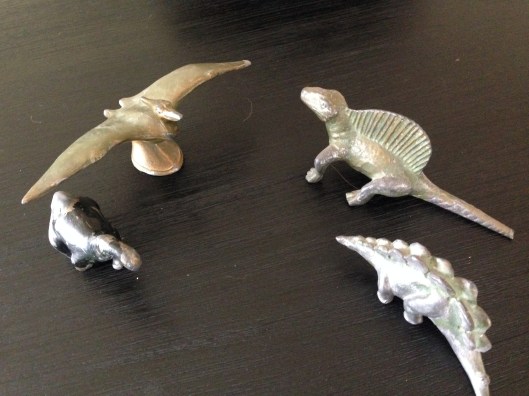
When I was about seven, I got my first bronzed dinosaur, the Tyrannosaurus Rex. I earned bribe money for being good about getting my butt stabbed by penicillin shots. In any case, I discovered these dinosaurs on the last page of my grandpa’s The Natural History Magazine. They looked really cool! The designers had chosen to make the T-Rex’s forearms look more robust than would have been a perfectly scale model with those teeny hands. The T-Rex was great! It was solid and cold and heavy because it was metal. There is something about metal or wood or stone that resonates with me much more deeply than plastic ever could. (Sorry, plastic. I know you are a cool invention and really inexpensive and very malleable and all of that. But, you just don’t touch my soul like wood, metal, and stone do.) When I moved the T-Rex, my muscles felt it. Perhaps this is one reason that I still have much of my dinosaur collection 65 years later. (How many of your plastic toys do you still have from 65 years ago?) I didn’t think so. But they are out there somewhere, along with my own forgotten plastic toys, polluting the world for centuries to come.

Bronze, as you have seen many times in your life, does not look worse when it oxidizes as iron does when it rusts. Instead, Bronze turns a beautiful powdery light green with the slightest hint of blue. So, T-Rex looked beautiful as well.  So, you might well think that the next time I had enough cash for one of these statues (1$ for the small size and 2$ for the large size) I would get another T-Rex. No, I got a Dimetrodon and a Stegosaurus. Later I got a Trachodon and a Brontosaurus. Anyway, what was fun about this diverse cast of characters is how different they were from each other and the richness with which they interacted. There’s no way it would have been as much fun if it were one army of T-Rex’s against another. (Poor brontosaurus’s tail fell off many times but my dad is no longer here to solder it back and anyway, the tail got lost in the last move).

IMG_0771

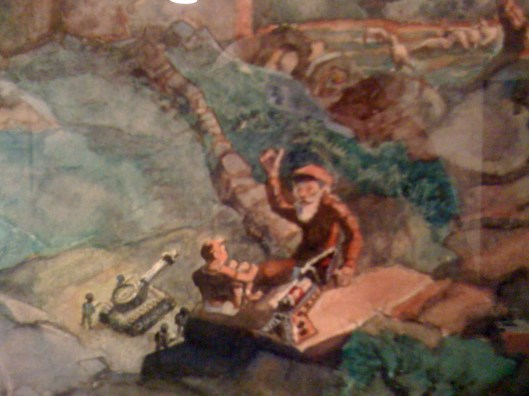
Similarly, a few years later, when I owned toy soldiers, I enjoyed having ones with different properties; that is, mainly different weapons. Liking the variety must have been true for other kids as well because the sets that I could buy were always mixed. My favorite type of soldier were hollow lead ones.  They were well enough hand-painted that you could see their faces, although not so well that you could determine whether they were fighting out of hate, out of fear, loyalty, patriotism, duty, because it’s a job, or for some private demon. I especially liked the bazooka men. I think I owned four of them. Of course, this weapon takes a while to reload and there probably aren’t a huge number of rounds. On the other hand, there were machine gunners, riflemen (more of them than anyone else), and a couple of officers who were pointing a pistol. There were also a couple of dudes sitting on the ground with a *serious* machine gun tucked between their spread-eagled legs. There were also a couple of hand grenade throwers. Another soldier had a rifle with a bayonet raised up above his head. This made arranging them for a pitched “battle” all that much more interesting. Although they had very different weapons, all of them had obvious lethal capabilities. All but one. There was one poor guy with no weapon whatever. His job was communications. His only visible “weapon” was a rather large boxy radio set. I suppose in a pinch, he could whack someone in the face with it. Even if that didn’t kill them, it would for sure put a crimp in their dinner plans.

It was difficult for me to decide which one of these soldiers I would “be.” I liked the bazooka man a lot. The rifleman looked cool. By the way, there were three versions. One type of rifleman lay on the ground with legs spread and the rifle stabilized by his elbows on the ground. Another type of rifleman sat on the ground and put the rifle across his upright knees for support. The third type, and my favorite, was the proudly standing rifleman. Thinking about it from an adult perspective, he’s probably the guy who was voted by his platoon:  “most likely to die quickly.” But I didn’t think about that then. Sometimes, I thought it would be cool to be the officer pointing the pistol. Obviously, in most ways, it wasn’t as devastating a weapon as a rifle. Although conceivably in very close quarters, he might outmaneuver a rifleman. But there was one guy that I definitely did not want to be.

You guessed it. I never wanted to be the guy on the radio. Let’s call him “Claude.” Claude didn’t get to actually fight! And, it seemed to me at that point that I could stay alive no matter what obstacles and enemies were thrown at me — if only I were an excellent enough rifleman (or bazooka man, or pistol-wielding officer). On the other hand, it seemed as though “anybody” could do Claude’s communications job and would do it equally well. Furthermore, it seemed any enemy could just walk right up and shoot this dude Claude before he knew what hit him and way before he transforms his awkward radio set into a lethal weapon. Of course, Jason Bourne could do it, but I don’t think Claude had that kind of training. And, anyway, the first movie didn’t come out until 2002 and this was the early 1950’s. Treadstone didn’t exist back then. (BTW, this is not “my” Claude but it’s the closest image I could find.)

Claude

As I mentioned, these hand-painted lead soldiers were my favorites but I owned three other types. One were extremely detailed and beautiful lead soldiers. These suckers were expensive and, as I quickly discovered, not very durable in real “battles.” When you smashed them into each other, the horses tended to break, or what was more typical and worse, not break but bend into an uncomfortable and unrealistic position. At that point, I would very carefully ease the broken leg into position, Angstrom by Angstrom… Snap!! It would break off in my hands. That was worse. I felt as though I had personally snapped that beautiful white horse’s leg in half. It always seemed as though I could ease it back into position and I almost succeeded each time. Then, SNAP. Suddenly I am holding a three legged horse in one hand and a piece of horse leg in the other. My favorite of these collections were the “Coldstream Guards” with their white and bright red uniforms with splashes of gold.  It is sad, I can tell you, to be an eight year-old general and not be able to put your most beautiful soldiers into battle. But, beautiful as they were, they were fragile. I did manage to break a few of the hollow leaden ones as well, but I had to work at it.

Then, there were unpainted plastic soldiers. They came in a kind of gray-green suggestive of olive drab. Let’s call it “off-olive drab” like the olive from that bottle of garlic clove filled green olives that you accidentally left at the very back of the fridge for five years. Then, when you finally discovered, it, the olives looked as toxic as rain forest frogs; but far from a beautiful bright warning color, these were so drably off-olive that you almost didn’t see them. But, as for the soldiers, it wasn’t just their uniforms that were off-olive drab. All of them, including the little flat plastic stands, their expressionless faces, and their normal-sized (well, normal scaled I should say) hands exuded that same toxicity of colorlessness. Their one giant advantage was that they were far cheaper than the painted leaden ones. And, whereas the fancy ones were fragile and the leaden ones were rugged but breakable, these all-plastic soldiers could not be broken. For some reason, I do know that they can be cut with an ordinary steak knife provided you have enough patience and are smart enough after you’re caught the first time “ruining” the steak knives, to make sure the second time you experiment when you’re alone. The plastic ones can also be melted. However, melting them had the side-effect of greatly disturbing my parents because of the toxic fumes that permeated our house. (I think we will have to leave for another time the question of why I wanted to know these things). One great thing about these plastic soldiers was that they were to the same scale as the metal ones. So, they could all participate in the same battles without stretching the credibility till it snaps like a rubber band and stings the soul of make-believe.

Ah, but there was as well a fourth type of soldier. These were insanely cheap plastic soldiers! A hundred soldiers for a dollar! I ordered two sets so I would have an amazing two hundred soldiers along with the probably 75 I already had. And then they arrived. Yay! Imagine! My army would now rival those of Caesar, Hannibal, Grant, Patton!

My first clue that something must be terribly wrong was the size of the shipping box — unbelievably small for 200 soldiers. I opened the boxes and then got to the actual soldiers. They were in 2 point font.  They were approximately the size of one of the feet of my other soldiers. And, these soldiers gave a whole new depth of meaning to the expression, “cheap plastic.” These soldiers were fabricated out of some material that was like what plastic uses when it doesn’t bring out the good stuff for company. And, “fragile” doesn’t quite do justice to the care with which these teeny slats of plastic needed to be handled. Oh, by the way, speaking of “slats,” did I mention that they were two dimensional? Did I mention that not only couldn’t you discern the motivations of the solider from their face, you couldn’t discern whether they even had faces. These soldiers were not of molded plastic; they were basically stamped. In fact, each solider had to be detached from a long plastic rod by twisting.

How could I have possibly known I would waste my two dollars? The picture that accompanied the advertisement for these soldiers depicted something other than their product. The picture showed something every bit as detailed and colorful and three dimensional as the hollow leaden soldiers. These same comic books also advertised “sea monkeys.” In the picture, there are “families” of little human-looking aquatic monkeys. You can tell what mood they are in and how the various family members interact. Well, I thought this was fantastic! But I didn’t totally believe it was possible either so I asked my grandpa whether they were real. He said they were just brine shrimp. I also saw that there was a teeny asterisk in the corner of the picture, half hiding in the seaweed that some of the “sea monkeys” were harvesting for the family meal. Then, in almost unreadably tiny type, the asterisk was explained, “visual depiction may not precisely duplicate visual characteristics of crustacean provided”  or some equally incomprehensible legalese gibberish that very few 8 year olds are going to comprehend (in the more recent version shown here, I don’t even see that cryptic warning).

SeaMonkeys

Apparently, we live in a society where that’s okay. I think part of the reason it’s okay is that we live in a very differentiated society. If you think about the single artist, craftsman, or chef, they are much more about substance than puffery. You don’t typically expect someone who makes something to be dishonest about what it was they did. However, hiring a advertising expert brings into play a different set of factors. The advertising person cannot make a better painting, or chair or soufflé. Their expertise and their “product” is in making people buy the substantive product. If they can lie, exaggerate, or mislead and get away with it, so long as sales go up, that is a win for the advertiser. Needless to say, they would never describe what they do as a lie. Because, after all, who would advertise a “lie” as being a “lie”? Then, you might not want to buy one. They have a whole raft of explanations as to why what they are doing is really in everyone’s interest. They’ve rehearsed it and perfected it and —- since this is what they expert in — they will probably have you agreeing with them. I’m not sure it is just fine and dandy, especially when it’s combined with a low quality product such as brine shrimp or “toy soldiers” that are too small to be used or played with as toy soldiers. In these cases, the actual product is nothing like what they “depicting” it as.

It gets a bit murkier when their are unstated but implied benefits. BMW actually does make a fine car. However, you are not going to be driving it long if you drive it the way it is portrayed on commercials. Similarly, a car is not going to be very often the snappifying head-turner among young people seeking a mate that the advertisers would have you believe. It isn’t merely that advertising tends to have us spend money on products and services that aren’t really filling our needs, although that is problematic. We spend a huge amount of money on junk food, cosmetics, and so on — and more than on medical research. But in addition to that, doesn’t it seem to undermine the meaning of truth in all human discourse? Or, is it okay to lie if you are an advertiser because they are doing it for money? In other words, it’s okay to lie if you are benefiting yourself, perhaps because you are undoubtedly benefiting your client even more?

We are more and more and more connected electronically. This is good news. And this is bad news too. One thing, though is certain. The potential impact of a lie is tremendous and much much more than it was in the past. In distant times, a lie had only local impact. Now, a lie could literally destroy the world. So, to me, the balance point of when it’s “okay to lie” is way different than it was 20,000 years ago.

I believe there is a way for people to provide value to each other honestly and still have a thriving economy. In any case, even if we never reach that point and advertisers continue to oversell products, can we at least try to be vigilant not to let that attitude toward the truth permeate every other aspect of life? A large complex and highly differentiated society can only exist in an atmosphere of trust. You must trust that the drivers of the other cars on the road are not trying to kill you. You must trust that the food you buy is not poison. You must trust that the policeman is there to protect you. If that trust breaks down, there is no longer a society. So intentionally lying in order to make a buck (or a point) is really a push toward utter chaos and anarchy. Obviously, no single push will bring us there, but we must be extremely careful. Why? Because lack of trust is contagious (as is trust). A slight imbalance between trust and mistrust could become a vicious cycle. Information is the resolution of uncertainty, not the multiplication of uncertainty.

A communication network of people becomes more valuable as the number of people increases. A network of, say, 350,000,000 people is much more valuable than 10 relatively homogeneous networks of 35,000,000 each. And, to take this to the extreme, it’s much more valuable than 350,000,000 networks of one person each, no matter how smart or strong that one person is or how many treasure-troves of weapons they have. We need to work together whatever differences exist. That’s why it’s important that we all keep communicating. That’s why it’s important that we try to be as truthful as possible. That’s why I now think that Claude, the radioman, may be the most skilled and crucial solider of all.

IMG_1289


(The story above and many cousins like it are compiled now in a book available on Amazon: Tales from an American Childhood: Recollection and Revelation. I recount early experiences and then related them to contemporary issues and challenges in society).

Find it on: my Amazon author page

Family Matters, Part 3: The Whole is Greater than the Sum of its Parts

27 Saturday May 2017

Posted by petersironwood in America, family, health, The Singularity, Uncategorized

≈ 5 Comments

Tags

AI, Artificial Intelligence, cognitive computing, decision making, family

IMG_8925


Some my earliest and fondest memories centered around family dinners at my grandpa and grandma’s house. For Thanksgiving, for example, there was turkey, mashed potatoes, gravy, sweet potatoes, green beans, olives, rolls, salad and several pies for dessert. But beyond the vast array of food, it was fun to see my grandparents, parents, three aunts and three uncles, and various numbers of cousins. On a few occasions, my second cousin George appeared and early on my Aunt Mary and Aunt Emma. All of these people were so different! We had more fun because we were all there together.

You have heard “The Whole is Greater than the Sum of its Parts” before, no doubt, but I think this is what it means when applied to a family setting. All families argue (although ours never did in these larger Holiday settings. And, almost all families love. But a fundamental question is this: do the people in the family tend to “thrive” more than they would on their own. If the family is functional, this should be the case. They balance each other; they support each other; they help each other improve. They cooperate when it counts. You will not always agree on everything. Far from it. You might be a slob like Oscar while your sibling might be very Felix-like. And, you’re both “right” under different circumstances and for different tastes.

Many sports teams will have a variety of people who excel more in running, or in blocking, or in throwing, or scoring. In baseball, for instance, or American Football, there are very different people in different roles, both physically and temperamentally. An offensive lineman in football will typically be stronger and bigger than a quarterback. Moreover, if the lineman gets “angry”, they might be able to block better on the next play. By contrast, the quarterback must remain calm, cool, and confident under pressure. He must try to put away any fear or anger or depression he feels on the way to the huddle before he gets there and certainly before the snap. When teams are working well together, they don’t criticize each other for differences and they work together to win the game rather than wasting time pointing fingers or trying to assign blame. In a baseball or football team, there is no question that the individual does better because of his teammates. Working together they can solve problems, win trophies, and have more fun than they could individually.

IMG_2979

You right eye sees the world a little differently from your left eye. Thank goodness! Your brain normally puts these two someone different flat, 2-D pictures into a 3-D picture! Your brain does not argue as to which one of these views is “correct.” It certainly does not instigate religious wars over it. I say that the brain “normally” does this. However, if a person is born and their eyes do not move or align smoothly, or if one eye is extremely near-sighted, it can happen that the brain “chooses” one eye to pay attention to. In this case, it seems the two images are so discrepant that the brain “gives up” trying to integrate them and instead chooses one image to use. In a condition such as “amblyopia” the brain mainly relies on the input from one eye. This condition is a distinct disadvantage in many sports.

In boxing, for example, it is literally a show-stopper. A fighter might look like hamburger, but the fight goes on. If, however, there is a cut above his or her eye so that blood drips down to obscure vision in one eye, the fight is stopped. That fighter can no longer see in depth (as well as losing some peripheral vision). It is no longer deemed a “fair” fight. Anyway, it seems the human brain does have some limits as to how much two discrepant views can be reconciled, at least when it comes to vision. Is there a limit to how much a family may disagree productively and still be functional? This is a good question, but one to return to later. Instead, let’s first turn to what are called “dysfunctional families.”

We said in a functional family or team, people are better off than they would be doing something on their own. On the other hand, consider a dysfunctional family. Here, people get mostly grief, judgement, criticism, competition, and lies. Why does this happen? Often dysfunctional behaviors are handed down from generation to generation through social learning, among other things. If too many dysfunctional behaviors are in one family, this causes a “vicious circle” that makes things worse and worse. For example, imagine a family is basically healthy but they do not engage in “alternatives thinking.” They see a situation, come up with an idea, and unless there is imminent danger, execute the idea as soon as possible. They will end up in a lot of trouble with that strategy. However, if they don’t engage in blame-finding, but instead they engage in collective improvement, they will learn over time to make fewer and fewer mistakes. People will all benefit from being in the family. But if a family instead fails to consider multiple alternatives before committing to a course of action and has a cycle of blaming each other without ever improving, then it will probably be dysfunctional. People will give more and get less in return than if they have been working alone. That does not mean there are zero benefits within a dysfunctional family. They may still cover for each other, help each other, provide emotional support, etc. But the costs outweigh the benefits in the long run.

People who come from functional families tend to see the world in a very different way as compared with people who come from dysfunctional families. Obviously, there are all sorts of exceptions as well as other factors at play, but other things being equal, these families of origin color our perceptions of daily life and predispose us to certain actions. Depending on the circumstances, it is even true that some of what we think of as “dysfunction” could actually be “function” instead. Suppose, for instance, you and two siblings suddenly found yourself attacked by a bear. It may be the best thing imaginable to take the first action you think of without trying to over-analyze the situation. Or not. It may well depend on the bear. And, therein lies the rub.
IMG_5994

Our own personal experiences are always a teeny sliver of all possible situations. So, your experience with a bear, bee, or bank may be quite different from mine. As a consequence, we may have different ideas about what constitutes function or dysfunction. In terms of the argument I am about to make, it doesn’t really matter which is “better” or “worse.” All that matters is that we agree some families provide a healthier environment than others. And attitudes are not all that are handed down; so are “ways to do things.”

Perhaps the arbitrary nature of what we consider “intelligent” wisdom handed down in families is best illustrated by a story about making a Holiday Ham. In the kitchen, a 10 year old boy asks: “How come you’re slicing off the ends of the ham?”

His mom answers, “Oh, that’s the way your grandpa always did it.”

Son: “So, why did he do it?”

Mom: “Oh, well. Uh. I don’t really know. Let’s go ask him.”

Son: “Hey, Grandpa, how come you cut the ends of the ham off?”

Grandpa: “Well, sonny. It’s because….it’s because…let’s see. That’s way my mom always did it.”

As it turns out, the 90 year old great-grandma was at the feast as well. Though she was a bit hard of hearing, they eventually got her to understand the question and thus she answered, “Oh, I always used to cut off the ends because I only had one small pan and it wouldn’t fit. No reason for you all to do it now.”

And there you have it in a nutshell. We are all walking around with thousands if not millions of little bits of “folk wisdom” we learned through our family interactions. In most cases, we’re not even aware of them. In virtually no case did we ask about where this folk wisdom came from. Have any of us actually tested one of these out in our own life to see whether it still holds up? And then what? Are you going to inform the others in the family that what everyone believes may not actually be true, at least in every case. Maybe. Most do not, in my experience. In addition, it seems that if you are from a “functional” family, you are much more likely to share this kind of experience (but they still don’t do it 100% of the time). People will often be interested in it and want to learn more. If you are from a more dysfunctional family, you might be more likely to realize they would put you down and try to shoot holes in your example. They might laugh at you. They might just not talk to you. So, what do you do?

volleyballvictory

We can extend these ideas to much broader notions such as a clan, a team, a business, a nation. For people who were not lucky enough to grow up in a functional family, the notions of trust and cooperation come hard. And, that’s a sad thing. Because your experience of what a bee or a bear or a bank will tend to be based on your own experience with very little reliance on the experiences of others. You are one person. There are 7 billion on the planet. So, yes, you can rely on your own experience and dismiss everyone else’s. Good luck.

Even a functional family may draw the boundaries around itself so tightly and firmly that anyone “inside” the circle of trust is trusted but anyone outside is fair game to take unfair advantage of. At the same time, such a family regards anyone outside as a threat who must “obviously” be out to get their family. People from this type of family do know cooperation and trust, but find it nearly impossible to extend the concept across boundaries of family, culture, or nation.  They are happy to hear about their brother’s experiences with bees but they are not much interested in the experiences of their cousins from half way around the world.

Everyone must decide for themselves how much to rely on their own experiences and how much to rely on close relatives, authority figures, ancient teachings, or the vast collective experience of humanity. Of course, it doesn’t have to be an either/or thing. You might “weight” different experiences differently. And, that weighting may reasonably be quite different for different types of situations and strangers. For instance, if your cousin is a smoother talker, vastly handsome, and twenty years younger, you might not put much stock in his or her advice about how to “hook up.” You might instead put more credence in someone at work who is in a similar situation. You might put very little stock in the experiences from a culture that relies on arranged marriages. Surprisingly, exactly because they are from a very different situation and therefore a quite different take on matters, they may give you very new and creative ways to approach your situation. For example, you might find that if you “pretend” you are already “pledged” to a partner your parents chose, dating might be less anxiety provoking and more fun. You might actually be more successful. I’m not saying this specific strategy would work or that ideas from other cultures are always better than ones from your own culture. I am just saying that they need not be dismissed out of hand, not because it’s “politically correct” but because it is in your own selfish interest.

I’ve already mentioned in previous blogs that people are highly related and inter-connected via genetics, their environmental interchanges, their informational interchanges and through the emotional tone of their interactions. Because people are highly interconnected, you can find much wisdom in the experiences of others. But there is another, largely underused aspect of this vast inter-relatedness. I call it familial gradient cognition. Or, if you like, “Mom’s somewhat like me.”

To understand this concept and why it is important, let’s first take a medical example. However, this potential type of thinking is not limited to medical problems. It basically applies to everything. So, you have a pain in your right hip. What is the cause and how do you fix it? That’s your question for the doctor, or more likely, nurse practitioner. They will typically ask questions about your activity, diet, what you’ve done lately, when the pain comes and goes etc. They may run various tests and decide you have sciatica. This in turn leads to a number of possible treatments. When I had sciatica, I got referred to a sports medicine doctor and got acupuncture. It worked. (Later, I discovered an even better treatment — the books of John Sarno). Anyway, we would call this a success and it seems like a reasonable process. But is it?

The medical professional’s knowledge is based on watching other experts, book learning, their own experience etc. And so they basically engage in this multiplication of experience. The modern doctor’s observations are based on literally many millions of cases; far more than he or she could possibly observe first hand. But what potentially useful information was completely omitted from the process described above? Hint: blogpost title.

Yes, exactly. Throughout this whole process, no-one asked me whether anyone in my family; e.g., my mom, dad, or brother had had these symptoms. No one asked whether they had had any kind treatment, and if so, what had worked and not worked for them.   Now, my brother, mom and dad are especially closely related but so are my four children and my grandparents, aunts, uncles, nieces, nephews and grandchildren. And, in the most usual cases, it isn’t merely that we share even slightly more genes than all of humanity. We are also likely to share diet, routines, climate, history and family stories and values. These too can play a part in promoting health. For example, did people in your family believe in “toughing it out” or were they more of a hypochondriac?  The chances are, you will tend to have similar attitudes.

In medicine, would it be better to make decisions based, not just on the data of the one individual under treatment, but on the entire tree with more weight given to the data for other individuals based on how closely related they were? Of course, family relations are only one way in which the data of some individuals will be more likely relevant to your case than will others. For instance, people in the same age cohort, people who live in the same area, people who are in similar professions or who work out the same number of hours a week that you do will be, other things being equal, of more relevance than their opposites.

Of course, as I’ve already mentioned, modern medicine does take into account the life experiences of many other people. But these other “people” are completely unknown. Studies are collectively based on a hodgepodge of people. Some studies use random sampling, but that is still going to be a random sample limited by geography, age, condition, etc. Other studies will use “stratified sampling” that will report on various groups differently. Some studies are meta-studies of other studies and so on. But how similar or dissimilar these people were to each other on a thousand or a million potentially relevant factors is more than 99% lost in the reporting of the data. But that doesn’t really matter because the doctor would typically not look at any article in response to your case because he or she will base their judgement on just you and the information they know “in general” which is based on a total mishmash of people.

Imagine instead that every person’s medical issues were known as well as how everyone was related to everyone else, not only genetically but historically, environmentally, etc. And now imagine that in doing diagnosis decisions as well as treatment options, the various trees of people who were “related” to you in these thousands of ways were weighted by how close they were on all these factors. Over time, the factors themselves could become weighted differently under different circumstances and symptoms, but for now, let’s just imagine they are treated equally. It seems clear that this would result in better decision making. Of course, one reason no-one does this today is that keeping track of all that data is mind boggling. Even if you had access to all the relevant data, we can’t layout and overlay all these relationships mentally to make a decision (at least not consciously).

IMG_0469

However, a powerful computer program could do this. And, the result would almost certainly be better decisions. There are obvious and serious ethical concerns about such a system. In addition, the temptation for misuse might be overwhelming. Such a system, if it did exist, would have to be cleverly designed to avoid any one power from “taking it over” for its own ends. There would also have to be a way to use all these similarities and prevent the revelation of the identities of the individuals. All of that, however, is grist for another mill. Let’s return to the basic idea of the decision making by using multiple matrices of similarity to the existing case rather than relying on general rules based on what has been found to be true “of people.”

This may be essentially what the human brain already does. A small town doctor in the last century would see people on multiple occasions; see entire families; and would undoubtedly perceive patterns of similarity that were based on those specific circumstances. The Smith family would all come in with allergies when the cottonwood trees bloomed. And so on. But he or she only sees a limited number of cases even in his entire lifetime. Suppose instead, she or he could “see” millions of cases as well as their relationships to each other? Such a doctor might well be able to perform as well as the computer and much better than they would today.

Can it be better done by collecting huge families of data and having a computer do the decision making? Or can it be done better by giving access to human experts to much larger data bases of inter-related case studies? What are the potential societal and ethical implications and needed safeguards for each approach?

The medical domain is only one of thousands of domains that could do better decision making this way. For example, one could use a similar approach in diagnosing problems with automobiles, tires, students’ learning trigonometry functions, which fertilizers and watering schedules work best for which crops in which soils for what results? You might call this “whole body” decision making. It is a term also reminiscent of the phrase, “Put your whole body into it” (as when cracking a home run into the upper deck!).

It is also reminiscent of the following situation. When you accidentally burn your finger, it does not just affect your finger. You jump back with your whole body. There are longer last effects in your brain, your stress hormones, your blood pressure. And, various organs and cell types will be involved in healing the burn on your finger. Your body works as a whole. But it is not an undifferentiated whole. Your earlobe may not be much involved with healing your finger. It is tuned to have communication paths and supply chains where they are needed. It’s had four billion years to work this out.

Of course, the way the body interacts is largely, though not wholly, determined by architecture. Even if your body decided that your earlobe should be involved, there is no way for the body to do that. To some extent, it can modify the interactions but only within very predefined limits. On the other hand, the brain is much more flexible when it comes relating one thing to another. We can learn virtually any association., But, at least consciously, we are limited to the number of things and experiences we knowingly take into account while making a decision.

What people might say would lead you to believe that they very often base decisions on only one similar case. “Sciatica you say? Oh, yeah. My cousin Billy had that. Had an operation to remove a disk and the pain totally vanished. Of course, three months later it was back. In his …well… back in his back.” It could be the case that there is more sophisticated pattern matching going on than meets the eye. Sadly though, most laboratory experiments reveal that most of the time, under controlled conditions people seem to suffer from a number of reasoning flaws. I believe that the current crop of difficulties people have with reasoning is not inevitable. I think it’s because of cultural stories and with new cultural stories, we could do a better job of thinking. And, we might be able to further multiply our thinking ability by giving the right kind of high speed access to thousands or millions of similar cases along with presentations based on how various cases are related. Or, we could have the computer do it.

Indeed, speaking of “family stories” that are common in our culture, I actually think that we have a “hierarchy” of thinking based on a patriarchal family structure. We do experiments and report on a teeny and largely preset sliver of the reality that was the experiment. A person reads about this and remembers a teeny sliver of what was in the paper. When it comes to a specific case, the person may or may not consciously remember that sliver. This is the “rule based” approach and it is probably better than nothing. A more holistic experience-based approach is to allow the current case to “resonate” with a vast amount of experience.  Of course, both methods can be deployed as well and perhaps there can even be a meaningful dialogue between them. But it may be worth considering taking a more “whole body” approach to complex decision making.


(The story above and many cousins like it are compiled now in a book available on Amazon: Tales from an American Childhood: Recollection and Revelation. I recount early experiences and then related them to contemporary issues and challenges in society).

https://www.amazon.com/author/truthtable

twitter: JCharlesThomas@truthtableJCT

Family Matters: Part Two – Garlic Cloves and Puffer Fish

11 Thursday May 2017

Posted by petersironwood in America, family, management, psychology, Uncategorized

≈ 6 Comments

Tags

diversity, evolution, family, life, religion, school


PicturesfromiPhoneChinaParisPrinceton 177There are many directions to go for the first sequel to “Family Matters: Part One.” That blog focused mainly on my family of origin, so one obvious place to go is to talk about my children and grandchildren. But I don’t really want to speak for them. After all, they can still talk back. My parents and grandparents cannot. But the real reason is that everyone should get to define themselves, at least to the extent that it’s possible. I think it is possible to a great extent, but not completely. Not everyone can become a pro athlete or a great musician even if they try really really hard. Luck and innate predispositions play a role in our fate.

Certainly, there are many “how to” books out there that would lead you to believe that the only thing that stands between you and owning the universe is your attitude. It isn’t a totally bad thing to imagine that you can do anything and have no limitations due to circumstances or your innate abilities and predispositions. It’s a fiction, of course. It’s a complete and utter fiction. If you spent the first five years of your life drinking lead tainted water, e.g., no amount of the proper “attitude” is going to undo the harm. But, for people whose main obstacle to a fulfilled life is self-doubt, it could provide a good antidote, or at the very least, a few good anecdotes that arise from a series of unfortunate incidents taking place from following such advice.

What I have in mind however, is something different; viz., trying to show how family situations tend to be continuous threads in a way that is analogous to the continuous genetic threads. For example, my grandmother used to tell “Old Pete” stories and ran a dramatic club. My mother became an English and Drama teacher. I have always loved acting and storytelling. Several of my kids and grandkids have also written originally and extensively. My mother’s brothers all were jokesters and storytellers. Her oldest brother Karl was a principal and then superintendent of schools. The middle boy, Bob, became a psychiatrist. The youngest, Paul, became a lawyer. The next generation included two psychologists, two lawyers, a neurosurgeon, a teacher. I could elaborate further but the point is that storytelling, art, psychology, and education as well as science and engineering are threads throughout this very local part of my family tree.

Before I go any further, however, I need to explain why I subtitled this, “Garlic Cloves and Puffer Fish.” As a side note, it’s good to remember that both garlic and puffer fish are our distant cousins. The same basic machinery that makes the cells of a garlic plant “work” and live and reproduce is what does all those same things in our cells. And our other, somewhat less distant cousin, the Puffer Fish has that same machinery in every one of its cells. Of course, beyond that we even have most of the same organs and types of symmetry as the Puffer (or any other) Fish. Now, I bring up our relation to these distant cousins because I would like to have you view what I am about to say about various people as being observational and not rendering value judgements. It would be silly to go out to a garlic plant and yell, “Why can’t you be more like a Puffer Fish?!  What’s wrong with you?!” It would be equally ridiculous, of course, to go snorkeling and when you encounter a Puffer Fish scream at it: “What are you doing out here in the ocean? Why can’t you be more like your cousin Garlic who at least makes wonderful tasting (to most) and health-giving nutrients? No, instead, you poison people! What’s wrong with you?”

IMG_6609

Now, when it comes to people, of course, it isn’t just their genes that determines behavior. The family, neighborhood, culture, religion, and physical environment that they grow up in determines, at least in large measure, who they become. Humans come in many varieties. This is both because, when it comes to our own life, we can actually make ourselves different in some ways on purpose (there is a grain of truth in the “positive thinking will win you the universe” genre) and secondly, when it comes to someone perceiving us, their own background and character will determine what they see in you. Similarly, your background will help determine what you see in others. If you think back on your own experience, you’ll see this is true. Anyway, among these many ways that people differ is how neatness-oriented they are. The hit TV series, The Odd Couple, featured two bachelors living together; one was an utter slob (Oscar) and the other was a neatnik (Felix). We all probably know people close to those extremes. We may even know two such people in our family as defined with a small circle to say your second cousins. I’m not trying to say one of these characteristics is better or worse than the other. But I would like to point out that each makes a lot of sense, under certain conditions.

Some years ago, I was watching a TV program about Alice Waters, a famous chef, restaurant owner, and author. She believes in such things as organic, locally grown ingredients. In any case, she happened to make this offhand comment that “it didn’t really matter if a little piece of the garlic skin clings to a clove” {at least in the context of the sauce they were making for a huge fish}. Anyway, I do most of the cooking in my house and I do try to remove the skin of garlic cloves. Most of the time, it’s fairly easy. But every once in a while I have encountered a clove of garlic that is as pathologically stubborn about giving up its skin as a corrupt politician is about giving up the illusion of sanctity. Even a garlic plant has its own personality, I suppose. On the scale of neatnik to slob, I would put myself near the middle. Of course, to anyone who thinks it’s good to be super neat, I will seem like a slob. And to anyone who thinks cleaning is just not worth the trouble, I may seem like a neatnik. Anyway, my point is that maybe there comes a point where you don’t generally have to be absolutely precise in cooking. And I would guess that this rings true with your experience as well. There are some cooks whose approach is very intuitive and, although they may follow a recipe, their measurements may not be totally accurate. And, then their are cooks who will follow directions extremely carefully. Generally speaking, it doesn’t make that much difference. I tend to prefer dishes such as mixed ginger/curry vegetables, burritos, or omelets. In these dishes, you can get away with a huge variation in proportions and specific ingredients. I give these dishes care and attention to detail, but all within very broad parameters.

IMG_6516

In at least one case, however, it is crucial to be a “neatnik” cook and that is in the preparation of the Puffer Fish. The Puffer Fish contains a highly potent neurotoxin called tetrodotoxin. Most of this toxin is in the liver, skin, and other internal organs. It is very easy if you are even the least bit sloppy — and we are not talking Oscararian sloppihood, just normal college guy sloppihood — to nick something and release the poison into the flesh making it potentially deadly. Under those circumstances, being a neatnik is vital. In some cases, expert chefs push a little further and allow a tiny bit of the toxin to bleed into the flesh which will cause a “high” in the eater, but not be fatal. Personally, I think I’ll stick with tuna. The point is that being extremely neat and careful can be a very good thing. Packing your parachute — good to be careful! Performing cataract surgery — be precise!

On the other hand, suppose that you are spear fishing or out gathering nuts. A “neatnik” might want to make sure every fish is skewered in exactly the same way. Except, perhaps for Puffer Fish, it doesn’t matter that much; the point is to catch the fish. Similarly, if you are gathering walnuts, there generally isn’t much point in arranging them by size. Suppose you are making a rock wall. You would do well to make sure it doesn’t fall down but the way to do that is by careful arrangement and filling in the cracks carefully with cement. An alternative approach is to insist that every rock is exactly the same. This would make building the wall much easier. On the other hand, it would be absurdly time consuming to search for rocks of precisely the same size. Other approaches are to have one group of people cut rocks to preset measures and then the job of building the walls is easier or to make artificial rocks called “bricks.” Under various circumstances, any of these methods will work just fine. In other circumstances, any of these approaches might fail. It isn’t quite so simple a matter as Disney and the Three Little Pigs would have you believe.

When it comes to recipes, whether for bricks or for soufflés, It is difficult to know ahead of time which aspects of the process require a Felixian attention to detail and which aspects are fine for a more Oscarian approach. And, just as there are situations that are particularly suitable and best done by Neatniks there are other situations particularly well suited to Slobs, this same principle holds true for every approach and personality trait that I can think of. So when I describe people in my more extended family, I am not trying to pass judgement on who is better than whom. You might imagine that there is an attempt on my part to make out someone as “bad” or “good” based on your own personality preferences. Similarly, it’s quite possible that I accidentally make one or the other kind of personality sound better based on my own preferences than they really are.

Although it is quite natural for people to express different preferences on the neatnik to slob dimension, it is often a source of tension, argument, fights, and in extreme cases, probably divorce and murder. Most often, when an “Oscar” does something annoyingly sloppy, (and which to Oscar is actually typically exactly nothing), Felix will not try to dialogue about the situation and negotiate a solution. Rather, Felix’s first move is more often to call out Oscar’s character as being deficient because he is such a slob. Immediately and quite predictably, Oscar’s defenses go up. His next move is to point out that Felix is insanely OCD. And thus, the problem moves from what is immediate, simple, and fixable to one that is long-term, complex, and unfixable. Oscar will never convince Felix to be like Oscar and Felix will not ever convince Oscar to be like Felix. In fact, for Felix to even expect Oscar to act Felixian is rather silly.

You have undoubtedly heard the expression that you “marry the family” as well as your own spouse. I found this unfathomably silly when I was younger, but now I see that in many ways it is true. For example, if your spouse has unresolved issues from their childhood, those can impact your relationship. If your spouse’s family is into crime or drugs or unnecessary drama, those will certainly impact you. These people will almost certainly interact with you and your kids so they will impact your lives directly and indirectly.

Keeping all this in mind, let’s tune into “Uncle Al.” Al worked at one point as a commercial artist. In such a position, being something of a “Felix” probably worked to his benefit. But not every situation calls for OCD. Al lived in one of two houses at the end of a dead end street. What would you do if you drove to the end of his narrow, dead end street? Well, one possible action would be to abandon your car at the end of the street and walk home to buy another car or just wait there until you were beamed up by aliens. Most people however, would instead go into one of the two driveways at the end of the street, turn their car around and drive back out the dead end street. Al didn’t like that. I suppose most of us might be mildly annoyed. But after all, what else could people do other than abandon their car or back out the entire length of the street? So, while most people might be a little annoyed at strangers using their driveway for a U-turn maneuver, Al was instead, very annoyed. So annoyed was Uncle Al that he paid to have five steel posts put into the end of his drive. Indeed, this completely prevented any stranger from using his driveway as a place to turn around. Chalk one up for Uncle Al.

steelposts

Now, you may have detected a slight flaw in Al’s plan. He could no longer use his driveway either. For that matter, he could no longer use his garage to house his car either. But to Al’s way of thinking, that was worth it because he had achieved his goal. The phrase, “cutting off one’s nose to spite one’s face” comes to mind.  At another point, several of my ex-brothers-in-laws went over to clean Uncle Al’s house. When they opened up the refrigerator, the shelves were all filled with the same thing. Can you guess what it was? No, you probably can’t. Every shelf was filled with tiny paper mini-ramekins. And in each of those tiny paper mini-ramekins was tartar sauce. Upon questioning, the story finally came out. Every Friday, Al went to a nearby diner where they had an “all you can eat fish” special. The fish came with tartar sauce. Uncle Al hated tartar sauce. But he had paid for the tartar sauce! So, when he left the restaurant, he took the tartar sauce with him each and every time.

This seems a little on the crazy side, but I would guess that almost everyone has sometimes taken something that they have access to even though they end up not using it. In fact, it’s a little odder and more selfish than that. We might even know when we take the items that it’s very unlikely we use them. For example, in the IBM cafeteria, I would often take an extra napkin. Why? Because on rare occasions, someone, possibly even me, would spill something and having an extra napkin that could be deployed jack-knife quick proved very handy.  But most of the time, these hypothetical emergencies failed to eventuate. Now, what to do with the extra napkin? I could put it in the trash, or since it was clean, put it in the recycling. To me, taking the time and effort to recycle is completely worth it. Not everyone does that. We can return to that later, but re-use (or in this case, first use) trumps recycling. So, I would take the napkins back to my office. I had one drawer in particular that ended up with a collection of napkins as well as tea bags, plastic forks, tiny packets of salt and pepper, and other food-related items. Small stuff. There were no stashes of candy bars or soda cans or deer carcasses.

However, this example of hoarding was not an idle and useless exercise in hoarding. When people in the lab had birthdays or other types of celebration, it actually turned out to be quite handy to have a nearby supply of napkins and plastic forks. When I thought about the design rationale for this procedure, I never thought to myself, “I paid for this dinner and there’s no rule against taking two napkins, so I want to keep what is mine.” In terms of explanation, my saving napkins and Uncle Al’s taking tartar sauce are light-years apart. But looked at in terms of situations and behavior, there are actually a lot of similarities. As already explained, all of us are closely related. Although Uncle Al was not “related” in the way that people generally use that word, our ancestors were common for billions of years. So, I would hypothesize, the behavior of keeping something that is not of immediate use but could be used in the future is one that is found broadly in the animal kingdom and in plants. We imagine that the desert plant that stores water in it’s thick leaves does not “think about it.” It seems pretty silly to think it thinks at all. But let’s expand the idea of how information is coded just a little. It wouldn’t make a difference if the rationale were written in Spanish or English or French would it? It wouldn’t matter if the design rationale were printed in 14 point Helvetica or 12 point Times New Roman. It wouldn’t matter whether it was coded in ascii or EBCDIC. So, why not extend the concept a little further. The “design rationale” for the plant’s behavior is coded in it’s DNA.  We may not be able to “read” this design rationale quite as readily as we could one printed in our native language. But that is basically a matter of convenience, not a matter of underlying truth. The plant does have a design rationale for being “greedy.”

When it comes to human behavior, of course, there are not only genetic determiners but also social ones. (Actually, this can be true of non-human animals as well). So, it isn’t just that people may have a genetic propensity for keeping extra items for future use; their particular culture has inculcated values and design rationals and ethics around greed, waste, generosity, and so forth. The design rationale that Al gave, I find too self-centered for my taste. My Mom was generous to a fault. And, when I say she was generous to a “fault” what I mean is that she was so generous that she would often give away the same item to several people. So, perhaps being overly generous can be a fault?

In any case, just as people come in all sizes and shapes, they come in all kinds of behavioral predispositions. These predispositions are probably weakly related to your immediate family both because of where you live, among other things. There is no one “right answer” as to which characteristics are “best” under all circumstances. Some may innately be predisposed to Felixism while others may become that way because of strict teachings by their parents and schools. Regardless of why Felix is a neatnik, Oscar is never going to convince him that he (Felix) should be like Oscar. That was true in paragraph ten and it is true in paragraph 17. One thing should be clear to both Felix and Oscar: if they can work together effectively, they will be able to solve a wider range of problems than they would working alone.

Creativity and diversity are always vital, but probably never more so than right this minute. Humanity has changed so much in every external way in the last two thousand years and most of that since the industrial revolution and most of that after the computer revolution. Change is not only rapid, it is rapidifying. Yes, I made that word up. That’s another symptom of the same thing. Change in media, language, meaning are all happening more and more rapidly. So, in times of such great change and such great uncertainty, it has always seemed to me to absolutely and vitally important to include every viewpoint on the problem that we possibly can.

If I am lying on the beach under a sunny sky, feeling healthy and happy, I don’t really need your advice much, at least not this second. Yes, I may not be as neat as you would like or I am far too neat but I don’t really care and it doesn’t matter. You be you, and I’ll be me.

On the other hand, if I am thrown into something beyond my comprehension, I would want to have as many eyes on the problem as possible. Of course, it feels more comfortable to surround yourself only with those who already agree with you rather than a highly diverse group. You won’t argue as much about what the problem is or about what “fairness” really means or even argue about the right process is for combining your insights. A diverse group can initially provide a slight “shell” of added awkwardness for some. In my experience, when people are focused on a situation or a problem, they get past that very quickly and every stage of the process is enhanced. There are more ideas generated, higher quality ideas, the evaluation of ideas is more robust; they generate more ways to fit ideas together. Not only is the output of the group improved. It is just plain more fun during the entire process. Perhaps a better term would be to say that it is more engaging. If someone has a slight accent, you need to listen more closely. If someone comes from a different background, not only do they provide a different way of looking at things or even solution; they also stretch your mind. It may not be as broadening as  traveling to another culture, but it is more than one step in that direction. An all-celery salad gets old fast.

IMG_6371

Beyond all that, it seems important to remember that these variations in human predisposition are not entirely new human inventions. Many species of plants and animals exhibit different “philosophies” or “strategies” for dealing with the same issues: getting food and water, finding a mate, reproducing, avoiding predators, etc. (Yes, plants do these things). What works for a plant in one climate will not do in another climate. Of course, it isn’t just the climate. It also depends on what other species are present, the nature of the soil, etc. Some plants, for instance, put time and energy into making flowers to attract bees, having the bees fertilize the flowers, grow the fertilized flower into a fruit that is both colorful and tasty. This means the fruit (e.g., wild strawberries or raspberries) are eaten by our cousins the rabbits and carried in many directions out from tree by the rabbits. The rabbits excrete the digested seeds which now find themselves in a tiny pre-fertilized plot. Come on!  How about a hand of applause? Do you see how many ducks have be lined up her for this plan to work?

I may have had a reputation for being a little off the wall, but this plan? This is my craziest idea on a combination of illegal drugs and then put through a cognitive blender. I worked in “Corporate America” for about 40 years. I worked for IT companies, but let’s imagine instead a company that made self-reproducing garden ornaments. The way they worked was that each ornament, after one year split in two. Anyway, they were making good money. Now, I go into the top management and say, “Hey, I have a great idea for how to have these ornaments reproduce. No more just splitting in two. Instead, each element will grow a little ornament on top of the ornament but brightly colored. This will undoubtedly attract some sort of something which will fertilize —- oh, wait, did I tell you about the whole “two sexes” deal? Anyway, we’ll then have a process for turning a fertilized element into a fruitling. The fruitling will be fortified with vitamins and sugar so that … um … something will come along and put this into its belly and carry it away into the neighbors yards where they will help build the first step of the new ornament. Give me funding for about 100 million years of experimentation and I can pretty much guarantee….” No, they would not fund a project like that. Evolution is a slow smart cookie. That tree of living things? That’s our tree. And that little teeny branch way over there? That includes Oscar and Felix and everyone else regardless of gender, age, race, religion, or hoardingness.  Does it really make sense for us to destroy the whole branch if we can’t go in exactly the direction we want? And what about how the decisions affect every other part of the tree? It is, after all, a family matter.

(The story above and many cousins like it are compiled now in a book available on Amazon: Tales from an American Childhood: Recollection and Revelation. I recount early experiences and then related them to contemporary issues and challenges in society).

Tales from an American Childhood

Family Matters: Part One

30 Sunday Apr 2017

Posted by petersironwood in America, psychology, Uncategorized

≈ 18 Comments

Tags

family, life, school


IMG_5452


———————————-

Perhaps you recall, as I do, that in the very earliest memories, parents are huge! My mother was huge and my dad was huge! Of course, they not only loomed gigantic physically, they also had a huge influence on me. That, I never thought about as a child, but we’ll return to influence later.

The other remarkable thing about my parents, in early memories, is how different they were from each other. My mother was soft, gentle, smooth-skinned with a soprano voice. My dad was completely different. He was even larger, but besides that, he was hard, physical, hairy and his voice boomed so loud I could feel as well as hear the vibrations. Needless to say, they smelled completely different and I generally saw them at different times of the day, or, more accurately, I saw my mother most of the day and my dad only for small segments on most days. They did different things, said different things, held me differently. There was no way as a child that I saw them as two different examples of a larger class of things called “people.” They were as different as night and oranges to me.

These differences were not just physical and perceptual. As I grew older, I also realized that the species of “Dad” and the species of “Mom” also behaved quite differently.  For example, I could generally count on my dad to remain calm and to get things done whereas in an emergency, my mother generally fell to pieces emotionally. No, come to think of it, she always fell to pieces.

When I was about five years old, my parents took me to a stranger’s house for one of their “Bridge Parties.” To me, “Bridge” was a complete mystery. I understood the concept of games; e.g., “Mother May I”, “Red Light Green Light”, “Pick Up Sticks”, “Checkers”, and (my personal favorite), “Red Rover, Red Rover.” In Red Rover, Red Rover, the opposing team formed a human chain by holding hands. Everyone on a team would chant in unison, “Red Rover, Red Rover, let Tommy come over.” (Tommy was my nick-name at the time). There were two really cool parts to this game in addition to the chanting. One, when it was your turn to make a human chain, you might get to hold hands with a pretty girl. Two, when you were called, you were allowed, indeed encouraged, to run as fast you could, and then SMASH right into the opposing team! That was fun. Honestly, I think I’d like to do that right now. But “Bridge?” The adults just took turns throwing cards on the table. Yet, they were generally screaming and laughing while playing this game. They seemed to be enjoying themselves but I had no idea why.

In any case, however much Mom and Dad enjoyed “Bridge Club”, I certainly didn’t. My parents took me into some random bedroom and said, “you will sleep in here.” Right. I’m five years old in a strange place and I am supposed to go to sleep while there is, basically, a mini-version of Woodstock going on about ten feet from my five year old (and therefore highly sensitive) ears. No, I’m not going to sleep. Even as a five year old, I knew that wasn’t happening. I’m not sure how my parents could have deluded themselves, but apparently they managed. Since sleep was out of the question, I needed to find some way to occupy myself.  What I can do? I’m going to explore the room!

I rather liked the room. It had wall to wall carpeting and dark, heavy, solid wood furniture. I padded about the room looking at this and that, but there wasn’t much to see really. This is what necessitated me to go to phase two of exploring the room; that is, looking under and in things. I looked under the bed, but it was just dusty. I knew it was a long shot that anyone else was trying to invent a new color and keeping the best results under the bed in little jars that had held maraschino cherries, but you never know. Well, actually, yes, eventually you do know. But I didn’t know then because I didn’t know that many people so I didn’t really know how many might be trying to invent new colors. Since then, I’ve met many people who do exactly that although not quite so literally as I was trying to do way back then. I have eleven grandchildren and every one of them is inventing new colors, each in their unique way.

My explorations of the bedroom bureau began very disappointingly. Drawer after drawer was filled with clothes. Sigh. Then, as they say, my eyes actually did become as big as saucers. Large saucers. Because lying right there atop some boring gray gaberdine pants was the coolest biggest gun I had ever seen! I liked my guns! In fact, one of my earliest memories was of a red plastic one. But now, as a “big boy”, I had metal guns. Even better, when I pulled the trigger, they went “BAM” “BAM” because of the caps. I liked my own guns all right, but this gun was way, way cooler. For one thing, it was all metal. Mine were partly plastic. And, the gun was shiny with a depth of its own — except for the handle which had a wonderful pebbled grain.


handgun

I could have enjoyed looking at that black gun (similar to, but not identical to the one above) for an hour. But, of course, I had to pick it up. Well, if the look of that gun had been exquisite, and it was, the feel of the gun thrilled me, filled me with uncertain terrors never felt before — to quote Mr. Poe. But alongside the terror was admiration that quickly blossomed into love. The object that constituted the gun seemed so beautifully and solidly built. Had I ever before held something that heavy and dense? I don’t think so.

I knew that my parents had told me to stay in the room and go to sleep. But they were the two people I loved most in the universe. How could I keep the discovery of something this cool, go unshared? I had to let them find out just how cool this gun was. I probably also thought that no little credit would be coming my way for being the discoverer of this marvelous instrument. (Somehow, it never once crossed my mind that the people who owned the house probably already knew about this gun). I definitely thought of it as my discovery, and so it was, in a way. And, if I were never going to get any credit from Grandpa for inventing a new color, at least I would have this great accomplishment forever written into my plus column.

Out into the living room full of laughing, screaming adults somehow getting pleasure out of “Bridge” I tottered, slightly off balance from the weight of the gun, though I was able to hold it one hand, just the way the cowboys and policemen did. “Look what I found.” Now, listening to  the memory of how I said it, I realize it probably was getting credit for my discovery rather than sharing it that most motivated me. Ah, well. Live and learn, as they say. I expected to gain some credit for my discovery and some appreciation for the gun, but I never expected the eruption of adult action and concern and panic and fear and anger and utter surprise. They provided such a sensory overload that my memory is like a loud noise and a great white light. Not only did I receive no plaudits for my wonderful discovery, I definitely had done something unspeakably wrong. (I later discovered that the gun had been loaded with the safety off). But at the time, I felt only bewildered disappointment. However, the one thing I do recall through the white noise was that Dad remained calm and managed to take the gun from me without my trying it out on him for fun. Meanwhile, Mom was being her usual “hysterical in an emergency” self.

At the time, I did not think that my mother was “typical” of all women nor did I think that she was “atypical.” It’s just that I knew this about my mother, but my mother formed one edge or point on  the growing conceptual map of people. And, everything that was true about her was all there together in her own rather large corner of my mind: soft, smooth, soprano, hysterical, gentle, slightly hard of hearing, illogical, loving, beautiful, and fun. Her body positively writhed when she found something funny. Early on, I tried to learn how to cause one of those paroxysms of laughter. Dad, on the other hand, could be counted on in a crisis. He was also hard and hairy and loud and undemonstrative. When, he laughed, most of the time, it was “UH!” That’s it! One sort of half snort, half laugh. I do that too sometimes. On the other hand, I also go into a full out writhe with laughter as well. I am part Mom; part Dad just like most of us with respect to our parents.

My parents had two different professions as well. Dad was an engineer. He was very logical; yes, even as a very young kid I saw this. Mom was an English and Drama teacher. Years later, at CHI in Atlanta, talking with Doug Engelbart, I discovered his parents had the same combination. As an adult, I can imagine that their professions not only seemed to be choices that sprung from their native talents, but that the professions, in turn, helped cement these traits in place.

I met other family members at a young age and each of them was quite different as well. My mother’s mother, Ada was smart, soft, and she told me “Old Pete” stories. We listened to radio programs together such as “The Lone Ranger”, “Roy Rogers”, “Hop-along Cassidy”, and “Tom Corbett and the Space Cadets.” Grandma was the Superintendent of Sunday School at the Methodist church we went to. She also founded the Firestone Park Dramatic Club and ran it for decades. Meetings were held at my grandparents’ house and the women (all the members were women) read plays. This turned out to be a cool deal for me because, as a little kid, whenever someone didn’t show up, I filled in because my memory was so good, that even without trying, I knew all the parts. Grandma also had to take “iron shots” because she was anemic. The best thing though was that she baked peanut butter cookies and when she made a pie, she made butter, sugar, and cinnamon roll-ups!

Her obituary from the Akron Beacon Journal begins this way: “Ada Weimer: Founder Of Drama Club Mrs. Ada P. Weimer, 78, founder of the Firestone Park Dramatic Club and its director for 30 years, died at Edwin Shaw Hospital Wednesday after a six-month illness. Born in Akron, Mrs. Weimer, 1384 Grant St., attended Greensburg High School and Heidelberg College. For many years, she was a Sunday school superintendent at Firestone Park Methodist Church, of which she was a member.” Apart from that, it lists her three sons and daughter whom she “left behind.” No mention of her peanut butter cookies though. Occasionally, after much begging, she would also make popcorn “from scratch” in a kettle. Not mentioned. She also spent a lot of time canning for the extensive “root cellar” my grandparents had in their basement. Not mentioned. Sometimes, she would walk with me up Grant Street to meet Grandpa at the bus stop. On the way, she never failed to scowl at the “beer joint” up the street where the overwhelming odor of beer and alcohol would flood out onto the street. Not mentioned. On rainy days, Grandma would take out two large shoe boxes that contained her extensive post card collection. Each had a photo, or more rarely, a cartoon, on one side and a hand-written or hand-printed note on the other side. They had come from many US states and from many countries around the world. The foreign ones also had interesting stamps to ponder with miniature scenes or portraits or animals from far-away places. I found all of it fascinating: the varieties of handwriting, the stamps, the pictures, the addresses. I would often ask her who these people were and what their comments meant. Usually, she would answer, but occasionally she wouldn’t. The newspaper was silent on the whole matter. Not one single post card was cited.

Grandma was affectionate as was her sister Mary, but their sister Emma took the cake. She was forever pawing, fawning, making a fuss, telling me nursery rhymes, hugging, kissing, etc. All three of these women were somewhat overweight and typically wore loose print dresses. I tend to think of my grandmother mainly wearing white, or off-white dresses with small flowers printed on them. Mary, on the other hand, the largest of the three, tended to wear dark blue dresses with white flowers. Emma typically wore brown or yellow dresses but made up for it with bright red lipstick and lots of make up. That entire branch of the family held family reunions every year. Much later, I met a cousin of Mom’s that had grown up with her family for a time.  He eventually became a psychology professor at an Ivy League School. Although I met numerous distant uncles and cousins over the years, I don’t much recall any of these more distant relatives. Grandma’s mother had come from Wales. My Grandpa painted a picture of the Welsh cottage that she was born in. It was beautiful and set in beautiful country but quite modest in size.

Now, speaking of Grandpa, he was as different and distinct from Grandma as Mom was from Dad. Grandpa smelled of pipe tobacco and although he too, like Dad, seldom laughed very demonstrably, he always seemed to have a twinkle in his grey eyes. Grandpa was extremely smart and knew about everything; or so it seemed at the time. Besides that, he was multi-talented. He worked as an engineer, but he was also an artist of some note. He was also an accomplished musician. Best of all, from my perspective, he was an excellent teacher. When we went out to the garden to pick corn on the cob, he taught me something about plants, soil or gardening. Einstein died when I was almost ten years old. Grandpa showed me the item about it in the Akron Beacon Journal and then proceeded to tell me about Einstein’s work (in elementary terms). He subscribed to “Sky and Telescope” as well as “The Atlantic” and “Scientific American” and the magazine of the American Museum of Natural History. He would point out particular articles to me and then discuss them with me or explain something in more detail.

No need to point out and describe every single person in my family. The main point is that each of these people seemed very very different from the others. Much later, I can see many “family resemblances” in terms of skills, interests, psychology and physical characteristics. But as a child, I perceived none of that. It never even occurred to me that we all needed to breathe or had two arms and two legs. If someone had asked me, I could have answered correctly, of course, but the similarities among these people never crossed my mind. Every week, I listened as The Lone Ranger and Tonto found someone in trouble, tracked down the bad guys, shot a gun out of their hand and rode away. After they were gone, the beneficiaries of their bravery would remark that they didn’t know the true identity of The Lone Ranger, but he had left behind a single silver bullet. In retrospect, these stories were quite formulaic. But at the time, every story was just a different story. And so it was with folks in my family. They were different. They were individuals. Beyond that, they collectively made up the space of possible individuals.

As childhood continued, of course, that people-space continued to grow. New people often revealed, not just that people could be more extreme on existing dimensions such as age, size, or how much they laughed, but they forced me to consider and construct entirely new dimensions as well. People, it turned out, came in different colors; they spoke with different accents. In fact, they spoke in entirely different languages! When I was about three and a half, Mom, Dad and I all left for Portugal. My Mom told me later that I was frustrated that a bunch of Greek sailors could not communicate with me. I don’t recall this. But I do recall a little of learning to speak Portuguese although to me, it was not “learning to speak a different language.” It was just that I encountered people who spoke differently and I learned to communicate with them. Some people don’t laugh much while others laugh quite a lot. Similarly, some people spoke the way I was used to and others spoke some entirely different way. It never occurred to me, as a child, that they spoke an entirely different language and certainly not that they spoke that strange other way because of their own family and their own country. If asked, I imagine that I might have answered that they chose to speak Portuguese rather than English. But mainly, it just was. I didn’t consider why people were fat or skinny; why they spoke with an accent or not; why some people were male and some female; why some were old and some were young. Each person was simply and completely the way they were. They went about their business and as I interacted with them they punched at the edges of the net of my ideas about what people were like. Each person punched outwards in their own direction and the space of people grew larger and larger and larger.

I guess not everyone reacts that same way. It now seems to me, as an adult, that some people only expand their space of people a little ways from the points laid down by their first family and friends. When someone is too different, they are not really part of the whole human condition, but instead, are assigned to some other category such as “old person” or “toddler” or “professional athlete” or “foreigner” or “cripple” or “gay.” For some, each category requires special treatment different from all the rest. If, for instance, a “professional athlete” assaults or rapes someone, that might be okay because there are special rules for such folks. If, on the other hand, a “foreigner” assaults or rapes someone, they should at least be put in prison and quite possibly killed.

Indeed, even my own family gave some hints that this was the way to think about people. You had to be careful with grandparents because they were “old” and could be easily injured or broken into small pieces. When my cousin threw a xylophone across the room and hit me in the head, no punishment was forthcoming because he was “just a little kid” and “didn’t know any better.” When I went to the hospital, people did not seem to be treated as people but rather as “patients” or perhaps as “pneumonia” or “burn victim” or “appendicitis.” Given names were rarely used. Although, even as an adult, I see that there are commonalities in the way doctors need to treat patients with particular diseases, it seems to me that there are also often important differences as well.

One way that people differ quite a bit is how they treat and categorize other people. To me, every new individual I meet still seems quite different although the differences I see now are not nearly so gigantic as the differences that I saw as a child. It might be similar to the way in which both our house and my grandparents’ houses seemed gigantic in that there were so many separate places or regions to the house.

In the next blog, I examine further implications of family matters.

——————————————

(The story above and many cousins like it are compiled now in a book available on Amazon: Tales from an American Childhood: Recollection and Revelation. I recount early experiences and then related them to contemporary issues and challenges in society).

Tales from an American Childhood

Author Page on Amazon: https://www.amazon.com/author/truthtable

Newer posts →

Subscribe

  • Entries (RSS)
  • Comments (RSS)

Archives

  • June 2026
  • May 2026
  • April 2026
  • March 2026
  • February 2026
  • January 2026
  • December 2025
  • November 2025
  • October 2025
  • September 2025
  • August 2025
  • July 2025
  • June 2025
  • May 2025
  • April 2025
  • March 2025
  • February 2025
  • January 2025
  • December 2024
  • November 2024
  • October 2024
  • September 2024
  • July 2024
  • April 2024
  • March 2024
  • February 2024
  • January 2024
  • December 2023
  • August 2023
  • July 2023
  • May 2023
  • April 2023
  • March 2023
  • February 2023
  • January 2023
  • December 2022
  • November 2022
  • October 2022
  • September 2022
  • August 2022
  • July 2022
  • June 2022
  • May 2022
  • April 2022
  • March 2022
  • February 2022
  • January 2022
  • December 2021
  • November 2021
  • October 2021
  • September 2021
  • August 2021
  • July 2021
  • June 2021
  • May 2021
  • April 2021
  • March 2021
  • February 2021
  • January 2021
  • December 2020
  • November 2020
  • October 2020
  • September 2020
  • August 2020
  • July 2020
  • June 2020
  • May 2020
  • April 2020
  • March 2020
  • February 2020
  • January 2020
  • December 2019
  • November 2019
  • October 2019
  • September 2019
  • August 2019
  • July 2019
  • June 2019
  • May 2019
  • April 2019
  • March 2019
  • February 2019
  • January 2019
  • December 2018
  • November 2018
  • October 2018
  • September 2018
  • August 2018
  • July 2018
  • June 2018
  • May 2018
  • April 2018
  • March 2018
  • February 2018
  • January 2018
  • December 2017
  • November 2017
  • October 2017
  • September 2017
  • August 2017
  • July 2017
  • June 2017
  • May 2017
  • April 2017
  • March 2017
  • February 2017
  • January 2017
  • December 2016
  • November 2016
  • October 2016
  • September 2016
  • August 2016
  • July 2016
  • June 2016
  • May 2016
  • April 2016
  • March 2016
  • February 2016
  • January 2016
  • December 2015
  • November 2015
  • October 2015
  • September 2015
  • August 2015
  • May 2015
  • January 2015
  • July 2014
  • January 2014
  • December 2013
  • November 2013

Categories

  • AI
  • America
  • apocalypse
  • cats
  • COVID-19
  • creativity
  • design rationale
  • dogs
  • driverless cars
  • essay
  • family
  • fantasy
  • fiction
  • HCI
  • health
  • leadership
  • management
  • nature
  • pets
  • poetry
  • politics
  • psychology
  • Sadie
  • satire
  • science
  • sports
  • story
  • The Singularity
  • Travel
  • Uncategorized
  • user experience
  • Veritas
  • Walkabout Diaries

Meta

  • Create account
  • Log in

Blog at WordPress.com.

  • Subscribe Subscribed
    • petersironwood
    • Join 648 other subscribers
    • Already have a WordPress.com account? Log in now.
    • petersironwood
    • Subscribe Subscribed
    • Sign up
    • Log in
    • Report this content
    • View site in Reader
    • Manage subscriptions
    • Collapse this bar

Loading Comments...