• About PeterSIronwood

petersironwood

~ Finding, formulating and solving life's frustrations.

petersironwood

Tag Archives: Design

Small Successes Early: Metaphor & Fable

20 Saturday Jan 2018

Posted by petersironwood in America, apocalypse, Uncategorized

≈ 4 Comments

Tags

Business, Design, iterative development, life, pattern language, politics

IMG_9849

This post is an extension to the Pattern —   Small Successes Early — and trials the addition of two more sections to the traditional form of a Pattern: Metaphor and Fable.

Metaphor:

(This section is a departure from the traditional form of Patterns. It’s intent is to show how the same general principles that are embodied in the pattern also apply in other domains).

Life on earth, according to current estimates, has been around for 4.75 billion years. Evolution has had a long time to “learn” effective ways to do things. Have you ever seen an oak tree decide to migrate to a new place in the forest? Have you noticed it getting grumpy and yanking itself up by the roots and walking 30 meters to richer soil or closer to a stream and stabbing its roots back into the dirt in order to settle in its new place? (I mean apart from Tolkien’s Ents?) No, and neither have I. What does an oak tree do? It puts some energy into making acorns. Each acorn costs the tree (a tiny bit) in terms of water, soil nutrients, and sugar that it made from photosynthesis in its leaves. But it does not bet the farm on a better place. Some acorns will be scattered by squirrels onto new and better ground. If the conditions are just right the acorn will germinate and send up a small shoot and send down a primary root. Over time that acorn may grow into a mighty oak. Small successes early. Similar strategies are taken by other plants whether they propagate by runners, by seeds, or by spores. Animals typically also “start small.”

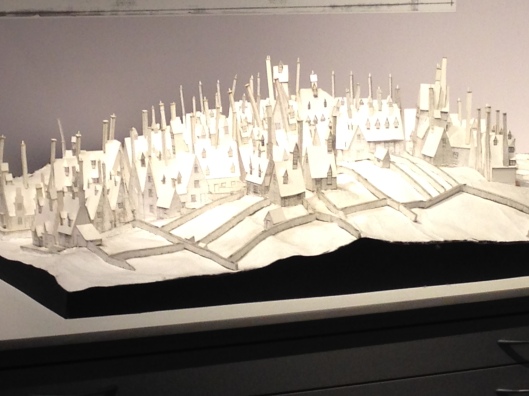
What can we learn from human practices that have evolved over millennia? For example, people have been building things for a long time. What are the practices around making a new building? People don’t just dig into a huge building project. They draw up plans; they discuss it; they typically build small scale models. If they see no problems with these models, they begin construction on the real thing. We think of these plans and models as being ways to coordinate the work and so they are. But they also serve a critical social purpose. Various stakeholders can look at the plans and models and question various decisions before there is a huge sunk cost.

IMG_5684

What do people do when they want to put on a stage play? They don’t typically write a play and then immediately spend a huge amount of money advertising it, building scenery, making costumes and then sell tickets for the Broadway opening. No. People write a play and then do a “reading” with a small group of people. Many issues get ironed out. Eventually, people may cast the play and have people rehearse. Again, they need not do this with full costumes, make-up, and scenery. Instead, they “work out the kinks” in the play, occasionally changing lines, but very often changing the manner in which lines are said. In later stages, the blocking or lighting may change. Eventually, people have what are called “dress rehearsals” to make sure everything is working right. The producers want to insure that the scenery doesn’t fall down; that the costumes don’t rip; that people know their lines. In many cases, people open off-Broadway to give them a further chance for improvement before a Broadway opening with its potential for roasting by drama critics.

One of the longest running continuous institutions is the Catholic Church. Would you like to be elected Pope? Good luck with that. The Pope isn’t chosen by an open lottery or elected by the general populace who pick anyone they like. If you want to be Pope, you have to first pass through all sorts of “tests” to prove yourself as a Catholic; then, prove yourself as a Priest; after a long successful career, you may be eventually become a Bishop. Many professions that have had a long history developed similar though perhaps less elaborate hierarchies based on expertise and experience. They start with small successes. If you can handle lower level duties successfully, you move up the hierarchy from apprentice, to journeyman to master.

So, when it comes to biology, which has had billions of years of evolution, the tendency is overwhelmingly to use “Small Successes Early” and when it comes to human cultural evolution of roles and large scale processes that have been around for thousands of years, people use “Small Successes Early.” It is only some modern business managers who feel there is no need for such prudence because, after all, they are smart enough to foresee all consequences and therefore have no need for “Small Successes Early.”

Fable: 

(This section is another addition and departure from the form of a typical Pattern. It tries to encapsulate the basic idea of the Pattern into a fable similar to those of Aesop).

fullsizeoutput_1a5a

Rarin’ Rabbit hated the farmers who kept chasing him and his brethren from the gardens. The whole hutch spent as much energy going from their warren to the garden and getting chased back as they did from the occasional tasty morsel they managed to steal.

One bright day, Rarin’ Rabbit happened upon a dry creek bed filled with clover, purslane, and plantain. He immediately went back to the warren and convinced all his fellow rabbits to move their warren into the sides of the dry creek bed. Now, all they had to do for a great meal was step outside their front door! No farmers chasing them! It really did seem as though Rarin’ Rabbit had led his entire tribe to the promised land!

Rarin’ Rabbit grew immensely popular. One hot and humid day in late summer, Rarin’ Rabbit and his compatriots were munching on some wild roses that grew on the sides of the arroyo  when they heard thunder in the distant hills. Some of the rabbits got nervous and began wondering if the rain drops would come down on them. Some suggested perhaps that it was prudent to stop snacking and head back to the shelter of their warren. “Nonsense!” Rarin’ Rabbit protested. “There’s no rain here! Let’s keep eating till we’re as big as elephants! You have to dream greatly if you want to succeed greatly!” Most of the rabbits stayed for Rarin’ Rabbit was indeed quite popular — right up until the flash flood came hurtling down the canyon sweeping away Rarin’ Rabbit, all his companions, and the rabbit warren. Every last one drowned.

IMG_7249

The moral of the story is: “Dream greatly. But test out your great dreams by first trying to find small successes early.”


Author Page on Amazon

Small Successes Early

20 Saturday Jan 2018

Posted by petersironwood in management, psychology, Uncategorized

≈ 4 Comments

Tags

Business, competition, Design, innovation, pattern language, politics

IMG_5159

This is the third “Pattern” in a proposed “Socio-technical Pattern Language” that aims to capture best practices in collaboration and coordination at various levels of organization from having a civil society to having small groups work in ways that are: 1) enjoyable in the moment, 2) productive in terms of the end-product, and 3) build skills in the participants. The notions of “Patterns” a “Pattern Language” are described in more detail in the first of this series, “Special Spaces and Wonderful Places.” The idea for the pattern, Small Successes Early, crystalized from reading DeMarco & Lister’s excellent book, Peopleware.

Small Successes Early. 

Author, reviewer and revision dates:

Created by John C. Thomas, December 2001.

Reviewed in early 2002 by Alison Lee and Catalina Danis.

Revised and extended, January, 2018.

Synonyms: 

Start Small.

Abstract:

Many problems in a modern industrialized society require very large teams of relative strangers to work together cooperatively in order to design and build an adequate system or solution or to solve the overall problem. Yet, because of the sense of urgency and artificial “deadlines,” in many settings, people fail to take the time to learn to trust one another as well as to learn one another’s strengths and weaknesses and preferred styles of working. Plunging a large group of strangers immediately into a complex task often results in non-productive jockeying for position, failure, blaming, finger-pointing, etc. Therefore, insure that the team or community first undertakes a task that is likely to bring some small success before engaging in a complex effort.

Context: 

A complex undertaking often requires the interaction of many people with various backgrounds, skills, and temperaments. Often, whether in an industrial setting, a community building effort, or in political life, many of these people have not worked together before. The group wants to get started and wants to be successful. Although their diversity is a potential source of strength, at first, there is likely to be natural confusion about how to proceed because people will have different experiences about the best way to organize and proceed.

As the pace of change in society increases, a greater and greater proportion of the work that people do cannot be done in a routine or top-down way. Such a “command and control” style can work well under some circumstances; for example, when the solution is knowable before starting and everyone can be counted on to know their exact function and to be motivated toward an outcome agreed upon by all. Even in such extreme cases, it can still be worthwhile for people to learn about each other before attempting a larger effort. Most teams, even when hierarchically controlled and doing repetitive tasks, will improve over time as they gain experience with each other. In complex tasks with emergent solutions, the effect of practice will be even greater.

Forces: 

  • Problems are often too complex for all aspects to be addressed simultaneously.
  • If a problem is understood, it is logically better to deal with the hardest constraints first.
  • The structure of complex problems often becomes more clear as people try to solve the problem.
  • A part of any complex problem solving process requiring more than one person is the interaction and relationship among the people.
  • People in a new team need to learn about each other’s skills, working styles, and trustworthiness.
  • When people get frustrated because of non-success, they tend to blame each other.
  • As people work toward a goal, the goal tends to become viewed as more valuable and therefore people are willing to work harder to reach it.

Solution: 

Therefore, when bringing new teams or organizations together, it is useful to begin with a small success. In this way, people begin to learn about each other and trust each other. People learn more about the nature of the problem domain. This makes tackling more difficult problems later relatively easier.

OLYMPUS DIGITAL CAMERA

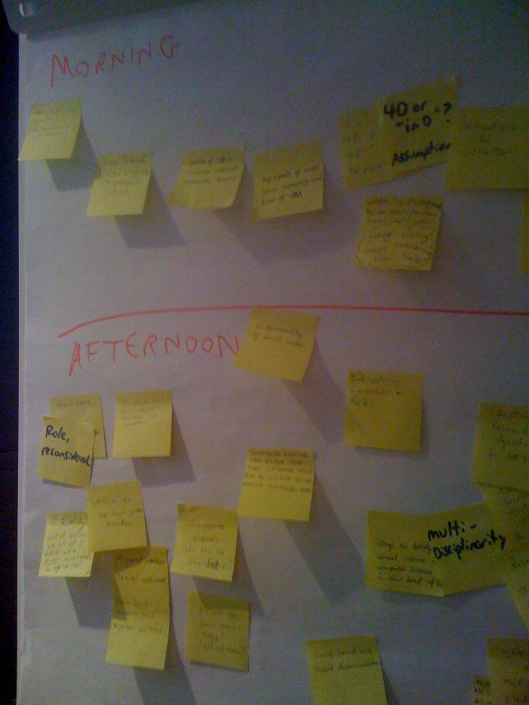
CHI Workshop On HCI for Development Began with Map-Making

Example: 

At the kick-off to a new software development project, rather than having the people be invited to “attend” an event that is “thrown” for them, which might typically include a mind-numbing series of powerpoint presentations from executives about how much money the company will earn if the project is successful, instead, encourage the workers themselves to organize a party, cook-out, pot-luck, song-fest, or storytelling event among themselves. In the process of organizing and carrying out this activity, they will learn about each other’s styles, learn about the trustworthiness of others, and be encouraged by having a success.

Alternatively, the team might simply work on one small aspect of the problem to be solved, provided it is something fairly clear that will result in “success” quickly. For instance, the team might initially work profitably on short presentations about the project, posters, or scenarios but not immediately jump into working on a systems design or a requirements document.

At a workshop on “Human-Computer Interaction for Development” held in Florence (at CHI 2007), we began by having the group make a “map of the world” (shown above) with stones and other materials at hands. Although everyone who signed up was presumably interested in the topic, people were mainly strangers from many parts of the world and had not worked together before. We not only jointly created the map but then had people engage in simple tasks that made use of the map; e.g., stand somewhere close to where you were born; stand somewhere you’d really like to visit but never have; stand somewhere representing a wonderful experience. In an earlier workshop on “Cross-cultural issues in Human Computer Interaction” (CHI 1992 in Monterey), the workshop room was set up like a classroom so our first task was to work together to jointly re-arrange the furniture in the room into a kind of “circle.”

Rationale: 

As people experience team success, they tend to view the others in the team more positively. Teamwork is often hard under the best of circumstances. In highly complex problems, when people come together from different cultures, backgrounds, or agendas, it often becomes so difficult as to seem impossible. Rather than having people simultaneously attempt to solve a complex problem and at the same time learn to work together as a team, it is often more effective to separate the otherwise tangled problems.

First, have the people solve a tractable problem where it is clear to everyone that they have a common agenda. A successful experience working together to solve that simple problem will help people learn each other’s styles, strengths, weaknesses and so on. With this knowledge and trust, they can now move on to try to solve more difficult problems.

Examples: 

The human factors psychologist James Welford was called in as a consultant to deal with what appeared to be a very large age effect. People over 35 were having a tremendous difficulty learning new hand weaves. The difficulty, as Welford discovered, was in having older people try to solve two tangled problems. On the one hand, it was hard for older workers to see the actual threads and second, it was hard to learn the weave patterns. What Welford did was introduce a short training segment with very large, quite visible cords. Once people had mastered the weave patterns with these large cords, they were then transferred to the much smaller production size. This eliminated the so-called “age effect” and in fact, both older and younger people learned much more effectively and efficiently.

In similar fashion, trying to solve a complex problem with virtual strangers, especially when there is reason to believe there may be a difference in agendas, is a “tangled problem.” Untangling the “getting to know people” aspect from the complex production or design task will help insure ultimate success.

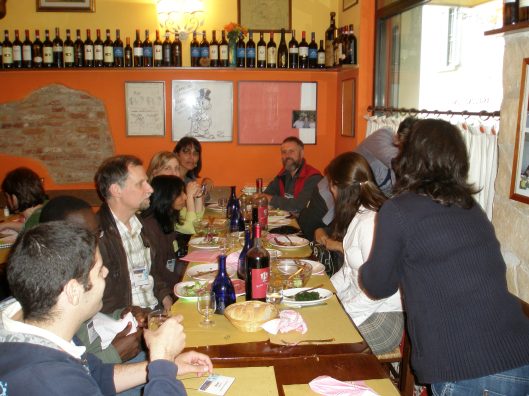
Some care should be given to the task and setting. The “small successes early” task should allow some degree of give and take, some opportunity for expressive (not just instrumental) communication. People should have the opportunity and space for doing something creative, for sharing stories, for physical interaction. Ideally, it should either be somewhat task related, domain related, or be something nearly everyone enjoys (e.g., eating, playing music, dancing, hiking).

IMG_3240

References: 

DeMarco, T. and Lister, T. ( 1999) Peopleware: Productive Projects and Teams. (2nd Edition). Upper Saddle River, NJ. : Addison-Wesley.

Schuler, D. (2008). Liberating Voices: A Pattern Language for Communication Revolution. Cambridge, MA: MIT Press.

Thomas, J. C. (2012). Patterns for emergent global intelligence. In Creativity and Rationale: Enhancing Human Experience By Design J. Carroll (Ed.), New York: Springer.


Author Page on Amazon

Special Spaces & Wonderful Places

“Reality Check”

16 Tuesday Jan 2018

Posted by petersironwood in America, apocalypse, management, Uncategorized

≈ 6 Comments

Tags

advertising, Business, creativity, Design, epistomology, innovation, learning, life, pattern language, politics

IMG_9660

This is the second in a series of blogs that present Patterns in a Socio-technical Pattern Language of best practices for collaboration and coordination in complex societies. I intend to organize these in multiple ways (e.g., type of goal; where in a typical development process the pattern is most applicable; how large a collection of people the pattern is most applicable to, etc.).  I am entering them in this blog in an order that reflects current events. For example, there seems to be a movement to deny reality outright and insist everyone simply believe what the leaders promulgate. This, to me, is outright evil. But even when people are acting with the best of intentions, it is natural to take short cuts. Those short cuts can make life seem more efficient in the short run, but it can also lead to serious issues in the longer term.

Reality Check

Author, reviewer and revision dates:

Created by John C. Thomas on 4 September, 2001

Revised, JCT, 17 December, 2001

Revised, JCT, 15 January, 2018

Synonyms: 

Abstract:

In developing complex systems, it is often expedient to develop feedback loops based on ersatz measures of what we are really interested in assessing and controlling. While this seems expedient in the short term, it often leads to serious problems and distortions, particularly in times of crisis or transition when the correlation between ersatz measures and actuality substantially drifts or even suddenly disconnects. Actions can be based on these measures or models of reality rather than on reality(or more complete measures) and result in negative consequences. The solution is to perform regular “reality checks” to insure that measures or indicators of reality continue to reflect that reality.

Problem:

In developing complex systems, it is often expedient to develop feedback loops based on ersatz measures of what we are really interested in assessing and controlling. While this may seem expedient in the short term, it often leads to serious problems and distortions, particularly in times of crisis or transition when the correlation between ersatz measures and actuality substantially drifts or even suddenly disconnects. Actions can be based on these measures or models of reality rather than on reality. This can result in negative, even deadly, consequences.

IMG_4382

Context:

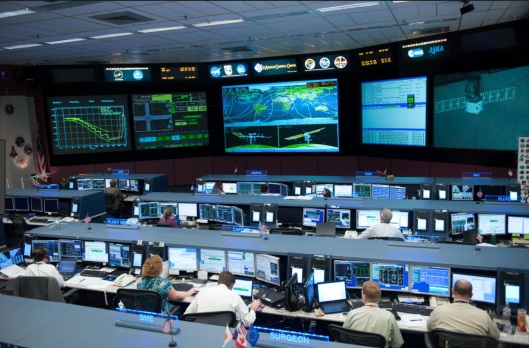
Many problems were partly responsible for the disaster at the Three Mile Island. One crucial problem, in particular, arose from the design of a feedback loop. A switch was supposed to close a valve. Beside the switch was a light that was supposed to show that the valve was closed. In fact, rather than having the light go on as the result of actual feedback from the valve closure itself, the signal light was merely a collateral circuit to the switch. All it actually showed was that the switch had moved position (Wickens, 1984). Under normal operation; that is, when the valve was operating properly, these two events were perfectly correlated. At a critical point in the meltdown, however, the valve was not operating properly. Yet, the human operator believed that the valve was closed even though it had failed to close in reality. His resulting actions, taken on the basis of the assumption that the valve was closed, exacerbated the subsequent problems. My colleague, Scott Robertson, has recently posted an analysis of the recent error that resulted in the nuclear missile scare in Hawaii. (See link).

View at Medium.com

In running an application program several years ago, I was given a feedback message that a file was posted. In fact, it wasn’t. The programming team of the application, rather than checking to see whether the file was actually posted, merely relied on the completion of an internal loop.

In advertising campaigns, it is difficult to measure the impact on sales. Instead, companies typically measure the “recall” and “recognition” rates of ads. This may often be correlated with sales changes, but in some cases, the ad may be very memorable but give the customer a very negative impression of the company and decrease the chances of actually selling a product.

Historically, monarchs and dictators (and even would-be dictators) often surrounded themselves only with people who gave them good reports and support no matter how their decisions impacted the reality of their realm. Eventually, the performance of such people tends to deteriorate severely because their behavior is shaped by this ersatz feedback rather than by reality.

IMG_5245

During the “oil crisis” in the seventies, oil companies relied on mathematical models of continually increasing demand. Year after year, for seven years, they relied on these models to predict demand despite the fact that, for all seven years, demand actually went down. The results are purported to have cost them tens of billions of dollars (Van der Heijden, 1996).

In some cases, the known existence of ersatz measures directly contributes to the destruction of the utility of these very measures. For example, if management decides the “easy way” to measure programmer productivity is “Lines Of Code,” once programmers discover this, the code base may grow quickly in terms of that measure, but not in terms of actual functionality.

IMG_7683

In America @2018, many people view money as the only legitimate value of interest for countries, companies, or individuals. Measures such as the GDP and the stock market index are taken as adequate and complete measures of the economic well-being of the society. There is a sense that, since we spend the most on weapons and health care, we must perforce be the “safest” and “healthiest” nation on the planet. This is clearly not the case. Similarly, ads talk about a person’s “net worth” when what they are really talking about is merely a person’s net financial worth. “Worth” is not the same as “financial worth.”

A large research organization that I am familiar with used to have a large number of administrative assistants who helped arrange meetings, send in expense reports, and answer telephones. At some point, most of these administrative assistants were laid off and the tasks were now done by the researchers themselves who were typically not nearly so efficient at them. The researchers took at least as long to do them as had the administrative assistants. Accountants looked favorably at all the “money they had saved” because they could easily see that the line item for administrative assistants was far less costly than it had been. Not visible, of course, was the fact that the much more highly paid researchers were now doing the same work that had been done before by the administrative assistants, but they were doing it less efficiently and at a far higher cost.

Forces: 

* Organizations are often hierarchically decomposed and bureaucratic. Therefore, it is often simplest to communicate with those close to us in the hierarchy and to build systems that rely for their model of reality only on things within the immediate control span of our small part of the organization.

* While more comfortable to limit system design and development to those things within one’s own team or department, it is often precisely the work necessary to capture more reality-based measures that will reveal additional challenges and opportunities in business process coherence.

*A more direct measure of reality is often more time-consuming, more costly, or more difficult than the measure of something more proximal that is often highly correlated with those aspects of reality of real interest.

*It is likely to be exactly at times of crisis and transition that the correlation be-tween proximal ersatz measures and their referent in reality will be destroyed.

*It is likely to be exactly under times of crisis and transition that people will tend to simplify their cognitive models of the world and, among other things, forget that the proximal measure is only ersatz.

Solution: 

Therefore:

Whenever feasible, feedback should ideally be based on reality checks, not solely on ersatz measures. When this is too costly (as opposed to merely inconvenient or uncomfortable), then at least design systems so that the correlation between proximal measures and their referent in reality is double-checked periodically.

IMG_0396

Examples:

Rather than rely solely on a circle of politically minded advisors, Peter the Great disguised himself and checked out various situations in Russia in person.

As reported by Paula Underwood (who was the designated storyteller for her branch of the Iroquois), her ancestors at one point felled giant trees for long houses in the Pacific Northwest. Later, when the tribe lived in the “Great Plains”, there were no trees of that size. The tribe began to doubt the existence of trees as large as what their oral history portrayed. In order to check on this, one brave spent many years walking back to that area and seeing with his own eyes that there were indeed trees as tall as had been portrayed in the oral history and then returning to the tribe to report back.

Resulting Context:

Ideally, over time, people who actually double-check reality will come to better understand when and how these reality checks will be necessary. They may also invent methods of making a check-in closer to what is really of interest more convenient or cheaper.

Related Patterns:

System as a Whole

Convergent Measures

Drawing the Line

Who Speaks for Wolf

Known Uses:

Richard Feynman, during the Manhattan project, noticed that the bureaucracy was worried about the possibility of accidentally stockpiling a critical mass of uranium. To prevent this, each section chief was required to insure that their section did not have a critical mass. To insure this, each section chief instructed each sub-section chief to insure that their subsection didn’t have a critical mass and so on, down to the smallest level of the bureaucracy. Upon hearing this plan, Feynman observed that neutrons probably didn’t much care whose subsection they reported to!

In another incident reported by Feynman, various bureaucrats were each trying to prove that they had better security than their peers. In order to prove this, they escalated the buying of bigger and thicker safes. The bigger and thicker the safe, the more bureaucrats felt that they had made their secrets secure. Feynman discovered that more than half of the super-safe safes had been left with the factory installed combinations of 50-50-50 and were therefore trivially easy to break into!

IMG_8585

References: 

Wickens, C. (1983). Engineering psychology and human performance. Columbus: Merrill, (p.1).

Van der Heijden, K. (1996). Scenarios: The art of strategic conversation. Chichester: Wiley.

Hutchings, E., Leighton, R., Feynman, R., and Hibbs, A. (1997). Surely, you’re joking Mr. Feynman. New York: Norton.

Underwood, P. (1993). The Walking People: A Native American oral history. San Anselmo, CA: Tribe of Two Press.

————————————

https://petersironwood.wordpress.com/2017/02/25/the-invisibility-cloak-of-habit/

https://www.amazon.com/author/truthtable

“Who Speaks for Wolf?”

09 Tuesday Jan 2018

Posted by petersironwood in America, psychology, Uncategorized

≈ 8 Comments

Tags

Business, Design, environment, family, innovation, learning, life, marketing, Native American, pattern language, politics

IMG_0727

This is the first of many socio-technical “Patterns” in a socio-technical Pattern Language meant to encapsulate best practices for collaboration and coordination. The common “parts” of every Pattern are displayed below in bold. A brief discussion follows the Pattern.

Who Speaks for Wolf?

Author, reviewer and revision dates: 

Created by John C. Thomas on December 17, 2001

A shorter version is included in Liberating Voices by Douglas Schuler.

A longer version was published as an IBM Research Report, 2002.

Reviewed by <John C. Thomas> on <January 9, 2018>

Revised by <John C. Thomas> on <January 9, 2018>


Synonyms 

Engage all the Stakeholders

Abstract: 

A lot of effort and thought goes into decision making and design. Nonetheless, it is often the case that bad decisions are made and bad designs conceived and implemented primarily because some critical and relevant perspective has not been brought to bear. This is especially often true if the relevant perspective is that of a stakeholder in the outcome. Therefore, make sure that every relevant stakeholder’s perspective is brought to bear early.

Problem:

Problem solving or design that proceeds down the wrong path can be costly or impossible to correct later. As the inconvenience and cost of a major change in direction mount, cognitive dissonance makes it likely that the new information will be ignored or devalued so that continuance along the wrong path is likely.

Context: 

Complex problems such as the construction of new social institutions or the design of complex interactive systems require that a multitude of viewpoints be brought to bear. Unfortunately, this is all too often not the case. One group builds a “solution” for another group without fulling understanding the culture, the user needs, the extreme cases, and so on. The result is often a “system” whether technical or social, that creates as many problems as it solves.

The inspiration for this pattern comes from a Native American story transcribed into English by Paula Underwood.

In brief, the story goes as follows. The tribe had as one of its members, a man who took it upon himself to learn all that he could about wolves. He became such an expert, that his fellow tribespeople called him “Wolf.” While Wolf and several other braves were out on a long hunting expedition, it became clear to the tribe that they would have to move to a new location. After various reconnaissance missions, a new site was selected and the tribe moved to the new location.

Shortly thereafter, it became clear that a mistake had been made. The new location was in the middle of the spring breeding ground of the wolves. The wolves were threatening the children and stealing the drying meat. Now, the tribe was faced with a hard decision. Should they move again? Should they post guards around the clock? Or, should they destroy the wolves? And, did they even want to be the sort of people who would kill off another species for their own convenience?

At last it was decided they would move to yet another new location. But as was their custom, they also asked themselves, “What did we learn from this? How can we prevent making such mistakes in the future.” Someone said, “Well, if Wolf would have been at our first council meeting, he would have prevented this mistake.”

“True enough,” they all agreed. “Therefore, from now on, whenever we meet to make a decision, we shall ask ourselves, ‘Who speaks for Wolf’ to remind us that someone must be capable and delegated to bring to bear the knowledge of any missing stakeholders.

Forces:

  • Gaps in requirements are most cheaply repaired early in development; it is important for this and for reasons of acceptance (as well as ethics!) by all parties that all stakeholders have a say throughout any development or change process.
  • Logistical difficulties make the representation of all stakeholder groups at every meeting difficult.
  • A new social institution or design will be both better in quality and more easily accepted if all relevant parties have input. Once a wrong path is chosen, both social forces and individual cognitive dissonance make it difficult to begin over, change direction or retrace steps.

Solution:

Provide a way to remind everyone of stakeholders who are not present. These could be procedural (certain Native Americans always ask, “Who Speaks for Wolf” to remind them) or visual or auditory with technological support.

Examples: 

In “A behavioral analysis of the Hobbit-Orcs problem,” I discovered that people find it difficult to solve a simple puzzle because it appears that they must “undo” progress that has already been made.

As a positive case, some groups make it a practice to “check in” at the beginning of any meeting to see whether any group members have an issue that they would like to have discussed. In “User Centered Design”, and “Contextual Design” methodologies, an attempt is made to get input from the intended users of the system early on in the design process.

In a negative case, we developed a system to help automate “intercept calls” for a telecommunications company. We tested the end users to make sure it was workable. When we went to install the system, however, we learned that the folks in charge of central offices, would not allow our software to be installed until we provided documentation in the same format that they were used to from AT&T. So, we redid all the documentation to put it into the AT&T format. At that point, our lawyers, however informed us that that format was “copyrighted” so we could not simply use it. In this case, although many stakeholders were consulted, we had left out two important constituencies. (Eventually, the system was deployed — the first in the US that incorporated speech recognition into an application on the Public Service Network.

Resulting Context:

When every stakeholder’s views are taken into account, the solution will be improved in quality and in addition, there will be less resistance to implementing the solution.

Rationale:

Much of the failure of “process re-engineering” can be attributed to the fact that “models” of the “is” process were developed based on some executive’s notion of how things were done rather than a study of how they were actually done or asking the people who actually did the work how they were done. A “should be” process was designed to be a more efficient version of the “is” process and then implementation was pushed down on workers. However, since the original “is” model was not based on reality, the “more efficient” solution often left out vital elements.

Technological and sociological “imperialism” provide many additional examples where the input of all the stakeholders is not taken into account. Of course, much of the history of the US government’s treatment of the Native Americans was an avoidance of truly including all the stakeholders.

A challenge in applying the “Who Speaks for Wolf” pattern is to judge honestly and correctly whether, indeed, someone does have the knowledge and delegation to “speak for Wolf.” If such a person is not present, we may do well to put off design or decision until such a person, or better, “Wolf” can be present.

Related Patterns: 

Radical Co-location (Provided all stakeholders are physically present in the radical co-location, this tends to insure that their input will be given at appropriate times).

Known Uses:

As a variant of this, a prototype creativity tool was been created at IBM Watson Research Center. The idea was to have a virtual “Board of Directors” consisting of famous people. When you have a problem to solve, you are supposed to be reminded of, and think about, how various people would approach this problem. Ask yourself, “What would Einstein have said?” “How would Gandhi have approached this problem?” And so on. The original prototype consisted of simple animations. Today’s technology would allow one to develop a raft of chat-bots instead.

References: 

Thomas, J. C. (1974). An analysis of behavior in the hobbits-orcs problem. Cognitive Psychology, 6(2), 257-269.

Thomas, J.C. (1996). The long-term social implications of new information technology. In R. Dholakia, N. Mundorf, & N. Dholakia (Eds.), New Infotainment Technologies in the Home: Demand Side Perspectives. Hillsdale, New Jersey: Lawrence Erlbaum.

Thomas, J.C., Lee, A., & Danis, C (2002). “Who Speaks for Wolf?” IBM Research Report, RC-22644. Yorktown Heights, NY: IBM Corporation.

Thomas, J.C. (2003), Social aspects of gerontechnology.  In Impact of technology on successful aging N. Charness & K. Warner Schaie (Eds.). New York: Springer.

Underwood, Paula. (1983). Who speaks for Wolf: A Native American Learning Story. Georgetown TX (now San Anselmo, CA): A Tribe of Two Press.

IMG_5572

Discussion. 

I have personally found this pattern to extremely useful in a variety of social and business situations. In some ways, it seems like “common sense” to get the input of everyone touched by a decision. But we live in a very “hurried” society as I earlier examined in the Blog Post “Too Much.” I’ve seen many projects hurried through design and development without taking a sufficient look at the possible implications for various stakeholders. There is currently what I consider a reasonable concern over what the impact of AI will be. But other technologies on the horizon such as biotechnology and nanotechnology also need to be thought about. As we examined in a whole series of blog posts in the fall of 2017, social media have had huge unintended (and negative) consequences.

I’ve also been involved in “cross-cultural issues” in Human-Computer Interaction (HCI) and in how HCI impacts people and societies in other cultures. Even relatively simple technologies like dishwashers, microwaves, and cars often have considerable unanticipated social consequences. It is not only the “fair” thing to involve everyone who will be seriously impacted; it will ultimately result in faster progress with less strife.

I’m very interested in other people’s experiences relevant to this Pattern.

IMG_9829


“Turing’s Nightmares” – scenarios of possible AI futures.

Special Spaces & Wonderful Places

07 Sunday Jan 2018

Posted by petersironwood in America, apocalypse, psychology, Uncategorized

≈ 24 Comments

Tags

Design, environment, learning, life, pattern language, politics, school

IMG_4695

When you think back to your childhood, no matter how luxurious, dilapidated, or war-torn that  childhood might have been, I’m guessing that like me, you had some particular places that you loved. Perhaps they stayed secret to you; perhaps you shared only with one or two chums. Somehow, those specific places held a kind of magic for you as they did for me. I will just point out a few examples from my own childhood.

Grandpa’s basement, for instance, though dark and dank, held a printing press made of cast iron. Although he cautioned me not to play with it because, he insisted, it was not a plaything but an important tool, I nonetheless found opportunity to move the gigantic heavy four handled wheel, having first carefully noted the exact position in order to return it just as I had found it. In some way beyond my comprehension as a child, I knew this press was something magical. It was, after all, involved in printing. I recall years later seeing a picture of Benjamin Franklin with just such a printing press. And, even as a very young child, I knew that printing held great power. Beyond that, the object itself loomed and commandeered that entire corner of the basement. I knew it was heavy beyond imagining, and not just in the epistemological sense. I could judge the weight of the entire machine from how hard it was to turn the wheel which, though heavy, comprised only a small fraction of the entire press. Cast iron also has this magical texture which seems to inhale light out of the surrounding region like a giant beast. Perhaps best of all, and what appealed to the engineer in me, the machine’s form and function flowed beautifully together. Compare that with a modern automobile, for instance. What it actually does is largely hidden in the design. This goes along with branding, and advertising, and customer loyalty and so on. A modern car does not typically marry form and function nearly so nicely as did that printing press.

IMG_5135

On the “side yard” of our house on North Firestone Boulevard, three tulips shot up every spring, so colorful and perfect, not to mention mysterious. Where did they come from every year? How could this rounded plant of petals have a three pointed star inside!? On more than one occasion, I caught sight of a butterfly feasting on the pollen within. This place was cool patly just because adults always seemed hell-bent on the next task or chore. So, while this tiny patch of ground technically belonged to the whole family, in fact, I’m the only one who enjoyed it for more than a casual glance. I smelled and touched and explored every vein in that tulip. I watched butterflies do their drunken dance and tried (and largely failed) to predict when and where they would next alight.

IMG_7660

At David Hill Elementary School, the sandstone retaining wall provided another special place. With a lot of work, kids like me could turn sandstone into sand. And we did. With work, we even made tunnels. At one point, we stuffed a grasshopper into a tunnel, covered the entrance,  and watched for him until he eventually hopped out ten feet away! For a long time, none of the adults seemed to pay much attention to the fact that we were slowly but quite assuredly destroying the retaining wall which kept our school and its landscaping from falling into the playground below. Sadly, at some point, the gravely voice of the principal, which always seemed to be enveloped in the black death robes of a priest at a funeral, informed us that we were now forbidden to play in or on the wall.

When we moved to Ellet, these special places disappeared from consideration but were immediately replaced by a much grander array of them. Right behind our house lay a forest! That forest sported a spring of fresh water coming right out of the ground, two gigantic elm trees wrapped in thick hair cables of poison ivy vines, an oak with a swinging grape vine and a creek. Eventually, I came to know the special places of the creek where you could put in bark “boats” and have the longest races ad the places where you could cross with the least chance slipping on a loose stepping stone and dousing your entire body. Depending on the temperature, that might or might not be all that uncomfortable, but it would inevitably be followed by something that was definitely uncomfortable — being punished by your parents for getting your clothes all wet. Now, it must be said, that when I had done this terrible deed of getting my clothes all wet, the first thing they did with those clothes was to put them in the washer where, yes, they would get wet. Hmm. Part of what makes these some of these special places special is that they radiate event streams outward into your lives. And, the feeling or inspiration or information or decisions that come from these special places need not be confined there. We draw comfort from them, even if we know we will never visit them again.

We all know that some places “feel right” – there is something about them that seems mysterious, beautiful, awe-insipring, calming, or exotic. But what makes a place “good” or “special”? Partly it is individual experience, no doubt, but partly it is the environment itself. So what is it about form and texture and organization that makes a place special? That is an interesting question that seems to have intrigued Christopher Alexander as well. Alexander and a team of collaborators looked at places that “worked” from around the world. The result was a book called “A Pattern Language.” They formalized, to a large extent, intuitions of what makes a place “special”; what makes it “work.”

OLYMPUS DIGITAL CAMERA

OLYMPUS DIGITAL CAMERA

Each actual pattern is pretty elaborate, but I can give a few examples to illustrate the point. One of the Patterns is called “European Pub” which has activity around the edges and large tables. This helps people socialize. The activity around the edges gives people an excuse to circumnavigate the room. The large tables mean that there is room for “legitimate peripheral participation.” If I’m new in town, I can sit somewhat away from everyone but still within earshot. When someone says something I can relate to, I jump into the conversation. This arrangement is much more conducive to socialization than many American bars which feature stools all facing a TV. This does not encourage interaction.

Another Pattern points out that a small town near a big city should put its “center” placed eccentrically toward the city. This makes it more convenient for a larger number of commuters to stop at local stores on their way to the city and back.

These are both gross over-simplifications of the actual patterns, but I think they convey something of what is being aimed at. There is a belief that these patterns would generally “work” in any religious, cultural, geographic, or political context. These patterns are really meant to focus on the invariants across a large number of details. In that way, they make design problem solving more effective. You will be less likely, so goes the claim, to be exploring parts of the design space that are far removed from optimal if you think about things in terms of these patterns.

A “Pattern Language” purports to take a useful middle ground. The patterns are abstract enough to be widely useful but narrow enough not to be meaningless. A “Pattern” is the named solution to a recurring problem. A “Pattern Language” is a lattice or web of Patterns that largely covers a field. Christopher Alexander coined the term after he and his colleagues went around the world to see what “worked” in terms of city planning, house design, building design, neighborhood design, the building process and so on. I think nearly everyone will find “A Pattern Language” a fascinating book.

The impact of A Pattern Language, however, extends far beyond architecture and urban planning. People have found the concept of a “Pattern Language” useful in many other domains. Perhaps the best known such domain is in Object-Oriented Programming with the so-called “Gang of Four” authoring many of the original books on the subject. Other domains which have been addressed with “A Pattern Language” include pedagogy, human-computer interaction, change management, e-business, sustainability, and how society might evolve.

I became interested in Pattern Languages at least 20 years ago and have since co-organized and co-led a number of workshops on patterns in “Computer Human Interaction” as well as “Socio-technical Patterns” including working on patterns for “Liberating Voices: A Pattern Language for Communication Revolution” and chapter 19 in John Carroll’s book on design rationale, “Patterns for Emergent Global Intelligence.”


In 2017, I recounted in this blog  childhood memories and how they relate to what is happening in today’s world. To summarize briefly, we have great opportunities as a species but we are also in a train wreck of trouble! We seem trapped in a nightmare of a comic farce, but one which has tragic consequences of potentially epic proportions; e.g., atomic war or having the USA walk away from the Paris accords on climate change. Is anything to be done?

IMG_1245

What I want to accomplish in the first half of 2018 is to generate interest in the beginnings of a socio-technical “Pattern Language” that can help us get back on track again. I’ll post some of the ones I know about, but I’d be very interested to work with people on other suggestions.  In most cases, even when I post patterns it will be the case that I did not “invent” the patterns from first principles or construct them myself. In the same way that Christopher Alexander and his team main observed what worked and only then attempted to codify generic best practices into a “Pattern Language,” I also found many of these from observation or reading other sources or both. For example, the patterns, “Who Speaks for Wolf?” and “The Iroquois Rule of Six” are not by any means my inventions. I learned about them from the works of Paula Underwood. She was the “designated storyteller” of her branch of the Iroquois and provided an English transcription of the oral history of that branch in The Walking People. Indeed, I have argued that the “Walking People” basically developed a kind of pattern language in their oral history.

https://www.amazon.com/Walking-People-Native-American-History/dp/1879678101

https://www.slideshare.net/John_C_Thomas/the-walkingpeople

https://www.slideshare.net/John_C_Thomas/walking-people-analysis

A Pattern Language is a difficult business.  For maximum utility, each pattern has considerable thought behind it and is written into a specific form. In fact, at one CHI workshop, we developed an XML specification for patterns in Human Computer Interaction called (Pattern Language Markup Language) PLML (pronounced “pell mell”). I will not be quite this formal with the form of my patterns but will adhere as closely to it as practical. I do think that the form of the Patterns within a Pattern Language is important. Each of the parts serves a purpose and it is handy to know what role each part plays. For example, each Pattern has at least these parts: A Title,  (possibly subtitled), synonyms, a Version history, one or more Authors, an Abstract, a statement of the problem, a statement of the context in which the problem and solution arise and are appropriate, an analysis of the “Forces” at play, the Solution, Examples, the Resulting Context, Known Uses, Related Patterns, and References. For many people, having such a complex structure seems to be too much “baggage” but we must remember that design problems are themselves inherently complex. In addition to textual elements, the Patterns of Christopher Alexander include both photographic images to “set the mood” and, typically, at least one diagram to illustrate the general nature of the pattern.

The domain I am most interested in developing a Pattern Language for is perhaps most often labelled as a “Socio-technical Pattern Language.” These would be a collection of patterns that would help people cooperate, collaborate and solve problems together. Although the fabric and texture, perhaps even the scent, of endeavors would depend on culture, the field, current events and a host of other factors; however, the form of these solutions to recurring problems would remain roughly constant.

Next up: An Example. “Who Speaks for Wolf?”

—————————————————————————

https://petersironwood.wordpress.com

It’s not Your Fault; It’s not Your Fault

12 Tuesday Jan 2016

Posted by petersironwood in driverless cars, The Singularity, Uncategorized

≈ Leave a comment

Tags

AI, Artificial Intelligence, cognitive computing, Design, ethics, law, the singularity, Turing

IMG_5867

“Objection, your honor! Hearsay!” Gerry’s voice held just the practiced and proper combination of righteous outrage and reasoned eloquence.

“Objection noted but over-ruled.” The Sing’s voice rang out with even more practiced tones. It sounded at once warmly human yet immensely powerful.

“But Your Honor…” began Gerry.

“Objection noted and overruled” The Sing repeated with the slightest traces of feigned impatience, annoyance, and the threat of a contempt citation.

Gerry sat, he drew in a deep calming breath and felt comforted by the rich smell of panelled chambers. He began calculating his next move.

The Sing continued in a voice of humble reasonableness with undertones of boredom. “The witness will answer the question.”

Harvey wriggled uncomfortably trying to think clearly despite his nervousness. “I don’t exactly recall what he said in answer to my question, but surely…” Harvey paused and glanced nervously at Gerry looking for a clue, but Gerry was paging through his notecards. “Surely, there are recordings that would be more accurate than my recollection.”

The DA turned to The Sing avatar and held up a sheaf of paper. “Indeed, Your Honor, the people would like to introduce into evidence a transcript of the notes of the conversation between Harvey Ross and Quillian Silverman recorded on November 22, 2043.”

Gerry approached the bench and glanced quickly through the sheaf. “No objection Your Honor.”

Gerry returned to his seat. He wondered how his father, were he still alive, would handle the current situation. Despite Gerry’s youth, he already longed for the “good old days” when the purpose of a court proceeding was to determine good old-fashioned guilt or innocence. Of course, even in the 20th century, there was a concept of proportional liability. He smiled ruefully yet again at the memory of a liability case of someone who threw himself onto the train tracks in Grand Central Station and had his legs cut off and subsequently and successfully sued the City of New York for a million dollars. On appeal, the court decided the person who threw themselves on the tracks was 60% responsible and the City only had to pay $400,000. Crazy, but at least comprehensible. The current system, while keeping many of the rules and procedures of the old court system was now incomprehensible, at least to the few remaining human attorneys involved. Gerry forced himself to return his thoughts to the present and focused on his client.

The DA turned some pages, highlighted a few lines, and handed the sheaf to Harvey. “Can you please read the underlined passage.”

Harvey looked at the sheet and cleared his throat.

“Harvey: Have you considered possible bad -weather scenarios?”

Qullian: “Yes, of course. Including heavy rains and wind.”

“Harvey: Good. The last thing we need…” Harvey bit his lower lip, biding time. He swallowed heavily. “…is some bleeding heart liberal suing us over a software oversight.

Quillian: (laughs). Right, boss.”

“That’s it. That’s all that’s underlined.” He held out the transcript to the DA.

The DA looked mildly offended. “Can you please look through and read the section where you discuss the effects of ice storms?”

Gerry stood. “Your Honor. I object to these theatrics. The Sing can obviously scan through the text faster than my client can. What is the point of wasting the court’s time while he reads through all this?”

The DA shrugged. “I’m sorry Your Honor. I don’t understand the grounds for the objection. Defense counsel does not like my style or…?”

The Sing’s voice boomed out again, “Counselor? What are the grounds for the objection?”

Gerry sighed. “I withdraw the objection, Your Honor.”

Meanwhile, Harvey had finished scanning the transcript. He already knew the answer. “There is no section,” he whispered.

The DA spoke again, “I’m sorry. I didn’t hear that. Can you please speak up.”

Harvey replied, “There is no section. We did not discuss ice storms specifically. But I asked Quillian if he had considered all the various bad weather scenarios.” Havey again offered the sheafed transcript back to the DA.

“I’m sorry. My memory must be faulty.” The DA grinned wryly. “I don’t recall the section where you asked about all the various bad weather scenarios. Could you please go back and read that section again?”

Harvey turned back to the yellow underlining. “Harvey: Have you considered possible bad weather scenarios?” “Quillian: Yes, of course, including heavy rains and wind.”

Gerry wanted to object yet again, but on what grounds exactly? Making my client look like a fool?

The DA continued relentlessly, “So, in fact, you did not ask whether all the various bad weather scenarios had been considered. Right? You asked whether he had considered possible bad weather scenarios and he answered that he had and gave you some examples. He also never answered that he had tested all the various bad weather scenarios. Is that correct.?

Harvey took a deep breath, trying to stay focused and not annoyed. “Obviously, no-one can consider every conceivable weather. I didn’t expect him to test for meteor showers or tidal waves. By ‘possible bad weather scenarios’ I meant the ones that were reasonably likely.”

The DA sounded concerned and condescending. “Have you heard of global climate change?”

Harvey clenched his jaw. “Of course. Yes.”

The DA smiled amiably. “Good. Excellent. And is it true that one effect of global climate change has been more extreme and unusual weather?”

“Yes.”

“Okay,” the DA continued, “so even though there have never been ice storms before in the continental United States, it is possible, is it not, that ice storms may occur in the future. Is that right?”

Harvey frowned. “Well. No. I mean, it obviously isn’t true that ice storms have never occured before. They have.”

The DA feigned surprise. “Oh! I see. So there have been ice storms in the past. Maybe once or twice a century or…I don’t know. How often?”

Gerry stood. Finally, an objectable point. “Your Honor, my client is not an expert witness on weather. What is the point of this line of questioning? We can find the actual answers.”

The DA continued. “I agree with Counselor. I withdraw the question. “Mr. Ross, since we all agree that you are not a weather expert, I ask you now, what weather expert or experts did you employ in order to determine what extreme weather scenarios should be included in the test space for the auto-autos? Can you please provide the names so we can question them?”

Harvey stared off into space. “I don’t recall.”

The DA continued, marching on. “You were the project manager in charge of testing. Is that correct?”

“Yes.”

“And you were aware that cars, including auto-autos would be driven under various weather conditions. They are meant to be used outdoors. Is that correct?”

Harvey tried to remind himself that the Devil’s Advocate was simply doing his job and that it would not be prudent to leap from the witness stand and places his thumbs on the ersatz windpipe. He took a deep breath, reminding himself that even if he did place his thumbs on what looked like a windpipe, he would only succeed in spraining his own thumbs against the titanium diamond fillament surface. “Of course. Of course, we tested under various weather conditions.”

“By ‘various’ you mean basically the ones you thought of off-hand. Is that right? Or did you consult a weather expert?”

Gerry kept silently repeating the words, “Merde. Merde” to himself, but found no reason yet to object.

“We had to test for all sorts of conditions. Not just weather. Weather is just part of it.” Harvey realized he was sounding defensive, but what the hell did they expect? “No-one can foresee, let alone test, for every possible contingency.”

Harvey realized he was getting precious little comfort, guidance or help from his lawyer. He glanced over at Ada. She smiled. Wow, he still loved her sweet smile after all these years. Whatever happened here, he realized, at least she would still love him. Strengthened in spirit, he continued. “We seem to be focusing in this trial on one specific thing that actually happened. Scenario generation and testing cannot possibly cover every single contingency. Not even for weather. And weather is a small part of the picture. We have to consider possible ways that drivers might try to over-ride the automatic control even when it’s inappropriate. We have to think about how our auto-autos might interact with other possible vehicles as well as pedestrians, pets, wild animals, and also what will happen under conditions of various mechanical failures or EMF events. We have to try to foresee not only normal use but very unusual use as well as people intentionally trying to hack into the systems either physically or electronically. So, no, we do not and cannot cover every eventuality, but we cover the vast majority. And, despite the unfortunate pile-up in the ice storm, the number of lives saved since auto autos and our competitors…”

The DA’s voice became icy. “Your Honor, can you please instruct the witness to limit his blather—- …his verbal output to answering the questions.”

Harvey, continued, “Your Honor, I am attempting to answer the question completely by giving the necessary context of my answer. No, we did not contact a weather expert, a shoe expert, an owl expert, or a deer expert.”

The DA carefully placed his facial muscles into a frozen smile. “Your Honor, I request permission to treat this man as a hostile witness.”

The Sing considered. “No, I’m not ready to do that. But Doctor, please try to keep your answers brief.”

The DA again faked a smile. “Very well, Your Honor. Mr. — excuse me, Doctor Ross, did you cut your testing short in order to save money?”

“No, I wouldn’t put it that way. We take into account schedules as well as various cost benefit anayses in priortizing our scenario generation and tests, just as everyone in the auto —- well, for that matter, just as everyone in every industry does, at least to my awareness.”

On and on the seemingly endless attacks continued. Witnesses, arguments, objections, recesses. To Harvey, it all seemed like a witch hunt. His dreams as well as his waking hours revolved around courtroom scenes. Often, in his dreams, he walked outside during a break, only to find the sidewalks slick with ice. He tried desperately to keep his balance, but in the end, arms flailing, he always smashed down hard. When he tried to get up, his arms and legs splayed out uncontrollably. As he looked up, auto-autos came careening toward him from all sides. Just as he was about to smashed to bits, he always awoke in an icy cold sweat.

Finally, after interminal bad dreams, waking and asleep, the last trial day came. The courtroom was hushed. The Sing spoke, “After careful consideration of the facts of the case, testimony and a review of precendents, I have reached my Assignment Figures.”

Harvey looked at the avatar of The Sing. He wished he could crane his neck around and glance at Ada, but it would be too obvious and perhaps be viewed as disrespectful.

The Sing continued, “I find the drivers of each of the thirteen auto-autos to be responsible for 1.2 percent of the overall damages and court costs. I find that each of the 12 members of the board of directors of Generic Motors as a whole to be each 1.4 per cent responsible for overall damages and court costs.”

Harvey began to relax a little, but that still left a lot of liability. “I find the shareholders of Generic Motors as a whole to be responsible for 24% of the overall damages and court costs. I find the City of Nod to be 14.6% responsible. I find the State of New York to be 2.9% responsible.”

Harvey tried to remind himself that whatever the outcome, he had acted the best he knew how. He tried to remind himself that the Assignment Figures were not really a judgement of guilt or innocence as in old-fashioned trials. It was all about what worked to modfiy behavior and make better decisions. Nonetheless, there were real consequences involved, both financial and in terms of his position and future influence.

The Sing continued, “I find each of the thirty members of the engineering team to be one halff percent responsible each, with the exception of Quillian Silverman who will be held 1 % responsible. I find Quillian Silverman’s therapist, Anna Fremde 1.6% responsible. I find Dr. Sirius Jones, the supervisor of Harvey Ross, 2.4% responsible.”

Harvey’s mind raced. Who else could possibly be named? Oh, crap, he thought. I am still on the hook for hundreds of credits here! He nervously rubbed his wet hands together. Quillian’s therapist? That seemed a bit odd. But not totally unprecedented.

“The remainder of the responsibility,” began The Sing.

Crap, crap, crap thought Harvey.

“I find belongs to the citizenry of the world as a whole. Individual credit assignment for each of its ten billion inhabitants is however incalculable. Court adjourned.”

Harvey sat with mouth agape. Had he heard right? His share of costs and his decrement in influence was to be zero? Zero? That seemed impossible even if fair. There must be another shoe to drop. But the avatar of The Sing and the Devil’s Advocate had already blinked out. He looked over at Gerry who was smiling his catbird smile. Then, he glanced back at Ada and she winked at him. He arose quickly and found her in his arms. They were silent and grateful for a long moment.

The voice of the Balif rang out. “Please clear the Court for the next case.”

Customer Experience does not equal Website Design

25 Monday Nov 2013

Posted by petersironwood in Uncategorized

≈ 1 Comment

Tags

Business, Customer, Customer experience, Design, Pen, problem formulation, User (computing), Web design, Website

Website design is important.  Let there be no mistake about that.  That is an interesting and fascinating topic in its own right.  What I am talking about though is much broader.  You can have a very cool looking website; you can make it easy to navigate within that web site, but still make your overall customer experience totally SUCK!   In fact, that seems to be pretty much the norm.

I am a customer.  Let’s say I want to buy a pen on-line.  Is it really necessary for me to create an account?  Do I have to give you my e-mail and make up a user name?  I can just about guarantee that the first N names I choose will already be taken.  So I end up with some impossible to recall username like, PTERESWOODIRON465.   Sure, I will write it down.  Along with 43,235,309 OTHER user names I have.  Then, of course, I need a password.  Of course, I could make up something simple and easy to remember like PEN or even PENPASSWORD.  How secure is that?  Or, I could pick a password that I use on other sites.  Even worse.  Or, I can make up something really hard to crack and marginally hard to remember like trumpetpalmcandle.  But I’ll probably still have to write it down because it will be YEARS before I go your site to buy another pen.  Meanwhile, if you really suck, you are going to ask for demographic information as well.

Now, before we get stuck in the details of what the screen looks like that asks me for this information and whether to use a scroll down list for the state name, can we go back and ask WHY I really need an “account” to order a frigging pen?  Of course, the dream of the site owners is that once I have an account and keep getting unsolicited email from them about all the wonderful deals they have on pens, I will be unable to control myself and buy another pen several times a day.  NOT LIKELY!  Extremely Unlikely, in fact.  Here is my overwhelmingly normal pen buying behavior.  I DON’T.  I go stay at the Motel Six where they leave the light on for me and I take their pen.  It doesn’t bother me in the least that it says MOTEL SIX on it.  If it writes, I use it.  This is not going to change because of your wonderful website design even if it is relatively simple to put in my username and password and then give the details of my upbringing.  What I AM going to do is get so PO’d at the idea of yet another web account that I am not going to buy a pen at your site at all.   I am going to go to Amazon where I already have an account and buy it there.   If I’m really PO’d, I may even tell my friends what an idiotic company PEN INC (fictional name, I think) is for forcing me to create an account just to buy a pen for my nephew’s birthday.  Even sadder is the fact that no-one in PEN INC will ever have the slightest idea that they not only lost a sale but created a really bad customer experience.  — !PSI

Update addendum on Saturday, Sept. 20th, 2025.

As bad as is the customer experience outlined above, the Democratic Party has seemed to view that as a challenge goal: can we make something even worse. And–yes, they have succeeded! Don’t get me wrong; I generally do vote Democrat and I definitely don’t vote Nazi and I continue to contribute money, but certainly not because of the view that their “contributions consultants” apparently have of me. First, there is the sheer volume of requests which come through every conceivable crack in my electronic armor. Second, there is the degree of stupidity which they assign to me. E-mails are typically headlined with world-shattering news and any set of three e-mails will have at least five contradictions: “John Roberts destroys Trump!” “John Roberts is in Trump’s pocket!” “John Roberts resigns!” “John Roberts becomes POTUS!” etc. None of these headlines are true. It’s click-bait pure and simple. What they really want is money. Okay. Campaigns do take money. But don’t treat your users like idiots who will believe that all it takes is a five dollar contribution to take down the Trumputin Misadministration. It will take money but it will also take planning, coordination, and mutual trust. None of these is enhanced by scattershot e-mail, overblown rhetoric, and bad logic. If I wanted that, I’d be contributing to the Not-See Party (formerly known as the GOP).

Political parties may be the worst offenders, but they are not the only ones. On-line so-called news services are often nearly as bad. When I learned the very little I know about journalism, a headline was supposed to be constructed to inform the reader and the first paragraph of the article was supposed to fill in the most important facts. The rest of the article was meant to include more information in case the reader was particularly interested in that article. Instead, my so-called news feeds are filled with click bait headlines such as: Scientists confirm Life on Mars…; Gerontologists prove that immortality is simply…; Every Billionaire in America knows this simple trick…. And that’s it. That’s all you learn from the headline. If you pay to go behind the firewall and wade through the slog of pop-up ads and read the entire article, you will discover that the headlines should have been: Scientists confirm Life on Mars may be hard to find evidence of; Gerontologists prove that immortality is simply not feasible at this time; Every Billionaire in America knows this simple trick–don’t waste your time with on-line click bait.  

Of course, the details of an e-mail or a website or a message make a difference to customer experience, but if everything you do is geared toward milking as much money from your user right now with no regard to what it means to your longer term relationship or credibility, your customer experience will suck  even if you have a nice font and a good layout.

The Self-Made Man

Essays on America: The Game

You Bet Your Life

Where does your loyalty lie?

How the Nightingale Learned to Sing

Dance of Billions

Roar, Ocean, Roar

Newer posts →

Subscribe

  • Entries (RSS)
  • Comments (RSS)

Archives

  • February 2026
  • January 2026
  • December 2025
  • November 2025
  • October 2025
  • September 2025
  • August 2025
  • July 2025
  • June 2025
  • May 2025
  • April 2025
  • March 2025
  • February 2025
  • January 2025
  • December 2024
  • November 2024
  • October 2024
  • September 2024
  • July 2024
  • April 2024
  • March 2024
  • February 2024
  • January 2024
  • December 2023
  • August 2023
  • July 2023
  • May 2023
  • April 2023
  • March 2023
  • February 2023
  • January 2023
  • December 2022
  • November 2022
  • October 2022
  • September 2022
  • August 2022
  • July 2022
  • June 2022
  • May 2022
  • April 2022
  • March 2022
  • February 2022
  • January 2022
  • December 2021
  • November 2021
  • October 2021
  • September 2021
  • August 2021
  • July 2021
  • June 2021
  • May 2021
  • April 2021
  • March 2021
  • February 2021
  • January 2021
  • December 2020
  • November 2020
  • October 2020
  • September 2020
  • August 2020
  • July 2020
  • June 2020
  • May 2020
  • April 2020
  • March 2020
  • February 2020
  • January 2020
  • December 2019
  • November 2019
  • October 2019
  • September 2019
  • August 2019
  • July 2019
  • June 2019
  • May 2019
  • April 2019
  • March 2019
  • February 2019
  • January 2019
  • December 2018
  • November 2018
  • October 2018
  • September 2018
  • August 2018
  • July 2018
  • June 2018
  • May 2018
  • April 2018
  • March 2018
  • February 2018
  • January 2018
  • December 2017
  • November 2017
  • October 2017
  • September 2017
  • August 2017
  • July 2017
  • June 2017
  • May 2017
  • April 2017
  • March 2017
  • February 2017
  • January 2017
  • December 2016
  • November 2016
  • October 2016
  • September 2016
  • August 2016
  • July 2016
  • June 2016
  • May 2016
  • April 2016
  • March 2016
  • February 2016
  • January 2016
  • December 2015
  • November 2015
  • October 2015
  • September 2015
  • August 2015
  • May 2015
  • January 2015
  • July 2014
  • January 2014
  • December 2013
  • November 2013

Categories

  • AI
  • America
  • apocalypse
  • cats
  • COVID-19
  • creativity
  • design rationale
  • dogs
  • driverless cars
  • essay
  • family
  • fantasy
  • fiction
  • HCI
  • health
  • management
  • nature
  • pets
  • poetry
  • politics
  • psychology
  • Sadie
  • satire
  • science
  • sports
  • story
  • The Singularity
  • Travel
  • Uncategorized
  • user experience
  • Veritas
  • Walkabout Diaries

Meta

  • Create account
  • Log in

Blog at WordPress.com.

  • Subscribe Subscribed
    • petersironwood
    • Join 661 other subscribers
    • Already have a WordPress.com account? Log in now.
    • petersironwood
    • Subscribe Subscribed
    • Sign up
    • Log in
    • Report this content
    • View site in Reader
    • Manage subscriptions
    • Collapse this bar
 

Loading Comments...