• About PeterSIronwood

petersironwood

~ Finding, formulating and solving life's frustrations.

petersironwood

Tag Archives: cooperation

Indian Wells Tennis Tournament

19 Monday Mar 2018

Posted by petersironwood in management, sports, Uncategorized

≈ 6 Comments

Tags

Business, collaboration, competition, cooperation, Indian Wells, life, pattern language, sports, teamwork, Tennis

IMG_2778

This blog post is a short break from my attempts to build a “Pattern Language” of best practices for teamwork, collaboration, coordination, and cooperation. I wish to re-iterate why I feel the enterprise is important. I have been attending the  Indian Wells tennis tournament and watched some amazing matches. While it’s tempting to write about the matches, I will leave that aside. What struck me about the tournament, aside from the athleticism and grit of the players, was the widespread and effective teamwork, collaboration, coordination, and cooperation that the tournament represents. This is obviously related to the Pattern Language because it gives an example of what can result from excellent teamwork and cooperation. In other words, this tennis tournament is just one illustration of why it matters.

IMG_2764

It’s nicer in some ways to sit in your living room and watch sporting events on TV. You don’t have to deal with glaring hot sun at noon or chilly winds in the evening. You can get up to hit the bathroom any time you want and snacks are right there in the kitchen. However, you do not get a feel for just how incredible is the athletic ability of the players nor the velocity and precision of the shots when you watch on TV. More important in the context of cooperation is that when you watch on TV, every time there is a break in the action, you are treated to commercials. When you are at the actual venue, however, there is also ample opportunity for observing a little bit of the incredible collaboration and teamwork that an event like this requires. Even at the venue, all you see is the snow that dusts the surface of that tenth of the iceberg that rises above the ocean. With a little imagination, you can get an inkling of how much more collaboration must be required that you do not see.

IMG_2773

The reason I want to dwell on this for just a little is that collaboration and cooperation permeate a healthy society. Indeed, widespread collaboration and cooperation are critical for society’s existence. Yet, it is easy to take cooperation for granted like the air we breathe. People like me, who have lived almost their lives in peaceful and kind circumstances, may easily forget that it need not be so. People have lived in circumstances of war, oppression, and slavery. We should never take cooperation for granted. Even in a very peaceful circumstances, there are many screw-ups in collaboration and while we notice the screw-ups when they affect us directly, we tend not to realize the vast interconnected threads of collaboration and cooperation that we rely on every day.

IMG_2823

Let’s return then to the Indian Wells tennis tournament and examine just a few of the many collaborative aspects. First, there are the professional athletes, of course. Let’s return to this later, to understand a little of the massive cooperation required for there to be professional athletes in general and what’s required in cooperation to make any particular athlete operate at their amazing level of skill. What other roles are there? Possibly coaches, trainers, officials, and the ball boys and ball girls come to mind. It’s quite likely that if you watch tennis (or any other sport) on TV, one of the most salient roles is that of the TV announcers. They are a major part of most people’s experience of pro sports. Yet, when you are actually at the venue, they are relatively invisible. If we watch TV, we are cooperating in making the TV announcer a major part of our sports experience.

IMG_2810

At the venue itself, there are many other obvious roles. There are police assigned to the area. There are hundreds of volunteers who help people park, answer questions, check bags and check tickets. There are vendors selling various wares as well as offering up a variety of food items. This is all much more obvious when you attend a sports event in person. But the cooperation doesn’t stop there. How do the clothing and food get to the venue? How are we able to eat food that is grown far away and sometimes packaged? Where did the recipes come from? Why do people share recipes? At this point in our cultural evolution, you can attend an event in Southern California and enjoy some excellent Japanese food at Nobu. Japanese speak Japanese. And Japan is more than 5000 miles away. So, somehow, through a giant network of collaborative and cooperative relationships, people in Southern California are able to produce delicious meals that reflect a cuisine developed in a different culture with a different language. Of course, Japanese is not the only cuisine represented at the venue. There are hundreds of options that originated elsewhere.

There is also clothing on offer, much of it designed in one place, manufactured in another place, and shipped via complex supply chains. You can buy it with a credit card. But how does that work? You guessed it. It works because of other giant networks of cooperation and trust. Yes, it’s true that some people steal credit cards and there are elaborate systems to minimize losses but even those elaborate systems work on trust.

IMG_2791

The venue comprises parking, stadiums, parks, practice courts, with running water and electricity, working toilets, wheelchair access, and gates for crowd control. Again, the existence of the venue requires widespread cooperation among various levels of government, financial institutions, tennis organizations, volunteer organizations, and fans. But it isn’t even just contemporary cooperation that’s involved. These kinds of large scale venues go back in our history thousands of years. We’ve been collaboratively building best practices in city planning, architecture, crowd control, with many idea exchanges across cultures. We must remember that, by and large, the fans also cooperate. They don’t simply mob the gates to crash in without paying. The vast majority of fans are quiet during actual play, sit in their assigned seats, get up to allow others to pass and so on. This kind of cooperation also depends, in part, on widespread public education in how to be civil.

IMG_2811

Let’s return for a moment now to consider that our society has professional athletes. Some people make a career out of playing a sport extremely well. But playing the game extremely well does not, in and of itself, enable professional athletics to exist. There have to be fans both at the venue and watching TV who pay, either with dollars or with taxes or with their attention to commercials. There are organizations who administer the sport. There are, in this example, thousands of coaches and tennis venues to develop the sport and spot prodigies early who then receive additional coaching and training. There are ranking systems and systems to seed players in tournaments. There are manufacturers who make tennis balls and tennis racquets which have evolved over time to allow more elegant play which pushes the game toward more extremes of human performance. This kind of evolution of artifacts does not happen “automatically.” It too requires communication and cooperation.

IMG_2787

Indian Wells is just one event in one sport. If you dig beneath the surface just a little, you will see that nearly everything on the planet is the result of thousands of years of mainly cooperative enterprise. Of course, the players compete. They try their hardest to win. But they try to win within an agreed upon set of rules and regulations. If no-one followed the rules, there would be nothing very interesting to watch. If you’ve seen one bar fight, you’ve seen them all. There is no elegance and no beauty in watching thugs slug it out and waste time and resources. I dwell on this because it is critical to keep in mind that having a decent society that helps people thrive depends on having cooperation, teamwork, collaboration, and coordination. The individual human brain may be relatively large compared to an ape’s. But what really sets us apart is not our individual intelligence. Abandon a baby with a perfectly good brain into a forest by themselves and, if they survive at all, they will not behave much differently from an ape or a raccoon. They may scrabble for food and water, but they will not end up building a tennis court or constructing a tennis racquet.

IMG_2816

It’s not turtles all the way down. It’s trust. It’s cooperation. That’s what makes us human. If we just grab everything for ourselves and lie about it, it subverts the very foundation of human life. Our human nature is to control our competition to acting within agreed upon boundaries for the good of all. If we forget that, we are not “lowering ourselves” to the level of wild animals. We are way below that. We are like a wild cat who refuses to use its hearing and fast reflexes to hunt. We are like a redwood tree who refuses to use the sun’s rays. We are like a deer in the forest who refuses to forage but instead expects other deer to bring them food. Willfully ignoring that we are a social species; intentionally lying in order to gain advantage to ourselves will never help create a bigger pie. In the short term, it can get you a bigger piece. But the cost is that you despoil what it means to be human. Grabbing all you can for yourself subverts the very essence of what makes humanity such a successful species. This has always been true throughout human history. Now, however, cooperation is more vital than ever both because we are on the brink of destroying the ecosystem we depend on for life itself and because we have even more brutally destructive weapons than ever before. We have cooperated through much of our human history. Now, we need to do it even more intelligently and more consistently — or face extinction. The earth doesn’t need us. But we need the earth. And, each other.

IMG_2818———————————————————

Author Page on Amazon: https://www.amazon.com/author/truthtable

Pattern Language Overview

02 Friday Mar 2018

Posted by petersironwood in management, psychology, Uncategorized

≈ 5 Comments

Tags

Business, collaboratoin, competition, cooperation, innovation, pattern language, teamwork

Pattern Language Overview 

Prolog/Acknowledgement: 

An old story recounts a person walking down a path and noticing two workers laying stones and cementing them into place. The walker noticed that one of the workers walked with a bounce in their step and a whistle on their lips. The other worker, however, trudged from stone pile to wall with a scowl. The walker imagined that perhaps the disgruntled worker was being paid less or was ill or had suffered a recent tragedy. Because the walker was familiar with the “Iroquois Rule of Six” however, they knew that it would be better to test their hypotheses than make assumptions about the reasons. He asked the disgruntled worker what they were doing. “Isn’t it obvious? I have to take these stones from the pile over there and lay them in that wall over there and cement them in place.” When asked the same question, the worker with the sunny disposition answered, “Isn’t it obvious? I’m building a cathedral!”

IMG_6052

Many years ago, I read in IBM’s company magazine, Think, about a training program that IBM had provided in Kingston for people working in their chip fabrication plant. Management had decided to give an overview of the entire process to the assembly line workers. According to the story, one older worker jumped up in class and yelled, “Oh, NO! I’ve been doing it wrong! All these years!” Upon questioning, it turned out that the worker’s career had been in inspecting masks. Each mask was, in turn, used to make tens or hundreds of thousands of chips. Since so much effort went into the making of a mask, the worker had always thought it would be counter-productive to toss out masks that only had one or two flaws in them.

Astronauts who see the earth from space see things in a new and different perspective. In some cases, it causes them to better see the inter-relatedness of all nations and the desperate necessity of working together to ensure the ecological viability of the earth.

earthfromspace

These stories illustrate that an overview, map, or vision can serve two important purposes in collaboration and coordination. First, it can serve as a motivation. Who wouldn’t rather be building a cathedral rather than merely moving stones? Second, an overview can inform people about how their work interacts with the work of others and thereby allow them to make choices that positively impact the project, product, or campaign as a whole.

I’m talking a pause from posting specific Patterns to provide a preview/overview of the proposed Pattern Language on “best practices” for teamwork, collaboration, coordination, and cooperation. There are many things that have caused me to believe we need such a Pattern Language. Among them, the most important reason for me is the recent up-tick in uncivil communication and in turning nearly every single human activity into a “competition.” I’ve also seen a continued misuse of the biological metaphor that evolution proceeds by fierce competition. Of course, competition is important in evolution. So is cooperation. So, I argue, is individual choice (See blog post: “Ripples”.)

This Pattern Language is still a “Work in Progress” so I cannot yet give a highly coherent and motivating overview, but I hope this list will at least give some better notion of where this project might be heading. I briefly summarize the Patterns for the first two months of 2018 and to preview some upcoming Patterns by presenting only their essence. Providing this overview is itself attempting to make use of a Pattern – “Provide a Motivating Map.” As you read through a larger number quickly, I am hoping that you will begin to see that these Patterns are not a set of independent disconnected parts but more like an inter-connected web of ideas. There are, I believe, a number of different ways to organize this web for particular purposes. More on that later, but so far, I have thought of at least two ways to categorize the Patterns.

First, the Patterns could be categorized into four basic classes of human needs; 1) to acquire new things or experiences, 2) to defend, 3) to bond, 4) to learn. Often a large scale human activity may have 2, 3 or even all 4 of these as goals. But, at least in terms of the focus of current activity, one of these predominates. I would argue that when having a Synectics session (a kind of structured brainstorming), the primary goal is to acquire new ideas or solutions. It may result in a product that “defends” a company’s position in the marketplace; it may well increase social bonding in the group; and participants will almost certainly learn something. But, the most relevant Patterns to the situation at hand are those whose primary purpose is to better acquire things. The primary purpose of Meaningful Initiation, however is social bonding.

A second way of categorizing the Pattern is in terms of the current stage of development of a product, service, or work one is currently in. If you are engaged in problem finding, or problem formulation, Bohm Dialogue is particularly well-suited to the current task at hand. After Action Review, however, is better suited to looking back at or near the end of a project, development, construction, or campaign. There are no hard and fast boundaries implied. These are heuristics meant to help deal with the complexity of an entire Pattern Language. One could use a slightly altered After Action Review as a jumping off place for new product idea generation. Instead of asking, “What could we do better next time to avoid making error X?” you could ask instead, “How could a mobile phone app be used to help make sure people would avoid making error X?”

A third thing to note about Patterns, is that they form an inter-connected lattice. They are not a strict hierarchy, but some Patterns are higher level than others. A higher level Pattern may have lower level Patterns as components or as alternatives. Two high level Patterns are: Special Processes for Special Purposes and Special Roles for Special Functions. Some alternatives for special purposes are Synectics for generating alternatives and stimulating divergent thinking, the K-J Method of Clustering, and Voting Schemes for prioritizing ideas to pursue. Some examples of various alternative roles include Moderator, Facilitator, and Authority Figure.

Author, reviewer and revision dates: 

Created by John C. Thomas on First of March, 2018

Already Published in January – February.  

Who Speaks for Wolf? 

Make sure to hear from all relevant stakeholders and areas of expertise (or their able proxies).

Reality Check. 

For convenience, we often use an ersatz measure that’s somewhat correlated with what we are really interested in because it’s easier. In such cases, you must check to insure the correlation is still valid.

Small Successes Early. 

We like to jump right into large, complex tasks. When this is done with a large group of people meant to work smoothly on a large project, it is counter-productive. Instead, begin with a task that is fairly easy, fun and/or relevant and fairly assured of success.

Radical Collocation. 

When problems are complex and the sub-parts heavily interact in unpredictable ways, it is worth having the entire group work in very close proximity.

Meaningful Initiation. 

When done properly and meaningfully in the right context and controlled by appropriate Authority Figures, initiations may increase group cohesiveness.

The Iroquois Rule of Six. 

Human behavior is very tricky to interpret. When you observe behavior, and generate a reason for that behavior, before acting, generate at least five more plausible reasons.

Greater Gathering. 

Periodically and/or on special occasions, everyone should have a chance to get together with all of their work colleagues(and in some contexts, their families) and have some fun.

Context-Setting Entrance. 

It really helps social interaction if people know what is expected of them. The entrance, metaphorical or physical, can serve a vital role in setting the mood, tone, and formality of the upcoming social interaction.

Bohm Dialogue. 

Let someone speak. Listen to what they say without rehearsing your own answer. Reflect on what they say. Share your reflection. A Dialogue seeks to create some shared truth without setting into “sides” or “camps” or judging each statement made on the basis of what it means for me.

Build from Common Ground. 

People all share tremendous common ground even across the entire globe. Yet, we often try to jump into resolving our “differences” without first re-affirming what our common ground is. That’s a mistake. Start with discovering common ground and build from that.

To Be Elaborated On:

Use an Appropriate Pattern of Criticism.

For example: first, ask the person for positives and how they could improve; then, ask their peers for the same; then, the Authority Figure adds their feedback in the same order.

Negotiate from Needs, not Positions. 

Win/win solutions are much more likely if people negotiate from their needs than from positions. Example: Two sisters fight over the single orange. They both say they want it. At last they compromise and split the orange in half. Neither one is completely satisfied nor dissatisfied. Had they been honest about their real needs, they would have discovered that one wanted the peel for a cake flavoring and the other wanted to eat the fruit inside.

https://en.wikipedia.org/wiki/Harvard_Negotiation_Project

Give a Sympathetic Read. 

Natural language is incredibly ambiguous and vague. A reader should take a “sympathetic” stance toward what they read (or hear or feel). Instead of trying to find the “holes” in someone else’s arguments, first try to interpret it so that it does make sense to you.   

After Action Review. 

After a significant event takes place, parties who were involved in the decision making, should all get together with appropriate facilitators to see what can be learned from the situation. This is neither a “witch hunt” nor a “finger-pointing exercise” but an opportunity to see how to improve the organization over time.

Positive Deviance. 

(From book by the same title). The idea is that in any complex situation that you might want to “improve” or “fix” there are some who are in that situation and have already figured out how to succeed. Instead of designing and imposing a solution, you can find out who the success stories are, observe what they are doing, get feedback from the observed and then encourage the success stories to share what they do with the larger community.

https://en.wikipedia.org/wiki/Positive_deviance

Provide a Motivating Map. 

Everyone would rather help build a cathedral than simply lay stones atop each other. It’s more motivating to see that you are building something greater than the sum of its parts.

Provide an Overview Map. 

The purpose of this map is to let people understand how their particular tasks fit into the grand scheme. This proves useful in many situations. Sometimes, the same Map can serve both as an Overview and Motivating Map.

Collaborating Music. 

There is value to be gained in terms of social capital with listening to common music, more in dancing to common music and more still in the creation of common music. Of course, many collaborative activities can create social capital, but music seems to be one of the most “whole-brain” experiences we have and is particularly well-suited to building social capital.

IMG_2185

Making Music Together

Narrative Insight Method. 

People exchange and build on each other’s stories in specified ways to create and organize insights and lessons learned.

Elicit from Cultural Diversity. 

Empirical research shows that more diverse groups can produce more creative and innovative outcomes. Even if such a group cannot work together always, at least use this during divergent thinking, though there is value in diversity for convergent thinking as well. Below is a (badly distorted) map of the world showing the nations from which readers of this blog hailed so far. (Invite your friends from all over the world!)
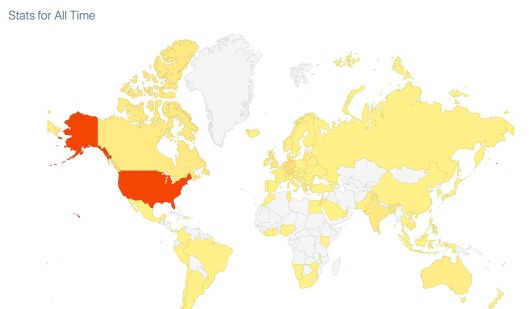
Map of Readers of Blog

Help Desk Feeds Design. 

(I really want a more general title.) People who work at “help desks” are under time pressure but there should be mechanisms in place for what they learn about customers, tasks, contexts, pain points, to be fed back to development. In a similar fashion, in any domain, whatever information is garnered from interacting face to face with uses, customers, stakeholders, friends, enemies should be fed back to people who design systems, services, products, or governance.

Queue of Communicating Peers.

In many instances, people in queue, whether physical or electronic, share certain concerns in common. (There is always common ground). Rather than have them “stand in line” staring at the back of someone else’s head, encourage them to help enhance mutual understanding among the group.

Palaver Tree. 

This name comes from some places in sub-Saharan Africa where people from a village gather to respectfully discuss what concerns the whole village. Generally, this is near a big tree that can provide shade during dry seasons. In colder climates, a communal fire can serve as the focal point. There may be other special places that are conducive to this kind of Dialogue.

Click to access jbe-thesis.pdf

Talking Stick. 

Often, when confronting a problem that is pressing, complex, or anxiety-provoking, everyone wants to talk at once. No progress is made because people cannot even hear what is being said in the resulting din and no-one is paying attention to anything but getting their own point heard. A Talking Stick provides a visible cue as to who “has the floor.” Only one person at a time can hold the Talking Stick and only they can talk.

Round Robin Turn Taking.

In a group, it often happens that a small group of people tend to “monopolize” the discussion if it is held in a free-wheeling manner. An alternative is to have an Authority Figure or Moderator or Facilitator make sure that every person gets a chance to speak and that every person, including the shiest are encouraged to give their perspectives.

Mentoring Circle. 

It is often easiest for us to learn from people who have recently faced and solved the same problems that we are now facing. A Mentoring Circle provides a way for people to learn from other individuals and from the group.

iPhoneDownloadJan152013 533

Levels of Authority.

As one becomes more experienced and more trusted by a group, it is normal to grant more authority to that person to act on behalf of the group and to have more access to its resources.

Anonymous Stories for Organizational Learning

Often individuals make errors that can provide a learning experience, not only for them, but for others as well. Unfortunately, the competitive nature of many organizations makes admitting to errors costly for the person who made the mistake. An anonymized story can provide a way for the organization as a whole to learn from individuals without their accruing blame and ridicule.  

iPhoneDownloadJan152013 955

Registered Anonymity.

In Amy Bruckman’s MIT dissertation (Moose Crossing), she provided a space for middle school kids to teach each other object-oriented programming. She wanted to make sure the kids “behaved” appropriately despite their being anonymous and on-line despite the fact that these conditions often spawn inappropriate and even mean-spirited comments. While using real identities could help prevent that, it could also lead to even worse behavior. Instead, she used Registered Anonymity. That is, she knew everyone’s real identity and made it clear that inappropriate behavior would not be tolerated. But the child participants were not allowed to share their real identities.

Answer Garden. 

People are busy and don’t want to answer the same simple question over and over. In Answer Garden, developed by Mark Ackerman for his MIT dissertation, people with expertise claimed a part of the tree of knowledge that they were familiar with and agreed to answer questions about that specific subject area. Once the question was answered however, newcomers were expect to first look through the tree for the answer they needed. If there are no appropriate answer, they would post their question at the nearest node to the requested answer. The expert would come by and answer that question, not only for the person who initially asked it, but the tree would grow with that newly posted answer as well.

fullsizeoutput_1a5a

Community of Communities. 

Complex wide-ranging problems such as ensuring that the world economy is organized to sustain the ecosystem require many people to address various problems. While a very large group of people may be concerned that they leave a livable planet for their descendants, everyone cannot work on every aspect. Better is to have communities work on those aspects for which they have particular interest and expertise. In Sweden, for example, Karl-Henrik Robert (https://en.wikipedia.org/wiki/Karl-Henrik_Robèrt) developed a program called “The Natural Step.” This led to the development of specific communities aiding in the way they best could; e.g., lawyers for a sustainable Sweden might concentrate on legislation and regulation, psychologists for a sustainable Sweden might concentrate on methods to raise public awareness; traffic engineers for a sustainable Sweden might concentrate on making more efficient kinds of roundabouts.

Special Roles for Special Purposes. 

Every culture seems to have developed this notion. There are many specific roles that have been developed for specific purposes. Below are just a few.

Master of Ceremonies. 

This is literally someone in charge of a ceremony, ritual, or rite. It has come to include an entertainer who serves to welcome guests and introduce them. A closely related concept is the “Session Chair” who introduces speakers, makes sure they have what they need, keeps track of time, and moderates audience participation.

Storyteller

In many oral cultures, one person, often chosen because of interest or ability, is chosen to memorize and repeat the oral history. In such cases, the role typically lasts a lifetime, not just a project.

Stake Warrior

The idea of a “stake warrior” is that they literally pound a stake into the ground and then tether themselves to that stake during battle. They can advance, go laterally or retreat, but only so far. Conceptually, a stake warrior shows some flexibility in discussion or negotiation, but there are boundaries beyond which they refuse to go.

DeBono’s Colored Hats. 

Edward DeBono has written a number of books about creativity and innovation. One of his ideas is to use colored hats either physically or conceptually to signal which role a person is speaking in. For example, a person wearing a Black Hat is judging ideas while a Green Hat is more for creativity and provocation. More empirical research is needed to validate whether using hats (even metaphorically) actually improves performance.

Moderator

A Moderator’s main job is to make sure that a group actually follows whatever rules it has set out for itself about time limits, civility, taking turns, etc. A Moderator may also adjudicate disputes between two sides.

Facilitator

A Facilitator’s main job is to keep the group moving forward. They might, for instance, suggest a different way of looking at a topic, or try to invoke a metaphor or to draw out less forthcoming group members.

Setting Expectations. 

Promise a person five dollars and give them ten. They will be very happy. Promise another person twenty and give them ten. The will be unhappy about it. What’s different? They both get ten dollars. Many books on developing projects will recommend “under-promising and over delivering.” In some cases, because of science fiction, TV programs, and the popular press, people may come to think anything is possible.

Support Flow and Breakdown. 

When designing a new system, there is an anticipated way for it to work, whether it’s traffic flow in a city, water flow in the plumbing or information flow in an organization. However, eventually, there will be breakdowns in any of these systems. Breakdowns are always a hassle, but they will be far less so if the possibility of a breakdown has been anticipated ahead of time and then planned for.

Ratchet Social Change with Infrastructure. 

Social changes are initially subject to falling back into previous patterns. In some cases, it may help make a social change more permanent by creating an infrastructure that supports the new system. For instance, if you want to improve relations between two countries, you could fund projects jointly that have a long completion time. Or, if you wanted to divide people, you could make it harder for people to see news and information from people across that divide.

Authority Figure. 

Sometimes, a decision needs to be made quickly. Or, perhaps consensus will never be reached. In such cases, it is sometimes useful to have an agreed upon Authority Figure who can be trusted to make an informed decision that takes into account all the relevant interests. Naturally, Authority Figure who makes decisions from a position of ignorance or self-interest must be removed as quickly as possible.

IMG_5935

Celebrate Local Successes Globally. 

Often a very large-scale collaboration project such as developing a new product or service, governing a country, or trying to manage a cross-cultural non-profit stands to lose coherence and motivation when compared with a small co-located team. One way to help both with organizational learning and with encouraging high spirits is to celebrate local successes with the global team. If done correctly, this can be motivating for both the successful team members and the larger team.

Special Processes for Special Purposes. 

This is another high level Pattern. People have developed numerous special purpose processes. Below I review a few. The reason for having different processes for different purposes is that a process can take into account the number of people, the type of goal, the time constraints, and other conditions so that a process is particularly likely to help insure success. A process can fail if it is badly executed but it can also fail simply because it is not appropriate to the task at hand.

Synectics. 

Originally, the term derived from the work of Prince and Gordon as a way to describe a suite of techniques for creative problem solving. It is similar to brainstorming in that the emphasis is on generating many ideas quickly and without taking time out of idea generation in order to evaluate and debate each idea. Also like brainstorming, people are encouraged to build on each other’s ideas. In addition, they describe various clever ways to incorporate metaphorical thinking into the process. They also allow each person to work on the “Problem As Understood” and this can be slightly different for each person. I have personally found synectics to be extremely useful. It “works” in generating many ideas, some of which can be quite useful and novel. For example, many years ago, I facilitated such a session and the foreign equivalent of the American IRS decided that increasing tax revenue was their goal but that to achieve that, there were other methods than increasing tax rates and increasing compliance.

https://en.wikipedia.org/wiki/Synectics

Speed Dating. 

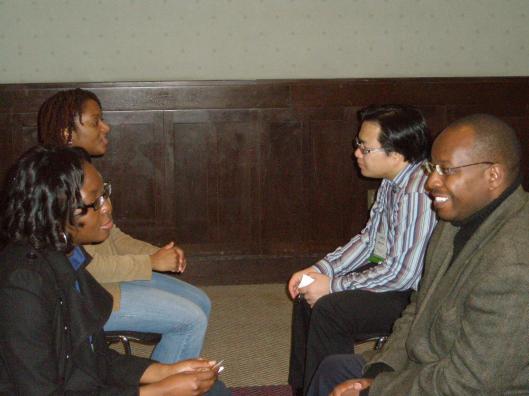
Although there are actual speed dating venues, here this term refers to a way for a moderate sized group of people to get to know each other quickly by spending two minutes with one other person in the group quickly recounting their backgrounds and interests and then moving on to form new pairs.
OLYMPUS DIGITAL CAMERA

KJ Method. 

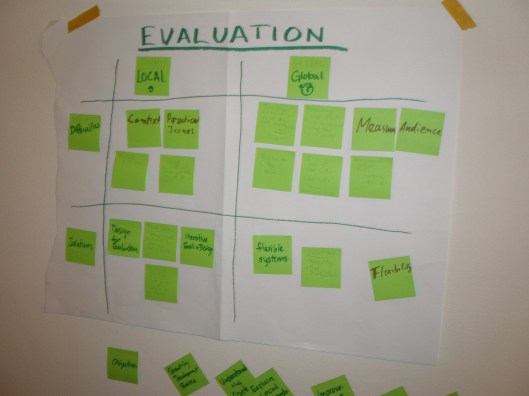
This is a way to cluster ideas. Many people are now familiar with this as a way of clustering ideas from a brainstorming or synectics session or for clustering ethnographic observations in order to later address product features and functions to address them. Basically, a large number of post-in notes are put on a wall and re-arranged by the group, some of whom may focus on a particular area of the overall cognitive map that is being build or spend their time thinking more about the whole. This method is often used, for example, in CHI Program Committee meetings to take a first pass at developing sessions. There have also been attempts to automate such processes.
OLYMPUS DIGITAL CAMERA

Rating and Ranking.

Often a large number of ideas are generated but the resources available do not allow all of them to be pursued. Therefore, a variety of voting, ranking and rating systems have been developed so that the group as a whole has input into the direction taken.

Incremental Value. 

It is difficult for people, either as groups or individuals, to move from a current way of doing things to a new one. Almost invariably, people will find the old way of doing things more “comfortable.” The transition to a new way will be much easier if there are incremental improvements in performance along the way rather than the mere promise of some wondrous new state at the conclusion of a long process of change.

Jump Start. 

Sometimes, change in an organization or process needs to be “jump-started” by providing additional incentives or special organizational support in some way.

Active Reminders. 

As people are learning new methods, processes, and skills, it is helpful to have Active Reminders so that people are less likely to fall into old habits. For example, in attempting to do brainstorming, many people find it very difficult to withhold judgment and criticism from ideas that others put forth. It can be helpful in such cases to have the “Rules” of brainstorming prominent displayed or to have someone whose role is mainly to remind people to build on each other’s ideas when someone critiques an idea.

Controlling Growth. 

While people often want their company, non-profit, or movement to grow as quickly as possible, growth without restraint is often called “cancer.” Growth needs to be controlled so that unanticipated side-effects do not destroy the entire company, non-profit or movement. People Express Airlines, for instance, is often thought to have have tanked because their success led to such rapid growth that they could not sustain what made them successful in the first place.

Expressive Communication Builds Mutual Trust.

Studies of cooperation in games such as the “Prisoner’s Dilemma” show that when people communicate something personal and apart from the game such as sharing photos, backgrounds, hobbies, etc. it tends to increase the chances of cooperation.

These Patterns (or really, more accurately, hints of Patterns, are not meant to be exhaustive. But hopefully, there are enough Patterns in this post to give readers a better idea of the wide variety of Patterns than might cohere into a Socio-Technical Pattern Language for Collaboration and Teamwork.

References: 

https://socialworldsresearch.org/sites/default/files/j-ag.final-fmt.pdf

https://www.cc.gatech.edu/fac/Amy.Bruckman/thesis/

Fincher, S., Finlay, J., Green, S., Matchen, P., Jones, L., Thomas, J.C., Molina, P. (2004) Perspectives on HCI patterns: Concepts and tools.  Workshop at CHI 2004, ACM Conference on Human Factors and Computing Systems.

Pan, Y., Roedl, D., Blevis, E., & Thomas, J. (2015). Fashion Thinking: Fashion Practices and Sustainable Interaction Design. International Journal of Design, 9(1), 53-66.

http://www.it.bton.ac.uk/staff/lp22/HF2000.html

Schuler, D. (2008).  Liberating Voices: A Pattern Language for Social Change. Cambridge MA: MIT Press.

Thomas, J. C., Kellogg, W.A., and Erickson, T. (2001) The Knowledge Management puzzle: Human and social factors in knowledge management. IBM Systems Journal, 40(4), 863-884.

Thomas, J.C. and Carroll, J. (1978). The psychological study of design. Design Studies, 1 (1), pp. 5-11.

Thomas, J. C. (2012). Patterns for emergent global intelligence. In Creativity and Rationale: Enhancing Human Experience By Design J. Carroll (Ed.), New York: Springer.

Thomas, J. C. & Richards, J. T. (2012). Achieving psychological simplicity: Measures and methods to reduce cognitive complexity. In The Human-Computer Interaction Handbook. J. Jacko (Ed.) Boca Raton, FL: CRC Press.

Thomas, J.(2008).  Fun at work: Managing HCI from a Peopleware perspective. HCI Remixed. D. McDonald & T. Erickson (Eds.), Cambridge, MA: MIT Press.

Thomas, J.C. (2003), Social aspects of gerontechnology.  In Impact of technology on successful aging N. Charness & K. Warner Schaie (Eds.). New York: Springer.

Thomas, J. C. (2001). An HCI Agenda for the Next Millennium: Emergent Global Intelligence. In R. Earnshaw, R. Guedj, A. van Dam, and J. Vince (Eds.), Frontiers of human-centered computing, online communities, and virtual environments. London: Springer-Verlag.


Thomas, J.C. (1996). The long-term social implications of new information technology. In R. Dholakia, N. Mundorf, & N. Dholakia (Eds.), New Infotainment Technologies in the Home: Demand Side Perspectives. Hillsdale, New Jersey: Lawrence Erlbaum.

Thomas, J.C., Lee, A., & Danis, C (2002). “Who Speaks for Wolf?” IBM Research Report, RC-22644. Yorktown Heights, NY: IBM Corporation.

Thomas, J. C. (2017). Building Common Ground in a Wildly Webbed World: A Pattern Language Approach. PPDD Workshop, 5/25/2017, San Diego, CA.

Thomas, J. C. (2017). Old People and New Technology: What’s the Story? Presented at Northwestern University Symposium on the Future of On-Line Interactions, Evanston, Ill, 4/22/2017.

Greater Gathering

08 Thursday Feb 2018

Posted by petersironwood in America, management, psychology, sports, Uncategorized

≈ 3 Comments

Tags

Business, collaboration, cooperation, coordination, innovation, pattern language, social capital, sports, teamwork, trust


IMG_9267

Greater Gathering.

Author, reviewer and revision dates:

Created by John C. Thomas on Dec. 11, 2004

Reviewed by <> on <>

Revised by JCT on Feb. 7, 2018.

Prologue and Acknowledgements. 

This pattern can be found in many teams, companies, NGO’s, families, and religious organizations. If you are interested in how this happened to strike me as a pattern, feel free to read this section Otherwise, you can skip it. I began to notice this pattern after two events happened to coincide.

While working at IBM Research many years ago, I played in an inter-company tennis league in Westchester County, New York. During those matches, I met many IBMers from outside of IBM Research. One of the people I met worked in the corporate tax department. In those days, long before Google, we used a Key Word In Context system (ITERC?) to scan for potentially useful documents. Every week, I would get a long list of abstracts based on my list of keywords. This system was not nearly so accurate as what many of us have access to today. While there were many “hits” for me, there were also quite a few false positives. For example, I was interested in the psychological process of “induction” – learning a rule based on examples. I often got abstracts, however, about “induction motors.” One day, I got one of those “false positives” about a new tax law that allowed highly profitable companies like IBM to “trade” tax liabilities with companies who were struggling like the tire companies in my home town of Akron. According to the abstract, it was in the financial interests of both companies to use this “trading” mechanism. I had little interest in it, but I liked the guy I had met from corporate and we had traded contact information for tennis purposes. I sent him the abstract. As it turned out, this was precisely applicable to IBM and saved them a lot of money.

At the same time, I was reading about the history of IBM and particularly thought it interesting that they had put so much time and effort into the 100% club meetings. This was a country-wide meeting to bring together sales people from all over the US who had met or exceeded their sales quotas. I was never in sales, but even at Research, we had “annual picnics” in which everyone in IBM Research was invited to come with their families. As I began thinking about it, I realized that these kinds of “larger gatherings” were common across many different cultures, domains, and types of groups. The tax example showed a very specific financial benefit to the IBM company but I realized there were many other potential benefits as well.

IMG_9895

Synonyms:

Conference. Congress. Convention. Jamboree. National Holidays.

Abstract:

When moderate to large groups work to solve large, complex problems, it is often necessary for them to subdivide the work into distinct subgroups. This results in the group being more efficient and effective. However, it also means that each group comes to develop their own vocabulary, search for people who are particularly good at certain things,  and in various other ways, the people within the subgroup communicate a lot, come to trust each other, and have clear common interests. They are often at conflict with other subgroups for resources. In addition, there is less trust across these organizational boundaries than within such a boundary. Often, the people themselves come to be somewhat different kinds of people. Large effective groups therefore participate at least annually in a “Greater Gathering” which allows people to meet and co-mingle across these organizational boundaries. These meetings are constructed to emphasize “common ground” within the larger group. As a result, new lines of communication are lined up; mutual trust is enhanced; sometimes, real problems are solved.

Problem: 

As large, complex problems are broken down into pieces and assigned to different groups, efficiency and effectiveness increase. Not only that, the individuals within each of these various subgroups typically grow more trusting of each other within that sub-group.  They learn about each other’s skills and motivations, so over time, the sub-group as a whole grows more effective and efficient.

However, this high intra-group cohesion comes at a price. People in one part of an organization consider themselves the “in-group” and may begin to limit their learning because of a lack of diversity in that one perspective. Furthermore, they may come to work so hard to solve their own sub-problem that they lose sight of the larger problem and make sub-optimizing decisions. In some cases, the ideas of various subgroups about how to handle something will differ and result in conflict. Even worse, sometimes, decisions made in Group A help them a little but make life for Group B much more difficult and make the overall objective of the group, whatever it is, more difficult to achieve and no-one ever realizes it. There may be lack of trust between different sub-groups or even outright mistrust among sub-groups. Often sub-groups that are “at odds” with each other, not only have different management chains and objectives; they may also be geographically apart; they may be from different cultures; they may be of different professions, etc. For these reasons, a suspicion may grow over time while mutual trust diminishes. Information sharing becomes strained. The overall organization is not doing as well as it might nor are the people within that organization doing as well as they might.

IMG_9320

Context: 

A group of people has been attempting to accomplish some task as effectively and efficiently as possible. In order to do this, one common method is to breakdown a large, complex task into smaller, less complex tasks. Often, those people working on a subtask naturally spend more time with others on that subtask than on other subtasks. It naturally occurs in this context that since people spend a lot of time together, they may develop common interests and also spend leisure time together as well. Sharing common sub-goals, physical contexts, and leisure activities as well as working on the same subtasks may eventually lead to an “in-group” feeling.

Over time, these subgroups develop different methods, procedures, values, customs, terms of art. They become, in a sense, different sub-cultures. But just as cooperation and communication can be trickier when two historical cultures are involved, so too, it can more difficult for, say, someone from each of the legal department, the accounting department and the R&D department to understand each other than, say, three accountants. Sometimes, various departments actually want the same thing. They simply don’t know it because they are speaking different languages.

Some degree of “antagonism” of purpose is often built in to the organization. The R&D department will ask for more money. Finance will say no. But these kinds of one-sided or even two-sided or multi-sided competitions are much healthier both for the organization and its people if they are done with respect and rules. Having completely different sub-cultures can enhance the difficulty of such negotiations.

Forces:

*People are naturally gregarious.

*People working on a common problem often bond as well.

*People working on a common sub-problem often lose sight of the larger problem.

*Social sanctions can lead to a lack of diversity of perspectives.

*All people share certain basic drives.

*Shared special events help build social bonds.

*People enjoy novel experiences and viewpoints, under some circumstances

*An expectation of what happens (based on story and experience) can help mold what does happen.

  • The possibility of one person harming another and not doing so increases mutual trust.
  • Shared experiences tend to increase mutual trust.

Solution:

All the sub-groups that need to cooperate in a larger group should get together periodically for a meeting of “Greater Gathering.” This should be periodic and structured. Activities need to be formulated that help everyone visualize and experience common ground. Eating, drinking, dancing, singing, athletic contests, and other physical activities should also be included since these are experiences people will relate to and enjoy regardless of which sub-group they belong to or which sub-problem they are working on.

OLYMPUS DIGITAL CAMERA

Examples:

Companies generally used to have many of these events when such companies were run by people who cared about the companies and the people within those companies rather than simply caring about using companies as a tool to enhance the power and wealth of a few. For example, when I first joined IBM, they sponsored many sports leagues within IBM Research including tennis, golf, softball, and soccer. Furthermore, they participated, as in the prologue of this pattern, in sports leagues across nearby IBM locations which included sales, CHQ, Engineering, Programming and Technology, Marketing, and Advanced Ad Tech. Every year, there was an elaborate company picnic. There was a Holliday Party and fairly frequent less formal award ceremonies with refreshments. There were also numerous recognition events which were attended by people outside your sub-group.

Other examples are numerous. Boy Scouts and Girl Scouts have national Jamborees. Families have extended family reunions. Sometimes, these can be at a civic level such as Mardi Gras or a local annual parade that most people work on or attend.

I’ve been very active for a long time in a group called “CHI” for “Computer-Human Interaction.” It’s a Special Interest Group of the Association for Computing Machinery. (ACM). Anyway, the people who do research in this field are scattered across the globe. They work for different university departments or companies or non-profits or governments or as individual consultants. We have full professors and undergraduate students; we have people with original backgrounds in electrical engineering, philosophy, psychology, design, architecture, fine arts, English, human-computer interaction, mathematics, mechanical engineering and many more. Some are doing research whose application is out at least 20 years and others are worried about whether their start-up will survive the quarter. Some work for giant multi-nationals and others are one person companies. Every year, we have a rather challenging conference where all of these folks are invited. The conference centers around the technical program, but there are also many things meant to provide a larger gathering; to foster mutual trust; to have a great time together so that we can better respect each other, communicate more effectively and achieve common goals.

fullsizeoutput_1b3b

Resulting Context:

The result of the first example above is that people throughout IBM at that time almost universally thought of themselves as IBMers rather than someone from the accounting department. What this meant was that there was a high level of trust for people from other parts of the company. I’m not saying it was perfect but it was much higher with more people honestly trying to do what was best for the company rather than what was best for them or their immediate manager. Now, that’s largely reversed. Of course, it’s hard to know how much is due to the “cutting out of all the fat” like annual picnics and sport’s leagues.

In the second example, Boy Scouts get a chance to see that people of different shades of skin, creeds, geographical locations share a lot in common.

In the third example, the CHI conference continues, I believe, to be an important reason that people in such a wide variety of circumstances can collaborate and communicate so well.

Rationale:

It is easy to imagine that people we rarely or never see are not only different from us superficially, but that they are different in essence. If you meet people from various parts of your organization in a neutral informal situation that stresses your commonality such as a picnic, a sporting even, an ice-cream social, or a walk-a-thon, you will see that you have some common ground, trust, and makes communication easier.

IMG_3898

Related Patterns:

Conversational Support at the Boundaries.

Known Uses:

Metaphors: 

Many species go to a common place at least annually. We humans attribute this to the benefits of cross-fertilization or more global competitions in survival of the fittest. Is it also possible that they are also exchanging information that is useful for the species as a whole?

Fable: 

I think I will defer, at least temporarily, to that excellent fable of Norton Juster’s: The Phantom Tollbooth. In that fable, Rhyme and Reason are banished to separate kingdoms and the results are not good.

References:

The Iroquois Rule of Six

03 Saturday Feb 2018

Posted by petersironwood in management, psychology, Uncategorized

≈ 15 Comments

Tags

Barnga, collaboration, cooperation, coordination, Iroquois Rule of Six, Native American, pattern language, teamwork

IMG_5031

Iroquois Rule of Six

Prolog/Acknowledgement: 

The idea for this Pattern comes from the work of Paula Underwood who was the designated storyteller for her branch of the Iroquois (See references below). Of course, even she would not claim to have invented the pattern which grew out of long cultural experience.

Author, reviewer and revision dates: 

Created by John C. Thomas on February 2, 2018

Synonyms: 

Don’t Jump to Conclusions, Sympathetic Reading, Give Others the “Benefit of a Doubt,” “Look before you leap!” “See the Whole Elephant”

Abstract: 

Human beings are very complex and we only see snippets of someone else’s behavior. Yet, we are trained that it is important to quickly interpret why someone else is doing something. By the time we’re adults, when someone does something that violates our expectations, we tend to come up with an “explanation” very quickly. Furthermore, we tend to treat this explanation or interpretation as fact when, in many cases, we have only a very small amount of actual data to depend on. A misinterpretation of someone’s motivation can quickly cause bad feelings on everyone’s part. Therefore, according to the Iroquois “Rule of Six,” before you act on the basis of your initial interpretation, you are advised to think of at least five other interpretations and try to gain evidence about these six or more hypotheses before taking action.

Problem:

Groups function better under a wide variety of circumstances if there is a high degree of internal mutual trust. If people work together over a long period of time, trust will develop if warranted. While we sometimes know some of what’s going on in someone else’s life, we only know a very small proportion of what is going on, even if it’s someone we are very close to and spend a lot of time with. In work groups or teams, the proportion of the whole of someone else’s situation that we see is very small indeed. This is even more true when we are trying to work in a new or ad hoc group. We feel it’s important to understand the motivations of others and what they are likely to do. Often, we therefore jump to conclusions about others that are far from the truth. When we act on such incorrect premises, it can derail progress toward solving a problem and damage trust and relationships for the future as well.

Context: 

Complex problems and large problems can often only be solved by groups. For the group to work well together to solve ill-defined or wicked problems, it is useful for them to understand each other’s situations and motivations. We generally come to expect others to do certain things based on logic, authority, agreement, trust, the current situation and other factors. In fact, it’s often hard to understand even our own motivations or to predict what we ourselves will do in novel situations.

People are often in a hurry to make progress on solving problems. Thus, when someone does appear to violate our expectations, we are tempted to come up with a “reason” for their behavior. However, because people are complex and situations that require cooperation and coordination are also complex, we seldom actually know why a person does something. There are things about them that we may be unaware of such as their physiological state (e.g., tired, sick, on drugs, low blood sugar). There are also things about their situation that we are unlikely to know about (e.g., time pressure, lack of appropriate training, unusual experiences, knowledge beyond our ken).

People find it very difficult to operate in a sea of ambiguity and therefore seek to find explanations and clarity very quickly. Unfortunately, people therefore tend to jump to a conclusion about someone else and that conclusion can then blind them to further information about that person, particularly when the new information is at odds with the initial impression.

IMG_6744

Forces:

  • Everyone comes to expect certain forms of behavior from others in a specific context.
  • The expectations of any one person are primarily based on their own experiences.
  • The behavior of any other person is largely based on that person’s experiences.
  • The behavior of another person can also be heavily influenced by that other person’s situation.
  • Each person only knows a small proportion of another person’s situation.
  • When faced with another person’s violation of expectations, people tend to quickly generate an explanation of why that person did what they did.
  • Because of “confirmation bias,” once a person comes up with an explanation of anything (including why someone did something), they tend to look for evidence to support their initial explanation.

Solution:

When a person comes up with an explanation of someone else’s behavior, they should generate at least five other hypotheses and then seek evidence for and against all six hypotheses before taking action.

Examples: 

1. A babysitter is put in charge of an infant. The baby cries and the babysitter assumes it is hungry and feeds it. Yet, the baby keeps crying. The babysitter assumes it is still hungry and tries to feed it more but the baby refuses food and keeps crying any way. She tries a variety of foods but the baby doesn’t seem to like any of them. Rather than assuming that the baby is hungry and keep trying to find a food the baby will like, according to the Iroquois Rule of Six, the sitter might consider other hypotheses; e.g, the baby might have gas, have a wet diaper, be sick, miss her parents, or (as was actually the case) have a diaper pin stuck through her skin.

2. You have an important project meeting with Jerry Jones on your calendar for 10 am in room 435. You are sitting at the table but Jerry Jones is nowhere to be seen. The clock on the wall says 10:10. Still no Jerry Jones. You think to yourself, “Well, okay, fine. Obviously, Jerry doesn’t really care about this project.”

That kind of thought is a normal human reaction. Unfortunately, once the thought occurs to you, it is easy to now treat your interpretation of events as a fact about Jerry’s commitment to the project.

The Iroquois recognized this tendency and the “Rule of Six” suggests that before taking any action, you should first generate at least six interpretations, not just one. In this particular hypothetical case, several come to mind.

  1. Jerry doesn’t care about the project so he’s not coming or doesn’t care how late he is.
  2. Jerry comes from a culture where 10:10 is not actually late for a 10 am meeting.
  3. Jerry was unattainably delayed.
  4. You wrote down the wrong room for the meeting.
  5. You are not actually in room 435.
  6. You are in room 435 but in the wrong building.
  7. You wrote down the wrong time.

  8. The clock on the wall is wrong.
  9. You wrote down the wrong day for the meeting.
  10. 10. Jerry sent you email asking to change the meeting time but you didn’t check your email.

3. You and your tennis doubles partner are in a crucial match. Your partner keeps serving up weak second serves and your opponents both keep running around their backhands and zinging heavy forehand shots at your body. You’ve already been hit twice because you cannot react quickly enough even to defend yourself. You conclude that your partner must be trying to get you killed and you tell them so. In this case, despite your interpretation, it seems exceedingly unlikely that your partner is literally trying to get you killed. If they are, this is a singularly ineffective way to do it. In fact, despite your having said this to your partner, it’s unlikely you really even believe it yourself. But even thinking this may have several bad effects. First, having told your partner this is bound to make them trust you less. Second, it will make your partner more up-tight and probably make an even worse serve or double fault more likely. Third, it prevents you from finding out what might really be going on. For some odd reason, even though you know in your heart that it is not a likely explanation, the mere having of the thought (and even more so telling your partner) actually makes it less likely that you will try to find more reasonable interpretations. Fourth, it keeps you from working with your partner to find a solution. Other (and, in this case, much more likely partial explanations) include:

  1. Your partner wants to avoid having you hit at the net so badly that they keep trying to hit an ace on their first serve.
  2. Your partner wants to avoid a double fault at all costs so “powder puffs” their second serve.
  3. Your partner has a sore shoulder.
  4. Your partner thinks your opponents like pace and that a slow serve will throw off their timing.
  5. Your partner thinks your opponents are overhitting the returns of their second serves and that the balls would fly way long if you would just duck or get out of the way.
  6. Your partner knows that you want to improve your net game and thinks you will enjoy the challenge of hard hit balls and eventually improve your net game.
  7. Your partner is really being bothered by the sun right now and is finding serving very difficult because, no matter how they try their toss is right in the sun.
  8. Your partner knows that you want both of you to be at net as soon as possible and is therefore concentrating to hard on rushing the net that they are not paying enough attention to first finishing the service motion itself before charging to the net.

In this tennis example, imagining your partner wants to kill you does not suggest any appropriate action to fix the problem. Possible actions that might help you win the tennis match could include getting your partner to hit a slightly less aggressive first serve and a slightly more aggressive second serve, making sure that they know that even thought it’s obviously not desirable to double fault, it’s not the world’s greatest sin either; asking your partner if they are okay physically and if not, coming up with a different plan; playing back on the second serve; moving more at the net to distract your opponents during the return; lending your partner your sun glasses; playing Australian (squatting near the center of the court and signaling your partner which way you will go right before they serve); making sure that your own serve is as different as possible from your partner’s serve thereby making both your serve and theirs more difficult to return; at the outset of the next set, test out more carefully which of you should be serving into the sun.

IMG_1428

4. Although generally conceived of as a useful “best practice” in teams or groups, this “rule” can also be applied when it comes to problem solving in general. In particular, it could be particularly useful when resolving issues among two different groups, tribes, companies, or countries. While you pretty much know that the idea your tennis partner is trying to kill you is silly, if you’re part of a group of people who repeat such preposterous stories to each other enough, you will strongly come to believe such stories as the only possible explanation. Thus, a negotiator may try to bring about peace, or at least a ceasefire, between two warring parties, A and B. A thinks to themselves, “OK, I’ll sit down and talk but I know damned well B’s real purpose is to destroy me.” Meanwhile, of course, B is thinking, “OK, I’ll sit down and talk, but I know damned well A’s real purpose is to destroy me.” Ideally, you would like each side to consider the Iroquois Rule of Six. In fact, although this will be discussed in much more detail later, the very fact that they both distrust each other so much could be the initial starting point for finding common ground. Perhaps applying the Iroquois Rule of Six is something they could work on together. They might agree that there could be other motivations for X to fight Y aside from X trying to destroy Y and vice versa.

5. In a workshop I co-organized on “Cross-Cultural Issues in Human Computer Interaction,” we used a card game called Barnga (http://www.acadiau.ca/~dreid/games/Game_descriptions/Barnga1.htm)

In this game, much like Bridge, Whist, Eucher, people play a car in turn face up and the one with the “highest” car wins that “trick” (those four cards). The participants are shown a brief description of the game but not allowed to talk (to simulate the difficulties of cross-cultural communication). This is meant for groups of at least 12 in which case you would divide the 12 into 3 tables of four each. Each table plays for awhile and then the winners and losers move respectively “up” or “down” one table. So far, the participants at each table have been playing by the same set of rules. However, the three tables have three different sets of rules. For instance, at one table there is no trump. At another table spades are trump. (The 2 of a trump card beats any non-trump card). At another table, aces are the lowest car in the deck rather than the highest. Now, people who have learned and operated under different sets of rules try to play together. Well, of course, two people will both reach for the same “trick.”

What is interesting in the context of the Iroquois Rule of Six is that people almost always had one of two first thoughts: “What is wrong with that person? They’re so stupid!” or “What is wrong with that person? They’re such a cheater!” Remember, that these were people who had come together from around the world precisely to talk about cross-cultural issues! And, yet, not only was their first interpretation wrong, it impugned the other as being evil or incompetent. Most people from every culture do follow the rules of that culture. Rules often differ from culture to culture. Thinking about the Iroquois Rule of Six may help you remember that.

OLYMPUS DIGITAL CAMERA

Resulting Context:

Generally speaking, the application of the Iroquois Rule of Six will tend to greatly lessen the chances that teamwork will be disrupted by bad feelings. In addition, if one takes the time to consider and gain evidence about alternative hypotheses, one will learn more about others and base decisions on fact rather than fantasy. Having a wide range of hypotheses, even when it is difficult to gather enough evidence to prove conclusively which one is correct, will greatly widen the scope of consideration of various solutions. In adversarial situations, the Iroquois Rule of Six might at least move people to consider bargaining on the basis of actual needs and desires rather than pre-established positions based on misinterpretations of another groups motives.

Of course, I do not mean to suggest that all conflicts are based on misperceptions of someone else’s motives. In some situations, a finite resource may be in contention by multiple parties. (Even here, it’s possible for the three to agree on a scheme of determination; e.g., rotation, lottery, third-party adjudication, etc.).

Rationale:

Actions are always better based on reality than on fantasy. Yet, humans often latch onto a particular interpretation of events very quickly and with insufficient data. The Iroquois Rule of Six reminds people to generate alternative hypotheses and gather evidence before acting.

Related Patterns: 

Reality Check, Check-In.

Known Uses:

Science often approximates doing business in a similar spirit. Scientists are subject to the same sort of “jumping to conclusions” as is everyone else. During their training however, mentors, colleagues, students, professors, and journal editors will constantly be asking the fledgeling scientist to consider various other hypotheses and not simply be satisfied with the first one that pops into mind. In addition, the scientist will be shown how to find evidence capable of disproving their hypothesis.

In Rational-Emotive Therapy, the therapist often tries to get the client to consider alternatives and consequences. Among the alternatives that need most to be encouraged are attributions about other people’s motives.

In Gerri Spence’s highly recommended book, How to argue and win every time, he suggests that when someone in your family is angry with you, rather than getting angry back, instead, you “follow the hurt.” Try to discover what is hurting them. This is not precisely the same idea as The Iroquois Rule of Six, but it seems a cousin. Your initial reaction to anger is often anger. Along with that emotion typically goes some negative attribution about the other person; e.g., “What an A-Hole!” “You’re such an idiot!” “I didn’t put your sweater back? Yeah? How about the time you wrecked my bike?” Rather than sticking with these first impressions, try to uncover what’s really going on. By focusing on the real problem, rather than being blinded by your own emotional reaction, you’ll be more likely to work on a team to solve the underlying problem.

Metaphors: 

The strongest metaphor that leaps to mind is life itself. No form of life continues to make unaltered copies of itself forever. There is always variation in the next generation. Life never “sticks” to only one hypothesis.

The second metaphor is human learning. Although it’s annoying that I cannot ever seem to “perfect” my tennis stroke, by the same token, human motor behavior always has some “variation” in it. As we learn to gain more and more skill, we tend to keep those variations that are better. (There are limitations to this approach, but in the current context, the point is that we are not robots and never stick to precisely one way of doing things).  

References: 

Spence, G. (1995). How to Argue and Win Every Time: At home, at work, in court, everywhere, every day. New York: St. Martin’s Press.

 Underwood, P. (1993). The Walking People: An American Oral History. San Anselmo, CA: Tribe of Two Press.

Underwood, P. (1994). Three Strands in the Braid: A Guide for Enablers of Learning. San Anselmo, CA: Tribe of Two Press.

Meaningful Initiation

29 Monday Jan 2018

Posted by petersironwood in America, management, psychology, sports, Uncategorized

≈ 2 Comments

Tags

Business, collaboration, coming of age, cooperation, coordination, Design, initiation, life, pattern language, ritual

Meaningful Initiation

Prolog: 

I have mixed feelings about the phenomenon of “initiation.” I’d be very interested to hear about other people’s experiences, intuitions, and studies related to this very common social phenomenon.

IMG_1033

Author, reviewer and revision dates: 

Created by John C. Thomas on January 29, 2018


Synonyms: 

Appropriate Initiation

Abstract: 

Persistent social groups typically require people who want to join the group to pass an initiation ceremony, rite, or test. Some of these “initiations” include meaningful tests of skill, knowledge, or loyalty. Such initiations prevent people who are deemed unworthy or not ready from joining the group. This has several additional effects. People who pass the initiation, especially if it is severe, value the group more. The initiation also tends to prevent people who do not really value the group enough (or even seek to subvert it) from joining. In addition, people who have no interest in joining the group may also value it more highly if they know it is difficult to join. Initiations may be severe by virtue of having the test of skill itself be difficult, or by requiring endurance, pain, or embarrassment on the part of the would-be joiner.

Problem:

Groups function better under a wide variety of circumstances if there is a high degree of internal mutual trust. If people work together over a long period of time, trust will develop if warranted. However, often even a newcomer to a group can cause chaos and mistrust due to lack of experience, competence, or in some cases, intentionally. Groups therefore need some way to ensure that everyone in the group is minimally competent, values the group and works for the group’s benefit, not just their individual benefit. It’s important for the group work that everyone value the group and trust each other.

Context: 

Complex problems and large problems can often only be solved by groups. For the group to work well together to solve ill-defined or wicked problems, they need to have a common way of communicating, have knowledge of what each other knows, and have a high degree of trust. At the other extreme, consider slaves chained to their oars, slaves picking cotton, or even volunteers, each of whom scans a very small pre-assigned segment of the night sky. In these cases, someone outside the group is typically “in charge” and the cooperation and coordination required among the members of the group is determined, not by the group, but by an overseer. As the problem space becomes more complex however, it becomes more and more necessary for the group to be able to re-prioritize, re-arrange how they work together, and even for fundamental values and goals to evolve. In these latter contexts, it is very important for the group members to share common experiences and trust each other.

In some cases, the normal progression of education, joining a sports league or becoming a full-fledged member of a profession has an initiation aspect even if its accidental. For instance, becoming a tennis professional will require submitting to the requests of coaches and doing a lot of repetition of the fundamentals. It may also require many hours of working out for flexibility, strength, balance, and cardio fitness. In addition, as the person gains skill, their opponents and the venues will tend to produce more and more stressful situations that must be mastered in order to progress to the next level. Similarly, to become a medical doctor requires hundreds of hours of study as well as practical, hands on experiences which will typically require higher and higher levels of skill and stress. Sometimes there are actual specific ritual initiations in addition, but sometimes the structure of the profession itself serves an initiative function.

fullsizeoutput_1164

Forces:

  • If someone works harder, or suffers more pain or embarrassment to be accepted into a group, they will tend to value the group more (though this findings has not always been replicated).
  • For groups to work well together, they need common ways to communicate.
  • Common experiences tend to increase mutual trust.
  • For many groups, it is vital that the members of the group are selected so as to have adequate speed, strength, vision, courage, training, skill, or other characteristics.
  • Groups which are perceived to be very difficult to join may be viewed as being higher prestige than those which are easy to join.
  • Groups with higher prestige may enjoy more benefits from the larger society such as special laws, exceptions to general regulations, or a better pool of candidates.
  • Some people may use the excuse of an initiation in order to satisfy their own need to inflict cruelty on others regardless of the impact of that cruelty on the individual being initiated or on the effectiveness and cohesion of the group.

Solution:

Before someone is allowed to join a group, they have to “prove themselves” by undergoing an initiation. This insures they have some minimal qualifications. It also increases the strength of loyalty, social capital, and trust within the group. It may also increase the “cachet” of the group among others.

Examples: 

As Royal Dutch Petroleum was nearing its hundredth year of existence, they commissioned Aries de Gues to find out whether corporations ever existed as long as a century and if so, what were the characteristics. He found that indeed, there were companies that old and they had four common characteristics. One was a high degree of mutual trust. A second was “strong boundaries.” This latter characteristic meant that it was difficult to join such companies and people tended to stay for a long time. Both these characteristics are logically related to having meaningful initiations. (The other two are not strongly related to this Pattern; Tolerance for Exploration at the Edges and Financial Conservatism).

IMG_3898

See link for examples of religious initiations: https://en.wikipedia.org/wiki/Religious_initiation_rites

Many so-called “primitive” cultures had initiations and rites of passage. Here are a few references.

https://www.artofmanliness.com/2015/09/30/lessons-from-the-sioux-in-how-to-turn-a-boy-into-a-man/

https://mightywrites.wordpress.com/2012/02/21/maori-ta-moko-a-ritual-of-passage-a-study-of-tattoing/

http://www.maasai-association.org/ceremonies.html

https://video.nationalgeographic.com/video/us-apachegirl-pp

Resulting Context:

Presumably and hopefully, the resulting context is a self-sustaining group over time whose members trust each other, communicate well, and highly value their group membership.

Rationale:

Initiations are supposed to have these benefits: 1) The initiation screens out anyone who is incapable or not sufficiently interested to undergo bad things in order to join the group. 2) The initiation causes members of the group to value the group more highly. 3) The initiation provides a common experience that all group members can share. 4) The initiation may make the group seem more “selective” to people outside.

Related Patterns: 

Special Roles; Strong Boundaries; Levels of Trust; Bell, Book, and Candle; Apprenticeships; Official Sanctions of Competency.

Known Uses:

College fraternities and sororities, clubs, sports teams, commercial groups in many settings, military groups, religious groups, and professional societies among others, all require tests and/or initiations before one becomes a full-fledged member. In some cases, such as a Ph.D. dissertation and defense, the “initiation” is mainly a test and an educational experience, but there is often an “endurance” aspect as well. While college fraternity initiations may include tests of knowledge of the participants; e.g., about the fraternity, it’s origins and members; it seems mainly to require the pledge to endure humiliation, discomfort, endurance and sometimes physical danger.

Known Misuses:

(Note: This is not a standard section in the Patterns of a Pattern Language. In this case, I think it’s important. While I do think this overall Pattern can be a useful one, it is particularly prone to misuse as well. I’d like to hear other people’s thoughts and experiences of initiations and what could be done to insure that this is a positive pattern.)

College fraternities in particular are known for so-called “hazing” that sometimes results in deaths. The most common cause of death is from drinking too much alcohol in too short a period of time.

Although part of what internships for medicine do is teaching and testing the ability of doctors to handle pressure, the schedules and attitudes often seem to include an element of cruelty and possibly even danger to the health and well-being of both interns and patients. Many professionals in other fields as well have experienced abuse of one sort or another from superiors during or associated with such tests.

In the movie, A Few Good Men, a commander orders a “Code Red” on a recruit who has repeatedly fallen short in various physical tests. The recruit dies. It turns out that his inability to perform some of the physical requirements of Marine training were because of an undiagnosed heart problem. This is at least arguably an example (albeit fictional) of initiation gone horribly wrong. Even though the fallen soldier was “in” the Marines, he was still in basic training which consists of a combination of skills training, conditioning, and repeated “initiation rituals.”

IMG_5348

When I was a Boy Scout, my “initiation” consisted of supposedly being branded by a hot poker. Three of us were to be initiated during a week-end long camp outing. The kids who were already in the troop were in the main common room and we three were told to wait our turn in another, smaller room. The main room had a roaring fire and fireplace tools including a poker. I volunteered to go first. I was blindfolded and led into the main room where I had to lay down on a bench next to the fire. My shirt was pulled up and after a few minutes, when my torso felt hot from the fire, an ice cube was laid on my stomach. As you can easily verify for yourself, if you sense both hot and cold at the same time, it produces a burning sensation. I was instructed to scream bloody murder for the benefit of the guys still in the other room. As best I can recall at the time, I had been fairly well convinced that I was not actually going to be branded. (But either way, I thought it better to go first). For one thing, I had been swimming with all these guys and never noticed any kind of a scar that would be consistent with being branded with a hot poker. The second guy went through a similar procedure and was also told to scream bloody murder. After his “branding” the troop members took a towel and put ketchup on it to simulate blood. They took this in to show the third and last one of tonight’s “initiates.” The two of us who had already been initiated still moaned mournfully as though in pain, as per our instructions. When the boys went to blindfold and bring the last initiate in however, he completely freaked out. He not only refused; he fought as though his life depended on it, punching, kicking, biting, and otherwise wreaking mayhem on the older and larger boys who were trying to subdue him for the initiation. Realizing how extreme was his fear, they tried to intimate that he was not really going to be branded but this last boy was far too wound up to pay attention to what was being “intimated.” The troop eventually gave up on his initiation. That boy was seriously traumatized. I can’t really say whether he ever believed us that no-one really meant him physical damage, but he never looked any of us in the eye again or spoke much during the remainder of the camping trip. He never asked for another go at an initiation and, to the best of my recollection, everyone else in the troop felt very bad. Rather than increase social cohesion in the group, this misadventure backfired completely. Whatever the reason, this particular troop soon disbanded. This example serves as a cautionary tale about “initiations” because none of the people involved foresaw this particular outcome or were operating out of conscious cruelty.

Early in high school, I got a volunteer job as a “Y leader” at the local YMCA. I basically taught and supervised younger kids in basketball and various fitness tests. My manager was a young man probably in college. He said I would have to pass a “test” first which consisted, basically, of doing a chore for him; I was supposed to go to a nearby department store and pick up a shade that he had bought and paid for. I went to the department store but no-one in the drapery department had the least knowledge of this guy and the shade he had supposedly bought. I had to return empty handed and figured I had failed my “test.” He explained, however, that he hadn’t bought window shades but lamp shades. Back to the store I trudged and returned with his lamp shades. It all struck me as weird and irrelevant to my job as a Y-leader. But there was more to come.

In order to be fully admitted into this little “club” of the Y-leaders we had to go through an initiation. We had several weeks to memorize every athletic record of that local Y, as well as their times or weights or distances. There was also additional material about the procedures and the hierarchy of the YMCA and so on. Then, we came to the initiation night. I think there were four of us who were initiates. We initiates took turns and had to answer questions given by this same manager mentioned above. While doing this, we stared into a very bright light. He was behind the light so that I could only see a slight shadow of the outline of his head. He and the rest of the Y leaders called us “worms” during this little ritual. On the other hand, the initiates were supposed to begin and end each of our utterances with “sir.” Well, I hadn’t really cared much about the material and quickly got three wrong. Now, I was given a choice: I could either delay being initiated and try again next month, or I could take 40 whacks with a wooden paddle. I opted for the 40 whacks. I had been paddled before with wooden paddles, but never more than a few times.

As I soon discovered, there was another crucial difference. My other paddling had been by teachers. Although they certainly wanted to make the paddling punishment hurt, they also certainly wanted to avoid a lawsuit. Although back then, lawsuits were not so plentiful as raindrops, there were some. In any case, I don’t think any of them actually wanted to physically injure us. This paddling was done by all the boys who were already Y leaders. This paddling was done by my peers. They were not adults but young teen-aged boys. As they took their turns, a few went easy on me and most hit fairly hard — around “teacher” velocity. Two brothers, however, had some kind of sadistic streak. They took several steps forward during the “wind-up” and swung the paddle with both hands like a baseball bat. Anyway, I “passed” the initiation. My backside was black and blue however, not just on my buttocks, which I would have been capable of hiding, but also on the back of my thighs. Two of my co-initiates also received 40 whacks. The last guy had taken the task very seriously and knew an incredible amount of trivia about a bunch of local athletes. But as he answered question after question, the manager simply made the questions more and more obscure, venturing well outside the scope of what we had been told we needed to learn. I realized that the point of the whole exercise was not to have us learn anything but to get to have us paddled. At last, the last boy got three wrong, but to my surprise, when it came to the question, he said he would study again for next month.

Eventually, my parents found out (because the bruising was visible, not just on my buttocks but all the way down the back of my legs) and complained to the Y about this whole initiation. Again, this “initiation” seems to have backfired in every sense. One has to wonder whether overly powerful initiation rituals are also part of why sexual abuse and child abuse often go unreported when it occurs in certain tightly knit groups. Initiation is a tool that needs to be used appropriately, carefully, and protected from the misuse of those who are really interested in inflicting cruelty to others merely under the ruse of carrying out an “initiation.” Need initiations be “secret”? They often are and this increases the tendency for them to be subject to perversion from being what is potentially good for the group into a private exercise in cruelty.

Metaphor:

A sperm cell, whether human animal or flowering plant, must be healthy enough to traverse some distance before getting to an egg. It then has to penetrate the cell wall of the egg. While we do not expect the sperm to therefore “value” the joining with the egg, this process does perform a kind of screening function.

In some team competitions, there are a series of “rounds” before the final round. One could think of these earlier rounds as a kind of trial that has some aspects of initiation. Only the best teams continue on in further into the tournament. In addition, it probably also has the effect of increasing social capital within the team.

Apprenticeship programs often require new apprentices to perform the most menial tasks. This process of gradually assigning more responsibility as the initiate gains more skill is necessary for safe and productive work, but it also may partly serve an initiation function as well.

IMG_0327

References: 

Aronson, E., & Mills, J. (1959). The effect of severity of initiation on liking for a group. The Journal of Abnormal and Social Psychology, 59(2), 177-181.

http://dx.doi.org/10.1037/h0047195

https://en.wikipedia.org/wiki/List_of_hazing_deaths_in_the_United_States

De Gues, Arie. (1997), The Living Company. London: Nicholas Brealy.

Gerard, H. & Matthewson, G. (1966),  The effect of severity of initiation on liking for a group: a replication, Journal of Experimental Social Psychology, 2(3), 278-287.

Walsh, A. (1990). Becoming an American and liking it as a function of social distance and severity of initiation. Sociological Inquiry, 60(2), 177-189.

Radical Collocation

26 Friday Jan 2018

Posted by petersironwood in management, psychology, Uncategorized

≈ 1 Comment

Tags

Business, collaboration, cooperation, Design, innovation, learning, pattern language, politics, science

ControlRoom

Radical Collocation.

(This Pattern was initially inspired by a talk at CSCW 2000 — see reference — and the Socio-Technical Pattern Language Workshop at CSCW).

Author, reviewer and revision dates:

Created by John C. Thomas on 5th Sept., 2001.

Reviewed by <> on <>

Revised by JCT on Dec. 17, 2001, January 25, 2018.

Synonyms:

“Put the team in one room for the duration of the project”, “War rooms”

Abstract:

When small to medium teams of people need to solve a problem or design a novel solution and there are many highly interactive parts, it is useful for the people to work in one large room where people have easy access to each other and shared work objects can be easily viewed, modified, and referred to when necessary.

Problem: 

Some problems are amenable to decomposition; that is, the overall problem can be broken down into a series of subproblems and when each of the subproblems is solved, the overall problem will be solved, possibly with slight modification to some of the sub-solutions. In other cases, especially problems that are relatively novel, complex, or “wicked”, such decomposition is not possible. In such cases, if a decomposition is attempted and each of the subproblems is solved, the resulting composition of sub-solutions will typically not be anything close to an overall solution. Under these circumstances, people working alone on their subproblem will become frustrated because all the progress they thought they had made will prove illusory. Morale will suffer. Management will become upset that the apparent progress has not been real and typically attempt a variety of counter-productive measures such as requiring more frequent reports and adding new personnel to meet a schedule.

Context: 

In the design of complex systems with many interacting parts, it is often the case that understanding how best to “decompose” a problem cannot be determined ahead of time. Examples include complex software systems, especially where the overall system includes human-human and human-computer interaction, new machinery, novel nuclear power plant designs, complex military operations.

In such a context, handing out separate “assignments” to various individuals or small teams will at first seem to produce progress as each individual or small team carries out their assignment. Unfortunately, when an attempt is made to compose or integrate these sub-solutions into an overall solution, the result doesn’t work because of unanticipated interactions.

For instance, suppose that a software development team is designing an integrated office support package. Independently, various teams or individuals design various functions. Each of these may be well-designed in itself. However, the combination will be flawed on at least three counts. First, numerous functions will have been duplicated in separate modules. Second, some functionality that would have been useful for the whole package will not have been implemented at all because it would have been too much work for any one team. Third, the user experience will be scattered and inconsistent as separate designers make independent choices about what the user experience will be. In addition, it is quite likely that hard bugs will also be in the design due to the inconsistent treatment of data objects, deadlocks, infinite loops, etc.

There are two main general solutions common in the software development community. First, there may be an attempt to set “ground rules” or “style guides” that everyone is supposed to follow. These will help ameliorate the problem but cannot solve it entirely. Second, there may be overall project meetings where people report on progress or even do mutual design reviews. Again, this helps but even if problems are found and resolved, the resolution will re-quire considerable rework.

iPhoneDownloadJan152013 533

Forces:

*People are naturally gregarious.

*People can concentrate better on difficult mental tasks when it is quiet and when there are a minimum of interruptions.

*Some problems are amenable to decomposition into relatively independent sub-problems; others are not.

*Social cues can be used to guide the interruptibility of others.

*Having work-related shared artifacts that can be viewed and understood by others continually leads to productivity.

*Shuffling work artifacts in and out of view in a small space takes time.

*Space costs money and is therefore limited.

*A group will tend to develop useful social conventions when they are co-located.

*Noticing and resolving conflicts among sub-solutions early will result in minimizing rework.

*Noticing common problems and solving them collectively as soon as possible will result in maximum efficiency.

*Human performance often shows a “social facilitation” effect; that is, people perform better in the presence of others.

  • The possibility of one person harming another and not doing so increases mutual trust.
  • Shared experiences tend to increase mutual trust.

Solution:

When small to medium sized teams work on non-decomposable problems, it is useful for them to be radically co-located in one large room. This room should provide each person some private space and individual work tools (e.g., a computer, a drawing table) as well as numerous spaces for public display of large scale work artifacts (e.g., designs, work plans, diagrams, decisions, group rules, etc.).

Examples:

In the Manhattan Project, people from all over the country were relocated to a relatively remote and isolated area. There they had large workrooms to work on complex problems together.

Recently, automobile companies have empirically compared software work teams that were radically co-located with traditional software development and found the former to be significantly more productive. Interestingly, although before the experience, people thought that they would hate working in a single room, afterwards they said they preferred it.

iPhoneDownloadJan152013 536

Resulting Context:

Prior to the experiments at the auto companies, developers were afraid that they would be too distracted by noise and interruptions to get much work done. In fact, social cues can be read fairly well and a potential interrupter can gauge the time to interrupt. In radical co-location, a person might have to wait minutes or hours to resolve an issue by conversation and mutual problem solving. In traditional software development, they may have to wait for a weekly meeting or not discover a problem until integration testing. People working under conditions of radical co-location tend to develop common vocabulary and artifacts quickly and can easily and efficiently refer to these artifacts. Motivationally, it is also easier to see where the individual’s work fits into the larger whole. Having had many face to face interactions, the group now has more social capital.

Rationale:

In a complex problem solving process, it is most efficient to solve the most difficult constraints first. Similarly, the sooner potential design conflicts or potential design commonalities are discovered, the more efficient the global optimization. Social groups that work together can rely on subtle cues about whether to interrupt or not. Being alone in the office may seem more conducive to concentration but is still amenable to a knock on the door or a phone call; in this case, the per-son interrupting generally does not know the state of concentration of the person being interrupted. When we work separately, it is easy to imagine that others are “slacking off.” If we actually see all of our colleagues working, it tends to motivate us to work harder as well.

Related Patterns:

Conversational Support at the Boundaries.

Who Speaks for Wolf?

Known Uses:

War rooms, command centers, trials.

Metaphors: 

The human body is mainly organized at one level into organs. These organs are generally completely co-located. Your brain cells are near other brain cells; spleen cells are near other spleen cells; bone cells are mainly near other brain cells. This is true in most (but not all) other species.

For many millennia, humans were hunter/gatherers. In some cases, our very distant ancestors may well have simply eaten “on the go” just as some of us still do off path-hugging berry bushes. But long ago, we gathered food, processed it, categorized it, re-shuffled it into various stews. All of these processes were typically done by a subgroup of the people. This co-work is at least one quite natural way to work.

Why is education arranged the way it is: into courses, lectures, topics, and so on? Why not just bombard kids with random facts from a computer? There are many reasons but one main one is that learning about a subject in a coherent way may help you see the larger coherence of the subject area.

Fable: 

Once upon a time, there were three little lemur sisters and they each went to provide some shelter for themselves from the elements as well as protection from the ferocious leopards that roamed their forest. The first little lemur wanted her home to be as gigantic as possible. So, she fashioned some sticks and put them widely spaced over a large area. Unfortunately, the lemur had no trouble whatsoever going between these widely spaced sticks and he ate up the first little lemur.

The second little lemur, having learned from her sister’s unfortunate demise made a much, much tighter circle. In fact, her sticks were so tightly packed that she could not really lie down and sleep. After several days, she could stand it no longer so she went outside to hunt and sleep and was eaten by the roaming leopard.

The third little lemur, having learned from both of her two younger sisters’ untimely demises, instead struck a deal with the leopard. “You know,” said the lemur, “I can climb very high into the treetops. And from there, I can see for many miles around and advise you on your best direction for prey. In return, you don’t eat me. And, that would not be to your advantage anyway because then you’d have to revert to your old way of using guesswork to find prey.”

Instead of helping the leopard, the third little lemur used his high position to mislead the leopard and warn the prey through intermediaries. At last, the leopard grew quite weary and hungry and demanded to see the third little lemur about their deal.

“Sure, I’ll be right down!” The third little lemur had carried only a single stick up to his high nest. But he had sharpened with his teeth. She sprang upon the leopard jamming the spear deep into its soft underbelly.

The moral of the story is: if you combine the collective experiences of people with relevant knowledge and use creative problem solving, you’re likely to be able to solve any problem.

References:

Bos, N., Olson, J., Gergen, D., Olson, G. & Wright, Z. (2002) Effect of four computer-mediated communication channels on trust development, pp. 135-140. Proceedings of CHI 2002, New York: ACM.

Olson, G. & Olson, J. (2000) Distance matters. Human Computer Interaction. 15 (2,3), 139-178.

Teasley, S., Covi, L., Krishnan, M., & Olson, J. (2002). How does radical collocation help a team succeed? pp. 339-346.  In Proceedings of CSCW 2000. New York: ACM.

Happy New Year!

01 Monday Jan 2018

Posted by petersironwood in America, apocalypse

≈ Leave a comment

Tags

advertising, civility, cooperation, greed, innovation, life, media, religion, social media

PicturesfromiPhoneChinaParisPrinceton 174

It’s not really the champagne or the fireworks that make New Year’s special.

Many people around the world, in their own time zones, celebrate New Year’s. Precisely when depends on where you live and to a large extent, the major religion in your area. Some people tend to celebrate in the Spring; others in the Autumn; many around the winter solstice; and a few traditional cultures celebrate the new year in the summer. Some of the traditional calendars are based on 12 lunar cycles which does not make a full year so their “New Year’s Day” shifts over time relative to the Gregorian calendar.

It’s easy to get lost in the details of the differences among traditions, cultures, and religions. But what I find remarkable about New Year’s is not the fact that there are differences across the world. What I find both remarkable and heartening is that many different cultures in many different countries have some kind of “New Year” celebration; that people across the globe recognize that time has a cyclical as well as a linear aspect; that people everywhere recognize the importance of new beginning and that special events are “marked” in some way and that these celebrations are shared by scores, thousands or millions of people across the planet.

earthfromspace

What I find even more wonderful is that people across the globe are able to learn something about other people and cultures. Right now, at the beginning of 2018, there are some few extremely greedy people who want to play on your hate and fear of anyone and anything that is different. They want to enhance your ignorance and play on your negative emotions for one and only one reason — to cheat you out of your freedom and therefore your life. Make no mistake about it. There really are dangers in the world and for best results, you really do want protection from those dangers — protection for you and for your family. Some of those people who threaten you do speak different languages or do practice or profess different religions.  But some don’t. Some people who are threats may dress differently or eat different kinds of foods. But some don’t. Basically, all those people across the globe are very much like you. And, just like you, they too need to understand that some of their leaders are also trying to steal things away from them and in order to do that, they want to make their followers believe that you and your kind are the threats and dangers.

Chances are much greater than 50-50 that if you were suddenly set down in the middle of a completely different culture, you would eventually be accepted and even welcomed. Why? Because people are fundamentally similar. However, people “getting along” is not in everyone’s interest; it’s only in the interest of the vast majority of human beings on the planet. Those who have positions of power and no real leadership skills to help “grow the common pie” will instead try to arouse your feelings that other people are trying to steal your piece of pie. If you cede your freedom to such power brokers, they promise they will protect you from these “others” who are trying to steal your pie. Instead, it is these very people in power who are out to steal your pie and add it to their considerable stack of pies — more than they could ever possibly eat.

IMG_9803

Here’s a secret though. The people who are inventing new pies; the people who are sowing wheat to make new flour for pies; the people growing the berries; the people actually baking pies — we are all very similar regardless of dress, language, religion, or customs. People in power are absolutely terrified that the rest of us will all discover the extent of the emperor’s nakedness and call it out for all to see. Those in power would hate to see a true meritocracy because they have very little skill when it comes to any aspect of actually making pies. By and large, their only skill is to make you fear that others are out to steal your pie. If everyone else becomes friends and colleagues across the globe, there is no more reason for the power-hungry to rule you.

Meanwhile, people across the planet collectively have a huge amount of power. In some places, there are still free elections and those can be one way to change the world and exercise your own power. But it is not the only way. Whatever wealth you have, you will have some choice about where to spend it. What if everyone rewarded companies that are ethical and punished companies that do unethical things by refusing to spend money on their product and services? What if people refuse to give up the hours of their lives for working for companies that act unethically? Would you be willing to take a 5% pay cut to pay for a company that believes “ethics” is not just a training exercise for underlings but also applies to the top executives of the company as well? How about 25%? Would you be willing to blow a whistle on corporate crime? Would you be willing to buy local product and support local services unless and until large multi-nationals behaved like good citizens? Are you willing to refuse further increases in productivity until there is a plan in place to share the gains in productivity between workers and those who own the companies? A world-wide or national strike would cause people to take notice and eventually change business practices.

IMG_7660

Last year, I wrote a long series of blogs about some of the root causes of divisiveness in America — though much of it applies equally to other countries in the world. There can be changes to social media, for instance, that could make it more of a force for unity and good and less a force for maximizing advertising dollars. Yet, none of the three social media companies I use most: LinkedIn, Facebook, or Twitter have asked me (or, so far as I know, any other user or citizens in general) what I would like to see different about their policies, procedures, and principles. We don’t have to wait for them to ask though. We are their users and their customers. Right now, they mainly care about their advertisers because advertisers are very vocal about policies if it affects their pocketbooks. But you and I can be just as vocal about policies that impact our society as are the advertisers. Ultimately, the advertising dollars depend on you and I using these social media.

For instance, check out the “Terms of Service” for these social media. It’s not always clear what constitutes a violation, but it does seem very clear that these social media are free to use the content you created for their own profit and that includes any clever things you say, photos, videos and music tracks. On the other hand, if you post something that you don’t have legal rights to, you and you alone are responsible. The terms of service are not “negotiated” with you; they are a “take it or leave it” affair and they are aimed at protecting the company, not at protected our democracy or humanity in general.

https://twitter.com/en/tos

https://www.facebook.com/legal/terms?_rdr=

https://www.linkedin.com/legal/user-agreement

But we can change that. We can collectively pressure social media to make changes that we feel are in the best interests of humanity. And this does not just apply to social media companies. It also applies to Walmart and Apple and Amazon and every other large multinational. We don’t have to be purely passive recipients of what others deem is the most profitable way for them to do business. We can change the commercial world so that products and services work better, are safer, and that the profits of productivity do not just accrue to owners but to workers as well. Yes, we can.

And that would indeed be a Happy New Year.

IMG_3071 - Version 2


Author Page on Amazon

All…what?

25 Monday Dec 2017

Posted by petersironwood in America, apocalypse, psychology, Uncategorized

≈ 1 Comment

Tags

collaboration, competition, cooperation, fascism, fear, greed, hate, learning, life, love, science

IMG_9070

Humanity finds itself in a new place. In evolutionary terms, we could say humanity suddenly finds itself in this new place. Life on earth, by best estimates is 4.75 billion years old. It’s easy to imagine, as a person, that the whole point of evolution is us. I don’t really see any reason to believe that. To the dolphin, deer, dog, dodo, and dinosaur, every one of their lives are every bit as precious to them as ours are to us. I do not even think humans are the “smartest” species on earth, at least, not in any absolute sense. We are the smartest in the directions of thought and behavior that humans find useful. So far as we know, we are the only species who has the information to know that our collective behavior can destroy us along with a lot of the other limbs on the giant, diverse tree of life and yet, here we still are, with atomic weapons, not pointed out defensively against invasions from outer space but pointed at other people on the planet. How could we possibly think we are the smartest species? Even if we avoid that kind of catastrophe, we still face dangers from over-polluting the planet, over-heating it, over-populating it, over-fishing and being over-hating. Indeed, this is nearly the darkest day in the darkest year. Is there reason to celebrate?

I think there is. In the blink of an eye, in evolutionary terms, we’ve managed to migrate across the entire planet. People live in tropical jungles, hot desserts, and in the frozen tundra. We’ve developed tools of thought and tools of trade and ways of dividing labor and communicating. And, now, although many people still do not have access, we have a communication network that spans the globe and we can communicate to some degree with people of different religions, cultures, languages, and experiences. We have vast networks of trade. We’ve come a long way.

OLYMPUS DIGITAL CAMERA

OLYMPUS DIGITAL CAMERA

Yes, there are a few greedy people who, like Voldemort, cannot or will not experience love or its benefits. Instead, they have convinced themselves that everyone is out to get as much as they can for themselves (or, if some people aren’t on that program, they’re just stupid, in the view of the greedy). In reality, only a few people are completely hooked on greed and power. They do not see other human beings as partners, or colleagues, or fellow explorers in this vast world before us — a world that still has billions of unfound discoveries. Indeed, we have even built machines to help us make new discoveries. And, if we don’t change trajectories, we may make far fewer discoveries than we might. Of course, it isn’t just the people completely hooked on greed that are accomplices in humanity’s direction toward greed. The alternative is to think quite consciously about our decisions in terms of who we invest in, what product we buy, how we talk with our neighbor, how we ourselves do business. We ourselves can make choices that move us toward greater cooperation rather than necessarily choosing only on the basis of immediate cost/benefit analyses. Then, and only then, can we turn the world to kindness and discovery.

Despite our many advances, we have yet, for instance, to have conquered cancer; we have yet to conquer war; we have yet to conquer hate and fear. You see how easily, in fact, the metaphors of war pervade our thinking. It is possible that we don’t need to “conquer” cancer, war, hate or fear. Maybe, we just need to let them go. Maybe if we understand these things sufficiently, they will dissipate. Maybe these four things all required quite different approaches from anything that has yet been tried, and possibly all require a different approach from each other. But my reflexive approach is to state this in terms of “conquering” – that is, winning over an enemy rather than winning over an enemy.

OLYMPUS DIGITAL CAMERA

OLYMPUS DIGITAL CAMERA

Perhaps, instead, the right approach to conquering cancer is not to “destroy” cancer cells but to re-integrate them into the society of the body. Perhaps they have been disillusioned that being part of the whole (body) is working for them. Maybe there is a way to “convince” them not to be cancer cells but to revert to what they were before cancer began.

Or, maybe we put something on an edge of the human body that has more of what the cancer cells “want” then anyplace within the body and let them “migrate” to the edge (and out of the human body — the “Pied Piper Approach”).

Or, perhaps, apart from pollution, a huge reason for cancer is that people are so busy so much of the time that they are not “noticing” teeny cancers within them. Perhaps people can be trained from birth to notice cancer cells and to send an overwhelming immune response before its too late. It sounds a bit absurd, but is it really? People can learn to “turn on” a single neuron in their brains with proper feedback. Is it really so far beyond the pale to imagine we could train ourselves to mount a targeted immune response?

IMG_9333

Perhaps all of these approaches might work and perhaps none of these approaches would work. The point is, that we need not reflexively think that “armed conflict” and “destruction” are the only methods that work to change the world. Many biologists think that the “nucleus” of our cells as well as our “mitochondria” were originally different organisms that started living symbiotically inside our cells. Is it too much to imagine that we could some day control the process of cells mutating and do it for our benefit? It seems absurd and ridiculous from the perspective of our knowledge today. And, yet — what would have our common ancestors on the African Savannah have thought 1,000,000 years ago if we could have explained to them that someday we would have machines that fly us around the globe — and to the moon? Or, how would they have reacted to the idea that we would have a network allowing us to communicate around the globe; that we would build machines that enable us to look into the workings of cells or the far reaches of the galaxy; that we would build fantastically beautiful musical instruments and that we could share music and ideas and stories across this earth; or that many people in our world die from having too much to eat!? 

It is quite possible that a century from now, people will very seldom die from cancer — or any other disease. In a similar fashion, we may well be able to set aside, recommission, redesign, or simply let go of war, hate, and irrational fear.

But none of that will happen unless we collectively decide what we want to be when we grow up. Because, as a species, despite wonderful achievements, we are still adolescents, at best. There are many tyrants in the world. Tyrants, as I’ve explained in prior postings, hate love and hate the truth. They really need war for cover in order to stay in power. Love complicates things. It’s just too unpredictable for people who want to be in control of everything. People’s reactions to absolute power wielded without ethics are much more predictable. Under enough painful torture, anyone will say anything 99% of the time. Of course, nothing positive and growth oriented ever comes from hate and fear alone. Only love moves life forward. Only love creates a more beautiful earth for our descendants. Only love discovers new beginnings, offers new ideas and new approaches. Beyond love’s instrumental value, more importantly, a world run by love is a world that feels good most of the time while it is happening, moment to moment. Of course, even in a world run largely by love, you will stub your toe or lose a friend, but most of every day’s activities you spend doing something because you feel as though you are making a contribution to something beyond yourself.

OLYMPUS DIGITAL CAMERA

OLYMPUS DIGITAL CAMERA

On the other hand, in a world run largely by hate and fear, the momentary experience of almost everyone almost all of the time is miserable. You are basically snarling or sniveling with every communication. Naturally, even so, there will be moments of joy, but it will never be unmarred because joy will either fall prey to guilt, or even worse, spend so much resources defending against guilt that life will become gray and pointless. Every day, most of the time you are doing what you’re going because you feel as though you’ll be badly punished if you don’t.

Does it make any sense then, to have a society run by the very greediest people among us? What if the only reason they are so greedy is because they don’t experience the full spectrum of human emotion that the rest of us do? What if a huge part of their greed is actually specifically and quite consciously designing and demanding a society run by hate and fear?

Why? Because they themselves don’t feel love and they don’t want others to be able to in an unrestricted way either. They are jealous and the only way they see to avoid being faced with their own shortcomings is to reshape the world so that no-one can express love openly and fully. I am not talking only about restrictions on sexual partners. I am talking as well about artistic expression, a free press, scientific exploration, and education. Everything is subject to restriction in a dictatorial society. Love is the source of exploration. It cannot be fully functioning under a dictatorship.

And what about Christmas? What about the solstice? What about the light and the dark? I do believe we now live in much, much darker times than most people realize. We are, in one of three states: 1) we are like one of the beginning scenes of the Star Trek prequel where Kirk speeds a stolen car towards that he does not realize is a deadly chasm. At the last moment, he tries to skid sideways to a stop, leaps from the car, begins to totter over the side and holds on by his fingernails — then clambers back up. 2) we in the same scene but this time, our foot hits the door an inch to the left and we don’t quite make it. 3) we are like the road-runner cartoon character who has just run straight off a deadly cliff but his legs are still windmilling and for a short time — he appears to be running, and does not fall until he looks down and realizes he is no longer on solid ground.

OLYMPUS DIGITAL CAMERA

OLYMPUS DIGITAL CAMERA

Well, it’s Christmas Day for me. And, the winter solstice has passed. The darkness really is receding and the daylight is encroaching on that darkness, minute by minute. We humans have had some dire times before and gotten through them. That doesn’t prove we’ll survive this Age of Greed, but I think it possible, perhaps even likely. But we must put the brakes on now. We must jump very carefully. And we must hold on for dear life.

We must hold on to each other. We must hold on to ethics as something that matters. We must hold on to the thought that, ultimately, we are all in this together. We must hold on to the thought that we are much more alike than we are different regardless of what customs, clothes, and food we prefer. We must hold on to the realization that a few greedy people cannot really rule the world, unless we participate with our own greed, fear, and hate.

We can pull this off. Instead of being the despoilers of the planet, we will make it ever more beautiful. Eventually, we will be “in tune” again, with nature and each other. How precisely to make this happen isn’t clear and no two people would probably approach it precisely the same way. Nonetheless, if we work together as best we can, keep discussing our differences in a civil way, and make as many decisions as we possibly can with at least a thought to the greater good, we will make it.

IMG_3071 - Version 2

Merry Christmas.


Author Page on Amazon


Turing’s Nightmares: Eight

20 Sunday Mar 2016

Posted by petersironwood in psychology, The Singularity, Uncategorized

≈ 2 Comments

Tags

AI, Artificial Intelligence, cognitive computing, collaboration, cooperation, the singularity, Turing

OLYMPUS DIGITAL CAMERA

Workshop on Human Computer Interaction for International Development

In chapter 8 of Turing’s Nightmares, I portray a quite different path to ultra-intelligence. In this scenario, people have begun to concentrate their energy, not on building a purely artificial intelligence; rather they have explored the science of large scale collaboration. In this way, referred to by Doug Engelbart among others as Intelligence Augmentation, the “super-intelligence” comes from people connecting.

It could be argued, that, in real life, we have already achieved the singularity. The human race has been pursuing “The Singularity” ever since we began to communicate with language. Once our common genetic heritage reached a certain point, our cultural evolution has far out-stripped our genetic evolution. The cleverest, most brilliant person ever born would still not be able to learn much in their own lifetime compared with what they can learn from parents, siblings, family, school, society, reading and so on.

One problem with our historical approach to communication is that it evolved for many years among a small group of people who shared goals and experiences. Each small group constituted an “in-group” but relations with other groups posed more problems. The genetic evidence, however, has become clear that even very long ago, humans not only met but mated with other varieties of humans proving that some communication is possible even among very different tribes and cultures.

More recently, we humans started traveling long distances and trading goods, services, and ideas with other cultures. For example, the brilliance of Archimedes notwithstanding, the idea of “zero” was imported into European culture from Arab culture. The Rosetta Stone illustrates that even thousands of years ago, people began to see the advantages of being able to translate among languages. In fact, modern English contains phrases even today that illustrate that the Norman conquerers found it useful to communicate with the conquered. For example, the phrase, “last will and testament” was traditionally used in law because it contains both the word “will” with Germanic/Saxon origins and the word “testament” which has origins in Latin.

Automatic translation across languages has made great strides. Although not so accurate as human translation, it has reached the point where the essence of many straightforward communications can be usefully carried out by machine. The advent of the Internet, the web, and, more recently google has certainly enhanced human-human communication. It is worth noting that the tremendous value of google arises only a little through having an excellent search engine but much more though the billions of transactions of other human beings. People are already exploring and using MOOCs, on-line gaming, e-mail and many other important electronically mediated tools.

Equally importantly, we are learning more and more about how to collaborate effectively both remotely and face to face, both synchronously and asynchronously. Others continue to improve existing interfaces to computing resources and inventing others. Current research topics include how to communicate more effectively across cultural divides; how to have more coherent conversations when there are important differences in viewpoint or political orientation. All of these suggest that as an alternative or at least an adjunct to making purely separate AI systems smarter, we can also use AI to help people communicate more effectively with each other and at scale. Some of the many investigators in these areas include Wendy Kellogg, Loren Terveen, Joe Konstan, Travis Kriplean, Sherry Turkle, Kate Starbird, Scott Robertson, Eunice Sari, Amy Bruckman, Judy Olson, and Gary Olson. There are several important conferences in the area including European Conference on Computer Supported Cooperative Work, and Conference on Computer Supported Cooperative Work, and Communities and Technology. It does not seem at all far-fetched that we can collectively learn, in the next few decades how to take international collaboration to the next level and from there, we may well have reached “The Singularity.”

————————————-

For further reading, see: Thomas, J. (2015). Chaos, Culture, Conflict and Creativity: Toward a Maturity Model for HCI4D. Invited keynote @ASEAN Symposium, Seoul, South Korea, April 19, 2015.

Thomas, J. C. (2012). Patterns for emergent global intelligence. In Creativity and Rationale: Enhancing Human Experience By Design J. Carroll (Ed.), New York: Springer.

Thomas, J. C., Kellogg, W.A., and Erickson, T. (2001). The Knowledge Management puzzle: Human and social factors in knowledge management. IBM Systems Journal, 40(4), 863-884.

Thomas, J. C. (2001). An HCI Agenda for the Next Millennium: Emergent Global Intelligence. In R. Earnshaw, R. Guedj, A. van Dam, and J. Vince (Eds.), Frontiers of human-centered computing, online communities, and virtual environments. London: Springer-Verlag.

Thomas, J.C. (2016). Turing’s Nightmares. Available on Amazon. http://tinyurl.com/hz6dg2

Turing’s Nightmares: Seven

13 Sunday Mar 2016

Posted by petersironwood in The Singularity, Uncategorized

≈ Leave a comment

Tags

AI, Artificial Intelligence, cognitive computing, competition, cooperation, ethics, the singularity, Turing

Axes to Grind.

finalpanel1

Why the obsession with building a smarter machine? Of course, there are particular areas where being “smarter” really means being able to come up with more efficient solutions. Better logistics means you can deliver items to more people more quickly with fewer mistakes and with a lower carbon footprint. That seems good. Building a better Chess player or a better Go player might have small practical benefit, but it provides a nice objective benchmark for developing methods that are useful in other domains as well. But is smarter the only goal of artificial intelligence?

What would or could it mean to build a more “ethical” machine? Can a machine even have ethics? What about building a nicer machine or a wiser machine or a more enlightened one? These are all related concepts but somewhat different. A wiser machine, to take one example, might be a system that not only solves problems that are given to it more quickly. It might also mean that it looks for different ways to formulate the problem; it looks for the “question behind the question” or even looks for problems. Problem formulation and problem finding are two essential skills that are seldom even taught in schools for humans. What about the prospect of machines that do this? If its intelligence is very different from ours, it may seek out, formulate, and solve problems that are hard for us to fathom.

For example, outside my window is a hummingbird who appears to be searching the stone pine for something. It is completely unclear to me what he is searching for. There are plenty of flowers that the hummingbirds like and many are in bloom right now. Surely they have no trouble finding these. Recall that a hummingbird has an incredibly fast metabolism and needs to spend a lot of energy finding food. Yet, this one spent five minutes unsuccessfully scanning the stone pine for … ? Dead straw to build a nest? A mate? A place to hide? A very wise machine with freedom to choose problems may well pick problems to solve for which we cannot divine the motivation. Then what?

In this chapter, one of the major programmers decides to “insure” that the AI system has the motivation and means to protect itself. Protection. Isn’t this the major and main rationalization for most of the evil and aggression in the world? Perhaps a super intelligent machine would be able to manipulate us into making sure it was protected. It might not need violence. On the other hand, from the machine’s perspective, it might be a lot simpler to use violence and move on to more important items on its agenda.

This chapter also raises issues about the relationship between intelligence and ethics. Are intelligent people, even on average, more ethical? Intelligence certainly allows people to make more elaborate rationalizations for their unethical behavior. But does it correlate with good or evil? Lack of intelligence or education may sometimes lead people to do harmful things unknowingly. But lots of intelligence and education may sometimes lead people to do harmful things knowingly — but with an excellent rationalization. Is that better?

Even highly intelligent people may yet have significant blind spots and errors in logic. Would we expect that highly intelligent machines would have none? In the scenario in chapter seven, the presumably intelligent John makes two egregious and overt errors in logic. First, he says that if we don’t know how to do something, it’s a meaningless goal. Second, he claims (essentially) that if empathy is not sufficient for ethical behavior, then it cannot be part of ethical behavior. Both are logically flawed positions. But the third and most telling “error” John is making is implicit — that he is not trying to dialogue with Don to solve some thorny problems. Rather, he is using his “intelligence” to try to win the argument. John already has his mind made up that intelligence is the ultimate goal and he has no intention of jointly revisiting this goal with his colleague. Because, at least in the US, we live in a hyper-competitive society where even dancing and cooking and dating have been turned into competitive sports, most people use their intelligence to win better, not to cooperate better. 

If humanity can learn to cooperate better, perhaps with the help of intelligent computer agents, we can probably solve most of the most pressing problems we have even without super-intelligent machines. Will this happen? I don’t know. Could this happen? Yes. Unfortunately, Roger is not on board with that program toward better cooperation and in this scenario, he has apparently ensured the AI’s capacity for “self-preservation through violent action” without consulting his colleagues ahead of time. We can speculate that he was afraid that they might try to prevent him from doing so either by talking him out of it or appealing to a higher authority. But Roger imagined he “knew better” and only told them when it was a fait accompli. So it goes.

Turing’s Nightmares

Newer posts →

Subscribe

  • Entries (RSS)
  • Comments (RSS)

Archives

  • December 2025
  • November 2025
  • October 2025
  • September 2025
  • August 2025
  • July 2025
  • June 2025
  • May 2025
  • April 2025
  • March 2025
  • February 2025
  • January 2025
  • December 2024
  • November 2024
  • October 2024
  • September 2024
  • July 2024
  • April 2024
  • March 2024
  • February 2024
  • January 2024
  • December 2023
  • August 2023
  • July 2023
  • May 2023
  • April 2023
  • March 2023
  • February 2023
  • January 2023
  • December 2022
  • November 2022
  • October 2022
  • September 2022
  • August 2022
  • July 2022
  • June 2022
  • May 2022
  • April 2022
  • March 2022
  • February 2022
  • January 2022
  • December 2021
  • November 2021
  • October 2021
  • September 2021
  • August 2021
  • July 2021
  • June 2021
  • May 2021
  • April 2021
  • March 2021
  • February 2021
  • January 2021
  • December 2020
  • November 2020
  • October 2020
  • September 2020
  • August 2020
  • July 2020
  • June 2020
  • May 2020
  • April 2020
  • March 2020
  • February 2020
  • January 2020
  • December 2019
  • November 2019
  • October 2019
  • September 2019
  • August 2019
  • July 2019
  • June 2019
  • May 2019
  • April 2019
  • March 2019
  • February 2019
  • January 2019
  • December 2018
  • November 2018
  • October 2018
  • September 2018
  • August 2018
  • July 2018
  • June 2018
  • May 2018
  • April 2018
  • March 2018
  • February 2018
  • January 2018
  • December 2017
  • November 2017
  • October 2017
  • September 2017
  • August 2017
  • July 2017
  • June 2017
  • May 2017
  • April 2017
  • March 2017
  • February 2017
  • January 2017
  • December 2016
  • November 2016
  • October 2016
  • September 2016
  • August 2016
  • July 2016
  • June 2016
  • May 2016
  • April 2016
  • March 2016
  • February 2016
  • January 2016
  • December 2015
  • November 2015
  • October 2015
  • September 2015
  • August 2015
  • May 2015
  • January 2015
  • July 2014
  • January 2014
  • December 2013
  • November 2013

Categories

  • AI
  • America
  • apocalypse
  • cats
  • COVID-19
  • creativity
  • design rationale
  • driverless cars
  • essay
  • family
  • fantasy
  • fiction
  • HCI
  • health
  • management
  • nature
  • pets
  • poetry
  • politics
  • psychology
  • Sadie
  • satire
  • science
  • sports
  • story
  • The Singularity
  • Travel
  • Uncategorized
  • user experience
  • Veritas
  • Walkabout Diaries

Meta

  • Create account
  • Log in

Blog at WordPress.com.

  • Subscribe Subscribed
    • petersironwood
    • Join 664 other subscribers
    • Already have a WordPress.com account? Log in now.
    • petersironwood
    • Subscribe Subscribed
    • Sign up
    • Log in
    • Report this content
    • View site in Reader
    • Manage subscriptions
    • Collapse this bar
 

Loading Comments...