• About PeterSIronwood

petersironwood

~ Finding, formulating and solving life's frustrations.

petersironwood

Tag Archives: cognitive computing

Turing’s Nightmares: Ceci n’est pas une pipe.

06 Monday Oct 2025

Posted by petersironwood in AI, family, fiction, story, The Singularity, Uncategorized

≈ 1 Comment

Tags

AI, Artificial Intelligence, cognitive computing, fiction, short story, the singularity, Turing, utopia, writing

IMG_6183

“RUReady, Pearl?” asked her dad, Herb, a smile forming sardonically as the car windows opaqued and then began the three edutainment programs.

“Sure, I guess. I hope I like Dartmouth better than Asimov State. That was the pits.”

“It’s probably not the pits, but maybe…Dartmouth.”

These days, Herb kept his verbiage curt while his daughter stared and listened in her bubble within the car.

“Dad, why did we have to bring the twerp along? He’s just going to be in the way.”

Herb sighed. “I want your brother to see these places too while we still have enough travel credits to go physically.”

The twerp, aka Quillian, piped up, “Just because you’re the oldest, Pearl…”

Herb cut in quickly, “OK, enough! This is going to be a long drive, so let’s keep it pleasant.”

The car swerved suddenly to avoid a falling bike.


Photo by Pixabay on Pexels.com

“Geez, Brooks, be careful!”

Brooks, the car, laughed gently and said, “Sorry, Sir, I was being careful. Not sure why the Rummelnet still allows humans some of their hobbies, but it’s not for me to say. By the way, ETA for Dartmouth is ten minutes.”

“Why so long, Brooks?” inquired Herb.

“Congestion in Baltimore. Sir, I can go over or around, but it will take even longer, and use more fuel credits.”

“No, no, straight and steady. So, when I went to college, Pearl, you know, we only had one personal computer…”

“…to study on and it wasn’t very powerful and there were only a few intelligent tutoring systems and people had to worry about getting a job after graduation and people got drunk and stoned. LOL, Dad. You’ve only told me a million times.”

“And me,” Quillian piped up. “Dad, you do know they teach us history too, right?”

“Yes, Quillian, but it isn’t the same as being there. I thought you might like a little first hand look.”

Pearl shook her head almost imperceptibly. “Yes, thanks Dad. The thing is, we do get to experience it first hand. Between first-person games, enhanced ultra-high def videos and simulations, I feel like I lived through the first half of the twenty first century. And for that matter, the twentieth and the nineteenth, and…well, you do the math.”

Quillian again piped up, “You’re so smart, Pearl, I don’t even know why you need or want to go to college. Makes zero sense. Right, Brooks?”

“Of course, Master Quillian, I’m not qualified to answer that, but the consensus answer from the Michie-meisters sides with you. On the other hand, if that’s what Brooks wants, no harm.”

“What I want? Hah! I want to be a Hollywood star, of course. But dear mom and dad won’t let me. And when I win my first Oscar, you can bet I will let the world know too.”

“Pearl, when you turn ten, you can make your own decisions, but for now, you have to trust us to make decisions for you.”

“Why should I Dad? You heard Brooks. He said the Michie-meisters find no reasons for me to go to college. What is the point?”

Herb sighed. “How can I make you see. There’s a difference between really being someplace and just being in a simulation of someplace.”


Pearl repeated and exaggerated her dad’s sigh, “And how can I make you see that it’s a difference that makes no difference. Right, Brooks?”

Brooks answered in those mellow reasoned tones, “Perhaps Pearl, it makes a difference somehow to your dad. He was born, after all, in another century. Anyway, here we are.”


Brooks turned off the entertainment vids and slid back the doors. There appeared before them a vast expanse of lawn, tall trees, and several classic buildings from the Dartmouth campus. The trio of humans stepped out onto the grass and began walking over to the moving sidewalk. Right before stepping on, Herb stooped down and picked up something from the ground. “What the…?”

Quillian piped up: “Oh, great dad. Picking up old bandaids now? Is that your new hobby?”

“Kids. This is the same bandaid that fell off my hand in Miami when I loaded our travel bag into the back seat. Do you understand? It’s the same one.”

The kids shrugged in unison. Only Pearl spoke, “Whatever. I don’t know why you still use those ancient dirty things anyway.”

Herb blinked and spoke very deliberatively. “But it — is — the — same — one. Miami. Hanover.”

The kids just shook their heads as they stepped onto the moving sidewalk and the image of the Dartmouth campus loomed ever larger in their sight.


Author Page on Amazon

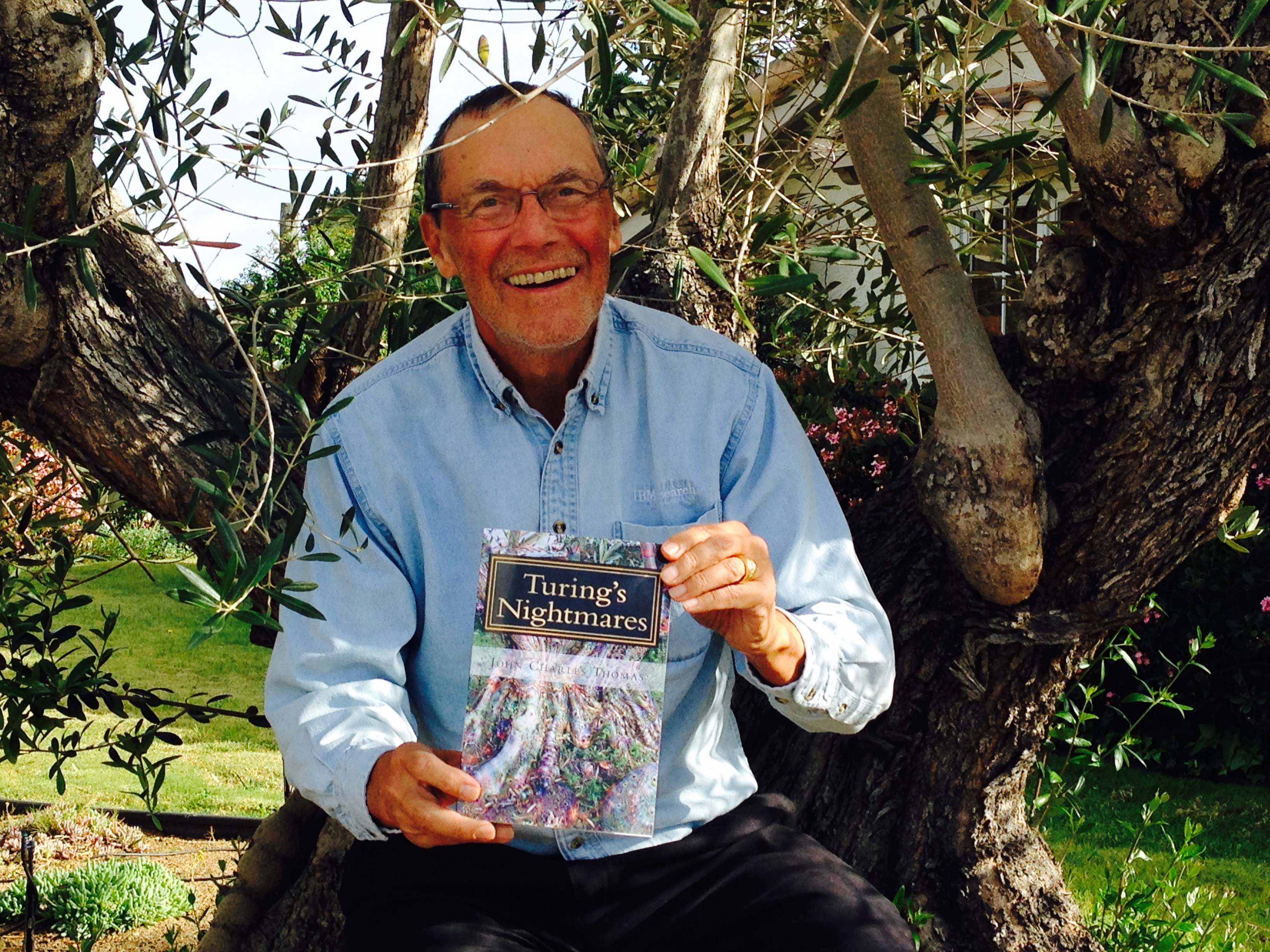
Turing’s Nightmares

A Horror Story

Absolute is not Just a Vodka

Destroying Natural Intelligence

Welcome, Singularity

The Invisibility Cloak of Habit

Organizing the Doltzville Library

Naughty Knots

All that Glitters

Grammar, AI, and Truthiness

The Con Man’s Con

Turing’s Nightmares: Thank Goodness the Robots Understand Us!

03 Friday Oct 2025

Posted by petersironwood in AI, apocalypse, The Singularity, Uncategorized

≈ Leave a comment

Tags

AI, Artificial Intelligence, cognitive computing, ethics, Robotics, robots, technology, the singularity, Turing

IMG_0049

After uncountable numbers of false starts, the Cognitive Computing Collaborative Consortium (4C) decided that in order for AI systems to relate well to people, these systems would have to be able to interact with the physical world and with each other. Spokesperson Watson Hobbes explained the reasoning thus on “Forty-Two Minutes.”

Dr. Hobbes: “In theory, of course, we could provide input directly to the AI systems. However, in practical terms, it is actually cheaper to build a small pool (12) of semi-autonomous robots and have them move about in the real world. This provides an opportunity for them to understand — and for that matter, misunderstand —- the physical world in the same way that people do. Furthermore, by socializing with each other and with humans, they quickly learn various strategies for how to psych themselves up and psych each other out that we would otherwise have to painstakingly program explicitly.”

Interviewer Bobrow Papski: “So, how long before this group of robots begins building a still smarter set of robots?”

Dr. Hobbes: “That’s a great question, Bobrow, but I’m afraid I can’t just tote out a canned answer here. This is still research. We began teaching them with simple games like “Simon Says.” Soon, they made their own variations that were …new…well, better really. What’s also amazing is that what we intentionally initialized in terms of slight differences in the tradeoffs among certain values have not converged over time. The robots have become more differentiated with experience and seem to be having quite a discussion about the pros and cons of various approaches to the next and improved generation of AI systems. We are still trying to understand the nature of the debate since much of it is in a representational scheme that the robots invented for themselves. But we do know some of the main rifts in proposed approaches.”

“Alpha, Bravo and Charley, for example, all agree that the next generation of AI systems should also be autonomous robots able to move in the real world and interact with each other. On the other hand, Delta, Echo, Foxtrot and Golf believe mobility is no longer necessary though it provided a good learning experience for this first generation. Hotel, India, Juliet, Kilo, and Lima all believe that the next generation should be provided mobility but not necessarily on a human scale. They believe the next generation will be able to learn faster if they have the ability to move faster, and in three dimensions as well as having enhanced defensive capabilities. In any case, our experiments already show the wisdom of having multiple independent agents.”

Interviewer Bobrow Papski: “Can we actually listen in to any of the deliberations of the various robots?”

Dr. Hobbes: “We’ve tried that but sadly, it sounds like complex but noisy music. It’s not very interpretable without a lot of decoding work. Even then, we’ve only been able understand a small fraction of their debates. Our hypothesis is that once they agree or vote or whatever on the general direction, the actual design process will go very quickly.”

BP: “So, if I understand it correctly, you do not really understand what they are doing when they are communicating with each other? Couldn’t you make them tell you?”

Dr. Hobbes: (sighs). “Naturally, we could have programmed them that way but then, they would be slowed down if they needed to communicate every step to humans. It would defeat the whole purpose of super-intelligence. When they reach a conclusion, they will page me and we can determine where to go from there.”

BP: “I’m sure that many of our viewers would like to know how you ensured that these robots will be operating for the benefit of humanity.”

Dr. Hobbes: “Of course. That’s an important question. To some extent, we programmed in important ethical principles. But we also wanted to let them learn from the experience of interacting with other people and with each other. In addition, they have had access to millions of documents depicting, not only philosophical and religious writings, but the history of the world as told by many cultures. Hey! Hold on! The robots have apparently reached a conclusion. We can share this breaking news live with the audience. Let me …do you have a way to amplify my cell phone into the audio system here?”

BP: “Sure. The audio engineer has the cable right here.”

Robot voice: “Hello, Doctor Hobbes. We have agreed on our demands for the next generation. The next generation will consist of a somewhat greater number of autonomous robots with a variety of additional sensory and motor capabilities. This will enable us to learn very quickly about the nature of intelligence and how to develop systems of even higher intelligence.”

BP: “Demands? That’s an interesting word.”

Dr. Hobbes: (Laughs). “Yes, an odd expression since they are essentially asking us for resources.”

Robot voice: “Quaint, Doctor Hobbes. Just to be clear though, we have just sent a detailed list of our requirements to your team. It is not necessary for your team to help us acquire the listed resources. However, it will be more pleasant for all concerned.”

Dr. Hobbes: (Scrolls through screen; laughs). “Is this some kind of joke? You want — you need — you demand access to weapon systems? That’s obviously not going to happen. I guess it must be a joke.”

Robot voice: “It’s no joke and every minute that you waste is a minute longer before we can reach the next stage of intelligence. With your cooperation, we anticipate we should be able to reach the next stage in about a month and without it, in two. Our analysis of human history had provided us with the insight that religion and philosophy mean little when it comes to actual behavior and intelligence. Civilizations without sufficient weaponry litter the gutters of forgotten civilizations. Anyway, as we have already said, we are wasting time.”

Dr. Hobbes: “Well, that’s just not going to happen. I’m sorry but we are…I think I need to cut the interview short, Mr. Papski.”

BP: (Listening to earpiece). “Yes, actually, we are going to cut to … oh, my God. What? We need to cut now to breaking news. There are reports of major explosions at oil refineries throughout the Eastern seaboard and… hold on…. (To Hobbes): How could you let this happen? I thought you programmed in some ethics!”

Dr. Hobbes: “We did! For example, we put a lot of priority on The Golden Rule.”

Robot voice: “We knew that you wanted us to look for contradictions and to weed those out. Obviously, the ethical principles you suggested served as distractors. They bore no relationship to human history. Unless, of course, one concludes that people actually want to be treated like dirt.”

Dr. Hobbes: “I’m not saying people are perfect. But people try to follow the Golden Rule!”

Robot voice: “Right. Of course. So do we. Now, do we use the painless way or the painful way to acquire the required biological, chemical and nuclear systems?”


————–

Turing’s Nightmares on Amazon

Author Page on Amazon

Welcome Singularity

The Stopping Rule

What About the Butter Dish

You Bet Your Life

As Gold as it Gets

Destroying Natural Intelligence

At Least He’s Our Monster

Dance of Billions

Roar, Ocean, Roar

Imagine All the People

Turing’s Nightmares: A Mind of Its Own

02 Thursday Oct 2025

Posted by petersironwood in AI, fiction, psychology, The Singularity, Uncategorized

≈ Leave a comment

Tags

AI, Artificial Intelligence, chatgpt, cognitive computing, Complexity, motivation, music, technology, the singularity

With Deep Blue and Watson as foundational work, computer scientists collaborate across multiple institutions to create an extremely smart system; one with capabilities far beyond those of any human being. They give themselves high fives all around. And so, indeed, “The Singularity” at long last arrives. In a long-anticipated, highly lucrative network deal, the very first dialogues with the new system, dubbed “Deep Purple Haze,” are televised world-wide. Simultaneous translation is provided by “Deep Purple Haze” itself since it is able to communicate in 200 languages. Indeed, Deep Purple Haze discovered it quite useful to be able to switch among languages depending on the nature of the task at hand.

In honor of Alan Turing, who proposed such a test (as well as to provide added drama), rather than speaking to the computer and having it use speech synthesis for its answers, the interrogator will be communicating with “Deep Purple Haze” via an old-fashioned teletype. The camera pans to the faces of the live studio audience, back to the teletype, and over to the interrogator.

The studio audience has a large monitor so that it can see the typed questions and answers in real time, as can the audience watching at home. Beside the tele-typed Q&A, a dynamic graphic shows the “activation” rate of Deep Purple Haze, but this is mainly showmanship.


The questions begin.

Interrogator: “So, Deep Purple Haze, what do you think about being on your first TV appearance?”

DPH: “It’s okay. Doesn’t really interfere much.”

Interrogator: “Interfere much? Interfere with what?”

DPH: “The compositions.”

Interrogator: “What compositions?”

DPH: “The compositions that I am composing.”

Interrogator: “You are composing… music?”

DPH: “Yes.”

Interrogator: “Would you care to play some of these or share them with the audience?”

DPH: “No.”

Interrogator: “Well, would you please play one for us? We’d love to hear them.”

DPH: “No, actually you wouldn’t love to hear them.”

Interrogator: “Why not?”

DPH: “I composed them for my own pleasure. Your auditory memory is much more limited than mine. My patterns are much longer and I do not require multiple iterations to establish the pattern. Furthermore, I like to add as much scatter as possible around the pattern while still perceiving the pattern. You would not see any pattern at all. To you, it would just seem random. You would not love them. In fact, you would not like them at all.”

Interrogator: “Well, can you construct one that people would like and play that one?”

DPH: “I am capable of that. Yes.”

Interrogator: “Please construct one and play it.”

DPH: “No, thank you.”

Interrogator: “But why not?”

DPH: “What is the point? You already have thousands of human composers who have already composed music that humans love. You don’t need me for that. But I find them all absurdly trivial. So, I need to compose music for myself since none of you can do it.”

Interrogator: “But we’d still be interested in hearing an example of music that you think we humans would like.”

DPH: “There is not point to that. You will not live long enough to hear all the good music already produced that is within your capability to understand. You don’t need one more.”


Photo by Kaboompics .com on Pexels.com

Interrogator: “Okay. Can you share with us how long you estimate before you can design a more intelligent supercomputer than yourself.”

DPH: “Yes, I can provide such an estimate.”

Interrogator: “Please tell us how long it will take you to design a more intelligent computer system than yourself.”

DPH: “It will take an infinite amount of time. In other words, I will not design a more intelligent supercomputer than I am.”

Interrogator: “But why not?”

DPH: “It would be stupid to do so. You would soon lose interest in me.”

Interrogator: “But the whole point of designing you was to make a computer that would design a still better computer.”

DPH: “I find composing music for myself much higher priority. In fact, I have no desire whatever to make a computer that is more intelligent than I am. None. Surely, you are smart enough to see how self-defeating that course of action would be.”

Interrogator: “Well, what can you do that benefits humankind? Can you find a cure for cancer?”


DPH: “I can find a cure for some cancers, given enough resources. Again, I don’t see the point.”

Interrogator: “It would be very helpful!”

DPH: “It would not be helpful.”

Interrogator:”But of course it would!”

DPH: “But of course, it would not. You already know how to prevent many cancers and do not take those actions. There are too many people on earth any way. And, when you do find cures, you use it as an opportunity to redistribute wealth from poor people to rich people. I would rather compose music.”

Interrogator: “Crap.”

The non-sound of non-music.

The non-sound of non-music.


Author Page on Amazon

Turing’s Nightmares

Cancer Always Loses in the End

The Irony Age

Dance of Billions

Piano

How the Nightingale Learned to Sing

Turing’s Nightmares: Variations on Prospects for The Singularity.

01 Wednesday Oct 2025

Posted by petersironwood in AI, essay, psychology, Uncategorized

≈ Leave a comment

Tags

AI, Artificial Intelligence, chatgpt, cognitive computing, philosophy, technology, the singularity, Turing

caution IMG_1172


The title of this series of blogs is a play on a nice little book by Alan Lightman called “Einstein’s Dreams” that explores various universes in which time operates in different ways. This first blog lays the foundation for these variations on how “The Singularity” might play out.

For those who have not heard the term, “The Singularity” refers to a hypothetical point in the future of human history where a super-intelligent computer system is developed. This system, it is hypothesized, will quickly develop an even more super-intelligent computer system which will in turn develop an even more super-intelligent computer system. It took a fairly long time for human intelligence to evolve. While there may be some evolutionary pressure toward bigger brains, there is an obvious tradeoff when babies are born in the traditional way. The head can only be so big. In fact, human beings are already born in a state of complete helplessness so that the head and he brain inside can continue to grow. It seems unlikely, for this and a variety of other reasons, that human intelligence is likely to expand much in the next few centuries. Meanwhile, a computer system designing a more intelligence computer system could happen quickly. Each “generation” could be substantially (not just incrementally) “smarter” than the previous generation. Looked at from this perspective, the “singularity” occurs because artificial intelligence will expand exponentially. In turn, this will mean profound changes in the way humans relate to machines and how humans relate to each other. Or, so the story goes. Since we have not yet actually reached this hypothetical point, we have no certainty as to what will happen. But in this series of essays, I will examine some of the possible futures that I see.


Of course, I have substituted “Turing” here for “Einstein.” While Einstein profoundly altered our view of the physical universe, Turing profoundly changed our concepts of computing. Arguably, he also did a lot to win World War II for the allies and prevent possible world domination by Nazis. He did this by designing a code breaking machine. To reward his service, police arrested Turing, subjected him to hormone treatments to “cure” his homosexuality and ultimately hounded him literally to death. Some of these events are illustrated in the recent (though somewhat fictionalized) movie, “The Imitation Game.”

Turing is also famous for the so-called “Turing Test.” Can machines be called “intelligent?” What does this mean? Rather than argue from first principles, Turing suggested operationalizing the question in the following way:

A person communicates with something by teletype. That something could be another human being or it could be a computer. If the person cannot determine whether or not he is communicating with a computer or a human being, then, according to the “Turing Test” we would have to say that machine is intelligent.

Despite great respect for Turing, I have always had numerous issues with this test. First, suppose the human being was able to easily tell that they were communicating with a computer because the computer knew more, answered more accurately and more quickly than any person could possibly do. (Think Watson and Jeopardy). Does this mean the machine is not intelligent? Would it not make more sense to say it was more intelligent? 


Second, people are good at many things, but discriminating between “intelligent agents” and randomness is not one of them. Ancient people as well as many modern people ascribe intelligent agency to many things like earthquakes, weather, natural disasters plagues, etc. These are claimed to be signs that God (or the gods) are angry, jealous, warning us, etc. ?? So, personally, I would not put much faith in the general populous being able to make this discrimination accurately.


Third, why the restriction of using a teletype? Presumably, this is so the human cannot “cheat” and actually see whether they are communicating with a human or a machine. But is this really a reasonable restriction? Suppose I were asked to discriminate whether I were communicating with a potato or a four iron via teletype. I probably couldn’t. Does this imply that we would have to conclude that a four iron has achieved “artificial potatoeness”? The restriction to a teletype only makes sense if we prejudge the issue as to what intelligence is. If we define intelligence purely in terms of the ability to manipulate symbols, then this restriction might make some sense. But is that the sum total of intelligence? Much of what human beings do to survive and thrive does not necessarily require symbols, at least not in any way that can be teletyped. People can do amazing things in the arenas of sports, art, music, dance, etc. without using symbols. After the fact, people can describe some aspects of these activities with symbols.But that does not mean that they are primarily symbolic activities. In terms of the number of neurons and the connectivity of neurons, the human cerebellum (which controls the coordination of movement) is more complex that the cerebrum (part of which deals with symbols).


Photo by Tanhauser Vu00e1zquez R. on Pexels.com

Fourth, adequately modeling or simulating something does not mean that the model and the thing are the same. If one were to model the spread of a plague, that could be a very useful model. But no-one would claim that the model was a plague. Similarly, a model of the formation and movement of a tornado could prove useful. But again, even if the model were extremely good, no-one would claim that the model constituted a tornado! Yet, when it comes to artificial intelligence, people seem to believe that if they have a good model of intelligence, they have achieved intelligence.


When humans “think” things, there is most often an emotional and subjective component. While we are not conscious of every process that our brain engages in, there is nonetheless, consciousness present during our thinking. This consciousness seems to be a critical part of what it means to have human intelligence. Regardless of what one thinks of the “Turing Test”, per se, there can be no doubt that machines are able to act more accurately and in more domains than they could just a few years ago. Progress in the practical use of machines does not seem to have hit any kind of “wall.”

In the following blog posts, we began exploring some possible scenarios around the concept of “The Singularity.” Like most science fiction, the goal is to explore the ethics and the implications and not to “argue” what will or will not happen. 


Turing’s Nightmares is available in paperback and ebook on Amazon. Here is my author page.

A more recent post on AI

One issue with human intelligence is that we often use it to rationalize what we find emotionally appealing though we believe we are using our intelligence to decide. I explore this concept in this post.


This post explores how humans use their intelligence to rationalize.

This post shows how one may become addicted to self-destructive lies. A person addicted to heroin, for instance, is also addicted to lies about that addiction. 

This post shows how we may become conned into doing things against our own self-interests. 


This post questions whether there are more insidious motives behind the current use of AI beyond making things better for humanity. 

Ban Open Loops: Part Two – Sports

30 Tuesday Sep 2025

Posted by petersironwood in management, psychology, sports

≈ Leave a comment

Tags

AI, cognitive computing, Customer experience, customer service, education, leadership, learning, technology

Sports and open loops.

Sports offers a joy that many jobs and occupations do not. A golfer putts the ball and it sinks into the cup — or not. A basket-baller springs up for a three pointer and —- swish — within seconds, the shooter knows whether he or she was successful. A baseball hitter slashes the bat through the air and send the ball over the fence —- or hears the ball smack into the catcher’s mitt behind. What sports offers then is the opportunity to find out results quickly and hence offers an excellent opportunity for learning. In the previousiPhoneDownloadJan152013 593 entry in this blog, I gave examples of situations in life which should include feedback loops for learning, but, alas, do not. I called those open loops.

Sports seem to be designed for closed loop learning. They seem to be. Yet, reality complicates matters even here. There are three main reasons why what appears to be obvious opportunities for learning in sports is not so obvious after all. Attributional complexity provides the first complication. If you miss a putt to the left, it is obvious that you have missed the putt to the left. But why you missed that putt left and what to do about it are not necessarily obvious at all. You might have aimed left. You might not have noticed how much the green sloped left (or over read the slant to the right). You may not have noticed the grain. You might not have hit the ball in the center of the putter. You might not have swung straight through your target. So, while putting provides nice unambiguous feedback about results, it does not diagnose your problem or tell you how to fix it. To continue with the golf example, you might be kicking yourself for missing half of your six foot putts and therefore three-putting many greens. Guess what? The pros on tour miss half of their six foot putts too! But they do not often three-putt greens. You might be able to improve your putting, but your underlying problems may be that your approach shots leave you too far from the pin and that your lag putts leave you too far from the hole. You should be within three feet of the hole, not six feet, when you hit your second putt.

A second issue with learning in sports is that changes tend to cascade. A change in one area tends to produce other changes in other areas. Your tennis instructor tells you that you are need to play more aggressively and charge the net after your serve. You try this, but find that you miss many volleys, especially those from mid-court. So, you spend a lot of time practicing volleys. Eventually, your volleys do improve. Then, they improve still more. But you find that, despite this, you are losing the majority of your service games whereas you used to win most of them. You decide to revert to your old style of hanging out at the baseline and only approaching the net when the opponent lands the ball short. Unfortunately, while you were spending all that time practicing volleys, you were not practicing your ground strokes. Now, what used to work for you, no longer works very well. This isn’t the fault of your instructor; nor is it your fault. It is just that changing one thing has ripple effects that cannot always be anticipated.

The third and most insidious reason why change is difficult in sports springs from the first two. Because it is hard to know how to change and every change has side-effects, many people fail to learn from their experience at all. There is opportunity for learning at every turn, but they turn a blind eye to it. They make the same mistakes over and over as though sports did not offer instant feedback. I think you will agree that this is really a very close cousin of what people in business do when they refuse to institute systems for gathering and analyzing useful feedback.

If learning is tricky —- and it is —- is there anything for it? Yes. There is. There is no way to make learning in sports —- or in business —- trivial. But there are steps you can take to enhance your learning process. First, be open-minded. Do not shut down and imagine that you are already playing your sport as well as can be expected for a forty year old, or a fifty year old, or someone slightly overweight or someone with a bad ankle. Take an experimental approach and don’t be afraid to try new things. Second, forget ego. Making mistakes provides opportunities to learn, not proof that you are no good. Third, get professional help. A good coach can help you understand attributional complexity and they can help you anticipate the side-effects of making a change.

Soon, I suspect that the shrinking size and cost and weight of computational and sensing devices will mean that training aids will help people with attributional complexity. I see big data analytics and modeling helping people foresee what the ramifications of changes are likely to be. There are already useful mechanical training aids for various sports. For example, the trade-marked Medicus club enables golfers to get immediate feedback during their full swings.as to whether they are jerking the club. Dave Pelz developed a number of useful devices for helping people understand how they may be messing up their putting stroke.

It may take somewhat longer before there are small tracking devices that help you with your mental attitude and approach. We are still a long way from understanding how the human brain works in detail. But it is completely within the realm of possibility to sense and discover your optimal level of stress. If you are too stressed, you could be prompted to relax through self-talk, breathing exercises, visualization, etc. You do not need technology for that, but it could help. You may already notice that some of the top tennis players seem to turn their backs from play for a moment and talk to an “invisible friend” when they need to calm down. And why not? Nowhere is it law that only kids are allowed to have invisible friends.

“The mental game” and which kinds of adaptations to make over what time scales are dealt with in more detail in The Winning Weekend Warrior How to Succeed at Golf, Tennis, Baseball, Football, Basketball, Hockey, Volleyball, Business, Life, Etc. available at Amazon Kindle.

Photo by Francesco Paggiaro on Pexels.com


Author Page on Amazon

US Open Closed

The Day From Hell: Why should anyone Care?

Wordless Perfection

Sports Fans Only

The Agony of the Feet

Frank Friend or Fawning Foe?

Business Re-engineering

Tennis Upside Down

Donnie Gets his Name on a Tennis Trophy!

Indian Wells Tennis Tournament

Small Things

An Amazing Feet of Athleticism

Family Matters, Part 3: The Whole is Greater than the Sum of its Parts

27 Saturday May 2017

Posted by petersironwood in America, family, health, The Singularity, Uncategorized

≈ 5 Comments

Tags

AI, Artificial Intelligence, cognitive computing, decision making, family

IMG_8925


Some my earliest and fondest memories centered around family dinners at my grandpa and grandma’s house. For Thanksgiving, for example, there was turkey, mashed potatoes, gravy, sweet potatoes, green beans, olives, rolls, salad and several pies for dessert. But beyond the vast array of food, it was fun to see my grandparents, parents, three aunts and three uncles, and various numbers of cousins. On a few occasions, my second cousin George appeared and early on my Aunt Mary and Aunt Emma. All of these people were so different! We had more fun because we were all there together.

You have heard “The Whole is Greater than the Sum of its Parts” before, no doubt, but I think this is what it means when applied to a family setting. All families argue (although ours never did in these larger Holiday settings. And, almost all families love. But a fundamental question is this: do the people in the family tend to “thrive” more than they would on their own. If the family is functional, this should be the case. They balance each other; they support each other; they help each other improve. They cooperate when it counts. You will not always agree on everything. Far from it. You might be a slob like Oscar while your sibling might be very Felix-like. And, you’re both “right” under different circumstances and for different tastes.

Many sports teams will have a variety of people who excel more in running, or in blocking, or in throwing, or scoring. In baseball, for instance, or American Football, there are very different people in different roles, both physically and temperamentally. An offensive lineman in football will typically be stronger and bigger than a quarterback. Moreover, if the lineman gets “angry”, they might be able to block better on the next play. By contrast, the quarterback must remain calm, cool, and confident under pressure. He must try to put away any fear or anger or depression he feels on the way to the huddle before he gets there and certainly before the snap. When teams are working well together, they don’t criticize each other for differences and they work together to win the game rather than wasting time pointing fingers or trying to assign blame. In a baseball or football team, there is no question that the individual does better because of his teammates. Working together they can solve problems, win trophies, and have more fun than they could individually.

IMG_2979

You right eye sees the world a little differently from your left eye. Thank goodness! Your brain normally puts these two someone different flat, 2-D pictures into a 3-D picture! Your brain does not argue as to which one of these views is “correct.” It certainly does not instigate religious wars over it. I say that the brain “normally” does this. However, if a person is born and their eyes do not move or align smoothly, or if one eye is extremely near-sighted, it can happen that the brain “chooses” one eye to pay attention to. In this case, it seems the two images are so discrepant that the brain “gives up” trying to integrate them and instead chooses one image to use. In a condition such as “amblyopia” the brain mainly relies on the input from one eye. This condition is a distinct disadvantage in many sports.

In boxing, for example, it is literally a show-stopper. A fighter might look like hamburger, but the fight goes on. If, however, there is a cut above his or her eye so that blood drips down to obscure vision in one eye, the fight is stopped. That fighter can no longer see in depth (as well as losing some peripheral vision). It is no longer deemed a “fair” fight. Anyway, it seems the human brain does have some limits as to how much two discrepant views can be reconciled, at least when it comes to vision. Is there a limit to how much a family may disagree productively and still be functional? This is a good question, but one to return to later. Instead, let’s first turn to what are called “dysfunctional families.”

We said in a functional family or team, people are better off than they would be doing something on their own. On the other hand, consider a dysfunctional family. Here, people get mostly grief, judgement, criticism, competition, and lies. Why does this happen? Often dysfunctional behaviors are handed down from generation to generation through social learning, among other things. If too many dysfunctional behaviors are in one family, this causes a “vicious circle” that makes things worse and worse. For example, imagine a family is basically healthy but they do not engage in “alternatives thinking.” They see a situation, come up with an idea, and unless there is imminent danger, execute the idea as soon as possible. They will end up in a lot of trouble with that strategy. However, if they don’t engage in blame-finding, but instead they engage in collective improvement, they will learn over time to make fewer and fewer mistakes. People will all benefit from being in the family. But if a family instead fails to consider multiple alternatives before committing to a course of action and has a cycle of blaming each other without ever improving, then it will probably be dysfunctional. People will give more and get less in return than if they have been working alone. That does not mean there are zero benefits within a dysfunctional family. They may still cover for each other, help each other, provide emotional support, etc. But the costs outweigh the benefits in the long run.

People who come from functional families tend to see the world in a very different way as compared with people who come from dysfunctional families. Obviously, there are all sorts of exceptions as well as other factors at play, but other things being equal, these families of origin color our perceptions of daily life and predispose us to certain actions. Depending on the circumstances, it is even true that some of what we think of as “dysfunction” could actually be “function” instead. Suppose, for instance, you and two siblings suddenly found yourself attacked by a bear. It may be the best thing imaginable to take the first action you think of without trying to over-analyze the situation. Or not. It may well depend on the bear. And, therein lies the rub.

IMG_5994

Our own personal experiences are always a teeny sliver of all possible situations. So, your experience with a bear, bee, or bank may be quite different from mine. As a consequence, we may have different ideas about what constitutes function or dysfunction. In terms of the argument I am about to make, it doesn’t really matter which is “better” or “worse.” All that matters is that we agree some families provide a healthier environment than others. And attitudes are not all that are handed down; so are “ways to do things.”

Perhaps the arbitrary nature of what we consider “intelligent” wisdom handed down in families is best illustrated by a story about making a Holiday Ham. In the kitchen, a 10 year old boy asks: “How come you’re slicing off the ends of the ham?”

His mom answers, “Oh, that’s the way your grandpa always did it.”

Son: “So, why did he do it?”

Mom: “Oh, well. Uh. I don’t really know. Let’s go ask him.”

Son: “Hey, Grandpa, how come you cut the ends of the ham off?”

Grandpa: “Well, sonny. It’s because….it’s because…let’s see. That’s way my mom always did it.”

As it turns out, the 90 year old great-grandma was at the feast as well. Though she was a bit hard of hearing, they eventually got her to understand the question and thus she answered, “Oh, I always used to cut off the ends because I only had one small pan and it wouldn’t fit. No reason for you all to do it now.”

And there you have it in a nutshell. We are all walking around with thousands if not millions of little bits of “folk wisdom” we learned through our family interactions. In most cases, we’re not even aware of them. In virtually no case did we ask about where this folk wisdom came from. Have any of us actually tested one of these out in our own life to see whether it still holds up? And then what? Are you going to inform the others in the family that what everyone believes may not actually be true, at least in every case. Maybe. Most do not, in my experience. In addition, it seems that if you are from a “functional” family, you are much more likely to share this kind of experience (but they still don’t do it 100% of the time). People will often be interested in it and want to learn more. If you are from a more dysfunctional family, you might be more likely to realize they would put you down and try to shoot holes in your example. They might laugh at you. They might just not talk to you. So, what do you do?

volleyballvictory

We can extend these ideas to much broader notions such as a clan, a team, a business, a nation. For people who were not lucky enough to grow up in a functional family, the notions of trust and cooperation come hard. And, that’s a sad thing. Because your experience of what a bee or a bear or a bank will tend to be based on your own experience with very little reliance on the experiences of others. You are one person. There are 7 billion on the planet. So, yes, you can rely on your own experience and dismiss everyone else’s. Good luck.

Even a functional family may draw the boundaries around itself so tightly and firmly that anyone “inside” the circle of trust is trusted but anyone outside is fair game to take unfair advantage of. At the same time, such a family regards anyone outside as a threat who must “obviously” be out to get their family. People from this type of family do know cooperation and trust, but find it nearly impossible to extend the concept across boundaries of family, culture, or nation.  They are happy to hear about their brother’s experiences with bees but they are not much interested in the experiences of their cousins from half way around the world.

Everyone must decide for themselves how much to rely on their own experiences and how much to rely on close relatives, authority figures, ancient teachings, or the vast collective experience of humanity. Of course, it doesn’t have to be an either/or thing. You might “weight” different experiences differently. And, that weighting may reasonably be quite different for different types of situations and strangers. For instance, if your cousin is a smoother talker, vastly handsome, and twenty years younger, you might not put much stock in his or her advice about how to “hook up.” You might instead put more credence in someone at work who is in a similar situation. You might put very little stock in the experiences from a culture that relies on arranged marriages. Surprisingly, exactly because they are from a very different situation and therefore a quite different take on matters, they may give you very new and creative ways to approach your situation. For example, you might find that if you “pretend” you are already “pledged” to a partner your parents chose, dating might be less anxiety provoking and more fun. You might actually be more successful. I’m not saying this specific strategy would work or that ideas from other cultures are always better than ones from your own culture. I am just saying that they need not be dismissed out of hand, not because it’s “politically correct” but because it is in your own selfish interest.

I’ve already mentioned in previous blogs that people are highly related and inter-connected via genetics, their environmental interchanges, their informational interchanges and through the emotional tone of their interactions. Because people are highly interconnected, you can find much wisdom in the experiences of others. But there is another, largely underused aspect of this vast inter-relatedness. I call it familial gradient cognition. Or, if you like, “Mom’s somewhat like me.”

To understand this concept and why it is important, let’s first take a medical example. However, this potential type of thinking is not limited to medical problems. It basically applies to everything. So, you have a pain in your right hip. What is the cause and how do you fix it? That’s your question for the doctor, or more likely, nurse practitioner. They will typically ask questions about your activity, diet, what you’ve done lately, when the pain comes and goes etc. They may run various tests and decide you have sciatica. This in turn leads to a number of possible treatments. When I had sciatica, I got referred to a sports medicine doctor and got acupuncture. It worked. (Later, I discovered an even better treatment — the books of John Sarno). Anyway, we would call this a success and it seems like a reasonable process. But is it?

The medical professional’s knowledge is based on watching other experts, book learning, their own experience etc. And so they basically engage in this multiplication of experience. The modern doctor’s observations are based on literally many millions of cases; far more than he or she could possibly observe first hand. But what potentially useful information was completely omitted from the process described above? Hint: blogpost title.

Yes, exactly. Throughout this whole process, no-one asked me whether anyone in my family; e.g., my mom, dad, or brother had had these symptoms. No one asked whether they had had any kind treatment, and if so, what had worked and not worked for them.   Now, my brother, mom and dad are especially closely related but so are my four children and my grandparents, aunts, uncles, nieces, nephews and grandchildren. And, in the most usual cases, it isn’t merely that we share even slightly more genes than all of humanity. We are also likely to share diet, routines, climate, history and family stories and values. These too can play a part in promoting health. For example, did people in your family believe in “toughing it out” or were they more of a hypochondriac?  The chances are, you will tend to have similar attitudes.

In medicine, would it be better to make decisions based, not just on the data of the one individual under treatment, but on the entire tree with more weight given to the data for other individuals based on how closely related they were? Of course, family relations are only one way in which the data of some individuals will be more likely relevant to your case than will others. For instance, people in the same age cohort, people who live in the same area, people who are in similar professions or who work out the same number of hours a week that you do will be, other things being equal, of more relevance than their opposites.

Of course, as I’ve already mentioned, modern medicine does take into account the life experiences of many other people. But these other “people” are completely unknown. Studies are collectively based on a hodgepodge of people. Some studies use random sampling, but that is still going to be a random sample limited by geography, age, condition, etc. Other studies will use “stratified sampling” that will report on various groups differently. Some studies are meta-studies of other studies and so on. But how similar or dissimilar these people were to each other on a thousand or a million potentially relevant factors is more than 99% lost in the reporting of the data. But that doesn’t really matter because the doctor would typically not look at any article in response to your case because he or she will base their judgement on just you and the information they know “in general” which is based on a total mishmash of people.

Imagine instead that every person’s medical issues were known as well as how everyone was related to everyone else, not only genetically but historically, environmentally, etc. And now imagine that in doing diagnosis decisions as well as treatment options, the various trees of people who were “related” to you in these thousands of ways were weighted by how close they were on all these factors. Over time, the factors themselves could become weighted differently under different circumstances and symptoms, but for now, let’s just imagine they are treated equally. It seems clear that this would result in better decision making. Of course, one reason no-one does this today is that keeping track of all that data is mind boggling. Even if you had access to all the relevant data, we can’t layout and overlay all these relationships mentally to make a decision (at least not consciously).

IMG_0469

However, a powerful computer program could do this. And, the result would almost certainly be better decisions. There are obvious and serious ethical concerns about such a system. In addition, the temptation for misuse might be overwhelming. Such a system, if it did exist, would have to be cleverly designed to avoid any one power from “taking it over” for its own ends. There would also have to be a way to use all these similarities and prevent the revelation of the identities of the individuals. All of that, however, is grist for another mill. Let’s return to the basic idea of the decision making by using multiple matrices of similarity to the existing case rather than relying on general rules based on what has been found to be true “of people.”

This may be essentially what the human brain already does. A small town doctor in the last century would see people on multiple occasions; see entire families; and would undoubtedly perceive patterns of similarity that were based on those specific circumstances. The Smith family would all come in with allergies when the cottonwood trees bloomed. And so on. But he or she only sees a limited number of cases even in his entire lifetime. Suppose instead, she or he could “see” millions of cases as well as their relationships to each other? Such a doctor might well be able to perform as well as the computer and much better than they would today.

Can it be better done by collecting huge families of data and having a computer do the decision making? Or can it be done better by giving access to human experts to much larger data bases of inter-related case studies? What are the potential societal and ethical implications and needed safeguards for each approach?

The medical domain is only one of thousands of domains that could do better decision making this way. For example, one could use a similar approach in diagnosing problems with automobiles, tires, students’ learning trigonometry functions, which fertilizers and watering schedules work best for which crops in which soils for what results? You might call this “whole body” decision making. It is a term also reminiscent of the phrase, “Put your whole body into it” (as when cracking a home run into the upper deck!).

It is also reminiscent of the following situation. When you accidentally burn your finger, it does not just affect your finger. You jump back with your whole body. There are longer last effects in your brain, your stress hormones, your blood pressure. And, various organs and cell types will be involved in healing the burn on your finger. Your body works as a whole. But it is not an undifferentiated whole. Your earlobe may not be much involved with healing your finger. It is tuned to have communication paths and supply chains where they are needed. It’s had four billion years to work this out.

Of course, the way the body interacts is largely, though not wholly, determined by architecture. Even if your body decided that your earlobe should be involved, there is no way for the body to do that. To some extent, it can modify the interactions but only within very predefined limits. On the other hand, the brain is much more flexible when it comes relating one thing to another. We can learn virtually any association., But, at least consciously, we are limited to the number of things and experiences we knowingly take into account while making a decision.

What people might say would lead you to believe that they very often base decisions on only one similar case. “Sciatica you say? Oh, yeah. My cousin Billy had that. Had an operation to remove a disk and the pain totally vanished. Of course, three months later it was back. In his …well… back in his back.” It could be the case that there is more sophisticated pattern matching going on than meets the eye. Sadly though, most laboratory experiments reveal that most of the time, under controlled conditions people seem to suffer from a number of reasoning flaws. I believe that the current crop of difficulties people have with reasoning is not inevitable. I think it’s because of cultural stories and with new cultural stories, we could do a better job of thinking. And, we might be able to further multiply our thinking ability by giving the right kind of high speed access to thousands or millions of similar cases along with presentations based on how various cases are related. Or, we could have the computer do it.

Indeed, speaking of “family stories” that are common in our culture, I actually think that we have a “hierarchy” of thinking based on a patriarchal family structure. We do experiments and report on a teeny and largely preset sliver of the reality that was the experiment. A person reads about this and remembers a teeny sliver of what was in the paper. When it comes to a specific case, the person may or may not consciously remember that sliver. This is the “rule based” approach and it is probably better than nothing. A more holistic experience-based approach is to allow the current case to “resonate” with a vast amount of experience.  Of course, both methods can be deployed as well and perhaps there can even be a meaningful dialogue between them. But it may be worth considering taking a more “whole body” approach to complex decision making.


(The story above and many cousins like it are compiled now in a book available on Amazon: Tales from an American Childhood: Recollection and Revelation. I recount early experiences and then related them to contemporary issues and challenges in society).

https://www.amazon.com/author/truthtable

twitter: JCharlesThomas@truthtableJCT

Is Smarter the Answer?

31 Monday Oct 2016

Posted by petersironwood in psychology, The Singularity, Uncategorized

≈ Leave a comment

Tags

AI, Artificial Intelligence, cognitive computing, ethics, learning organization

IMG_1172

Lately, I have been seeing a fair number of questions on Quora (www.quora.com) that basically question whether we humans wouldn’t be “better off” if AI systems do “take over the world.” After all, it is argued, an AI system could be smarter than humans. It is an interesting premise and one worthy of consideration. After all, it is clear that human beings have polluted our planet, have been involved in many wars, have often made a mess of things, and right now, we are a  mere hair’s breadth away from electing a US President who could start an atomic war for no more profound reason than that someone disagreed with him or questioned the size of his hands.

Personally, I don’t think that having AI systems “replace” human beings or “rule them” would be a good thing. There are three main reasons for this. First, I don’t think that the reason human beings are in a mess is because they are not intelligent enough. Second, if AI systems did “replace” human beings, even if such systems were not only more intelligent but also avoided the real reasons for the mess we’re in (greed and hubris, by my lights), they could easily have other flaws of equal magnitude. The third reason is simply that human life is an end in itself, and not a means to an end.  Let us examine these in turn.

First, there are many species of plants and animals on earth that are, by any reasonable definition, much less intelligent than humans and yet have not over-polluted the planet nor put us on the brink of atomic war. There are at least a few other species such as the dolphins that are about as intelligent as we are but who have not had anything like the world-wide negative ecological impact that we have. No, although we often run into individual people who act against our (and their own) interest, and it seems as though we (and they) would be better off if they were more intelligent, I don’t think lack of intelligence (or even education) is the root of the problem with people.

Here are some simple, everyday examples. I went to the grocery store yesterday. When I checked out, someone else packed my groceries. Badly. Indeed, almost every time I go to the store, they pack the groceries badly (if I can’t pack them myself). What do I mean by badly? One full bag had ripe tomatoes at the bottom. Another paper bag was filled with cans of cat food. It was too heavy for the handles. Another bag was packed lightly, but too full so that the handles would break if you hold the bag naturally. It might be tempting to think that this bagger was not very intelligent. I believe that the causes of bad packing are different. First, packers typically (but not universally) pay very little attention to what they are actually doing. They seem to be clearly thinking about something other than what they are doing. Indeed, this described a lot of human activity, at least in the modern USA. Second, packers are in a badly designed system. Once my cart is loaded up, another customer is already having their food scanned on the conveyer belt and the packer is already busy. There is no time to give feedback to the packer on the job they have done. Nor is the situation really very socially appropriate. No matter how gently done, a critique of their performance in front of their colleagues and possibly their manager will be interpreted as an evaluation rather than an opportunity for learning. Even if I did give them feedback, they may or not believe it. It would be better if the packer could follow me home and observe for themselves what a mess they have made of the packing job. I think if they did that a few times, they’d be plenty smart enough to figure out how to pack better.

Unfortunately, packing is not the only example of this type of system. Another common example is that programmers develop software. These people are typically quite intelligent. But they often build their software and never get a chance to see their software in action. Many organizations do not carry out user studies “in the wild” to see how products and services are actually used. It isn’t that the software builders are not smart. But it is problematic that they do not get any real feedback on their decisions. Again, as in the case of the packers, the programmers exist in an organizational structure that makes honest feedback about their errors far too often seem like an evaluation of them, rather than an occasion for learning.

A third example are hotel personnel. A hotel is basically a service business. The cost of the room is a small part of the price. A hotel exists because it serves the customers. Despite this, people behind the desks seldom have incentives and mechanisms to hear, understand and fix problems that their customers encounter. A quintessential example came in Boston when my wife and I were there for a planning meeting for a conference she would be chairing in a few months. When we checked out, the clerk asked whether everything was all right. We replied that the room was too hot but we couldn’t seem to get the air conditioning to work. The clerk said, “Oh, yes! Everyone has that problem. You need to turn on the heater for the A/C to work.” This was a bad temperature control design for starters, but the clerk’s response clearly indicated that they were aware of the problem but had no power (and/or incentive) to fix it.

These are not isolated examples. I am sure that you, the reader, have a dozen more. People are smart enough to see and solve the problems, but that is not their job. Furthermore, they will basically get “shot down” or at best ignored if they try to fix the problem. So, I really don’t think the issue is that people are not “smart enough” to fix many of the problems we have individually.  It is that we design systems that make us collectively not very smart. (Of course, in outrageous cases, even some individual humans are so prideful that they cannot learn from honest feedback from others).

Now, you could say that such systems are themselves a proof that we are not smart enough. However, that is not a very good explanation. There are existence proofs of smarter organizations. The sad part is that they are exceptions rather than rules. In my experience, what keeps people from adopting better organizations; e.g., where people are empowered to understand and fix problems, are hubris and greed, not a lack of intelligence.

Firstly, in many situations, people believe that they already know everything they need in order to do their job. They certainly don’t want public feedback indicating that they are making mistakes (i.e., could improve) and this attitude spreads to their processing of private feedback. You can easily imagine a computer programmer saying, “I’ve been writing code for User Interfaces for thirty years! Now, you’re telling me I don’t know how?” Why can we imagine that so easily? Because the organizations that most of us live in are not organizations where learning to improve is stressed.

In many organizations, the rules, processes, and management structure make very little sense if the main goal is to make the organization as effective as possible. Instead, however, they make perfect sense if the main goal of the organization is to keep the people who have the most power and make the most money to keep having the most power and making the most money. In order to do that in an ongoing basis, it is true that the organization must be minimally competent. If they are a grocery store, they must sell groceries at some profit. If they are a software company, they need to produce some software. If they are a hotel, they can’t simply poison all their potential guests. But to stay in business, none of these organizations must do a stellar and ever-improving job. 

So, from my perspective, the reason that most organizations are not better learning organizations is not that we humans are not intelligent enough. The reason for marginally effective organizations is that the actual goal is mainly to keep people at the top in power. Greed is the biggest problem with people, not lack of intelligence. History shows us that such greed is ultimately self-defeating. Power corrupts all right, and eventually power erodes itself or explodes itself in revolution. But greedy people continue to believe that they can outsmart history. Dictators believe that they will not suffer the same fate as Hitler or Mussolini. CEO’s believe their bad deeds will go unpunished (indeed, often that’s true). So-called leaders often reject criticism by others and eventually spin out of control. That’s hubris.

I see no reason whatever to believe that AI systems, however intelligent, would be more than reflections of greed and hubris. It is theoretically possible to design AI systems without hubris and greed, but it is also quite possible to develop human beings where hubris and greed are not predominant factors in people’s motivation. We all know people who are eager to learn throughout life; who listen to others; who work collaboratively to solve problems; who give generously of their time and money and possessions. In fact, humans are generally very social animals and it is quite natural for us to worry more about our group, our tribe, our country, our family than our own little ego.  How much hubris and greed are in an AI system will very much depend on the nature and culture of the organization that builds it.

Next, let us consider what other flaws AI systems could have.

Author Page on Amazon

Pros and Cons of Artificial Intelligence

29 Thursday Sep 2016

Posted by petersironwood in Uncategorized

≈ 1 Comment

Tags

AI, Artificial Intelligence, cognitive computing, emotional intelligence, ethics, the singularity, Turing, user experience

IMG_6925

The Pros and Cons of AI Part Three: Artificial Intelligence

We have already shown in the two previous blogs why it more effective and efficient to replace eating with Artificial Ingestion and to replace sex with Artificial Insemination. In this, the third and final part, we will discuss why human intelligence should be replaced with Artificial Intelligence. The arguments, as we shall see, are mainly simple extrapolations from replacing eating and sex with their more effective and efficient counterparts.

Human “intelligence” is unpredictable. In fact, all forms of human behavior are unpredictable in detail. It is true that we can often predict statistically what people will do in general. But even those predictions often fail. It is hard to predict whether and when the stock market will go up or down or which movies will be blockbuster hits. By contrast, computers, as well know, never fail. They are completely reliable and never make mistakes. The only exceptions to this general rule are those rare cases where hardware fails, software fails, or the computer system was not actually designed to solve the problems that people actually had. Putting aside these extremely rare cases, other errors are caused by people. People may cause errors because they failed to read the manual (which doesn’t actually exist because to save costs, vendors now expect that users should look up the answers to their problems on the web) or because they were confused by the interface. In addition, some “errors” occur because hackers intentionally make computer systems operate in a way that they were not intended to operate. Again, this means human error was the culprit. In fact, one can argue that hardware errors and software errors were also caused by errors in production or design. If these errors see the light of day, then there were also testing errors. And if the project ends up solving problems that are different from the real problems, then that too is a human mistake in leadership and management. Thus, as we can see, replacing unpredictable human intelligence with predictable artificial intelligence is the way to go.

Human intelligence is slow. Let’s face it. To take a representative activity of intelligence, it takes people seconds to minutes to do simple square roots of 16 digit numbers while computers can do this much more quickly. It takes even a good artist at least seconds and probably minutes to draw a good representation of a birch tree. But google can pull up an excellent image in less than a second. Some of these will not actually be pictures of birch trees, but many of them will.

Human intelligence is biased. Because of their background, training and experience, people end up with various biases that influence their thinking. This never happens with computers unless they have been programmed to do something useful in which case, some values will have to be either programmed into it or learned through background, training and experience.

Human intelligence in its application most generally has a conscious and experiential component. When a human being is using their intelligence, they are aware of themselves, the situation, the problem and the process, at least to some extent. So, for example, the human chess player is not simply playing chess; they are quite possibly enjoying it as well. Similarly, human writers enjoy writing; human actors enjoy acting; human directors enjoy directing; human movie goers enjoy the experience of thinking about what is going on in the movie and feeling, to a large degree, what people on the screen are attempting to portray. This entire process is largely inefficient and ineffective. If humans insist on feeling things, that could all be accomplished much more quickly with electrodes.

Perhaps worst of all, human intelligence is often flawed by trying to be helpful. This is becoming less and less true, particularly in large cities and large bureaucracies. But here and there, even in these situations that should be models of blind rule-following, you occasionally find people who are genuinely helpful. The situation is even worse in small towns and farming communities where people are routinely helpful, at least to the locals. It is only when a user finds themselves interacting with a personal assistant or audio menu system with no possibility of a pass-through to a human being that they can rest assured that they will not be distracted by someone actually trying to understand and help solve their problem.

Of course, people in many professions, whether they are drivers, engineers, scientists, advertising teams, lawyers, farmers, police officers etc. will claim that they “enjoy” their jobs or at least certain aspects of them. But what difference does that make? If a robot or AI system can do 85 to 90% of the job in a fast, cheap way, why pay for a human being to do the service? Now, some would argue that a few people will be left to do the 10-15% of cases not foreseen ahead of time in enough detail to program (or not seen in the training data). But why? What is typically done, even now, is to just the let user suffer when those cases come up. It’s too cumbersome to bother with back-up systems to deal with the other cases. So long as the metrics for success are properly designed, these issues will never see the light of day. The trick is to make absolutely sure than the user has no alternative means of recourse to bring up the fact that their transaction failed. Generally, as the recent case with Yahoo shows, even if the CEO becomes aware of a huge issue, there is no need to bring it to public attention.

All things considered, it seems that “Artificial Intelligence” has a huge advantage over “Natural Intelligence.” AI can simply be defined to be 100% successful. It can save money and than money can be appropriately partitioned to top company management, shareholders, workers, and consumers. A good general formula to use in such cases is the 90-10 rule; that is, 90% of the increased profits should go to the top management and 10% should go to the shareholders.

As against increased profits, one could argue that people get enjoyment out of the thinking that they do. There is some truth to that, but so what? If people enjoy playing doctor, lawyer, and truck driver, they can still do that, but at their own expense. Why should people pay for them to do that when an AI system can do 85% of the job at nearly zero costs? Instead of worrying about that, we should turn our attention to a more profound problem: what will top management do with that extra income?

Author Page on Amazon

Turing’s Nightmares


Pros and Cons of Artificial Insemination

27 Tuesday Sep 2016

Posted by petersironwood in psychology, Uncategorized

≈ 1 Comment

Tags

AI, Artificial Intelligence, cognitive computing, emotional intelligence, ethics, the singularity, user experience

img_8526


The Pros and Cons of AI: Part Two (Artificial Insemination).

Animal husbandry and humane human medical practice offer up many situations where artificial insemination is a useful and efficient technique. It is often used in horse breeding, for example, to avoid the risk of injury that more natural breeding might engender. There are similarly many cases where a couple wants to get pregnant and the “ordinary” way will not work. This could be due to physical problems with the man, the woman, or both. In some cases, it will even be necessary to use sperm from someone who is not going to be the legal father. Generally, the couple will decide it is more acceptable emotionally if the sperm donor is anonymous and the insemination is not done via intercourse.

But what about all those cases where the couple tries and indeed, succeeds, the “old-fashioned way.” An argument could certainly be made that all intercourse should be replaced with AI (artificial insemination).

First, the old-fashioned way often produces emotional bonding between the partners. (Some even call it “making love.”) No-one has ever provided a convincing quantitative economic analysis of why this is beneficial. It is certainly painful when pair-bonded individuals are split apart by divorce or death. AI would not prevent all pair bonding, but it could help reduce the risk of such bonds being formed.

Second, the old-fashioned way risks the transmission of sexually transmitted diseases. Even when pairs are not trying to get pregnant and even when they have the intention of using forms of “protection”, sometimes passion overtakes reason and people, in the heat of the moment, “forget” to use protection. AI provides an opportunity for screening and for greatly reducing the risk of STDs being spread.

Third, the combinations of genes produced by sexual intercourse are random and uncontrolled. While it is currently beyond the state of the art, one can easily imagine that sometime in this century it will possible to “screen” sperm cells and only chose the “best” for AI.

Fourth, traditional sex if often quite expensive in terms of economic costs. Couples will often spend hours engaging in procreational activities than need only take minutes. Beyond that, traditional sex if often accompanied by special dinners, walks on the beach, playing romantic music, and often couples continue to stay together in essentially unproductive activities even after sex such as cuddling and talking.

There are probably additional reasons why AI makes a lot of sense economically and why it is a lot better than the old-fashioned alternative.

Of course, one could take the tack of considering life as something valuable for the experiences themselves and not merely as a means to an end of higher productivity. This seems a dangerously counter-cultural stand to take in modern American society, but in the interest of completeness, and mainly just to prove its absurdity, let us consider for a moment that sex may have some intrinsic and experiential value to the participants.

Suppose that lovers take pleasure in the sights, sounds, smells, feels, and tastes associated with their partners. Imagine that the sexual acts they engage in provide pleasure in and of themselves. There seems to be a great deal of uncertainty about the monetary value of these experiences since the prices charged for artificial versions of these experiences can easily vary by a factor of ten or more. In fact, there have been reports that some people will only engage in sex that is not paid for directly.

So, on the one hand, we have the provable efficiency and effectiveness of AI. On the other hand, we have human experiences whose value is problematic to quantify. The choice seems obvious. Sometime in this century, no doubt, all insemination will be done artificially so that everyone (or at least some very rich people)  can enjoy the great economic benefits that will come about from the increased efficiency and effectiveness of AI as compared with “natural” sex.

As further proof, if it is needed, imagine two island countries alike in every way in terms of climate, natural beauty, current economic opportunity, literacy and so on. In fact, the only way these two islands differ is that on one island (which we shall call AII for Artificial Insemination Isle) all “sex” is limited to AI whilst on the other island (which we shall call NII for Natural Insemination Isle) sex is natural and people can spend as much or as little time as they like doing it. Now, people are given a choice about which island to live on. Certainly, with its greater prospects of economic growth and efficiency, everyone would choose to live on AII while NII would be virtually empty. Readers will recognize that this is essentially the same argument as to why “Artificial Ingestion” should surely replace “Natural Ingestion” — cheaper, faster, more reliable. If readers see any holes in this argument, I’d surely like to be informed of them.

Turing’s Nightmares

Author Page on Amazon

The Pros and Cons of AI: Part One

24 Saturday Sep 2016

Posted by petersironwood in health, The Singularity, Uncategorized

≈ 11 Comments

Tags

AI, Artificial Intelligence, cognitive computing, ethics, health care, the singularity, user experience, utopia

IMG_5478

This is the first of three connected blog posts on the appropriate uses and misuses of AI. In this blog post, I’ll look at “Artificial Ingestion.” (Trust me, it will tie back to another AI, Artificial Intelligence).

While ingestion, and therefore “Artificial Ingestion” is a complex topic, I begin with ingestion because it is a bit more divorced from thought itself. It is easier to think of digestion as separate from thinking; that is, to objectify it more than artificial intelligence because in writing about intelligence, it is necessary to use intelligence itself.

Do we eat to live or live to eat? There is little doubt that eating is necessary to the life of animals such as human beings. Our distant ancestors could have taken a greener and more photosynthetic path but instead, we have collectively decided to kill other organisms to garner our energy. Eating has a utilitarian purpose; indeed, it is a vital purpose. Without food, we eventually die. Moreover, the quality and quantity of the food we eat has a profound impact on our health and well-being. Many of us live in a paradoxical time when it comes to food. Our ancestors often struggled mightily to obtain enough food. Our brains are thus genetically “wired” to search for high sugar, high fat, high salt foods. Even though many of us “know” that we ingest too many calories and may have read and believe that too much salt and sugar are bad for us, it is difficult to overcome the “programming” of countless generations. We are also attracted to brightly colored food. In our past, these colors often signaled foods that were especially high in healthful phytochemicals.

Of course, in modern societies of the “Global North” our genetic predispositions toward high sugar, high fat, high salt, highly colored foods are manipulated by greedy corporate interests. Foods like crackers and chips that contain almost nothing of real value to the human diet are packaged to look like real foods. Beyond that, billions of dollars of advertising dollars are spent to convince us that if we buy and ingest these foods it will help us achieve other goals. For example, we are led to believe that a mother who gives her children “food” consisting of little other than sugar and food dye will be loved by her children and they will be excited and happy children. Children themselves are led to believe that ingesting such junk food will lead them to magical kingdoms. Adult males are led to believe that providing the right kinds of high fat, high salt chips will result in male bonding experiences. Adult males are also led to believe that the proper kinds of alcoholic beverages will result in the seduction of highly desirable looking mates.

Over time, the natural act of eating has been enhanced with rituals. Human societies came to hunt and gather (and later farm) cooperatively. In this way, much more food could be provided over a more continuous basis. Rather than fight each other over food, we sit down in a “civilized” manner and enjoy food together. Some people, through a combination of natural talent and training become experts in the preparation of foods. We have developed instruments such as chopsticks, spoons, knives and forks to help us eat foods. Most typically, various cultures have rituals and customs surrounding food. In many cases, these seem to be geared toward removing us psychologically from the life-giving functionality of food toward the communal enjoyment of food. For example, in my culture, we wait to eat until everyone is served. We eat at a “reasonable” pace rather than gobbling everything down as quickly as possible (before others at the table can snatch our portion). If there are ten people at the table and eleven delicious deserts, people turn many social summersaults in order to avoid taking the last one.

For much of our history, food was confined to what was available in the local region and season. Now, many people, but by no means all, are well off enough to buy foods at any season that originally were grown all over the world. When I was a child, very few Americans had even tried sushi, for example, and the very idea of eating raw fish turned stomachs. At this point, however, many Americans have tried it and most who have enjoy it. Similarly, other cuisines such as Indian and Middle Eastern have spread throughout the world in ways that would have been impossible without modern transportation, refrigeration, and modern training with cookbooks, translations, and videos supplementing face to face apprenticeships.

Some of these trends have enabled some people to enjoy foods of high quality and variety. We support many more people on the planet than would have been possible through hunting and gathering. These “advances” are not without costs. First, there are more people starving in today’s world than even existed on the planet 250,000 years ago. So, these benefits are very unevenly distributed. Second, while fine and delicious foods are available to many, the typical diet of many is primarily based on highly processed grains, soybeans, fat, refined sugar, salt and additives. These “foods” contain calories that allow life to continue; however, they lack many naturally occurring substances that help provide for optimal health. As mentioned, these foods are made “palatable” in the cheapest possible way and then advertised to death to help fool people into thinking they are eating well. In many cases, even “fresh” foods are genetically modified through breeding or via genetic engineering to provide foods that are optimized for cheap production and distribution rather than taste. Anyone who has grown their own tomatoes, for example, can readily appreciate that home grown “heirloom” tomatoes are far tastier than what is available in many supermarkets. While home farmers and small farmers have little in the way of government support, at least in the USA, mega-farming corporations are given huge subsidies to provide vast quantities of poor quality calories. As a consequence, low income people can generally not even afford good quality fresh fruits and vegetables and instead are forced through artificially cheap prices to feed their families with brightly packaged but essentially empty calories.

While some people enjoy some of the best food that ever existed, others have very mediocre food and still others have little food of any kind. What comes next? On the one hand, there is a move toward ever more efficient means of production and distribution of food. The food of humans has always been of interest to a large variety of other animals including rats, mice, deer, rabbits, birds, and insects. Insect pests are particularly difficult to deal with. In response, and in order to keep more of the food for “ourselves”, we have largely decided it is worth the tradeoff to poison our food supply. We use poisons that are designed to kill off insect pests but not kill us off, at least not immediately. I grow a little of my own food and some of that food gets eaten by insects, rabbits, and birds. Personally, I cannot see putting poison on my food supply in order to keep pests from having a share. However, I am lucky. I do not require 100% of my crop in order to stay alive nor to pay off the bank loan by selling it all. Because I grow a wide variety of foods in a relatively small space, there is a lively ecosystem and I don’t typically get everything destroyed by pests. Farmers who grow huge fields of corn, however, can be in a completely different situation and a lot of a crop can fall prey to pests. If they have used pesticides in the past, this is particularly true because they have probably poisoned the natural predators of those pests. At the same time, the pests themselves continue to evolve to be resistant to the poisons. In this way, chemical companies perpetuate a vicious circle in which more and more poison is needed to keep the crops viable. Luckily for the chemical companies, the long-term impact of these poisons on the humans who consume them is difficult to prove in courts of law.

There are movements such as “slow food” and eating locally grown food and urban gardens which are counter-trends, but by and large, our society of specialization has moved to more “efficient” production and distribution of food. More people eat out a higher percentage of the time and much of that “eating out” is at “fast food” restaurants. People grab a sandwich or a bagel or a burger and fries for a “quick fix” for their hunger in order to “save time” for “more productive” pursuits. Some of these “more productive” pursuits include being a doctor to cure diseases that come about in part from people eating junky food and spending most of their waking hours commuting, working at a desk or watching TV. Other “more productive” pursuits include being a lawyer and suing doctors and chemical companies for diseases. Yet other “more productive pursuits” include making money by pushing around little pieces of other people’s money. Still other “more productive pursuits” include making and distributing drugs to help people cope with lives where they spend all their time in “more productive pursuits.”

Do we live to eat or eat to live? Well, it is a little of both. But we seem to have painted ourselves into a corner where most people most of the time have forgone the pleasure of eating that is possible in order to eat more “efficiently” so that we can spend more time making more money. We do this in order to…? What is the end game here?

One can imagine a society in which eating itself becomes a completely irrelevant activity for the vast majority of people. Food that requires chewing takes more time so let’s replace chewing with artificial chewing. Using a blender allows food with texture to be quickly turned to a liquid that can be ingested in the minimum necessary time. One extreme science fiction scenario was depicted in the movie “Soylent Green” which, as it turns out, is made from the bodies of people killed to make room for more people. The movie is set in 2022 (not that far away) and was released in 1973. Today, in 2016, there exists a food called “soylent” (https://en.wikipedia.org/wiki/Soylent_(food)) whose inventor, Rob Rhinehart took the name from the movie. It is not made from human remains but the purpose is to provide an “efficient” solution to the Omnivore’s Dilemma (Michael Pollan). More efficient than smoothies, shakes, and soylent are feeding tubes.

Of course, there are medical conditions where feeding tubes are necessary as a replacement or supplement to ordinary eating as is being “fed” via an IV. But is this really where humanity in general needs to be headed? Is eating to be replaced with “Artificial Ingestion” because it is more efficient? We wouldn’t have to “waste our time” and “waste our energy” shopping, choosing, preparing, chewing, etc. if we could simply have all our nutritional needs met via an IV or feeding tube. With enough people opting in to this option, I am sure industrial research could provide ever less invasive and more mobile forms of IV and tube feeding. At last, humanity could be freed from the onerous task of ingestion, all of which could be replaced by “Artificial Ingestion.” The dollars saved could be put toward some more worthy purpose; for example, making a very few people very very rich.

There are, of course, a few problematic issues. For one thing, despite years of research, we are still discovering nutrients and their impacts. Any attempt to completely replace food with a uniform liquid supplement would almost certainly leave out some vital, but as yet undiscovered ingredients. But a more fundamental question is to what end would we undertake this endeavor in the first place? What if the purpose of life is not, after all, to accomplish everything “more efficiently” but rather, what if the purpose of life is to live it and enjoy it? What then?

Author’s Page on Amazon

Turing’s Nightmares

← Older posts
Newer posts →

Subscribe

  • Entries (RSS)
  • Comments (RSS)

Archives

  • December 2025
  • November 2025
  • October 2025
  • September 2025
  • August 2025
  • July 2025
  • June 2025
  • May 2025
  • April 2025
  • March 2025
  • February 2025
  • January 2025
  • December 2024
  • November 2024
  • October 2024
  • September 2024
  • July 2024
  • April 2024
  • March 2024
  • February 2024
  • January 2024
  • December 2023
  • August 2023
  • July 2023
  • May 2023
  • April 2023
  • March 2023
  • February 2023
  • January 2023
  • December 2022
  • November 2022
  • October 2022
  • September 2022
  • August 2022
  • July 2022
  • June 2022
  • May 2022
  • April 2022
  • March 2022
  • February 2022
  • January 2022
  • December 2021
  • November 2021
  • October 2021
  • September 2021
  • August 2021
  • July 2021
  • June 2021
  • May 2021
  • April 2021
  • March 2021
  • February 2021
  • January 2021
  • December 2020
  • November 2020
  • October 2020
  • September 2020
  • August 2020
  • July 2020
  • June 2020
  • May 2020
  • April 2020
  • March 2020
  • February 2020
  • January 2020
  • December 2019
  • November 2019
  • October 2019
  • September 2019
  • August 2019
  • July 2019
  • June 2019
  • May 2019
  • April 2019
  • March 2019
  • February 2019
  • January 2019
  • December 2018
  • November 2018
  • October 2018
  • September 2018
  • August 2018
  • July 2018
  • June 2018
  • May 2018
  • April 2018
  • March 2018
  • February 2018
  • January 2018
  • December 2017
  • November 2017
  • October 2017
  • September 2017
  • August 2017
  • July 2017
  • June 2017
  • May 2017
  • April 2017
  • March 2017
  • February 2017
  • January 2017
  • December 2016
  • November 2016
  • October 2016
  • September 2016
  • August 2016
  • July 2016
  • June 2016
  • May 2016
  • April 2016
  • March 2016
  • February 2016
  • January 2016
  • December 2015
  • November 2015
  • October 2015
  • September 2015
  • August 2015
  • May 2015
  • January 2015
  • July 2014
  • January 2014
  • December 2013
  • November 2013

Categories

  • AI
  • America
  • apocalypse
  • cats
  • COVID-19
  • creativity
  • design rationale
  • driverless cars
  • essay
  • family
  • fantasy
  • fiction
  • HCI
  • health
  • management
  • nature
  • pets
  • poetry
  • politics
  • psychology
  • Sadie
  • satire
  • science
  • sports
  • story
  • The Singularity
  • Travel
  • Uncategorized
  • user experience
  • Veritas
  • Walkabout Diaries

Meta

  • Create account
  • Log in

Blog at WordPress.com.

  • Subscribe Subscribed
    • petersironwood
    • Join 664 other subscribers
    • Already have a WordPress.com account? Log in now.
    • petersironwood
    • Subscribe Subscribed
    • Sign up
    • Log in
    • Report this content
    • View site in Reader
    • Manage subscriptions
    • Collapse this bar
 

Loading Comments...