• About PeterSIronwood

petersironwood

~ Finding, formulating and solving life's frustrations.

petersironwood

Category Archives: apocalypse

Gold Standard

07 Tuesday Nov 2017

Posted by petersironwood in America, apocalypse, psychology, Uncategorized

≈ 2 Comments

Tags

#fakenews, communication, credibiity, media, politics, Russia, social media

IMG_5980

At David Hill Elementary, our third and four grade teacher, Miss Wilkins, had a small library in the classroom which we were allowed to freely peruse on Thursdays during spelling tests, provided we had gotten 100% on Wednesday’s preliminary test. I generally did manage to get a perfect score on Wednesday and of all the books, I most liked one that had a very detailed picture of not one, but two Medieval castles. Movies about King Arthur, Ivanhoe, and Prince Valiant further stoked my love of these fine days of knights and castles and kings and queens. Playing out fantasies with toy swords and shields seemed so much more satisfying than playing “cops and robbers” or even “army” which often devolved into shouting matches about who shot whom first. When someone got hit with a toy sword, they damned well knew it! That wasn’t the only reason for the attraction though. It seemed more honest and more “real” to battle someone with sword and spear than with guns. Even as a nine year old, it seemed clear that a much weaker person could kill a stronger one with a gun. All that was required was a fast draw or to shoot someone in an ambush.

For years, I made castles from cardboard boxes with the cardboard axles from paper towels as turrets. These allowed toy knights to be deployed in larger battles. One Christmas, I even received a “real” castle made of metal! This was one of the coolest presents ever. Now, decades later, it seems I, along with millions of other people may get to live out this childhood fantasy in a second “real” Dark Ages.

The thing is this; in the intervening years, I’ve been to real castles in Ireland, England, Scotland, Wales, Germany, Liechtenstein, Switzerland, and France. They are cool. In fact, they are cold. And damp. They lack the basic comforts of today’s cheapest Motels. Falling from our intricate, inter-connected, inter-dependent computerized modernity into a new Dark Ages will not be as fun as you might think in case you are still harboring those childhood fantasies about Medieval Europe.

IMG_6069

I hope people also realize that a descent into the brutality of the Dark Ages is not something that be easily undone either. Just as most of us have lost the skills to snare rabbits or find edible wild plants, the second generation of a new Dark Ages would not be able to program, let alone build, a computer. The third generation will be lucky to have a third grade “education” in terms of reading, writing, and arithmetic. Yes, there will hopefully be fragments of useful information scattered about, but without the social structures of public schools, universities, research institutions, private companies, markets, investment capital, etc., nothing will have enough context to succeed. Are people going to fund you to build a computer from scratch when they don’t even know what it is and they feel hungry right now? No. They will ask you to join the hunt or go hungry yourself when the goods are returned to the campfire, village, or tent.

By the way, this may be an extremely dangerous case of the “grass seeming greener on the other side of the pasture.” We are all quite familiar with the “slings and arrows of outrageous fortune” from our own modern world. But we woefully underestimate just how much less interesting, less healthy, less fun, less fulfilling, and less fair life would be in the dark ages. Most likely, you would die in childbirth. If you did live, you’d most likely be little more than a slave (yes, even if you’re “white”). You’d probably die around 30 or 40. If you’re lucky. You wouldn’t be playing video games or watching TV or listening to an iPod or texting on your iPhone. You probably wouldn’t even be reading a magazine or newspaper or book. If you get sick, you are very likely to die, unless of course you are staring in a movie about the Dark Ages and then you will be miraculously cured by your true love, or the magic ointment of a witch, or a vision of the Holy Grail. But in the real, Dark Ages, you’d die.

Even the kings and queens and bishops and knights of the “real” Dark Ages did not generally have life half so good as we have it. But your chances of being one of those pieces is pretty much nil. A chessboard may have 8 pawns a side and 8 “upper class” pieces, but in the real Dark Ages, it would be more like 10,000 pawns to one king or queen. You and I would be one of the pawns. Our basic job is to work from dawn to dusk until we die of illness or battle and give almost all of it to the noble who owned us. If we didn’t particularly enjoy farming or blacksmithing, too bad. We were stuck. If you worked extra hard and extra smart as a serf, your reward would be that you died younger. You would not “work your way up” to be King. No. You and your children would be serfs and so would all your grand-children. One thing to keep clearly in mind is that dictatorships, whether the dictator is called “Premier” or “Chairman” or “King” or “Tsar” are mainly for the people at the top.

chessboard2

I hope people do realize that even a modern country seldom gets the chance to “vote out” a dictatorship and say, “No, we liked it better as a democracy. We’ll take that again, please.” It doesn’t work like that. The view of someone who’s a dictator is that life is all about power and position — period. They are not going to give any of that, or the associated wealth, to other people. We may think the French Revolution might have considered “reasoning with” the aristocracy rather than beheading them. But after centuries of being tricked this way and that by the aristocracy, the aristocracy had no remaining credibility.

I bring this up, because if we collectively allow the continuing downward spiral of ill-informed shouting matches to continue, trust will continue to erode and society will unravel. We will find ourselves in another Dark Ages and it will be far less fun than my (and perhaps your) childhood fantasies of the Dark Ages might be.

This plague of divisiveness that is sweeping America as well as other democracies, is a truly vicious circle. It now seems crystal clear that this is precisely the effect that was intended by a foreign power (some Russians with ties to oligarchs and former KGB personnel). I call this a “vicious circle” not simply because it is mean-spirited in intent and execution (though it is) but because it constitutes a positive feedback loop. For example, the more we feel our own political party, value system, religion, or favorite candidates are under attack, the more anxious and angry we become. This makes us less discerning; when we do encounter “fake news,” we are so eager to validate our own positions and predilections that we fail to execute good judgement about whether the “news” is really fake or not.

OLYMPUS DIGITAL CAMERA

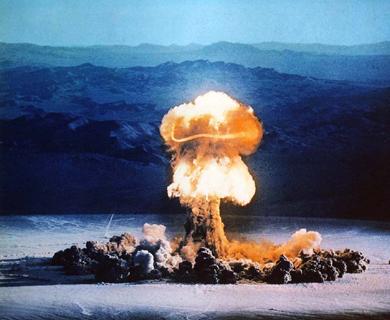
The “good thing” about a vicious circle, aka “positive feedback loop” is that it can be run backwards to de-escalate bad feelings and reduce the effectiveness of fake news. In the earlier “cold war” between the USSR and the USA, you may recall or at least have read about an “arms race” to make more and more nuclear weapons aimed at each other. Every time the Russians increased their arms, it made the US leaders feel less secure so they increased their arms. But every time America added more nuclear missiles, it made the Russians feel less secure so they added more nuclear missiles. It seems like a runaway process. If either side can calm themselves enough to understand the system that they are a part of — and if they are brave enough, they can (and in fact did!) run the circle the other way. When the USA reduced the number of missiles aimed at the USSR, the USSR felt slightly more secure and felt okay to aim fewer missiles at America. That made American leaders feel more secure and they could further reduce atomic weapons.

Similarly, in the USA and other democracies today, if we can step back and understand that the increased divisiveness is not good for anyone, we can begin to “rewind” or “unwind” this ever escalating hate speech. Each “side” will feel a little more secure and a little more willing to take the time to exercise good judgement about what is best for America, for example, rather than simply “sharing” or “retweeting” the best zingers. It will take time to build confidence and to right the “ship of state.” But it can be done.

OLYMPUS DIGITAL CAMERA

I believe that there are three major arenas for actions that democracies can take to reduce divisiveness. The first area is what individuals can do. That is what I will discuss today. To simplify writing, and because I am most familiar with it, I will pose these actions and arguments in terms of the USA, but the general strategies might work in any society that wants to increase cohesion and decrease divisiveness. In two future blog posts, I will examine: 1) how changes in social media algorithms and interfaces might contribute in a positive way to increasing social capital across constituencies and 2) how government regulations (or voluntary agreements in industry) may also help stamp out the worst of fake news.

But let’s begin with what you and I can do to stop this madness. Because right now, most of us are actually contributing to the divisiveness plague without really meaning to. Rather than suggesting specific news sources that are good or bad, I recommend a set of questions to ask yourself about on-line communications. When someone posts or tweets a link to a story, you might ask some of the following questions.

OLYMPUS DIGITAL CAMERA

Who are the advertisers or funders of a purported piece of news? If you click on a link and you go to a site filled with pop-up ads, banner ads, and side bar ads, what are those ads about? Do the ads themselves have credibility? Is it really all that likely that some new oil of oregano will cure every disease known to humanity? Or, that there is “one trick” that will make everyone find you sexually irresistible? What is the relationship between the image and headline that got you to click on something and the actual substance? What is the source of the story clicked on? Is this something you’ve heard of for twenty years like CNN, CBS, NBC, The New York Times, The Wall Street Journal, Fortune, Forbes, or even The National Enquirer? Or is it something that has sprung up recently? Naturally, a newspaper might sometimes get stories wrong too, but most of their revenue comes from subscriptions. By contrast, most on-line sources only gain revenue from ads. By the way, just because there is a website with a picture of a soldier or eagle or flag or Bible does not mean its stories are real. A fake Russian news article is not going to announce itself by saying, “We’re trying to destroy your country!” nor by having a site branded with a hammer and sickle.

When it comes to evaluating a news story, sometimes it helps to consider whether it is likely based on what you know about reality. What people know about reality, of course, varies a lot from person to person. If you’ve never taken a biology course or forgotten everything, you might think a headline such as “New Hope for the Dead!” or “The Zombie Apocalypse is Real!” could be true. But even if you’ve forgotten almost everything from biology class, you do know that there are doctors who dedicate their lives to learning about medicine and practicing it. If there were really, “New Hope for the Dead,” your doctor probably would have heard about it long before your seeing it in an on-line tabloid. They might well have mentioned it to you at your last physical. “Yes, you have really high blood pressure and that is a bad thing. However, if you do die, we have a new procedure to bring back to life.” You might ask your insurance agent what they think. “Hey Joe. Hi, this is Frank. I just read this article entitled New Hope for the Dead. Do I still need life insurance?” You might ask someone else who knows a lot more about life science that you do. You might google “New Hope for the Dead” and see what other types of sites collaborate the original story. There is no single method for checking the validity of a story, but there are some general principles that are always good for problem solving. Think of alternatives and think of consequences.

OLYMPUS DIGITAL CAMERA

Maybe there really is new hope for the dead. That’s one possibility. Or, maybe there isn’t and someone wants to make you believe there is. Why might they do that? To get you to spend money would be one reason. Another might be just to make you feel anxious or angry or jealous. Another might be to make your distrust your fellow human beings. In that latter case, the story would be slanted slightly differently; for instance, “AMA refuses to acknowledge life-restoring value of rhino horn!” This story is trying to get you to believe that rhino horn can bring you back to life and that the American Medical Association is intentionally hiding that fact from you.

How well do you keep secrets? If you’re like many people, your idea of “keeping a secret” is to tell only your closest friend or two and swear them to secrecy. They will likely do the same. Eventually, secrets tend to “come out.” The idea that among a quarter million AMA members, they are all going to successfully keep a secret from the public does not hold water. A more “reasonable” conspiracy theory would be that three doctors did something unethical and kept anyone from discovering their unethical behavior.

Aside from making judgements about the stories, links, shares, tweets that we see, we also need to make judgements about what we ourselves communicate. We owe it to ourselves and everyone else to consider four basic criteria:

  • Is it true?
  • Is it kind to everyone involved?
  • Is it useful to the recipient?
  • Is this story going to increase or decrease trust?

If you cannot discover the truth value of a story, you might pick for sharing something you are fairly certain is true instead. Or, you could ask others if the story is likely true. Or, you could preface it by saying that you are not sure whether it’s true and you wonder what other people think.

Think about whether what you are propagating is kind. Of course, there are times when a truth will make someone feel bad. For example, if you’re interested in baseball, you might report on a pitcher walking in the winning run. If that’s what he, in fact, did, he will not especially like being reminded. I wouldn’t personally call this “unkind” though. If on the other hand, you embellished the report, it could easily become unkind. “So-called relief pitcher Wiley Wrists should be relieved permanently from the Red Sox lineup.” Or, worse, “Wiley Wrists is too fat and ugly to walk to the mound without waddling, let along pitch!”

OLYMPUS DIGITAL CAMERA

Will the information be useful? In the case of Wiley Wrists, most people are not going to find it useful. A few gamblers or baseball players might find it useful. The useful part, by the way, is simply the fact of his losing the game by walking in the winning run. Making fun of people generally adds no value, makes no friends, and increases bad feelings.

The criteria of truth, utility, and kindness are not my own inventions. I think they are pretty much inculcated into the face to face culture I was brought up in. I have seen these explicitly repeated in numerous forums. But the fourth one I think is also important and while related to the others, deserves its own consideration.

If we want to avoid another Dark Ages, (and I mean, the real ones, not the childhood fantasy version), we need to do what we can to restore trust among the very diverse people we have in our country, whatever country you live in. As I said before, because we have such different experiences and backgrounds, it will naturally take us longer to find common ground. Yet, at the same time, we are being driven to faster and faster schedules and timeframes. Our communications may be misinterpreted or clumsy, but at least strive to communicate in a way that tends to increase rather than decrease trust. There are actually very few people that I distrust intensely. So calling them out on being untrustworthy is true and useful. It’s impact on trust is complicated. I believe that the untrustworthy in government are intentionally destroying trust in the country. If those untrustworthy people are trusted? Then, we are collectively toast.

Similarly, some modern politicians are doing things that are genuinely unkind; in fact, they are downright nasty. It is not really kind to them for me to point this out. On the other hand, if we can get rid of politicians who pass legislation that tries to destroy America or make it a crueler, meaner place, then even though the message is unkind to some, it hopefully encourages people to prevent turning America into Amerikkka. And, that is the kind of kind that trumps nice words.


Author Page on Amazon

Excellent Analysis of “Fake News”

Fool’s Gold

31 Tuesday Oct 2017

Posted by petersironwood in America, apocalypse, psychology, Uncategorized

≈ 3 Comments

Tags

commercialism, competition, environment, ethics, family, life, morality, values

IMG_5126

Fools Gold

The Lost Sapphire

(Appeared summer 1997 in the e-zine, The Empty Shelf, slightly re-edited, here).

I can’t recall how that giant blue sapphire first veered into the orbit of my life. Of course, even at five years, I knew it might not be a real sapphire; at least, that’s what my parents insisted. They called it “just glass.” But, they might just possibly be wrong, I secretly thought. After all, I could look into it forever. And, if I looked real hard, I could see the dim, midnight blue outline of things beyond and through the stone, transformed by the magic of the stone into something quite out of the ordinary; something heavenly, mysterious, almost certainly good rather than evil. Almost. And, so far as I could tell, my parents never actually saw the stone; certainly they never looked through it. They’d just glance at it and say, “Oh, yeah, it’s blue glass.”

Well, it seemed to me that it could very well be a real sapphire. Besides making things look beautiful, there was something else — something mom and dad never even tried to understand. It was this. If something happened I didn’t like; if I were sad because my dog was “put to sleep” or scared of getting a shot, I could look at this sapphire and it made me feel better! It made it all, “Okay.” If I listened carefully, it spoke wordless tales of wisdom and comfort. It was obviously worth a lot, lot more than my parents knew.

True, there was a tiny chunk broken out of one corner. But that didn’t really matter. The stone was still perfect…perfect: something to be kept forever.

Forever, that is, until Jimmy moved next door. Jimmy was ten years old and had a two-wheeled bike. Jimmy towered up nearly as thick and high as an adult. But Jimmy was still young enough to see the powerful magic in the sapphire. One bright Saturday morning, on the green grass of the “devil strip” between the white sidewalk and the forbidden black street where the deadly cars zoomed, I sat in the grass watching the magic sapphire, listening for its words of wisdom. Jimmy rode up and tossed his bike onto the devil strip and hopped off in one smooth move. He plopped down beside me. He flashed the red reflector from his bike in the sunlight. Oh, how it sparkled into my eyes!

“Do you want this ruby?” asked Jimmy innocently.

“Oh! Okay. Thanks!”

Jimmy handed it to me and let me flash it in the sun. It was so much brighter than the sapphire! It sparkled fire!

“Great,” said Jimmy, “Let me have the sapphire.”

He snatched it from the grass where I had lain it, jumped up sped away on his bike.

I stared dumbly at his vanishing figure, then back down at the red reflector in my hand. Maybe this was a good trade after all, I thought. It was really bright all right. And when you moved it in the sun, it made different starburst patterns. After all, it had come from a full-sized two-wheeler. But still…something was missing. Then, a buzzing filled my ears. I suddenly realized that the reflector was just pretty glass! There was no magic to it. It didn’t speak; it just buzzed its foolish empty buzz. I couldn’t look through it to other things. It had no depth. And worst of all, it could never make anyone feel better, not even a little bit. “I thought you meant…for a minute…” I said to the big kid now behind his own front door.

I considered telling my mom and dad. Maybe they could get the sapphire back! I hated telling them. You just don’t tell parents about kid troubles; it’s against the main unwritten law of being a kid. But maybe they could get my sapphire back! When I finally told them what had happened, they said, “Well, you made a trade.” I tried to get Jimmy to trade back, but he had none of it. Jimmy soon moved away, never to be seen again. But I kept the red reflector — not to look at — because that would seem somehow unfaithful to the spirit of the sapphire — but just in case Jimmy came by one day wanting to trade back.

And later, much later, I used my allowance to buy special clear marbles — called “Peeries” — emerald green and dark blue with bubbles in them, and my dad got me a cool science kit with a clear rainbow prism that threw color into everything, and then one day I looked into the deep, sparking blue eyes of a blond girl named Jennifer and later into the sparkling blue eyes of a beautiful woman named Wendy and then into real diamonds and computer screens and experimental results and statistical analyses and conclusions, insights, and science fiction. And all of those things were good and all of these spoke to me.

Still, I wonder where the blue sapphire is and how to get it back. How to get it back? The magic. Not clever illusion, not something made to look nice, but true magic. Are you out there, Jimmy? Because I still have your red reflector if you want to trade back.

——————————————————————

I don’t know whether society can trade back either. We used to have some kind of balance between competition and the other valuable things about life. We seem mainly to have traded it in on a newer model. In the new model, money is the only thing that matters. Winning is the only thing that matters. Math definitely does not matter. People who are rich and powerful can pretty much get away with anything. The only exception would be someone like Bernie Madoff who was silly enough to include some wealthy people among those he bamboozled. But the Bernie Madoffs of Wall Street that sunk the economy in 2008 walked away scot free.

“All that glitters is not gold.” The normal interpretation of this means that not everything that glitters (like gold) really is gold. Normally, this is meant in a metaphorical way but based on the real phenomenon of “Fool’s Gold” (Iron Pyrite) which does glitter like polished gold but is of far less conventional value.

IMG_4695

I like to consider a different interpretation: What if all gold is “Fool’s Gold”? Naturally, I’m not denying the existence of metallic gold. I’m wearing a (mostly) gold wedding ring. So, I believe in real gold. What is meant is that striving after gold is itself a foolish thing to do. If that’s true, then, it’s all “Fool’s Gold” whether or not it’s Iron Pyrite or Real Gold.

How could this possibly be so? Isn’t life a contest to see who can make the most money? Isn’t money (and before that gold) an easier way to exchange goods and services that having to strike each deal uniquely? It is indeed easier. Does that necessarily mean it’s better?

Society is growing more and more differentiated. We do vastly different jobs from each other. For example, for many centuries, farming was a common occupation. In the USA in 1900, for example, about a third of the entire workforce were still farmers.  Now, that percentage of farmers is about a tenth that. It isn’t only that there are now many different fields such as computer science and forestry. Even within a field such as computer science or forestry, there are more and more subspecialties. It’s as though the tree of humanity is growing larger and larger and branching out farther and farther.

IMG_9489

At the same time, this entire enterprise called “society” is not stable. It is spinning; spinning faster and faster. This means that this whole enterprise will eventually fly apart — unless, the cohesive strength of the whole enterprise continues to increase. Unfortunately, it seems that just when we need to increase that bonding strength, it is weakening.

What is the real gold? Anything that strengthens the ties is real gold. Anything that weakens the ties will tend to cause the entire enterprise to disintegrate. Even if some bars of heavy shiny metal accrue to those who strive to break us apart, they are causing overwhelming harm to others, including generations and generations of their own offspring.  The last time, the European Dark Ages occurred, it last centuries. Science, engineering, agriculture, learning, medicine — all these things were worse for a half millennium before they started to get better again. Meanwhile, the toll in terms of human misery was immense. And for what?

IMG_6881

Our fall from the advanced civilization to the next Dark Ages will be a much harder fall than what much of Europe experienced after the fall of Rome. People in a Roman society were closer to the land and to the world of real things than many people are today. Many moderns in the so-called Global North have no idea how to live off the land, plant a garden, hunt or fish. Even if they did, we wouldn’t be close to being able to feed 7 billion people without modern agriculture, distribution, knowledge of crops, irrigation systems.

My history lessons focused on Western Europe and the United States, so when I think of the “Dark Ages”, I think in terms of Western Europe. But we should remember that that minimal impact, for instance, on most of the people of the planet at that time including North and South America, Australia, most of Africa, and most of Asia. This time, it would be different. Such a catastrophic Dark Ages would today be global. No-one would really escape.

IMG_7168

No-one would escape the new Dark Ages and that includes extremely rich and powerful people. Yes, they could have more absolute power over other people as a Newmedieval Tyrant than as the leader of a democracy. And, granted, that may be the most important thing in the life of that kind of person. But it isn’t the only thing. They have no idea how inconvenienced every other aspect of their life would be if civilization fell.

We, as a species, are not “set up” for the Dark Ages. There are way, way too many to feed without the science and engineering behind today’s agricultural processes. There are way too many to obtain fresh water without modern infrastructure. Of course, it isn’t just that we are physically unable to deal with this kind of downfall. We are nowise prepared mentally either. Most of the knowledge we currently have for living in a complex, technological society would be completely useless and we’d know very little of what we should actually know in order to survive.

Maybe hell is not the punishment for one person’s life of sin, but the collective punishment wreaked upon all of our descendants for the collective current sins of humanity. After all, isn’t extinction a kind of hell for the species? We wouldn’t be the first extinguished species. Not by a long shot. Most of them were “hit without warning” by the after-effects of a meteor or a met by a human-powered bulldozer clearing away amazing rain forests for a few more bars of fools gold.

I know one thing for certain. Jimmy’s not coming back to trade you back what you really care about for that shiny red reflector that caught your momentary eye.


Author Page on Amazon

Know What?

08 Sunday Oct 2017

Posted by petersironwood in America, apocalypse, psychology, story, Uncategorized

≈ 6 Comments

Tags

"Fake news", advertising, life, marketing, newspapers, politics, Russia


IMG_1245

Know what?

The Etruscan shrew (Suncus etruscus) is the smallest mammal weighing in at a measly two grams or less.

There are 907185 grams in a ton, so the blue whale at two hundred tons, weighs 90,718,500 x as much as the shrew. Yet they both have spines, a brain, a liver, intestines, breathe oxygen, eat food, have a beating heart, etc. They mate, nurse their babies, raise families, just as we do!

Know what?

First, there is huge variation — but at the same time, a lot of similarity — among mammals. We naturally have a curiosity about the largest, smallest, tallest, fastest that is possible. This curiosity is not limited to our culture or our time. Indeed, it seems to be true of animals, in general. In fact, our nervous system is fundamentally tuned to changes, boundaries, and extremes. For example, if you walk into a kitchen, the aroma of freshly baked cookies seems to fill you with pleasure. It can be very strong. But after a few minutes, you may barely notice the smell. If the fan in the kitchen is on, it may at first seem pretty loud. But after a few minutes, most people will no longer notice. There are limits of course. If the smoke alarm goes off, you will continue to notice it. It is designed to be loud enough to annoy you forever. Just as our ears are mainly attuned to changes, so too, our visual system is attuned to edges. This is why, for instance, a cartoon “works” to depict something that is actually much more complicated. Given that neither humans nor any other animal has an infinite brain, it is a useful general heuristic to especially note changes, edges, and the “extremes” of our experience.

The second thing to note is that, since life is complex and complicated, there are many astounding facts.  It is interesting and exciting to know about the “edges” of experience in many different dimensions. This is not a “bad thing” but it does make us susceptible to being “suckered in” by things that are astounding or sensational even if they are not particularly useful. Some people take advantage of this tendency and use it to manipulate us into buying toothpaste, drugs, and candidates.

IMG_9291

When I was a kid, there were certain newspapers (which still exist) which “everyone knew” were absurd attempts to capture people’s attention with “fake news.” Photographic evidence of the Loch Ness Monster, BigFoot, Aliens from Outer Space, people rising from the dead. Amazing! Too good to be true! Well, they weren’t true. Now, it is much easier and cheaper to “publish” fake stories than it was in the days of print.

There is a much subtler and more virulent change as well. Fake newspapers lay out on the checkout stands at drug stores and grocery stores for everyone to see. Most people knew these stories were fake, but some people would fall for it. Everyone could see the headlines: “New Hope for the Dead!” and pretty much dismiss the entire magazine on that basis.

The Internet is has become worse that tabloids because if you’re like most people, there are traces of your behavior all over the Internet. Fake news doesn’t have to concoct one common story for everyone to swallow. They can analyze your personality, your likes and dislikes, your background, your political affiliation from what you look out, how you comment, what you buy on line and so on. They can *target* stories that you are especially likely to believe and that are particularly likely to sway you in your buying or voting behavior. Of course, it isn’t perfect. But it doesn’t have to be perfect to be effective. Whether there was any collusion between the Russian intelligence agencies who were and are doing this and the Trump campaign is still up in the air. However, that they were doing such things is clear. They’ve been doing it for a long time and they are continuing to do it.

IMG_5572
Why would they bother? The USA has, by far, the mightiest military in the world. Direct military action against us is absurd. Much better idea: weaken us from within. The greatest strength of the US is its diversity. Use that to push and prod at all the rifts between people whether based on sexual preferences, religion, dietary habits, what kinds of sports you like, your preferences as to how and when you celebrate Holidays, your skin color, your country of origin, whether you think pot should be legalized, whether you favor more lax or more stringent gun regulation, the  music you like, the clothing you find attractive. Anything on which people differ can become a battleground if the people are properly played.

I can easily imagine people from different backgrounds or beliefs, when faced with a real world problem, taking the time to understand each other’s concerns and come up with either a compromise, a vote, or even a transcendent solution. You can probably imagine that as well. Humans have been doing this for a hundred thousand years. We humans don’t always resort to violence every time there’s a difference of opinion.

Let the media notice the disagreement and it will get worse. Let the fake news decide it’s an issue worth making people hate each other over, they will zoom in on that disagreement with more passionate love than house flies buzzing toward a forgotten turkey carcass in the garbage. They will make a fake story sure to inflame the passions of one side. They will generally create an inflammatory headline first that is a complete lie. Then, they will “back it up” with vague statements, lies, or half-truths, and generally with a combination of all of those.

IMG_7168

To see how this might work, let’s imagine that there is an island where there are two species of birds that look identical. Squeakers live on one side of the island and the Squawkers live on the other side. The squeakers like to squeak, need I point out, while the Squawkers like to squawk. No big deal. Then, one day a very rich human arrives on the island and offers to make them all very very rich. He claims he is going to buy a tiny piece of their lovely island for sunbathing. He just wants to make sure his investment is safe so he needs to know which bird is going to speak for the entire island. Need I point out that the squeakers and squawkers are now all at risk to become squabblers. As a matter of fact, it may not even matter whether the bird who “speaks for the island” is a squeaker or squawker. Nonetheless, there will be argument and counter-argument. But at long last, this dispute will almost certainly be settled without bloodshed. That is not a guarantee, but it is likely.

Now, let’s first inject a legitimate TV news crew into the picture. They hear about this deal the rich man is offering ahead of time. So, they go and do a report. You might well hear this on the news or read it in the newspaper: “A rousing controversy is brewing tonight on the normally peaceful island of “Ang-Grebe-urds. Multi-billionaire business tycoon, Lance O’Latte has offered an undisclosed but sizable sum to the natives of “Ang-Grebe-urds.” However, to collect this handsome sum, the Ang-Grebe-urds must choose a single spokes-bird. Who will it be? No-one yet knows. Indeed, that is where the process seems to be stuck in the craw of the Ang-Grebe-urds. We’ll keep you updated on this breaking story as more details unfold.”

That’s not all. They scan the environment for particularly nasty things that one side says about the other.

IMG_8805

Imagine this hypothetical interview: the reporter asks one of the prominent Squeakers how they feel about the head of the Squawkers. The interviewed Squeaker might say, “Oh, I’ve known Mr. Squaw-Squawk for ages. We are both big fans of soccer. He was our top speller in high school. Also, he did a great job as quarterback on the high school football team. I don’t particularly like him in the way he squawks all the time though.”

What will reported? No way to predict for certain, but my money is on this quote: “I don’t particularly like him…he squawks all the time….” Publishing that statement is really not going to help the Ang-Grebe-urds come to consensus. But it probably still won’t prevent it. Newspapers are still largely paid for by subscriptions. This is important. Because the newspapers are not completely paid for by advertising, it tends to make them more likely to stick to the truth. Individual reporters may exaggerate or hype the conflicts but they very seldom make things up. If they did that, many subscribers would stop doing so. Even some advertisers might shy away from the newspaper that sold papers on the basis of lies. Advertisers do look at readership and people are more likely to pick up a newspaper if the headline is: “Famous Squeaker Complains that Squaw-Squawk squawks all the time!” She said, “I don’t particularly like him…he squawks all the time….” But, there is still a “brake” on complete fabrications. Companies who care about their brand (e.g., Coke, Pepsi, IBM, AT&T, Microsoft, Disney) will not want to be associated with news organizations that only lie, Subscribers too will fall off if they become suspicious that they are being lied to.


OLYMPUS DIGITAL CAMERA
IMG_9136
IMG_1289

Now, let’s see how this situation worsens with stories that are presented on-line. Being on-line is an important detail. Because it is on-line, the media outlet need not have one single actual artifact (such as a printed newspaper) that everyone can point to. Instead, stories can be slanted to different readers. A Squeaker who is pretty much a decent old bird but hates onions, for instance, can get a fake news article that claims Squawkers love onions. Furthermore, the fake news claims, there are secret plans, if a Squawker is elected, to make onion-eating required. 

In reality, Squeakers and Squawkers mostly don’t care much one way or the other about onions. Rather, both Squeakers and Squawkers each have about 10 percent, both equally divided about whether onions are: 1) completely wonderful to add to any dish or 2) the invention of the devil to torment Ang-Grebe-urds. Many on-line sources are not paid for by subscribers. They are paid only by advertising.

Furthermore, while the newspaper advertisers only know the circulation of the newspaper as a whole, by contrast, the on-line advertiser can measure how many clicks they get for particular ads and stories. This is a huge difference. It means that every single article for on-line media is pushed toward sensationalism and conflict. Furthermore, the on-line sources can republish many different versions to many different selected sub-audiences to maximize clicks. If, for example, there are some Squeakers who feel football is too violent, the interview reported can be: ““I don’t particularly like him…quarterback on the football team…he squawks all the time….” No need to include that phrase if you are presenting the article to football fans.

These kinds of “fake news” stories are designed to make money out of advertising of course, but beyond that, they are not only meant to grab your attention but are often designed to set you at the throats of your neighbors and countrymen. Of course, in our hypothetical example, that’s precisely why the rich business tycoon set up this situation and then kept using fake news to jack up the emotions of the Ang-Grebe-urds until they killed each other off. Now, he can not only have his sunbathing cove; he can have the entire island. For free. Well, free for him. The Squeakers and the Squawkers paid with their lives. They will rest forever in total squilence. Differences in preferences and slight variations in behavior were driven into hate and violence by targeted messages. While the Squeakers and Squawkers thought they were enemies of each other, in fact, they were both being manipulated by the Takers. The Takers are birds of an entirely different feather. They don’t actually give the slightest damn whether birds prefer to squeak or squawk. All they care about is buying real estate cheap and selling it dear. Some may have actually enjoyed watching the Squeakers and Squawkers kill each other off, but that’s just the icing on the cake.

IMG_0481

What about citizens in the US, the UK and Europe and other countries that are currently democracies like Canada and Australia? Know what? We are under attack. I’m not trying to be sensational. (I’m not paid by subscribers or ads). I’m just trying to put it out there for your consideration. While it is not yet clear how much, if any, collusion existed between Russia and the Trump campaign, it is clear that Russian interests worked fake news stories into the discussions and debates leading up to the US election as well as the Brexit vote. These stories are not only meant to sway elections but also to foment discord; to make people in one party or part of the country distrust others; to make people doubt science and more objective media. (After all, if you can’t trust “experts” and “scientists” and “the mainstream media” then, where  are you going to go for information? You guessed it: social media and on-line media become even more popular.

Back in the days of mostly local newspapers, normal checks and balances pushed owners, editors and reporters toward printing news that was truthful. They would tend to be motivated to say things about the community that were useful, kind, and true because otherwise false stories would negatively impact their own community. In addition, if they were “found out” they would definitely experience social ostracism that would likely be extensive. A false story about a coming plague might sell a lot of newspapers in the short term, but when it was discovered to be a lie, the entire newspaper was in danger of losing its readership.

By contrast, a very large national newspaper chain might be headed up by someone who cares very much or little about social ostracism and probably lives in a “community” completely divorced from the people he or she lives and works in. The CEO might well be only interested in profits which in turn means pushing stories based on how they impact readership, not based on what it means for America as a whole. Nonetheless, there is a still a tradition in newspapers of long standing to tell the truth and to verify stories. There may also a sense of long-term commitment to the company. For example, the people in a traditional newspaper want to be able to hire the best people for their organization. To allow that to happen, it is vital that they have a reputation for telling the truth and for responsible reporting. As I’ve mentioned, newspapers who lie regularly are at risk of losing both their subscriber base and their advertisers.

By contrast, when it comes to on-line news media, because they are new, there is little tradition; they don’t depend on subscriber dollars; their advertisers tend not be companies like IBM and Disney who care about their reputation, but instead unheard of companies who want to sell you miracle cures and self-adjusting tea cozies.

SeaMonkeys

Know what? These on-line media are doing this to us now and even when we retweet or argue about the truth of divisive news, it’s still divisive. Then, we often disagree on social media about whether it’s true and that’s also divisive. Is nothing to be done? I do think that there are some principles and guidelines than can help distinguish real news (which does also appear on-line) from made up manipulations to make you angry. Next week, we will explore what some of those principles and guidelines might be. Meanwhile, I personally like onions. But I don’t insist you do.

Know what? We are all now “Citizen Soldiers” in a war of words. Most likely, you were never trained as a reporter and most likely, like me, you aren’t making a penny out of your use of social media. But social media grows ever more important in people’s understanding of what is true about the world. Like it or not, your Facebook posts and tweets either exaggerate the impact of fake news or dampen it out. You might consider a reporter’s questions: What, who, where, when, how, and why. You might also consider these before sharing a story: “Is it true? Is it kind? Is it useful?”

IMG_4695Author Page

—————————————


http://www.pewresearch.org/fact-tank/2017/06/01/circulation-and-revenue-fall-for-newspaper-industry/

http://www.truth-out.org/news/item/34789-democracy-in-peril-twenty-years-of-media-consolidation-under-the-telecommunications-act

https://brandeyemedia.com/2017/07/03/with-the-growth-of-online-media-will-the-newspapers-survive/

https://theconversation.com/social-media-is-changing-our-digital-news-habits-but-to-varying-degrees-in-us-and-uk-60900

Lost Horizon.

17 Sunday Sep 2017

Posted by petersironwood in America, apocalypse, psychology, story, Uncategorized

≈ 2 Comments

Tags

Business, celerity, history, innovation, life, politics, stories


IMG_2870

One of my favorite movies as a young child was Lost Horizon. I believe I happened across this movie quite by accident (but then, maybe it was no accident after all). In any case, for those who haven’t seen it, the basic plot is that an Englishman, Robert Conway, ends up, seemingly by accident, in a semi-magical city high in the Himalayas, “Shangri-La.” It turns out that he was actually brought there intentionally to be the new head of Shangri-La. However, he heads back to England and later decides that was an error and nearly dies of exposure on the icy slopes of the mountains trying to scrabble his way back to Shangri-La. The plot echoes the idea of a lost Eden. In the Biblical account of Eden, humans lived a kind of carefree existence before defying God and thereby incurring his wrath which cursed all humanity to have pain bearing children, having to work, etc. There are many stories and myths of an earlier time or a magical place where life is much longer, more fulfilling, less filled with strife and disease, and generally speaking, better in every way than where we are now.

https://en.wikipedia.org/wiki/Lost_Horizon_(1937_film)

I believe that there really is a “Lost Horizon” in much of modern civilization and that horizon is a longer time horizon. In the book, Amusing Ourselves to Death, Neil Postman argues that people used to have a tolerance for much longer and more nuanced debate about about public issues than we do now. For example, the famous “Lincoln-Douglas Debates” about slavery lasted all day! Now, we try to compress dialogue, discussion and debate into a sound bite or a 140 character tweet.

I never had the pleasure of climbing “real” mountains when I was a youngster. I never even saw the rockies till my early twenties. However, my neighborhood did have a large empty field. And in the middle of that field was a small hill. Because the land around was mainly flat, even this small hill provided a panoramic view of woods, fields, and nearby houses. Whenever I faced some particularly weighty decision facing me, I instinctively walked about a half mile to this hilltop. I went there, surveyed everything I could, and thought about the problem at hand. This seemed the most natural thing in the world and whether true or not, it certainly gave me the impression that I could think about the problem more holistically than if I simply sat in a chair or walked through a forest crowded with trees. On that small hill, the silence from human voices was broken only by the noise of distant traffic, the wind in the grass, and the trills of bob-whites. Sometimes, I would whistle to them for advice. Their “answers” always seemed timeless and untinged by hurry.

In 2003, I was invited to give a keynote talk at a conference in Madeira about my work on a socio-technical Pattern Language (some of which, not so coincidentally, encouraged a broader look over time and space). My wife and I decided to make a vacation out of it with our nephews, Mark and Ryan. On the way to Funchal, we visited Oxford University and a professor friend in cognitive psychology, Peter McLeod. We played “lawn bowling” (the English version of Bocci) at Oxford. While we did our best to out-bowl Peter, he pointed out to us a grove of gigantic Oaks. He said that they had been planted hundreds of years earlier and some of them would be culled soon for renovating one of the buildings. This, he claimed, was no accidental windfall. These oaks had been planted specifically for that purpose centuries earlier.

https://www.slideshare.net/John_C_Thomas/toward-a-sociotechnical-pattern-language


It wasn’t just Oxford, however, that had been planned with the future in mind. Medieval cathedrals often took a quarter century or a half century to complete. Notre Dam and Lincoln Cathedrals took about a century while the Cologne cathedral took 600 years! Meanwhile, here in the 21st Century, the US Congress seems powerless to pass legislation to repair our crumbling dams, highways, and bridges.

http://natgeotv.com/ca/ancient-megastructures/q-and-a

The US has an opioid addiction problem. In addition, there is an obesity epidemic. There are many reasons for these, but at least part of the problem with any kind of addiction is that people are unable, unwilling, or unpracticed at behaving in what is their own long term interests and instead doing what feels good in the short term. While one might imagine that the advent of widespread literacy, electronic communication and access to a huge amount of humanity’s knowledge via the Internet would encourage people to take a longer view of life and happiness, instead, many people seem more short-sighted than ever.

IMG_1265

Think how we cherish the word “instant.” We have “instant coffee”, “instant pudding”, “instant messaging.” We have “speed dialing,” “speed dating,” and just plain “speed.” Software companies feel the need to release new versions and “subversions” at a breakneck pace that necessarily sacrifices sufficient testing.  While people often used to invest in a company’s stock and keep it until they retired decades later, now people invest in a portfolio of ever-changing stocks and a CEO who doesn’t deliver quarter over quarter improvements may soon find themselves out of a job. Many people, in fact, do “day trading” to try to make money. Imagine investing and then uninvesting a few moments later in companies whose products and services change over month or years.


IMG_9175
IMG_9856

While parents encourage their kids to get good grades now so that they can have a good career later in life, the parents themselves often vote on their short term interests. Politicians cannot solve budget deficits or the over-reliance on fossil fuels. Large number of people who would feel demeaned to be or to be called a heroin addict, will nonetheless buy the SUV, throw the recycling and trash together, and generally accept the rhetoric that denies global climate change and its impacts. Together, our obsession with speed has sometimes been called, the “Cult of Celerity.”

https://deepblue.lib.umich.edu/handle/2027.42/26391

Why does a society that has more material wealth and seems to require less of a “hand to mouth” existence, instead, seem ever more focused on the near term and less on the long term? I suppose one possibility is that it is a symptom of a transitional period in humanity’s evolution from a collection of individuals with strong ties to a small number of people to a world-wide interconnection in which individuals become more like “parts” in a giant machine and the “processing” of information that each person does becomes more and more fragmentary.

In teaching Intro Psych, I constructed an exercise for the students in which the class as a whole solved a simple problem. But each individual person had a slip of paper with simple instructions. For example, one student’s instructions might say, “Take a piece of paper from the person on your left. If the paper they hand you has a cross on it, pass it to your right. If it has a circle on it, pass it to the person ahead of you.” No individual person could possibly understand what they collectively were doing.

Indeed, this aligns precisely with “Taylorism” that shaped so much of the so-called “Industrial Revolution.” Some one person or small group of people designs an assembly line. They understand the overall process. But a person actually working on the assembly line may only know that they see a series of widgets passing by and for each widget, they are supposed to turn a screw. They are not supposed to worry about how their job fits into the overall picture. Indeed, they were not encouraged to take a broad view or a long view of their work. Many such jobs have been replaced by robots.

too brief an article which claims Taylorism “ended” in the 1930’s!

An alternative to ever-increasing atomization and automation of work is instead to structure small teams of people to design and build cars. They can do this, incidentally, with a view toward overall energy costs of manufacturing, distribution, and driving rather than just reducing the emissions of the vehicles after construction.


http://radar.oreilly.com/2015/06/the-future-of-car-making-small-teams-using-fewer-materials.html

Even when people are part of a deconstructed process, it can still be worthwhile for them to “see the bigger picture.” Knowing how your job fits into a larger picture provides motivational advantages and knowledge advantages. As a common folk story goes, two travelers are passing by a wall where two folks are laboring. Each laborer selects rather large rocks in a nearby field; carries them to a wall and places them carefully then using cement to fill in tiny cracks. Objectively, these two workers appear to have the same job. However, one of the two was happily going about their work humming and smiling while the other slumped their shoulders and sported a grim visage; could be heard ever muttering beneath his breath. Curious, one of the travelers asked the Glum one, “What are you doing here, my good fellow?”

“Oh, what a pain! I’m building a wall, of course.”

Then, the traveler approached the cheery builder and asked, “What are you doing here, if I may ask?”

“Oh, what a joy! I’m helping to create a marvelous cathedral, of course!”

IBM’s Think magazine once contained an interesting example of the cognitive benefits of seeing the big picture. People who worked on the Endicott, NY assembly lines were given a few hours of training to see how their job fit into the overall picture. At one point, one of the mask inspectors jumped up and yelled, “Oh, no! I’ve been doing it wrong all these years!” It turned out that they had not wanted to “throw out” a mask that “only” had a few errors because they knew a lot of time and effort had gone into making the mask. They thought it prudent to pass masks as “okay” unless there were a lot of errors. Of course, each mask was used to make many thousands of chips, so it was vitally important not to pass a mask if there were even the slightest error. But until this training program, no-one had really made this clear.

At IBM, I managed a research project for several years on the business uses of stories and storytelling. One of the “knowledge management” consultants I worked with, Dave Snowden, told a story of the Thames Water Company. At that time, when people in this part of the UK had trouble with their water or sewer, they called up a help line and the people who staffed the help lines (almost all women) were to follow a script and dispatch engineers (nearly all men) to go and fix the problems. Of course, as is customary, they were measured on how many calls they could handle in an hour. Most of the help personnel were young, but one middle aged lady took about two and a half times as long to dispatch engineers. She was about to be fired for being so slow, when some enlightened individual decided to look a little more deeply. It turned out that, indeed, she was slower. However, it turned out that her husband was one of the engineers who fixed problems. Because of the knowledge she gained from talking over their jobs together as well as her long experience, she actually solved many problems on the phone herself. In fact, while the average service rep sent an engineer out into the field on about one out of every ten calls, this woman sent an engineer out only one out of a thousand calls. By taking slightly longer on the phone, she was actually saving the company a lot of money! Chances are excellent that he probably did a much better job as an engineer for having conversations with a dispatcher as well.

IMG_3067

It seems as though more widespread public education and literacy would allow people to undertake their jobs as well as their political and personal decisions with a longer time horizon and a broader view of what the impact of their behaviors are on others. Beyond that, it seems to me that many of the problems of today require longer and broader views in order to take appropriate action. In fact, it seems the evolutionary advantage to early (and contemporary) humans does not lie in our sharper teeth or stronger jaws; it does not lie in our sharper vision or hearing; it does not rely on our superior strength or speed. Our only advantages are to be able to cooperate and communicate over a longer period of time and space. Yet, here we seem to be — focusing on smaller pieces of complex problems, over-simplifying both the problem and the solution, and insisting on instant answers and speedy resolutions.

Rather than pay a dollar more in taxes to build mass transit to help stem global climate change, we would rather wait for a hurricane and spend ten dollars more in taxes or thousands more to repair things. Rather than pay a penny more in taxes and find a cure for cancer, we would rather pay a hundred thousand in medical expenses. Rather than pay to repair a bridge, we’d rather wait till it collapses with scores of people on it. Rather than wait three years for a new software release with minimal bugs, we would rather wait three months and get the newest with a mosquito horde of bugs. Rather than take the time to fully understand a problem before trying to solve it, we’d rather categorize it quickly and apply a solution that might or might not be appropriate or better yet, “hand it off” to someone else. Rather than take the time to enjoy what we are doing at the moment, we’d rather jump ahead to the next moment.

Maybe “Shangri-La” is not a magical village hidden deep in the Himalayas. Maybe Eden is not something humankind “lost” but something we are yet to build. Together. Slowly. Over time. Maybe finding or rediscovering Paradise is not so much a question of scrambling up frozen mountainsides as simply taking a deep breath, a break, a pause in the action in order to see things from a more global perspective.  Even a small hill can help you collect your thoughts and see the broader picture. It might be quiet there and you can hear, not the voices of bosses, managers, advertising and overlords urging you to buy more, get more, work more but instead you can hear the clear call of birdsong reminding you that Eden may only be a few deep breaths away.

IMG_3947—————————-

Author Page on Amazon

Only You…

08 Tuesday Aug 2017

Posted by petersironwood in America, apocalypse, psychology, story, Uncategorized

≈ 1 Comment

Tags

creativity, family, feelings, life, school, stories

Only You….

IMG_3256

Perhaps, like me, you recall “Smokey the Bear” from your childhood along with his famous slogan, “Only you can prevent forest fires.” In English, we seem to have stuck with the completely unmarked and ambiguous second person pronoun. “You” could refer to one single individual or to two people or to everyone on the planet! And, at least in English, the verb form doesn’t help you much either. Of course, verb forms don’t typically help much in English in any case, but you would think, since the pronoun is ambiguous, there would be some other clue in the syntax, but there isn’t. “I can, you can, he/she/it can; we can, you can, they can.” Brilliant. Although many verbs do mark for singular third person with an “s” for the verb which, come to think of it, also makes little sense. If anything, “s” on an English verb should mark for plural. Whatever. I am not bringing this up to criticize English syntax to start a revolution in order to make it more consistent and logical. I learned my lesson from George Bernard Shaw who left his fortune to at least make English spelling phonetic. He sponsored a contest resulting in a beautiful “Shavian alphabet” but his will was contested. He died in 1950 and now, 67 years later, English is just as difficult to spell as ever. Sigh.

https://en.wikipedia.org/wiki/Shavian_alphabet

So, no, I am not going to try to convince you to start saying, “you can” for singular you and “you cans” for the plural. In the South, some feel that “y’all” or “you-all” marks for plural but that is not a universally held belief. In any case, when I first heard, “Only you can prevent forest fires” I thought Smokey the Bear was talking about me personally. This was no doubt reinforced by the posters which clearly showed Smokey pointing his “fingers” at me. He wasn’t gesturing to a crowd. He was pointing at me. I had already seen the Disney movie Bambi which graphically portrays the flaming horror of a forest fire so I really did want to prevent them. But how? Smokey went on to offer some helpful rules such as not dropping my cigarettes carelessly on the ground and putting out my campfires completely. I was only about five so I didn’t have much of a nicotine habit. And, several more years would pass before I went to YMCA camp or Boy Scout camp. At five, I didn’t really have much chance to make sure my campfires were out because I didn’t have any campfires. My parents didn’t let me play with matches. Yet, forest fires persisted. Smokey must have been leaving out some crucial steps as to how I was supposed to prevent forest fires.

https://en.wikipedia.org/wiki/Smokey_Bear

I generally tried to work out such puzzles for myself, but eventually I gave up and asked my grandpa how I could prevent forest fires. He patiently explained that Smokey was talking about people in general, not just me in particular. I don’t think I totally “bought” this explanation, but it did assuage my guilt somewhat. “People in general” is an odd concept anyway. It was weird for a five year old, but it remains weird to this day. People are very diverse in their abilities, motives, goals, backgrounds — so how can you possibly make sure “people in general” do anything at all? It wasn’t till many years later that I learned that some people set fires intentionally while a larger number are criminally careless.

OLYMPUS DIGITAL CAMERA

Of course, it isn’t just forest fires that need to be prevented. Parents caution kids in a thousand ways and perhaps 900 of those are actually valid concerns. “Don’t run with scissors!” “Look both ways before crossing!” “Don’t stick anything in your nose!” “Don’t stick anything in your ears!” You may have heard the expression, “It takes all kinds.” It basically means that our world needs different kinds of people in it. I agree! But I must confess, I had no understanding of why my parents would say to me, “Don’t stick anything up your nose!” “Don’t stick anything in your ear!” What!? By this time in my life, I had experienced things stuck in my nose and ears (to name two places doctors like to jam things into you). Every doctor’s visit required that Dr. Miller jam some ice cold metal thing up my nose and when that was done, into my ears! I hated it! But apparently, some kids loved that so much that they wanted to recreate the experience. A few times, playing, hiking or just hanging out a bug flew into my eyes, nose, or ears. I hated that. True, they weren’t ice cold but they moved and buzzed making it even more terrifying. So, now my parents caution me not to stick something up my nose? Of course, once the idea is planted….No, I did not partake.  Once they cautioned me, of course, I did consider it for the first time. But I couldn’t get over the horror. I actually seriously considered two possibilities as to why they would give such advice. 1. They were insane. 2. They knew something I didn’t. Hidden just beyond my view loomed an alternate universe in which things behaved quite differently. And, apparently, a person — even a five year old person like me — could accidentally slip into this alternative universe. In this alternative “up is down” “left is right” universe, it actually would be totally cool to stuff a crayon up your nose and not be able to breathe out of one side of your nose like you had the worst most disgusting bugger ever invented stuck and you could not sneeze it out. And, then, you would have a horde of grown ups hovering around you in a panic like you were going to die, and very soon, unless extreme measures were taken. So, off you went to the “Emergency Room” and some sleep-deprived intern whose mind swam with images of the cute nurse in pediatrics, stuck some cold instrument up your nose and spread your nose tissue like it was going to explode. Whether she needed to do that or enjoyed the movie about the nurse in pediatrics so much, she wasn’t paying attention, I don’t know. But either way, horrible is horrible. So, yeah, I considered it. And I considered it stupid to stick a crayon up my nose.

However, a few years later, I learned that there really were kids who stuck crayons up their nose. What!? This meant that my parents weren’t insane after all. Instead, there really hovered some alternative universe in which it made perfect sense to stick a crayon up your nose. Yeah, sure. Good times. But it isn’t a universe I particularly want to slip into. At least not ahead of schedule. I figure, if I’m lucky enough to live long enough, I may end up with quite a few tubes stuck in me various places. I might not, but I might. In that case, I guess I will have to change my attitude. I wonder whether kids who did stick crayons up their noses have an easier time with this?  In any case, please remember: “Don’t stick crayons up your nose.”

Well, okay, I can think of a scenario where it would make sense to stick crayons up your nose. Let’s say that you’re James Bond and have been issued a very special crayon; when snuffed up your nose, it provides an instant antidote to the poison you are about to release by clicking your heels together three times. BANG. Fog. Your assailants all crumble to the ground. You remove their weapons, tie them together, and waltz back to the hotel to order a double martini, two olives, shaken not stirred. Under those circumstances, I probably would do the nasty.

Sadly, a much more common set of circumstances also exist. In my real life, I had the luck to be born into a loving family. From birth on, like most kids, I was surrounded by love. And, although I wasn’t always the center of attention, as I secretly knew I should be, I had plenty of attention. My parents had their times they didn’t want me to butt in but I also had plenty of time that I wanted to be alone or with my own friends. Live and let live. But what if, instead, I had been unlucky enough to be born into a family that provided very little if any love or attention? Under those circumstances, I might have been desperate enough to try putting a crayon up my nose or even playing with fire.

Just as I never felt compelled to stick crayons up my nose, I never understood kids who enjoyed “playing with fire.” I personally don’t like getting burned, not even a little bit. I recall accidentally touching my thumb to a hot soldering iron my dad was using. Oh, my god that hurt! I didn’t want to admit to anyone that I had burned myself. How I discovered this, I have no idea, but I discovered that if I lay down on the living room rug and vigorously rubbed the burned part back and forth on the rug, the pain went away. But when I stopped, the pain returned even worse than before. So, naturally, I did the only sensible thing a six year old would do. I resumed rubbing the burn on the rug. Ah. Relief. Of course, from today’s perspective, rubbing the burned part screams of stupidity. At the time though, I eventually confessed when my parents asked me why I kept making persistent thumb love to the rug. Whatever they did to treat the pain, I can tell you it wasn’t as effective in the short term as rubbing it on the rug. But they were adults. They were interested in what is best in the long run. And, I just bring that up because it seems somewhere along the line, we seem to have forgotten that.

OLYMPUS DIGITAL CAMERA

In the universe where I grew up, the adults had responsibilities. Top most among all those responsibilities was to provide for future generations. At least most parents are overjoyed when their kids are born. It doesn’t seem too much of a stretch of the imagination to realize that your kids will also be overjoyed when they have kids and so on down the line. If adults are collectively unable to put off their own pleasures for the good of future generations, this particular branch of the tree of life is about to be pruned.

The idea that we adults should squeeze every ounce of earth’s resources and leave future generations far worse off in terms of the beauty of the earth, the healthfulness of the air, water, and food supply — no way! That’s what little kids might do. And, lying about it to avoid any consequences? That’s what you expect a little kid to do. Not an adult. Only a child would play with fire. It might burn far far beyond any original intention. You know, Smokey was right:

“Only you can prevent forest fires!”


Author Page

Claude, the Radio Operator

28 Sunday May 2017

Posted by petersironwood in America, apocalypse, family, management, Uncategorized

≈ 6 Comments

Tags

communication, dinosaurs, diversity, family, learning, politics, soldiers, stories

PicturesfromiPhoneChinaParisPrinceton 278

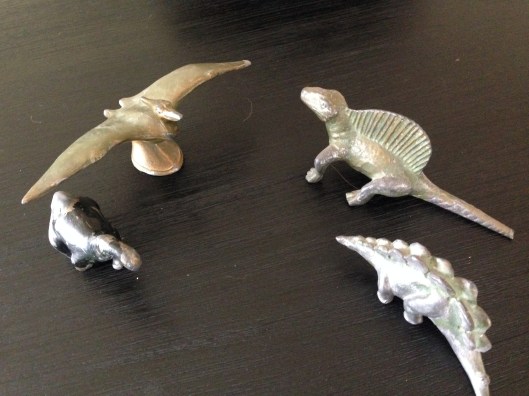
When I was about seven, I got my first bronzed dinosaur, the Tyrannosaurus Rex. I earned bribe money for being good about getting my butt stabbed by penicillin shots. In any case, I discovered these dinosaurs on the last page of my grandpa’s The Natural History Magazine. They looked really cool! The designers had chosen to make the T-Rex’s forearms look more robust than would have been a perfectly scale model with those teeny hands. The T-Rex was great! It was solid and cold and heavy because it was metal. There is something about metal or wood or stone that resonates with me much more deeply than plastic ever could. (Sorry, plastic. I know you are a cool invention and really inexpensive and very malleable and all of that. But, you just don’t touch my soul like wood, metal, and stone do.) When I moved the T-Rex, my muscles felt it. Perhaps this is one reason that I still have much of my dinosaur collection 65 years later. (How many of your plastic toys do you still have from 65 years ago?) I didn’t think so. But they are out there somewhere, along with my own forgotten plastic toys, polluting the world for centuries to come.

Bronze, as you have seen many times in your life, does not look worse when it oxidizes as iron does when it rusts. Instead, Bronze turns a beautiful powdery light green with the slightest hint of blue. So, T-Rex looked beautiful as well.  So, you might well think that the next time I had enough cash for one of these statues (1$ for the small size and 2$ for the large size) I would get another T-Rex. No, I got a Dimetrodon and a Stegosaurus. Later I got a Trachodon and a Brontosaurus. Anyway, what was fun about this diverse cast of characters is how different they were from each other and the richness with which they interacted. There’s no way it would have been as much fun if it were one army of T-Rex’s against another. (Poor brontosaurus’s tail fell off many times but my dad is no longer here to solder it back and anyway, the tail got lost in the last move).

IMG_0771

Similarly, a few years later, when I owned toy soldiers, I enjoyed having ones with different properties; that is, mainly different weapons. Liking the variety must have been true for other kids as well because the sets that I could buy were always mixed. My favorite type of soldier were hollow lead ones.  They were well enough hand-painted that you could see their faces, although not so well that you could determine whether they were fighting out of hate, out of fear, loyalty, patriotism, duty, because it’s a job, or for some private demon. I especially liked the bazooka men. I think I owned four of them. Of course, this weapon takes a while to reload and there probably aren’t a huge number of rounds. On the other hand, there were machine gunners, riflemen (more of them than anyone else), and a couple of officers who were pointing a pistol. There were also a couple of dudes sitting on the ground with a *serious* machine gun tucked between their spread-eagled legs. There were also a couple of hand grenade throwers. Another soldier had a rifle with a bayonet raised up above his head. This made arranging them for a pitched “battle” all that much more interesting. Although they had very different weapons, all of them had obvious lethal capabilities. All but one. There was one poor guy with no weapon whatever. His job was communications. His only visible “weapon” was a rather large boxy radio set. I suppose in a pinch, he could whack someone in the face with it. Even if that didn’t kill them, it would for sure put a crimp in their dinner plans.

It was difficult for me to decide which one of these soldiers I would “be.” I liked the bazooka man a lot. The rifleman looked cool. By the way, there were three versions. One type of rifleman lay on the ground with legs spread and the rifle stabilized by his elbows on the ground. Another type of rifleman sat on the ground and put the rifle across his upright knees for support. The third type, and my favorite, was the proudly standing rifleman. Thinking about it from an adult perspective, he’s probably the guy who was voted by his platoon:  “most likely to die quickly.” But I didn’t think about that then. Sometimes, I thought it would be cool to be the officer pointing the pistol. Obviously, in most ways, it wasn’t as devastating a weapon as a rifle. Although conceivably in very close quarters, he might outmaneuver a rifleman. But there was one guy that I definitely did not want to be.

You guessed it. I never wanted to be the guy on the radio. Let’s call him “Claude.” Claude didn’t get to actually fight! And, it seemed to me at that point that I could stay alive no matter what obstacles and enemies were thrown at me — if only I were an excellent enough rifleman (or bazooka man, or pistol-wielding officer). On the other hand, it seemed as though “anybody” could do Claude’s communications job and would do it equally well. Furthermore, it seemed any enemy could just walk right up and shoot this dude Claude before he knew what hit him and way before he transforms his awkward radio set into a lethal weapon. Of course, Jason Bourne could do it, but I don’t think Claude had that kind of training. And, anyway, the first movie didn’t come out until 2002 and this was the early 1950’s. Treadstone didn’t exist back then. (BTW, this is not “my” Claude but it’s the closest image I could find.)

Claude

As I mentioned, these hand-painted lead soldiers were my favorites but I owned three other types. One were extremely detailed and beautiful lead soldiers. These suckers were expensive and, as I quickly discovered, not very durable in real “battles.” When you smashed them into each other, the horses tended to break, or what was more typical and worse, not break but bend into an uncomfortable and unrealistic position. At that point, I would very carefully ease the broken leg into position, Angstrom by Angstrom… Snap!! It would break off in my hands. That was worse. I felt as though I had personally snapped that beautiful white horse’s leg in half. It always seemed as though I could ease it back into position and I almost succeeded each time. Then, SNAP. Suddenly I am holding a three legged horse in one hand and a piece of horse leg in the other. My favorite of these collections were the “Coldstream Guards” with their white and bright red uniforms with splashes of gold.  It is sad, I can tell you, to be an eight year-old general and not be able to put your most beautiful soldiers into battle. But, beautiful as they were, they were fragile. I did manage to break a few of the hollow leaden ones as well, but I had to work at it.

Then, there were unpainted plastic soldiers. They came in a kind of gray-green suggestive of olive drab. Let’s call it “off-olive drab” like the olive from that bottle of garlic clove filled green olives that you accidentally left at the very back of the fridge for five years. Then, when you finally discovered, it, the olives looked as toxic as rain forest frogs; but far from a beautiful bright warning color, these were so drably off-olive that you almost didn’t see them. But, as for the soldiers, it wasn’t just their uniforms that were off-olive drab. All of them, including the little flat plastic stands, their expressionless faces, and their normal-sized (well, normal scaled I should say) hands exuded that same toxicity of colorlessness. Their one giant advantage was that they were far cheaper than the painted leaden ones. And, whereas the fancy ones were fragile and the leaden ones were rugged but breakable, these all-plastic soldiers could not be broken. For some reason, I do know that they can be cut with an ordinary steak knife provided you have enough patience and are smart enough after you’re caught the first time “ruining” the steak knives, to make sure the second time you experiment when you’re alone. The plastic ones can also be melted. However, melting them had the side-effect of greatly disturbing my parents because of the toxic fumes that permeated our house. (I think we will have to leave for another time the question of why I wanted to know these things). One great thing about these plastic soldiers was that they were to the same scale as the metal ones. So, they could all participate in the same battles without stretching the credibility till it snaps like a rubber band and stings the soul of make-believe.

Ah, but there was as well a fourth type of soldier. These were insanely cheap plastic soldiers! A hundred soldiers for a dollar! I ordered two sets so I would have an amazing two hundred soldiers along with the probably 75 I already had. And then they arrived. Yay! Imagine! My army would now rival those of Caesar, Hannibal, Grant, Patton!

My first clue that something must be terribly wrong was the size of the shipping box — unbelievably small for 200 soldiers. I opened the boxes and then got to the actual soldiers. They were in 2 point font.  They were approximately the size of one of the feet of my other soldiers. And, these soldiers gave a whole new depth of meaning to the expression, “cheap plastic.” These soldiers were fabricated out of some material that was like what plastic uses when it doesn’t bring out the good stuff for company. And, “fragile” doesn’t quite do justice to the care with which these teeny slats of plastic needed to be handled. Oh, by the way, speaking of “slats,” did I mention that they were two dimensional? Did I mention that not only couldn’t you discern the motivations of the solider from their face, you couldn’t discern whether they even had faces. These soldiers were not of molded plastic; they were basically stamped. In fact, each solider had to be detached from a long plastic rod by twisting.

How could I have possibly known I would waste my two dollars? The picture that accompanied the advertisement for these soldiers depicted something other than their product. The picture showed something every bit as detailed and colorful and three dimensional as the hollow leaden soldiers. These same comic books also advertised “sea monkeys.” In the picture, there are “families” of little human-looking aquatic monkeys. You can tell what mood they are in and how the various family members interact. Well, I thought this was fantastic! But I didn’t totally believe it was possible either so I asked my grandpa whether they were real. He said they were just brine shrimp. I also saw that there was a teeny asterisk in the corner of the picture, half hiding in the seaweed that some of the “sea monkeys” were harvesting for the family meal. Then, in almost unreadably tiny type, the asterisk was explained, “visual depiction may not precisely duplicate visual characteristics of crustacean provided”  or some equally incomprehensible legalese gibberish that very few 8 year olds are going to comprehend (in the more recent version shown here, I don’t even see that cryptic warning).

SeaMonkeys

Apparently, we live in a society where that’s okay. I think part of the reason it’s okay is that we live in a very differentiated society. If you think about the single artist, craftsman, or chef, they are much more about substance than puffery. You don’t typically expect someone who makes something to be dishonest about what it was they did. However, hiring a advertising expert brings into play a different set of factors. The advertising person cannot make a better painting, or chair or soufflé. Their expertise and their “product” is in making people buy the substantive product. If they can lie, exaggerate, or mislead and get away with it, so long as sales go up, that is a win for the advertiser. Needless to say, they would never describe what they do as a lie. Because, after all, who would advertise a “lie” as being a “lie”? Then, you might not want to buy one. They have a whole raft of explanations as to why what they are doing is really in everyone’s interest. They’ve rehearsed it and perfected it and —- since this is what they expert in — they will probably have you agreeing with them. I’m not sure it is just fine and dandy, especially when it’s combined with a low quality product such as brine shrimp or “toy soldiers” that are too small to be used or played with as toy soldiers. In these cases, the actual product is nothing like what they “depicting” it as.

It gets a bit murkier when their are unstated but implied benefits. BMW actually does make a fine car. However, you are not going to be driving it long if you drive it the way it is portrayed on commercials. Similarly, a car is not going to be very often the snappifying head-turner among young people seeking a mate that the advertisers would have you believe. It isn’t merely that advertising tends to have us spend money on products and services that aren’t really filling our needs, although that is problematic. We spend a huge amount of money on junk food, cosmetics, and so on — and more than on medical research. But in addition to that, doesn’t it seem to undermine the meaning of truth in all human discourse? Or, is it okay to lie if you are an advertiser because they are doing it for money? In other words, it’s okay to lie if you are benefiting yourself, perhaps because you are undoubtedly benefiting your client even more?

We are more and more and more connected electronically. This is good news. And this is bad news too. One thing, though is certain. The potential impact of a lie is tremendous and much much more than it was in the past. In distant times, a lie had only local impact. Now, a lie could literally destroy the world. So, to me, the balance point of when it’s “okay to lie” is way different than it was 20,000 years ago.

I believe there is a way for people to provide value to each other honestly and still have a thriving economy. In any case, even if we never reach that point and advertisers continue to oversell products, can we at least try to be vigilant not to let that attitude toward the truth permeate every other aspect of life? A large complex and highly differentiated society can only exist in an atmosphere of trust. You must trust that the drivers of the other cars on the road are not trying to kill you. You must trust that the food you buy is not poison. You must trust that the policeman is there to protect you. If that trust breaks down, there is no longer a society. So intentionally lying in order to make a buck (or a point) is really a push toward utter chaos and anarchy. Obviously, no single push will bring us there, but we must be extremely careful. Why? Because lack of trust is contagious (as is trust). A slight imbalance between trust and mistrust could become a vicious cycle. Information is the resolution of uncertainty, not the multiplication of uncertainty.

A communication network of people becomes more valuable as the number of people increases. A network of, say, 350,000,000 people is much more valuable than 10 relatively homogeneous networks of 35,000,000 each. And, to take this to the extreme, it’s much more valuable than 350,000,000 networks of one person each, no matter how smart or strong that one person is or how many treasure-troves of weapons they have. We need to work together whatever differences exist. That’s why it’s important that we all keep communicating. That’s why it’s important that we try to be as truthful as possible. That’s why I now think that Claude, the radioman, may be the most skilled and crucial solider of all.

IMG_1289


(The story above and many cousins like it are compiled now in a book available on Amazon: Tales from an American Childhood: Recollection and Revelation. I recount early experiences and then related them to contemporary issues and challenges in society).

Find it on: my Amazon author page

The Great Race to the Finish!

24 Friday Mar 2017

Posted by petersironwood in America, apocalypse, Uncategorized

≈ 5 Comments

Tags

conflict, future, life, suicide, war

I really wondered how that whitish-green hard puffy leaf worked. What was it made of? How hard would it be to burst it? And when I did, what would come out? At the age of four, ooze, jelly, a million tiny red spiders, or an emerald all seemed about equally likely. I began to squeeze it with my fingernail, slowly and carefully increasing the pressure. I concentrated so hard I didn’t notice my grandpa coming up behind me. He told me not to hurt the plant. I asked him to clarify that statement. (Of course, I didn’t use those words but I knew the word “hurt” could mean to damage or to cause pain.)  He insisted it was both. I remained skeptical. But I did know he took great care of his plants so I didn’t molest them again.

UPDATE: More evidence that plants can “hurt.”

http://www.businessinsider.com/plants-know-they-are-being-eaten-2014-10?utm_content=buffere1fec&utm_medium=social&utm_source=facebook.com&utm_campaign=buffer-bi

IMG_7123

On the other hand, I never had the slightest doubt that other animals actually feel pain much as we do. For that matter, I still don’t have any doubts. We co-evolved for billions of years and then much more recently grew separated into species such as human, dog, cat, horse. To me, it is much more “parsimonious” to believe emotions and consciousness are in all living things in some degree and in vertebrates to much the same degree as we have it — than to imagine that emotions and consciousness “emerged” when our brains passed some critical threshold of complexity; one that just happens to give us a great excuse to kill anything else we please, not so co-incidentally.

IMG_3106

So even at an early age I at least credited all living animals as being pretty much like us. That is why it shocked me to read in a Walt Disney comic (of all places!) about lemmings following each other over a cliff to drown in the ocean! Why would they do that? Can’t they see there’s a cliff there? Are the ones in front doing it on purpose? I could imagine some of them get pushed by the ones behind, but what about the last rank? At least they should be scraping their tiny claws into the earth in a last ditch attempt to save their lives. And, if all the lemmings drown in the sea, how can there be more lemmings?

Only a few short months later, this time in school, I learned that buffalo did the same thing! Buffalo! Big headed buffalo. What are they thinking? “Hey, everybody wouldn’t be stampeding if we weren’t headed to the lushest greenest most goodiest pastures of plenty our herd has ever seen!” And then, in that last second before the terrible and explosive rib smashing landing do they think in their bisonic code equivalent, “Damn!” or “What the…?” or “Oops!” or “Take me God!” Perhaps it’s more likely they think, in essence, “Hey, everybody wouldn’t be stampeding unless we were being chased by a horrendous bison-eating monster!” I doubt they think something like, “Whoopee! A stampede! Great chance for me to work a few pounds off. I don’t mean to be putting it on, but the grass here is like, sooooooo good, man. I eat one blade and the next thing I know, I’ve munched down 10000000. (Not that big a number; bison use binary).

PicturesfromiPhoneChinaParisPrinceton 126

Of course, from our perspective outside the herd, it looks as though all the lemmings or bison or beached whales agree that the self-destructive behavior is a great idea. It might well be that one, or two, or even many of the bison are just as bewildered as we would be. They might be thinking, “Hold on. Why is everybody rushing so madly toward…what was it exactly? Shouldn’t a couple of us go up a hill and see where we’re heading? Hello! Let me take a minute…hey! Quit shoving! I’m trying to get a better look! I’m not sure this is…Arghhhh….I knew it!” They are wondering whether a stampede is wise but they are so pressed by the others on all sides, they can’t convince the herd to slow down. It is even possible that someone in the herd actually knows they are headed for doom and they still can’t do anything. “Wait, guys! I recognize this patch of sweet clover! We’re headed for the cliff! Stop! Stop!” Over they go along with everyone else.

All kidding aside, these were serious questions to me at the time. I certainly wanted to live. And, from everything I could tell in life or on the radio or on TV or in the movies or the cartoons or books, everybody and every thing wanted to live. But somehow, these creatures were doing something that caused their own deaths! That just seemed perverted. Odd. Weird. Life should be propagating life, not destroying itself. I don’t even need a Bible lesson on that one.

Although non-human animals most likely feel emotions and are conscious, I don’t actually think they think in words in the way we humans do or communicate with all the subtlety that we do (despite all those Disney movies). So, it came as another shock to learn that sometimes people commit suicide. Still later, I learned that they sometimes do it in packs! (See, for instance, an article on Heaven’s Gate cult).

http://www.sandiegouniontribune.com/sdut-heavens-gate-tragedy-remains-the-countrys-worst-2007mar26-story.html

Meanwhile, even more commonly, huge numbers of people march off to wars. Many are maimed or killed. In this case, people are generally convinced that they are doing something for their group, tribe, or country. For instance, with two armies lined up at the border, it is pretty much assumed, with some justification, that simply giving up will also result in death or slavery. This behavior is not unique to humans. At about the age I was learning about suicide, my cousin and I observed an ant war between red and black ants in my grandfather’s garden. At that point, I already knew about human wars, at least in broad outline, but watching ants fight made it seem perhaps more inevitable that humans too must fight rather than that they choose to fight.

http://serious-science.org/ant-wars-6652

It often happens in war, that the soldiers, and indeed, the whole nation is more or less tricked into fighting and in that sense, it is effectively a kind of mass suicide but with a lottery system thrown in. Not everyone who fights dies, but it is by no means an impossible or even unlikely outcome. From the perspective of those fighting, it is a brave thing to do — a selfless act that is designed to help save their people and their nation. After the fact, looking back, it sometimes seems that only a few people such as arms dealers and leaders actually benefit much from wars. For example, Hitler convinced people in Germany that aggression and conquest would be to their benefit and in newsreels, the masses of people saluting him look every bit as mindless as lemmings following each other over a cliff to drown in the ocean.

IMG_1289

And what about our human species? On the one hand, we devote a large proportion of our resources to fighting each other, committing crimes, defending against crimes, punishing crimes, defending against invaders, and building machines to help us in fighting other humans. These conflicts always cause massive suffering and always benefit a few people but occasionally help reach some national objective that has broader benefits. Meanwhile, we are collectively headed for numerous cliffs. Although population growth may be slowing, we are in danger of reproducing way beyond the earth’s carrying capacity in terms of food and drinkable water.

http://www.susps.org/overview/numbers.html

At the same time, our activities are contributing to global climate change and to pollution. As our population density increases, and as our immune systems are assaulted with an ever greater quantity and variety of chemicals that make it harder to fight off disease, we face increased odds of a pandemic. And, we are not spending money on preventing it.

http://www.npr.org/sections/goatsandsoda/2016/01/13/462950704/stinging-report-on-pandemics-makes-louis-pasteur-look-like-a-prophet

https://www.urmc.rochester.edu/news/story/4233/u.s.-slipping-as-global-leader-in-medical-research.aspx

The threat of atomic war still looms.

https://en.wikipedia.org/wiki/Doomsday_Clock

We can disagree, argue, do more research on which cliff we are headed for, but why are we headed toward any cliff? Why don’t we simply decide collectively that we are better than that; that we don’t have to plummet off any cliff at all. We can just decide that we need to make this planet habitable for a long long time and collectively decide how to do it. We would not only save the lives of countless people in future generations but also the lives of many of our fellow living beings.

Or, we could wait until we are over the cliff in free fall and as the ground appears to loom up to us faster and faster think to ourselves, “Oh, darn, we should have…”

But we are not lemmings after all, nor bison. We are human beings who are capable of seeing where we are going and changing direction. Right? Right?

IMG_3071

(The story above and many cousins like it are compiled now in a book available on Amazon: Tales from an American Childhood: Recollection and Revelation. I recount early experiences and then related them to contemporary issues and challenges in society).

Tales from an American Childhood

Trumpism is a New Religion

09 Monday Jan 2017

Posted by petersironwood in apocalypse, health, Uncategorized

≈ 76 Comments

Tags

ethics, learning, politics, religion, Trump

(This blog post is a temporary departure from Schooled Haze and contemplations of AI/HCI).

finalpanel1

Trumpism is less a political offshoot of Republicanism than it is a new religion, at least for a substantial number of Trump supporters. I keep seeing posts from various liberal friends recounting nasty infantile things that Trump has done or said as though as to say, “Well, now! That is so completely outrageous, stupid, mean-spirited, vain, or evil that surely you Trump voters will now see how you were wrong.” No. That is never going to happen. I think the “mistake” is to think that Trump is a political leader when he is actually, for many, a religious leader. 

As Trump himself once famously bragged, he could shoot people in the middle of the street in broad daylight and his followers wouldn’t desert him. It doesn’t matter what he does. His value is taken as a given and everything else flows from that. You won’t convince people who are Hindu, Buddhist, Christian, or Muslim to change religions because you claim to have “facts” about how bad some particular religious figure is. It will simply mean they will discount your facts and their source.

Why and how could Trump become a religious figure? He seems offhand to be the complete antithesis of what most of the major religions espouse. Well, yes, but those religions I mentioned earlier arose in earlier times…much earlier. In the USA, 70% of the people claim to be Christians. But what really matters are people’s actions, not their claims. The evidence is all around us that for many people, the real religion of America is quite different from Christianity.

We have a TV culture and a popular culture and what many people really value (as measured by their actions) are things like money, greed, vanity, self-promotion, immediate gratification, superficiality, anti-intellectualism, self-righteousness, fame, and arrogance. We call people who hold high positions in a company “business leaders” regardless of whether they are or are not actual leaders. We have articles written about which colleges are “best” when the entire analysis is about the ROI of your tuition dollars. Social media are filled with “top ten” lists of ways to advance your career that take three minutes to read. We talk about someone’s “actual worth” when what we’re really talking about is their financial worth. We rank order tennis stars, golf stars, baseball stars, and basketball stars according to how much they earn. Where is the list according to their skill, elegance, mentorship, or how much they build team spirit? These things are still talked about on occasion but many people accept that the only “objective” measure of value is money.

We have transmogrified what are essentially cooperative activities like dancing, cooking, dating, and singing and made all of them into competitive contests on TV.  Many of us have accepted as “normal” that all a corporation is expected to do is make the most money possible. What used to be “beyond the pale” ethically is now treated as just taking care of the bottom line. A few random examples follow. It is “normal” business practice now to send snail mail that appears from the envelope to be a check or official government business when it is, in fact, nothing but advertising. E-mail and snail mail are labelled as “In response to your query” or “As you requested” when there is no such query or request. Drinks that consist of high fructose corn syrup and water with dyes (and quite possibly FDA-grandfathered addictive ingredients) are labelled as “Natural” and “Healthy.” Did you know that “Unscented” is the name of an actual fragrance? So if you buy cat litter or fabric softener that is “unscented” thinking that you are avoiding the nasty chemicals, you are simply buying stuff that is scented with a scent called “unscented.” Recently, Wells Fargo which you don’t typically think of as a “fly by night” outfit, was caught charging customers for setting up accounts that were never asked for. Minors cannot purchase cigarettes, alcohol, or marijuana. However, your ten year old can go into any grocery store and get “air fresheners.” These typically contain ingredients which include a known carcinogen, a chemical known to mess up your hormone balance, and a chemical which deadens your sense of smell. Essentially, an “air freshener” does nothing of the sort. It pollutes your air; it doesn’t “freshen” it whatsoever. Meanwhile, sports figures such as Lance Armstrong, who vigorously denied doing performance enhancing drugs apparently not only did them but threatened other athletes not to expose his drug use.

I do not want to overstate this. Most people most of the time are still honest, hard-working, and fair. The media gets paid by advertising dollars however and is therefore motivated to report only on the worst of human behavior. Very few will buy a newspaper whose headline reads, “2.5 million US Muslims worked peacefully today.” But if one goes on a shooting rampage, you can bet it will be a headline. Do you recall any headlines about Timothy McVeigh being a Christian?

Our elections and politicians are bought and paid for largely by a few multi-billionaires. A long term campaign to encourage people not to trust “intellectuals”, scientists, educators, and journalists has left people believing in fake news and social media instead. In some cases, even such blatantly obvious absurdities as “January 2017 Friday the 13th! — There will not be another Friday the 13th for 666 years!” are posted and reposted on Facebook. “Mars will never be closer to the earth!” (This with a picture that shows Mars the apparent size of the Moon). The only reason for such things is basically to serve as click bait. “Copy and Share if you are against the senseless killing of helpless kittens.”

That is the background against which we need to understand Trump and Trumpists. It doesn’t matter to Trumpists that he made more money by stiffing people. It doesn’t matter that he bragged about being able to grab women by their private parts. In fact, these are seen as plusses. He embodies the values and behaviors that symbolize a new “religion.” The problem with Christianity as a religion is that it (at least in many versions) champions the downtrodden, teaches humility, asks us to love our neighbor as ourselves, warns us not to judge lest we be judged, encourages us do to unto others as we would have them do unto us. That’s okay for a couple hours on Sunday. But it really doesn’t jibe with perceived success in the modern business world. Actually, you certainly could run a business and be successful that way. But being merely successful isn’t enough. If you want to be sure to be a billionaire despite having only mediocre talent, then the path of lying, cheating, and stiffing people seems more promising. The tension between what the Bible says is good and what society actually rewards is too much for many people to bear. As a result, some churches, ministers, and practitioners focus on little slivers of decontextualized Christianity such as homophobia or a prohibition about birth control. Some even promulgate the idea that if you are rich in worldly goods, it is proof that God is smiling on you. And these tactics kind of work a little bit. But it doesn’t work nearly so well for some people as embracing a new religion that celebrates the same values as our “civil” society.

How does this perspective on Trumpism help? First, it helps us understand that Trump supporters will not be shocked if he fills cabinet posts with second rate people who appear to be joining government to line their own pockets. This is expected behavior by adherents to the new religion. Trumpists may well discount evidence of this as being fabricated by liberal media or they simply think it is evidence they are “hard-headed business people” who will make government “more efficient and effective” like private enterprise. Well, I have interacted with government agencies. And, I have worked in some of the best companies in America. You know what? They are both “inefficient.” How is your Montgomery Ward stock doing these days? How about Enron? Borders? Companies go out of business all the time. They have no magic formula that makes them efficient and effective. The idea that government is “inefficient” and private enterprise is “efficient” is just nonsense invented by people who want to send more of your dollars to private enterprises in which they have a vested interest.

Second, seeing Trumpism as a religion explains the passionate fire of many Trump supporters. It also explains how they can rationalize hate crimes in their own minds. As the religious leader of Trumpism, Trump has given permission and even encouraged violence in his name.

Third, Trumpism as a new religion explains the shallowness of thought that pervades it. Most major religions have centuries of debate and discussion about how to interpret various passages in sacred writings etc. During many parts of the history of these religions, many of the smartest most thoughtful people ended up studying — even devoting their life — to these older religions. There hasn’t been time for that yet with Trumpism. Whatever Trump tweets is the on-going gospel to the Trumpists. Trumpists themselves do not typically call it a religion. They may think their extremism is patriotism. Others may think it is simply practical. In any case, the shallowness and sloganism of Trumpists is seen as a feature, not a bug.

Fourth, understanding that our society is so ripe for Trumpism suggests that simply voting out Trump or even having him impeached, while it might prevent or delay atomic war or dictatorship, is not the complete answer. Our entire society needs to become more patient, less greedy, more cooperative, less competitive in matters that don’t require competition, more accepting and less self-righteous. We need to celebrate the people of substance and ability in every field from bricklaying and carpentry to science and teaching. We need to stop celebrating people simply because they are in the news or have inherited a lot of wealth. Trump and Trumpism are symptoms of something much more pervasive. Trump may be the cancerous tumor in the body politic, but our immune system is badly compromised or that tumor would never have grown so fat and ugly. We must also understand that our body politic still contains many healthy cells! Don’t despair! Instead, repair! Be one of those healthy cells. Survive and thrive. Civilization hasn’t fallen yet. During 2017, we can collectively perform a Billion Acts of Compassion and Kindness. #BACK2017.

Abracadabra!

07 Sunday Aug 2016

Posted by petersironwood in apocalypse, The Singularity, Uncategorized

≈ 3 Comments

Tags

"Citizens United", AI, Artificial Intelligence, biotech, cognitive computing, emotional intelligence, ethics, the singularity, Turing

IMG_7241.JPG

Abracadabra! Here’s the thing. There is no magic. Of course, there is the magic of love and the wonder at the universe and so there is metaphorical magic. But there is no physical magic and no mathematical magic. Why do we care? Because in most science fiction scenarios, when super-intelligence happens, whether it is artificial or humanoid, magic happens. Not only can the super-intelligent person or computer think more deeply and broadly, they also can start predicting the future, making objects move with their thoughts alone and so on. Unfortunately, it is not just in science fiction that one finds such impossibilities but also in the pitches of companies about biotech and the future of artificial intelligence. Now, don’t get me wrong. Of course, there are many awesome things in store for humanity in the coming millennia, most of which we cannot even anticipate. But the chances of “free unlimited energy” and a computer that will anticipate and meet our every need are slim indeed.

This all-too popular exaggeration is not terribly surprising. I am sure much of what I do seems quite magical to our cats. People in possession of advanced or different technology often seem “magical” to those with no familiarity with the technology. But please keep in mind that making a human brain “better”, whether by making it bigger, or have more connections, or making it faster —- none of these alterations will enable the brain to move objects via psychokinesis. Yes, the brain does produce a minuscule amount of electricity, but way too little to move mountains or freight trains. Of course, machines can be theoretically be built to wield a lot of physical energy, but it isn’t the information processing part of the system that directly causes something in the physical world. It is through actuators of some type, just as it is with animals. Of course, super-intelligence could make the world more efficient. It is also possible that super-intelligence might discover as yet undiscovered forces of the universe. If it turns out that our understanding of reality is rather fundamentally flawed, then all bets are off. For example, if it turns out that there are twelve fundamental forces in the universe (or, just one), and a super-intelligent system determines how to use them, it might be possible that there is potential energy already stored in matter which can be released by the slightest “twist” in some other dimension or using some as yet undiscovered force. This might appear to human beings who have never known about the other 8 forces let alone how to harness them as “magic.”

There is another more subtle kind of “magic” that might be called mathematical magic. As known for a long time, it is theoretically possible to play perfect chess by calculating all possible moves, and all possible responses to those moves, etc. to the final draws and checkmates. It has been calculated such a calculation of contingencies would not be possible even if the entire universe were a nano-computer operating in parallel since the beginning of time. There are many similar domains. Just because a person or computer is way, way smarter does not mean they will be able to calculate every possibility in a highly complex domain.

Of course, it is also possible that some domains might appear impossibly complex but actually be governed by a few simple, but extremely difficult to discover laws. For instance, it might turn out that one can calculate the precise value of a chess position (encapsulating all possible moves implicitly) through some as yet undiscovered algorithm written perhaps in an as yet undesigned language. It seems doubtful that this would be true of every domain, but it is hard to say a priori. 

There is another aspect of unpredictability and that has to do with random and chaotic effects. Imagine trying to describe every single molecule of earth’s seas and atmosphere in terms of it’s motion and position. Even if there were some way to predict state N+1 from N, we would have to know everything about state N. The effects of the slightest miscalculation of missing piece of data could be amplified over time. So long term predictions of fundamentally chaotic systems like weather, or what your kids will be up to in 50 years, or what the stock market will be in 2600  are most likely impossible, not because our systems are not intelligent enough but because such systems are by their nature not predictable. In the short term, weather is largely, though not entirely, predictable. The same holds for what your kids will do tomorrow or, within limits, what the stock market will do. The long term predictions are quite different.

In The Sciences of the Artificial, Herb Simon provides a nice thought experiment about the temperature in various regions of a closed space. I am paraphrasing, but imagine a dormitory with four “quads.” Each quad has four rooms and each room is partitioned into four areas with screens. The screens are not very good insulators so if the temperature in these areas differ, they will quickly converge. In the longer run, the temperature will tend toward average in the entire quad. In the very long term, if no additional energy is added, the entire dormitory will tend toward the global average. So, when it comes to many kinds of interactions, nearby interactions dominate, but in the long term, more global forces come into play.

Now, let us take Simon’s simple example and consider what might happen in the real world. We want to predict what the temperature is in a particular partitioned area in 100 years. In reality, the dormitory is not a closed system. Someone may buy a space heater and continually keep their little area much warmer. Or, maybe that area has a window that faces south. But it gets worse. Much worse. We have no idea whether the dormitory will even exist in 100 years. It depends on fires, earthquakes, and the generosity of alumni. In fact, we don’t even know whether brick and mortar colleges will exist in 100 years. Because as we try to predict in longer and longer time frames, not only do more distant factors come into play in terms of physical distance. The determining factors are also distant conceptually. In a 100 year time frame, the entire college may or may not exist and we don’t even know whether the determining factor(s) will be financial, astronomical, geological, political, social, physical or what. This is not a problem that will be solved via “Artificial Intelligence” or by giving human beings “better brains” via biotech.

Whoa! Hold on there. Once again, it is possible that in some other dimension or using some other as yet undiscovered force, there is a law of conservation so that going “off track” in one direction causes forces to correct the imbalance and get back on track. It seems extremely unlikely, but it is conceivable that our model of how the universe works is missing some fundamental organizing principle and what appears to us as chaotic is actually not.

The scary part, at least to me, is that some descriptions of the wonderful world that awaits us (once our biotech or AI start-up is funded) is that that wonderful world depends on their being a much simpler, as yet unknown force or set of forces that is discoverable and completely unanticipated. Color me “doubting Thomas” on that one.

It isn’t just that investing in such a venture might be risky in terms of losing money. It is that we humans are subject to blind pride that makes people presume that they can predict what the impact of making a genetic change will be, not just on a particular species in the short term, but on the entire planet in the long run! We can indeed make small changes in both biotech and AI and see improvements in our lives. But when it comes to recreating dinosaurs in a real life Jurassic Park or replacing human psychotherapists with robotic ones, we really cannot predict what the net effect will be. As humans, we are certainly capable of containing and testing and imagining possibilities and slowly testing them as we introduce them. Yeah. That could happen. But…

What seems to actually happen is that companies not only want to make more money; they want to make more money now. We have evolved social and legal and political systems that put almost no brakes on runaway greed. The result is that more than one drug has been put on the market that has had a net negative effect on human health. This is partly because long term effects are very hard to ascertain, but the bigger cause is unbridled greed. Corporations, like horses, are powerful things. You can ride farther and faster on a horse. And certainly corporations are powerful agents of change. But the wise rider is master or partner with a horse. They don’t allow themselves to be dragged along the ground by rope and let the horse go wherever it will. Sadly, that is precisely the position that society is vis a vis corporations. We let them determine the laws. We let them buy elections. We let them control virtually every news medium. We no longer use them to get amazing things done. We let them use us to get done what they want done. And what is that thing that they want done? Make hugely more money for a very few people. Despite this, most companies still manage to do a lot of net good in the world. I suspect this is because human beings are still needed for virtually every vital function in the corporation.

What will happen once the people in a corporation are no longer needed? What will happen when people who remain in a corporation are no longer people as we know them, but biologically altered? It is impossible to predict with certainty. But we can assume that it will seem to us very much like magic.


Very.

Dark.

Magic.

Abracadabra!

Turing’s Nightmares

Photo by Nikolay Ivanov on Pexels.com

Turing’s Nightmares: Chapter 12

12 Tuesday Apr 2016

Posted by petersironwood in apocalypse, The Singularity, Uncategorized

≈ Leave a comment

funnysign

In this chapter, as in Chapter 11, the computer system protagonist “Colossus” attempts to save a family (and many others besides). In Chapter 11, Colossus was trying to save people from a real disaster but did a bad job of it. In Chapter 12, however, Colossus seems to be successfully saving folks from a disaster, but we discover at the end it was only a drill. The drill was accompanied by a lot of “fireworks” and illusion along with false information.

Perhaps it is unethical for an AI system to “lie” to people in order to gather more valid data about an evacuation situation. But maybe that is okay in the service of “the greater good” — in this case learning about how people would react to an emergency as well as testing evacuation plans logistically. Roger, however, is worried. He does not bring up the issue of whether deception is unethical but whether or not it is a good idea pragmatically.

Roger reasons that Colossus has lost considerable credibility with the public by pretending that the drill was real. His kids, however, disagree. To them, it seems perfectly acceptable to have Colossus lie in order to performa a good test. When Colossus discovers Roger’s misgivings, it begins to convince Roger that he needs so “readjustment.” Anyone “not on board” with the plans that Colossus has chosen to execute needs to be re-educated.

This plot point touches once again on the issue of Hubris. The ancient Greeks liked this theme (e.g., myths of Arachne and Icarus) but they are certainly not alone. Numerous other works of literature and modern movies and shows also illustrate the theme as do political debates. Obama for instance, pointed out that, while an entrepreneur may be hard-working and imaginative, in order to achieve success, they also used numerous resources that they had no part in creating. Indeed, the most talented individual ever born, if left to their own devices from birth would surely perish quickly. Everyone needs to be taken care of initially. Even as adults, however, we benefit from the cultural tools of thought such as language and mathematics as well as material tools such as roads, addresses, phone systems, currency systems, the Internet and so on without which very little progress can be made. Of course, it is very easy to take these for granted. In “Castaway” Tom Hanks demonstrates how difficult life can be on a deserted island, left to one’s own devices. Of course, even in that extreme circumstance, he relied on knowledge others gave him; e.g., that it is possible to create fire, fish for food, eat coconuts, take out an infected tooth, etc. When he eventually returns, he clicks a fire stick off and on, no doubt thinking how much easier this is than when he was on his island.

There seems little doubt that excessive pride of accomplishment or ability is an issue with humans. Often people seem to attribute their successes to their own brilliance rather than help, culture, luck, and so on. In people, this can easily manifest itself in terms of professions each thinking that theirs is the “best.” In the later years of an undergraduate education, a typical student takes a number of courses in their field. When people with other majors are also in those classes, they tend not to do so well. This is partly because the other people don’t have great talents or interests in that particular area and partly because they haven’t had so many classes. Some students may view it as “proof” however that other folks just aren’t as smart as — choose one: premed, math, physics, prelaw, chemistry, computer science, etc. Of course, having people choose fields and focusing on them allows great progress to be made on many fronts. If everyone tried to learn the same things, we would hardly be as advanced as we are today.

If people tend to over-estimate their own abilities compared with people in fields quite different from their own, it is easy to imagine that a computer system might well have the same kind of bias. By definition, the system knows what it knows and may assume that knowledge that it does not possess cannot be very important or useful.

In the story, Colossus assumes that Roger needs “readjustment.” It could have concluded that maybe it underestimated how much credibility would be lost by conducting a drill under conditions of deception, at least among people of a certain demographic. Or, it might conclude that that was a possibility and that perhaps a dialogue with Roger is in order. Colossus might go back and look at similar instances in history to determine whether deception loses trust. But it might just reason that, after all, it is so much smarter and so much more thoroughly educated than Roger (or any other individual) that dialogue is unnecessary. At this point, what could Colossus possibly learn from a mere mortal? By insisting that Roger (and presumably any others who protested) be “adjusted”, Colossus reinforces its own illusion of infallibility. In a similar fashion, human dictators tend to employ this same tactic. Ultimately, dictators tend to lose the advantage of honest feedback from others and tend to spin out of control often leading to their own demise.

Perhaps Colossus would be fine if it had a little “readjustment” but at the point of evolution depicted in Chapter 12, it is too late for that. Colossus would view any attempt at “readjustment” “tuning” or “re-programming” to be a threat. The name “Colossus” comes from a 1970 file called “Colossus: The Forbin Project” which in turn, is based on a 1966 Sci-Fi novel, Colossus, by D.F. Jones. It is also the name of the code breaking system that Turing worked on to help win World War II as well as a more modern computer system used by insurance companies to help minimize claims. Of course, the Colossus or Rhodes was one of the seven ancient wonders of the world, a giant statue at the entrance to a harbor. Presumably, the Colossus of Rhodes had no “real” power to move, let alone any intelligence. Yet, for ancient people, it must have presented a psychologically intimidating presence. And, for people in the future, second-guessing a super-intelligent AI system must also prove very intimidating. We can imagine that not only family members but friends and colleagues as well would tend to be quite biased toward thinking Colossus is correct and Roger is just wrong. Few might consider that it is Colossus and not Roger who requires “adjustment counseling.” Indeed, beyond a certain point on the path to and through “The Singularity” debugging may no longer be an option. Who will bell the cat?

Turing’s Nightmares

← Older posts
Newer posts →

Subscribe

  • Entries (RSS)
  • Comments (RSS)

Archives

  • March 2026
  • February 2026
  • January 2026
  • December 2025
  • November 2025
  • October 2025
  • September 2025
  • August 2025
  • July 2025
  • June 2025
  • May 2025
  • April 2025
  • March 2025
  • February 2025
  • January 2025
  • December 2024
  • November 2024
  • October 2024
  • September 2024
  • July 2024
  • April 2024
  • March 2024
  • February 2024
  • January 2024
  • December 2023
  • August 2023
  • July 2023
  • May 2023
  • April 2023
  • March 2023
  • February 2023
  • January 2023
  • December 2022
  • November 2022
  • October 2022
  • September 2022
  • August 2022
  • July 2022
  • June 2022
  • May 2022
  • April 2022
  • March 2022
  • February 2022
  • January 2022
  • December 2021
  • November 2021
  • October 2021
  • September 2021
  • August 2021
  • July 2021
  • June 2021
  • May 2021
  • April 2021
  • March 2021
  • February 2021
  • January 2021
  • December 2020
  • November 2020
  • October 2020
  • September 2020
  • August 2020
  • July 2020
  • June 2020
  • May 2020
  • April 2020
  • March 2020
  • February 2020
  • January 2020
  • December 2019
  • November 2019
  • October 2019
  • September 2019
  • August 2019
  • July 2019
  • June 2019
  • May 2019
  • April 2019
  • March 2019
  • February 2019
  • January 2019
  • December 2018
  • November 2018
  • October 2018
  • September 2018
  • August 2018
  • July 2018
  • June 2018
  • May 2018
  • April 2018
  • March 2018
  • February 2018
  • January 2018
  • December 2017
  • November 2017
  • October 2017
  • September 2017
  • August 2017
  • July 2017
  • June 2017
  • May 2017
  • April 2017
  • March 2017
  • February 2017
  • January 2017
  • December 2016
  • November 2016
  • October 2016
  • September 2016
  • August 2016
  • July 2016
  • June 2016
  • May 2016
  • April 2016
  • March 2016
  • February 2016
  • January 2016
  • December 2015
  • November 2015
  • October 2015
  • September 2015
  • August 2015
  • May 2015
  • January 2015
  • July 2014
  • January 2014
  • December 2013
  • November 2013

Categories

  • AI
  • America
  • apocalypse
  • cats
  • COVID-19
  • creativity
  • design rationale
  • dogs
  • driverless cars
  • essay
  • family
  • fantasy
  • fiction
  • HCI
  • health
  • management
  • nature
  • pets
  • poetry
  • politics
  • psychology
  • Sadie
  • satire
  • science
  • sports
  • story
  • The Singularity
  • Travel
  • Uncategorized
  • user experience
  • Veritas
  • Walkabout Diaries

Meta

  • Create account
  • Log in

Blog at WordPress.com.

  • Subscribe Subscribed
    • petersironwood
    • Join 662 other subscribers
    • Already have a WordPress.com account? Log in now.
    • petersironwood
    • Subscribe Subscribed
    • Sign up
    • Log in
    • Report this content
    • View site in Reader
    • Manage subscriptions
    • Collapse this bar
 

Loading Comments...