• About PeterSIronwood

petersironwood

~ Finding, formulating and solving life's frustrations.

petersironwood

Tag Archives: learning

Radical Collocation

26 Friday Jan 2018

Posted by petersironwood in management, psychology, Uncategorized

≈ 1 Comment

Tags

Business, collaboration, cooperation, Design, innovation, learning, pattern language, politics, science

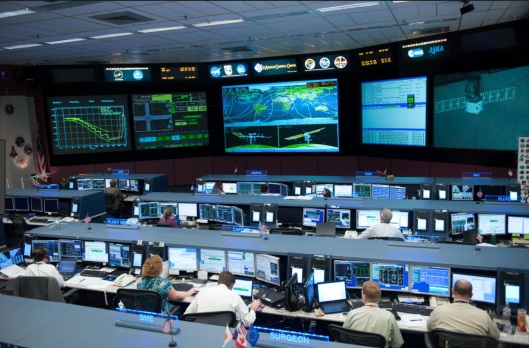
ControlRoom

Radical Collocation.

(This Pattern was initially inspired by a talk at CSCW 2000 — see reference — and the Socio-Technical Pattern Language Workshop at CSCW).

Author, reviewer and revision dates:

Created by John C. Thomas on 5th Sept., 2001.

Reviewed by <> on <>

Revised by JCT on Dec. 17, 2001, January 25, 2018.

Synonyms:

“Put the team in one room for the duration of the project”, “War rooms”

Abstract:

When small to medium teams of people need to solve a problem or design a novel solution and there are many highly interactive parts, it is useful for the people to work in one large room where people have easy access to each other and shared work objects can be easily viewed, modified, and referred to when necessary.

Problem: 

Some problems are amenable to decomposition; that is, the overall problem can be broken down into a series of subproblems and when each of the subproblems is solved, the overall problem will be solved, possibly with slight modification to some of the sub-solutions. In other cases, especially problems that are relatively novel, complex, or “wicked”, such decomposition is not possible. In such cases, if a decomposition is attempted and each of the subproblems is solved, the resulting composition of sub-solutions will typically not be anything close to an overall solution. Under these circumstances, people working alone on their subproblem will become frustrated because all the progress they thought they had made will prove illusory. Morale will suffer. Management will become upset that the apparent progress has not been real and typically attempt a variety of counter-productive measures such as requiring more frequent reports and adding new personnel to meet a schedule.

Context: 

In the design of complex systems with many interacting parts, it is often the case that understanding how best to “decompose” a problem cannot be determined ahead of time. Examples include complex software systems, especially where the overall system includes human-human and human-computer interaction, new machinery, novel nuclear power plant designs, complex military operations.

In such a context, handing out separate “assignments” to various individuals or small teams will at first seem to produce progress as each individual or small team carries out their assignment. Unfortunately, when an attempt is made to compose or integrate these sub-solutions into an overall solution, the result doesn’t work because of unanticipated interactions.

For instance, suppose that a software development team is designing an integrated office support package. Independently, various teams or individuals design various functions. Each of these may be well-designed in itself. However, the combination will be flawed on at least three counts. First, numerous functions will have been duplicated in separate modules. Second, some functionality that would have been useful for the whole package will not have been implemented at all because it would have been too much work for any one team. Third, the user experience will be scattered and inconsistent as separate designers make independent choices about what the user experience will be. In addition, it is quite likely that hard bugs will also be in the design due to the inconsistent treatment of data objects, deadlocks, infinite loops, etc.

There are two main general solutions common in the software development community. First, there may be an attempt to set “ground rules” or “style guides” that everyone is supposed to follow. These will help ameliorate the problem but cannot solve it entirely. Second, there may be overall project meetings where people report on progress or even do mutual design reviews. Again, this helps but even if problems are found and resolved, the resolution will re-quire considerable rework.

iPhoneDownloadJan152013 533

Forces:

*People are naturally gregarious.

*People can concentrate better on difficult mental tasks when it is quiet and when there are a minimum of interruptions.

*Some problems are amenable to decomposition into relatively independent sub-problems; others are not.

*Social cues can be used to guide the interruptibility of others.

*Having work-related shared artifacts that can be viewed and understood by others continually leads to productivity.

*Shuffling work artifacts in and out of view in a small space takes time.

*Space costs money and is therefore limited.

*A group will tend to develop useful social conventions when they are co-located.

*Noticing and resolving conflicts among sub-solutions early will result in minimizing rework.

*Noticing common problems and solving them collectively as soon as possible will result in maximum efficiency.

*Human performance often shows a “social facilitation” effect; that is, people perform better in the presence of others.

  • The possibility of one person harming another and not doing so increases mutual trust.
  • Shared experiences tend to increase mutual trust.

Solution:

When small to medium sized teams work on non-decomposable problems, it is useful for them to be radically co-located in one large room. This room should provide each person some private space and individual work tools (e.g., a computer, a drawing table) as well as numerous spaces for public display of large scale work artifacts (e.g., designs, work plans, diagrams, decisions, group rules, etc.).

Examples:

In the Manhattan Project, people from all over the country were relocated to a relatively remote and isolated area. There they had large workrooms to work on complex problems together.

Recently, automobile companies have empirically compared software work teams that were radically co-located with traditional software development and found the former to be significantly more productive. Interestingly, although before the experience, people thought that they would hate working in a single room, afterwards they said they preferred it.

iPhoneDownloadJan152013 536

Resulting Context:

Prior to the experiments at the auto companies, developers were afraid that they would be too distracted by noise and interruptions to get much work done. In fact, social cues can be read fairly well and a potential interrupter can gauge the time to interrupt. In radical co-location, a person might have to wait minutes or hours to resolve an issue by conversation and mutual problem solving. In traditional software development, they may have to wait for a weekly meeting or not discover a problem until integration testing. People working under conditions of radical co-location tend to develop common vocabulary and artifacts quickly and can easily and efficiently refer to these artifacts. Motivationally, it is also easier to see where the individual’s work fits into the larger whole. Having had many face to face interactions, the group now has more social capital.

Rationale:

In a complex problem solving process, it is most efficient to solve the most difficult constraints first. Similarly, the sooner potential design conflicts or potential design commonalities are discovered, the more efficient the global optimization. Social groups that work together can rely on subtle cues about whether to interrupt or not. Being alone in the office may seem more conducive to concentration but is still amenable to a knock on the door or a phone call; in this case, the per-son interrupting generally does not know the state of concentration of the person being interrupted. When we work separately, it is easy to imagine that others are “slacking off.” If we actually see all of our colleagues working, it tends to motivate us to work harder as well.

Related Patterns:

Conversational Support at the Boundaries.

Who Speaks for Wolf?

Known Uses:

War rooms, command centers, trials.

Metaphors: 

The human body is mainly organized at one level into organs. These organs are generally completely co-located. Your brain cells are near other brain cells; spleen cells are near other spleen cells; bone cells are mainly near other brain cells. This is true in most (but not all) other species.

For many millennia, humans were hunter/gatherers. In some cases, our very distant ancestors may well have simply eaten “on the go” just as some of us still do off path-hugging berry bushes. But long ago, we gathered food, processed it, categorized it, re-shuffled it into various stews. All of these processes were typically done by a subgroup of the people. This co-work is at least one quite natural way to work.

Why is education arranged the way it is: into courses, lectures, topics, and so on? Why not just bombard kids with random facts from a computer? There are many reasons but one main one is that learning about a subject in a coherent way may help you see the larger coherence of the subject area.

Fable: 

Once upon a time, there were three little lemur sisters and they each went to provide some shelter for themselves from the elements as well as protection from the ferocious leopards that roamed their forest. The first little lemur wanted her home to be as gigantic as possible. So, she fashioned some sticks and put them widely spaced over a large area. Unfortunately, the lemur had no trouble whatsoever going between these widely spaced sticks and he ate up the first little lemur.

The second little lemur, having learned from her sister’s unfortunate demise made a much, much tighter circle. In fact, her sticks were so tightly packed that she could not really lie down and sleep. After several days, she could stand it no longer so she went outside to hunt and sleep and was eaten by the roaming leopard.

The third little lemur, having learned from both of her two younger sisters’ untimely demises, instead struck a deal with the leopard. “You know,” said the lemur, “I can climb very high into the treetops. And from there, I can see for many miles around and advise you on your best direction for prey. In return, you don’t eat me. And, that would not be to your advantage anyway because then you’d have to revert to your old way of using guesswork to find prey.”

Instead of helping the leopard, the third little lemur used his high position to mislead the leopard and warn the prey through intermediaries. At last, the leopard grew quite weary and hungry and demanded to see the third little lemur about their deal.

“Sure, I’ll be right down!” The third little lemur had carried only a single stick up to his high nest. But he had sharpened with his teeth. She sprang upon the leopard jamming the spear deep into its soft underbelly.

The moral of the story is: if you combine the collective experiences of people with relevant knowledge and use creative problem solving, you’re likely to be able to solve any problem.

References:

Bos, N., Olson, J., Gergen, D., Olson, G. & Wright, Z. (2002) Effect of four computer-mediated communication channels on trust development, pp. 135-140. Proceedings of CHI 2002, New York: ACM.

Olson, G. & Olson, J. (2000) Distance matters. Human Computer Interaction. 15 (2,3), 139-178.

Teasley, S., Covi, L., Krishnan, M., & Olson, J. (2002). How does radical collocation help a team succeed? pp. 339-346.  In Proceedings of CSCW 2000. New York: ACM.

“Reality Check”

16 Tuesday Jan 2018

Posted by petersironwood in America, apocalypse, management, Uncategorized

≈ 6 Comments

Tags

advertising, Business, creativity, Design, epistomology, innovation, learning, life, pattern language, politics

IMG_9660

This is the second in a series of blogs that present Patterns in a Socio-technical Pattern Language of best practices for collaboration and coordination in complex societies. I intend to organize these in multiple ways (e.g., type of goal; where in a typical development process the pattern is most applicable; how large a collection of people the pattern is most applicable to, etc.).  I am entering them in this blog in an order that reflects current events. For example, there seems to be a movement to deny reality outright and insist everyone simply believe what the leaders promulgate. This, to me, is outright evil. But even when people are acting with the best of intentions, it is natural to take short cuts. Those short cuts can make life seem more efficient in the short run, but it can also lead to serious issues in the longer term.

Reality Check

Author, reviewer and revision dates:

Created by John C. Thomas on 4 September, 2001

Revised, JCT, 17 December, 2001

Revised, JCT, 15 January, 2018

Synonyms: 

Abstract:

In developing complex systems, it is often expedient to develop feedback loops based on ersatz measures of what we are really interested in assessing and controlling. While this seems expedient in the short term, it often leads to serious problems and distortions, particularly in times of crisis or transition when the correlation between ersatz measures and actuality substantially drifts or even suddenly disconnects. Actions can be based on these measures or models of reality rather than on reality(or more complete measures) and result in negative consequences. The solution is to perform regular “reality checks” to insure that measures or indicators of reality continue to reflect that reality.

Problem:

In developing complex systems, it is often expedient to develop feedback loops based on ersatz measures of what we are really interested in assessing and controlling. While this may seem expedient in the short term, it often leads to serious problems and distortions, particularly in times of crisis or transition when the correlation between ersatz measures and actuality substantially drifts or even suddenly disconnects. Actions can be based on these measures or models of reality rather than on reality. This can result in negative, even deadly, consequences.

IMG_4382

Context:

Many problems were partly responsible for the disaster at the Three Mile Island. One crucial problem, in particular, arose from the design of a feedback loop. A switch was supposed to close a valve. Beside the switch was a light that was supposed to show that the valve was closed. In fact, rather than having the light go on as the result of actual feedback from the valve closure itself, the signal light was merely a collateral circuit to the switch. All it actually showed was that the switch had moved position (Wickens, 1984). Under normal operation; that is, when the valve was operating properly, these two events were perfectly correlated. At a critical point in the meltdown, however, the valve was not operating properly. Yet, the human operator believed that the valve was closed even though it had failed to close in reality. His resulting actions, taken on the basis of the assumption that the valve was closed, exacerbated the subsequent problems. My colleague, Scott Robertson, has recently posted an analysis of the recent error that resulted in the nuclear missile scare in Hawaii. (See link).

View at Medium.com

In running an application program several years ago, I was given a feedback message that a file was posted. In fact, it wasn’t. The programming team of the application, rather than checking to see whether the file was actually posted, merely relied on the completion of an internal loop.

In advertising campaigns, it is difficult to measure the impact on sales. Instead, companies typically measure the “recall” and “recognition” rates of ads. This may often be correlated with sales changes, but in some cases, the ad may be very memorable but give the customer a very negative impression of the company and decrease the chances of actually selling a product.

Historically, monarchs and dictators (and even would-be dictators) often surrounded themselves only with people who gave them good reports and support no matter how their decisions impacted the reality of their realm. Eventually, the performance of such people tends to deteriorate severely because their behavior is shaped by this ersatz feedback rather than by reality.

IMG_5245

During the “oil crisis” in the seventies, oil companies relied on mathematical models of continually increasing demand. Year after year, for seven years, they relied on these models to predict demand despite the fact that, for all seven years, demand actually went down. The results are purported to have cost them tens of billions of dollars (Van der Heijden, 1996).

In some cases, the known existence of ersatz measures directly contributes to the destruction of the utility of these very measures. For example, if management decides the “easy way” to measure programmer productivity is “Lines Of Code,” once programmers discover this, the code base may grow quickly in terms of that measure, but not in terms of actual functionality.

IMG_7683

In America @2018, many people view money as the only legitimate value of interest for countries, companies, or individuals. Measures such as the GDP and the stock market index are taken as adequate and complete measures of the economic well-being of the society. There is a sense that, since we spend the most on weapons and health care, we must perforce be the “safest” and “healthiest” nation on the planet. This is clearly not the case. Similarly, ads talk about a person’s “net worth” when what they are really talking about is merely a person’s net financial worth. “Worth” is not the same as “financial worth.”

A large research organization that I am familiar with used to have a large number of administrative assistants who helped arrange meetings, send in expense reports, and answer telephones. At some point, most of these administrative assistants were laid off and the tasks were now done by the researchers themselves who were typically not nearly so efficient at them. The researchers took at least as long to do them as had the administrative assistants. Accountants looked favorably at all the “money they had saved” because they could easily see that the line item for administrative assistants was far less costly than it had been. Not visible, of course, was the fact that the much more highly paid researchers were now doing the same work that had been done before by the administrative assistants, but they were doing it less efficiently and at a far higher cost.

Forces: 

* Organizations are often hierarchically decomposed and bureaucratic. Therefore, it is often simplest to communicate with those close to us in the hierarchy and to build systems that rely for their model of reality only on things within the immediate control span of our small part of the organization.

* While more comfortable to limit system design and development to those things within one’s own team or department, it is often precisely the work necessary to capture more reality-based measures that will reveal additional challenges and opportunities in business process coherence.

*A more direct measure of reality is often more time-consuming, more costly, or more difficult than the measure of something more proximal that is often highly correlated with those aspects of reality of real interest.

*It is likely to be exactly at times of crisis and transition that the correlation be-tween proximal ersatz measures and their referent in reality will be destroyed.

*It is likely to be exactly under times of crisis and transition that people will tend to simplify their cognitive models of the world and, among other things, forget that the proximal measure is only ersatz.

Solution: 

Therefore:

Whenever feasible, feedback should ideally be based on reality checks, not solely on ersatz measures. When this is too costly (as opposed to merely inconvenient or uncomfortable), then at least design systems so that the correlation between proximal measures and their referent in reality is double-checked periodically.

IMG_0396

Examples:

Rather than rely solely on a circle of politically minded advisors, Peter the Great disguised himself and checked out various situations in Russia in person.

As reported by Paula Underwood (who was the designated storyteller for her branch of the Iroquois), her ancestors at one point felled giant trees for long houses in the Pacific Northwest. Later, when the tribe lived in the “Great Plains”, there were no trees of that size. The tribe began to doubt the existence of trees as large as what their oral history portrayed. In order to check on this, one brave spent many years walking back to that area and seeing with his own eyes that there were indeed trees as tall as had been portrayed in the oral history and then returning to the tribe to report back.

Resulting Context:

Ideally, over time, people who actually double-check reality will come to better understand when and how these reality checks will be necessary. They may also invent methods of making a check-in closer to what is really of interest more convenient or cheaper.

Related Patterns:

System as a Whole

Convergent Measures

Drawing the Line

Who Speaks for Wolf

Known Uses:

Richard Feynman, during the Manhattan project, noticed that the bureaucracy was worried about the possibility of accidentally stockpiling a critical mass of uranium. To prevent this, each section chief was required to insure that their section did not have a critical mass. To insure this, each section chief instructed each sub-section chief to insure that their subsection didn’t have a critical mass and so on, down to the smallest level of the bureaucracy. Upon hearing this plan, Feynman observed that neutrons probably didn’t much care whose subsection they reported to!

In another incident reported by Feynman, various bureaucrats were each trying to prove that they had better security than their peers. In order to prove this, they escalated the buying of bigger and thicker safes. The bigger and thicker the safe, the more bureaucrats felt that they had made their secrets secure. Feynman discovered that more than half of the super-safe safes had been left with the factory installed combinations of 50-50-50 and were therefore trivially easy to break into!

IMG_8585

References: 

Wickens, C. (1983). Engineering psychology and human performance. Columbus: Merrill, (p.1).

Van der Heijden, K. (1996). Scenarios: The art of strategic conversation. Chichester: Wiley.

Hutchings, E., Leighton, R., Feynman, R., and Hibbs, A. (1997). Surely, you’re joking Mr. Feynman. New York: Norton.

Underwood, P. (1993). The Walking People: A Native American oral history. San Anselmo, CA: Tribe of Two Press.

————————————

https://petersironwood.wordpress.com/2017/02/25/the-invisibility-cloak-of-habit/

https://www.amazon.com/author/truthtable

“Who Speaks for Wolf?”

09 Tuesday Jan 2018

Posted by petersironwood in America, psychology, Uncategorized

≈ 9 Comments

Tags

Business, Design, environment, family, innovation, learning, life, marketing, Native American, pattern language, politics

IMG_0727

This is the first of many socio-technical “Patterns” in a socio-technical Pattern Language meant to encapsulate best practices for collaboration and coordination. The common “parts” of every Pattern are displayed below in bold. A brief discussion follows the Pattern.

Who Speaks for Wolf?

Author, reviewer and revision dates: 

Created by John C. Thomas on December 17, 2001

A shorter version is included in Liberating Voices by Douglas Schuler.

A longer version was published as an IBM Research Report, 2002.

Reviewed by <John C. Thomas> on <January 9, 2018>

Revised by <John C. Thomas> on <January 9, 2018>


Synonyms 

Engage all the Stakeholders

Abstract: 

A lot of effort and thought goes into decision making and design. Nonetheless, it is often the case that bad decisions are made and bad designs conceived and implemented primarily because some critical and relevant perspective has not been brought to bear. This is especially often true if the relevant perspective is that of a stakeholder in the outcome. Therefore, make sure that every relevant stakeholder’s perspective is brought to bear early.

Problem:

Problem solving or design that proceeds down the wrong path can be costly or impossible to correct later. As the inconvenience and cost of a major change in direction mount, cognitive dissonance makes it likely that the new information will be ignored or devalued so that continuance along the wrong path is likely.

Context: 

Complex problems such as the construction of new social institutions or the design of complex interactive systems require that a multitude of viewpoints be brought to bear. Unfortunately, this is all too often not the case. One group builds a “solution” for another group without fulling understanding the culture, the user needs, the extreme cases, and so on. The result is often a “system” whether technical or social, that creates as many problems as it solves.

The inspiration for this pattern comes from a Native American story transcribed into English by Paula Underwood.

In brief, the story goes as follows. The tribe had as one of its members, a man who took it upon himself to learn all that he could about wolves. He became such an expert, that his fellow tribespeople called him “Wolf.” While Wolf and several other braves were out on a long hunting expedition, it became clear to the tribe that they would have to move to a new location. After various reconnaissance missions, a new site was selected and the tribe moved to the new location.

Shortly thereafter, it became clear that a mistake had been made. The new location was in the middle of the spring breeding ground of the wolves. The wolves were threatening the children and stealing the drying meat. Now, the tribe was faced with a hard decision. Should they move again? Should they post guards around the clock? Or, should they destroy the wolves? And, did they even want to be the sort of people who would kill off another species for their own convenience?

At last it was decided they would move to yet another new location. But as was their custom, they also asked themselves, “What did we learn from this? How can we prevent making such mistakes in the future.” Someone said, “Well, if Wolf would have been at our first council meeting, he would have prevented this mistake.”

“True enough,” they all agreed. “Therefore, from now on, whenever we meet to make a decision, we shall ask ourselves, ‘Who speaks for Wolf’ to remind us that someone must be capable and delegated to bring to bear the knowledge of any missing stakeholders.

Forces:

  • Gaps in requirements are most cheaply repaired early in development; it is important for this and for reasons of acceptance (as well as ethics!) by all parties that all stakeholders have a say throughout any development or change process.
  • Logistical difficulties make the representation of all stakeholder groups at every meeting difficult.
  • A new social institution or design will be both better in quality and more easily accepted if all relevant parties have input. Once a wrong path is chosen, both social forces and individual cognitive dissonance make it difficult to begin over, change direction or retrace steps.

Solution:

Provide a way to remind everyone of stakeholders who are not present. These could be procedural (certain Native Americans always ask, “Who Speaks for Wolf” to remind them) or visual or auditory with technological support.

Examples: 

In “A behavioral analysis of the Hobbit-Orcs problem,” I discovered that people find it difficult to solve a simple puzzle because it appears that they must “undo” progress that has already been made.

As a positive case, some groups make it a practice to “check in” at the beginning of any meeting to see whether any group members have an issue that they would like to have discussed. In “User Centered Design”, and “Contextual Design” methodologies, an attempt is made to get input from the intended users of the system early on in the design process.

In a negative case, we developed a system to help automate “intercept calls” for a telecommunications company. We tested the end users to make sure it was workable. When we went to install the system, however, we learned that the folks in charge of central offices, would not allow our software to be installed until we provided documentation in the same format that they were used to from AT&T. So, we redid all the documentation to put it into the AT&T format. At that point, our lawyers, however informed us that that format was “copyrighted” so we could not simply use it. In this case, although many stakeholders were consulted, we had left out two important constituencies. (Eventually, the system was deployed — the first in the US that incorporated speech recognition into an application on the Public Service Network.

Resulting Context:

When every stakeholder’s views are taken into account, the solution will be improved in quality and in addition, there will be less resistance to implementing the solution.

Rationale:

Much of the failure of “process re-engineering” can be attributed to the fact that “models” of the “is” process were developed based on some executive’s notion of how things were done rather than a study of how they were actually done or asking the people who actually did the work how they were done. A “should be” process was designed to be a more efficient version of the “is” process and then implementation was pushed down on workers. However, since the original “is” model was not based on reality, the “more efficient” solution often left out vital elements.

Technological and sociological “imperialism” provide many additional examples where the input of all the stakeholders is not taken into account. Of course, much of the history of the US government’s treatment of the Native Americans was an avoidance of truly including all the stakeholders.

A challenge in applying the “Who Speaks for Wolf” pattern is to judge honestly and correctly whether, indeed, someone does have the knowledge and delegation to “speak for Wolf.” If such a person is not present, we may do well to put off design or decision until such a person, or better, “Wolf” can be present.

Related Patterns: 

Radical Co-location (Provided all stakeholders are physically present in the radical co-location, this tends to insure that their input will be given at appropriate times).

Known Uses:

As a variant of this, a prototype creativity tool was been created at IBM Watson Research Center. The idea was to have a virtual “Board of Directors” consisting of famous people. When you have a problem to solve, you are supposed to be reminded of, and think about, how various people would approach this problem. Ask yourself, “What would Einstein have said?” “How would Gandhi have approached this problem?” And so on. The original prototype consisted of simple animations. Today’s technology would allow one to develop a raft of chat-bots instead.

References: 

Thomas, J. C. (1974). An analysis of behavior in the hobbits-orcs problem. Cognitive Psychology, 6(2), 257-269.

Thomas, J.C. (1996). The long-term social implications of new information technology. In R. Dholakia, N. Mundorf, & N. Dholakia (Eds.), New Infotainment Technologies in the Home: Demand Side Perspectives. Hillsdale, New Jersey: Lawrence Erlbaum.

Thomas, J.C., Lee, A., & Danis, C (2002). “Who Speaks for Wolf?” IBM Research Report, RC-22644. Yorktown Heights, NY: IBM Corporation.

Thomas, J.C. (2003), Social aspects of gerontechnology.  In Impact of technology on successful aging N. Charness & K. Warner Schaie (Eds.). New York: Springer.

Underwood, Paula. (1983). Who speaks for Wolf: A Native American Learning Story. Georgetown TX (now San Anselmo, CA): A Tribe of Two Press.

IMG_5572

Discussion. 

I have personally found this pattern to extremely useful in a variety of social and business situations. In some ways, it seems like “common sense” to get the input of everyone touched by a decision. But we live in a very “hurried” society as I earlier examined in the Blog Post “Too Much.” I’ve seen many projects hurried through design and development without taking a sufficient look at the possible implications for various stakeholders. There is currently what I consider a reasonable concern over what the impact of AI will be. But other technologies on the horizon such as biotechnology and nanotechnology also need to be thought about. As we examined in a whole series of blog posts in the fall of 2017, social media have had huge unintended (and negative) consequences.

I’ve also been involved in “cross-cultural issues” in Human-Computer Interaction (HCI) and in how HCI impacts people and societies in other cultures. Even relatively simple technologies like dishwashers, microwaves, and cars often have considerable unanticipated social consequences. It is not only the “fair” thing to involve everyone who will be seriously impacted; it will ultimately result in faster progress with less strife.

I’m very interested in other people’s experiences relevant to this Pattern.

IMG_9829


“Turing’s Nightmares” – scenarios of possible AI futures.

Special Spaces & Wonderful Places

07 Sunday Jan 2018

Posted by petersironwood in America, apocalypse, psychology, Uncategorized

≈ 24 Comments

Tags

Design, environment, learning, life, pattern language, politics, school

IMG_4695

When you think back to your childhood, no matter how luxurious, dilapidated, or war-torn that  childhood might have been, I’m guessing that like me, you had some particular places that you loved. Perhaps they stayed secret to you; perhaps you shared only with one or two chums. Somehow, those specific places held a kind of magic for you as they did for me. I will just point out a few examples from my own childhood.

Grandpa’s basement, for instance, though dark and dank, held a printing press made of cast iron. Although he cautioned me not to play with it because, he insisted, it was not a plaything but an important tool, I nonetheless found opportunity to move the gigantic heavy four handled wheel, having first carefully noted the exact position in order to return it just as I had found it. In some way beyond my comprehension as a child, I knew this press was something magical. It was, after all, involved in printing. I recall years later seeing a picture of Benjamin Franklin with just such a printing press. And, even as a very young child, I knew that printing held great power. Beyond that, the object itself loomed and commandeered that entire corner of the basement. I knew it was heavy beyond imagining, and not just in the epistemological sense. I could judge the weight of the entire machine from how hard it was to turn the wheel which, though heavy, comprised only a small fraction of the entire press. Cast iron also has this magical texture which seems to inhale light out of the surrounding region like a giant beast. Perhaps best of all, and what appealed to the engineer in me, the machine’s form and function flowed beautifully together. Compare that with a modern automobile, for instance. What it actually does is largely hidden in the design. This goes along with branding, and advertising, and customer loyalty and so on. A modern car does not typically marry form and function nearly so nicely as did that printing press.

IMG_5135

On the “side yard” of our house on North Firestone Boulevard, three tulips shot up every spring, so colorful and perfect, not to mention mysterious. Where did they come from every year? How could this rounded plant of petals have a three pointed star inside!? On more than one occasion, I caught sight of a butterfly feasting on the pollen within. This place was cool patly just because adults always seemed hell-bent on the next task or chore. So, while this tiny patch of ground technically belonged to the whole family, in fact, I’m the only one who enjoyed it for more than a casual glance. I smelled and touched and explored every vein in that tulip. I watched butterflies do their drunken dance and tried (and largely failed) to predict when and where they would next alight.

IMG_7660

At David Hill Elementary School, the sandstone retaining wall provided another special place. With a lot of work, kids like me could turn sandstone into sand. And we did. With work, we even made tunnels. At one point, we stuffed a grasshopper into a tunnel, covered the entrance,  and watched for him until he eventually hopped out ten feet away! For a long time, none of the adults seemed to pay much attention to the fact that we were slowly but quite assuredly destroying the retaining wall which kept our school and its landscaping from falling into the playground below. Sadly, at some point, the gravely voice of the principal, which always seemed to be enveloped in the black death robes of a priest at a funeral, informed us that we were now forbidden to play in or on the wall.

When we moved to Ellet, these special places disappeared from consideration but were immediately replaced by a much grander array of them. Right behind our house lay a forest! That forest sported a spring of fresh water coming right out of the ground, two gigantic elm trees wrapped in thick hair cables of poison ivy vines, an oak with a swinging grape vine and a creek. Eventually, I came to know the special places of the creek where you could put in bark “boats” and have the longest races ad the places where you could cross with the least chance slipping on a loose stepping stone and dousing your entire body. Depending on the temperature, that might or might not be all that uncomfortable, but it would inevitably be followed by something that was definitely uncomfortable — being punished by your parents for getting your clothes all wet. Now, it must be said, that when I had done this terrible deed of getting my clothes all wet, the first thing they did with those clothes was to put them in the washer where, yes, they would get wet. Hmm. Part of what makes these some of these special places special is that they radiate event streams outward into your lives. And, the feeling or inspiration or information or decisions that come from these special places need not be confined there. We draw comfort from them, even if we know we will never visit them again.

We all know that some places “feel right” – there is something about them that seems mysterious, beautiful, awe-insipring, calming, or exotic. But what makes a place “good” or “special”? Partly it is individual experience, no doubt, but partly it is the environment itself. So what is it about form and texture and organization that makes a place special? That is an interesting question that seems to have intrigued Christopher Alexander as well. Alexander and a team of collaborators looked at places that “worked” from around the world. The result was a book called “A Pattern Language.” They formalized, to a large extent, intuitions of what makes a place “special”; what makes it “work.”

OLYMPUS DIGITAL CAMERA

OLYMPUS DIGITAL CAMERA

Each actual pattern is pretty elaborate, but I can give a few examples to illustrate the point. One of the Patterns is called “European Pub” which has activity around the edges and large tables. This helps people socialize. The activity around the edges gives people an excuse to circumnavigate the room. The large tables mean that there is room for “legitimate peripheral participation.” If I’m new in town, I can sit somewhat away from everyone but still within earshot. When someone says something I can relate to, I jump into the conversation. This arrangement is much more conducive to socialization than many American bars which feature stools all facing a TV. This does not encourage interaction.

Another Pattern points out that a small town near a big city should put its “center” placed eccentrically toward the city. This makes it more convenient for a larger number of commuters to stop at local stores on their way to the city and back.

These are both gross over-simplifications of the actual patterns, but I think they convey something of what is being aimed at. There is a belief that these patterns would generally “work” in any religious, cultural, geographic, or political context. These patterns are really meant to focus on the invariants across a large number of details. In that way, they make design problem solving more effective. You will be less likely, so goes the claim, to be exploring parts of the design space that are far removed from optimal if you think about things in terms of these patterns.

A “Pattern Language” purports to take a useful middle ground. The patterns are abstract enough to be widely useful but narrow enough not to be meaningless. A “Pattern” is the named solution to a recurring problem. A “Pattern Language” is a lattice or web of Patterns that largely covers a field. Christopher Alexander coined the term after he and his colleagues went around the world to see what “worked” in terms of city planning, house design, building design, neighborhood design, the building process and so on. I think nearly everyone will find “A Pattern Language” a fascinating book.

The impact of A Pattern Language, however, extends far beyond architecture and urban planning. People have found the concept of a “Pattern Language” useful in many other domains. Perhaps the best known such domain is in Object-Oriented Programming with the so-called “Gang of Four” authoring many of the original books on the subject. Other domains which have been addressed with “A Pattern Language” include pedagogy, human-computer interaction, change management, e-business, sustainability, and how society might evolve.

I became interested in Pattern Languages at least 20 years ago and have since co-organized and co-led a number of workshops on patterns in “Computer Human Interaction” as well as “Socio-technical Patterns” including working on patterns for “Liberating Voices: A Pattern Language for Communication Revolution” and chapter 19 in John Carroll’s book on design rationale, “Patterns for Emergent Global Intelligence.”


In 2017, I recounted in this blog  childhood memories and how they relate to what is happening in today’s world. To summarize briefly, we have great opportunities as a species but we are also in a train wreck of trouble! We seem trapped in a nightmare of a comic farce, but one which has tragic consequences of potentially epic proportions; e.g., atomic war or having the USA walk away from the Paris accords on climate change. Is anything to be done?

IMG_1245

What I want to accomplish in the first half of 2018 is to generate interest in the beginnings of a socio-technical “Pattern Language” that can help us get back on track again. I’ll post some of the ones I know about, but I’d be very interested to work with people on other suggestions.  In most cases, even when I post patterns it will be the case that I did not “invent” the patterns from first principles or construct them myself. In the same way that Christopher Alexander and his team main observed what worked and only then attempted to codify generic best practices into a “Pattern Language,” I also found many of these from observation or reading other sources or both. For example, the patterns, “Who Speaks for Wolf?” and “The Iroquois Rule of Six” are not by any means my inventions. I learned about them from the works of Paula Underwood. She was the “designated storyteller” of her branch of the Iroquois and provided an English transcription of the oral history of that branch in The Walking People. Indeed, I have argued that the “Walking People” basically developed a kind of pattern language in their oral history.

https://www.amazon.com/Walking-People-Native-American-History/dp/1879678101

https://www.slideshare.net/John_C_Thomas/the-walkingpeople

https://www.slideshare.net/John_C_Thomas/walking-people-analysis

A Pattern Language is a difficult business.  For maximum utility, each pattern has considerable thought behind it and is written into a specific form. In fact, at one CHI workshop, we developed an XML specification for patterns in Human Computer Interaction called (Pattern Language Markup Language) PLML (pronounced “pell mell”). I will not be quite this formal with the form of my patterns but will adhere as closely to it as practical. I do think that the form of the Patterns within a Pattern Language is important. Each of the parts serves a purpose and it is handy to know what role each part plays. For example, each Pattern has at least these parts: A Title,  (possibly subtitled), synonyms, a Version history, one or more Authors, an Abstract, a statement of the problem, a statement of the context in which the problem and solution arise and are appropriate, an analysis of the “Forces” at play, the Solution, Examples, the Resulting Context, Known Uses, Related Patterns, and References. For many people, having such a complex structure seems to be too much “baggage” but we must remember that design problems are themselves inherently complex. In addition to textual elements, the Patterns of Christopher Alexander include both photographic images to “set the mood” and, typically, at least one diagram to illustrate the general nature of the pattern.

The domain I am most interested in developing a Pattern Language for is perhaps most often labelled as a “Socio-technical Pattern Language.” These would be a collection of patterns that would help people cooperate, collaborate and solve problems together. Although the fabric and texture, perhaps even the scent, of endeavors would depend on culture, the field, current events and a host of other factors; however, the form of these solutions to recurring problems would remain roughly constant.

Next up: An Example. “Who Speaks for Wolf?”

—————————————————————————

https://petersironwood.wordpress.com

All…what?

25 Monday Dec 2017

Posted by petersironwood in America, apocalypse, psychology, Uncategorized

≈ 1 Comment

Tags

collaboration, competition, cooperation, fascism, fear, greed, hate, learning, life, love, science

IMG_9070

Humanity finds itself in a new place. In evolutionary terms, we could say humanity suddenly finds itself in this new place. Life on earth, by best estimates is 4.75 billion years old. It’s easy to imagine, as a person, that the whole point of evolution is us. I don’t really see any reason to believe that. To the dolphin, deer, dog, dodo, and dinosaur, every one of their lives are every bit as precious to them as ours are to us. I do not even think humans are the “smartest” species on earth, at least, not in any absolute sense. We are the smartest in the directions of thought and behavior that humans find useful. So far as we know, we are the only species who has the information to know that our collective behavior can destroy us along with a lot of the other limbs on the giant, diverse tree of life and yet, here we still are, with atomic weapons, not pointed out defensively against invasions from outer space but pointed at other people on the planet. How could we possibly think we are the smartest species? Even if we avoid that kind of catastrophe, we still face dangers from over-polluting the planet, over-heating it, over-populating it, over-fishing and being over-hating. Indeed, this is nearly the darkest day in the darkest year. Is there reason to celebrate?

I think there is. In the blink of an eye, in evolutionary terms, we’ve managed to migrate across the entire planet. People live in tropical jungles, hot desserts, and in the frozen tundra. We’ve developed tools of thought and tools of trade and ways of dividing labor and communicating. And, now, although many people still do not have access, we have a communication network that spans the globe and we can communicate to some degree with people of different religions, cultures, languages, and experiences. We have vast networks of trade. We’ve come a long way.

OLYMPUS DIGITAL CAMERA

OLYMPUS DIGITAL CAMERA

Yes, there are a few greedy people who, like Voldemort, cannot or will not experience love or its benefits. Instead, they have convinced themselves that everyone is out to get as much as they can for themselves (or, if some people aren’t on that program, they’re just stupid, in the view of the greedy). In reality, only a few people are completely hooked on greed and power. They do not see other human beings as partners, or colleagues, or fellow explorers in this vast world before us — a world that still has billions of unfound discoveries. Indeed, we have even built machines to help us make new discoveries. And, if we don’t change trajectories, we may make far fewer discoveries than we might. Of course, it isn’t just the people completely hooked on greed that are accomplices in humanity’s direction toward greed. The alternative is to think quite consciously about our decisions in terms of who we invest in, what product we buy, how we talk with our neighbor, how we ourselves do business. We ourselves can make choices that move us toward greater cooperation rather than necessarily choosing only on the basis of immediate cost/benefit analyses. Then, and only then, can we turn the world to kindness and discovery.

Despite our many advances, we have yet, for instance, to have conquered cancer; we have yet to conquer war; we have yet to conquer hate and fear. You see how easily, in fact, the metaphors of war pervade our thinking. It is possible that we don’t need to “conquer” cancer, war, hate or fear. Maybe, we just need to let them go. Maybe if we understand these things sufficiently, they will dissipate. Maybe these four things all required quite different approaches from anything that has yet been tried, and possibly all require a different approach from each other. But my reflexive approach is to state this in terms of “conquering” – that is, winning over an enemy rather than winning over an enemy.

OLYMPUS DIGITAL CAMERA

OLYMPUS DIGITAL CAMERA

Perhaps, instead, the right approach to conquering cancer is not to “destroy” cancer cells but to re-integrate them into the society of the body. Perhaps they have been disillusioned that being part of the whole (body) is working for them. Maybe there is a way to “convince” them not to be cancer cells but to revert to what they were before cancer began.

Or, maybe we put something on an edge of the human body that has more of what the cancer cells “want” then anyplace within the body and let them “migrate” to the edge (and out of the human body — the “Pied Piper Approach”).

Or, perhaps, apart from pollution, a huge reason for cancer is that people are so busy so much of the time that they are not “noticing” teeny cancers within them. Perhaps people can be trained from birth to notice cancer cells and to send an overwhelming immune response before its too late. It sounds a bit absurd, but is it really? People can learn to “turn on” a single neuron in their brains with proper feedback. Is it really so far beyond the pale to imagine we could train ourselves to mount a targeted immune response?

IMG_9333

Perhaps all of these approaches might work and perhaps none of these approaches would work. The point is, that we need not reflexively think that “armed conflict” and “destruction” are the only methods that work to change the world. Many biologists think that the “nucleus” of our cells as well as our “mitochondria” were originally different organisms that started living symbiotically inside our cells. Is it too much to imagine that we could some day control the process of cells mutating and do it for our benefit? It seems absurd and ridiculous from the perspective of our knowledge today. And, yet — what would have our common ancestors on the African Savannah have thought 1,000,000 years ago if we could have explained to them that someday we would have machines that fly us around the globe — and to the moon? Or, how would they have reacted to the idea that we would have a network allowing us to communicate around the globe; that we would build machines that enable us to look into the workings of cells or the far reaches of the galaxy; that we would build fantastically beautiful musical instruments and that we could share music and ideas and stories across this earth; or that many people in our world die from having too much to eat!? 

It is quite possible that a century from now, people will very seldom die from cancer — or any other disease. In a similar fashion, we may well be able to set aside, recommission, redesign, or simply let go of war, hate, and irrational fear.

But none of that will happen unless we collectively decide what we want to be when we grow up. Because, as a species, despite wonderful achievements, we are still adolescents, at best. There are many tyrants in the world. Tyrants, as I’ve explained in prior postings, hate love and hate the truth. They really need war for cover in order to stay in power. Love complicates things. It’s just too unpredictable for people who want to be in control of everything. People’s reactions to absolute power wielded without ethics are much more predictable. Under enough painful torture, anyone will say anything 99% of the time. Of course, nothing positive and growth oriented ever comes from hate and fear alone. Only love moves life forward. Only love creates a more beautiful earth for our descendants. Only love discovers new beginnings, offers new ideas and new approaches. Beyond love’s instrumental value, more importantly, a world run by love is a world that feels good most of the time while it is happening, moment to moment. Of course, even in a world run largely by love, you will stub your toe or lose a friend, but most of every day’s activities you spend doing something because you feel as though you are making a contribution to something beyond yourself.

OLYMPUS DIGITAL CAMERA

OLYMPUS DIGITAL CAMERA

On the other hand, in a world run largely by hate and fear, the momentary experience of almost everyone almost all of the time is miserable. You are basically snarling or sniveling with every communication. Naturally, even so, there will be moments of joy, but it will never be unmarred because joy will either fall prey to guilt, or even worse, spend so much resources defending against guilt that life will become gray and pointless. Every day, most of the time you are doing what you’re going because you feel as though you’ll be badly punished if you don’t.

Does it make any sense then, to have a society run by the very greediest people among us? What if the only reason they are so greedy is because they don’t experience the full spectrum of human emotion that the rest of us do? What if a huge part of their greed is actually specifically and quite consciously designing and demanding a society run by hate and fear?

Why? Because they themselves don’t feel love and they don’t want others to be able to in an unrestricted way either. They are jealous and the only way they see to avoid being faced with their own shortcomings is to reshape the world so that no-one can express love openly and fully. I am not talking only about restrictions on sexual partners. I am talking as well about artistic expression, a free press, scientific exploration, and education. Everything is subject to restriction in a dictatorial society. Love is the source of exploration. It cannot be fully functioning under a dictatorship.

And what about Christmas? What about the solstice? What about the light and the dark? I do believe we now live in much, much darker times than most people realize. We are, in one of three states: 1) we are like one of the beginning scenes of the Star Trek prequel where Kirk speeds a stolen car towards that he does not realize is a deadly chasm. At the last moment, he tries to skid sideways to a stop, leaps from the car, begins to totter over the side and holds on by his fingernails — then clambers back up. 2) we in the same scene but this time, our foot hits the door an inch to the left and we don’t quite make it. 3) we are like the road-runner cartoon character who has just run straight off a deadly cliff but his legs are still windmilling and for a short time — he appears to be running, and does not fall until he looks down and realizes he is no longer on solid ground.

OLYMPUS DIGITAL CAMERA

OLYMPUS DIGITAL CAMERA

Well, it’s Christmas Day for me. And, the winter solstice has passed. The darkness really is receding and the daylight is encroaching on that darkness, minute by minute. We humans have had some dire times before and gotten through them. That doesn’t prove we’ll survive this Age of Greed, but I think it possible, perhaps even likely. But we must put the brakes on now. We must jump very carefully. And we must hold on for dear life.

We must hold on to each other. We must hold on to ethics as something that matters. We must hold on to the thought that, ultimately, we are all in this together. We must hold on to the thought that we are much more alike than we are different regardless of what customs, clothes, and food we prefer. We must hold on to the realization that a few greedy people cannot really rule the world, unless we participate with our own greed, fear, and hate.

We can pull this off. Instead of being the despoilers of the planet, we will make it ever more beautiful. Eventually, we will be “in tune” again, with nature and each other. How precisely to make this happen isn’t clear and no two people would probably approach it precisely the same way. Nonetheless, if we work together as best we can, keep discussing our differences in a civil way, and make as many decisions as we possibly can with at least a thought to the greater good, we will make it.

IMG_3071 - Version 2

Merry Christmas.


Author Page on Amazon


Love All.

20 Wednesday Dec 2017

Posted by petersironwood in America, psychology, Uncategorized

≈ 1 Comment

Tags

competition, creativity, innovation, learning, life, military, politics, science


IMG_5197

Love All. Hmm.

I don’t feel very loving toward people who are SHRUGS and pretending to be SHILLS, especially when they are using the trust we gave them as being public officials not to betray their country’s interest. Is there really a way to love all?

I think it is quite possible to love the totality of something without loving each and every part. A person might, for example, love their body but hate that big mole. They might really like their car but hate its squeaky rattle. They might love all of humanity yet hate so much of what one person does it is impossible to feel love for that part of it. At least I feel that way. I love the forest but hate deer flies, though it is a qualified hate. Once I’m back indoors, I don’t dwell on the fact that they’re still out there sucking blood from deer or hikers. There is a bit of humor and even admiration for the damned things. You would think it would be pretty easy for humans to outsmart them and yet…they are very hard to catch. The one trick I did develop was to wait till they landed on the back of my neck and then smack them quickly with my hand, stunning them. When they awoke, I would explain to them that if they didn’t immediately cease and desist, I would crush them. But they never responded so I crushed them anyway.

There are several aspects of love and one is understanding. They are not equivalent of course, but understanding seems good in any case. I can reach the point of trying to understand deer flies or SHRUGS. Beyond that, I cannot go.

IMG_3193

Teddy Roosevelt is famously purported to have said, “Speak softly and carry a big stick.” Let’s examine this a little further in the context of contemporary international relations. The United States is, or at least was until recently, the “world’s only remaining superpower.” That’s what we told ourselves. We certainly spend the most of any country on the military. Our military strength is also built on having a well-educated populace, superior technology, excellent training, and, considering that the military has a “military culture,” it is fact-based. After operations, initiatives, mistakes, successes, the military conducts “after action reviews.” In other words, there are mechanisms in place, to realize that human beings make errors and the important things are to try to avoid them and then to learn from them. The military, like much of American culture, strives to be a meritocracy.

How on earth does it make sense to “shout loudly and carry a teeny stick.”? But at least some of the SHRUGS seem hell-bent on just such a course. There is certainly a lot of “shout loudly” but isn’t there a promise to spend more on the military? Yes, but — superior military depends on many things besides money. It depends on having superior technology. Having superior technology depends on, among other things, attracting the best minds from around the world to a country they find attractive and accepting. Executive orders already made many people feel less welcome. This was followed by a Congressional-sponsored Theft Bill which made it virtually impossible for anyone but the richest to attend graduate school.

IMG_7320

Strike One. Notice, I did not say the most able, or creative, or hardest working. No, the richest. Well, apart from the mind-numbing unfairness and transparent self-interest, it is a death sentence to the USA having a long term lead in biotechnology, computer science including cryptography and cybersecurity, nanotechnology, and artificial intelligence. Breakthroughs in any one of these fields could render our nuclear arms useless or worse (e.g., our systems “think” they are launching to other targets when in fact they are all aimed at other cities in the US). That’s Strike One.

Strike Two. And in every other branchlet of the executive, the message has gone out loud and clear that promotions and possibly even firings will depend more on loyalty and less on merit. These government agencies will necessarily be less effective and as the general quality of the career public servants plummets, the few remaining effective people will become more and more frustrated and also leave making the race to the bottom of quality all the faster. These other branches of the executive include many that have a direct impact on the quality of the military.

IMG_9136

Strike Three Believe it or not, it matters what people feel they are fighting for. If all of what America “stands for” is unbridled greed so that more and more of the world’s resources can be funneled without objection into the pockets of the world’s richest, the soldiers don’t really care to go the extra mile. Why should they?

So the combination of these three factors: damaging science, making government inefficient, and destroying morale will weaken the military in its effectiveness but increase the chances of a world-destroying mistake.

So, yeah, I can’t quite get there yet with the “Love All.”


Author Page on Amazon


Peace & Love, Part One: Casualty Count.

13 Wednesday Dec 2017

Posted by petersironwood in America, apocalypse, psychology, Uncategorized

≈ 3 Comments

Tags

environment, hate, learning, life, love, peace, war

Peace and Love: Part One (War Casualties).

(In response to suggestions from a few readers, I am trying a slightly new format of much shorter and more frequent posts; we’ll see how that works, for me and for readers.  Feedback welcome on that or anything else.)

IMG_5197

To some readers, “Peace and Love” reminds you, as it does me, of slogans from the 1960’s. It arose in response to the war in Vietnam which President Johnson led us into full-bore with a lie about the Gulf of Tonkin. That war produced over 58,000 American deaths.

https://www.archives.gov/research/military/vietnam-war/casualty-statistics.html

There were also more than a few American citizens who were wounded physically and a great many who were wounded mentally as well as their families.  It also resulted in millions of Vietnamese casualties.

https://www.britannica.com/event/Vietnam-War

However, the loss of lives did allow Vietnam to remain a free and democratic nation. Wait. Wait. No it didn’t. Vietnam became communist and sadly Vietnam was only the first “domino to fall.” Now, all of Asia is communist. Oh, wait. No it isn’t. I’m sorry. I’m confused. How could “the greatest” nation on earth spend nearly a trillion dollars (in current dollars) and kill so many lives and end up losing the war?

How Much Did The Vietnam War Cost?

mandibles

And how could the fall of Vietnam not result in Japan and South Korea and Singapore and India becoming communist once this first domino nation fell? What happened to the other dominos?  I’ll tell you how. In war, truth is the first casualty.

https://www.theguardian.com/notesandqueries/query/0,5753,-21510,00.html

We were lied to in order to get enough support to get us into the war and we were lied to continuously about the likely consequences of losing the war and about the progress of the war. What would our lives be like now in America, let alone Vietnam, if all the money we poured into the war had instead gone into advances in science, medicine, technology, infrastructure and education?

iPhoneDownloadJan152013 1150

Not only were there many protests about the war in America; there were actually candidates who ran mainly on a platform to end the war. Some may recall the names of Eugene McCarthy and George McGovern who ran on peace platforms. You may also recall that Hubert Humphrey, who had been Johnson’s Vice President obtained the nomination of the Democratic Party via shenanigans at the convention in Chicago. Meanwhile, the Chicago police beat up peaceful demonstrators outside the convention. Humphrey would have won the nomination, most likely, even if the people in charge of the Democratic Party had allowed the McGovern camp to speak their piece. I was so pissed off at the senseless violence perpetrated by the police against peaceful demonstrators that I found myself sorely tempted to vote for the Republican candidate in protest. He had a “secret plan” so he claimed, to end the war in Vietnam.

Richard Nixon did get voted in as President and I did vote for him even though I was skeptical that he actually had a secret plan. But he did! He did have a secret plan to end the war. The plan was to give up. Yeah, there were more deaths and more lies along the way, but basically his secret plan was to give up. Well, that and rely on “dirty tricks” to secure his power. I was mistaken to vote for Nixon. He was impeached and he was a liar and he was, despite his protestations to the contrary, a crook. (My “revenge” vote against the establishment of the Democratic Party didn’t really work.) However, whatever faults Nixon might have had, he was a paragon of virtue compared with #45.

David's DreamDeeply

At least America learned a good lesson. Before going into a costly war, we now make sure we know the real facts. And so, before Bush got us into the second Iraq war, Republicans and Democrats worked together to make absolutely positively sure that the Iraqis really did have “weapons of mass destruction.” Oh wait. I am so sorry. I got confused again! No, we didn’t. We had a Vice President with financial interests in having a war in the Middle East. We had rich old men who had cheated their ways to fortunes who hoped to cash in on even more oil money through the war. And so they did. A small price to pay — a few tens of thousands of American deaths and a few hundreds of thousands of Iraqis killed and maimed. There seems to be no consensus on the exact numbers.

https://en.wikipedia.org/wiki/Casualties_of_the_Iraq_War

https://www.reuters.com/article/us-iraq-war-anniversary/iraq-war-costs-u-s-more-than-2-trillion-study-idUSBRE92D0PG20130314

At least now, there is finally a unified and peaceful Iraq though so maybe it was worth it. Oh, wait. Damn! Something in the water must be muddying my memory because, no, there isn’t a peaceful, democratic and unified Iraq. How could the “greatest nation on earth” spend two trillion dollars on a war and end up gaining nothing from it? I guess we just sacrificed all that money that we could have spent on education, keeping our bridges and roads from collapsing, researching cures to cancer and other diseases for the benefit of Iraqis. That is really quite remarkably altruistic of us. But I guess it was worth it because now, as everyone knows, the middle east is at last at peace. Democracy everywhere! Or, at least everywhere except Iran, Iraq, Saudi Arabia, Egypt, Syria and maybe a dozen other places. Apart from the lack of success in meeting our objectives…which were what exactly? Anyway, apart from meeting our objectives, it wasn’t that big of a deal because all we lost were wealth and human lives and limbs and a working infrastructure for Iraq. Oh, there is the continuing cost of medical and psychiatric care for Gulf War vets and the impact the war had on their families and our national debt, but hey. Every success requires sacrifice, right? Or, to put it in slightly more exact terms, every success for the transfer of wealth from the middle class and poor to a few extremely wealthy people requires sacrifice on the part of ordinary citizens who don’t really count for much anyway because, well, if they really counted for anything, they’d already be wealthy! If they really counted for anything, they sure as hell wouldn’t be off fighting a war where other people were shooting at them! They’d be in the National Guard doing nothing. Or, they’d be excused from military service because of a severe medical problem such as heel spur which might, luckily enough, heal later.

fullsizeoutput_120c


Author Page on Amazon

Create Peace!

05 Tuesday Dec 2017

Posted by petersironwood in America, apocalypse, family, Uncategorized

≈ 9 Comments

Tags

civil discource, Democracy, history, innovation, learning, life, politics

IMG_9452

Monday, I had so-called secondary cataracts lasered off the back of the membrane that holds in my clear plastic lens. I now feel that my vision, in terms of acuity, is the best it has been in my entire life. Just let that sink in for a moment. I’m 72 years old and experiencing the best my vision has ever been in terms of detail. My grandfather was an artist. When in his 60’s, he developed cataracts. He had surgery but his results were disappointing; the results are far better today. I am not sure he was even checked for secondary cataracts. His vision at 72 was frighteningly bad — especially when he drove. Wednesday, I played tennis for the first time since the laser treatment. The little fuzz hairs on the chartreuse ball, the grimace on the opponent’s face, the serve that misses the mark by a half inch and I can call it out because I am 100% certain it’s out- this is the joy of good vision, or at least a tiny sampling thereof. The result of Monday’s surgery is a moment to moment miracle for me personally, but it is also a miracle in cooperation across many kinds of borders.

It so happens one of my former colleagues at IBM Research, Jim Wynne was one of the co-inventors of laser surgery. People that do this procedure, or any other avant-garde medical procedure, typically share information around the world. They do this to benefit everyone, themselves included. Progress works best when information is shared. Over time, a very complex process has been developed in science to help insure that only truthful information is shared and that the most important information is more widely distributed (not necessarily the most sensational information). The system also provides a nice balance of tools for the researcher to find the information most relevant to what he is doing and tools for the publishers of information to guide it in directions likely to find interested consumers/reactors to that information.

People sometimes disagree in the scientific community about something, but violence rarely breaks out! Why? Because everyone values the truth? Well, that is part of it. Most people in the scientific community do respect the truth pretty much above all else. But not everyone feels that way all the time. So, just as the American Constitution is designed to provide good governance despite selfish or evil intentions of particular individuals, so too, the scientific community has processes and procedures to resolve differences and, for the most part, those processes and procedures work very well even if a particular scientist fakes data, say. He or she will be found out. And they will be held accountable. Even if they are not fired, their reputation is forever sullied in their scientific community.

fullsizeoutput_1379

There is a downside to settling differences the way the scientific community does. It can take time. In fact, almost every method of settling differences takes time. This should not be surprising. But let’s just make sure it’s front of mind. The only method that can resolve things extremely quickly is total power hierarchical chain of command. That’s its rep at least. But does it really work? Let’s just take another look at that. Imagine two hypothetical countries, let’s arbitrarily call them Russia and America just for fun. Let’s imagine that one of these countries — let’s say Russia — is essentially headed by a dictator who wants to exert personal control over the country. The dictator has an advantage of being able to decide things quickly and exert power over the press. Now, imagine that there are nuclear disasters in both countries. How are these handled?

In a dictatorship, it might take time for the truth to even be known that there was a nuclear disaster. People in charge of a nuclear plant will not want to let anyone else know. Eventually, of course, the truth will out. Eventually, the dictator will know. But the dictator will lie about it and then try to minimize what happened. This is really evil. People world-wide and probably even within Russia will fail to take adequate steps to minimize injury and will also fail to learn how to prevent such accidents in the future; they will fail to have the information available to make intelligent trade-offs about safety versus having a renewable energy source. If the Russian government lies about where and how much radiation leaked, then it also means people’s health will continue to be worse than it otherwise could be. People will be led to believe certain places are safe to live even though they are not. Mutations in the genes will cause medical problems for generations to come. The total cost of attempting to hide and obscure information about the nuclear accident will outweigh the initial cost of the disaster.

finalpanel1

In a democratic country with a free press such as America still has, it will be much more difficult for the government to hide and obscure information. People in America will learn far faster about the proper tradeoffs between safety and renewable energy. More will be learned about how to recover from nuclear accidents as well as how to prevent them. Having a free society doesn’t mean there won’t be mistakes. Of course, there will be. But we can all learn from them much more easily than we can in a fascist state.

Dictatorships almost always promulgate wars and violence. By getting everyone in a country to see enemies “out there”, and by being at war, anyone who disagrees or tries to work against the war is jailed for the excuse of being a “traitor.” The populace may be bombed, taxed, and conscripted — but they are brainwashed into believing it is all for a good cause. Meanwhile, people are too busy scrambling to stay alive to ask themselves who actually benefits from the war. In most cases, only a very small percentage of the population of a state benefits from war. But everyone in the nation feels it’s time for celebration when a major victory is “won” even though that “win” probably costs hundreds, thousands or even millions of innocent human lives.

IMG_8483

In the long run, I have no doubt whatever that democracy will prevail over autocracy. Though not the main topic of this post, I’ll outline the argument briefly. Dictatorships bring out the worst in people and especially where novelty and creativity are necessary. Yes, you can build pyramids with slave labor but you cannot really invent the transistor with it. When people are stressed to deliver exactly what is required on a short fuse, they will tend to stick to the tried and true. It isn’t just technological innovation that lags behind under dictatorship; it is also learning about every craft, every process, every art. Since income and privilege are so unevenly distributed in a dictatorship, it will always be the case that the dictator is inches from being mobbed and killed. In order to secure their position, they see their chief enemy as a free press and dictators will do just about anything to destroy truth. While this may keep them on their throne longer, it has the unfortunate side-effect of making it much more difficult for everyone in the society to learn from their mistakes or to make good decisions about anything. Being fed false information over a long period of time ruins people’s intuitions about what’s what. Although dictatorships claim to have the advantage of efficiency because of speed of decision making and centralized coordination, in point of fact, the dictatorship becomes more inefficient over time, both due to a lessened creativity but also just the general incompetence implied by “might makes right.” At every point in the hierarchy, there will be a growing likelihood of that position being filled by a power-hungry individual rather than one interested in getting the job done. Of course, these two goals are not always in direct conflict, but generally speaking they lead in somewhat different directions. Bureaucracies come to be more and more staffed with incompetents who have “powerful friends” rather than people who are more competent. Almost all decisions are better when the input of all who have knowledge are consulted. But the bully in power doesn’t want to do this. In his mind, gathering the opinions of experts just reinforces the fact that the bully is not an expert. Knowing how petty and egomaniacal the tyrant is, on rare occasions when he does ask for opinions, most of his underlings will try to guess what the tyrant wants to do (or, when possible, what will enhance their own position) and state that. So, first of all the type of social interaction that predominates in these two governmental forms is quite different. In the democratic case, people are focused primarily on how to identify and solve problems. In the autocratic case, people’s attention will be on kissing ass, figuring out how to advance their position, how to avoid making a mistake, how to pin the blame on someone else if they do make a mistake. Of course, both types of thinking take place in both a meritocracy and an autocracy, but how can there not be a correlation between prevalence of type of action and what is valued in the society? For these reasons, whatever initial advantage a particular autocratic nation may have had will soon be lost and that nation will tend to be surpassed by democratic ones.

OLYMPUS DIGITAL CAMERA

Autocratic nations at that point (or slightly before once losing position becomes clear) will decide  under the autocrat’s authority that it’s time to go to war. All sorts of reasons may be given to try to rationalize why there needs to be war but the real reason is always the same: to maintain or consolidate the power of the autocrat. There may have been a time when kings and queens physically led their troops in battle but that is not happening today. The autocrat knows he will be safe as long as possible. Lots of other people will die, but who cares?

So, therein lies the puzzle. Let’s posit that other things being equal, most people would rather live in peace than war. Most people would prefer not having their friends and neighbors shot dead in front of them. Most people would prefer not having their homes and fields destroyed by bombs and flames. Most people would prefer not having to give up their own dreams and ambitions in order to fulfill a military goal. But even if we assume peace is more desirable than war, what can be done to avoid war when autocratic nations are determined to go to war?

twinsthreemonthbirthday

There may be alternative answers to this question but one answer seems obvious: the international community — the entire population of the planet —  should work to ensure that all nations are ruled by some variant of democracy. If that happens, it won’t necessarily put an end to all wars, but two democratic nations at least have the possibility of talking through their disagreements because they both value truth over power. Autocratic nations, on the other hand, will eventually fall behind economically and in pretty much every other way because of the inherent inefficiency of dictatorships. So, those countries will necessarily go to war because that will be the only way a dictator sees to keep power.

In some cases, a deal might be made between many democracies and a dictator. Essentially, the democracies might say, “Hey, we’ll help keep you in power but don’t go to war (or at lest, not too much, and definitely not with us) or otherwise thwart our interests. Because if you do, we will crush you.” So, the dictator who is a successful bully in his country cannot pull that off on the international stage. The bully/dictator will probably make a condition of his being propped up and beholden to the democracies that that fact not be made known to the people of his own country. The bully/dictator will posture and speechify (and more recently tweet) that he is in control and has everyone else over a barrel. The only thing that the dictator (and its supporters) really value is power. So, the bully/dictator must keep up the illusion that he has power. Otherwise, his supporters will simply dessert him or her.

So we have a somewhat uneasy peace between dictators and the democratic countries of the world. The democratic countries typically don’t want war. Unless they are able to lie convincingly about the war and/or keep domestic casualties to a minimum, they’ll be voted out of office. This is why the US, for instance, engages in bombing, drones, or small strike forces rather than sending thousands of people out to die in a ground war. Those moves prove very unpopular. Most people don’t like seeing their friends and relatives come back in body bags.

fullsizeoutput_11fd

Dictators don’t really care how many civilians are killed so long as there are sufficient protections and compensations for them and their supporters. They can’t be voted out of office by the population as a whole. Democratic countries realize that having a dictator in charge of any country is a potential threat to them because the dictator has far less to lose in a war, other things being equal. Of course, they are not equal and collectively, the democracies of the world enjoy a higher standard of living. The dictators don’t really care because they can always steal enough from their own people to keep themselves and their handful of supporters happy. But if any dictatorship creates a hazard for democracies, why let them survive? Why don’t all the democracies simply get together and eliminate all the dictatorships by force? Although non-peaceful and destructive in the short terms, wouldn’t there be more peace in the long term?

Not necessarily. It is possible for a democracy to become a dictatorship. The way that works is fairly simple. A candidate in a democracy appears or pretends to be an ordinary candidate who is “playing the game” of democracy. If such a candidate comes to power however, they will immediately wage a campaign that has absolutely nothing to do with improving their country (though they may claim that) but has everything to do with consolidating their power; i.e., making them a dictator. For example, they will see which people in the democracy are statistically likely to vote for them. These people will be favored over people who are statistically unlikely to vote for them. The latter will be disadvantaged economically and various roadblocks will be enacted to prevent them from voting. Government positions will not be filled by those most experienced or most able to fill the roles. Instead, government positions will be filled by those most willing to forgo a sense of duty to the common good of the citizens and instead to subjugate such motives to absolute loyalty to the would-be dictator. In many cases, the dictator will fill important roles with family and personal friends regardless of how incompetent such people are to fill the post they are supposed to be assigned to.

The free press will come under attack at the same time the would-be dictator spews forth a string of “big lies.” Political opponents will come under attack; in many cases, they will be accused of crimes. However absurd such charges will be, the loyal backers of the would-be dictator will join the chorus of accusers. The would-be dictator will also try to fill courts with people whose decisions are based only loosely on the law or the facts of particular cases, but who are willing to hand down decisions based on what will help the dictator consolidate their power. In some cases, this means putting political opponents in jail. In other cases, it means handing down decisions that simply make life extremely difficult for those who would vote the dictator out of power. For example, let’s imagine a country where there are people of different colors. (It doesn’t really matter much what the difference is; it could be religion, region, origin, color, style of walking, education level or all of the above). What matters is that there is a statistical difference in voting patterns. Suppose, people whose skin is colored green vote for the dictator while people whose skin is colored purple do not typically vote for the dictator. Then, people who are colored purple will be vilified, lied about, and, thanks to the courts, incarcerated much more often and for much longer than green people. The lies about purple people will be initially seen as absurd and ridiculous. But after constant repetition for years and years, even gray people and pink people will begin to wonder. (And of course, the would be dictator’s supporters — largely green folk — will immediately take it on faith that purple people all deserve to be in prison).

IMG_5572

I’ve already mentioned that such dictatorships are ultimately inefficient and don’t really work very well from a practical standpoint. Beyond that, they are much more horrible to live under for most people than are democracies. And, beyond that, they almost always will end up in wars. Dictatorships kill. Often, democracies do as well. But it isn’t a requirement for a democracy to get into a war. Dictatorships will always strive toward war. So, part of creating “Peace on Earth” is to prevent dictatorships from arising from democracies. This is apparently harder than it would seem. Part of the reason is that most people who have grown up in a democracy have been taught to “play by the rules” and to cooperate. They tend to assume that others will do the same. The would be dictator pretends to play by the rules, but in fact, will break absolutely any rule to consolidate power for themselves. In most cases, there are plenty of signs that the would be dictator is just that. In today’s world, there are many public records of behavior from tweets to tax records that give insights into the character of a candidate. No dictator, no matter how clever, or well-connected can possibly come to power without the willing support of a substantial fraction of people in the democracy. Remember that Hitler was initially voted into power and so were many other dictators.

We must therefore ask ourselves the question why people would vote in someone who wants to be a dictator. Why would people give up democracy for autocracy? There are many possible reasons; these reasons need not be the same for everyone. Some people in a democracy may feel that they are “losers.” Since democracy is not “working for them,” they are willing to try anything else if it might mean they will now be “winners.” This is not completely irrational. After all, if someone has voted for various seemingly different stripes of competent candidates who are playing the “democracy game” and yet, the voter’s real purchasing power continues to fall, why not try someone playing some other game? Maybe things will be better. Of course, the would-be dictator plays into this and tells such voters that their lives will be so much better once the dictator is in charge. In some cases, the would be dictator will blame other groups of people; in Hitler’s case, for instance, he mainly railed against Jews. In our hypothetical case, recall that it was the purple people who are responsible for all the bad in the world.

I think some people don’t believe anything the would-be dictator says. They actually see right through the childish lies. However, some believe that once a dictator is in charge, they too can literally get away with murder. Such a supporter can become a corrupt judge, police officer, petty bureaucrat and then kiss ass and lie and manipulate until they reach a position of personal power that allows them to force sexual favors, destroy lives, demand respect etc. While everyone probably has an element of this nastiness in them, most people work against it and try to feed “the good wolf” within them. A few people, however, just say, in effect, “Hell with it! I’m going to feed the bad wolf!” And so they do. In many cases, their fantasy never actually materializes. All it takes, after all, is one misstep and they piss off their superior. In fact, they might not even make any missteps. All that happens is that they are a handy scape-goat for their superior.

Some people who support the would be dictator do not feel as though they are losers at all. They are already rich and powerful. They literally have everything they need and nearly everything they could even imagine wanting. However, they may have gotten all this and feel immensely lucky. But luck can change. And, it is a normal human tendency, if you have 435 pies and your neighbor has zero pies to feel as though you should share some of the 435 pies. Most of us would normally do that. But some people instead keep all 435 pies and instead come up with a rationalization for keeping them all. “Well, you know, that next door neighbor of mine is purple and we know that once they get one pie, they will want more!” Or, “My next door neighbor doesn’t have any pies because he never learned to make any! Why should I give him mine?” Or, “My next door neighbor isn’t really a Christian. He doesn’t deserve any pies.” Or…well, you are probably just as good at making up bogus excuses as the next person. This kind of supporter of the would be dictator wants a system in which keeping the 435 pies is seen as the “right thing to do” rather than the rather selfish and cowardly act that it actually is.

A variety of other rationales, excuses, reasons etc. help prop up an unpopular dictator among his or her supporters. But how can we help prevent democracy from devolving into dictatorship? There will never be world-wide peace until we can solve that puzzle. We certainly cannot expect that the would be dictators will simply wake up one morning and say to themselves, “Gee. I’ve been focused way too much on enhancing my own power. I need to think about what I can really do to help my country.” Or, “Gee. It just occurs to me that if everyone acted as I do, we humans would never have invented the wheel or controlled fire. We’d be little more than chimps throwing feces at each other. I’d better change.” No, that kind of insight is not going to happen. It might be, as Socrates purportedly said, that the unexamined life is not worth living. But the would-be dictator just uses that as motivation to make as sure as possible that no-one else’s life is worth living either.

IMG_3193

In order to solve problems, people tend to focus their attention on what is different. We ask ourselves how this situation is different or how that person is different or which car has more horsepower or which stock will likely have a better ROI. We seldom think about how people are the same or what cars, in general, do to us and the environment or why we have a stock market. So too, when it comes to people we immediately gravitate toward what is different among people. When it comes to collective decisions, we tend to focus on how we differ. What would happen if, instead, we focused first on how we were the same? What if we went through a process that helped us identify what is similar or even identical in what we wanted and then worked together on ways to make those things more likely to become true? In other words, what if we identified and solved problems rather than characterizing each other in unflattering and overblown terms? On some items, maybe we would not agree. But to me, it seems exceedingly likely that any two people would find things that they did agree were desirable states of affair.

If that hypothesis is true, then, what would happen if these two people worked together to try to bring those states of affair into existence? It seems to me likely that they would make some progress toward their mutual goals. In the process, they would come to trust each other more. If they saw the world in different ways, or had different ideas how to proceed, could they not find a peaceful way to resolve those differences and continue to make progress? Wouldn’t they continue to learn from each other? If they worked together using a peaceful process on a problem — however large or small — it seems to me that they would be likely to plant seeds of peace on a small scale that could contribute to peace on a much, much larger scale.

We can do this. I see it quite clearly now.


Author Page on Amazon

IMG_7660

Issue Resolution.

19 Sunday Nov 2017

Posted by petersironwood in America, apocalypse, psychology, Uncategorized

≈ 2 Comments

Tags

civility, competition, compromise, debate, dialogue, discussion, innovation, issue resolution, learning, politics

finalpanel1

You have different experiences than I do. Yes, this is completely obvious. And yet, somehow when people like you and I are faced with a complex situation, we are initially surprised (if not amazed or stunned) that everyone doesn’t see it the same way or instantly agree on a course of action. Why would that happen when we have such vastly different experiences? It wouldn’t. It couldn’t. Even my five cats have completely different reactions to most situations.

We also have different real and imagined interests in various outcomes. If I am rich and would benefit from a tax break for the wealthy, I might be more inclined to think it’s a good idea than if I stood to lose. For some people, self-interest plays the largest part. For some, it plays the only role. But for others, it plays very little role. They are more motivated by something else; e.g., what they think of as “fair” or “best for economic growth” or “most likely to reduce crime.”

You and I won’t even go to the grocery store and pick out the same box of cereal (at least, not usually). Why on earth would be expect to agree on everything when we have different experiences and different interests? We even have different priorities about what even counts as our interest. For example, I look at the past primarily as a vast storehouse of things to learn from. I appreciate that change takes time and that people are able to adapt to change at different rates. But I don’t really care much about preserving a law, custom, or method “for its own sake” or “just because we’ve done it that way” unless there is a current or future benefit or unless the change is likely to produce an avalanche of unwanted side-effects. For instance, I’m happy to try out new computer technologies, but more reluctant to try out some new drug.

IMG_9503

On the other hand, I care a great deal about how the future turns out for my family, my nation, my species and for life on the planet. You, on the other hand, may love all things retro and think of the future as something that is completely unknowable and that any action you take in order to make X occur is just as likely to make ~X occur. You might care about only your own country, or your own species, or your nation. Or, you might care a lot about some specific other species such as whales or polar bears.

So, if we agreed on every issue, it would be astounding. You and I are going to differ, at least on some issues. You and your neighbor are also going to disagree on some issues. You and your boss will disagree; you and your spouse will disagree; you and your son will disagree; you and your daughter will disagree. That isn’t a bad thing. It is an inevitable thing. It has always happened; is happening; will always happen.

There nothing new in disagreement. Humanity, however, seems lately to have forgotten most of the ways of handling disagreements and how to accomplish intelligent issue resolution. 

IMG_9895

Currently, many of the popular social media are not, at least in the current way they are being used, very productive in creating issue resolution. They may be quite useful in energizing people who feel the same way you do about at issue. Perhaps we can create something to do a better job of issue resolution electronically.  For now, social media proved useful in the Arab Spring and the Ukrainian ouster of Putin’s puppet but have proven not so useful in resolving where America wants to go as a country.

Face to face negotiations are a better venue in which to manage issue resolution. Let us delve into why a bit later. But first, let’s review some of the general strategies for issue resolution. In the most general case, I want X and you want Y. Now, what do we do about it?

I, for one, do not expect everyone to agree with me on every issue. I am however, more than a little disappointed that our current society does not seem so mature at issue resolution as my friends and I were as pre-teens.

When I attended Junior High School, our neighborhood featured many brand new homes in various stages of construction. This afforded opportunities to hang out indoors without prying parental eyes. One of the things we did was play penny-ante poker. Different people preferred different poker variations. So, what did we do? Did we argue all day and go home mad? No, we played “dealer’s choice.” In many card games, one person, “the dealer,” shuffles the cards. Typically, someone else “cuts” the cards at a random place. Then, the dealer deals out the cards. The next round, the deal passes and it’s someone else’s turn to deal and to specify which game is to be played for that round. Some of my compatriots liked naming lots of “wild cards.” Others didn’t. Personally, I liked five card draw, nothing wild and seven card stud. We sometimes tried to convince the dealer to pick something other than their first choice. But we never quit because of their choice or tried to “beat them up” until they picked the same thing we would. We knew that preserving the integrity of the game was better than wrecking the game in an ill-advised attempt to get our own way.

IMG_6833

For the same reason, we didn’t cheat. I can assure you that if someone cheated more than once, he would have been ostracized and not invited to play again. We would not have tolerated cheaters or bullies. And, if that person lied about their behavior, it wouldn’t have helped their case at all. Taking turns is one general strategy for dealing with disagreements. Of course, it cannot be applied to everything. It makes sense to let the dealer chose the game for a hand of cards. It makes no sense to have one administration build bridges and have the next administration tear them down and then have the next administration build them up again.

When we played pick-up baseball, basketball or American football or soccer, the two “captains” typically took turns choosing players. We chose the captains through a voice vote. One of the captains chose first from the remaining players. Which captain? Sometimes we flipped a coin, or saw which captain could roll a baseball closest to a bat that was about twenty feet away. Most often, the captains played a game of taking turns placing their hands on a bat. Whoever got to the “top” won first choice. So, as a general rule, on some occasions, luck or skill determined a small issue resolution.

IMG_5187

Later in high school, I joined a “debate team.” We prepared for these debates by structuring arguments and also by doing research to gather facts, stories, arguments, statistics. We wrote perhaps 100-200 hundred cards and organized them. It never occurred to me to fill one of these cards with lies; e.g., exaggerated statistics. I never thought about why we didn’t make up statistics to prove our points. It simply wasn’t done. So far as I know, we all recognized at some level that this would be cheating and that cheating would spoil the game for everyone. What possible honor would their be in a ribbon, medal or trophy that won by cheating? I suppose, if asked, I might have also pointed out that being caught making up facts, quotes, or statistics would be humiliating. I suspect our teacher coaches would have also extracted some penalty beyond that, but I never had one of my debate team mates even suggest such ploys.

These debates were run by rules. No-one in these debates used ad hominem arguments or belittled their opponents. We were sixteen years old. By the way, we debated “real” topics. One topic I recall was federal aid to education. Another topic involved free trade agreements among the Americas. The topics were non-trivial. The debates followed rules of turns and timing as well as conventions about what was an acceptable line of argument. Debaters cited facts; used metaphors. We argued as persuasively as we could. But I never despised or even disliked my opponents. If someone came up with a novel clever argument, I would be appreciative just as I am today if my tennis opponent hits a particularly good shot. Before the debate began, we introduced ourselves and shook hands. Did I mention that we were sixteen years old? At sixteen, my brain was not fully mature, and my hormones were pouring into my veins. I could literally get angry in one second. Yet, we always debated with civility and sportsmanship. How on earth have we come to a place where national leaders behave more like children than sixteen year old debaters or twelve year old boys playing baseball or poker?

It wasn’t just me. By the age of 16, everyone I went to school with knew about resolving issues by luck, by skill, by taking turns, and by debate according to rules and based on facts. 

IMG_5507

Two additional methods we were fully aware of were physical power plays and decision by authority. On very rare occasions, and generally at a much younger age, a kid might try to get their own way by physical intimidation. This worked for them in the short term, but never in the long run. Bullies were quickly ostracized. Of course, parents and teachers were authority figures and sometimes they would insist on resolving an issue “their way” simply because they were the authority. This method seems a close kin to bullying. On some occasions, we would protest the decision of a teacher, administrator, referee or debate judge. If we pushed that too far, we could get ejected from the class or the game. That was rare. In some instances, I managed to change an authority’s mind. Most of them were invested more in doing the right thing and making the right decision than in simply demonstrating their superior position. We expected them to be fair even though we didn’t always agree with their decisions.

I recall on one occasion that we won a debate. As my teammate and I were leaving the room after the debate was over, the debate judge continued to argue with the other team over the subject matter of the debate! The evident bias of our judge ruined the victory retroactively. It ruined the experience for the losers but it also ruined the experience for my teammate and me.

IMG_6012

It astounds me that many Americans seem to have forgotten even these simple methods of issue resolution that I knew as a teenager. Since then, I’ve learned four additional techniques that probably each deserve their own blog post to describe in some detail. I will list them briefly before returning to catalogue some of the reasons why issue resolution is generally best done face to face.

The first method I first discovered when I got married the first time in a Quaker meeting. The branch of Quaker that I married into did not vote to resolve disagreements. They talked about it until there was a consensus! I was incredulous to learn of this. I asked, “What do you do when people don’t agree?” The answer was, “We keep talking.” The style of these Quaker meetings was for people to simply stand up and say things that came to mind. It was definitely not a structured debate. In fact, sometimes a person’s comments left no clue as to whether they were “pro” or “con” on an issue under discussion. Many years later, I discovered the work of the quantum physicist David Bohm on “Dialogue” which has a very similar flavor. He does not claim to have invented “Dialogue.” Instead, he says that many so-called primitive tribes including Native Americans, naturally engage in the practice. Basically, one person says something. Everyone listens with respect. Everyone then reflects silently on what was said. If they now have something to contribute, they do. It doesn’t have to be an argument “pro” or “con.” It can simply be an observation or question.

https://www.amazon.com/Dialogue-Routledge-Classics-76/dp/0415336414

https://en.wikipedia.org/wiki/Bohm_Dialogue

The next method for issue resolution comes from the work of Christopher Alexander and his colleagues who developed a “Pattern Language” for building. A Pattern is the named repeated outline of a solution to a common problem. A Pattern Language is a lattice of inter-related patterns that covers at least a large part of a domain. Initially, Christopher Alexander and his colleagues developed a Pattern Language that covered city planning, public buildings, and homes. Each pattern has a number of parts, including a listing of opposing forces. The opposing forces tend to push solutions in various and often opposite directions. The Pattern that forms the solution involves either a useful point of compromise, or more wonderfully, a transcendent solution to the (apparently) opposing forces.

https://en.wikipedia.org/wiki/A_Pattern_Language

https://www.amazon.com/Pattern-Language-Buildings-Construction-Environmental/dp/0195019199

https://www.slideshare.net/John_C_Thomas/toward-a-sociotechnical-pattern-language?qid=dd8c7ab3-fca0-41f3-9aa4-d460827b2409&v=&b=&from_search=3

While at the NYNEX AI lab, I commissioned someone to teach a three day workshop based on the Harvard Negotiation project. The basic concept of this approach is to negotiate according to your needs and wants rather than your positions. In a simple example, two sisters each want the only orange they have. Eventually, they decide to split the orange in half as the only fair compromise. As it turned out, however, one of the sisters really wanted the peel in order to use the zest for a cake while the other sister wanted to eat the flesh of the orange. Rather than settle for half of their actual desires, they could have each had it all — if only they had honestly talked about what they needed and why. For more information, see the link below.

https://www.pon.harvard.edu/blog/

Still more recently, while working at IBM Research on knowledge management, I helped start a monthly meeting of people from several companies who were all interested in knowledge management. One of the participants, I believe from United Technologies, told us about TRIZ. TRIZ was developed by a Russian, Genrich Altshuller. He was a Russian inventor who wrote a letter to Stalin suggesting it was important for Russia to become more creative. For what was seen as an implied criticism, he was sent to prison where he connected with other very intelligent and highly educated Russians who had also been sent to Siberian prison camps. By talking with experts in a wide variety of domains, he developed a general way of solving engineering problems. The method gives general ways of resolving apparently opposing demands. For example, an auto axle needs to be light to reduce gas consumption and materials costs so this would lead to an axle of minimum diameter. But an auto axle also needs to be strong. Having your axle break when you hit a bump at 60 miles per hour can ruin your day. So, you want the axle to be of maximum diameter for strength. The lowest level “solution” is a linear compromise. You want the axle to be sufficiently thin to be economical but not so thin as to be easily breakable. A more “transcendent” solution is to make the axle hollow. Such an axle is nearly as strong as a solid one but much lighter. A still more “transcendent” solution is to lose the axle altogether. Four independently operating wheels are too tricky for most humans to handle, but I suspect that when autos are all self-driving, we will eventually see axle-less autos as well. Under the proper algorithmic control, four independent wheels could be lighter and safer.

https://en.wikipedia.org/wiki/TRIZ

All of these methods are worth considering in more depth. However, let’s return to the notion that Issue Resolution is best done face to face. Is that true? If so, why? What is it about face to face communication that makes it better for Issue Resolution?

IMG_5159

During my career in IT and telecommunications, the bandwidth for remote communications has increased tremendously. I recall as a young child that my mother was tremendously excited to see the coronation of Elizabeth II live on TV. The black and white picture was extremely grainy and the content, at least to a young child was snoringly boring. We watch the live high definition TV events of today broadcast in much more fidelity and color. Likewise, teleconferencing often includes picture phone and/or screen sharing. An engineering view suggests that we can make teleconferencing work as well as face to face meetings by increasing bandwidth until it is indistinguishable from face to face.

To a psychologist like me, however, simply increasing bandwidth will never be enough to make teleconferencing equivalent to face to face meetings. Let me illustrate by example. For two years, in the early 1980’s, I worked in IBM’s Office of the Chief Scientist. My main objective was to get the IBM company to pay more attention to the usability of its products. In this regard, I visited the majority of IBM development labs, programming centers, and scientific centers. By traveling there, I could not only see people but experience what they were experiencing. At one meeting, for instance, a Danish doctor came to a meeting of European IBM executives and product managers. He began his talk by placing a metal box on the table in front of him and turning a switch. The box emitted a horrible noise! He began talking and showing slides and his audience immediately objected and asked that the box be turned off. He calmly said, “Oh, just ignore it” and he continued with his talk. The protests grew more vehement. He remained calm. “Oh, that? The noise? Just ignore it. That’s what you ask your users to do. This is only 60 Decibels, the same as your acceptable and actual noise levels on your new terminals.” Had this meeting been a teleconference, this demonstration would have been far less effective. On a teleconference, many would have simply turned down the volume or even turned to other tasks until the noise ceased. The participants would not have been able to sense the tension in the room or seen the dawning comprehension on the faces of their colleagues.

Face to face meetings allow the possibility of doing each other direct, immediate physical harm. Of course, most of the time, we don’t actually do that, but the fact that we could cause harm but refrain, builds trust. Remote participants cannot punch you. So, the fact that they don’t punch you doesn’t build trust. It just reinforces your understanding of physical reality.

Beyond the meetings themselves, traveling to a remote location allows you to understand at a much deeper level that you are in another location. You experience the food, the physical context, the restrooms, the transportation system, the language, at least to some extent, the culture. For instance, at the lab I visited in Sweden, some people brought their kids to work. Every person in that lab had a window. It is one thing to read about these things and a completely different thing to experience it first hand. I began learning even before arriving at the airport in Stockholm. I sat next to a Swede on the plane and, in the normal course of events (neither of us having an iPhone at the time), he told me interesting and important details about their culture. For instance, no matter how much land someone owned, travelers were allowed on that land up to about 200 yards of the owner’s house. They were allowed to forage and to use fallen wood as firewood. The people at the top of companies were only paid about 20 times what the lowest paid person was paid.

IMG_5197

In another case, I drove the spectacular and extremely scary road from Nice to the IBM lab in La Gaud. Once there, I spoke to their “usability” person. He showed me their “usability lab.” It became clear upon my questioning that this was essentially a “Potemkin Village” usability lab. It had never been used or even completely set up. It was a ruse to show that they were in compliance with orders from headquarters. After being unable to answer a number of my pointed questions, the “usability person” admitted to the scam as well as his own lack of qualification to run a usability lab. He could have easily fooled me via teleconference.

One of the potentially important factors about face to face meetings is the high degree of time synchrony. It turns out that people can sense and interrupt each other and move in rhythm much more easily with essentially zero lag. There is also always the possibility of shared experiences beyond what is necessary for business. For example, when I travelled for IBM to Zurich in the summer of 2000 to meet about knowledge management with ABB group, there happened to be a solar eclipse “visible” from Zurich. Unfortunately, the day was quite overcast. Nonetheless, our host provided everyone at the meeting with safe viewing equipment and we all left the meeting to view the eclipse. All we saw were clouds. After a few minutes, however, the clouds parted and we all got a good look (through the smoked glasses) of the eclipse for a few minutes before resuming the meeting indoors. If you and I are in the same physical space, there is a chance, however remote, that I might save your life, you might save mine, or we might work together to save someone else. It seldom happens but it could happen. This means that you and I might have to depend on each other. We might have to trust each other. This possibility may well make us more prone to be civil.

If you think back on your personal experience, you will probably come to a similar conclusions. Some things are best done face to face, regardless of bandwidth. However, you don’t have to rely on your own experience or mine. There is an entire empirical literature on this. Here are some good places to start.

http://mail.shireroth.org/misc/Distance_Matters_Gary_M._Olson_and_Ju.pdf

https://www.microsoft.com/en-us/research/publication/what-still-matters-about-distance/

https://link.springer.com/chapter/10.1007/978-3-319-21536-5_4

http://content.time.com/time/health/article/0,8599,1998396,00.html

My wife Wendy and I were among the co-organizers of a CHI workshop on “cross-cultural issues in HCI” that took place in Monterey in 1992. At that workshop, we had participants from many countries. We began the workshop by having all the participants cooperate to physically rearrange the space so that we were in a large circle rather than in rows (as though listening to a lecture).

OLYMPUS DIGITAL CAMERA

Another CHI Workshop begins with a physical task

So, we began working together on something physical that we were all familiar with (but not something we were expert in). What happened is that we sensed that the other people were pretty much like us. On the other hand, if your first encounter is with words, you will immediately notice an accent and in many cases, it will be difficult even to understand what they say. After working together to successfully re-arrange the room, now when one of those people speaks, there is already a tiny bit of a bond. As a result, each person tries a little harder to understand accented speech. If you don’t understand something, you are slightly more apt to speak up and ask what was said. Perhaps, the initial common ground of a successful physical task made the entire two day workshop go more smoothly. I wonder whether others have experienced anything similar. Comments welcome.

IMG_3067

—————————————-

https://www.amazon.com/author/truthtable

Much lost!

10 Sunday Sep 2017

Posted by petersironwood in America, psychology, Uncategorized

≈ 2 Comments

Tags

family, history, learning, life, loss, marketing, politics, rationality


IMG_9722Why do we feel so devastated after losing someone we love when we generally felt pretty good before we ever met them? That person lives in us; at least a mental model does and that includes what they looked like, how they talked, their habits, their mannerisms, their smell, what they liked and disliked, specific interactions and conversations, shared memories. It’s really little wonder people believe in ghosts. I often dream about my grandparents, for example, decades after they died.

Their life is gone and that is a huge sadness but there is also an impact on you and me. We will have to do things differently, say things differently, recall things that they used to recall. In some cases, of course, it means we may now have sole responsibility for raising children or running a business.

Here’s another strange case. People pretty much exactly like us physically used to live, mate, reproduce, bring up kids, find food, find shelter, find water, avoid enemies, make friends, grow old, share stories, and eventually die. But they did all that without cellphones. They did that without television. They did that without oil or wheels or electricity. They did not miss these conveniences because, for them, they were not even conceptions. But if all those things are taken away from us, we would feel deprived.

IMG_5931

Let’s get more specific. The video games of today are fantastic. But, let’s rewind recent history. I thought the original adventure game was completely awesome. We would type in two word commands and the 80 character by 40 line display would flash up green word descriptions of places and events. The descriptions were well-written and there were clever puzzles to be solved. But how many gamers of today would be able to enjoy the original Adventure game as we did in the 1980’s? Maybe all of them? But probably not.

Every time I go to youtube, they ask whether I want an “ad-free” experience which I can “try” for free! Of course, after having the ad-free experience, going back will be relatively difficult whereas right now, I don’t even notice them. I totally get why people eventually become unable to “hear” the other side of a political argument. Instead, they simply tune it out. Indeed, it is often the same approach and probably often the same people who end up trying to “sell” a political candidate as those trying to “sell” a new brand of deodorant. There is much that needs to be fixed about our current political system. But if we replace it with corporate rule, I think we will miss the “good old days” very much indeed.

Do you recall the oddly delicious pain of a loose tooth? To wiggle that tooth caused pain. At least that’s the way I remember it. Yet, I loved to cause myself that hurt. It didn’t hurt much. And, I could control the pain pretty precisely by how hard I pushed with my tongue. Of course, I knew that eventually the tooth would come out and be replaced by a newer stronger tooth. I also knew that placing my tooth under the pillow would cause my parents to supply cash; typically, a dime. That was not an inconsiderable sum. Yet, neither better teeth nor financial gain provided my main motivation for wiggling my tooth. Simply having a small pain that I could control seemed a wonderful thing.

In fact, once the tooth eventually fell out and the newer, bigger, stronger tooth began to grow in, I missed the old, weak, loose tooth, not because of the tooth, per se, but because I had lost that controllable pain. The desire to have something is rather strange, particularly because it is both fundamental to the “rational man” of classical economics and at the same time, extremely irrational. 

People who lived a hundred years ago did not desire iPhones, television, or central air conditioning. They might have thought, e.g., “I am frigging frying – need a cooler breeze.” But they wouldn’t exactly desire air conditioning. Later, some people actually could afford air conditioning and others could not. The “could not’s” would feel the lack of air conditioning much more than their ancestors. There is one group of people who would feel the sting even more: those who had air conditioning and subsequently lost it.

IMG_3066

In fact, once we have something for awhile, we not only feel the loss of that thing intently; we feel we deserve whatever it is we lost. After all, it is ours! (Even if we just stole that very same thing from someone else a few weeks ago!).

It isn’t just things and people that people feel a loss for. They feel a loss for places, situations, abilities, and even abstractions such as progress toward a goal. And that brings me to my dissertation.

I gave people a fairly simple river-crossing problem. The problem begins with three hobbits and three orcs on one side of the river. There is a small boat that can hold one or two creatures. The goal is to figure out how to get all six creatures to the other side of the river. They can’t swim, or wade, or leap, or build a bridge. The only way is to use the boat. At least one creature must be in the boat at all times. The orcs can never outnumber the hobbits on either side of the river. If that happens, the orcs will gang up and eat the hobbits. It’s a little tricky, but it is possible to get all six critters from one side of the river to the other by ferrying it back and forth.

Some people were first given “half” of the problem; that is to say, they were given a starting position that was half-way through the entire solution. After they solved that, they were given the whole problem. Many of them wanted to give up the problem as impossible, precisely at the spot from which they had just solved the half-problem no more than 20 minutes earlier. Apparently, the position was psychologically different if they were plunked into the spot as opposed to getting to that same spot through their efforts. People who started the problem from the beginning felt as though they had been making “progress” toward the goal. At one point, they had to appear to move away from the goal. It may have seemed to them, in other words, as though they were losing the progress that they had already made. On the other hand, when they started at that same mid-way point, they didn’t feel any “loss” and had an easy time solving the problem from that point forward.

This effect is related to a major deviation people have from acting in accordance with the economic fantasy of the “rational person” when it comes to decision making. Consider investments in stocks. Let’s say that  at one point, you buy 100 shares of IBM stock at $50/share and at another point, I buy 100 shares at $150/share.  Now, the current price is $100/share. You and I have the same exact information about IBM, the tech industry, the economy and so on. Rationally, we should make the same decision (leaving aside tax consequences and whether we need the money desperately). People do not typically view these situations as similar. If you bought the stock at $50/share, you feel as though selling it at $100/share is a great deal. You’ll make a cool $5000! Sounds great. On the other hand, what would you counsel me to do? You might well say that I should definitely not sell right now because I would lose $5000. Actually, the stock certificates have no memory. They have no idea what either of us paid for them and are worth identical amounts.

IMG_0727

I will not try to “prove” this to you. For now, it’s enough to realize that people feel quite different about the two situations. People are very motivated to avoid a loss. Indeed, even the pain of a wiggling tooth can be something not to lose. In Lord Byron’s poem about the Prisoner of Chillon, the long-time prisoner is finally set free, but feels the loss of the prison.

The longish poem ends with these lines.

“My very chains and I grew friends,

So much a long communion tends

To make us what we are:—even I

Regained my freedom with a sigh.”

Returning veterans, despite the dangerous and uncomfortable conditions they’ve been in, often feel as though they have lost something vital when returning to civilian life; e.g., a clarity of what is important, a clear mission, and being part of something bigger than themselves. In fact, the sense of loss can be so overwhelming that more US veterans have committed suicide after returning from duty in the middle east than have been killed in combat.

When people lose a limb, whether through war, an industrial accident or in some other way, they often have “phantom limb” feelings. They can feel sensation and even pain in the limb that is no longer there. Is this similar to what happens when we lose a loved one and then see them in a crowded room? Our mental models of what is true about the world, about others, and even about ourselves are always in danger of being out of touch with what is really happening now. As your kids grow up, your mental model of their capability is always behind the times because it is based on your past experience with them. People who are dangerously thin can still be concerned about being overweight. People no longer capable of driving safely because of their vision or memory may resist the suggestion to stop driving because of a lifetime of experience driving safely. To a computer program, loss and gain may appear symmetrical but they don’t appear that way to a person.

IMG_5006

My three older kids are a year apart in age. When they were young, there was one large shared toy box in the family room. On more than one occasion, one of the kids dug through a random pile Lincoln logs, Lego pieces, tinker toys, monopoly money and pulled out, say, a tiny, green, broken toy car. The car, so far as I could determine, had no QRC code, embedded electronics, or wireless connection. Yet, within seconds, one of the other kids would appear from the other end of the house where they had been doing homework or reading and — Voila! — they would appear and announce: “Hey, that’s my car. I’ve been looking for that! Where did you find it? Anyway, give it here.” Seriously? They hadn’t seen the car for two years, perhaps. They had completely “gotten over” the loss. Now, however, they were reminded of their loss as well as presented with an opportunity to recover that loss. You might think they would be much more inclined to share this toy than they would a new toy. You might think that if you didn’t have multiple kids of your own, that is. No. This “prodigal toy” was welcomed back with open arms and more than a little suspicion and hostility toward the sibling that discovered it.

Another controversial and related phenomenon is the notion of constructed memories or confabulations. Here is a simple example from the psych lab. You give a person the following list of words to recall:

Peach, Pear, Brandy, Tree, Plum, Orange, Pie, Book, Seed, Dish, Grove, Orchard,  Plate, Cinnamon, Zest, Peel, Cobbler, Supple, Couple, Farm, Sample, Computer. 

No, a few hours later, you ask them to recall the list. Almost everyone will remember part of the list. A few people might recall all of them. But more people typically recall “Apple” than any of the items actually on the list! Of course, advertisers are not unaware of this phenomenon and neither are political consultants. They can easily get you to imagine that the candidate said something when they actually did not say it. But the words chosen got you to think it and recall it. But wait. It gets even better. The inclusion of “Apple” in your memory is based on associations that are widely shared in the mental structure of most American native speakers of English. The same technique can be used to arouse words, thoughts, and images selectively in specific segments of the population.

Consider the following list:

Sharapova, Halep, Muguruza, Federer, Del Potro, Mcenroe, Navratilova, King, Evert, Keys, Vandeweghe, Tilden, Laver, Andersen, Radwanska, Gore, Nader, Roddick, Connors, Borg, Ulna, Radius, Radium. 

If I listen to that list and try to recall it a few hours later, I am very likely to include “Nadal” in the list. If you’ve never watched or followed professional tennis, you’re very unlikely to include “Nadal.” For you, the list is pretty random and has little association with “Rafa Nadal.” But for me, these are all strongly associated.

IMG_1428

Ponder that for a moment. Advertisers and political consultants can send an implicit message that only “works” for certain groups of people. When it comes to political consultants, one of their favorites is to convince you that you have in fact, lost something which you never had. Because it is something you come to believe you lost, you want it quite dearly.

A case in point is the mythical perfect America of the past. If you have been reading this blog before, you know that I love many of the things that actually used to be true in America. For instance, when I used to pull into a “Service Station”, I actually got service! Someone came and cleaned the window and checked the oil as well as pumped the gas. Now, when I pull into a “Gas Station” that does not happen. That really is a loss although if we did have that service today, gas might be $10 a gallon instead of $3. And, there are many other things that are gone that really did exist. But many people have also been convinced that there were a lot of things that they have lost, even those things that never actually existed. 

The Founding Fathers, for example, were not all Protestants. And, even among those who were Protestant, they did not all agree on the same Biblical interpretations. And, I am extremely confident that very few of the Founding Fathers interpreted the Bible in precisely the way that your particular minister does. There was never a time when workers didn’t complain, had no unions, and yet were treated fairly. There was never a time when every politician was above corruption. There was never a time when children were never molested, or when the press did not sensationalize, or when everyone “got along.” That is not an America that has since been lost. That is an America that never existed.

IMG_9452

Legends of a “lost land”, Atlantis, Eden, Shangri-La, and the “noble savage” are not unique to modern America, of course. Many politicians in many eras and many different lands have tried to gain power by making people feel that they have “lost” something that never actually existed! It’s a pretty cool trick when you think about it. If done with artistry and tact, and especially if done with billions of dollars of advertising, they can not only make you think you heard the word “apple”; they can make you remember the taste of an imaginary apple!

IMG_4382———————————

Author Page on Amazon

Poems of Loss

← Older posts
Newer posts →

Subscribe

  • Entries (RSS)
  • Comments (RSS)

Archives

  • April 2026
  • March 2026
  • February 2026
  • January 2026
  • December 2025
  • November 2025
  • October 2025
  • September 2025
  • August 2025
  • July 2025
  • June 2025
  • May 2025
  • April 2025
  • March 2025
  • February 2025
  • January 2025
  • December 2024
  • November 2024
  • October 2024
  • September 2024
  • July 2024
  • April 2024
  • March 2024
  • February 2024
  • January 2024
  • December 2023
  • August 2023
  • July 2023
  • May 2023
  • April 2023
  • March 2023
  • February 2023
  • January 2023
  • December 2022
  • November 2022
  • October 2022
  • September 2022
  • August 2022
  • July 2022
  • June 2022
  • May 2022
  • April 2022
  • March 2022
  • February 2022
  • January 2022
  • December 2021
  • November 2021
  • October 2021
  • September 2021
  • August 2021
  • July 2021
  • June 2021
  • May 2021
  • April 2021
  • March 2021
  • February 2021
  • January 2021
  • December 2020
  • November 2020
  • October 2020
  • September 2020
  • August 2020
  • July 2020
  • June 2020
  • May 2020
  • April 2020
  • March 2020
  • February 2020
  • January 2020
  • December 2019
  • November 2019
  • October 2019
  • September 2019
  • August 2019
  • July 2019
  • June 2019
  • May 2019
  • April 2019
  • March 2019
  • February 2019
  • January 2019
  • December 2018
  • November 2018
  • October 2018
  • September 2018
  • August 2018
  • July 2018
  • June 2018
  • May 2018
  • April 2018
  • March 2018
  • February 2018
  • January 2018
  • December 2017
  • November 2017
  • October 2017
  • September 2017
  • August 2017
  • July 2017
  • June 2017
  • May 2017
  • April 2017
  • March 2017
  • February 2017
  • January 2017
  • December 2016
  • November 2016
  • October 2016
  • September 2016
  • August 2016
  • July 2016
  • June 2016
  • May 2016
  • April 2016
  • March 2016
  • February 2016
  • January 2016
  • December 2015
  • November 2015
  • October 2015
  • September 2015
  • August 2015
  • May 2015
  • January 2015
  • July 2014
  • January 2014
  • December 2013
  • November 2013

Categories

  • AI
  • America
  • apocalypse
  • cats
  • COVID-19
  • creativity
  • design rationale
  • dogs
  • driverless cars
  • essay
  • family
  • fantasy
  • fiction
  • HCI
  • health
  • management
  • nature
  • pets
  • poetry
  • politics
  • psychology
  • Sadie
  • satire
  • science
  • sports
  • story
  • The Singularity
  • Travel
  • Uncategorized
  • user experience
  • Veritas
  • Walkabout Diaries

Meta

  • Create account
  • Log in

Blog at WordPress.com.

  • Subscribe Subscribed
    • petersironwood
    • Join 662 other subscribers
    • Already have a WordPress.com account? Log in now.
    • petersironwood
    • Subscribe Subscribed
    • Sign up
    • Log in
    • Report this content
    • View site in Reader
    • Manage subscriptions
    • Collapse this bar
 

Loading Comments...