• About PeterSIronwood

petersironwood

~ Finding, formulating and solving life's frustrations.

petersironwood

Tag Archives: innovation

Give a Sympathetic Reading

29 Thursday Mar 2018

Posted by petersironwood in management, psychology, Uncategorized

≈ 1 Comment

Tags

cooperation, family, innovation, interpretation, learning, pattern language, teamwork

IMG_3077

Give a Sympathetic Read

Prolog/Acknowledgement: 

As a high school debater, I instinctively knew that it was my job to find the holes in the arguments of the other side and then try to find arguments, examples, facts, figures, metaphors, and so on to try to show how those holes, however small, were fatal flaws. In my English literature and interpretation class at Case-Western University, however, I was first introduced to the notion of a “sympathetic reading.” Since English (and other natural languages) are extremely ambiguous and vague, if we want to understand what the author is getting at, it is vital to take a “sympathetic reading.” In other words, try to find one or more interpretations that do make sense rather than finding ones that do not make sense.

Author, reviewer and revision dates: 

Created by John C. Thomas March 28-30, 2018

IMG_5507

Abstract: 

In highly competitive societies, it is easy to fall into the habit of finding holes in the arguments of others and one easy way to do this is to exploit the ambiguity and vagueness of anything said in natural language. Instead, if there is an interest in teamwork and cooperation, it is important to first find a way to interpret the other person’s statements in a way that does make sense rather than a way that does not make sense. Instead, presume that the other person is trying to make a contribution and try to build on it. This imparts three advantages. First, it moves the problem solving forward. Second, it moves the problem solving process forward. Third, it makes the entire process more pleasant for everyone during the problem solving process.

Context: 

Complex problems can often only be solved by groups. In many cases, problem solving and design moves forward at least partly through the presentation of oral or written argumentation in natural language. In some cases, this is supplemented by models, sketches, or prototypes. Though generally less ambiguous than words, such artifacts still allow some ambiguity.

Naturally, there are some contexts for which using only a sympathetic reading is not appropriate. For example, if you are presenting a mathematical proof, you want your colleagues to find and point out any errors or ambiguities. Similarly, if you are aiding in a code walk-through, you want to point out cases where the proposed code will fail. The same holds for a usability walk-through. You want to find the cases where users will be confused or likely choose the wrong option.

There are many other contexts, however, where it is much more appropriate to find a sympathetic reading. These are contexts in which the team or group needs to work together to solve a problem, design a system, or reach a goal even though there may be disagreements along the way of how best to achieve a solution, system, or goal. This includes civic debate and disagreement on contentious issues. If you make the “worst possible” interpretation of someone else’s comments, instead of making any progress on the overall goal, you will instead end up in arguments about how to interpret things, what was meant, and the rules of grammar rather than the difficult issues that do need to be worked through.

fullsizeoutput_1351

Problem:

Especially in competitive societies, it’s easy to fall into the trap of viewing every statement that has an absurd interpretation as an opportunity to “score points” against the “other side.” The ridiculous interpretation only serves as “proof” of how stupid or ill-informed the other side is (and, by comparison, how right and righteous your own side is). If every ambiguity and vagueness in an argument is treated in this way, very little if any progress will ever be made. It is the nature of natural language that such ambiguities abound. In fact, every attempt to “clarify” or “specify” what was meant will typically be another set of natural language statements that will only further proliferate into set of arguments about what was meant.

Examples:

You are working as a part of a large software development team of 500 people. Your generally reasonable project manager sends an email that says: “Remember: everyone is responsible for everyone writing bug free code.” A sympathetic and reasonable interpretation of this is that the entire software team will be rewarded on the basis of the success of the team as a whole and that therefore, the team needs to use a process in which all the code is double checked and that there is adequate time in the development schedule for testing the code. In all likelihood this is at least close to what was meant. Another interpretation, arguably closer to the precise words, is that all 499 people on the project are responsible for checking your code and that you are personally responsible for checking the code of each of the other 499 people. If your project manager is at all reasonable, this is not what they meant. What would be gained by pointing out that it’s not feasible to have everyone check everyone’s else’s code in detail?

In another case, you get instructions for a hike along the Pacific Crest Trail. Included is the statement, “Make sure you have a good pair of hiking boots that you fit into.” This may not be the best possible way to put this, but don’t show up in size 12 hiking boots just because your size 7 feet indeed “fit into” the size 12 hiking boots. Even more absurd would be to show up with a house-sized shoe like the mythical shoe of “Old Mother Hubbard” from the Mother Goose Nursery rhyme, because, after all, you need a shoe that big for you to fit into it (rather than just your feet).

fullsizeoutput_11a7

This procedure becomes even more important (and more difficult) when interpreting other people’s statements about a contentious political issue.  For example, someone might say, “We should license gun use the way we regulate automobiles.” This is admittedly a vague statement, but it does nothing toward problem solving if the retort is, “There’s nothing in the Constitution about driving automobiles!” or “So, you think a gun owner should be forced to take a driving test?” What is recommended instead is to assume a reasonable rather than an unreasonable interpretation and then discuss more precisely what kind of licensing, training testing make sense for guns. Or, someone says, “I want to have a gun to protect my family.” You could say, “How is that going to protect them from an atomic bomb or a plague or the heat death of the universe?” Again, the original statement is vague. It doesn’t really specify how a gun is going to help protect a family against which kinds of threats. If instead, the parties tried to specify various scenarios and see how likely the various scenarios are statistically, at the end, the parties might still disagree but at least they would be disagreeing based on differences they actually have about what they actually believe rather than a made up fantasy about what is believed, a fantasy constructed from rather intentionally misunderstanding or misinterpreting what is said to make it absurd, ridiculous, unethical, etc.

Forces:

  • Groups of groups must sometimes work together to achieve common goals.
  • Often the only practical way to communicate about complex situations is in natural languages.
  • Natural language is vague and ambiguous.
  • If one person seizes on the vagueness and ambiguity in natural language to set up a “straw man” argument, it fails to move problem solving forward.
  • If one person seizes on a ridiculous interpretation of another person’s statement, it makes the first person feel disrespected.

* When people feel disrespected, they are less likely to be cooperative.

  • When people feel respected, they are more likely to be cooperative.

Solution:

Therefore, when people are working together to try to solve a problem, design a system, or address an issue, it behooves everyone to take a sympathetic reading of the other person’s statements. 

Resulting Context:

Once people participate in debate, discussions, or dialogue in which everyone is attempting to find interpretations of each other’s statements that make sense, it increases trust and social capital. People stop wasting time trying to attack and defend positions that don’t even exist. Progress toward solutions is more likely for the particular issue at hand. Perhaps even more important, people are more likely to work together cooperatively in the future.

PicturesfromiPhone 238

Related Patterns: 

Reality Check, Iroquois Rule of Six, Build from Common Ground.

References: 

http://www.kmworld.com/Articles/Column/David-Weinberger/Perspective-on-knowledge-Sympathetic-Knowledge-105751.aspx

http://www.goingtoseminary.com/2009/09/08/an-ethic-of-reading/

———————————

https://www.amazon.com/author/truthtable

Negotiate from Needs, not Positions

24 Saturday Mar 2018

Posted by petersironwood in America, psychology, Uncategorized

≈ 1 Comment

Tags

competition, cooperation, innovation, negotiation, pattern language, politics, problem solving, teamwork

fullsizeoutput_17f9

Negotiate from Needs, not Positions

Prolog/Acknowledgement: 

So long as I can recall, I’ve seen negotiation as an arena for creativity, but most people don’t like to play that way so I was very happy to learn about the Harvard Negotiation Project. When I was Executive Director of the NYNEX AI lab, Beth Adelson developed a short course in negotiation based on the Harvard Negotiation Project. (That project later evolved into the Project on Negotiation).

I have been struggling with a recurrent issue in writing these Patterns. The issue nearly every time is separating the “Problem” from the “Context.” In the format that I’ve been trying to use consistently, the “Problem” comes first and then the context. But in attempting to tell a compelling story, I typically find myself needing to say at least something about the context early on in order for the reader (or at least my mental representation of the reader) to make sense of why the problem arises. I had thought that Christopher Alexander might finesse the issue because people are typically already familiar with towns, cities, buildings etc. and because he uses an evocative image to remind people of the context. It generally seems much more difficult to point unambiguously to a social situation with a picture. I returned to A Pattern Language in order to find out how CA and his team handled this issue. Well, it turns out, A Pattern Language does not make anything like these separate categories! Patterns typically begin with a lead-in which contextualizes the problem. I think the format I was trying to use might work for the Object-Oriented Programming Language community because, in a sense, programming solutions are typically themselves decontextualized. Having separate and well-defined sections also helps someone using a Pattern Language navigate to a specific point. However, it may damage the logical and compelling presentation of the idea to begin with. This provides something of a puzzle, but for now, I am going to try to follow the spirit of CA’s original Pattern Languages for a time and thought I will attempt to keep separate sections, I will put Context before Problem.

The following Pattern is especially relevant today because as of this writing, there seem to be an increasing number of “leaders” in the world who are presuming that negotiating by positions is the only way to go and every negotiation leads to winners and losers. 

https://en.wikipedia.org/wiki/Harvard_Negotiation_Project

Author, reviewer and revision dates: 

Created by John C. Thomas March 15-24, 2018

Abstract: 

Especially in highly competitive societies, it is common to view negotiation in terms of a zero sum game. In this view, a “good negotiator” is someone who gets more of what they want at the expense of the other person. Instead of assuming that everyone else is just like us in every way and therefore wants the same exact things as we do, one might explore a more open problem solving space by finding out what the other person actually wants and discovering what you really want. Put another way, each negotiator might put on the table what their actual needs are rather than simply their position about one or a few things. Often both (or all) sides can work together to creatively construct a solution that satisfies the needs of all parties. If parties to a negotiation view each issue as unidimensional, monotonic, and independent, it tends to induce a competitive frame of mind. If parties to a negotiation instead view issues together in multiple dimensions, it is often possible to induce a problem solving frame of mind and all parties end up better off in terms of meeting their real needs. In addition, negotiating in this way tends to increase mutual trust and cooperation over time.

IMG_2764

Context: 

Complex problems can often only be solved by groups. Typically, really large scale groups are not homogeneous but have subgroups within them. This works at many levels of scale. For example, the world as a whole needs to solve the problems of climate change and pollution. Yet, it seems it would be efficient to implement some solutions on a country by country basis. But the countries will then tend to argue about how much is “their share” of the solution. Or, a nation needs to improve its solar energy research program. But some states will fight over where research money is invested. Others will argue all that money should go to oil and coal. There may be negotiation between son and father about how long to walk the dog. In every case of negotiation, there is both some sort of common goal and some difference of opinion about how to get there. In the case of Labor and Management, for instance, both want to avoid a strike. In the case of the countries, all the countries presumably want to have a livable planet for their descendants.

earthfromspace

There is another habit of work common at least in my cultural context (American business) that plays into typical negotiations. When people of many industries organize meetings, a key part of that organization is the agenda – the linear list of topics to be addressed. When applied to negotiations, this is translated into a list of individual issues that need to be addressed. The implication is that they are to be addressed one by one. An important underlying assumption is if the best solution is found on every issue, then we will also find the best solution overall. This is not necessarily so, but it is a common default way of addressing issues: one by one.

iPhoneDownloadJan152013 533

My own cultural experience of contemporary America is that it is insanely competitive. Competition has its place. Personally, I love competition in sports and games. My first book is titled, The Winning Weekend Warrior. It deals with strategy, tactics, and the mental game as applied to all sports. It also points out that this competition only “works” because people agree on a framework of competition and stick to that framework. Sportsmanship is fundamental to good competition. But I call out my current society as insanely competitive because we now apply it to nearly every human activity. You can turn on TV and not only find competitions in basketball, soccer, and tennis (which make sense) but also for activities which have historically been cooperative, enjoyable fun such as singing, dancing, cooking, and even dating! It has come to apply particularly to politics. There is almost no cooperative attempt to identify and solve important national issues. It is all a question of ratings, polls, press coverage, donation dollars and votes. This competitive mindset is then reinforced when people negotiate according to positions. Not only are such negotiations unlikely to yield any creative solutions, they encourage viewing the “other” in the negotiations as “the enemy” or even something sub-human. While competitive athletics at least works within an agreement about rules and procedures, in politics, there seems no longer to be any agreement about what is appropriate.

IMG_3240

Problem:

Especially in competitive societies, it’s easy to fall into the trap of viewing every negotiation as a contest with winners and losers. Labor, e.g.,  says they must have at least 20$/hour to prevent a strike and management says they can’t possibly afford more than 10$/hour to avoid bankruptcy. Of course, these are not necessarily true statements. Privately, labor may know that their membership would settle for 15$/hour. Privately, management might know that they could pay 30$/hour and not go bankrupt – but that would require cutting executive bonuses and dividends. So, here, in a nutshell is the situation. Two parties are both being dishonest and yet, they are relying on the other to solve a problem that requires trust.

Not only are the parties unlikely to end up even close to the “best” solution. Hard feelings and mistrust are likely to spill over into the work itself or any implementation of the solution. If either side feels “betrayed” they will be even more “hard-nosed” in the next negotiation. In some cases, the parties will no longer work together for their common good. Instead, there will be at various levels such effects as war between nations, secession and civil war, riots among citizens who feel unfairly disadvantages, or divorce between two people who fight to win – about what should be honest, mutual problem solving.

Forces:

  • Groups of groups must sometimes work together to achieve common goals.
  • Subgroups may disagree with each other about the best use of resources to achieve those common goals.
  • Honesty on every side and mutual trust is most effective and efficient in solving problems and implementing solutions.
  • When negotiating on the basis of positions, negotiation becomes viewed as a zero sum game.
  • In a zero sum game, it can work to your advantage to be dishonest.

* Negotiations that always treat every issue independently cannot always converge on the best solutions.

  • Zero sum games induce a highly competitive mindset.
  • Negotiating from real needs tends to induce a cooperative mindset.
  • Negotiating from real needs tends to increase trust.

* Higher levels of mutual trust lead to better outcomes and more pleasant experiences for all stakeholders.

Solution:

When it is necessary to negotiation among two or more sub-groups within a larger group, negotiate from actual needs not positions. Work together to discover the best solutions for the larger groups while minimizing undue pain for any one subgroup.

IMG_0745

Examples: 

1. A quintessential example used in the Harvard Negotiation Project is the story of the two sisters. They spied a lemon in the kitchen and both went for it at the same time. Each said they wanted the lemon. Eventually, the grudgingly cut the lemon in two. In this way, it would seem that they had reached a “fair” solution in that each one had met the other half-way. It turned out, however, that one of the sisters actually wanted the lemon peel for a cake recipe while her sister wanted to drink the juice of the lemon. It turned out they could have each had 100% of what they wanted. Perhaps they could have even planted a lemon tree from the seeds as well.

IMG_6578

2. Two countries are each trying to achieve more economic prosperity for its citizens. Some countries have relative advantages in the production of some goods and services over others; e.g., because of differences in natural resources, availability of necessary labor and expertise, cultural resonance with the required activity, or existing infrastructure. It makes much more sense for some countries to specialize in some rather than all goods and services. Over time, these differential advantages change. At one time, for instance, India and China, among others, had a huge advantage in terms of cheap labor but relatively less advantage in science and engineering expertise compared with, say, the United States. Labor costs in India and China are now higher (though still much less than in the US) while expertise in science and technology has skyrocketed. In any case, the US government has now decided to embark on a “trade war” with one of our most productive trading partners. In this case, the results will probably be bad for everyone except for a few very wealthy American executives who might make more money in the short term.

Instead, negotiators from China and the United States could get together and identify a number of issues that could be better solved by having the United States and China work together. As one example, as China becomes more proficient in science and engineering, they may find it increasingly in their interest to promote a more universal and more enforceable way to deal with intellectual property. As automation, robotics, and AI become more capable of replacing more jobs in both countries, they could work together on how to avoid massive unemployment. They could work together to define specific areas of scientific and engineering cooperation; e.g., how to provide clean water, how to slow and reverse climate change, how to ameliorate its effects, how to develop and share best practices in managing emergencies such as earthquakes or large fires. It’s infantile to imagine that there are a finite number of jobs available which must be apportioned between the US and China so that every job is either “given” to one party of the other.

IMG_1587

3. Joe and Suzi are New Yorkers who are already sick of the hot, hazy, humid weather in early July and they decide it’s time for planning a vacation for late August. Joe wants to take a vacation to Orlando while his wife Suzi wants to go to Aspen. These are their initial positions. If each “insists” on getting their way, there are several options that seem “fair.” They could flip a coin. They could agree to alternate vacations between the two places and flip a coin to decide which one “wins” first. They could find a place half-way between. In this case, that might be Little Rock, Arkansas. They could arm wrestle over it. Of course, they might want their own vacation site so much that they agree to take separate vacations.  There are options available but they are limited. Joe has no idea why Suzi wants to go to Aspen and he may not even be fully aware of why he wants to go to Orlando. He just remembers having a good time there as a Columbia college student on winter break. Suzi, for her part, has no idea why Joe wants to go to Orlando and may not even be fully aware of why she wants to go to Aspen. She remembers going to a design conference there about 15 years ago and she had a really good time and loving seeing the mountains in the background.

If Joe and Suzi are willing to trust each other and jointly figure out what they both want from a vacation, the space of possibilities for meeting their needs expands tremendously. As it turns out, Joe loves to bake in the sun. He likes to swim in the ocean. He likes to look for pretty rocks and shells. He likes to run along the beach. He likes to watch women in bikinis walk by. In college, he got uproariously drunk, but he has no such desire now. Suzi, for her part, enjoyed the design conference, more than Aspen. It was fun to meet new people doing interesting design projects.  She did enjoy a bit of some cross-country skiing and the way it got her heart racing. She also recalls that the town itself had pretty flowers and buildings.

IMG_3947

Once both parties become aware of their needs and wants rather than their positions, several things become clear to them as a team. First of all, when Joe went to Orlando as college student in the winter, he was getting away from the cold and lying on the beach in the sun seemed great. Now, it’s late August and hot. Orlando will only be hotter. Suzi will not be doing any cross-country skiing in Aspen in late August. More importantly, the Aspen Design conference is in the Spring. With more mutual planning and problem solving, they discover that San Diego has a design conference during their vacation time frame. They can drive into the mountains in an hour and there are plenty of beaches for Joe. Running along the beach, renting bikes, playing beach volleyball, or playing tennis could be pleasurable exercise. San Diego has plenty of flowers and nice looking houses. The climate is much more temperate than that of New York City. San Diego provides a much better “solution” to their needs than does Little Rock (which would be even more hot and humid than New York City in August and actually provide almost none of the desires for either Joe or Suzi). In their research about San Diego, they may discover things that they both want to do that they had not even thought about when their thinking was limited to trying to recreate something from their past. For instance, they may both want to visit the San Diego Zoo.

It might seem contrived to the reader that two adults might stick stubbornly to a preconceived “position” rather than attempt a mutual problem solving activity. In my experience, it isn’t the least bit contrived. As I mentioned earlier, this is precisely the kind of stance the American government seems determined to take toward negotiations.

4. To return to the Labor and Management example, this may seem to be one case where “positional” negotiation makes sense. After all, every penny management pays to workers means less pay for executives and stockholders. Even here, it is extremely likely that this is not really the case. A large company, for instance, will have much more leverage in providing affordable health care than will the individual workers. So, a dollar less in salary might mean $.50 goes to management and stockholders but another $.50 goes to health care that will actually save the employees $1.50 in healthcare costs.  While the employees say they want higher wages, what they really want might be worried about is paying their mortgage and sending their kids to college. Money is one way to help make that happen. But there could be other ways to help that might be much cheaper for the company. A large company, for instance, could put its considerable political pull behind cheaper government college loans, debt forgiveness or universal, government-sponsored 2 year degrees for everyone. Perhaps under certain conditions, they would co-sponsor housing loans. Another part of why workers might want more money is that, in our society, a person’s “worth” is erroneously equated with their financial worth. Workers might be willing to trade some dollars of salary for earned respect. In far too many companies, management may have very little or very limited perspective on how the work is actually done, instead relying on abstract and greatly over-simplified flow charts. Management issues orders to workers and workers are expected to follow those orders, however stupid they are in practice. Instead, workers and management together could identify and solve problems, agree on metrics of improvement, measure those improvements, engage in general profit-sharing and provide bonuses to workers who help identify and implement improvements.

Many studies also indicate that workers often produce more net in a 30 hour week than in a 60 hour week because the 60 hour week causes fatigue, burn-out, costly errors and accidents, work stoppages, and turnover. For some businesses and workers, four ten-hour days might improve the quality of life for workers at the same time that it reduced costs for the employers. The general point is this: No matter how “obvious” the unidimensional nature of a negotiation is, that obviousness is almost invariably an illusion.

Resulting Context:

Once people participate in joint problem solving to identify and agree upon ways to satisfy people’s needs rather than compromise on initial positions, they will be more likely to trust each other in future negotiations as well.  Furthermore, they will behave more cooperatively and civilly to each other between negotiations as well.

Related Patterns: 

Reality Check, Small Successes Early, Build from Common Ground.

Metaphors: 

In nature, competition certainly exists. But so does cooperation. Even when competition is “life and death” it is almost never treated as monotonic. A hungry fox will eat a rabbit. That’s nice for the fox but not so nice for the rabbit. Or, the rabbit gets away which is not so great for the fox. But the foxes do not “decide” that their hunger is due to rabbits and they are now going to set out to destroy every last one of them so they’ll never be hungry again. Clearly, if the foxes “succeeded” they would be full for a while — and then they would all starve to death. Foxes seem smart enough to intuit this. With humans, the jury is still out.

References: 

https://en.wikipedia.org/wiki/Program_on_Negotiation

https://en.wikipedia.org/wiki/The_Evolution_of_Cooperation

https://en.wikipedia.org/wiki/Finite_and_Infinite_Games

Thomas, J. C. (2017). Building Common Ground in a Wildly Webbed World: A Pattern Language Approach. PPDD Workshop, 5/25/2017, San Diego, CA.

———————————

https://www.amazon.com/author/truthtable

Use Thoughtful Group Feedback Structures and Processes

07 Wednesday Mar 2018

Posted by petersironwood in management, psychology, Uncategorized

≈ 1 Comment

Tags

Business, competition, Feedback, innovation, learning, military, pattern language, Peer Learning, RET, sports

caution

Use Thoughtful Group Feedback Structures & Processes

Prolog/Acknowledgement: 

The idea for this Pattern comes mainly from my experience as a Fellow at the Institute for Rational Living. In my two-year Fellowship in Rational-Emotive Therapy (a variant of cognitive, emotive, & behavioral therapy developed by Albert Ellis), I saw about 6-8 individual clients a week as well as running a weekly group therapy session. I participated in a two hour group supervision session with a more experienced senior therapist each week and received very useful feedback. In addition, I participated in several “Pattern Workshops” at various SIGCHI conferences where a similar though slightly different structure of feedback was used. I also have had experiences teaching, tutoring, and providing feedback on scientific papers and grant proposals. These all overwhelmingly positive experiences on the whole. Like most of us, however, I’ve also been subject to a variety of diatribes, harangues, and reviews which were useless as learning experiences.

Author, reviewer and revision dates: 

Created by John C. Thomas March 6-8, 2018

IMG_5216

Synonyms: 

Hamburger feedback. Writer’s Workshop.

Abstract: 

Life is complicated! The human brain is finite. We all make mistakes. Mistakes provide excellent opportunities to learn. Sometimes, we can learn all on our own, but in complex situations, even when we know we have failed, we often cannot tell why or how to improve. More experienced people can provide feedback to help us learn more effectively and efficiently. However, there are many different ways to point out errors and suggest improvements. Some of these ways provide much better learning experiences than others. Therefore, in providing feedback, choose a feedback structure and process designed to maximize the opportunity for learning and minimize negative emotions that can interfere with learning.

Problem:

When it comes to complex behavior in nearly every human domain (e.g., playing tennis or golf, writing a grant proposal or scientific paper, writing a short story, acting in a play, or providing therapy, cooking an omelet, drawing a portrait) there are many ways to go wrong. Generally speaking, people who are just learning a field know when they fail but often they cannot tell what they did wrong or how to improve. To the expert, the error is sometimes obvious. Since the expert teacher has seen the same mistakes made by over and over, it is easy to become impatient. The teacher may forget that even though they have pointed out this same error a thousand times in their career, it may only be the first time it has been pointed out to this particular learner. Even if it’s the tenth or twentieth time, it’s human nature for the learner to “revert” to a bad habit.

Furthermore, as Tversky and Kahnemann pointed out, coaches and teachers may find themselves “drifting” over time toward more and more emphasis on negative criticism rather than praise for a job well done. The reason posited by Tversky and Kahnemann is “regression to the mean.” Basically, performance in anything varies somewhat randomly over time. This random variation can be fairly large even as performance on the whole is improving. If a coach or teacher says something positive after an unusually good performance, chances are that the next performance will be somewhat worse. On the other hand, if a coach or teacher says something negative after a particularly bad performance, regression to the mean says that the next performance will usually be somewhat better. Over time, coaches and teachers tend to be punished for praising good performance and rewarded for criticizing bad performances. (I expanded on this idea to our self-criticism in “Why do I Self-Down? Because I’m an Idiot?”). Both praise and criticism can provide informative feedback. However, they are quite different in terms of the emotional impact that they make. Except for the very least self-motivated students, criticism will tend to provide too much stress for optimal learning. The newer or less intuitive the thing being learned is, the lower is the optimal level of stress.

In addition to the emotional impact, there is another problem with criticism. It often tends to fixate the attention of the person on the wrong things making further errors even more likely. If a golf coach, for example, says, “I’ve told you a hundred times! Don’t life your head up while you putt! You keep missing left because you keep lifting your head up, lifting your head up, lifting your head up!” Well! Even apart from making the student more nervous (which will make it harder to learn), by focusing on the student’s error, the coach has put it firmly in their student’s thought pattern: “Putt coming up. Don’t LIFT UP YOUR HEAD.”

IMG_1699

Even without the social and emotive element, providing feedback that is really useful can be difficult. In the case of putting, for instance, you may miss a putt left for many reasons: you might have misread the slope; you might have misread the grain; you might have been aiming the putter blade left; you may have hit the ball of the center of the putting blade; you might have hit the grass behind the ball; you might have swung the putter on a curved path (and, indeed, one cause of that could be lifting up your head too early); there are imperceptible imperfections in the green; you might not have noticed the extremely brisk wind. Even a marvelously skilled instructor is going to have difficulty knowing which of these many reasons is in fact the case.

Context: 

Complex skills require long training. Generally speaking, people will get much further in any field of human endeavor if they have formal or informal training and teaching in that field. The more complex the field, the more training is required. The better the coaching, training, teaching, or mentoring the student has along the way, the better will be their ultimate level of skill, other things being equal. Teaching is often done in classroom settings with only one teacher and many students. If the teacher does criticize a student, it is generally done in front of the whole class. The teacher seldom has the resources to find out why a student made an error. Feedback in the form of public ridicule can be worse than no feedback at all.

While formal teaching and training form one set of contexts for which it is useful to provide structured group feedback, there are many others. For instance, ten people submit a paper to a conference but only one gets in; ten people with a realistic chance try to win a gold medal in ice skating but only one does; ten people vie for one job with a job interview. None of these are primarily meant to be teaching experiences, but there is no reason that they cannot be. In fact, it is not just contests that provide opportunities for structured feedback from others; any time people face a challenge and meet it, is an opportunity for learning.

Forces:

  • Our brains are not infinite but finite. We all make mistakes.
  • Learning from others who have relevant experience can shorten learning time.
  • Humans are social creatures. We feel good when we get praise from others and feel worse when we get criticism.
  • Even a good teacher cannot see all the circumstances of a complex situation as well as a student’s peers might.
  • Because teachers are way beyond the learning phase of elementary skills, a students peers, who are closer to the learning phase, can sometimes offer better feedback.
  • We tend to believe informative feedback about our behavior more as more people give that same feedback.
  • Due to regression to the mean, over time, some instructors and teachers come to rely much more on punishment than praise.

* Instructors often see and correct the same wrong behavior thousands of times. They may tend to be impatient, forgetting that it isn’t this student who has made all those errors.

  • Each person only knows a small proportion of another person’s situation and individuality. Feedback from a group of peers may all convey the same information but someone may say exactly the “right thing” for this person in this situation.

Solution:

Whenever a group is attempting to solve problems and address issues of any kind and wishes to improve its abilities over time, then it pays to provide feedback to those attempting to learn from peers as well as superiors in thoughtfully structured ways. The method should provide the optimal information but also the right emotional tone to optimize experience as well as learning outcomes.

Examples: 

  1. At the Institute for Rational-Emotive Therapy, all the Fellows, including me, tape-recorded all our sessions (with the client’s knowledge). Each week, a small group of us (3 or 4) met with a Supervisor (a much more experienced therapist). We would typically play a segment of one of our sessions that we had found particularly troublesome in some way. After that, the Supervisor would fist ask the therapist who had played the tape what they were trying to accomplish and what they felt they had done very well at. Then, the Supervisor would ask that therapist what they saw that they could have improved upon and how.

The Supervisor then asked the peers for additional feedback, beginning each time with some additional positive thing. This was followed by suggestions for improvement. It would not be helpful, for instance, to say, “Be more empathic.” If someone did say that, the Supervisor might say something like, “Can you offer some specific suggestions; e.g., what has worked for you in becoming more empathic?”

At last, the Supervisor would give additional feedback and again beginning with additional positive aspects of the interaction and ending with additional suggestions for improvements or a summary of what everyone else had said. Although this sounds very formal, it typically felt quite natural. As psychologists, we all knew why this feedback was being provided in this manner and appreciated it.

IMG_1541

2. At Patterns Workshops, those who write a proposed Pattern present it to the group for feedback. These feedback sessions are structured in a very particular way which seems to work quite well. In broad outline, the writer supplies a written version of their Pattern. The are then asked to briefly summarize the pattern and read aloud a small part of it. Then they are asked to sit outside the rest of the group who are in a circle. Now, they are to be silent and listen (to be a “fly on the wall”). The rest of the presentation of the Pattern and the feedback will be hosted by someone else. The author is not to talking except for a brief clarification question. Everyone in the group is invited to give feedback on both Structure/Content. They are always asked for positive comments first and then suggestions for improvement. If someone has essentially the same comment as someone else, they can simply say, “Ditto.” When all the relevant feedback has been collected or time runs out, the author is thanked, invited back into the circle, and someone tells an irrelevant story or joke.

From my personal experience, not being allowed to talk during feedback and hearing the same thing from ten people is a truly amazing experience. By not being allowed to prepare your rebuttal — because there is no rebuttal — you instead listen to what is being said and are able to process what is said at a much deeper level. You think about what it means to your Pattern. What is outlined above are what I consider to be the main features that are most relevant to this Pattern. However, if you are interested in a succinct yet detailed suggested structure, see Jim Coplien’s Pattern for Patterns Workshops linked below.

https://sites.google.com/a/gertrudandcope.com/info/Publications/Patterns/WritersWorkshop

3. Readers will see similarities among the first two examples. In other contexts and in other cultures, different types of feedback sessions will be seen as effective. Ideally, the structure will have been developed through experience so as to maximize group learning, as opposed say, to feeding the ego of the most experienced member of the group. Another example of a structure process is in Code Reviews.

https://en.wikipedia.org/wiki/Code_review

4. Toastmasters is an organization designed to teach people how to give better presentations and provide peer feedback. Here is a link to a nice feedback guide by one of their members.

http://blog.toastspot.com/22-tips-for-giving-effective-feedback

5. After Action Reviews. The US military conducts After Action Reviews (AARs) as a standard part of learning from training exercises and field experience. Some of the same suggestions appear again: the spirit of the investigation is key; preparation is key; the purpose is not to point fingers but to learn how to do better.

Claude

Click to access tc25-20.pdf

Resulting Context:

Once a group experiences useful feedback delivered in a clear and constructive fashion, it maximizes the chances that learning will take place, and that the process itself is a positive one. Over time, a group may become even more effective over time as mutual trust is gained and people begin to gain proficiency in the process.

fullsizeoutput_1fcd

Rationale:

People learn from feedback more effectively if feedback includes positive statements; is specific and actionable; if they have a chance to suggest their own improvements first.

Related Patterns: 

Reality Check,

Metaphors: 

Make love not war. In all seriousness, feedback can feel more like the exercise of power — a kind of intellectual bullying — than it does like a learning experience. Poor feedback or even accurate feedback ineptly delivered feels like a sales person trying to guilt trip you into buying something. You feel manipulated and slightly dirty. It’s also a lot like a neighbor playing their rock music at full blast. It mostly feels obnoxious and not suited to your current situation or needs.

References: 

Thomas, J. (1978). Why do I self-down?  Because I’m an idiot? In Rational Living.

Pattern Language Overview

02 Friday Mar 2018

Posted by petersironwood in management, psychology, Uncategorized

≈ 5 Comments

Tags

Business, collaboratoin, competition, cooperation, innovation, pattern language, teamwork

Pattern Language Overview 

Prolog/Acknowledgement: 

An old story recounts a person walking down a path and noticing two workers laying stones and cementing them into place. The walker noticed that one of the workers walked with a bounce in their step and a whistle on their lips. The other worker, however, trudged from stone pile to wall with a scowl. The walker imagined that perhaps the disgruntled worker was being paid less or was ill or had suffered a recent tragedy. Because the walker was familiar with the “Iroquois Rule of Six” however, they knew that it would be better to test their hypotheses than make assumptions about the reasons. He asked the disgruntled worker what they were doing. “Isn’t it obvious? I have to take these stones from the pile over there and lay them in that wall over there and cement them in place.” When asked the same question, the worker with the sunny disposition answered, “Isn’t it obvious? I’m building a cathedral!”

IMG_6052

Many years ago, I read in IBM’s company magazine, Think, about a training program that IBM had provided in Kingston for people working in their chip fabrication plant. Management had decided to give an overview of the entire process to the assembly line workers. According to the story, one older worker jumped up in class and yelled, “Oh, NO! I’ve been doing it wrong! All these years!” Upon questioning, it turned out that the worker’s career had been in inspecting masks. Each mask was, in turn, used to make tens or hundreds of thousands of chips. Since so much effort went into the making of a mask, the worker had always thought it would be counter-productive to toss out masks that only had one or two flaws in them.

Astronauts who see the earth from space see things in a new and different perspective. In some cases, it causes them to better see the inter-relatedness of all nations and the desperate necessity of working together to ensure the ecological viability of the earth.

earthfromspace

These stories illustrate that an overview, map, or vision can serve two important purposes in collaboration and coordination. First, it can serve as a motivation. Who wouldn’t rather be building a cathedral rather than merely moving stones? Second, an overview can inform people about how their work interacts with the work of others and thereby allow them to make choices that positively impact the project, product, or campaign as a whole.

I’m talking a pause from posting specific Patterns to provide a preview/overview of the proposed Pattern Language on “best practices” for teamwork, collaboration, coordination, and cooperation. There are many things that have caused me to believe we need such a Pattern Language. Among them, the most important reason for me is the recent up-tick in uncivil communication and in turning nearly every single human activity into a “competition.” I’ve also seen a continued misuse of the biological metaphor that evolution proceeds by fierce competition. Of course, competition is important in evolution. So is cooperation. So, I argue, is individual choice (See blog post: “Ripples”.)

This Pattern Language is still a “Work in Progress” so I cannot yet give a highly coherent and motivating overview, but I hope this list will at least give some better notion of where this project might be heading. I briefly summarize the Patterns for the first two months of 2018 and to preview some upcoming Patterns by presenting only their essence. Providing this overview is itself attempting to make use of a Pattern – “Provide a Motivating Map.” As you read through a larger number quickly, I am hoping that you will begin to see that these Patterns are not a set of independent disconnected parts but more like an inter-connected web of ideas. There are, I believe, a number of different ways to organize this web for particular purposes. More on that later, but so far, I have thought of at least two ways to categorize the Patterns.

First, the Patterns could be categorized into four basic classes of human needs; 1) to acquire new things or experiences, 2) to defend, 3) to bond, 4) to learn. Often a large scale human activity may have 2, 3 or even all 4 of these as goals. But, at least in terms of the focus of current activity, one of these predominates. I would argue that when having a Synectics session (a kind of structured brainstorming), the primary goal is to acquire new ideas or solutions. It may result in a product that “defends” a company’s position in the marketplace; it may well increase social bonding in the group; and participants will almost certainly learn something. But, the most relevant Patterns to the situation at hand are those whose primary purpose is to better acquire things. The primary purpose of Meaningful Initiation, however is social bonding.

A second way of categorizing the Pattern is in terms of the current stage of development of a product, service, or work one is currently in. If you are engaged in problem finding, or problem formulation, Bohm Dialogue is particularly well-suited to the current task at hand. After Action Review, however, is better suited to looking back at or near the end of a project, development, construction, or campaign. There are no hard and fast boundaries implied. These are heuristics meant to help deal with the complexity of an entire Pattern Language. One could use a slightly altered After Action Review as a jumping off place for new product idea generation. Instead of asking, “What could we do better next time to avoid making error X?” you could ask instead, “How could a mobile phone app be used to help make sure people would avoid making error X?”

A third thing to note about Patterns, is that they form an inter-connected lattice. They are not a strict hierarchy, but some Patterns are higher level than others. A higher level Pattern may have lower level Patterns as components or as alternatives. Two high level Patterns are: Special Processes for Special Purposes and Special Roles for Special Functions. Some alternatives for special purposes are Synectics for generating alternatives and stimulating divergent thinking, the K-J Method of Clustering, and Voting Schemes for prioritizing ideas to pursue. Some examples of various alternative roles include Moderator, Facilitator, and Authority Figure.

Author, reviewer and revision dates: 

Created by John C. Thomas on First of March, 2018

Already Published in January – February.  

Who Speaks for Wolf? 

Make sure to hear from all relevant stakeholders and areas of expertise (or their able proxies).

Reality Check. 

For convenience, we often use an ersatz measure that’s somewhat correlated with what we are really interested in because it’s easier. In such cases, you must check to insure the correlation is still valid.

Small Successes Early. 

We like to jump right into large, complex tasks. When this is done with a large group of people meant to work smoothly on a large project, it is counter-productive. Instead, begin with a task that is fairly easy, fun and/or relevant and fairly assured of success.

Radical Collocation. 

When problems are complex and the sub-parts heavily interact in unpredictable ways, it is worth having the entire group work in very close proximity.

Meaningful Initiation. 

When done properly and meaningfully in the right context and controlled by appropriate Authority Figures, initiations may increase group cohesiveness.

The Iroquois Rule of Six. 

Human behavior is very tricky to interpret. When you observe behavior, and generate a reason for that behavior, before acting, generate at least five more plausible reasons.

Greater Gathering. 

Periodically and/or on special occasions, everyone should have a chance to get together with all of their work colleagues(and in some contexts, their families) and have some fun.

Context-Setting Entrance. 

It really helps social interaction if people know what is expected of them. The entrance, metaphorical or physical, can serve a vital role in setting the mood, tone, and formality of the upcoming social interaction.

Bohm Dialogue. 

Let someone speak. Listen to what they say without rehearsing your own answer. Reflect on what they say. Share your reflection. A Dialogue seeks to create some shared truth without setting into “sides” or “camps” or judging each statement made on the basis of what it means for me.

Build from Common Ground. 

People all share tremendous common ground even across the entire globe. Yet, we often try to jump into resolving our “differences” without first re-affirming what our common ground is. That’s a mistake. Start with discovering common ground and build from that.

To Be Elaborated On:

Use an Appropriate Pattern of Criticism.

For example: first, ask the person for positives and how they could improve; then, ask their peers for the same; then, the Authority Figure adds their feedback in the same order.

Negotiate from Needs, not Positions. 

Win/win solutions are much more likely if people negotiate from their needs than from positions. Example: Two sisters fight over the single orange. They both say they want it. At last they compromise and split the orange in half. Neither one is completely satisfied nor dissatisfied. Had they been honest about their real needs, they would have discovered that one wanted the peel for a cake flavoring and the other wanted to eat the fruit inside.

https://en.wikipedia.org/wiki/Harvard_Negotiation_Project

Give a Sympathetic Read. 

Natural language is incredibly ambiguous and vague. A reader should take a “sympathetic” stance toward what they read (or hear or feel). Instead of trying to find the “holes” in someone else’s arguments, first try to interpret it so that it does make sense to you.   

After Action Review. 

After a significant event takes place, parties who were involved in the decision making, should all get together with appropriate facilitators to see what can be learned from the situation. This is neither a “witch hunt” nor a “finger-pointing exercise” but an opportunity to see how to improve the organization over time.

Positive Deviance. 

(From book by the same title). The idea is that in any complex situation that you might want to “improve” or “fix” there are some who are in that situation and have already figured out how to succeed. Instead of designing and imposing a solution, you can find out who the success stories are, observe what they are doing, get feedback from the observed and then encourage the success stories to share what they do with the larger community.

https://en.wikipedia.org/wiki/Positive_deviance

Provide a Motivating Map. 

Everyone would rather help build a cathedral than simply lay stones atop each other. It’s more motivating to see that you are building something greater than the sum of its parts.

Provide an Overview Map. 

The purpose of this map is to let people understand how their particular tasks fit into the grand scheme. This proves useful in many situations. Sometimes, the same Map can serve both as an Overview and Motivating Map.

Collaborating Music. 

There is value to be gained in terms of social capital with listening to common music, more in dancing to common music and more still in the creation of common music. Of course, many collaborative activities can create social capital, but music seems to be one of the most “whole-brain” experiences we have and is particularly well-suited to building social capital.

IMG_2185

Making Music Together

Narrative Insight Method. 

People exchange and build on each other’s stories in specified ways to create and organize insights and lessons learned.

Elicit from Cultural Diversity. 

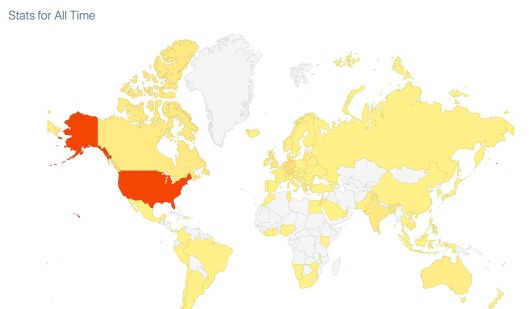
Empirical research shows that more diverse groups can produce more creative and innovative outcomes. Even if such a group cannot work together always, at least use this during divergent thinking, though there is value in diversity for convergent thinking as well. Below is a (badly distorted) map of the world showing the nations from which readers of this blog hailed so far. (Invite your friends from all over the world!)
Map of Readers of Blog

Help Desk Feeds Design. 

(I really want a more general title.) People who work at “help desks” are under time pressure but there should be mechanisms in place for what they learn about customers, tasks, contexts, pain points, to be fed back to development. In a similar fashion, in any domain, whatever information is garnered from interacting face to face with uses, customers, stakeholders, friends, enemies should be fed back to people who design systems, services, products, or governance.

Queue of Communicating Peers.

In many instances, people in queue, whether physical or electronic, share certain concerns in common. (There is always common ground). Rather than have them “stand in line” staring at the back of someone else’s head, encourage them to help enhance mutual understanding among the group.

Palaver Tree. 

This name comes from some places in sub-Saharan Africa where people from a village gather to respectfully discuss what concerns the whole village. Generally, this is near a big tree that can provide shade during dry seasons. In colder climates, a communal fire can serve as the focal point. There may be other special places that are conducive to this kind of Dialogue.

Click to access jbe-thesis.pdf

Talking Stick. 

Often, when confronting a problem that is pressing, complex, or anxiety-provoking, everyone wants to talk at once. No progress is made because people cannot even hear what is being said in the resulting din and no-one is paying attention to anything but getting their own point heard. A Talking Stick provides a visible cue as to who “has the floor.” Only one person at a time can hold the Talking Stick and only they can talk.

Round Robin Turn Taking.

In a group, it often happens that a small group of people tend to “monopolize” the discussion if it is held in a free-wheeling manner. An alternative is to have an Authority Figure or Moderator or Facilitator make sure that every person gets a chance to speak and that every person, including the shiest are encouraged to give their perspectives.

Mentoring Circle. 

It is often easiest for us to learn from people who have recently faced and solved the same problems that we are now facing. A Mentoring Circle provides a way for people to learn from other individuals and from the group.

iPhoneDownloadJan152013 533

Levels of Authority.

As one becomes more experienced and more trusted by a group, it is normal to grant more authority to that person to act on behalf of the group and to have more access to its resources.

Anonymous Stories for Organizational Learning

Often individuals make errors that can provide a learning experience, not only for them, but for others as well. Unfortunately, the competitive nature of many organizations makes admitting to errors costly for the person who made the mistake. An anonymized story can provide a way for the organization as a whole to learn from individuals without their accruing blame and ridicule.  

iPhoneDownloadJan152013 955

Registered Anonymity.

In Amy Bruckman’s MIT dissertation (Moose Crossing), she provided a space for middle school kids to teach each other object-oriented programming. She wanted to make sure the kids “behaved” appropriately despite their being anonymous and on-line despite the fact that these conditions often spawn inappropriate and even mean-spirited comments. While using real identities could help prevent that, it could also lead to even worse behavior. Instead, she used Registered Anonymity. That is, she knew everyone’s real identity and made it clear that inappropriate behavior would not be tolerated. But the child participants were not allowed to share their real identities.

Answer Garden. 

People are busy and don’t want to answer the same simple question over and over. In Answer Garden, developed by Mark Ackerman for his MIT dissertation, people with expertise claimed a part of the tree of knowledge that they were familiar with and agreed to answer questions about that specific subject area. Once the question was answered however, newcomers were expect to first look through the tree for the answer they needed. If there are no appropriate answer, they would post their question at the nearest node to the requested answer. The expert would come by and answer that question, not only for the person who initially asked it, but the tree would grow with that newly posted answer as well.

fullsizeoutput_1a5a

Community of Communities. 

Complex wide-ranging problems such as ensuring that the world economy is organized to sustain the ecosystem require many people to address various problems. While a very large group of people may be concerned that they leave a livable planet for their descendants, everyone cannot work on every aspect. Better is to have communities work on those aspects for which they have particular interest and expertise. In Sweden, for example, Karl-Henrik Robert (https://en.wikipedia.org/wiki/Karl-Henrik_Robèrt) developed a program called “The Natural Step.” This led to the development of specific communities aiding in the way they best could; e.g., lawyers for a sustainable Sweden might concentrate on legislation and regulation, psychologists for a sustainable Sweden might concentrate on methods to raise public awareness; traffic engineers for a sustainable Sweden might concentrate on making more efficient kinds of roundabouts.

Special Roles for Special Purposes. 

Every culture seems to have developed this notion. There are many specific roles that have been developed for specific purposes. Below are just a few.

Master of Ceremonies. 

This is literally someone in charge of a ceremony, ritual, or rite. It has come to include an entertainer who serves to welcome guests and introduce them. A closely related concept is the “Session Chair” who introduces speakers, makes sure they have what they need, keeps track of time, and moderates audience participation.

Storyteller

In many oral cultures, one person, often chosen because of interest or ability, is chosen to memorize and repeat the oral history. In such cases, the role typically lasts a lifetime, not just a project.

Stake Warrior

The idea of a “stake warrior” is that they literally pound a stake into the ground and then tether themselves to that stake during battle. They can advance, go laterally or retreat, but only so far. Conceptually, a stake warrior shows some flexibility in discussion or negotiation, but there are boundaries beyond which they refuse to go.

DeBono’s Colored Hats. 

Edward DeBono has written a number of books about creativity and innovation. One of his ideas is to use colored hats either physically or conceptually to signal which role a person is speaking in. For example, a person wearing a Black Hat is judging ideas while a Green Hat is more for creativity and provocation. More empirical research is needed to validate whether using hats (even metaphorically) actually improves performance.

Moderator

A Moderator’s main job is to make sure that a group actually follows whatever rules it has set out for itself about time limits, civility, taking turns, etc. A Moderator may also adjudicate disputes between two sides.

Facilitator

A Facilitator’s main job is to keep the group moving forward. They might, for instance, suggest a different way of looking at a topic, or try to invoke a metaphor or to draw out less forthcoming group members.

Setting Expectations. 

Promise a person five dollars and give them ten. They will be very happy. Promise another person twenty and give them ten. The will be unhappy about it. What’s different? They both get ten dollars. Many books on developing projects will recommend “under-promising and over delivering.” In some cases, because of science fiction, TV programs, and the popular press, people may come to think anything is possible.

Support Flow and Breakdown. 

When designing a new system, there is an anticipated way for it to work, whether it’s traffic flow in a city, water flow in the plumbing or information flow in an organization. However, eventually, there will be breakdowns in any of these systems. Breakdowns are always a hassle, but they will be far less so if the possibility of a breakdown has been anticipated ahead of time and then planned for.

Ratchet Social Change with Infrastructure. 

Social changes are initially subject to falling back into previous patterns. In some cases, it may help make a social change more permanent by creating an infrastructure that supports the new system. For instance, if you want to improve relations between two countries, you could fund projects jointly that have a long completion time. Or, if you wanted to divide people, you could make it harder for people to see news and information from people across that divide.

Authority Figure. 

Sometimes, a decision needs to be made quickly. Or, perhaps consensus will never be reached. In such cases, it is sometimes useful to have an agreed upon Authority Figure who can be trusted to make an informed decision that takes into account all the relevant interests. Naturally, Authority Figure who makes decisions from a position of ignorance or self-interest must be removed as quickly as possible.

IMG_5935

Celebrate Local Successes Globally. 

Often a very large-scale collaboration project such as developing a new product or service, governing a country, or trying to manage a cross-cultural non-profit stands to lose coherence and motivation when compared with a small co-located team. One way to help both with organizational learning and with encouraging high spirits is to celebrate local successes with the global team. If done correctly, this can be motivating for both the successful team members and the larger team.

Special Processes for Special Purposes. 

This is another high level Pattern. People have developed numerous special purpose processes. Below I review a few. The reason for having different processes for different purposes is that a process can take into account the number of people, the type of goal, the time constraints, and other conditions so that a process is particularly likely to help insure success. A process can fail if it is badly executed but it can also fail simply because it is not appropriate to the task at hand.

Synectics. 

Originally, the term derived from the work of Prince and Gordon as a way to describe a suite of techniques for creative problem solving. It is similar to brainstorming in that the emphasis is on generating many ideas quickly and without taking time out of idea generation in order to evaluate and debate each idea. Also like brainstorming, people are encouraged to build on each other’s ideas. In addition, they describe various clever ways to incorporate metaphorical thinking into the process. They also allow each person to work on the “Problem As Understood” and this can be slightly different for each person. I have personally found synectics to be extremely useful. It “works” in generating many ideas, some of which can be quite useful and novel. For example, many years ago, I facilitated such a session and the foreign equivalent of the American IRS decided that increasing tax revenue was their goal but that to achieve that, there were other methods than increasing tax rates and increasing compliance.

https://en.wikipedia.org/wiki/Synectics

Speed Dating. 

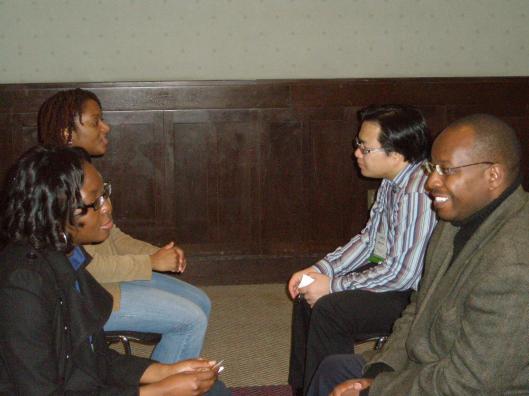
Although there are actual speed dating venues, here this term refers to a way for a moderate sized group of people to get to know each other quickly by spending two minutes with one other person in the group quickly recounting their backgrounds and interests and then moving on to form new pairs.
OLYMPUS DIGITAL CAMERA

KJ Method. 

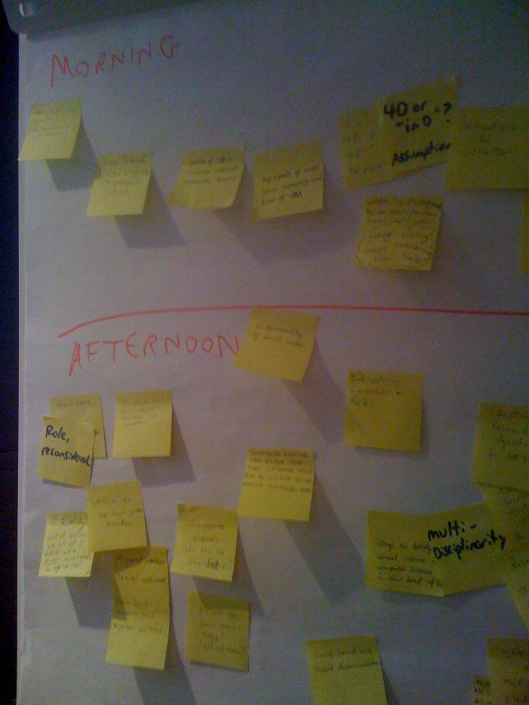
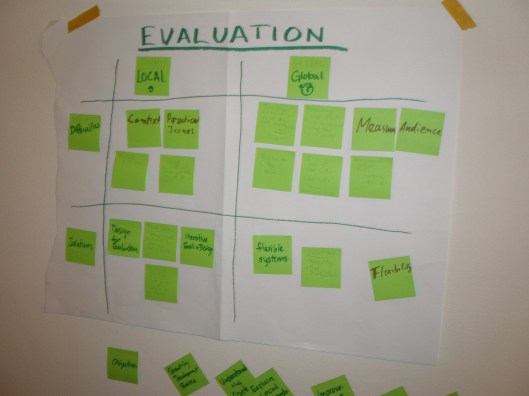
This is a way to cluster ideas. Many people are now familiar with this as a way of clustering ideas from a brainstorming or synectics session or for clustering ethnographic observations in order to later address product features and functions to address them. Basically, a large number of post-in notes are put on a wall and re-arranged by the group, some of whom may focus on a particular area of the overall cognitive map that is being build or spend their time thinking more about the whole. This method is often used, for example, in CHI Program Committee meetings to take a first pass at developing sessions. There have also been attempts to automate such processes.
OLYMPUS DIGITAL CAMERA

Rating and Ranking.

Often a large number of ideas are generated but the resources available do not allow all of them to be pursued. Therefore, a variety of voting, ranking and rating systems have been developed so that the group as a whole has input into the direction taken.

Incremental Value. 

It is difficult for people, either as groups or individuals, to move from a current way of doing things to a new one. Almost invariably, people will find the old way of doing things more “comfortable.” The transition to a new way will be much easier if there are incremental improvements in performance along the way rather than the mere promise of some wondrous new state at the conclusion of a long process of change.

Jump Start. 

Sometimes, change in an organization or process needs to be “jump-started” by providing additional incentives or special organizational support in some way.

Active Reminders. 

As people are learning new methods, processes, and skills, it is helpful to have Active Reminders so that people are less likely to fall into old habits. For example, in attempting to do brainstorming, many people find it very difficult to withhold judgment and criticism from ideas that others put forth. It can be helpful in such cases to have the “Rules” of brainstorming prominent displayed or to have someone whose role is mainly to remind people to build on each other’s ideas when someone critiques an idea.

Controlling Growth. 

While people often want their company, non-profit, or movement to grow as quickly as possible, growth without restraint is often called “cancer.” Growth needs to be controlled so that unanticipated side-effects do not destroy the entire company, non-profit or movement. People Express Airlines, for instance, is often thought to have have tanked because their success led to such rapid growth that they could not sustain what made them successful in the first place.

Expressive Communication Builds Mutual Trust.

Studies of cooperation in games such as the “Prisoner’s Dilemma” show that when people communicate something personal and apart from the game such as sharing photos, backgrounds, hobbies, etc. it tends to increase the chances of cooperation.

These Patterns (or really, more accurately, hints of Patterns, are not meant to be exhaustive. But hopefully, there are enough Patterns in this post to give readers a better idea of the wide variety of Patterns than might cohere into a Socio-Technical Pattern Language for Collaboration and Teamwork.

References: 

https://socialworldsresearch.org/sites/default/files/j-ag.final-fmt.pdf

https://www.cc.gatech.edu/fac/Amy.Bruckman/thesis/

Fincher, S., Finlay, J., Green, S., Matchen, P., Jones, L., Thomas, J.C., Molina, P. (2004) Perspectives on HCI patterns: Concepts and tools.  Workshop at CHI 2004, ACM Conference on Human Factors and Computing Systems.

Pan, Y., Roedl, D., Blevis, E., & Thomas, J. (2015). Fashion Thinking: Fashion Practices and Sustainable Interaction Design. International Journal of Design, 9(1), 53-66.

http://www.it.bton.ac.uk/staff/lp22/HF2000.html

Schuler, D. (2008).  Liberating Voices: A Pattern Language for Social Change. Cambridge MA: MIT Press.

Thomas, J. C., Kellogg, W.A., and Erickson, T. (2001) The Knowledge Management puzzle: Human and social factors in knowledge management. IBM Systems Journal, 40(4), 863-884.

Thomas, J.C. and Carroll, J. (1978). The psychological study of design. Design Studies, 1 (1), pp. 5-11.

Thomas, J. C. (2012). Patterns for emergent global intelligence. In Creativity and Rationale: Enhancing Human Experience By Design J. Carroll (Ed.), New York: Springer.

Thomas, J. C. & Richards, J. T. (2012). Achieving psychological simplicity: Measures and methods to reduce cognitive complexity. In The Human-Computer Interaction Handbook. J. Jacko (Ed.) Boca Raton, FL: CRC Press.

Thomas, J.(2008).  Fun at work: Managing HCI from a Peopleware perspective. HCI Remixed. D. McDonald & T. Erickson (Eds.), Cambridge, MA: MIT Press.

Thomas, J.C. (2003), Social aspects of gerontechnology.  In Impact of technology on successful aging N. Charness & K. Warner Schaie (Eds.). New York: Springer.

Thomas, J. C. (2001). An HCI Agenda for the Next Millennium: Emergent Global Intelligence. In R. Earnshaw, R. Guedj, A. van Dam, and J. Vince (Eds.), Frontiers of human-centered computing, online communities, and virtual environments. London: Springer-Verlag.


Thomas, J.C. (1996). The long-term social implications of new information technology. In R. Dholakia, N. Mundorf, & N. Dholakia (Eds.), New Infotainment Technologies in the Home: Demand Side Perspectives. Hillsdale, New Jersey: Lawrence Erlbaum.

Thomas, J.C., Lee, A., & Danis, C (2002). “Who Speaks for Wolf?” IBM Research Report, RC-22644. Yorktown Heights, NY: IBM Corporation.

Thomas, J. C. (2017). Building Common Ground in a Wildly Webbed World: A Pattern Language Approach. PPDD Workshop, 5/25/2017, San Diego, CA.

Thomas, J. C. (2017). Old People and New Technology: What’s the Story? Presented at Northwestern University Symposium on the Future of On-Line Interactions, Evanston, Ill, 4/22/2017.


Build from Common Ground

25 Sunday Feb 2018

Posted by petersironwood in America, psychology, sports, Uncategorized

≈ 6 Comments

Tags

A Pattern Language., collaboration, Common Ground, family, innovation, life, music, religion, sports, teamwork

OLYMPUS DIGITAL CAMERA

CHI Workshop Activity: Working Together to Create World Map (Florence, 2008)

Build From Common Ground

Prolog/Acknowledgement: 

The idea for this Pattern comes from long personal experience trying in many contexts to get to solutions quickly without first bothering to try to find common ground. In addition, I am working on a project to provide a platform to support civil discussion, debate, Dialogue, and deliberations. One of the other founders has a long history with The Interactivity Foundation which also uses various methods to build from common ground.

Author, reviewer and revision dates: 

Created by John C. Thomas on February 20-25, 2018

IMG_2979

Synonyms: 

Abstract: 

Human beings share a large majority of their genes. Life on earth began 4.75 billion years ago. Only around 100,000 years ago people began migrating out of Africa, going to different places and evolving different cultures, religions, and languages. In addition to our long common history, people across the globe want many of the same things: freedom, food, water, safety, love, friendship, a space to be themselves, a life with some pleasure and a sense of meaning or higher purpose.

In the so-called developed world, there is an emphasis on doing things as quickly and efficiently as possible. To accomplish that, many people are extremely specialized in their education and profession in addition to whatever differences they have in culture and family background. Often, in a highly populated, highly interconnected world, people must collaborate and cooperate at a very large scale. Since some of the problems we face (e.g., preventing atomic war; preventing plagues; reducing global climate change) are vital, people are passionate about getting to solutions. They want to do this quickly. There is often a natural tendency to focus immediately on the problem as initially defined, and then to focus on differences and to resolve those differences as quickly and efficiently as possible. This does not generally work. People are invested in their own solutions which depend on their own background and experiences in their various cultures, families, education and training. Focusing from the onset on differences sets up a competitive mindset which then has everyone thinking how to “win” against their competitors. Unlike athletic competitions, people are unlikely even to agree initially on the “rules” for deliberations and debate, and often have pre-existing “positions” to sell to everyone else or force on everyone else.

Therefore, for any group trying to solve a problem collaboratively, it works better to first identify and build on common ground. Later, after some degree of trust is established, people may (or may not) find it useful to examine as well their differences as a source of ideas for how to solve the larger problem.  They may choose from a variety of methods to make progress. Starting with common ground can help everyone involved to see that they are all part of one big and quite similar “in-group” with a problem to solve rather than focusing on everyone else as being in an “out-group” that needs to be defended against.

IMG_3240

Problem:

Groups function better under a wide variety of circumstances if there is a high degree of internal mutual trust. If people work together over a long period of time, trust will usually develop if warranted. This is what happens in most (but not all) work groups, teams, standing committees, etc. However, it often happens that other problems need to be understood and solved by groups that span pre-existing organizations. For example, a town needs to collectively decide whether to sell a beautiful community park to a mall developer who promises tax revenue and convenient shopping for the town. A state needs to decide whether to legalize marijuana or to ban assault weapons. A nation needs to decide whether or not to work with other nations to reduce air and water pollution. People addressing such issues will often have to address them in combination with others that they do not already know well and may not trust.

Often such decisions as those mentioned above must be made under some time pressure. Some people will have vested interests in a “solution” that is particularly favorable to them regardless of how much it hurts others. When people begin by stating their own position and trying to “sell it” to others, an adversarial atmosphere is created so that “winning” rather than “solving” becomes the dominant tone of subsequent conversations and actions. This almost always results in sub-optimal solutions and, in addition, almost always results in reducing trust and social capital among the people deciding.

Even under the best of circumstances, with everyone committed to finding a “good” solution for all, people will tend to misunderstand each other simply because language is ambiguous and vague. People have different assumptions based on their experiences, culture, and training what process to follow as well as what constitutes acceptable rules and boundaries. If we add to these inherent difficulties the further (and avoidable) difficulty that people are focused on the ways people are different, it will tend to prevent mutual trust and prevent the emergence of new ways to find, formulate and solve the problems at hand.

IMG_5159

Context: 

Complex problems can often only be solved by groups. Even when the nature of the problem is simple enough for one person to solve, people want to feel that they or their representatives are engaged in the process if the outcome will impact them. For the group to work well together to solve problems, it is useful for them to understand each other’s situations and motivations. When in a hurry or under stress, people often perceive others and their motivations, not on the basis of inquiry into what those are but on group membership and the way that group differentiates itself from other groups.

Our nervous systems (and those of other animals) are constructed to be particularly sensitive to differences and changes. Our education and society teach us to differentiate as much as possible. We celebrate the wine connoisseur who can tell you the year and vineyard and scoff at the person who simply says, “I like all wine.” Sometimes, of course, fine differentiation is critical, particularly for an omnivore. We need, for instance, to be able to differentiate the three leaves of a wild strawberry from the three leaves of poison ivy. In biology class, we get high grades for correctly labeling 100 different parts of the earthworm and get no credit for simply saying, “Look! These are all parts of an earthworm! How cool! I had no idea it was that complex inside or that it has so many of the same parts we do!” In many contexts, being able to further differentiate things is a good thing. Even in group problem solving, there are situations where this is true. However, we typically do not ask ourselves whether this is one of those situations. We tend to dive unthinkingly into exploring differences.

Forces:

  • Our brains are not infinite but finite. We, along with other animals, generally focus on foreground while ignoring or presuming the background. Our nervous system is especially tuned to differences and changes, not to similarities and constancies.
  • Our educational systems typically focuses on teaching people to make even finer and further differentiations beyond what our senses immediately show.
  • Societies typically celebrate finding additional differences rather than finding additional similarities. Experts are typically defined by their ability to detect differences rather than their ability to see similarities.
  • People are quintessentially social animals. Therefore we tend to join groups. Each group coheres around a group identity which tends to define itself in terms of differences from other groups and seldom mentions similarities.
  • Each person only knows a small proportion of another person’s situation and individuality. Often, we treat each person according to their differentiating group membership(s) rather than their similarities to ourselves or according to the complexity of their individual selves.

Solution:

When a group begins to address a situation that impacts many people in various ways, and especially if people already have opinions and positions on the situation, begin by stressing, creating, or fostering their common ground before even starting any other problem solving activity.

OLYMPUS DIGITAL CAMERA

Sharing a Meal at CHI 2008 Workshop

Examples: 

1. At IBM Research, for several years, I managed a research project on the “business uses of stories and storytelling.” I worked with a small team of researchers & consultants to develop tools and techniques. One patent (Story-based organizational assessment and effect system) was originally inspired by trying to help companies involved in mergers and acquisitions deal with cultural differences between companies. The suggested technique essentially involved collecting stories from the two original companies, analyzing them for the underlying values that were expressed in the stories, finding common values in the stories from both original companies, creating new stories using the values and situations from the originals but making sure the new stories were constructed to be memorable and motivating; and finally re-introducing these stories to the people from both companies. The reason for this whole process was to stress common ground so that people from two companies could work better together.

StoryPatent

2. At a workshop at the 1992 ACM Conference on Human Factors in Computing Systems (CHI ’92), I co-organized and co-led a workshop on “Cross-cultural issues in HCI.” At the beginning of the workshop, the participants entered the assigned workshop room to find that it had been set up in a “classroom style” with one small table and two chairs at the front of the room and all the other chairs and desks set up for the “listeners.” We wanted the room set up as a large circle. Everyone pitched in to re-arrange the room into this large circle. This physical activity provided additional common ground for the team. One outcome of the Pattern “Small Successes Early” is to provide common ground. Having people work together to perform a physical task is one way to establish common ground.

We also played a game called “Barnga.” In my introduction to the game, I explained that it was much like Bridge, Whist, or Euchre. To my surprise, none of the participants attending from Asia had any idea how to play such games or what I meant by “tricks” or “following suit.” That experience illustrates how easy it is (at least for me!) to over-estimate how much common ground exists in a group.  (http://www.acadiau.ca/~dreid/games/Game_descriptions/Barnga1.htm)

In a later workshop (2008) on “Human Computer Interaction for International Development,” at the suggestion of Andy Dearden, we began by cooperatively building a map of the world from materials at hand (illustrated above) before delving into the details of the workshop. Starting with this as “common ground” we then explored some of our differences by standing on the representation of where we were from, a favorite place we had visited, a place we wanted to visit, etc.

3. Religions regularly practice rites and rituals. For practitioners of the religion, this provides common ground regardless of a host of differences among the adherents. Of course, it is a double-edged sword because differences among these rites and rituals can also separate people. One of the more brilliant scenes from West Wing cuts among scenes of people attending religions services that are variously Jewish, Muslim, and Christian while the viewer knows that there is an unsuccessful peace effort underway. In this case, the uncommented footage helps to illustrate the common ground among these three religions.

earthfromspace

4. The Family of Man was both an ambitious photography exhibit and a book (definitely worth buying) that portrays people across the world to illustrate precisely that we do have common ground.

https://en.wikipedia.org/wiki/The_Family_of_Man

5. In an earlier blog post, I showed with back of the envelope calculations just how “related” humanity is in terms of genetics, experience, ideas, and matter. In fact, all of life on earth is highly inter-related and it has been for its entire 4.75 billion years.

https://petersironwood.wordpress.com/2017/03/09/math-class-who-are-you/

6. In a recent episode of the TV series, Madam Secretary, the Secretary of State is trying to resolve a conflict between two nations A and B. The diplomats from A say they cannot trust B and the diplomats from B say that they cannot trust A. She suggests that they start from their mutual distrust as part of common ground. In other words, rather than treating the mistrust of A and B as two separate issues, she begins by suggesting that A and B both share two things in common: not only a desire for peace but also a difficulty in trusting the other side. Even mutual distrust can be framed as a basis for common ground. This is more than a linguistic trick. It is an important reframing. It may well turn out that a single event such as a soccer game with teams that have members from both nations may help reduce mistrust on both sides at the same time.

7. Holiday celebrations, the preparation and consumption of food, listening to music, or appreciating the beauty of nature may all provide additional ways of beginning with common ground. Of course, there are cultural differences in all of these as well so one must take some care to provide something that actually is common ground and not something that tends to emphasize the differences among people in these activities.

8. One of the plenary speakers at CHI 1989 in Austin Texas was an astronaut who had been in space. I spoke with him after and during our conversation, he claimed that all astronauts, whatever country they were from, shared the same experience of seeing earth from space; viz., that the national boundaries we typically think so much about were only political; most are not physical. He said all the astronauts were struck by how thin and fragile our atmosphere is and that the earth is the only place around that is capable of sustain the breadth and depth of life. Many of them found this realization of “common ground” the most transformative of all their experiences in the space program.

Resulting Context:

Once people experience common ground, they may still disagree, debate, discuss, or hopefully dialogue in order to identify issues and problems. Experiencing common ground makes it harder to “dehumanize” the other side. It decreases the chances that people will engage in counter-productive actions such as “name calling” or using propaganda techniques to “prove” that they are right and their “opponents” are wrong.

Rationale:

Actions are always better based on reality than on fantasy. Reality is that people share much in common. Reality is that there are also many remaining differences. The entire problem solving process (including problem finding, problem formulation all the way through to finding issues with solutions and re-solving, re-negotiating, re-designing, or re-developing a solution) is enhanced when it is based on a balanced view that includes both real similarities and real differences. We already have a culture and an educational system that focuses on differences. Focusing on common ground is a critical factor in balancing our view so that we do not try to solve problems based on the partial truth that we are all different.

Related Patterns: 

Reality Check, Check-In, Small Successes Early.

Metaphors: 

It is a windy day in San Diego as I write this. We have a set of wind chimes outside the bedroom. Whichever direction the wind blows; however windy it gets (within bounds); and even if the wind is quite chaotic, the sound that emerges is always harmonic and tuneful. This is because of the structure and relationships of the chimes. It would be nice if we could have a platform that encouraged and promoted civility. I think that could work because of the nature of the platform. One of the “chimes” could be Bohm Dialogue; another could be “Building from Common Ground.”

Another musical example is Jazz Improvisation. If a group of musicians who know each other get together, they can improvise some very nice music. If they’ve never met, they will almost certainly agree on a few boundaries before beginning such as style, time signature, key signature. They may well start by having the percussion set up a “beat” that everyone relates to.

Now, imagine instead that seven random people are thrown together from seven different cultures. Each has an instrument that none of the others has ever seen. They have completely different musical experiences and expectations. Does it not make sense that they will take more time to converge on anything good? Doesn’t it seem as though they first need to discover some kind of common ground in terms of scales, rhythms, degree of repetition before achieving a good result? Or, do you think they should argue about which kind of music is best first? Do you think any of the seven will be able to convince the other six that “their” kind of music is superior? Suppose instead of having as one mutual goal making good music, instead, they are in a contest and only one of them will “win” and go on to the next round. Surely, this will only further confound any possible teamwork. Add to this, that they only have two minutes. What kind of performance would you expect now? And, yet, we seem to expect people from very different backgrounds to get on-line and instantly “make good music together.” Whether it’s 140 characters, 280 characters or a whole paragraph, it seems unlikely you will be able to sway anyone to move from “their position” to “your position.”

IMG_3524

International sports competitions such as the Olympics provide a setting where people from around the world get together and compete. These are not random people; they are all immensely talented and skilled; however, they are also all highly competitive. Yet, the venue provides a framework for competition that provides a structure for competing within common ground. Despite being from different cultures and using different languages, the athletes push each other to amazing performances with a minimum of rancor. Every athlete realizes as well that every other athlete has also gone through a rigorous selection and training process involving many sacrifices to get where they are — more common ground. The Olympics might be thought of as a particularly interesting example of finding common ground despite people having different backgrounds, language, and goals. Sports may also be thought of as a compelling metaphor. When politics are reported in the media, they are most often treated as a sporting event. But it is a strange kind of sporting event in that such reporting seldom stresses common ground and instead focuses on strategy, polls, winning, losing, and differences. It almost never reports on common ground in politics. In reporting on actual sporting events, however, the reporting focus often does cover the common ground that athletes face; e.g., the training, the dedication, the sacrifices that families must make, the importance of coaching, etc.

References: 

https://www.goodreads.com/book/show/197193.The_Family_of_Man

https://www.johngraham.org/coach/17-finding-common-ground-negotiating-and-resolving-conflicts-part-i

http://www.tandfonline.com/doi/full/10.1080/03057267.2016.1206351

http://journals.sagepub.com/doi/abs/10.1177/1049732306289705

https://www.researchgate.net/publication/221517384_Video_Helps_Remote_Work_Speakers_Who_Need_to_Negotiate_Common_Ground_Benefit_from_Seeing_Each_Other

Thomas, J. C. (2017). Building Common Ground in a Wildly Webbed World: A Pattern Language Approach. PPDD Workshop, 5/25/2017, San Diego, CA.

Thomas, J.C. & Kellogg, W. (1993). Cross-cultural perspectives on human-computer interaction: report on the CHI ’92 workshop. SIGCHI Bulletin, 25 (2), 40-45.


Bohm Dialogue

21 Wednesday Feb 2018

Posted by petersironwood in America, management, psychology, Uncategorized

≈ 4 Comments

Tags

A Pattern Language., Bohm Dialogue, Business, competition, dialogue, innovation, learning, politics


IMG_0706Bohm Dialogue

Prolog/Acknowledgement: 

The idea for this Pattern comes from the work of David Bohm. Bohm was a quantum physicist who, later in life, became interested in human communication. He would not say he “invented” dialogue; rather, he felt it was common in so-called “primitive” societies. Indeed, it seems to have been a common occurrence in the recounting of Paula Underwood in The Walking People. I learned more about Dialogue from Peter Senge and Bill Isaacs while working in “Knowledge Management” at NYNEX and IBM.

Author, reviewer and revision dates: 

Created by John C. Thomas on February 21, 2018


OLYMPUS DIGITAL CAMERA

Synonyms: 

Campfire Reflections. Quaker meeting.

Abstract: 

In a hyper-competitive society, conversations that might be related to actions that affect more than one person are framed as contests with winners and losers, much like a sporting event or a court case. Sometimes, this might be appropriate, but it is not generally a good method. An alternative method to debate and discussion is Dialogue. In discussion and debate, as soon as one person begins saying something in favor of X, others decide whether they are for or against X. Then, based on a superficial hearing of what the person is saying, they determine how to best add weight to X or detract from it. They typically want to be able to “jump in” as soon as there is the slightest gap in the conversation. As a result, they are typically rehearsing their own upcoming argument and not even listening to the other person beyond the first few words. By contrast, in Bohm Dialogue, one person says something and everyone else listens to them respectfully. After listening, everyone reflects on what has been said. Then, they might or might not make a comment. This comment does not have to be an argument pro or con. It can be an analogy, a story, a reflection, a question, an example, or an observation. Rather than dividing into “camps” or “teams” and trying to “win” an argument about whether X or ~X is better, everyone works collaboratively and cooperatively to understand the space of possibilities and consequences. In such cases, the group might end up doing X, ~X, or .5X. Or, they may decide to gather more data; they may invent Y; they might decide to experiment in a small way with X. It is a joint construction process.

Problem:

Groups consists of individuals who never have precisely the same interests or the same experiences. In some cases, people simply make their own choices. It isn’t necessary for everyone to eat the same food or read the same books. But in some cases, appropriate action requires that people agree. Do we drive on the left side of the road or the right side? Do we penalize companies for polluting the environment or not? Do we have daylight savings time or not?

In a competitive society, it is easy to fall into the trap of framing problems in terms of who will benefit and who will lose. Everyone on the “losing side” will tend to find arguments to support their position even before understanding the other side. Such a process rarely results in innovation or breakthrough thinking. In a rush to win, people tend to ignore subtleties and interactions so even the framing of the problem becomes over-simplified. If people become angry or fearful, their ability to process information deteriorates and they most often stick with something they already know. In extreme cases, people will literally “freeze” with fear and be unable to perform even a simple yet critical action such as pulling the ripcord on their parachute.

In addition, if group action is decided through a process that is framed in terms of winning and losing, those on the losing side may not fully cooperate with the group decision. Consciously or unconsciously, they may even act to thwart the implementation of the group decision.

In the rush to “win,” those on the winning side may not even listen to important concerns from the other “side” and even if the “correct” decision “wins out,” important implementational details are overlooked. In this way, the implementation of the group decision will be flawed even if everyone tries to cooperate.

By framing the group decision process in terms of “winners” and “losers,” group cohesion and mutual trust can often be lost. This is particularly true if the group process is so contentious that people use propaganda or outright lies to try to “win” the debate. This not only makes this particular problem solving exercise less than optimal; it also means that future interactions will be less cordial, less civil, and less likely to result in what is best for the group as a whole.

Context: 

Complex problems and large problems can often only be solved by groups. In addition, sometimes, decisions must necessarily impact the entire group. Groups may be as small as a couple deciding where to go on vacation or tennis doubles team deciding on an effective approach to their next match or as large as all of humanity deciding on how to deal with population growth and pollution.

Groups must not only decide on a collective course of action; generally, they must also implement that decision.

Forces:

  • Everyone wants to protect their “own interests.”
  • People may think of their “own interests” at varying levels; e.g., their own body, their own belief system, their own family, their own tribe, their own party, their own nation, all of humanity, or even all of life.
  • The expectations of any one person are primarily based on their own experiences.
  • The behavior of any other person is largely based on that person’s experiences.
  • If one person acts uncivilly or hyper-competitively, it tends to increase the chances that others will do the same.
  • In some societies, competition has become the default way to interact.
  • Competition tends to induce high stress levels in people.
  • High stress levels tend to make people less willing to listen, change, or think creatively.

* Everyone is an expert when it comes to their own experience.

Solution:

Instead of having a group debate or discuss two or a few alternatives to determine which one is the winner, instead use Bohm Dialogue to cooperatively, cooly, and calmly have the group examine a situation using everyone’s experience together. Have people listen respectfully to everyone’s contribution. Have everyone reflect on what they say. It helps if people frame their contribution in terms of their own experience rather than abstract and sweeping generalities and pronouncements. Let the group cooperatively build a joint understanding of the problem. This often results in an emergent solution. Even when it does not and, in the end, a vote on X or ~X must be taken, everyone feels respected by everyone else and people are much more likely to help implement the solution.

IMG_5216

Example: 

Imagine a tribe of people sitting around a fire at the end of the day. They reflect on their experiences. One says, “I gathered acorns today. There were very few though. This is not like the other years.” Everyone listens. They reflect.

Another says, “It would be nice if we could eat the acorns as the squirrels do, without having to wait.”

Another says, “Yes, though even they do not eat them all right away.”

Another: “Are there fewer oak trees? Or, is each tree making fewer acorns?”

The first says, “I am not sure. Let me think back. Each tree has fewer than in years past.”

Another says, “Speaking of fewer, I only caught two fish today in my favorite fishing spot. And the water was shallower.”

Another adds: “This spring I gathered fiddlehead ferns. There were only a few. Odd.”

Another: “There were so many nice sunny days this spring and summer. I guess there was a lot less rain.”

Another: “It would be nice if we could make it rain more.”

An older woman adds, “It has been raining less as I’ve grown older. Less and less each year.”

Another: “How can we make it rain more?”

Another: “I don’t know how we can make it rain more. But we could save the water when it does rain.”

Another: “I like water. Sometimes the small raindrops join together to make larger ones.”

Another: “Indeed, it is the nature of water to like the company of others.” Laughter.

Another, “Perhaps we can encourage water from the big river to visit us. We can dig a trench. If we encourage some water to go into that trench, other drops may follow into our stream.”

Another: “More water in our stream would encourage fish as well as fiddleheads and oaks to visit us more often.”

To the typical “modern person,” this dialogue seems needlessly random and inefficient. But is it really?

Sure, the typical business meeting has an agenda and it seems as though it’s efficient. The meeting below is pure fiction — but it is precisely in line with my typical experiences from a lifetime of meetings in “efficient corporate America.”

IMG_3898

10:10- 10:30 Discuss ways to get more acorns.

Chairperson: “We need more acorns. How can we get them?”

Person 1: “I need help. They are hard to find.”

Person 2: “Well, I can’t do it. I’m having enough trouble getting fish. That takes all my time.”

Person 3: “You think you’ve got troubles? I can’t find enough fiddleheads either, so I can’t help.”

Person 4 – speaking directly to Person 1: “You sure you’re really hunting acorns and not just ogling the women? Just kidding.”

Person 1: “You come gather the acorns then. You’ll see.”

Person 4: “I said I was just kidding.”

Person 2: “When can we talk about getting more help fishing? Can we put that on the agenda for next week?”

Chairperson: “It’s next on the agenda.”

Person 5: “The real solution is incentives. I hate to say it, but I just don’t think everyone is really pulling their own weight around here.”

Person 6: “The key is better metrics. Words like ‘fewer’ are very fuzzy. We need an accounting of all the acorns. And fish. And fiddleheads. Then, we will be able to quantify the extent of the problem.”

Person 1: “Who is going to count the acorns? You? I know I got fewer and it isn’t from not trying.”

Chairperson: “Hey, we’re almost out of time. Let’s table this discussion for now and put it on the agenda for next week. It seems to me, in the meantime, Person 1, you’re going to have to get up a little earlier in the morning and gather more acorns that way. Let’s vote. All in favor of Person 1 getting up earlier to gather more acorns, raise your hands.”

[Everyone raises their hands except Person 1].

Chairperson: “OK, motion carried. Person 1, give us a report next week on exactly how many acorns you got every day.”

Person 1: “Look, the acorns are largely gone now. Getting up earlier isn’t going to help.”

Chairperson: “Sorry, Person 1. Do the best you can. We need to move to the next item on the agenda which concerns fishing.”

Person 1: “I always do the best I can. But I’m telling you that there will still be fewer acorns next week.”

Chairperson: “OK, we need to take this off-line and talk about fishing. If you can’t gather acorns, we’ll find someone who can. Enough.”

What are the likely outcomes from this “efficient” meeting? First, it is quite likely that Person 1 is pretty pissed off. Second, the group is unlikely to ever realize that there is a problem with the acorn supply rather than the extent or manner in which Person 1 is gathering them. Third, the group is way far away from realizing the systemic nature of the problem and the fact that the “real problem” is a diminishing source of water, let alone making any progress toward solving that actual problem.

Resulting Context:

Generally speaking, using dialogue will be more not less efficient for finding and implementing solutions to root problems than will competitive debates or discussions. The solutions arising from Dialogue will be “owned” by the entire group and it is more likely that everyone will be working together to make sure the solution actually works. In addition, the long term effect on the group is to increase mutual trust and cooperation.

Rationale:

Actions are always better based on reality than on fantasy. Yet, humans often latch onto a particular interpretation of events very quickly and with insufficient data. As a consequence, people often work within the constraints of their own limited thought patterns. Treating what is essentially and quintessentially group problem solving as a competition between people for which of two or three solutions most often results in solving the wrong problem or at best only solving a sub-problem. In addition, “solutions” arrived at in this competitive way often result in decreased effectiveness of a group over time because of growing envy, resentment and mistrust.

By contrast, Bohm Dialogue encourages people to work together with respect and to understand a problematic situation from many angles. In this way, the real or more basic problem is understood as well as how it impacts everyone present.

As Bohm points out, many people mistakenly believe the word “Dialogue” comes from the Greek word logos for truth and the Latin root di for two implying that a dialogue is a two-sided debate.  Instead, “Dialogue” comes from the Greek logos and the Greek root dia which does not mean two but through. It is coming to the truth through interaction.

IMG_5400

Related Patterns: 

“Who Speaks for Wolf.” Reality Check.

Known Uses: (See the Incarnations section of the Wikipedia article on 2014)David Bohm referenced below). I have also had personal success running Dialogue sessions as Executive Director of the NYNEX AI lab and in SIGCHI meetings. If you explain the “rules of the game” people can fairly easily learn to Dialogue.

Quaker meetings are often run in this same fashion and the group does not “vote” to choose among a couple possible actions but instead reflects as a group until a consensus is reached.

Metaphors: 

Bohm, as I mentioned, was a quantum physicists and he likened what happens in dialogue to having people be in a “super-cooled” and therefore “super-conductive” state. When people are “agitated” to “win,” they are bouncing around like hot molecules and conducting information among them is difficult. The more you heat up a wire, the less well it conducts current or information. Near absolute zero, the wire instead becomes “superconductive.” When people relax and do not have an “axe to grind” and are not ego-invested in a predetermined outcome, they behave quite intelligently in discovering truths.

References: 

https://en.wikipedia.org/wiki/Bohm_Dialogue

 Bohm, D. (1996). On dialogue. New York: Routledge.

Holman, P & Devane,T. (1999). The change handbook: Group methods for shaping the future. San Francisco: Berrett-Koehler Publishers.

Isaacs, W. (1999). Dialogue and the Art of Thinking Together: A Pioneering Approach to Communicating in Business and in Life. Bantam Doubleday Dell Publishing Group.

Krishnamurti, J. and Bohm, D. (2014). The ending of time: Where philosophy and physics meet. New York: Harper/Collins.

Senge, P. M. (2006). The fifth discipline: the art and practice of the learning organization. Doubleday.

Shaw, P. (2002). Changing Conversations in Organizations. A complexity approach to change. London: Routledge.


Author Page on Amazon

Greater Gathering

08 Thursday Feb 2018

Posted by petersironwood in America, management, psychology, sports, Uncategorized

≈ 3 Comments

Tags

Business, collaboration, cooperation, coordination, innovation, pattern language, social capital, sports, teamwork, trust


IMG_9267

Greater Gathering.

Author, reviewer and revision dates:

Created by John C. Thomas on Dec. 11, 2004

Reviewed by <> on <>

Revised by JCT on Feb. 7, 2018.

Prologue and Acknowledgements. 

This pattern can be found in many teams, companies, NGO’s, families, and religious organizations. If you are interested in how this happened to strike me as a pattern, feel free to read this section Otherwise, you can skip it. I began to notice this pattern after two events happened to coincide.

While working at IBM Research many years ago, I played in an inter-company tennis league in Westchester County, New York. During those matches, I met many IBMers from outside of IBM Research. One of the people I met worked in the corporate tax department. In those days, long before Google, we used a Key Word In Context system (ITERC?) to scan for potentially useful documents. Every week, I would get a long list of abstracts based on my list of keywords. This system was not nearly so accurate as what many of us have access to today. While there were many “hits” for me, there were also quite a few false positives. For example, I was interested in the psychological process of “induction” – learning a rule based on examples. I often got abstracts, however, about “induction motors.” One day, I got one of those “false positives” about a new tax law that allowed highly profitable companies like IBM to “trade” tax liabilities with companies who were struggling like the tire companies in my home town of Akron. According to the abstract, it was in the financial interests of both companies to use this “trading” mechanism. I had little interest in it, but I liked the guy I had met from corporate and we had traded contact information for tennis purposes. I sent him the abstract. As it turned out, this was precisely applicable to IBM and saved them a lot of money.

At the same time, I was reading about the history of IBM and particularly thought it interesting that they had put so much time and effort into the 100% club meetings. This was a country-wide meeting to bring together sales people from all over the US who had met or exceeded their sales quotas. I was never in sales, but even at Research, we had “annual picnics” in which everyone in IBM Research was invited to come with their families. As I began thinking about it, I realized that these kinds of “larger gatherings” were common across many different cultures, domains, and types of groups. The tax example showed a very specific financial benefit to the IBM company but I realized there were many other potential benefits as well.

IMG_9895

Synonyms:

Conference. Congress. Convention. Jamboree. National Holidays.

Abstract:

When moderate to large groups work to solve large, complex problems, it is often necessary for them to subdivide the work into distinct subgroups. This results in the group being more efficient and effective. However, it also means that each group comes to develop their own vocabulary, search for people who are particularly good at certain things,  and in various other ways, the people within the subgroup communicate a lot, come to trust each other, and have clear common interests. They are often at conflict with other subgroups for resources. In addition, there is less trust across these organizational boundaries than within such a boundary. Often, the people themselves come to be somewhat different kinds of people. Large effective groups therefore participate at least annually in a “Greater Gathering” which allows people to meet and co-mingle across these organizational boundaries. These meetings are constructed to emphasize “common ground” within the larger group. As a result, new lines of communication are lined up; mutual trust is enhanced; sometimes, real problems are solved.

Problem: 

As large, complex problems are broken down into pieces and assigned to different groups, efficiency and effectiveness increase. Not only that, the individuals within each of these various subgroups typically grow more trusting of each other within that sub-group.  They learn about each other’s skills and motivations, so over time, the sub-group as a whole grows more effective and efficient.

However, this high intra-group cohesion comes at a price. People in one part of an organization consider themselves the “in-group” and may begin to limit their learning because of a lack of diversity in that one perspective. Furthermore, they may come to work so hard to solve their own sub-problem that they lose sight of the larger problem and make sub-optimizing decisions. In some cases, the ideas of various subgroups about how to handle something will differ and result in conflict. Even worse, sometimes, decisions made in Group A help them a little but make life for Group B much more difficult and make the overall objective of the group, whatever it is, more difficult to achieve and no-one ever realizes it. There may be lack of trust between different sub-groups or even outright mistrust among sub-groups. Often sub-groups that are “at odds” with each other, not only have different management chains and objectives; they may also be geographically apart; they may be from different cultures; they may be of different professions, etc. For these reasons, a suspicion may grow over time while mutual trust diminishes. Information sharing becomes strained. The overall organization is not doing as well as it might nor are the people within that organization doing as well as they might.

IMG_9320

Context: 

A group of people has been attempting to accomplish some task as effectively and efficiently as possible. In order to do this, one common method is to breakdown a large, complex task into smaller, less complex tasks. Often, those people working on a subtask naturally spend more time with others on that subtask than on other subtasks. It naturally occurs in this context that since people spend a lot of time together, they may develop common interests and also spend leisure time together as well. Sharing common sub-goals, physical contexts, and leisure activities as well as working on the same subtasks may eventually lead to an “in-group” feeling.

Over time, these subgroups develop different methods, procedures, values, customs, terms of art. They become, in a sense, different sub-cultures. But just as cooperation and communication can be trickier when two historical cultures are involved, so too, it can more difficult for, say, someone from each of the legal department, the accounting department and the R&D department to understand each other than, say, three accountants. Sometimes, various departments actually want the same thing. They simply don’t know it because they are speaking different languages.

Some degree of “antagonism” of purpose is often built in to the organization. The R&D department will ask for more money. Finance will say no. But these kinds of one-sided or even two-sided or multi-sided competitions are much healthier both for the organization and its people if they are done with respect and rules. Having completely different sub-cultures can enhance the difficulty of such negotiations.

Forces:

*People are naturally gregarious.

*People working on a common problem often bond as well.

*People working on a common sub-problem often lose sight of the larger problem.

*Social sanctions can lead to a lack of diversity of perspectives.

*All people share certain basic drives.

*Shared special events help build social bonds.

*People enjoy novel experiences and viewpoints, under some circumstances

*An expectation of what happens (based on story and experience) can help mold what does happen.

  • The possibility of one person harming another and not doing so increases mutual trust.
  • Shared experiences tend to increase mutual trust.

Solution:

All the sub-groups that need to cooperate in a larger group should get together periodically for a meeting of “Greater Gathering.” This should be periodic and structured. Activities need to be formulated that help everyone visualize and experience common ground. Eating, drinking, dancing, singing, athletic contests, and other physical activities should also be included since these are experiences people will relate to and enjoy regardless of which sub-group they belong to or which sub-problem they are working on.

OLYMPUS DIGITAL CAMERA

Examples:

Companies generally used to have many of these events when such companies were run by people who cared about the companies and the people within those companies rather than simply caring about using companies as a tool to enhance the power and wealth of a few. For example, when I first joined IBM, they sponsored many sports leagues within IBM Research including tennis, golf, softball, and soccer. Furthermore, they participated, as in the prologue of this pattern, in sports leagues across nearby IBM locations which included sales, CHQ, Engineering, Programming and Technology, Marketing, and Advanced Ad Tech. Every year, there was an elaborate company picnic. There was a Holliday Party and fairly frequent less formal award ceremonies with refreshments. There were also numerous recognition events which were attended by people outside your sub-group.

Other examples are numerous. Boy Scouts and Girl Scouts have national Jamborees. Families have extended family reunions. Sometimes, these can be at a civic level such as Mardi Gras or a local annual parade that most people work on or attend.

I’ve been very active for a long time in a group called “CHI” for “Computer-Human Interaction.” It’s a Special Interest Group of the Association for Computing Machinery. (ACM). Anyway, the people who do research in this field are scattered across the globe. They work for different university departments or companies or non-profits or governments or as individual consultants. We have full professors and undergraduate students; we have people with original backgrounds in electrical engineering, philosophy, psychology, design, architecture, fine arts, English, human-computer interaction, mathematics, mechanical engineering and many more. Some are doing research whose application is out at least 20 years and others are worried about whether their start-up will survive the quarter. Some work for giant multi-nationals and others are one person companies. Every year, we have a rather challenging conference where all of these folks are invited. The conference centers around the technical program, but there are also many things meant to provide a larger gathering; to foster mutual trust; to have a great time together so that we can better respect each other, communicate more effectively and achieve common goals.

fullsizeoutput_1b3b

Resulting Context:

The result of the first example above is that people throughout IBM at that time almost universally thought of themselves as IBMers rather than someone from the accounting department. What this meant was that there was a high level of trust for people from other parts of the company. I’m not saying it was perfect but it was much higher with more people honestly trying to do what was best for the company rather than what was best for them or their immediate manager. Now, that’s largely reversed. Of course, it’s hard to know how much is due to the “cutting out of all the fat” like annual picnics and sport’s leagues.

In the second example, Boy Scouts get a chance to see that people of different shades of skin, creeds, geographical locations share a lot in common.

In the third example, the CHI conference continues, I believe, to be an important reason that people in such a wide variety of circumstances can collaborate and communicate so well.

Rationale:

It is easy to imagine that people we rarely or never see are not only different from us superficially, but that they are different in essence. If you meet people from various parts of your organization in a neutral informal situation that stresses your commonality such as a picnic, a sporting even, an ice-cream social, or a walk-a-thon, you will see that you have some common ground, trust, and makes communication easier.

IMG_3898

Related Patterns:

Conversational Support at the Boundaries.

Known Uses:

Metaphors: 

Many species go to a common place at least annually. We humans attribute this to the benefits of cross-fertilization or more global competitions in survival of the fittest. Is it also possible that they are also exchanging information that is useful for the species as a whole?

Fable: 

I think I will defer, at least temporarily, to that excellent fable of Norton Juster’s: The Phantom Tollbooth. In that fable, Rhyme and Reason are banished to separate kingdoms and the results are not good.

References:

Radical Collocation

26 Friday Jan 2018

Posted by petersironwood in management, psychology, Uncategorized

≈ 1 Comment

Tags

Business, collaboration, cooperation, Design, innovation, learning, pattern language, politics, science

ControlRoom

Radical Collocation.

(This Pattern was initially inspired by a talk at CSCW 2000 — see reference — and the Socio-Technical Pattern Language Workshop at CSCW).

Author, reviewer and revision dates:

Created by John C. Thomas on 5th Sept., 2001.

Reviewed by <> on <>

Revised by JCT on Dec. 17, 2001, January 25, 2018.

Synonyms:

“Put the team in one room for the duration of the project”, “War rooms”

Abstract:

When small to medium teams of people need to solve a problem or design a novel solution and there are many highly interactive parts, it is useful for the people to work in one large room where people have easy access to each other and shared work objects can be easily viewed, modified, and referred to when necessary.

Problem: 

Some problems are amenable to decomposition; that is, the overall problem can be broken down into a series of subproblems and when each of the subproblems is solved, the overall problem will be solved, possibly with slight modification to some of the sub-solutions. In other cases, especially problems that are relatively novel, complex, or “wicked”, such decomposition is not possible. In such cases, if a decomposition is attempted and each of the subproblems is solved, the resulting composition of sub-solutions will typically not be anything close to an overall solution. Under these circumstances, people working alone on their subproblem will become frustrated because all the progress they thought they had made will prove illusory. Morale will suffer. Management will become upset that the apparent progress has not been real and typically attempt a variety of counter-productive measures such as requiring more frequent reports and adding new personnel to meet a schedule.

Context: 

In the design of complex systems with many interacting parts, it is often the case that understanding how best to “decompose” a problem cannot be determined ahead of time. Examples include complex software systems, especially where the overall system includes human-human and human-computer interaction, new machinery, novel nuclear power plant designs, complex military operations.

In such a context, handing out separate “assignments” to various individuals or small teams will at first seem to produce progress as each individual or small team carries out their assignment. Unfortunately, when an attempt is made to compose or integrate these sub-solutions into an overall solution, the result doesn’t work because of unanticipated interactions.

For instance, suppose that a software development team is designing an integrated office support package. Independently, various teams or individuals design various functions. Each of these may be well-designed in itself. However, the combination will be flawed on at least three counts. First, numerous functions will have been duplicated in separate modules. Second, some functionality that would have been useful for the whole package will not have been implemented at all because it would have been too much work for any one team. Third, the user experience will be scattered and inconsistent as separate designers make independent choices about what the user experience will be. In addition, it is quite likely that hard bugs will also be in the design due to the inconsistent treatment of data objects, deadlocks, infinite loops, etc.

There are two main general solutions common in the software development community. First, there may be an attempt to set “ground rules” or “style guides” that everyone is supposed to follow. These will help ameliorate the problem but cannot solve it entirely. Second, there may be overall project meetings where people report on progress or even do mutual design reviews. Again, this helps but even if problems are found and resolved, the resolution will re-quire considerable rework.

iPhoneDownloadJan152013 533

Forces:

*People are naturally gregarious.

*People can concentrate better on difficult mental tasks when it is quiet and when there are a minimum of interruptions.

*Some problems are amenable to decomposition into relatively independent sub-problems; others are not.

*Social cues can be used to guide the interruptibility of others.

*Having work-related shared artifacts that can be viewed and understood by others continually leads to productivity.

*Shuffling work artifacts in and out of view in a small space takes time.

*Space costs money and is therefore limited.

*A group will tend to develop useful social conventions when they are co-located.

*Noticing and resolving conflicts among sub-solutions early will result in minimizing rework.

*Noticing common problems and solving them collectively as soon as possible will result in maximum efficiency.

*Human performance often shows a “social facilitation” effect; that is, people perform better in the presence of others.

  • The possibility of one person harming another and not doing so increases mutual trust.
  • Shared experiences tend to increase mutual trust.

Solution:

When small to medium sized teams work on non-decomposable problems, it is useful for them to be radically co-located in one large room. This room should provide each person some private space and individual work tools (e.g., a computer, a drawing table) as well as numerous spaces for public display of large scale work artifacts (e.g., designs, work plans, diagrams, decisions, group rules, etc.).

Examples:

In the Manhattan Project, people from all over the country were relocated to a relatively remote and isolated area. There they had large workrooms to work on complex problems together.

Recently, automobile companies have empirically compared software work teams that were radically co-located with traditional software development and found the former to be significantly more productive. Interestingly, although before the experience, people thought that they would hate working in a single room, afterwards they said they preferred it.

iPhoneDownloadJan152013 536

Resulting Context:

Prior to the experiments at the auto companies, developers were afraid that they would be too distracted by noise and interruptions to get much work done. In fact, social cues can be read fairly well and a potential interrupter can gauge the time to interrupt. In radical co-location, a person might have to wait minutes or hours to resolve an issue by conversation and mutual problem solving. In traditional software development, they may have to wait for a weekly meeting or not discover a problem until integration testing. People working under conditions of radical co-location tend to develop common vocabulary and artifacts quickly and can easily and efficiently refer to these artifacts. Motivationally, it is also easier to see where the individual’s work fits into the larger whole. Having had many face to face interactions, the group now has more social capital.

Rationale:

In a complex problem solving process, it is most efficient to solve the most difficult constraints first. Similarly, the sooner potential design conflicts or potential design commonalities are discovered, the more efficient the global optimization. Social groups that work together can rely on subtle cues about whether to interrupt or not. Being alone in the office may seem more conducive to concentration but is still amenable to a knock on the door or a phone call; in this case, the per-son interrupting generally does not know the state of concentration of the person being interrupted. When we work separately, it is easy to imagine that others are “slacking off.” If we actually see all of our colleagues working, it tends to motivate us to work harder as well.

Related Patterns:

Conversational Support at the Boundaries.

Who Speaks for Wolf?

Known Uses:

War rooms, command centers, trials.

Metaphors: 

The human body is mainly organized at one level into organs. These organs are generally completely co-located. Your brain cells are near other brain cells; spleen cells are near other spleen cells; bone cells are mainly near other brain cells. This is true in most (but not all) other species.

For many millennia, humans were hunter/gatherers. In some cases, our very distant ancestors may well have simply eaten “on the go” just as some of us still do off path-hugging berry bushes. But long ago, we gathered food, processed it, categorized it, re-shuffled it into various stews. All of these processes were typically done by a subgroup of the people. This co-work is at least one quite natural way to work.

Why is education arranged the way it is: into courses, lectures, topics, and so on? Why not just bombard kids with random facts from a computer? There are many reasons but one main one is that learning about a subject in a coherent way may help you see the larger coherence of the subject area.

Fable: 

Once upon a time, there were three little lemur sisters and they each went to provide some shelter for themselves from the elements as well as protection from the ferocious leopards that roamed their forest. The first little lemur wanted her home to be as gigantic as possible. So, she fashioned some sticks and put them widely spaced over a large area. Unfortunately, the lemur had no trouble whatsoever going between these widely spaced sticks and he ate up the first little lemur.

The second little lemur, having learned from her sister’s unfortunate demise made a much, much tighter circle. In fact, her sticks were so tightly packed that she could not really lie down and sleep. After several days, she could stand it no longer so she went outside to hunt and sleep and was eaten by the roaming leopard.

The third little lemur, having learned from both of her two younger sisters’ untimely demises, instead struck a deal with the leopard. “You know,” said the lemur, “I can climb very high into the treetops. And from there, I can see for many miles around and advise you on your best direction for prey. In return, you don’t eat me. And, that would not be to your advantage anyway because then you’d have to revert to your old way of using guesswork to find prey.”

Instead of helping the leopard, the third little lemur used his high position to mislead the leopard and warn the prey through intermediaries. At last, the leopard grew quite weary and hungry and demanded to see the third little lemur about their deal.

“Sure, I’ll be right down!” The third little lemur had carried only a single stick up to his high nest. But he had sharpened with his teeth. She sprang upon the leopard jamming the spear deep into its soft underbelly.

The moral of the story is: if you combine the collective experiences of people with relevant knowledge and use creative problem solving, you’re likely to be able to solve any problem.

References:

Bos, N., Olson, J., Gergen, D., Olson, G. & Wright, Z. (2002) Effect of four computer-mediated communication channels on trust development, pp. 135-140. Proceedings of CHI 2002, New York: ACM.

Olson, G. & Olson, J. (2000) Distance matters. Human Computer Interaction. 15 (2,3), 139-178.

Teasley, S., Covi, L., Krishnan, M., & Olson, J. (2002). How does radical collocation help a team succeed? pp. 339-346.  In Proceedings of CSCW 2000. New York: ACM.

Small Successes Early

20 Saturday Jan 2018

Posted by petersironwood in management, psychology, Uncategorized

≈ 4 Comments

Tags

Business, competition, Design, innovation, pattern language, politics

IMG_5159

This is the third “Pattern” in a proposed “Socio-technical Pattern Language” that aims to capture best practices in collaboration and coordination at various levels of organization from having a civil society to having small groups work in ways that are: 1) enjoyable in the moment, 2) productive in terms of the end-product, and 3) build skills in the participants. The notions of “Patterns” a “Pattern Language” are described in more detail in the first of this series, “Special Spaces and Wonderful Places.” The idea for the pattern, Small Successes Early, crystalized from reading DeMarco & Lister’s excellent book, Peopleware.

Small Successes Early. 

Author, reviewer and revision dates:

Created by John C. Thomas, December 2001.

Reviewed in early 2002 by Alison Lee and Catalina Danis.

Revised and extended, January, 2018.

Synonyms: 

Start Small.

Abstract:

Many problems in a modern industrialized society require very large teams of relative strangers to work together cooperatively in order to design and build an adequate system or solution or to solve the overall problem. Yet, because of the sense of urgency and artificial “deadlines,” in many settings, people fail to take the time to learn to trust one another as well as to learn one another’s strengths and weaknesses and preferred styles of working. Plunging a large group of strangers immediately into a complex task often results in non-productive jockeying for position, failure, blaming, finger-pointing, etc. Therefore, insure that the team or community first undertakes a task that is likely to bring some small success before engaging in a complex effort.

Context: 

A complex undertaking often requires the interaction of many people with various backgrounds, skills, and temperaments. Often, whether in an industrial setting, a community building effort, or in political life, many of these people have not worked together before. The group wants to get started and wants to be successful. Although their diversity is a potential source of strength, at first, there is likely to be natural confusion about how to proceed because people will have different experiences about the best way to organize and proceed.

As the pace of change in society increases, a greater and greater proportion of the work that people do cannot be done in a routine or top-down way. Such a “command and control” style can work well under some circumstances; for example, when the solution is knowable before starting and everyone can be counted on to know their exact function and to be motivated toward an outcome agreed upon by all. Even in such extreme cases, it can still be worthwhile for people to learn about each other before attempting a larger effort. Most teams, even when hierarchically controlled and doing repetitive tasks, will improve over time as they gain experience with each other. In complex tasks with emergent solutions, the effect of practice will be even greater.

Forces: 

  • Problems are often too complex for all aspects to be addressed simultaneously.
  • If a problem is understood, it is logically better to deal with the hardest constraints first.
  • The structure of complex problems often becomes more clear as people try to solve the problem.
  • A part of any complex problem solving process requiring more than one person is the interaction and relationship among the people.
  • People in a new team need to learn about each other’s skills, working styles, and trustworthiness.
  • When people get frustrated because of non-success, they tend to blame each other.
  • As people work toward a goal, the goal tends to become viewed as more valuable and therefore people are willing to work harder to reach it.

Solution: 

Therefore, when bringing new teams or organizations together, it is useful to begin with a small success. In this way, people begin to learn about each other and trust each other. People learn more about the nature of the problem domain. This makes tackling more difficult problems later relatively easier.

OLYMPUS DIGITAL CAMERA

CHI Workshop On HCI for Development Began with Map-Making

Example: 

At the kick-off to a new software development project, rather than having the people be invited to “attend” an event that is “thrown” for them, which might typically include a mind-numbing series of powerpoint presentations from executives about how much money the company will earn if the project is successful, instead, encourage the workers themselves to organize a party, cook-out, pot-luck, song-fest, or storytelling event among themselves. In the process of organizing and carrying out this activity, they will learn about each other’s styles, learn about the trustworthiness of others, and be encouraged by having a success.

Alternatively, the team might simply work on one small aspect of the problem to be solved, provided it is something fairly clear that will result in “success” quickly. For instance, the team might initially work profitably on short presentations about the project, posters, or scenarios but not immediately jump into working on a systems design or a requirements document.

At a workshop on “Human-Computer Interaction for Development” held in Florence (at CHI 2007), we began by having the group make a “map of the world” (shown above) with stones and other materials at hands. Although everyone who signed up was presumably interested in the topic, people were mainly strangers from many parts of the world and had not worked together before. We not only jointly created the map but then had people engage in simple tasks that made use of the map; e.g., stand somewhere close to where you were born; stand somewhere you’d really like to visit but never have; stand somewhere representing a wonderful experience. In an earlier workshop on “Cross-cultural issues in Human Computer Interaction” (CHI 1992 in Monterey), the workshop room was set up like a classroom so our first task was to work together to jointly re-arrange the furniture in the room into a kind of “circle.”

Rationale: 

As people experience team success, they tend to view the others in the team more positively. Teamwork is often hard under the best of circumstances. In highly complex problems, when people come together from different cultures, backgrounds, or agendas, it often becomes so difficult as to seem impossible. Rather than having people simultaneously attempt to solve a complex problem and at the same time learn to work together as a team, it is often more effective to separate the otherwise tangled problems.

First, have the people solve a tractable problem where it is clear to everyone that they have a common agenda. A successful experience working together to solve that simple problem will help people learn each other’s styles, strengths, weaknesses and so on. With this knowledge and trust, they can now move on to try to solve more difficult problems.

Examples: 

The human factors psychologist James Welford was called in as a consultant to deal with what appeared to be a very large age effect. People over 35 were having a tremendous difficulty learning new hand weaves. The difficulty, as Welford discovered, was in having older people try to solve two tangled problems. On the one hand, it was hard for older workers to see the actual threads and second, it was hard to learn the weave patterns. What Welford did was introduce a short training segment with very large, quite visible cords. Once people had mastered the weave patterns with these large cords, they were then transferred to the much smaller production size. This eliminated the so-called “age effect” and in fact, both older and younger people learned much more effectively and efficiently.

In similar fashion, trying to solve a complex problem with virtual strangers, especially when there is reason to believe there may be a difference in agendas, is a “tangled problem.” Untangling the “getting to know people” aspect from the complex production or design task will help insure ultimate success.

Some care should be given to the task and setting. The “small successes early” task should allow some degree of give and take, some opportunity for expressive (not just instrumental) communication. People should have the opportunity and space for doing something creative, for sharing stories, for physical interaction. Ideally, it should either be somewhat task related, domain related, or be something nearly everyone enjoys (e.g., eating, playing music, dancing, hiking).

IMG_3240

References: 

DeMarco, T. and Lister, T. ( 1999) Peopleware: Productive Projects and Teams. (2nd Edition). Upper Saddle River, NJ. : Addison-Wesley.

Schuler, D. (2008). Liberating Voices: A Pattern Language for Communication Revolution. Cambridge, MA: MIT Press.

Thomas, J. C. (2012). Patterns for emergent global intelligence. In Creativity and Rationale: Enhancing Human Experience By Design J. Carroll (Ed.), New York: Springer.


Author Page on Amazon

Special Spaces & Wonderful Places

“Reality Check”

16 Tuesday Jan 2018

Posted by petersironwood in America, apocalypse, management, Uncategorized

≈ 6 Comments

Tags

advertising, Business, creativity, Design, epistomology, innovation, learning, life, pattern language, politics

IMG_9660

This is the second in a series of blogs that present Patterns in a Socio-technical Pattern Language of best practices for collaboration and coordination in complex societies. I intend to organize these in multiple ways (e.g., type of goal; where in a typical development process the pattern is most applicable; how large a collection of people the pattern is most applicable to, etc.).  I am entering them in this blog in an order that reflects current events. For example, there seems to be a movement to deny reality outright and insist everyone simply believe what the leaders promulgate. This, to me, is outright evil. But even when people are acting with the best of intentions, it is natural to take short cuts. Those short cuts can make life seem more efficient in the short run, but it can also lead to serious issues in the longer term.

Reality Check

Author, reviewer and revision dates:

Created by John C. Thomas on 4 September, 2001

Revised, JCT, 17 December, 2001

Revised, JCT, 15 January, 2018

Synonyms: 

Abstract:

In developing complex systems, it is often expedient to develop feedback loops based on ersatz measures of what we are really interested in assessing and controlling. While this seems expedient in the short term, it often leads to serious problems and distortions, particularly in times of crisis or transition when the correlation between ersatz measures and actuality substantially drifts or even suddenly disconnects. Actions can be based on these measures or models of reality rather than on reality(or more complete measures) and result in negative consequences. The solution is to perform regular “reality checks” to insure that measures or indicators of reality continue to reflect that reality.

Problem:

In developing complex systems, it is often expedient to develop feedback loops based on ersatz measures of what we are really interested in assessing and controlling. While this may seem expedient in the short term, it often leads to serious problems and distortions, particularly in times of crisis or transition when the correlation between ersatz measures and actuality substantially drifts or even suddenly disconnects. Actions can be based on these measures or models of reality rather than on reality. This can result in negative, even deadly, consequences.

IMG_4382

Context:

Many problems were partly responsible for the disaster at the Three Mile Island. One crucial problem, in particular, arose from the design of a feedback loop. A switch was supposed to close a valve. Beside the switch was a light that was supposed to show that the valve was closed. In fact, rather than having the light go on as the result of actual feedback from the valve closure itself, the signal light was merely a collateral circuit to the switch. All it actually showed was that the switch had moved position (Wickens, 1984). Under normal operation; that is, when the valve was operating properly, these two events were perfectly correlated. At a critical point in the meltdown, however, the valve was not operating properly. Yet, the human operator believed that the valve was closed even though it had failed to close in reality. His resulting actions, taken on the basis of the assumption that the valve was closed, exacerbated the subsequent problems. My colleague, Scott Robertson, has recently posted an analysis of the recent error that resulted in the nuclear missile scare in Hawaii. (See link).

View at Medium.com

In running an application program several years ago, I was given a feedback message that a file was posted. In fact, it wasn’t. The programming team of the application, rather than checking to see whether the file was actually posted, merely relied on the completion of an internal loop.

In advertising campaigns, it is difficult to measure the impact on sales. Instead, companies typically measure the “recall” and “recognition” rates of ads. This may often be correlated with sales changes, but in some cases, the ad may be very memorable but give the customer a very negative impression of the company and decrease the chances of actually selling a product.

Historically, monarchs and dictators (and even would-be dictators) often surrounded themselves only with people who gave them good reports and support no matter how their decisions impacted the reality of their realm. Eventually, the performance of such people tends to deteriorate severely because their behavior is shaped by this ersatz feedback rather than by reality.

IMG_5245

During the “oil crisis” in the seventies, oil companies relied on mathematical models of continually increasing demand. Year after year, for seven years, they relied on these models to predict demand despite the fact that, for all seven years, demand actually went down. The results are purported to have cost them tens of billions of dollars (Van der Heijden, 1996).

In some cases, the known existence of ersatz measures directly contributes to the destruction of the utility of these very measures. For example, if management decides the “easy way” to measure programmer productivity is “Lines Of Code,” once programmers discover this, the code base may grow quickly in terms of that measure, but not in terms of actual functionality.

IMG_7683

In America @2018, many people view money as the only legitimate value of interest for countries, companies, or individuals. Measures such as the GDP and the stock market index are taken as adequate and complete measures of the economic well-being of the society. There is a sense that, since we spend the most on weapons and health care, we must perforce be the “safest” and “healthiest” nation on the planet. This is clearly not the case. Similarly, ads talk about a person’s “net worth” when what they are really talking about is merely a person’s net financial worth. “Worth” is not the same as “financial worth.”

A large research organization that I am familiar with used to have a large number of administrative assistants who helped arrange meetings, send in expense reports, and answer telephones. At some point, most of these administrative assistants were laid off and the tasks were now done by the researchers themselves who were typically not nearly so efficient at them. The researchers took at least as long to do them as had the administrative assistants. Accountants looked favorably at all the “money they had saved” because they could easily see that the line item for administrative assistants was far less costly than it had been. Not visible, of course, was the fact that the much more highly paid researchers were now doing the same work that had been done before by the administrative assistants, but they were doing it less efficiently and at a far higher cost.

Forces: 

* Organizations are often hierarchically decomposed and bureaucratic. Therefore, it is often simplest to communicate with those close to us in the hierarchy and to build systems that rely for their model of reality only on things within the immediate control span of our small part of the organization.

* While more comfortable to limit system design and development to those things within one’s own team or department, it is often precisely the work necessary to capture more reality-based measures that will reveal additional challenges and opportunities in business process coherence.

*A more direct measure of reality is often more time-consuming, more costly, or more difficult than the measure of something more proximal that is often highly correlated with those aspects of reality of real interest.

*It is likely to be exactly at times of crisis and transition that the correlation be-tween proximal ersatz measures and their referent in reality will be destroyed.

*It is likely to be exactly under times of crisis and transition that people will tend to simplify their cognitive models of the world and, among other things, forget that the proximal measure is only ersatz.

Solution: 

Therefore:

Whenever feasible, feedback should ideally be based on reality checks, not solely on ersatz measures. When this is too costly (as opposed to merely inconvenient or uncomfortable), then at least design systems so that the correlation between proximal measures and their referent in reality is double-checked periodically.

IMG_0396

Examples:

Rather than rely solely on a circle of politically minded advisors, Peter the Great disguised himself and checked out various situations in Russia in person.

As reported by Paula Underwood (who was the designated storyteller for her branch of the Iroquois), her ancestors at one point felled giant trees for long houses in the Pacific Northwest. Later, when the tribe lived in the “Great Plains”, there were no trees of that size. The tribe began to doubt the existence of trees as large as what their oral history portrayed. In order to check on this, one brave spent many years walking back to that area and seeing with his own eyes that there were indeed trees as tall as had been portrayed in the oral history and then returning to the tribe to report back.

Resulting Context:

Ideally, over time, people who actually double-check reality will come to better understand when and how these reality checks will be necessary. They may also invent methods of making a check-in closer to what is really of interest more convenient or cheaper.

Related Patterns:

System as a Whole

Convergent Measures

Drawing the Line

Who Speaks for Wolf

Known Uses:

Richard Feynman, during the Manhattan project, noticed that the bureaucracy was worried about the possibility of accidentally stockpiling a critical mass of uranium. To prevent this, each section chief was required to insure that their section did not have a critical mass. To insure this, each section chief instructed each sub-section chief to insure that their subsection didn’t have a critical mass and so on, down to the smallest level of the bureaucracy. Upon hearing this plan, Feynman observed that neutrons probably didn’t much care whose subsection they reported to!

In another incident reported by Feynman, various bureaucrats were each trying to prove that they had better security than their peers. In order to prove this, they escalated the buying of bigger and thicker safes. The bigger and thicker the safe, the more bureaucrats felt that they had made their secrets secure. Feynman discovered that more than half of the super-safe safes had been left with the factory installed combinations of 50-50-50 and were therefore trivially easy to break into!

IMG_8585

References: 

Wickens, C. (1983). Engineering psychology and human performance. Columbus: Merrill, (p.1).

Van der Heijden, K. (1996). Scenarios: The art of strategic conversation. Chichester: Wiley.

Hutchings, E., Leighton, R., Feynman, R., and Hibbs, A. (1997). Surely, you’re joking Mr. Feynman. New York: Norton.

Underwood, P. (1993). The Walking People: A Native American oral history. San Anselmo, CA: Tribe of Two Press.

————————————

https://petersironwood.wordpress.com/2017/02/25/the-invisibility-cloak-of-habit/

https://www.amazon.com/author/truthtable

← Older posts
Newer posts →

Subscribe

  • Entries (RSS)
  • Comments (RSS)

Archives

  • April 2026
  • March 2026
  • February 2026
  • January 2026
  • December 2025
  • November 2025
  • October 2025
  • September 2025
  • August 2025
  • July 2025
  • June 2025
  • May 2025
  • April 2025
  • March 2025
  • February 2025
  • January 2025
  • December 2024
  • November 2024
  • October 2024
  • September 2024
  • July 2024
  • April 2024
  • March 2024
  • February 2024
  • January 2024
  • December 2023
  • August 2023
  • July 2023
  • May 2023
  • April 2023
  • March 2023
  • February 2023
  • January 2023
  • December 2022
  • November 2022
  • October 2022
  • September 2022
  • August 2022
  • July 2022
  • June 2022
  • May 2022
  • April 2022
  • March 2022
  • February 2022
  • January 2022
  • December 2021
  • November 2021
  • October 2021
  • September 2021
  • August 2021
  • July 2021
  • June 2021
  • May 2021
  • April 2021
  • March 2021
  • February 2021
  • January 2021
  • December 2020
  • November 2020
  • October 2020
  • September 2020
  • August 2020
  • July 2020
  • June 2020
  • May 2020
  • April 2020
  • March 2020
  • February 2020
  • January 2020
  • December 2019
  • November 2019
  • October 2019
  • September 2019
  • August 2019
  • July 2019
  • June 2019
  • May 2019
  • April 2019
  • March 2019
  • February 2019
  • January 2019
  • December 2018
  • November 2018
  • October 2018
  • September 2018
  • August 2018
  • July 2018
  • June 2018
  • May 2018
  • April 2018
  • March 2018
  • February 2018
  • January 2018
  • December 2017
  • November 2017
  • October 2017
  • September 2017
  • August 2017
  • July 2017
  • June 2017
  • May 2017
  • April 2017
  • March 2017
  • February 2017
  • January 2017
  • December 2016
  • November 2016
  • October 2016
  • September 2016
  • August 2016
  • July 2016
  • June 2016
  • May 2016
  • April 2016
  • March 2016
  • February 2016
  • January 2016
  • December 2015
  • November 2015
  • October 2015
  • September 2015
  • August 2015
  • May 2015
  • January 2015
  • July 2014
  • January 2014
  • December 2013
  • November 2013

Categories

  • AI
  • America
  • apocalypse
  • cats
  • COVID-19
  • creativity
  • design rationale
  • dogs
  • driverless cars
  • essay
  • family
  • fantasy
  • fiction
  • HCI
  • health
  • management
  • nature
  • pets
  • poetry
  • politics
  • psychology
  • Sadie
  • satire
  • science
  • sports
  • story
  • The Singularity
  • Travel
  • Uncategorized
  • user experience
  • Veritas
  • Walkabout Diaries

Meta

  • Create account
  • Log in

Blog at WordPress.com.

  • Subscribe Subscribed
    • petersironwood
    • Join 662 other subscribers
    • Already have a WordPress.com account? Log in now.
    • petersironwood
    • Subscribe Subscribed
    • Sign up
    • Log in
    • Report this content
    • View site in Reader
    • Manage subscriptions
    • Collapse this bar
 

Loading Comments...