• About PeterSIronwood

petersironwood

~ Finding, formulating and solving life's frustrations.

petersironwood

Tag Archives: communication

Tu-Swift’s Dream

27 Saturday Apr 2019

Posted by petersironwood in America, management, psychology, Uncategorized, Veritas

≈ 1 Comment

Tags

communication, ethics, horses, legend, myth, story, truth

Tu-Swift dreamed of one of the childhood games he most loved. In the game, the children stood in a circle and one, the “beater” tapped out a complex and complicated rhythm, typically just hitting one stick on another. The “caller” then called out a series of moves. The “dancer” then had to perform the moves in time to to the rhythm. The rest critiqued the performance. Generally, the “dancer” had to repeat the moves several times before perfecting the timing. Tu-Swift almost always “got” the correct rhythm immediately. Indeed, he often added various embellishments for “style.” His only fault was sometimes performing a movement one beat too quickly. Indeed, it was this, rather than his running speed, which first encouraged his clan-mates to call him “Tu-Swift.” 

IMG_8614

Now, he had returned in his dreams to these pleasant games, but as he viewed the dream children, they made longer and ridiculously complicated rhythms. The children in the dream grew old, morphing into Veritas adults such as Shadow Walker and Fleet of Foot. The tempo accelerated and even Tu-Swift had trouble keeping up. The game had gone all wrong and they seemed to all be drumming much too quickly to follow. 

A snake slithered toward the drum. Its giant fanged mouth opened wide and it reared back ready to strike. Tu-Swift heard a scream and awoke. He shook his head in the dim early light of day. He was puzzled that the children and the adults had all disappeared. He realized he had been dreaming and that the scream was his own.

Day-Nah face furrowed into a worry gully. Tu-Swift smiled and spoke reassuringly to the younger boy. Though Tu-Swift realized the youngster understood very little of the tongue of the Veritas, he hoped his tone would communicate enough. It seemed to work. The boy no longer looked frightened. 

6C787BB9-53BC-431C-BDB3-AD9F35A4AED3

Tu-Swift realized now that a nearby woodpecker tapped out the complex rhythms he had heard. They really were complex though. He frowned. Something was not right about this particular woodpecker. It had too many variations and the sound was too “bright” yet not loud enough to sound right. 

The phrase “On the northern side” suddenly came to mind. Then, “Are you okay?” Tu-Swift began to wonder whether he was still dreaming. “Where are you?” “Answer when you can.” I am not dreaming, Tu-Swift thought to himself. Those are drums! Well, not exactly drums, but this was the drum-style of Shadow Walker! He was out there pretending to be a woodpecker and sending him messages. They had come for him! 

Just then, he heard the the voices of the captors talking amongst themselves and drawing nearer to the building where the horses were kept, and where he and Day-Nah now made their home as well. Soon, the two boys were untied from the pillar and led, their feet still tethered, to the paddock where the same three burly men gestured and shouted that they were to further separate the foals from their mares. The narrow passage that Tu-Swift had engineered worked pretty well, but a few of the foals had not yet ventured into the narrow passage and would have to be encouraged to enter it. Such “encouragement” might be misinterpreted by the mares who might, in turn, smash the small boys with their hooves or give them a nasty bite. 

C3DFBFC1-D938-40E4-861D-15FD4F0FEA65

Tu-Swift grabbed two sticks from the nearby woodpile and walked over slowly to a point outside the fence near where a mare and her foal foraged inside. He spoke gently to them, as he always did, as he approached. Now, he took the two sticks and banged them together. He glanced over at the three burly men who seemed to be more concerned with their own discussion than they were in directing the labors of the boys. Tu-Swift hoped the Veritas were still nearby for the paddock was near the northern end of camp. He tried to use his drumming so that the three who stand atop horses would think he was trying to scare the horses into separating, but meanwhile, he tapped out: “I am here. I am OK. There is a small boy here too. Horses will soon escape. Come back after dark. After moonset. We are tied at night. I can untie. We will be in large building with horses.” He repeated the message again and managed to scare the foal into the small side pen. The foal’s mother was furious and wild that she couldn’t get back to her foal and slammed her hooves into the fence. For a moment, Tu-Swift thought she would destroy the fence. But all that sound and fury, even though it came from his mother, scared the small horse further into the corner. 

The burly men now came and tied the two boys back to back against a small elm tree while they threw other loops of rope around the foal and led it somewhere unknown. The mare grew frantic as the three men dragged, pushed, and scolded the foal into another place that the boys could not see, nor presumably could the mare. 

Tu-Swift wanted to tell the small boy about the rescuers and the drum messages. But Day-Nah’s understanding of Veritas remained minimal. Without being able to use his hands, he didn’t think he could explain how their situation had changed. As he thought about it, Tu-Swift considered than perhaps it was better not to explain the situation. Day-Nah was almost as helpless as the foals that he had just helped capture. Who knew how he might react to such news. Tu-Swift had himself struggled not to let any joy escape his heart and make visible camp on his face. 

Soon, the men returned and “freed” the two boys so they could separate another pair. Tu-Swift again wielded two sticks and repeated his message. In due course, the third and final pair were separated. Now, the boys were returned to the barn, provided a meal, and tied to a pillar so that they could move about five feet in any direction. 

Shadows grew long and the evening air grew chill. Tu-Swift busied himself teaching Day-Nah some simple commands that could prove useful if they got the chance to escape. It occurred to Tu-Swift on several occasions that they could simply leave the boy behind. But each time he considered it, such an action, while recognizing its convenience, he had no doubt whatever he would be feeding the “bad wolf.” 

Tu-Swift noticed that his mind always offered plausible excuses when such cowardly thoughts arose. “Let his own tribe come and save him.” “He will just slow us down.” “He’ll give away our position.” “Maybe he’ll be happier here. Who knows?” Tempting, but like the other Veritas, he had been taught at a very early age to understand that such thoughts were “Poison Ivy seeds.” 

IMG_2873

Many Paths had used that analogy showing Tu-Swift that, as is the way of many plants, poison ivy could spread by vine growth but also did sometimes sprout flowers and these flowers made white fruits which would fall to the ground and if conditions proved favorable, new vines could grow. Such seeds were poison to eat or even to touch, Many Paths had explained and so were easy rationalizations of selfishness. 

The knocking of the “woodpecker” returned and tore away his reverie. Shadow Walker’s drumming continued and repeated. “We will come for you just after moonset. Be awake. Be ready.” Tu-Swift took out the small sharp stone he managed to squirrel away and tapped out his response against the pillar to which they were tied. He hoped it could be heard, for there was now much stirring and moving about in the camp as they prepared for dinner.

“Ready. We are in large building with horses. Take me to horse fence. I will set them free.”  

Tu-Swift had still not found a way to communicate any of this to Day-Nah, and tried to hide his excitement. He made sure Day-Nah understood Veritas for “fast,” “slow,” “quiet,” and “hide.” After it seemed that the people who steal children were all asleep, he tapped out his message again. He hoped it sounded enough like a woodpecker not to arouse suspicion. He tried to recall whether he had ever heard a woodpecker at night but he wasn’t sure. Soon, the moon would be setting. He again emphasized “quiet” for the youngster. Then, he tried to explain escape. He had been worried the boy might shout for joy, but there was neither a shout for joy, nor, so far as Tu-Swift could see, the slightest understanding of “escape.” 

IMG_3532

Well, he either would understand when the time came or not. Tu-Swift took his sharp stone and rapidly shredded the remaining bonds on his feet, weakened earlier by the hungry, eager teeth of the horses. Each foot still sprouted a long length of rope, not ideal for running through underbrush to escape a people who stood atop horses. He had no time to cut through all the ropes but tied the loose ends as tightly as he could around his ankles to make it less likely they would trip him. Then, he began cutting through the bonds that held Day-Nah’s from full strides. 

Tu-Swift saw the youngster’s eyes grow wide in the dim light. Day-Nah whispered the word for “escape” and smiled. Day-Nah’s bonds at last were also cut through and Tu-Swift tied each of the loose ends around first one and then the other of the boy’s ankles. Now, they waited. Tu-Swift listened but no drumming came. The frogs were certainly noisy tonight though! 

Then, the image of Shadow Walker came to his mind. Shadow Walker had once spent an evening talking with Many Paths and Tu-Swift about snakes and frogs and made a very realistic frog sound. It suddenly hit Tu-Swift that Shadow Walker was talking to them! He was hiding his voice in the voice of the frogs! What was he saying? Of course! He was instructing them to go outside if they could and sneak back to the paddock. 

After the first night, they had always been tied to a pillar at night. He had no idea whether there were nearby guards, but he had not seen or heard any evidence of such. He again emphasized to Day-Nah that they must be quiet, quiet, quiet. Just as the last moonbeams sunk beneath the forest of firs, Tu-Swift lay along the ground and looked out into the large open space next to the barn. Seeing nothing, he wriggled a bit further as the wind blew. “Patience, Tu-Swift, patience” he told himself while imagining Many Paths saying that to him. 

brown frog surrounded by green floating pants on water

Photo by Richard Fletcher on Pexels.com

—————————————————————————

Author Page on Amazon

Essay on Feeding the “Good Wolf” 


Gold Standard

07 Tuesday Nov 2017

Posted by petersironwood in America, apocalypse, psychology, Uncategorized

≈ 2 Comments

Tags

#fakenews, communication, credibiity, media, politics, Russia, social media

IMG_5980

At David Hill Elementary, our third and four grade teacher, Miss Wilkins, had a small library in the classroom which we were allowed to freely peruse on Thursdays during spelling tests, provided we had gotten 100% on Wednesday’s preliminary test. I generally did manage to get a perfect score on Wednesday and of all the books, I most liked one that had a very detailed picture of not one, but two Medieval castles. Movies about King Arthur, Ivanhoe, and Prince Valiant further stoked my love of these fine days of knights and castles and kings and queens. Playing out fantasies with toy swords and shields seemed so much more satisfying than playing “cops and robbers” or even “army” which often devolved into shouting matches about who shot whom first. When someone got hit with a toy sword, they damned well knew it! That wasn’t the only reason for the attraction though. It seemed more honest and more “real” to battle someone with sword and spear than with guns. Even as a nine year old, it seemed clear that a much weaker person could kill a stronger one with a gun. All that was required was a fast draw or to shoot someone in an ambush.

For years, I made castles from cardboard boxes with the cardboard axles from paper towels as turrets. These allowed toy knights to be deployed in larger battles. One Christmas, I even received a “real” castle made of metal! This was one of the coolest presents ever. Now, decades later, it seems I, along with millions of other people may get to live out this childhood fantasy in a second “real” Dark Ages.

The thing is this; in the intervening years, I’ve been to real castles in Ireland, England, Scotland, Wales, Germany, Liechtenstein, Switzerland, and France. They are cool. In fact, they are cold. And damp. They lack the basic comforts of today’s cheapest Motels. Falling from our intricate, inter-connected, inter-dependent computerized modernity into a new Dark Ages will not be as fun as you might think in case you are still harboring those childhood fantasies about Medieval Europe.

IMG_6069

I hope people also realize that a descent into the brutality of the Dark Ages is not something that be easily undone either. Just as most of us have lost the skills to snare rabbits or find edible wild plants, the second generation of a new Dark Ages would not be able to program, let alone build, a computer. The third generation will be lucky to have a third grade “education” in terms of reading, writing, and arithmetic. Yes, there will hopefully be fragments of useful information scattered about, but without the social structures of public schools, universities, research institutions, private companies, markets, investment capital, etc., nothing will have enough context to succeed. Are people going to fund you to build a computer from scratch when they don’t even know what it is and they feel hungry right now? No. They will ask you to join the hunt or go hungry yourself when the goods are returned to the campfire, village, or tent.

By the way, this may be an extremely dangerous case of the “grass seeming greener on the other side of the pasture.” We are all quite familiar with the “slings and arrows of outrageous fortune” from our own modern world. But we woefully underestimate just how much less interesting, less healthy, less fun, less fulfilling, and less fair life would be in the dark ages. Most likely, you would die in childbirth. If you did live, you’d most likely be little more than a slave (yes, even if you’re “white”). You’d probably die around 30 or 40. If you’re lucky. You wouldn’t be playing video games or watching TV or listening to an iPod or texting on your iPhone. You probably wouldn’t even be reading a magazine or newspaper or book. If you get sick, you are very likely to die, unless of course you are staring in a movie about the Dark Ages and then you will be miraculously cured by your true love, or the magic ointment of a witch, or a vision of the Holy Grail. But in the real, Dark Ages, you’d die.

Even the kings and queens and bishops and knights of the “real” Dark Ages did not generally have life half so good as we have it. But your chances of being one of those pieces is pretty much nil. A chessboard may have 8 pawns a side and 8 “upper class” pieces, but in the real Dark Ages, it would be more like 10,000 pawns to one king or queen. You and I would be one of the pawns. Our basic job is to work from dawn to dusk until we die of illness or battle and give almost all of it to the noble who owned us. If we didn’t particularly enjoy farming or blacksmithing, too bad. We were stuck. If you worked extra hard and extra smart as a serf, your reward would be that you died younger. You would not “work your way up” to be King. No. You and your children would be serfs and so would all your grand-children. One thing to keep clearly in mind is that dictatorships, whether the dictator is called “Premier” or “Chairman” or “King” or “Tsar” are mainly for the people at the top.

chessboard2

I hope people do realize that even a modern country seldom gets the chance to “vote out” a dictatorship and say, “No, we liked it better as a democracy. We’ll take that again, please.” It doesn’t work like that. The view of someone who’s a dictator is that life is all about power and position — period. They are not going to give any of that, or the associated wealth, to other people. We may think the French Revolution might have considered “reasoning with” the aristocracy rather than beheading them. But after centuries of being tricked this way and that by the aristocracy, the aristocracy had no remaining credibility.

I bring this up, because if we collectively allow the continuing downward spiral of ill-informed shouting matches to continue, trust will continue to erode and society will unravel. We will find ourselves in another Dark Ages and it will be far less fun than my (and perhaps your) childhood fantasies of the Dark Ages might be.

This plague of divisiveness that is sweeping America as well as other democracies, is a truly vicious circle. It now seems crystal clear that this is precisely the effect that was intended by a foreign power (some Russians with ties to oligarchs and former KGB personnel). I call this a “vicious circle” not simply because it is mean-spirited in intent and execution (though it is) but because it constitutes a positive feedback loop. For example, the more we feel our own political party, value system, religion, or favorite candidates are under attack, the more anxious and angry we become. This makes us less discerning; when we do encounter “fake news,” we are so eager to validate our own positions and predilections that we fail to execute good judgement about whether the “news” is really fake or not.

OLYMPUS DIGITAL CAMERA

The “good thing” about a vicious circle, aka “positive feedback loop” is that it can be run backwards to de-escalate bad feelings and reduce the effectiveness of fake news. In the earlier “cold war” between the USSR and the USA, you may recall or at least have read about an “arms race” to make more and more nuclear weapons aimed at each other. Every time the Russians increased their arms, it made the US leaders feel less secure so they increased their arms. But every time America added more nuclear missiles, it made the Russians feel less secure so they added more nuclear missiles. It seems like a runaway process. If either side can calm themselves enough to understand the system that they are a part of — and if they are brave enough, they can (and in fact did!) run the circle the other way. When the USA reduced the number of missiles aimed at the USSR, the USSR felt slightly more secure and felt okay to aim fewer missiles at America. That made American leaders feel more secure and they could further reduce atomic weapons.

Similarly, in the USA and other democracies today, if we can step back and understand that the increased divisiveness is not good for anyone, we can begin to “rewind” or “unwind” this ever escalating hate speech. Each “side” will feel a little more secure and a little more willing to take the time to exercise good judgement about what is best for America, for example, rather than simply “sharing” or “retweeting” the best zingers. It will take time to build confidence and to right the “ship of state.” But it can be done.

OLYMPUS DIGITAL CAMERA

I believe that there are three major arenas for actions that democracies can take to reduce divisiveness. The first area is what individuals can do. That is what I will discuss today. To simplify writing, and because I am most familiar with it, I will pose these actions and arguments in terms of the USA, but the general strategies might work in any society that wants to increase cohesion and decrease divisiveness. In two future blog posts, I will examine: 1) how changes in social media algorithms and interfaces might contribute in a positive way to increasing social capital across constituencies and 2) how government regulations (or voluntary agreements in industry) may also help stamp out the worst of fake news.

But let’s begin with what you and I can do to stop this madness. Because right now, most of us are actually contributing to the divisiveness plague without really meaning to. Rather than suggesting specific news sources that are good or bad, I recommend a set of questions to ask yourself about on-line communications. When someone posts or tweets a link to a story, you might ask some of the following questions.

OLYMPUS DIGITAL CAMERA

Who are the advertisers or funders of a purported piece of news? If you click on a link and you go to a site filled with pop-up ads, banner ads, and side bar ads, what are those ads about? Do the ads themselves have credibility? Is it really all that likely that some new oil of oregano will cure every disease known to humanity? Or, that there is “one trick” that will make everyone find you sexually irresistible? What is the relationship between the image and headline that got you to click on something and the actual substance? What is the source of the story clicked on? Is this something you’ve heard of for twenty years like CNN, CBS, NBC, The New York Times, The Wall Street Journal, Fortune, Forbes, or even The National Enquirer? Or is it something that has sprung up recently? Naturally, a newspaper might sometimes get stories wrong too, but most of their revenue comes from subscriptions. By contrast, most on-line sources only gain revenue from ads. By the way, just because there is a website with a picture of a soldier or eagle or flag or Bible does not mean its stories are real. A fake Russian news article is not going to announce itself by saying, “We’re trying to destroy your country!” nor by having a site branded with a hammer and sickle.

When it comes to evaluating a news story, sometimes it helps to consider whether it is likely based on what you know about reality. What people know about reality, of course, varies a lot from person to person. If you’ve never taken a biology course or forgotten everything, you might think a headline such as “New Hope for the Dead!” or “The Zombie Apocalypse is Real!” could be true. But even if you’ve forgotten almost everything from biology class, you do know that there are doctors who dedicate their lives to learning about medicine and practicing it. If there were really, “New Hope for the Dead,” your doctor probably would have heard about it long before your seeing it in an on-line tabloid. They might well have mentioned it to you at your last physical. “Yes, you have really high blood pressure and that is a bad thing. However, if you do die, we have a new procedure to bring back to life.” You might ask your insurance agent what they think. “Hey Joe. Hi, this is Frank. I just read this article entitled New Hope for the Dead. Do I still need life insurance?” You might ask someone else who knows a lot more about life science that you do. You might google “New Hope for the Dead” and see what other types of sites collaborate the original story. There is no single method for checking the validity of a story, but there are some general principles that are always good for problem solving. Think of alternatives and think of consequences.

OLYMPUS DIGITAL CAMERA

Maybe there really is new hope for the dead. That’s one possibility. Or, maybe there isn’t and someone wants to make you believe there is. Why might they do that? To get you to spend money would be one reason. Another might be just to make you feel anxious or angry or jealous. Another might be to make your distrust your fellow human beings. In that latter case, the story would be slanted slightly differently; for instance, “AMA refuses to acknowledge life-restoring value of rhino horn!” This story is trying to get you to believe that rhino horn can bring you back to life and that the American Medical Association is intentionally hiding that fact from you.

How well do you keep secrets? If you’re like many people, your idea of “keeping a secret” is to tell only your closest friend or two and swear them to secrecy. They will likely do the same. Eventually, secrets tend to “come out.” The idea that among a quarter million AMA members, they are all going to successfully keep a secret from the public does not hold water. A more “reasonable” conspiracy theory would be that three doctors did something unethical and kept anyone from discovering their unethical behavior.

Aside from making judgements about the stories, links, shares, tweets that we see, we also need to make judgements about what we ourselves communicate. We owe it to ourselves and everyone else to consider four basic criteria:

  • Is it true?
  • Is it kind to everyone involved?
  • Is it useful to the recipient?
  • Is this story going to increase or decrease trust?

If you cannot discover the truth value of a story, you might pick for sharing something you are fairly certain is true instead. Or, you could ask others if the story is likely true. Or, you could preface it by saying that you are not sure whether it’s true and you wonder what other people think.

Think about whether what you are propagating is kind. Of course, there are times when a truth will make someone feel bad. For example, if you’re interested in baseball, you might report on a pitcher walking in the winning run. If that’s what he, in fact, did, he will not especially like being reminded. I wouldn’t personally call this “unkind” though. If on the other hand, you embellished the report, it could easily become unkind. “So-called relief pitcher Wiley Wrists should be relieved permanently from the Red Sox lineup.” Or, worse, “Wiley Wrists is too fat and ugly to walk to the mound without waddling, let along pitch!”

OLYMPUS DIGITAL CAMERA

Will the information be useful? In the case of Wiley Wrists, most people are not going to find it useful. A few gamblers or baseball players might find it useful. The useful part, by the way, is simply the fact of his losing the game by walking in the winning run. Making fun of people generally adds no value, makes no friends, and increases bad feelings.

The criteria of truth, utility, and kindness are not my own inventions. I think they are pretty much inculcated into the face to face culture I was brought up in. I have seen these explicitly repeated in numerous forums. But the fourth one I think is also important and while related to the others, deserves its own consideration.

If we want to avoid another Dark Ages, (and I mean, the real ones, not the childhood fantasy version), we need to do what we can to restore trust among the very diverse people we have in our country, whatever country you live in. As I said before, because we have such different experiences and backgrounds, it will naturally take us longer to find common ground. Yet, at the same time, we are being driven to faster and faster schedules and timeframes. Our communications may be misinterpreted or clumsy, but at least strive to communicate in a way that tends to increase rather than decrease trust. There are actually very few people that I distrust intensely. So calling them out on being untrustworthy is true and useful. It’s impact on trust is complicated. I believe that the untrustworthy in government are intentionally destroying trust in the country. If those untrustworthy people are trusted? Then, we are collectively toast.

Similarly, some modern politicians are doing things that are genuinely unkind; in fact, they are downright nasty. It is not really kind to them for me to point this out. On the other hand, if we can get rid of politicians who pass legislation that tries to destroy America or make it a crueler, meaner place, then even though the message is unkind to some, it hopefully encourages people to prevent turning America into Amerikkka. And, that is the kind of kind that trumps nice words.


Author Page on Amazon

Excellent Analysis of “Fake News”

What’s New?

16 Monday Oct 2017

Posted by petersironwood in America, psychology, Uncategorized

≈ 5 Comments

Tags

"Fake news", communication, life, marketing, media, online, politics, science

constitution

“What’s new?”

Can’t you just picture two spry and amiable old men from the small town of Kent Falls, Ohio meeting up at the corner grocery. It’s a fine warm day in late autumn. It’s one of those days when the trees are starting to glorify the reddish  rainbow and the nights are nippy. Yet, in late afternoon, it is warm enough for shirts and trousers; the sky is clear; when two acquaintances meet, what do them say?

And, when one of the small band of kids that often gets together for some pick-up game at the school baseball field is joined by Susie who was off visiting her Uncle in Dubuque for a few days shows up, her friends ask:

And, when the knitting circle/book club shows up at the local library every Tuesday night, before they get into the details of their latest pick, “Turing’s Nightmares,” one of them is sure to be heard saying:

“Hey, Doris. What’s new?” Elaine queries her companion. In some parts of the world, the acoustic wave forms might be slightly different; e.g., “Comment-alez vous?” (How goes (it with) you?) or “Vie Gehts?” (How goes (it)?) I only know a smattering of the expressions among all the languages of the world, but I am still willing to bet that strangers who trust each other as well as friends and acquaintances everywhere try to elicit news from others. This process tends to increase social capital. Your asking the question shows that you trust this other person not to lie. Their telling you (a truth as they see it) increases your trust in them. Further, the fact that you are communicating is community reinforcing because you are using the same language; more than that, and more deeply, you are sharing information. You are saying, in effect, “I don’t know everything. I want to learn more. We are members of a species who can communicate with each other so we can share knowledge. How cool! Let’s do it!”

And we are right to celebrate this ability to share information. We literally would not have survived as the human species to this day if we could not have. And, beyond that, our ability to learn from and communicate with each other has allowed us to grow to 7 billion in population. We are not feeding everyone. But we could. We are not housing everyone. But we could. We are not getting fresh clean water to everyone. But we could. Because our ability to learn and share information collectively has allowed people to specialize their knowledge in a million different ways and cure diseases, and invent in the fields of computing and telecommunications. That in turn, meant that people could communicate way beyond their own town, not just in books, but nearly instantaneously.

Claude

There is way too much for any one person to ever learn. And, on the other hand, you also share a tremendous amount of information with others. So, it is completely reasonable to ask, “What’s New?” You don’t want to hear, yet again, for example, that 2+2 is 4. You already know that. You want to know what’s new.”If you’re like many people, particularly in the “Global North” you have little patience to hear about something you already know.

Imagine that, out of nowhere, a cold wind blew up and it began to drizzle then pour down rain in big floppy drops. Your friend says, “Hey, it’s raining!” If you’re type A, you might say, “I know! I know!” or even “Yeah, tell me something I don’t know!”

As I’ve mentioned before, in modern societies, almost everything we do has an instrumental quality or aspect to it. In addition, many activities also have various intrinsic qualities. The rain itself may have an instrumental value in that it will be good for the crops. But rain also provides a range of potential experiences for you (and your communicating friend right now). You can feel it the soft patters on your scalp and shoulders and face. You even feel your skin shiver perhaps. You hear the plish plosh staccato drum on the pavement. You see everything become grayer, foggier, less clear and a bit of steam rising from the still warm blacktop. You smell the clean clear smell of new rain. It may even remind you of walking, as a child, through rain-filled gutters. Even the fact that the rain surprised you — shocked you a little — energized your consciousness. Suddenly, you had a purpose. Find shelter. Stay warm. Re-organize your plans for the day. These are all things to be experienced and enjoyed in that moment. It does not require your friend’s participation, but if you both experience it, it is bonding and makes the experience a little more pleasurable. If your friend says, “Hey, it’s raining” he or she is not trying to inform you in an instrumental way. He or she is just inviting you to share the experience.

IMG_5006

It is not at all uncommon to hear in the halls of modern commerce phrases such as: “Bottom line it.” “And…you’re point is?” “Just give me the 10,000 foot view.” “And, therefore…?” or even simply, “So?” Every one of these phrases is coming from the same place: looking at information exchange purely from the standpoint of what it means right now for this specific part of this specific company and how do we make more money, spend less money, or avoid prosecution. I mean, just let that sink in for a moment. You may be so used to it that you no longer see how truly bizarre it is.

Imagine a typical 12 person conference room gathering for the weekly progress report. Everyone has 5 minutes tops to discuss progress and problems. I walk in one minute before the start time with a wide-eyed stare and announce, “I just came in. There is a wildfire headed this way.” My boss says, “OK, well, this meeting is about progress on release 4.6.2.02 — what’s your progress on that.” Or, perhaps, they might even use the terser, “So?” This might be a slight exaggeration, but trust me, not much. People are so trained to think of information in instrumental terms that they don’t see any value in the intrinsic experience of information, at least in a business setting. Beyond that, however, they don’t just limit information to instrumental communications. They predefine small category boxes to be slotted into small agenda boxes at the appropriate time. That a wildfire may be about to destroy the building, the machinery, some of the data, and — did I mention —- the people is very instrumental. But it is not instrumental to the predefined task at hand.

When we walk up to friends, acquaintances or even folks we’ve seen in town before and we say, “What’s New?” we are “making small talk” and increasing social capital. It is conversation that has intrinsic value. In some cases, it also has instrumental value as well. If the person outside the Kent Falls barbershop says, “Well, did you hear about the cholera outbreak in Kent Corners?” or “Are you going to the big barn dance this week end?” or “My kid’s trying to get into the double’s tournament but he needs a partner.” or any one of a million other things, information has been exchanged that you might have an interest in. You might want to (respectively) avoid going to Kent Corners, ask your spouse if they want to go to the barn dance, and ask your kid if they’re interested in teaming up for a tennis tournament.

This person you meet could, of course, be lying. They could be saying whatever they are saying as part of a con. This could happen. But it’s very unlikely. Why? Because you know who this person is or at least you recognize them. You’ll find out the truth eventually and when you do, if they are lying, you will have often have the means to ostracize this person or even have them jailed for lying. You also have the advantage that you can look them in the eye, ask them questions, and generally be able to verify things pretty quickly. For instance, assuming Kent Falls is near Kent Corners, you’ll fine it easy to discover whether there is really a cholera outbreak. Some people can look you in the eye and lie pretty convincingly, but it’s not that easy. Not only can you see directly who is talking; the speaker knows that you are looking at them. They know you can pretty easily verify their statements. They know that if they lie, they can get in big trouble. So under these circumstances, lies tend to be few and far between.

With on-line media, however, the situation can be quite different. Someone famous tweets something and you don’t see that person actually do it. All you see are the 140 (soon to be 280?) characters. They may be tweeting, not about the next town over but about an island thousands of miles away. You have no easy way to verify what they say. Even worse, what they say may be “verified” by a so-called citizen’s group or news agency which is actually nothing like a citizen’s group or news agency. It is merely an invented tool to lend credibility to the lie.

If such lies become widespread on a national basis, coordination of ordinary activities becomes extremely difficult. In the case of the small town, if people begin to circulate false rumors of barn dances, eventually no one will bother to attend or organize a real barn dance. What if you’re told that Kent Corners is not suffering a cholera outbreak but that they are part of the zombie apocalypse and you need to burn down the village before they come for your town?

In a large country, even worse lies can be harder to track down. Imagine, for instance, that banks no longer feel obligated to tell you how much money of your money they actually have or imagine that they create new accounts and charge you fees for those accounts without asking your permission or telling you about them. Imagine doctors are paid by you to be their physician but unbeknownst to you, they are also being paid way more money than you can afford so that they will prescribe specific drugs that are actually not best for you. Imagine that wealthy bankers develop a system so that they make what are essentially long odds bets and when those bets pay off, they pocket the winnings. But when they lose all their money, they charge the taxpayers for those risky bets. It isn’t just that people are telling these specific lies to cheat you out of your money, time, or attention. That’s bad enough. But what they are also doing is destroying our ability to coordinate and trust and collaborate.

What’s amazing about such stories is that the events underneath these stories have a tremendous impact on the lives of ordinary citizens. Yes, the stories are often, long, complicated, and filled with detail. Perhaps that is why the media put far more coverage on sports teams and movie stars than on these scandals which, in actuality, are galactic in scope.

I implied earlier that every communication has a relationship impact. Compared with face to face communication, distant communication has a less positive impact on relationships. At best, it is simply not as warm. At worst, it can exacerbate arguments. Introduce an intermediary who is vying for everyone’s attention in a raging ocean of screaming voices also vying for attention. Only the loudest screamer gets heard. But this has the unfortunate effect of making everyone scream as loudly as possible. Similarly, the media have some push toward screaming as loud as possible. This tends to exaggerate differences, but let’s not also forget that it tends to further decrease the potentially positive relationship aspects of communication. In face to face meetings, it is always possible to have the two sides proffer hands and come to agreement. With news feeds going specifically to people who already believe what is about to be reported, the illusion among those people also grows that their view is the correct view. All of this happens even without fake news.

Now, let’s add fake news. It increases divisiveness. It further decreases any shreds of a felt commonality across the divides. But it also makes each communicative act less of an activity of warmth or connection. When newspapers report on facts, even many reputable ones end up having a general bias left or right. So, when they report on facts, the stories may emphasize different things. When people read stories from these different newspapers about events, they tend to read the papers who often look at things the way they do. So there is some isolation happening already. Two people may therefore read two somewhat different accounts of the same events and continue the disagreements inherent in the different slants.

However, with online fake news an entirely new dimension comes into play. This is not reputable newspapers looking at the same events from a different perspective. This is an online source, e.g., DarkBart, making crap up and reporting on it as news. Typically, there are multiple apparent sources reporting the same (totally made up) story. Often, to increase credibility further, they will post a picture of something that happened long ago or somewhere else. Though perhaps not stated explicitly, the import is clear in context that this is supposed to be a picture of the event talked about in the story. Other fake news sources will be delighted to rebroadcast any popular story whether true or not.

SeaMonkeys

If someone, say, Joe, has a vested interest; e.g., let’s say Joe’s job depends on big oil, and a story comes out in fake news that protesters against the Dakota pipeline were paid to protest by the czars of a wind and solar company. That person might tend to believe it because it’s in their interest to believe it. On the face of it, it’s a pretty absurd claim. Chances are, Joe doesn’t fall for this one. At first. But now, he sees the same story repeated on numerous on-line fora. Of course, the protestors deny this, but when CBS interviews the protestors and airs the interviews, this is a completely predictable event to DarkBart because they knew the story they ran was fake. So, they are all ready to go with the counter-story. CBS is heavily invested in by some of the same dark forces behind the Dakota protests. Or, CBS is fake news. Or, even, “We should review the license of CBS to see whether they should be able to keep their license.”

There has always been some degree of lying. What’s new is that people can lie now to millions of people at once. What’s new is that people who run media are not paid purely to tell the truth. The are partly paid to be attention-getting. What’s new is that the people who run media companies are not in your neighborhood. If they do lie to you, there are very little consequences. What’s new is that, while you and I have never been trained as journalist, by reposting and liking and retweeting, we are, in effect giving some sort of amplification to stories. What’s new is that some on-line news sources are only in it for the ad money. What’s new is that this entire system has been used by a foreign government in a kind Trojan Horse move to divide and mislead people.

IMG_8483

In ancient times, kings kept their subjects in the dark through power and intimidation but also by not letting them be educated. The printing press made that more difficult. Over the last few centuries, there has been a general trend toward enlightenment, democracy, and freedom. But don’t be fooled. There are plenty of people out there who would love to enslave you every bit as much as those ancient kings did. It’s too late to fool the current generations by withholding information. But it’s not too late to fool the current generations by flooding the information channels with fake news while every freedom and every penny is taken away or until power is so consolidated that it’s too late to do anything about it. At that point, there won’t be any news except what those in power want you to hear. That’s What’s New.

Claude, the Radio Operator

28 Sunday May 2017

Posted by petersironwood in America, apocalypse, family, management, Uncategorized

≈ 6 Comments

Tags

communication, dinosaurs, diversity, family, learning, politics, soldiers, stories

PicturesfromiPhoneChinaParisPrinceton 278

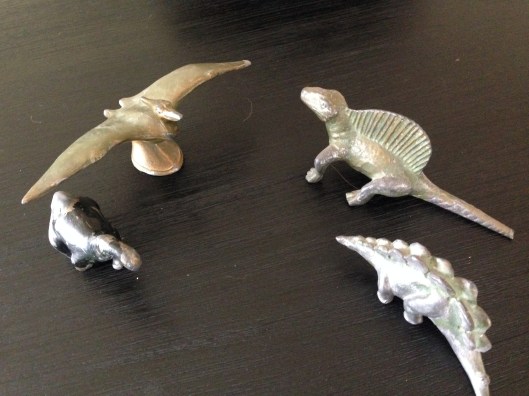
When I was about seven, I got my first bronzed dinosaur, the Tyrannosaurus Rex. I earned bribe money for being good about getting my butt stabbed by penicillin shots. In any case, I discovered these dinosaurs on the last page of my grandpa’s The Natural History Magazine. They looked really cool! The designers had chosen to make the T-Rex’s forearms look more robust than would have been a perfectly scale model with those teeny hands. The T-Rex was great! It was solid and cold and heavy because it was metal. There is something about metal or wood or stone that resonates with me much more deeply than plastic ever could. (Sorry, plastic. I know you are a cool invention and really inexpensive and very malleable and all of that. But, you just don’t touch my soul like wood, metal, and stone do.) When I moved the T-Rex, my muscles felt it. Perhaps this is one reason that I still have much of my dinosaur collection 65 years later. (How many of your plastic toys do you still have from 65 years ago?) I didn’t think so. But they are out there somewhere, along with my own forgotten plastic toys, polluting the world for centuries to come.

Bronze, as you have seen many times in your life, does not look worse when it oxidizes as iron does when it rusts. Instead, Bronze turns a beautiful powdery light green with the slightest hint of blue. So, T-Rex looked beautiful as well.  So, you might well think that the next time I had enough cash for one of these statues (1$ for the small size and 2$ for the large size) I would get another T-Rex. No, I got a Dimetrodon and a Stegosaurus. Later I got a Trachodon and a Brontosaurus. Anyway, what was fun about this diverse cast of characters is how different they were from each other and the richness with which they interacted. There’s no way it would have been as much fun if it were one army of T-Rex’s against another. (Poor brontosaurus’s tail fell off many times but my dad is no longer here to solder it back and anyway, the tail got lost in the last move).

IMG_0771

Similarly, a few years later, when I owned toy soldiers, I enjoyed having ones with different properties; that is, mainly different weapons. Liking the variety must have been true for other kids as well because the sets that I could buy were always mixed. My favorite type of soldier were hollow lead ones.  They were well enough hand-painted that you could see their faces, although not so well that you could determine whether they were fighting out of hate, out of fear, loyalty, patriotism, duty, because it’s a job, or for some private demon. I especially liked the bazooka men. I think I owned four of them. Of course, this weapon takes a while to reload and there probably aren’t a huge number of rounds. On the other hand, there were machine gunners, riflemen (more of them than anyone else), and a couple of officers who were pointing a pistol. There were also a couple of dudes sitting on the ground with a *serious* machine gun tucked between their spread-eagled legs. There were also a couple of hand grenade throwers. Another soldier had a rifle with a bayonet raised up above his head. This made arranging them for a pitched “battle” all that much more interesting. Although they had very different weapons, all of them had obvious lethal capabilities. All but one. There was one poor guy with no weapon whatever. His job was communications. His only visible “weapon” was a rather large boxy radio set. I suppose in a pinch, he could whack someone in the face with it. Even if that didn’t kill them, it would for sure put a crimp in their dinner plans.

It was difficult for me to decide which one of these soldiers I would “be.” I liked the bazooka man a lot. The rifleman looked cool. By the way, there were three versions. One type of rifleman lay on the ground with legs spread and the rifle stabilized by his elbows on the ground. Another type of rifleman sat on the ground and put the rifle across his upright knees for support. The third type, and my favorite, was the proudly standing rifleman. Thinking about it from an adult perspective, he’s probably the guy who was voted by his platoon:  “most likely to die quickly.” But I didn’t think about that then. Sometimes, I thought it would be cool to be the officer pointing the pistol. Obviously, in most ways, it wasn’t as devastating a weapon as a rifle. Although conceivably in very close quarters, he might outmaneuver a rifleman. But there was one guy that I definitely did not want to be.

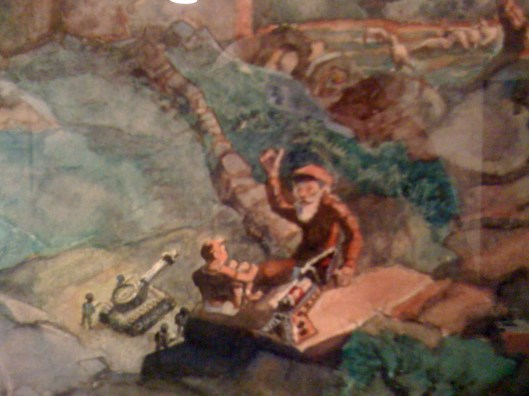
You guessed it. I never wanted to be the guy on the radio. Let’s call him “Claude.” Claude didn’t get to actually fight! And, it seemed to me at that point that I could stay alive no matter what obstacles and enemies were thrown at me — if only I were an excellent enough rifleman (or bazooka man, or pistol-wielding officer). On the other hand, it seemed as though “anybody” could do Claude’s communications job and would do it equally well. Furthermore, it seemed any enemy could just walk right up and shoot this dude Claude before he knew what hit him and way before he transforms his awkward radio set into a lethal weapon. Of course, Jason Bourne could do it, but I don’t think Claude had that kind of training. And, anyway, the first movie didn’t come out until 2002 and this was the early 1950’s. Treadstone didn’t exist back then. (BTW, this is not “my” Claude but it’s the closest image I could find.)

Claude

As I mentioned, these hand-painted lead soldiers were my favorites but I owned three other types. One were extremely detailed and beautiful lead soldiers. These suckers were expensive and, as I quickly discovered, not very durable in real “battles.” When you smashed them into each other, the horses tended to break, or what was more typical and worse, not break but bend into an uncomfortable and unrealistic position. At that point, I would very carefully ease the broken leg into position, Angstrom by Angstrom… Snap!! It would break off in my hands. That was worse. I felt as though I had personally snapped that beautiful white horse’s leg in half. It always seemed as though I could ease it back into position and I almost succeeded each time. Then, SNAP. Suddenly I am holding a three legged horse in one hand and a piece of horse leg in the other. My favorite of these collections were the “Coldstream Guards” with their white and bright red uniforms with splashes of gold.  It is sad, I can tell you, to be an eight year-old general and not be able to put your most beautiful soldiers into battle. But, beautiful as they were, they were fragile. I did manage to break a few of the hollow leaden ones as well, but I had to work at it.

Then, there were unpainted plastic soldiers. They came in a kind of gray-green suggestive of olive drab. Let’s call it “off-olive drab” like the olive from that bottle of garlic clove filled green olives that you accidentally left at the very back of the fridge for five years. Then, when you finally discovered, it, the olives looked as toxic as rain forest frogs; but far from a beautiful bright warning color, these were so drably off-olive that you almost didn’t see them. But, as for the soldiers, it wasn’t just their uniforms that were off-olive drab. All of them, including the little flat plastic stands, their expressionless faces, and their normal-sized (well, normal scaled I should say) hands exuded that same toxicity of colorlessness. Their one giant advantage was that they were far cheaper than the painted leaden ones. And, whereas the fancy ones were fragile and the leaden ones were rugged but breakable, these all-plastic soldiers could not be broken. For some reason, I do know that they can be cut with an ordinary steak knife provided you have enough patience and are smart enough after you’re caught the first time “ruining” the steak knives, to make sure the second time you experiment when you’re alone. The plastic ones can also be melted. However, melting them had the side-effect of greatly disturbing my parents because of the toxic fumes that permeated our house. (I think we will have to leave for another time the question of why I wanted to know these things). One great thing about these plastic soldiers was that they were to the same scale as the metal ones. So, they could all participate in the same battles without stretching the credibility till it snaps like a rubber band and stings the soul of make-believe.

Ah, but there was as well a fourth type of soldier. These were insanely cheap plastic soldiers! A hundred soldiers for a dollar! I ordered two sets so I would have an amazing two hundred soldiers along with the probably 75 I already had. And then they arrived. Yay! Imagine! My army would now rival those of Caesar, Hannibal, Grant, Patton!

My first clue that something must be terribly wrong was the size of the shipping box — unbelievably small for 200 soldiers. I opened the boxes and then got to the actual soldiers. They were in 2 point font.  They were approximately the size of one of the feet of my other soldiers. And, these soldiers gave a whole new depth of meaning to the expression, “cheap plastic.” These soldiers were fabricated out of some material that was like what plastic uses when it doesn’t bring out the good stuff for company. And, “fragile” doesn’t quite do justice to the care with which these teeny slats of plastic needed to be handled. Oh, by the way, speaking of “slats,” did I mention that they were two dimensional? Did I mention that not only couldn’t you discern the motivations of the solider from their face, you couldn’t discern whether they even had faces. These soldiers were not of molded plastic; they were basically stamped. In fact, each solider had to be detached from a long plastic rod by twisting.

How could I have possibly known I would waste my two dollars? The picture that accompanied the advertisement for these soldiers depicted something other than their product. The picture showed something every bit as detailed and colorful and three dimensional as the hollow leaden soldiers. These same comic books also advertised “sea monkeys.” In the picture, there are “families” of little human-looking aquatic monkeys. You can tell what mood they are in and how the various family members interact. Well, I thought this was fantastic! But I didn’t totally believe it was possible either so I asked my grandpa whether they were real. He said they were just brine shrimp. I also saw that there was a teeny asterisk in the corner of the picture, half hiding in the seaweed that some of the “sea monkeys” were harvesting for the family meal. Then, in almost unreadably tiny type, the asterisk was explained, “visual depiction may not precisely duplicate visual characteristics of crustacean provided”  or some equally incomprehensible legalese gibberish that very few 8 year olds are going to comprehend (in the more recent version shown here, I don’t even see that cryptic warning).

SeaMonkeys

Apparently, we live in a society where that’s okay. I think part of the reason it’s okay is that we live in a very differentiated society. If you think about the single artist, craftsman, or chef, they are much more about substance than puffery. You don’t typically expect someone who makes something to be dishonest about what it was they did. However, hiring a advertising expert brings into play a different set of factors. The advertising person cannot make a better painting, or chair or soufflé. Their expertise and their “product” is in making people buy the substantive product. If they can lie, exaggerate, or mislead and get away with it, so long as sales go up, that is a win for the advertiser. Needless to say, they would never describe what they do as a lie. Because, after all, who would advertise a “lie” as being a “lie”? Then, you might not want to buy one. They have a whole raft of explanations as to why what they are doing is really in everyone’s interest. They’ve rehearsed it and perfected it and —- since this is what they expert in — they will probably have you agreeing with them. I’m not sure it is just fine and dandy, especially when it’s combined with a low quality product such as brine shrimp or “toy soldiers” that are too small to be used or played with as toy soldiers. In these cases, the actual product is nothing like what they “depicting” it as.

It gets a bit murkier when their are unstated but implied benefits. BMW actually does make a fine car. However, you are not going to be driving it long if you drive it the way it is portrayed on commercials. Similarly, a car is not going to be very often the snappifying head-turner among young people seeking a mate that the advertisers would have you believe. It isn’t merely that advertising tends to have us spend money on products and services that aren’t really filling our needs, although that is problematic. We spend a huge amount of money on junk food, cosmetics, and so on — and more than on medical research. But in addition to that, doesn’t it seem to undermine the meaning of truth in all human discourse? Or, is it okay to lie if you are an advertiser because they are doing it for money? In other words, it’s okay to lie if you are benefiting yourself, perhaps because you are undoubtedly benefiting your client even more?

We are more and more and more connected electronically. This is good news. And this is bad news too. One thing, though is certain. The potential impact of a lie is tremendous and much much more than it was in the past. In distant times, a lie had only local impact. Now, a lie could literally destroy the world. So, to me, the balance point of when it’s “okay to lie” is way different than it was 20,000 years ago.

I believe there is a way for people to provide value to each other honestly and still have a thriving economy. In any case, even if we never reach that point and advertisers continue to oversell products, can we at least try to be vigilant not to let that attitude toward the truth permeate every other aspect of life? A large complex and highly differentiated society can only exist in an atmosphere of trust. You must trust that the drivers of the other cars on the road are not trying to kill you. You must trust that the food you buy is not poison. You must trust that the policeman is there to protect you. If that trust breaks down, there is no longer a society. So intentionally lying in order to make a buck (or a point) is really a push toward utter chaos and anarchy. Obviously, no single push will bring us there, but we must be extremely careful. Why? Because lack of trust is contagious (as is trust). A slight imbalance between trust and mistrust could become a vicious cycle. Information is the resolution of uncertainty, not the multiplication of uncertainty.

A communication network of people becomes more valuable as the number of people increases. A network of, say, 350,000,000 people is much more valuable than 10 relatively homogeneous networks of 35,000,000 each. And, to take this to the extreme, it’s much more valuable than 350,000,000 networks of one person each, no matter how smart or strong that one person is or how many treasure-troves of weapons they have. We need to work together whatever differences exist. That’s why it’s important that we all keep communicating. That’s why it’s important that we try to be as truthful as possible. That’s why I now think that Claude, the radioman, may be the most skilled and crucial solider of all.

IMG_1289


(The story above and many cousins like it are compiled now in a book available on Amazon: Tales from an American Childhood: Recollection and Revelation. I recount early experiences and then related them to contemporary issues and challenges in society).

Find it on: my Amazon author page

Newer posts →

Subscribe

  • Entries (RSS)
  • Comments (RSS)

Archives

  • February 2026
  • January 2026
  • December 2025
  • November 2025
  • October 2025
  • September 2025
  • August 2025
  • July 2025
  • June 2025
  • May 2025
  • April 2025
  • March 2025
  • February 2025
  • January 2025
  • December 2024
  • November 2024
  • October 2024
  • September 2024
  • July 2024
  • April 2024
  • March 2024
  • February 2024
  • January 2024
  • December 2023
  • August 2023
  • July 2023
  • May 2023
  • April 2023
  • March 2023
  • February 2023
  • January 2023
  • December 2022
  • November 2022
  • October 2022
  • September 2022
  • August 2022
  • July 2022
  • June 2022
  • May 2022
  • April 2022
  • March 2022
  • February 2022
  • January 2022
  • December 2021
  • November 2021
  • October 2021
  • September 2021
  • August 2021
  • July 2021
  • June 2021
  • May 2021
  • April 2021
  • March 2021
  • February 2021
  • January 2021
  • December 2020
  • November 2020
  • October 2020
  • September 2020
  • August 2020
  • July 2020
  • June 2020
  • May 2020
  • April 2020
  • March 2020
  • February 2020
  • January 2020
  • December 2019
  • November 2019
  • October 2019
  • September 2019
  • August 2019
  • July 2019
  • June 2019
  • May 2019
  • April 2019
  • March 2019
  • February 2019
  • January 2019
  • December 2018
  • November 2018
  • October 2018
  • September 2018
  • August 2018
  • July 2018
  • June 2018
  • May 2018
  • April 2018
  • March 2018
  • February 2018
  • January 2018
  • December 2017
  • November 2017
  • October 2017
  • September 2017
  • August 2017
  • July 2017
  • June 2017
  • May 2017
  • April 2017
  • March 2017
  • February 2017
  • January 2017
  • December 2016
  • November 2016
  • October 2016
  • September 2016
  • August 2016
  • July 2016
  • June 2016
  • May 2016
  • April 2016
  • March 2016
  • February 2016
  • January 2016
  • December 2015
  • November 2015
  • October 2015
  • September 2015
  • August 2015
  • May 2015
  • January 2015
  • July 2014
  • January 2014
  • December 2013
  • November 2013

Categories

  • AI
  • America
  • apocalypse
  • cats
  • COVID-19
  • creativity
  • design rationale
  • dogs
  • driverless cars
  • essay
  • family
  • fantasy
  • fiction
  • HCI
  • health
  • management
  • nature
  • pets
  • poetry
  • politics
  • psychology
  • Sadie
  • satire
  • science
  • sports
  • story
  • The Singularity
  • Travel
  • Uncategorized
  • user experience
  • Veritas
  • Walkabout Diaries

Meta

  • Create account
  • Log in

Blog at WordPress.com.

  • Subscribe Subscribed
    • petersironwood
    • Join 661 other subscribers
    • Already have a WordPress.com account? Log in now.
    • petersironwood
    • Subscribe Subscribed
    • Sign up
    • Log in
    • Report this content
    • View site in Reader
    • Manage subscriptions
    • Collapse this bar
 

Loading Comments...