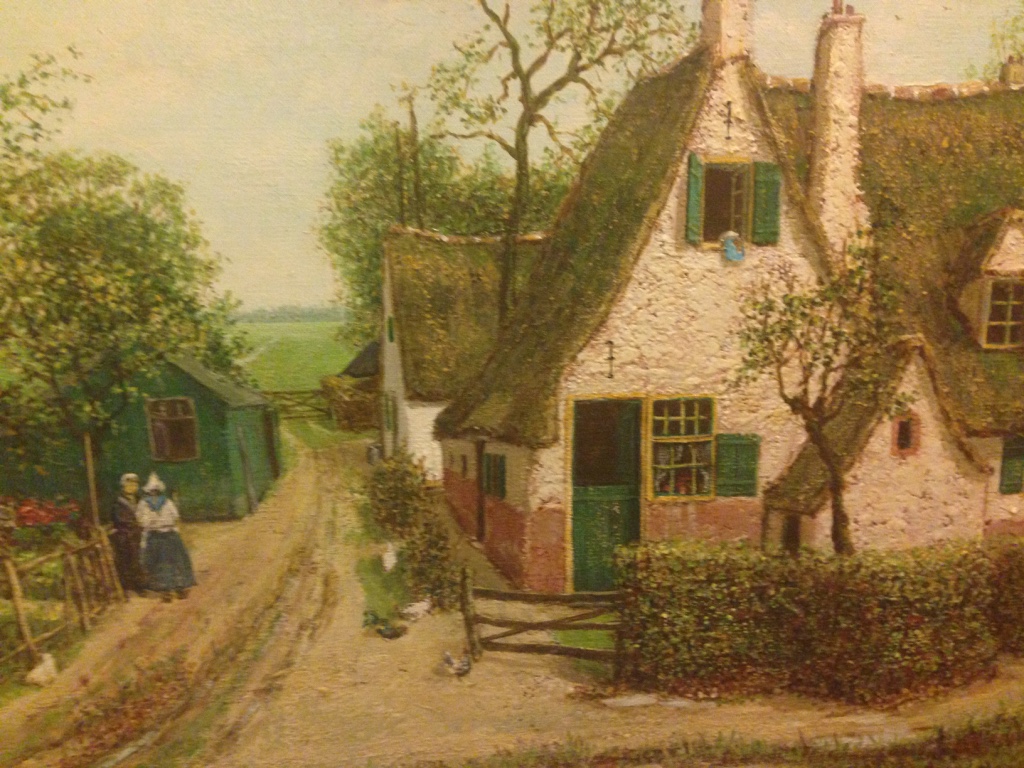
In our childhood, many of us heard the fable of the city mouse and country mouse. Briefly, the city mouse invites his cousin, country mouse, to visit him in the city. At first, the country mouse is quite impressed with the array of food available in the city mouse’s home. Then, the house cat comes with sharp claws and long pointed teeth and nearly rips them both apart. In the end, the country mouse scampers back and shouts back to his city cousin something to the effect that he’s happy to have his bread crumbs in peace rather than risking life and limb in the city. The exact words, I don’t recall, but they have probably suffered in the translation from Aesop’s ancient Greek to modern English and even more severely in the translation from mousespeak to human speech. Most likely, the original sounded something like this: “Squeak. Squeak. Squeak.”
Aesop Fable of the Mice
No doubt there are advantages and disadvantages for a mouse to live in the city or the country. Both places have sources of food and both have predators. But what about human beings? Here too, there are advantages and disadvantages of living in a large city versus living in the country or a small town. While human beings undoubtedly have many behaviors that are influenced by “instinct”, people are also capable of learning. Moreover, because we humans can talk and write and are fundamentally social beings, not only do urban and rural environments result in different kinds of individual skills, in a fairly short time, they also result in different cultures. These differences are not arbitrary but are adaptations to characteristics of the two environments.
In cities (and especially coastal cities), people typically come in contact with a huge variety of people. Many metropolitan areas feature different cuisines, attractions, races, religions, sexual preferences, and so on. Take the matter of cuisine. It is easy in New York City, San Francisco, Atlanta, Boston, Washington DC, Seattle, Minneapolis, Los Angeles, or San Diego to find restaurants that serve excellent Italian, French, Japanese, Chinese, Mexican, Vegetarian, Vegan, Ethiopian, Jewish or Indian food. I happen to love them all! But if someone hates any of these options, it is also easy to avoid that option. You don’t care for Indian food? No problem. Don’t go. Suppose however, you are with a group of friends and everyone else wants to go for sushi which you happen to hate. The vast majority of urban Japanese restaurants in the USA offer other options that are “close to” traditional American cuisine. So, you can go to a Japanese restaurant with your friends and order steak teriyaki while they all eat raw fish.
But let’s just suppose that for whatever reason, you are so appalled by raw fish that you get sick watching someone else eating it. Well, you simply don’t watch. Now, the thing about living in a big city is that you don’t have to create this solution on your own. That’s what everyone does. If they see something they don’t like, they look away. They learn not to dwell on it. It’s very crowded in a city. If you walk around or take public transportation being “offended” or “put off” by anyone who speaks differently, dresses differently, eats differently, worships differently, looks different, etc. you are going to quickly become completely stressed out and become one completely unhappy camper. People in large cities learn to be polite and focus their energy on the places and people that give them joy. It takes time to find friends but eventually you find people who share fundamental interests and values. They might be next door, but more likely, they are are a subway ride or long walk away. There are literally more than a million people in any large city that you never get to know. Because there are so many choices, plenty of opportunities arise to do what you like and many people who will join you. You might love tennis, roller skating, and art museums. You might never step foot in the science museum or the public library or the parks. It’s all fine. The culture of the city is tolerance for everyone. Yet, people find those they relate to from a huge pool. If you come from, say, China, and you want to stick with other Chinese people, you can easily do that. You can survive in New York City or San Francisco without having to experience Mexican food or even without learning much English. On the other hand, if you want to become assimilated into more “mainstream” American culture and eat pizza every day and listen to jazz and dress like an American Indian — hey, you’re welcome to do that too. Because everyone passes by people that are so different every day, almost everyone learns tolerance. In essence, you see, there is not “one” New York City or Los Angeles, there are thousands! People essentially live in their own version of these cities and become close only with a small group of like-minded people. Of course, your “tennis friends” might be different from your “roller skating friends” which might be a slightly different group than your “art museum friends.” But even putting all your friends together, the people you know are only 1/10,000 or 1/100,000 of the people in the city.

There is a down side. You may never get to know your next door neighbors. You and they may simply have very different tastes and interests. Besides that, there is a lot of turnover in a city. Often, there doesn’t seem to be much point in becoming friends simply because you live next door partly because they (or you) are quite likely to move away in a month. There is a worse down side as well. At the extreme, the distance that people create mentally to accommodate the extremely close physical proximity and the culture of leaving others alone also makes it possible for someone to be stabbed on the street without anyone helping. This phenomenon has been studied and called “bystander behavior.” People are actually much more likely to help if they are the only witness than if they are one of 100. Each of the 100 looks around and sees that none of the other 99 are doing anything and so conclude, all evidence to the contrary, that nothing much is happening or else the other 99 people would be helping. In any case, the “culture” that arises in cities is typically quite tolerant of differences, somewhat distant from the vast majority of your fellow citizens but certainly allows for close friendships based on any combination of a hundred different factors. Because large cities develop a culture of tolerance for other types of people, that fact becomes known and attracts still more diversity which in turn encourages more tolerance and diversity.
There is another important aspect of living in a large city. It is crowded and complex. You constantly have to “trust” people you don’t know who drive the taxis, deliver the food, come to fix your cable, police the streets and so on. These are typically not people you know. In fact, for the most part, you won’t even see them again. But it is impractical not to trust all these strangers. Most of the time, the trust works out though on rare occasions, it backfires.

The experience of living in a small rural town is completely different. There are not 400 different restaurants to choose from. There might be three. Possibly one of the three is ethnic, but it is far less likely. A Korean restaurant in New York City can be quite profitable if only .01% of the NYC population goes there regularly. That won’t work in Woburn MA or Bend OR though, let alone in a town of 5000. A small town in America may well have a baseball diamond and a public library. But they are unlikely to have a holography museum or a laser tag facility. The sheer small number of people living in a small town means, in essence, that the citizens must agree on what types of restaurants are available, what recreational facilities are available, what clothing stores are in town and so on. In addition, everyone in town is likely to run into everyone else again and again. Rather than learning to avoid and look away and ignore things you don’t personally care for, people in small towns instead lean in. They want to know what exactly is going on with everyone else in town. Everyone soon knows who the town drunk is and who is having an affair with whom. People in small towns do not typically think, “It’s none of my business” but that’s exactly what they think in large cities.
For these reasons, people in small towns are less likely to learn the skill of looking away. If they personally hate sushi and end up visiting a relative in a big city and then end up in a Japanese restaurant, they are both fascinated and disgusted by watching their cousin eat sushi. They could theoretically just look away, but that is not a very well learned skill for most. For these reasons, the culture of the small town also evolves to be different. People who thrive on diversity and believe strongly in tolerance feel as though they don’t belong and they also feel deprived of interesting possibilities so most end up moving away. Of course, that makes the town even more homogeneous. The small town ends up being much more “tight knit” than a random group of 5000 people in a large city. It seems much less likely people would fail to help someone being stabbed on the street (though I haven’t actually tried that experiment).

In a small town, since people know almost everyone they interact with, they don’t really have to trust strangers all that much. If someone new delivers the mail, the small town person is likely to ask whether they just moved in town, where they live and so on. This would be considered quite rude and even weird in a big city. People in a small town probe to know people in their small town. They tune in not out. They are much more likely to choose friends partly on the basis of location rather than vocation. Because of this cluster of factors, people in one small town are more likely to stay in that small town. It is probably much more “disruptive” to move from Woburn MA to Bend OR than to move from New York City to Los Angeles. Of course, either move means you will have to learn where things are, get a new driver’s license, make new friends etc., but the “culture” of cities is becoming similar all across America and indeed, all across the world. Two small towns can have quite different cultures.
People from large cities are likely to feel quite different on a number of issues compared with people from small towns. People in large cities have been trained and acculturated to simply look away and ignore things and people that they don’t like and to focus on what they do like. Conversely, people in small towns have learned to depend on everyone and so want everyone to agree on a much larger range of issues. There are enough resources in a large city to have scores of museums and hundreds of restaurants and scores of clothing stores. People don’t need to agree on taste. But in a small town, that’s not true. There is much greater pressure to agree on what the “right” museum is for the town, what the “right” kind of food is to serve at the handful of restaurants and what the “right” kind of clothing might be.
People in a small town are likely to know the police that they come in contact with. If a police officer in a small town arrests someone or even shoots them, people in a small town are much more likely to know both the police officer and the person arrested. Provided the police officer is known as a generally fair-minded person, the people in the small town are much more likely to be sympathetic. In addition, they may well known that the person arrested (or even shot) is and has been a “bad guy” the whole time he’s been in town.
In a large city, by contrast, people who read or hear about someone making an arrest or very unlikely to know personally either the policeman or the suspect. They probably still have a presumption that the police probably acted correctly. However, their reactions are much more likely to vary from person to person that what you would find in a small town.
Needless to say, cities do differ from each other in terms of culture and so do small towns. For example, Murray Hill, New Jersey is not a huge city (population around 3500). However, many of the people there were from Bell Labs, a large famous research institute long part of AT&T but now part of Nokia. That particular small area includes residents from many countries, liberal and very well funded schools, and so on. Small towns that grow up around trade centers, farming communities, research centers and universities, or coal mining undoubtedly have very different typical “cultures.” Similarly, a large city like New York that has people from all over the world is quite different than one of the Chinese cities around large-scale manufacturing facilities (e.g., Guangzhou or Shenzhen. Nonetheless, as a general rule, living in a small town versus a large city tends to produce different skill sets and a different outlook and culture.

What can small town cultures and big city cultures learn from each other? How can these cultures tolerate each other? Is there a way to have the advantages of both? If humanity keeps exponentially increasing population, will there even be any “small towns” left in 100 or 500 years? To me, city culture and small town/rural culture mirror many of the distinctions made by Jane Jacobs in “Systems of Survival.” I recommend this as an interesting (and short) read.
Systems of Survival
(The story above and many cousins like it are compiled now in a book available on Amazon: Tales from an American Childhood: Recollection and Revelation. I recount early experiences and then related them to contemporary issues and challenges in society).
author page on Amazon











 petersironwood