
“Something there is that doesn’t love a wall.”
So begins Robert Frost’s poem, The Mending Wall.

I was thinking about gates, doors, and walls as I went walking with Sadie on a sunny Thursday morning. We typically walk along the sides of streets. I let her wander onto the edges, but not onto other people’s yards or very far down their driveways. Often there are gates, much like our own gate. If the gate is closed and isn’t too far from the road, I often let her walk up to the gate. The gates are there both to prevent us from entering someone else’s property and to signal us not enter the property. I could, if my life depending on it, scale many of the gates, but that’s clearly asking for trouble. The gate is meant to keep people out, not as a challenge to overcome. Sadie generally couldn’t get through the bars of the gates. Of course, a gate is no barrier at all to birds, rabbits, mice, rats, lizards, snakes, raccoons, butterflies, or bees.

A door seems to me to offer more security than does a gate. While a gate may prevent me from entering, it’s quite easy to see through or around most gates, to hear the noise from the other side and to smell what’s on the other side. It’s true that one may listen through a door but the sound is typically muffled. Loud music or yelling creeps through to the outside but a conversation normally stays private.
A door also helps the inside stay warmer or cooler than the outside air. A gate has no such function.
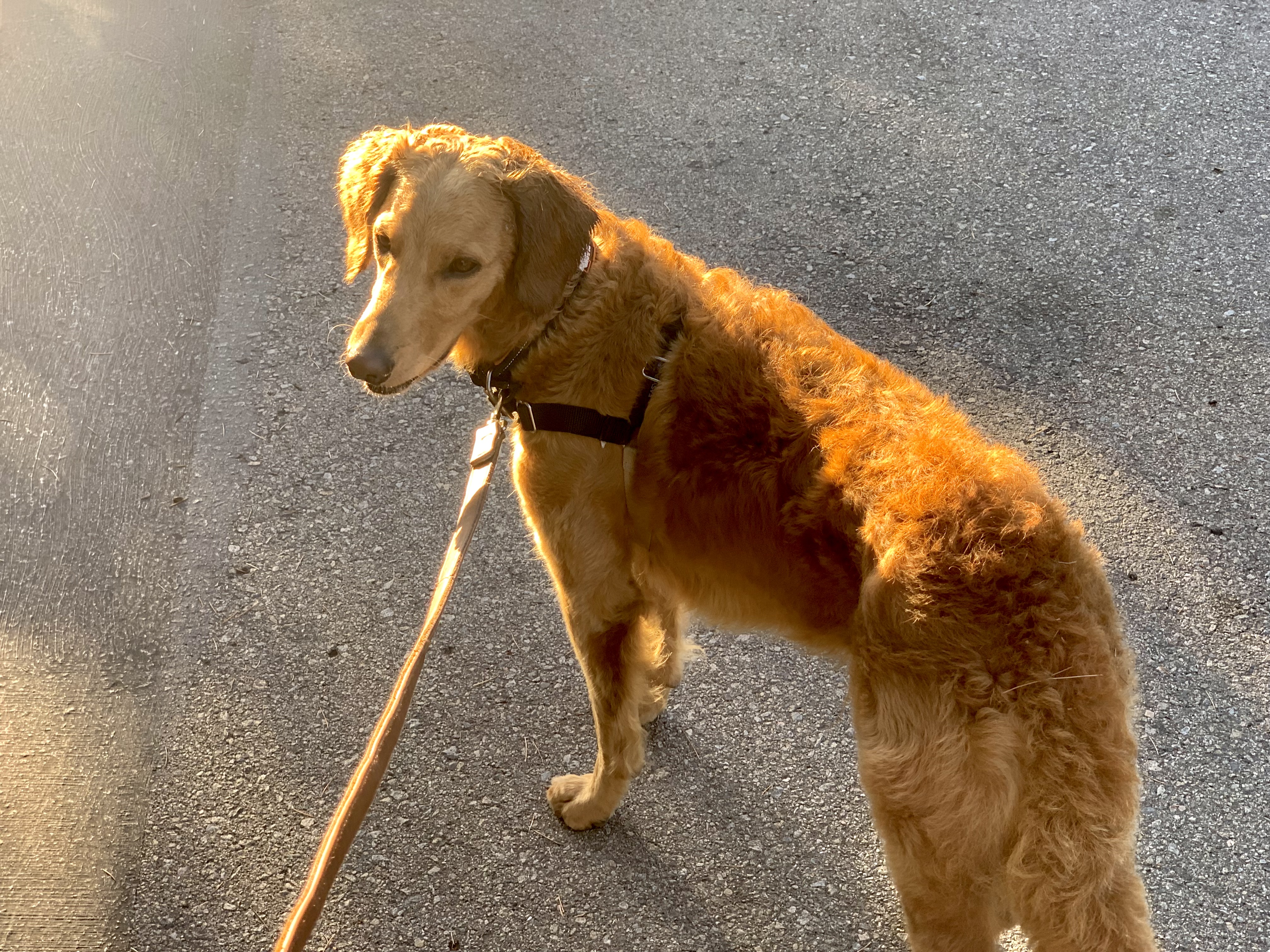
Among places dogs leave olfactory messages for each other, boundaries are high on the list. This includes hedges, curbs, and gates. Sadie “controls herself” well now, but when she was younger, she would often pee at the boundary of a social event. Specifically, when someone—especially someone new or someone she already liked but hadn’t seen for awhile, she’d pee. She also seems to understand what I mean when I say, “Sadie, we’re going for a ride in the car. You should go pee first and then we can get in the car.” I don’t think she “parses” the sentence and accesses the meanings of all the individual words. Nonetheless, she quickly pees and then goes over to get in the car.
A wall is a kind of transition as well. A gate is much more permeable than a wall and a door may be opened or closed or ajar. Often walls, such as castle walls have one or more gates or doors. People on one side of a wall almost always want to get to the other side, at least occasionally. At the very least, they want to be able to move information and goods from inside to outside and vice versa.

Why walls? The walls of a house keep you in a more easily controlled environment. A wall can provide a level of protection. That’s mainly what castle walls are for. Of course, they often fail as well. Invaders climb the walls or tear down the walls or burrow under the walls until the wall collapses. Of course, castles were also subject to sieges. Eventually, the defenders inside would run out of food. Primitive machines were constructed to hurl firebrands and large rocks in to wreak havoc and kill defenders.

The Greeks were unable to defeat the Trojans by destroying their castle. Instead, they famously made a large wooden horse as a “tribute” to the courage and tenacity of the Trojans. Overjoyed that the long siege was over, they opened the gates and led in the giant wooden horse and began to celebrate. Once everyone was drunk or sleeping, the soldiers hidden inside the horse snuck out and opened the gates to the much larger Greek army waiting outside.

Today’s technology is much more sophisticated of course, but walls, gates, and doors still exist. The defensive capabilities now include guided missiles, aircraft, submarines, and aircraft carriers as well as the threat of nuclear retaliation. During the so-called “Cold War” America and the USSR engaged in an “arms race” to develop the best weapons and more of them. Looking back on all the wasted energy and time on both sides, I think, “Imagine what could have been done if we had instead spent all that resource on preventing climate change, curing disease, and sponsoring science and education.
Of course, it’s not an easy problem. One side in a standoff can only stand down unilaterally if they trust the other side. Meanwhile, none of the amazing and exorbitantly expensive weapons, walls, doors, and gates we’ve developed are worth anything at all if we accept the modern Trojan Horse.

Social media, the press, the television, and nearly half of the political candidates spew misinformation on a daily, even hourly basis. We’re locked in a political race and one of the two candidates for President is himself a Trojan Horse. Like the ancient Trojans, all our walls and armaments will be useless.
The threat to America is, in many ways, worse than the threat to ancient Troy. The Trojan Horse that endangers us? It’s a steady steam of lies designed to induce Americans to kill each other.
No number of fighter jets; no cache of assault rifles; no armada of submarines; no hordes of fighters will save us from the Trojan Horse. The Trojan Horse is armored with something far more powerful than iron, steel, or depleted uranium. The Trojan Horse’s armor is your own mind.
Only courage will work to save you. It is not the courage to face an army. It is the courage to admit that you’ve been conned; that you were wrong; that you have been led down a garden path that leads nowhere near where you ever wanted to go.

Find that courage.

———————————-
 petersironwood
Pingback: Travels With Sadie 8 – Singing of the Rain | petersironwood
Pingback: Travels with Sadie 9: Joint Problem Solving | petersironwood
Pingback: Travels with Sadie 10: The Best Laid Plans | petersironwood
Pingback: Travels With Sadie 11: Teamwork | petersironwood
Pingback: Travels with Sadie 13: Dog Parks | petersironwood
Pingback: Fire Arrows | petersironwood
Pingback: Travels With Sadie 14: Stick With It | petersironwood