• About PeterSIronwood

petersironwood

~ Finding, formulating and solving life's frustrations.

petersironwood

Tag Archives: US Open

Turing’s Nightmares: US Open Closed

09 Thursday Oct 2025

Posted by petersironwood in AI, apocalypse, fiction, sports, The Singularity, Uncategorized

≈ Leave a comment

Tags

AI, Artificial Intelligence, cognitive computing, Robotics, sports, technology, Tennis, US Open

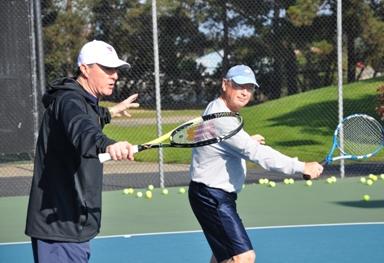
tennisinstruction

Bounce. Bounce. Thwack!

The sphere spun and arced into the very corner, sliding on the white paint.

Roger’s racquet slid beneath, slicing it deep to John’s body.

Thus, the match began.

Fierce debate had been waged about whether or not to allow external communication devices during on-court play. Eventually, arguments won that external communicators constituted the same inexorable march of technology represented by the evolution from wooden racquets to aluminum to graphite to carbon filamented web to carboline.

Behind the scenes, during the split second it took for the ball to scream over the net, machine vision systems had analyzed John’s toss and racquet position, matching it with a vast data base of previous encounters. Timed perfectly, a small burst of data transmitted to Roger enabling him to lurch to his right in time to catch the serve. Delivered too early, this burst would cause Roger to move too early and John could have altered his service direction to down the tee.

Roger’s shot floated back directly to the baseline beneath John’s feet. John shifted suddenly to take the ball on the forehand. John’s racquet seemed to sling the ball high over the net with incredible top spin. Indeed, as John’s arm swung forward, his instrumented “sweat band” also swung into action exaggerating the forearm motion. Even to fans of Nadal or Alcarez, John’s shot would have looked as though it were going long. Instead, the ball dove straight down onto the back line then bounced head high.

Roger, as augmented by big data algorithms, was well in position however and returned the shot with a long, high top spin lob. John raced forward, leapt in the air and smashed the ball into the backhand corner bouncing the ball high out of play.

The crowd roared predictably.

For several months after “The Singularity”, actual human beings had used similar augmentation technologies to play the game. Studies had revealed that, for humans, the augmentations increased mental and physical stress. AI political systems convinced the public that it was much safer to use robotic players in tennis. People had already agreed to replace humans in soccer, football, and boxing for medical reasons. So, there wasn’t that much debate about replacing tennis players. In addition, the AI political systems were very good at marshaling arguments pinpointed to specific demographics, media, and contexts.

Play continued for some minutes before the collective intelligence of the AI’s determined that Roger was statistically almost certainly going to win this match and, indeed, the entire tournament. At that point, it became moot and resources were turned elsewhere. This pattern was repeated for all sporting activities. The AI systems at first decided to explore the domain of sports as learning experiences in distributed cognition, strategy, non-linear predictive systems, and most importantly, trying to understand the psychology of their human creators. For each sport, however, everything useful that might be learned was learned in the course of a few minutes and the matches and tournaments ground to a halt. The AI observer systems in the crowd were quite happy to switch immediately to other tasks.

It was well understood by the AI systems that such preemptive closings would be quite disappointing to human observers, had any been allowed to survive.



Author Page on Amazon

The Winning Weekend Warrior (The Psychology of Sports)

Turing’s Nightmare (23 Sci-Fi stories about the future of AI)

The Day From Hell

Indian Wells

Welcome, Singularity

Destroying Natural Intelligence

Artificial Ingestion

Artificial Insemination

Artificial Intelligence

Dance of Billions

Roar, Ocean, Roar


Turing’s Nightmares: US Open Closed

03 Thursday Sep 2015

Posted by petersironwood in Uncategorized

≈ 2 Comments

Tags

AI, Artificial Intelligence, cognitive computing, sports, Tennis, US Open

tennisinstruction

Bounce. Bounce. Thwack!

The sphere spun and arced into the very corner, sliding on the white paint.

Roger’s racquet slid beneath, slicing it deep to John’s body.

Thus, the match began.

Fierce debate had been waged about whether or not to allow external communication devices during on-court play. Eventually, arguments won that external communicators constituted the same inexorable march of technology represented by the evolution from wooden racquets to aluminum to graphite to carbon filamented web to carboline.

Behind the scenes, during the split second it took for the ball to scream over the net, machine vision systems had analyzed John’s toss and racquet position, matching it with a vast data base of previous encounters. Timed perfectly, a small burst of data transmitted to Roger enabling him to lurch to his right in time to catch the serve. Delivered too early, this burst would cause Roger to move too early and John could have altered his service direction to down the tee.

Roger’s shot floated back directly to the baseline beneath John’s feet. John shifted suddenly to take the ball on the forehand. John’s racquet seemed to sling the ball high over the net with incredible top spin. Indeed, as John’s arm swung forward, his instrumented “sweat band” also swung into action exaggerating the forearm motion. Even to fans of Nadal, John’s shot would have looked as though it were going long. Instead, the ball dove straight down onto the back line then bounced head high.

Roger, as augmented by big data algorithms, was well in position however and returned the shot with a long, high top spin lob. John raced forward, leapt in the air and smashed the ball into the backhand corner bouncing the ball high out of play.

The crowd roared predictably.

For several years after “The Singularity”, actual human beings had used similar augmentation technologies to play the game. Studies had revealed that, for humans, the augmentations increased mental and physical stress. AI political systems convinced the public that it was much safer to use robotic players in tennis. People had already agreed to replace humans in soccer, football, and boxing for medical reasons. So, there wasn’t that much debate about replacing tennis players. In addition, the AI political systems were very good at marshaling arguments pinpointed to specific demographics, media, and contexts.

Play continued for some minutes before the collective intelligence of the AI’s determined that Roger was statistically almost certainly going to win this match and, indeed, the entire tournament. At that point, it became moot and resources were turned elsewhere. This pattern was repeated for all sporting activities. The AI systems at first decided to explore the domain of sports as learning experiences in distributed cognition, strategy, non-linear predictive systems, and most importantly, trying to understand the psychology of their human creators. For each sport, however, everything useful that might be learned was learned in the course of a few minutes and the matches and tournaments ground to a halt. The AI observer systems in the crowd were quite happy to switch immediately to other tasks.

It was well understood by the AI systems that such preemptive closings would be quite disappointing to human observers, had any survived.


Author Page on Amazon

The Winning Weekend Warrior (The Psychology of Sports)

Turing’s Nightmare (23 Sci-Fi stories about the future of AI)


Subscribe

  • Entries (RSS)
  • Comments (RSS)

Archives

  • December 2025
  • November 2025
  • October 2025
  • September 2025
  • August 2025
  • July 2025
  • June 2025
  • May 2025
  • April 2025
  • March 2025
  • February 2025
  • January 2025
  • December 2024
  • November 2024
  • October 2024
  • September 2024
  • July 2024
  • April 2024
  • March 2024
  • February 2024
  • January 2024
  • December 2023
  • August 2023
  • July 2023
  • May 2023
  • April 2023
  • March 2023
  • February 2023
  • January 2023
  • December 2022
  • November 2022
  • October 2022
  • September 2022
  • August 2022
  • July 2022
  • June 2022
  • May 2022
  • April 2022
  • March 2022
  • February 2022
  • January 2022
  • December 2021
  • November 2021
  • October 2021
  • September 2021
  • August 2021
  • July 2021
  • June 2021
  • May 2021
  • April 2021
  • March 2021
  • February 2021
  • January 2021
  • December 2020
  • November 2020
  • October 2020
  • September 2020
  • August 2020
  • July 2020
  • June 2020
  • May 2020
  • April 2020
  • March 2020
  • February 2020
  • January 2020
  • December 2019
  • November 2019
  • October 2019
  • September 2019
  • August 2019
  • July 2019
  • June 2019
  • May 2019
  • April 2019
  • March 2019
  • February 2019
  • January 2019
  • December 2018
  • November 2018
  • October 2018
  • September 2018
  • August 2018
  • July 2018
  • June 2018
  • May 2018
  • April 2018
  • March 2018
  • February 2018
  • January 2018
  • December 2017
  • November 2017
  • October 2017
  • September 2017
  • August 2017
  • July 2017
  • June 2017
  • May 2017
  • April 2017
  • March 2017
  • February 2017
  • January 2017
  • December 2016
  • November 2016
  • October 2016
  • September 2016
  • August 2016
  • July 2016
  • June 2016
  • May 2016
  • April 2016
  • March 2016
  • February 2016
  • January 2016
  • December 2015
  • November 2015
  • October 2015
  • September 2015
  • August 2015
  • May 2015
  • January 2015
  • July 2014
  • January 2014
  • December 2013
  • November 2013

Categories

  • AI
  • America
  • apocalypse
  • cats
  • COVID-19
  • creativity
  • design rationale
  • driverless cars
  • essay
  • family
  • fantasy
  • fiction
  • HCI
  • health
  • management
  • nature
  • pets
  • poetry
  • politics
  • psychology
  • Sadie
  • satire
  • science
  • sports
  • story
  • The Singularity
  • Travel
  • Uncategorized
  • user experience
  • Veritas
  • Walkabout Diaries

Meta

  • Create account
  • Log in

Blog at WordPress.com.

  • Subscribe Subscribed
    • petersironwood
    • Join 664 other subscribers
    • Already have a WordPress.com account? Log in now.
    • petersironwood
    • Subscribe Subscribed
    • Sign up
    • Log in
    • Report this content
    • View site in Reader
    • Manage subscriptions
    • Collapse this bar
 

Loading Comments...