• About PeterSIronwood

petersironwood

~ Finding, formulating and solving life's frustrations.

petersironwood

Tag Archives: pattern language

“Reality Check”

16 Tuesday Jan 2018

Posted by petersironwood in America, apocalypse, management, Uncategorized

≈ 6 Comments

Tags

advertising, Business, creativity, Design, epistomology, innovation, learning, life, pattern language, politics

IMG_9660

This is the second in a series of blogs that present Patterns in a Socio-technical Pattern Language of best practices for collaboration and coordination in complex societies. I intend to organize these in multiple ways (e.g., type of goal; where in a typical development process the pattern is most applicable; how large a collection of people the pattern is most applicable to, etc.).  I am entering them in this blog in an order that reflects current events. For example, there seems to be a movement to deny reality outright and insist everyone simply believe what the leaders promulgate. This, to me, is outright evil. But even when people are acting with the best of intentions, it is natural to take short cuts. Those short cuts can make life seem more efficient in the short run, but it can also lead to serious issues in the longer term.

Reality Check

Author, reviewer and revision dates:

Created by John C. Thomas on 4 September, 2001

Revised, JCT, 17 December, 2001

Revised, JCT, 15 January, 2018

Synonyms: 

Abstract:

In developing complex systems, it is often expedient to develop feedback loops based on ersatz measures of what we are really interested in assessing and controlling. While this seems expedient in the short term, it often leads to serious problems and distortions, particularly in times of crisis or transition when the correlation between ersatz measures and actuality substantially drifts or even suddenly disconnects. Actions can be based on these measures or models of reality rather than on reality(or more complete measures) and result in negative consequences. The solution is to perform regular “reality checks” to insure that measures or indicators of reality continue to reflect that reality.

Problem:

In developing complex systems, it is often expedient to develop feedback loops based on ersatz measures of what we are really interested in assessing and controlling. While this may seem expedient in the short term, it often leads to serious problems and distortions, particularly in times of crisis or transition when the correlation between ersatz measures and actuality substantially drifts or even suddenly disconnects. Actions can be based on these measures or models of reality rather than on reality. This can result in negative, even deadly, consequences.

IMG_4382

Context:

Many problems were partly responsible for the disaster at the Three Mile Island. One crucial problem, in particular, arose from the design of a feedback loop. A switch was supposed to close a valve. Beside the switch was a light that was supposed to show that the valve was closed. In fact, rather than having the light go on as the result of actual feedback from the valve closure itself, the signal light was merely a collateral circuit to the switch. All it actually showed was that the switch had moved position (Wickens, 1984). Under normal operation; that is, when the valve was operating properly, these two events were perfectly correlated. At a critical point in the meltdown, however, the valve was not operating properly. Yet, the human operator believed that the valve was closed even though it had failed to close in reality. His resulting actions, taken on the basis of the assumption that the valve was closed, exacerbated the subsequent problems. My colleague, Scott Robertson, has recently posted an analysis of the recent error that resulted in the nuclear missile scare in Hawaii. (See link).

View at Medium.com

In running an application program several years ago, I was given a feedback message that a file was posted. In fact, it wasn’t. The programming team of the application, rather than checking to see whether the file was actually posted, merely relied on the completion of an internal loop.

In advertising campaigns, it is difficult to measure the impact on sales. Instead, companies typically measure the “recall” and “recognition” rates of ads. This may often be correlated with sales changes, but in some cases, the ad may be very memorable but give the customer a very negative impression of the company and decrease the chances of actually selling a product.

Historically, monarchs and dictators (and even would-be dictators) often surrounded themselves only with people who gave them good reports and support no matter how their decisions impacted the reality of their realm. Eventually, the performance of such people tends to deteriorate severely because their behavior is shaped by this ersatz feedback rather than by reality.

IMG_5245

During the “oil crisis” in the seventies, oil companies relied on mathematical models of continually increasing demand. Year after year, for seven years, they relied on these models to predict demand despite the fact that, for all seven years, demand actually went down. The results are purported to have cost them tens of billions of dollars (Van der Heijden, 1996).

In some cases, the known existence of ersatz measures directly contributes to the destruction of the utility of these very measures. For example, if management decides the “easy way” to measure programmer productivity is “Lines Of Code,” once programmers discover this, the code base may grow quickly in terms of that measure, but not in terms of actual functionality.

IMG_7683

In America @2018, many people view money as the only legitimate value of interest for countries, companies, or individuals. Measures such as the GDP and the stock market index are taken as adequate and complete measures of the economic well-being of the society. There is a sense that, since we spend the most on weapons and health care, we must perforce be the “safest” and “healthiest” nation on the planet. This is clearly not the case. Similarly, ads talk about a person’s “net worth” when what they are really talking about is merely a person’s net financial worth. “Worth” is not the same as “financial worth.”

A large research organization that I am familiar with used to have a large number of administrative assistants who helped arrange meetings, send in expense reports, and answer telephones. At some point, most of these administrative assistants were laid off and the tasks were now done by the researchers themselves who were typically not nearly so efficient at them. The researchers took at least as long to do them as had the administrative assistants. Accountants looked favorably at all the “money they had saved” because they could easily see that the line item for administrative assistants was far less costly than it had been. Not visible, of course, was the fact that the much more highly paid researchers were now doing the same work that had been done before by the administrative assistants, but they were doing it less efficiently and at a far higher cost.

Forces: 

* Organizations are often hierarchically decomposed and bureaucratic. Therefore, it is often simplest to communicate with those close to us in the hierarchy and to build systems that rely for their model of reality only on things within the immediate control span of our small part of the organization.

* While more comfortable to limit system design and development to those things within one’s own team or department, it is often precisely the work necessary to capture more reality-based measures that will reveal additional challenges and opportunities in business process coherence.

*A more direct measure of reality is often more time-consuming, more costly, or more difficult than the measure of something more proximal that is often highly correlated with those aspects of reality of real interest.

*It is likely to be exactly at times of crisis and transition that the correlation be-tween proximal ersatz measures and their referent in reality will be destroyed.

*It is likely to be exactly under times of crisis and transition that people will tend to simplify their cognitive models of the world and, among other things, forget that the proximal measure is only ersatz.

Solution: 

Therefore:

Whenever feasible, feedback should ideally be based on reality checks, not solely on ersatz measures. When this is too costly (as opposed to merely inconvenient or uncomfortable), then at least design systems so that the correlation between proximal measures and their referent in reality is double-checked periodically.

IMG_0396

Examples:

Rather than rely solely on a circle of politically minded advisors, Peter the Great disguised himself and checked out various situations in Russia in person.

As reported by Paula Underwood (who was the designated storyteller for her branch of the Iroquois), her ancestors at one point felled giant trees for long houses in the Pacific Northwest. Later, when the tribe lived in the “Great Plains”, there were no trees of that size. The tribe began to doubt the existence of trees as large as what their oral history portrayed. In order to check on this, one brave spent many years walking back to that area and seeing with his own eyes that there were indeed trees as tall as had been portrayed in the oral history and then returning to the tribe to report back.

Resulting Context:

Ideally, over time, people who actually double-check reality will come to better understand when and how these reality checks will be necessary. They may also invent methods of making a check-in closer to what is really of interest more convenient or cheaper.

Related Patterns:

System as a Whole

Convergent Measures

Drawing the Line

Who Speaks for Wolf

Known Uses:

Richard Feynman, during the Manhattan project, noticed that the bureaucracy was worried about the possibility of accidentally stockpiling a critical mass of uranium. To prevent this, each section chief was required to insure that their section did not have a critical mass. To insure this, each section chief instructed each sub-section chief to insure that their subsection didn’t have a critical mass and so on, down to the smallest level of the bureaucracy. Upon hearing this plan, Feynman observed that neutrons probably didn’t much care whose subsection they reported to!

In another incident reported by Feynman, various bureaucrats were each trying to prove that they had better security than their peers. In order to prove this, they escalated the buying of bigger and thicker safes. The bigger and thicker the safe, the more bureaucrats felt that they had made their secrets secure. Feynman discovered that more than half of the super-safe safes had been left with the factory installed combinations of 50-50-50 and were therefore trivially easy to break into!

IMG_8585

References: 

Wickens, C. (1983). Engineering psychology and human performance. Columbus: Merrill, (p.1).

Van der Heijden, K. (1996). Scenarios: The art of strategic conversation. Chichester: Wiley.

Hutchings, E., Leighton, R., Feynman, R., and Hibbs, A. (1997). Surely, you’re joking Mr. Feynman. New York: Norton.

Underwood, P. (1993). The Walking People: A Native American oral history. San Anselmo, CA: Tribe of Two Press.

————————————

https://petersironwood.wordpress.com/2017/02/25/the-invisibility-cloak-of-habit/

https://www.amazon.com/author/truthtable

“Who Speaks for Wolf?”

09 Tuesday Jan 2018

Posted by petersironwood in America, psychology, Uncategorized

≈ 8 Comments

Tags

Business, Design, environment, family, innovation, learning, life, marketing, Native American, pattern language, politics

IMG_0727

This is the first of many socio-technical “Patterns” in a socio-technical Pattern Language meant to encapsulate best practices for collaboration and coordination. The common “parts” of every Pattern are displayed below in bold. A brief discussion follows the Pattern.

Who Speaks for Wolf?

Author, reviewer and revision dates: 

Created by John C. Thomas on December 17, 2001

A shorter version is included in Liberating Voices by Douglas Schuler.

A longer version was published as an IBM Research Report, 2002.

Reviewed by <John C. Thomas> on <January 9, 2018>

Revised by <John C. Thomas> on <January 9, 2018>


Synonyms 

Engage all the Stakeholders

Abstract: 

A lot of effort and thought goes into decision making and design. Nonetheless, it is often the case that bad decisions are made and bad designs conceived and implemented primarily because some critical and relevant perspective has not been brought to bear. This is especially often true if the relevant perspective is that of a stakeholder in the outcome. Therefore, make sure that every relevant stakeholder’s perspective is brought to bear early.

Problem:

Problem solving or design that proceeds down the wrong path can be costly or impossible to correct later. As the inconvenience and cost of a major change in direction mount, cognitive dissonance makes it likely that the new information will be ignored or devalued so that continuance along the wrong path is likely.

Context: 

Complex problems such as the construction of new social institutions or the design of complex interactive systems require that a multitude of viewpoints be brought to bear. Unfortunately, this is all too often not the case. One group builds a “solution” for another group without fulling understanding the culture, the user needs, the extreme cases, and so on. The result is often a “system” whether technical or social, that creates as many problems as it solves.

The inspiration for this pattern comes from a Native American story transcribed into English by Paula Underwood.

In brief, the story goes as follows. The tribe had as one of its members, a man who took it upon himself to learn all that he could about wolves. He became such an expert, that his fellow tribespeople called him “Wolf.” While Wolf and several other braves were out on a long hunting expedition, it became clear to the tribe that they would have to move to a new location. After various reconnaissance missions, a new site was selected and the tribe moved to the new location.

Shortly thereafter, it became clear that a mistake had been made. The new location was in the middle of the spring breeding ground of the wolves. The wolves were threatening the children and stealing the drying meat. Now, the tribe was faced with a hard decision. Should they move again? Should they post guards around the clock? Or, should they destroy the wolves? And, did they even want to be the sort of people who would kill off another species for their own convenience?

At last it was decided they would move to yet another new location. But as was their custom, they also asked themselves, “What did we learn from this? How can we prevent making such mistakes in the future.” Someone said, “Well, if Wolf would have been at our first council meeting, he would have prevented this mistake.”

“True enough,” they all agreed. “Therefore, from now on, whenever we meet to make a decision, we shall ask ourselves, ‘Who speaks for Wolf’ to remind us that someone must be capable and delegated to bring to bear the knowledge of any missing stakeholders.

Forces:

  • Gaps in requirements are most cheaply repaired early in development; it is important for this and for reasons of acceptance (as well as ethics!) by all parties that all stakeholders have a say throughout any development or change process.
  • Logistical difficulties make the representation of all stakeholder groups at every meeting difficult.
  • A new social institution or design will be both better in quality and more easily accepted if all relevant parties have input. Once a wrong path is chosen, both social forces and individual cognitive dissonance make it difficult to begin over, change direction or retrace steps.

Solution:

Provide a way to remind everyone of stakeholders who are not present. These could be procedural (certain Native Americans always ask, “Who Speaks for Wolf” to remind them) or visual or auditory with technological support.

Examples: 

In “A behavioral analysis of the Hobbit-Orcs problem,” I discovered that people find it difficult to solve a simple puzzle because it appears that they must “undo” progress that has already been made.

As a positive case, some groups make it a practice to “check in” at the beginning of any meeting to see whether any group members have an issue that they would like to have discussed. In “User Centered Design”, and “Contextual Design” methodologies, an attempt is made to get input from the intended users of the system early on in the design process.

In a negative case, we developed a system to help automate “intercept calls” for a telecommunications company. We tested the end users to make sure it was workable. When we went to install the system, however, we learned that the folks in charge of central offices, would not allow our software to be installed until we provided documentation in the same format that they were used to from AT&T. So, we redid all the documentation to put it into the AT&T format. At that point, our lawyers, however informed us that that format was “copyrighted” so we could not simply use it. In this case, although many stakeholders were consulted, we had left out two important constituencies. (Eventually, the system was deployed — the first in the US that incorporated speech recognition into an application on the Public Service Network.

Resulting Context:

When every stakeholder’s views are taken into account, the solution will be improved in quality and in addition, there will be less resistance to implementing the solution.

Rationale:

Much of the failure of “process re-engineering” can be attributed to the fact that “models” of the “is” process were developed based on some executive’s notion of how things were done rather than a study of how they were actually done or asking the people who actually did the work how they were done. A “should be” process was designed to be a more efficient version of the “is” process and then implementation was pushed down on workers. However, since the original “is” model was not based on reality, the “more efficient” solution often left out vital elements.

Technological and sociological “imperialism” provide many additional examples where the input of all the stakeholders is not taken into account. Of course, much of the history of the US government’s treatment of the Native Americans was an avoidance of truly including all the stakeholders.

A challenge in applying the “Who Speaks for Wolf” pattern is to judge honestly and correctly whether, indeed, someone does have the knowledge and delegation to “speak for Wolf.” If such a person is not present, we may do well to put off design or decision until such a person, or better, “Wolf” can be present.

Related Patterns: 

Radical Co-location (Provided all stakeholders are physically present in the radical co-location, this tends to insure that their input will be given at appropriate times).

Known Uses:

As a variant of this, a prototype creativity tool was been created at IBM Watson Research Center. The idea was to have a virtual “Board of Directors” consisting of famous people. When you have a problem to solve, you are supposed to be reminded of, and think about, how various people would approach this problem. Ask yourself, “What would Einstein have said?” “How would Gandhi have approached this problem?” And so on. The original prototype consisted of simple animations. Today’s technology would allow one to develop a raft of chat-bots instead.

References: 

Thomas, J. C. (1974). An analysis of behavior in the hobbits-orcs problem. Cognitive Psychology, 6(2), 257-269.

Thomas, J.C. (1996). The long-term social implications of new information technology. In R. Dholakia, N. Mundorf, & N. Dholakia (Eds.), New Infotainment Technologies in the Home: Demand Side Perspectives. Hillsdale, New Jersey: Lawrence Erlbaum.

Thomas, J.C., Lee, A., & Danis, C (2002). “Who Speaks for Wolf?” IBM Research Report, RC-22644. Yorktown Heights, NY: IBM Corporation.

Thomas, J.C. (2003), Social aspects of gerontechnology.  In Impact of technology on successful aging N. Charness & K. Warner Schaie (Eds.). New York: Springer.

Underwood, Paula. (1983). Who speaks for Wolf: A Native American Learning Story. Georgetown TX (now San Anselmo, CA): A Tribe of Two Press.

IMG_5572

Discussion. 

I have personally found this pattern to extremely useful in a variety of social and business situations. In some ways, it seems like “common sense” to get the input of everyone touched by a decision. But we live in a very “hurried” society as I earlier examined in the Blog Post “Too Much.” I’ve seen many projects hurried through design and development without taking a sufficient look at the possible implications for various stakeholders. There is currently what I consider a reasonable concern over what the impact of AI will be. But other technologies on the horizon such as biotechnology and nanotechnology also need to be thought about. As we examined in a whole series of blog posts in the fall of 2017, social media have had huge unintended (and negative) consequences.

I’ve also been involved in “cross-cultural issues” in Human-Computer Interaction (HCI) and in how HCI impacts people and societies in other cultures. Even relatively simple technologies like dishwashers, microwaves, and cars often have considerable unanticipated social consequences. It is not only the “fair” thing to involve everyone who will be seriously impacted; it will ultimately result in faster progress with less strife.

I’m very interested in other people’s experiences relevant to this Pattern.

IMG_9829


“Turing’s Nightmares” – scenarios of possible AI futures.

Special Spaces & Wonderful Places

07 Sunday Jan 2018

Posted by petersironwood in America, apocalypse, psychology, Uncategorized

≈ 24 Comments

Tags

Design, environment, learning, life, pattern language, politics, school

IMG_4695

When you think back to your childhood, no matter how luxurious, dilapidated, or war-torn that  childhood might have been, I’m guessing that like me, you had some particular places that you loved. Perhaps they stayed secret to you; perhaps you shared only with one or two chums. Somehow, those specific places held a kind of magic for you as they did for me. I will just point out a few examples from my own childhood.

Grandpa’s basement, for instance, though dark and dank, held a printing press made of cast iron. Although he cautioned me not to play with it because, he insisted, it was not a plaything but an important tool, I nonetheless found opportunity to move the gigantic heavy four handled wheel, having first carefully noted the exact position in order to return it just as I had found it. In some way beyond my comprehension as a child, I knew this press was something magical. It was, after all, involved in printing. I recall years later seeing a picture of Benjamin Franklin with just such a printing press. And, even as a very young child, I knew that printing held great power. Beyond that, the object itself loomed and commandeered that entire corner of the basement. I knew it was heavy beyond imagining, and not just in the epistemological sense. I could judge the weight of the entire machine from how hard it was to turn the wheel which, though heavy, comprised only a small fraction of the entire press. Cast iron also has this magical texture which seems to inhale light out of the surrounding region like a giant beast. Perhaps best of all, and what appealed to the engineer in me, the machine’s form and function flowed beautifully together. Compare that with a modern automobile, for instance. What it actually does is largely hidden in the design. This goes along with branding, and advertising, and customer loyalty and so on. A modern car does not typically marry form and function nearly so nicely as did that printing press.

IMG_5135

On the “side yard” of our house on North Firestone Boulevard, three tulips shot up every spring, so colorful and perfect, not to mention mysterious. Where did they come from every year? How could this rounded plant of petals have a three pointed star inside!? On more than one occasion, I caught sight of a butterfly feasting on the pollen within. This place was cool patly just because adults always seemed hell-bent on the next task or chore. So, while this tiny patch of ground technically belonged to the whole family, in fact, I’m the only one who enjoyed it for more than a casual glance. I smelled and touched and explored every vein in that tulip. I watched butterflies do their drunken dance and tried (and largely failed) to predict when and where they would next alight.

IMG_7660

At David Hill Elementary School, the sandstone retaining wall provided another special place. With a lot of work, kids like me could turn sandstone into sand. And we did. With work, we even made tunnels. At one point, we stuffed a grasshopper into a tunnel, covered the entrance,  and watched for him until he eventually hopped out ten feet away! For a long time, none of the adults seemed to pay much attention to the fact that we were slowly but quite assuredly destroying the retaining wall which kept our school and its landscaping from falling into the playground below. Sadly, at some point, the gravely voice of the principal, which always seemed to be enveloped in the black death robes of a priest at a funeral, informed us that we were now forbidden to play in or on the wall.

When we moved to Ellet, these special places disappeared from consideration but were immediately replaced by a much grander array of them. Right behind our house lay a forest! That forest sported a spring of fresh water coming right out of the ground, two gigantic elm trees wrapped in thick hair cables of poison ivy vines, an oak with a swinging grape vine and a creek. Eventually, I came to know the special places of the creek where you could put in bark “boats” and have the longest races ad the places where you could cross with the least chance slipping on a loose stepping stone and dousing your entire body. Depending on the temperature, that might or might not be all that uncomfortable, but it would inevitably be followed by something that was definitely uncomfortable — being punished by your parents for getting your clothes all wet. Now, it must be said, that when I had done this terrible deed of getting my clothes all wet, the first thing they did with those clothes was to put them in the washer where, yes, they would get wet. Hmm. Part of what makes these some of these special places special is that they radiate event streams outward into your lives. And, the feeling or inspiration or information or decisions that come from these special places need not be confined there. We draw comfort from them, even if we know we will never visit them again.

We all know that some places “feel right” – there is something about them that seems mysterious, beautiful, awe-insipring, calming, or exotic. But what makes a place “good” or “special”? Partly it is individual experience, no doubt, but partly it is the environment itself. So what is it about form and texture and organization that makes a place special? That is an interesting question that seems to have intrigued Christopher Alexander as well. Alexander and a team of collaborators looked at places that “worked” from around the world. The result was a book called “A Pattern Language.” They formalized, to a large extent, intuitions of what makes a place “special”; what makes it “work.”

OLYMPUS DIGITAL CAMERA

OLYMPUS DIGITAL CAMERA

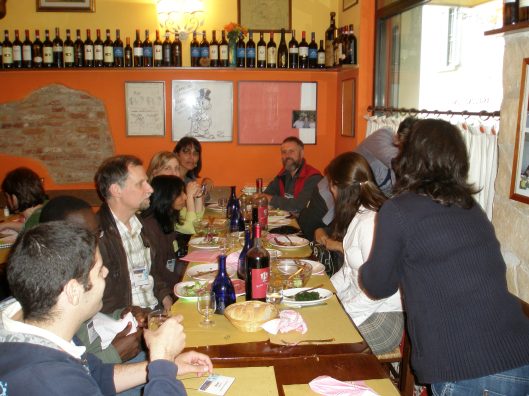
Each actual pattern is pretty elaborate, but I can give a few examples to illustrate the point. One of the Patterns is called “European Pub” which has activity around the edges and large tables. This helps people socialize. The activity around the edges gives people an excuse to circumnavigate the room. The large tables mean that there is room for “legitimate peripheral participation.” If I’m new in town, I can sit somewhat away from everyone but still within earshot. When someone says something I can relate to, I jump into the conversation. This arrangement is much more conducive to socialization than many American bars which feature stools all facing a TV. This does not encourage interaction.

Another Pattern points out that a small town near a big city should put its “center” placed eccentrically toward the city. This makes it more convenient for a larger number of commuters to stop at local stores on their way to the city and back.

These are both gross over-simplifications of the actual patterns, but I think they convey something of what is being aimed at. There is a belief that these patterns would generally “work” in any religious, cultural, geographic, or political context. These patterns are really meant to focus on the invariants across a large number of details. In that way, they make design problem solving more effective. You will be less likely, so goes the claim, to be exploring parts of the design space that are far removed from optimal if you think about things in terms of these patterns.

A “Pattern Language” purports to take a useful middle ground. The patterns are abstract enough to be widely useful but narrow enough not to be meaningless. A “Pattern” is the named solution to a recurring problem. A “Pattern Language” is a lattice or web of Patterns that largely covers a field. Christopher Alexander coined the term after he and his colleagues went around the world to see what “worked” in terms of city planning, house design, building design, neighborhood design, the building process and so on. I think nearly everyone will find “A Pattern Language” a fascinating book.

The impact of A Pattern Language, however, extends far beyond architecture and urban planning. People have found the concept of a “Pattern Language” useful in many other domains. Perhaps the best known such domain is in Object-Oriented Programming with the so-called “Gang of Four” authoring many of the original books on the subject. Other domains which have been addressed with “A Pattern Language” include pedagogy, human-computer interaction, change management, e-business, sustainability, and how society might evolve.

I became interested in Pattern Languages at least 20 years ago and have since co-organized and co-led a number of workshops on patterns in “Computer Human Interaction” as well as “Socio-technical Patterns” including working on patterns for “Liberating Voices: A Pattern Language for Communication Revolution” and chapter 19 in John Carroll’s book on design rationale, “Patterns for Emergent Global Intelligence.”


In 2017, I recounted in this blog  childhood memories and how they relate to what is happening in today’s world. To summarize briefly, we have great opportunities as a species but we are also in a train wreck of trouble! We seem trapped in a nightmare of a comic farce, but one which has tragic consequences of potentially epic proportions; e.g., atomic war or having the USA walk away from the Paris accords on climate change. Is anything to be done?

IMG_1245

What I want to accomplish in the first half of 2018 is to generate interest in the beginnings of a socio-technical “Pattern Language” that can help us get back on track again. I’ll post some of the ones I know about, but I’d be very interested to work with people on other suggestions.  In most cases, even when I post patterns it will be the case that I did not “invent” the patterns from first principles or construct them myself. In the same way that Christopher Alexander and his team main observed what worked and only then attempted to codify generic best practices into a “Pattern Language,” I also found many of these from observation or reading other sources or both. For example, the patterns, “Who Speaks for Wolf?” and “The Iroquois Rule of Six” are not by any means my inventions. I learned about them from the works of Paula Underwood. She was the “designated storyteller” of her branch of the Iroquois and provided an English transcription of the oral history of that branch in The Walking People. Indeed, I have argued that the “Walking People” basically developed a kind of pattern language in their oral history.

https://www.amazon.com/Walking-People-Native-American-History/dp/1879678101

https://www.slideshare.net/John_C_Thomas/the-walkingpeople

https://www.slideshare.net/John_C_Thomas/walking-people-analysis

A Pattern Language is a difficult business.  For maximum utility, each pattern has considerable thought behind it and is written into a specific form. In fact, at one CHI workshop, we developed an XML specification for patterns in Human Computer Interaction called (Pattern Language Markup Language) PLML (pronounced “pell mell”). I will not be quite this formal with the form of my patterns but will adhere as closely to it as practical. I do think that the form of the Patterns within a Pattern Language is important. Each of the parts serves a purpose and it is handy to know what role each part plays. For example, each Pattern has at least these parts: A Title,  (possibly subtitled), synonyms, a Version history, one or more Authors, an Abstract, a statement of the problem, a statement of the context in which the problem and solution arise and are appropriate, an analysis of the “Forces” at play, the Solution, Examples, the Resulting Context, Known Uses, Related Patterns, and References. For many people, having such a complex structure seems to be too much “baggage” but we must remember that design problems are themselves inherently complex. In addition to textual elements, the Patterns of Christopher Alexander include both photographic images to “set the mood” and, typically, at least one diagram to illustrate the general nature of the pattern.

The domain I am most interested in developing a Pattern Language for is perhaps most often labelled as a “Socio-technical Pattern Language.” These would be a collection of patterns that would help people cooperate, collaborate and solve problems together. Although the fabric and texture, perhaps even the scent, of endeavors would depend on culture, the field, current events and a host of other factors; however, the form of these solutions to recurring problems would remain roughly constant.

Next up: An Example. “Who Speaks for Wolf?”

—————————————————————————

https://petersironwood.wordpress.com

Newer posts →

Subscribe

  • Entries (RSS)
  • Comments (RSS)

Archives

  • January 2026
  • December 2025
  • November 2025
  • October 2025
  • September 2025
  • August 2025
  • July 2025
  • June 2025
  • May 2025
  • April 2025
  • March 2025
  • February 2025
  • January 2025
  • December 2024
  • November 2024
  • October 2024
  • September 2024
  • July 2024
  • April 2024
  • March 2024
  • February 2024
  • January 2024
  • December 2023
  • August 2023
  • July 2023
  • May 2023
  • April 2023
  • March 2023
  • February 2023
  • January 2023
  • December 2022
  • November 2022
  • October 2022
  • September 2022
  • August 2022
  • July 2022
  • June 2022
  • May 2022
  • April 2022
  • March 2022
  • February 2022
  • January 2022
  • December 2021
  • November 2021
  • October 2021
  • September 2021
  • August 2021
  • July 2021
  • June 2021
  • May 2021
  • April 2021
  • March 2021
  • February 2021
  • January 2021
  • December 2020
  • November 2020
  • October 2020
  • September 2020
  • August 2020
  • July 2020
  • June 2020
  • May 2020
  • April 2020
  • March 2020
  • February 2020
  • January 2020
  • December 2019
  • November 2019
  • October 2019
  • September 2019
  • August 2019
  • July 2019
  • June 2019
  • May 2019
  • April 2019
  • March 2019
  • February 2019
  • January 2019
  • December 2018
  • November 2018
  • October 2018
  • September 2018
  • August 2018
  • July 2018
  • June 2018
  • May 2018
  • April 2018
  • March 2018
  • February 2018
  • January 2018
  • December 2017
  • November 2017
  • October 2017
  • September 2017
  • August 2017
  • July 2017
  • June 2017
  • May 2017
  • April 2017
  • March 2017
  • February 2017
  • January 2017
  • December 2016
  • November 2016
  • October 2016
  • September 2016
  • August 2016
  • July 2016
  • June 2016
  • May 2016
  • April 2016
  • March 2016
  • February 2016
  • January 2016
  • December 2015
  • November 2015
  • October 2015
  • September 2015
  • August 2015
  • May 2015
  • January 2015
  • July 2014
  • January 2014
  • December 2013
  • November 2013

Categories

  • AI
  • America
  • apocalypse
  • cats
  • COVID-19
  • creativity
  • design rationale
  • driverless cars
  • essay
  • family
  • fantasy
  • fiction
  • HCI
  • health
  • management
  • nature
  • pets
  • poetry
  • politics
  • psychology
  • Sadie
  • satire
  • science
  • sports
  • story
  • The Singularity
  • Travel
  • Uncategorized
  • user experience
  • Veritas
  • Walkabout Diaries

Meta

  • Create account
  • Log in

Blog at WordPress.com.

  • Subscribe Subscribed
    • petersironwood
    • Join 661 other subscribers
    • Already have a WordPress.com account? Log in now.
    • petersironwood
    • Subscribe Subscribed
    • Sign up
    • Log in
    • Report this content
    • View site in Reader
    • Manage subscriptions
    • Collapse this bar
 

Loading Comments...