• About PeterSIronwood

petersironwood

~ Finding, formulating and solving life's frustrations.

petersironwood

Tag Archives: learning

Me Too!

27 Sunday Aug 2017

Posted by petersironwood in America, driverless cars, psychology, Uncategorized

≈ 13 Comments

Tags

conformity, diversity, driving, learning, life, teamwork, traffic

earthfromspace

One of George Carlin’s routines captures well our attitude toward our own driving vis-a-vis other drivers on the road. Basically, we think anyone who wants to drive more slowly than we want to drive is an idiot while anyone who wants to driver faster than we do is an a**hole. We can all relate to being stuck behind someone who seems to be going much more slowly than necessary for the road conditions and traffic. It’s frustrating! We need to get somewhere! We might think, “Why do I have to be stuck behind this slowpoke?!” On the other hand, just as we are mentally or vocally swearing about the slowpoke in front of us, seemingly out of nowhere, some jerk comes careening out into the passing lane on a hill or blind curve and zooms around three or four cars. This time they were lucky. No semi was coming the other way and they lived — this time — despite their erratic driving and general a**holiness.

Driving is an ever-present paradox in cooperation and individuality. In many areas of the world, people rely on public transportation such as rail and busses to commute to work or see relatives and friends. That is not unknown in the US, but it is rare. If we can possibly afford a junker, we do so that we can have the “freedom” to take our own path. Yet, that freedom comes with a high cost. Not only do we have to pay for a car, insurance, gas, oil, taxes and upkeep. We have to follow a set of conventions and laws about traffic in order to minimize traffic accidents and even deaths.

According to Fortune, there were about 40,000 deaths in America in 2016 with 4.6 million people suffering severe injuries. The overall cost of traffic accidents, in terms of lost productivity, medical and property damage is estimated at $432 billion for 2016. The USA is far from the “deadliest” place to drive. Many other countries have far more accidents per mile driven. It is estimated that world-wide, there are about 1.25 million deaths per year from road accidents. Sadly, in the US, traffic fatalities often strike down young people in their prime. They are both less experienced and less cautious. Often, young people do dangerous things in order to “prove themselves” or “be accepted” by their peer group. Any such act, including texting while driving, puts at risk their own lives, the lives of their friends, and usually the lives of total strangers as well.

The monetary costs associated with accidents do not include lost productivity due to traffic jams. According to an article published in Money magazine, this was estimated to be 124 billion dollars in 2013 for the USA. This is a considerable amount of money. I am pretty sure, that’s way more than in my wallet right now. Let me check. Yep. Not even close. You know the old saying, “A billion here. A billion there. Pretty soon, you’re talking about real money.” These cost estimates do not even include the stress and strain that being stuck in “stop and go” traffic puts on the people stuck, the kids that get yelled at as a result, or the impact that higher blood pressure has on people’s brains, kidneys, and hearts.

What if I told you that George Carlin’s skit depicting people’s reactions to other drivers is only an accurate description of how people currently choose to react to traffic? What if I told you that you may well be subjecting yourself to stress and inefficiency in the way you handle stop and go traffic?

IMG_4695

To begin with, let’s think back to your days in “Driver’s Ed” classes in high school. Or, perhaps you were lucky enough to have attended a “defensive driving” course more recently in order to reduce your insurance rates or because a judge ordered you to. In any case, one of the basic concepts taught in those classes is that you stay an “assured safe distance” behind the car in front of you. In my informal polling, many people seem to have completely forgotten about this concept and, when asked, offer absurdly short distances as “safe” when it comes to how far behind the driver in front they need to be; e.g., at 70 miles per hour, some people think they should be one or two car lengths behind the car in front. That, my friends, is way off. You should be seven car lengths behind the car in front at 70 mph, not one or two. There are almost zero reasons you can be safely closer than that and having “really good reflexes” is not one of them. If you are going up a very steep hill, you can get a little closer. But there are many more reasons why you need more distance. These include poor visibility due to curvy roads, low light, fog, smoke or smog. They also include bad brakes, going downhill, a wet road, a snowy road, or an icy road. They include anything that is distracting you the driver such as kids, conversation, sleepiness, even the slightest bit of alcohol, or having the car in front of you following the car in front of them too closely. If your brakes or tires are the slightest bit compromised, you need even more distance for safety.

But following the assured distance for safety is not necessary the “best” distance; it is only the minimal distance for safety. If you are interested in driving “efficiently” — and having the traffic around you being more efficient, there is more you can do. If you are interested in driving without adding to your personal stress as well as adding to the stress around you, there is more you can do. Watch closely as you consider your current strategy for driving in stop and go traffic and an alternative strategy.

Let’s say that a car length is about 15-18 feet though obviously a stretch limo stretches for a lot more and a mini-cooper is much less. Now if you are traveling in traffic that varies from 70 mph to 0 mph, your minimum car length would also vary from 18 x 7 = 126 feet to 18 x 0 = 0 feet. When you are stopped, you might be near the rear bumper of the car in front of you. When you are going “full speed” you might be 126 feet away. If you do this, in stop and go traffic, what you will experience is a long series of frustrations. For awhile, everything will go smoothly, and you’ll go zipping along at 70 mph. But then, for no discernible reason, everyone will suddenly come to a screeching halt. You sit there for a few seconds or a few minutes, one of many people bumper to bumper with the a line of other cars. Eventually, people will start to go slowly. But then, they will all stop again. Or, perhaps they will speed up again and then stop. The traffic may even speed up to 70 mph again and then stop again, and once more, for no discernible reason whatsoever. You may find such phrases as “What the h*** is wrong with people!” caroming off of your cranium and rattling round in your brain. You try to figure out how you can minimize your time in this awful traffic. You look for tiny spaces. The lane next to you appears to be moving! Ah, there’s a space! Slam into it quickly. You do. Your lane is moving! Yay! All it once it comes to complete stop. The lane you just got out of now appears to be moving better. Just your luck! Wait, you can get back in. No! Some a**hole just got into that space from the other lane! Damn! Wait, everyone’s moving again.

This is a very frustrating way to drive — particularly if you are late, or just an impatient person or both. You are stopping and starting all the time. Your hour commute now stretches like taffy (or traffy) into two hours.  And worse than that, per se, is that this all seems senseless. And worse than that is that you are sending your blood pressure through the roof and even that magnificent sacrifice on your part seems to have zero effect on clearing up the traffic jam. And, even worse than that, in the long run, is that your experience is causing you to think very uncomplimentary things about your teammates. Teammates? Yes, your co-drivers — every last one of them — are potentially your teammates. But if you drive in traffic the way I’ve been describing, you don’t see them as teammates at all but more like competitors. And we all know what our job is in a competition, right? To win!! 

volleyballvictory

That same exact objective physical situation can become a completely different experience. And, to make the transformation is simple. I didn’t say it was easy. But it is simple. The key is to stop focusing on keeping the minimum safe distance between you and the car in front of you and instead keep a much longer distance between you and the car in front. The key is to stop focusing on your commute and your goals and instead to think of the traffic as a whole moving efficiently.  The key is to stop driving as fast as you possibly can and instead to try to match your speed to the average speed of the traffic ahead of you. If you do those three things, something amazing happens. You get to the same place in the same time but you will hit your brakes and accelerator far less often. Furthermore, you will feel far safer and less frustrated. You will be able to see a much larger picture of the traffic in front. You will notice that, yes, leaving a large space in front of you does make it possible for other drivers to zip in front of you. But you will also notice that most of the time, these drivers will zip back out of your lane a few moments later.

But wait! There’s more! When you stop putting your brakes on so much, it gives other people a completely different impression of the traffic. If a person is on a divided highway (with four each way) and only sees 4-8 cars ahead of them (because everyone is jammed together) and every single one has their brakes on, they will come to something of a screeching halt, particularly if they have been driving right behind the car in front of them. If, however, they look up and see only 7 of the 8 visible cars with their brake lights on (because yours are not on), they will be far less prone to slam on their brakes. Furthermore, they may well be able to see more of the traffic ahead because of the space in front of you. It no longer looks jammed so their behavior will be less erratic. If they are behaving less erratically, that will be true of the people behind them as well.

But wait! There’s more! People who drive mostly look forward, but they also hopefully glance in rear view mirror on occasion. This means that the people in front of you will also have a somewhat different perception of the traffic conditions based on the fact that you are not driving erratically and that you have a large space (=not stop and go; not crowded; not bumper to bumper) in front of you. You won’t have as much influence on the people in front of you as you will on the people behind you, but you will have some. You will also have a subtle influence on the people beside you. Why? Because they also see that large space. This puts them in a more “traffic is moving” frame of mind than a “traffic is stop and go; Crap!” frame of mind. Not only can they see the large space, they can see through the large space. They are able to see a greater number of cars diagonally ahead through your lane. They can see whether the tail lights are on. They can see perhaps 16 cars instead of just 4-5. The impression when you see all four cars stopped in front of you with their brake lights on is quite different from the impression formed when you see, say, 13 cars stopped and 3 cars moving. So, the cars beside you will also drive less erratically.

OLYMPUS DIGITAL CAMERA

But wait! There’s more!  This means that the cars in back of them will also drive less erratically. And that’s swell news for you and everyone else because — since people do look in their rear view mirrors, the impression of moving traffic will be even stronger in the drivers ahead of you. This in turn will ripple through the entire set of drivers and tend to be a virtuous cycle instead of a vicious cycle. In other words, just you, yes you, you one driver can have a significant effect on the entire set of drivers around you. I know it sounds too good to be true, but give it a try!

But wait! There’s more! Of course, very few people have only one commute in their life. Human beings have memory. If you are in “stop and go traffic” and stay smooth with a large space in front of you, a few other people will notice and decide to try it for themselves. Eventually, it may dawn on them that “despite” your large buffer space in front of you, you are making just as much progress as they are. They may think, “Me too!”  If those people try it and succeed in having a better experience for themselves and others around them, that will tend to cause other people to try it as well, not only in this traffic jam, but in future ones as well.

Driving exemplifies the paradoxical nature of the human condition. We all want the freedom to be ourselves and we want to feel a part of the group. But some paradoxes have solutions. In this case, as I said, the solution is actually simple. You decide that the best way to be a team player is to be different. You stop playing the game of making sure there are no “unused spaces” in traffic. You stop playing the game of switching lanes to zip into the smallest “unused” space. You stop staring into the taillights of a few cars and back off to where you can see a much larger sample of cars. You stop playing the “me, me, me, it’s all about me” game and instead make up a different game which is matching your speed to the average speed of the traffic ahead. You stop worrying if someone zips into the lane in front of you. Just ease off the gas a bit and relax. And, by being yourself, and playing this different game, you will actually make all the traffic around you work better. You are a better teammate by being different. 

The traffic is a lot like free market capitalism operating without much analysis, foresight, or insight. To the extent that people see an opening, they vie for it. Having two people do this at the same time, of course, causes a near miss, a sideswipe or a 20-car pileup. But generally speaking, the person who manages to gets into open space feels wonderful. OMG, I pulled it off! Not quite like winning the Superbowl but in that ballpark, so to speak. Chances are, the lane-switcher finds themself temporarily ahead of the people who had been next to them confirming that their act of private “heroism” had a practical impact as well; it was efficient by plugging up that damned hole.

This may be related to the line of thought so common in business that if you are really being efficient, every single minute of your calendar should be booked a week in advance. Gaps are anathema. Gaps are viewed to be even be worse than double-booked time. If word gets around I’m double booked all the time, everyone will know I am important. Well, important to some, in the same way that jeetos are important to some not despite their ghastly orange hue and anti-nutritional value. Having space in your calendar means you have time to learn, to observe, to think about what is going on, who is your customer, how can you do better, how can our company do better, and so on. It’s no accident that IBM’s motto was “Think” and that it was so successful for so many years in a dramatically ever-changing world of technology.

IMG_0052

You might just give the alternative strategy a try, both in business and in driving. Oh, I know. It seems impossible that one person’s behavior could have much impact when there are 7 billion people on the planet. Imagine that instead of using the 7 billion teammates as an excuse not to change because, “it won’t make any difference,” you thought: “Wow! Seven billion people on the planet! That’s potentially seven billion people who could change, even a little, in the direction of greater cooperation.” What if, instead of thinking of yourself — or you plus a small number of similar people — as being in competition with a much larger number of people worldwide, what if you thought of 7 billion as the astounding number of teammates you have? You might not influence all of them, but you can influence some and they can influence others. Nearly all of those seven billion people use language. Think about that. At some point in our distant past, people did not use language. Now, they do. How did that happen? At some point in our past, people did not have power over fire. Now they do. How did that happen? At some point in my lifetime, no-one had a mobile phone or a personal computer or access to the internet. Now, billions do. Can you hear the music of people working together?

For several years, in the 1990s, my wife and I attended the Newport Folk Festival with John and Clare-Marie Karat. We heard an amazing array of great bands in a beautiful outdoor setting. I particularly like outdoor concerts because of the room it affords for dancing. I find it very difficult to sit still in the presence of stirring music. This concert was held in late summer and the weather was generally, hot, humid, and sunny or hazy. Although, as I said, the weather cooperated most days, one particular morning looked ominous. A particularly cool, hazy sprinkling morning warned us to wear clothes in layers and bring rain gear. An optimist, I wore my speedo underneath in case the weather cleared so I could dance in the sun which I hoped would soon appear.

When we arrived on the island, as usual, Wendy and Clare-Marie sprinted ahead with a blanket to get a prime spot for watching the stage while John and I lagged behind carrying the clutter and clatter of chairs and coolers. The music inspired as always but the weather was not cooperating. Everyone was huddled down in their rain gear, under their umbrellas. The thing about rain gear and umbrellas is that they are typically designed for keeping you dry temporarily in the rain. After sitting there with ten thousand other people, huddling and shivering in the cold rain, I finally decided enough was enough. I stripped down to my speedo and began dancing. After all, I thought, that’s what I came there to do! And, while most people dance to the beat of the music, I let the music dance through me. I don’t have some set moves that are done to the beat. Rather, every note impacts what my body does.

Now, the situation had changed. Instead of ten thousand people huddled under umbrellas getting wet and cold, there were only 9,999 people huddled under umbrellas getting wet and cold and there was one person, namely me,  joyously dancing in the rain. As a matter of fact, I felt warmer dancing in my speedo than I had sitting still under layers of soaking clothes. Yeah, people stared at me a little. So what? Michelle Shocked commented on how well the crowd was holding up in the horrid weather and gave a particular shout out to the guy “dancing nude” in the middle. Just for the record, I was not dancing nude (not even in my “tights”). There was a large umbrella right in front of me, and it might have looked as though I was nude from the stage. In any case, I kept dancing and I was having a great time. Then, a strange thing happened. A few more people got up, shed varying amounts of clothes and joined me. Now a half dozen people were dancing in the rain. Then, a dozen people. Then, two dozen. The rain continued and the cold continued, but the number of dancers grew and grew till it was probably over a thousand. Each person discovered for themselves, as had I, that it’s actually warmer and more comfortable to dance in the rain with a little clothing than to sit in a puddle of soaked clothes — not to mention, one hell of a lot more fun!

RainWaterGutters

When we first sat down in that cold rain, everyone looked around and saw that everyone else was coping with the rain in the same way. Everyone they saw had raincoats, umbrellas, or both. They looked at this spectacle and thought, “Me too!” But now, a few hours later, many people looked around and saw folks joyously dancing in the rain and thought, “Me too!” Indeed, “Me too!” is a double-edged sword. Use it wisely, whether it is dancing in the rain, leaving lots of space in stop-and-go traffic or taking the time to think in your job. You may be very pleasantly surprised at the results, both for you and your 7 billion planet-mates.

———————————————-

https://www.amazon.com/author/truthtable

http://fortune.com/2017/02/15/traffic-deadliest-year/

http://time.com/money/3511481/traffic-jams-cost-americans-124-billion-time-money/
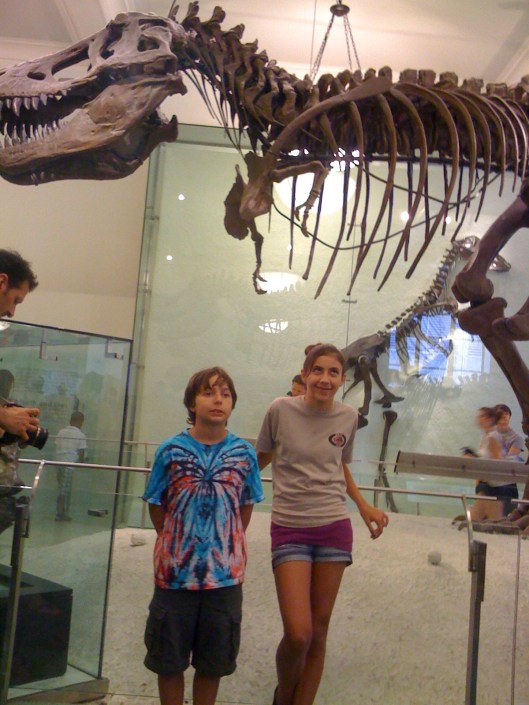
https://en.wikipedia.org/wiki/Newport_Folk_Festival

The Dance of Billions

Claude, the Radio Operator

28 Sunday May 2017

Posted by petersironwood in America, apocalypse, family, management, Uncategorized

≈ 6 Comments

Tags

communication, dinosaurs, diversity, family, learning, politics, soldiers, stories

PicturesfromiPhoneChinaParisPrinceton 278

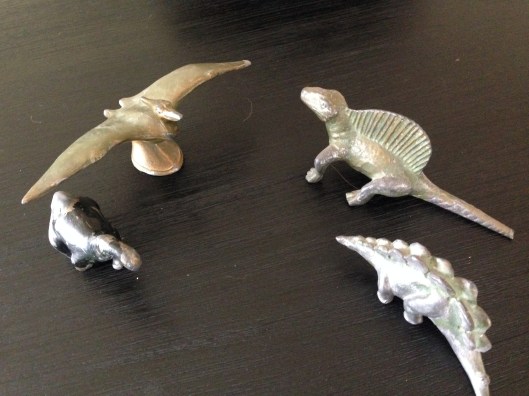
When I was about seven, I got my first bronzed dinosaur, the Tyrannosaurus Rex. I earned bribe money for being good about getting my butt stabbed by penicillin shots. In any case, I discovered these dinosaurs on the last page of my grandpa’s The Natural History Magazine. They looked really cool! The designers had chosen to make the T-Rex’s forearms look more robust than would have been a perfectly scale model with those teeny hands. The T-Rex was great! It was solid and cold and heavy because it was metal. There is something about metal or wood or stone that resonates with me much more deeply than plastic ever could. (Sorry, plastic. I know you are a cool invention and really inexpensive and very malleable and all of that. But, you just don’t touch my soul like wood, metal, and stone do.) When I moved the T-Rex, my muscles felt it. Perhaps this is one reason that I still have much of my dinosaur collection 65 years later. (How many of your plastic toys do you still have from 65 years ago?) I didn’t think so. But they are out there somewhere, along with my own forgotten plastic toys, polluting the world for centuries to come.

Bronze, as you have seen many times in your life, does not look worse when it oxidizes as iron does when it rusts. Instead, Bronze turns a beautiful powdery light green with the slightest hint of blue. So, T-Rex looked beautiful as well.  So, you might well think that the next time I had enough cash for one of these statues (1$ for the small size and 2$ for the large size) I would get another T-Rex. No, I got a Dimetrodon and a Stegosaurus. Later I got a Trachodon and a Brontosaurus. Anyway, what was fun about this diverse cast of characters is how different they were from each other and the richness with which they interacted. There’s no way it would have been as much fun if it were one army of T-Rex’s against another. (Poor brontosaurus’s tail fell off many times but my dad is no longer here to solder it back and anyway, the tail got lost in the last move).

IMG_0771

Similarly, a few years later, when I owned toy soldiers, I enjoyed having ones with different properties; that is, mainly different weapons. Liking the variety must have been true for other kids as well because the sets that I could buy were always mixed. My favorite type of soldier were hollow lead ones.  They were well enough hand-painted that you could see their faces, although not so well that you could determine whether they were fighting out of hate, out of fear, loyalty, patriotism, duty, because it’s a job, or for some private demon. I especially liked the bazooka men. I think I owned four of them. Of course, this weapon takes a while to reload and there probably aren’t a huge number of rounds. On the other hand, there were machine gunners, riflemen (more of them than anyone else), and a couple of officers who were pointing a pistol. There were also a couple of dudes sitting on the ground with a *serious* machine gun tucked between their spread-eagled legs. There were also a couple of hand grenade throwers. Another soldier had a rifle with a bayonet raised up above his head. This made arranging them for a pitched “battle” all that much more interesting. Although they had very different weapons, all of them had obvious lethal capabilities. All but one. There was one poor guy with no weapon whatever. His job was communications. His only visible “weapon” was a rather large boxy radio set. I suppose in a pinch, he could whack someone in the face with it. Even if that didn’t kill them, it would for sure put a crimp in their dinner plans.

It was difficult for me to decide which one of these soldiers I would “be.” I liked the bazooka man a lot. The rifleman looked cool. By the way, there were three versions. One type of rifleman lay on the ground with legs spread and the rifle stabilized by his elbows on the ground. Another type of rifleman sat on the ground and put the rifle across his upright knees for support. The third type, and my favorite, was the proudly standing rifleman. Thinking about it from an adult perspective, he’s probably the guy who was voted by his platoon:  “most likely to die quickly.” But I didn’t think about that then. Sometimes, I thought it would be cool to be the officer pointing the pistol. Obviously, in most ways, it wasn’t as devastating a weapon as a rifle. Although conceivably in very close quarters, he might outmaneuver a rifleman. But there was one guy that I definitely did not want to be.

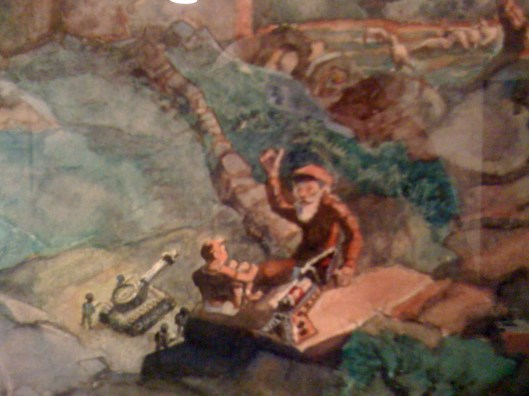
You guessed it. I never wanted to be the guy on the radio. Let’s call him “Claude.” Claude didn’t get to actually fight! And, it seemed to me at that point that I could stay alive no matter what obstacles and enemies were thrown at me — if only I were an excellent enough rifleman (or bazooka man, or pistol-wielding officer). On the other hand, it seemed as though “anybody” could do Claude’s communications job and would do it equally well. Furthermore, it seemed any enemy could just walk right up and shoot this dude Claude before he knew what hit him and way before he transforms his awkward radio set into a lethal weapon. Of course, Jason Bourne could do it, but I don’t think Claude had that kind of training. And, anyway, the first movie didn’t come out until 2002 and this was the early 1950’s. Treadstone didn’t exist back then. (BTW, this is not “my” Claude but it’s the closest image I could find.)

Claude

As I mentioned, these hand-painted lead soldiers were my favorites but I owned three other types. One were extremely detailed and beautiful lead soldiers. These suckers were expensive and, as I quickly discovered, not very durable in real “battles.” When you smashed them into each other, the horses tended to break, or what was more typical and worse, not break but bend into an uncomfortable and unrealistic position. At that point, I would very carefully ease the broken leg into position, Angstrom by Angstrom… Snap!! It would break off in my hands. That was worse. I felt as though I had personally snapped that beautiful white horse’s leg in half. It always seemed as though I could ease it back into position and I almost succeeded each time. Then, SNAP. Suddenly I am holding a three legged horse in one hand and a piece of horse leg in the other. My favorite of these collections were the “Coldstream Guards” with their white and bright red uniforms with splashes of gold.  It is sad, I can tell you, to be an eight year-old general and not be able to put your most beautiful soldiers into battle. But, beautiful as they were, they were fragile. I did manage to break a few of the hollow leaden ones as well, but I had to work at it.

Then, there were unpainted plastic soldiers. They came in a kind of gray-green suggestive of olive drab. Let’s call it “off-olive drab” like the olive from that bottle of garlic clove filled green olives that you accidentally left at the very back of the fridge for five years. Then, when you finally discovered, it, the olives looked as toxic as rain forest frogs; but far from a beautiful bright warning color, these were so drably off-olive that you almost didn’t see them. But, as for the soldiers, it wasn’t just their uniforms that were off-olive drab. All of them, including the little flat plastic stands, their expressionless faces, and their normal-sized (well, normal scaled I should say) hands exuded that same toxicity of colorlessness. Their one giant advantage was that they were far cheaper than the painted leaden ones. And, whereas the fancy ones were fragile and the leaden ones were rugged but breakable, these all-plastic soldiers could not be broken. For some reason, I do know that they can be cut with an ordinary steak knife provided you have enough patience and are smart enough after you’re caught the first time “ruining” the steak knives, to make sure the second time you experiment when you’re alone. The plastic ones can also be melted. However, melting them had the side-effect of greatly disturbing my parents because of the toxic fumes that permeated our house. (I think we will have to leave for another time the question of why I wanted to know these things). One great thing about these plastic soldiers was that they were to the same scale as the metal ones. So, they could all participate in the same battles without stretching the credibility till it snaps like a rubber band and stings the soul of make-believe.

Ah, but there was as well a fourth type of soldier. These were insanely cheap plastic soldiers! A hundred soldiers for a dollar! I ordered two sets so I would have an amazing two hundred soldiers along with the probably 75 I already had. And then they arrived. Yay! Imagine! My army would now rival those of Caesar, Hannibal, Grant, Patton!

My first clue that something must be terribly wrong was the size of the shipping box — unbelievably small for 200 soldiers. I opened the boxes and then got to the actual soldiers. They were in 2 point font.  They were approximately the size of one of the feet of my other soldiers. And, these soldiers gave a whole new depth of meaning to the expression, “cheap plastic.” These soldiers were fabricated out of some material that was like what plastic uses when it doesn’t bring out the good stuff for company. And, “fragile” doesn’t quite do justice to the care with which these teeny slats of plastic needed to be handled. Oh, by the way, speaking of “slats,” did I mention that they were two dimensional? Did I mention that not only couldn’t you discern the motivations of the solider from their face, you couldn’t discern whether they even had faces. These soldiers were not of molded plastic; they were basically stamped. In fact, each solider had to be detached from a long plastic rod by twisting.

How could I have possibly known I would waste my two dollars? The picture that accompanied the advertisement for these soldiers depicted something other than their product. The picture showed something every bit as detailed and colorful and three dimensional as the hollow leaden soldiers. These same comic books also advertised “sea monkeys.” In the picture, there are “families” of little human-looking aquatic monkeys. You can tell what mood they are in and how the various family members interact. Well, I thought this was fantastic! But I didn’t totally believe it was possible either so I asked my grandpa whether they were real. He said they were just brine shrimp. I also saw that there was a teeny asterisk in the corner of the picture, half hiding in the seaweed that some of the “sea monkeys” were harvesting for the family meal. Then, in almost unreadably tiny type, the asterisk was explained, “visual depiction may not precisely duplicate visual characteristics of crustacean provided”  or some equally incomprehensible legalese gibberish that very few 8 year olds are going to comprehend (in the more recent version shown here, I don’t even see that cryptic warning).

SeaMonkeys

Apparently, we live in a society where that’s okay. I think part of the reason it’s okay is that we live in a very differentiated society. If you think about the single artist, craftsman, or chef, they are much more about substance than puffery. You don’t typically expect someone who makes something to be dishonest about what it was they did. However, hiring a advertising expert brings into play a different set of factors. The advertising person cannot make a better painting, or chair or soufflé. Their expertise and their “product” is in making people buy the substantive product. If they can lie, exaggerate, or mislead and get away with it, so long as sales go up, that is a win for the advertiser. Needless to say, they would never describe what they do as a lie. Because, after all, who would advertise a “lie” as being a “lie”? Then, you might not want to buy one. They have a whole raft of explanations as to why what they are doing is really in everyone’s interest. They’ve rehearsed it and perfected it and —- since this is what they expert in — they will probably have you agreeing with them. I’m not sure it is just fine and dandy, especially when it’s combined with a low quality product such as brine shrimp or “toy soldiers” that are too small to be used or played with as toy soldiers. In these cases, the actual product is nothing like what they “depicting” it as.

It gets a bit murkier when their are unstated but implied benefits. BMW actually does make a fine car. However, you are not going to be driving it long if you drive it the way it is portrayed on commercials. Similarly, a car is not going to be very often the snappifying head-turner among young people seeking a mate that the advertisers would have you believe. It isn’t merely that advertising tends to have us spend money on products and services that aren’t really filling our needs, although that is problematic. We spend a huge amount of money on junk food, cosmetics, and so on — and more than on medical research. But in addition to that, doesn’t it seem to undermine the meaning of truth in all human discourse? Or, is it okay to lie if you are an advertiser because they are doing it for money? In other words, it’s okay to lie if you are benefiting yourself, perhaps because you are undoubtedly benefiting your client even more?

We are more and more and more connected electronically. This is good news. And this is bad news too. One thing, though is certain. The potential impact of a lie is tremendous and much much more than it was in the past. In distant times, a lie had only local impact. Now, a lie could literally destroy the world. So, to me, the balance point of when it’s “okay to lie” is way different than it was 20,000 years ago.

I believe there is a way for people to provide value to each other honestly and still have a thriving economy. In any case, even if we never reach that point and advertisers continue to oversell products, can we at least try to be vigilant not to let that attitude toward the truth permeate every other aspect of life? A large complex and highly differentiated society can only exist in an atmosphere of trust. You must trust that the drivers of the other cars on the road are not trying to kill you. You must trust that the food you buy is not poison. You must trust that the policeman is there to protect you. If that trust breaks down, there is no longer a society. So intentionally lying in order to make a buck (or a point) is really a push toward utter chaos and anarchy. Obviously, no single push will bring us there, but we must be extremely careful. Why? Because lack of trust is contagious (as is trust). A slight imbalance between trust and mistrust could become a vicious cycle. Information is the resolution of uncertainty, not the multiplication of uncertainty.

A communication network of people becomes more valuable as the number of people increases. A network of, say, 350,000,000 people is much more valuable than 10 relatively homogeneous networks of 35,000,000 each. And, to take this to the extreme, it’s much more valuable than 350,000,000 networks of one person each, no matter how smart or strong that one person is or how many treasure-troves of weapons they have. We need to work together whatever differences exist. That’s why it’s important that we all keep communicating. That’s why it’s important that we try to be as truthful as possible. That’s why I now think that Claude, the radioman, may be the most skilled and crucial solider of all.

IMG_1289


(The story above and many cousins like it are compiled now in a book available on Amazon: Tales from an American Childhood: Recollection and Revelation. I recount early experiences and then related them to contemporary issues and challenges in society).

Find it on: my Amazon author page

The Invisibility Cloak of Habit

25 Saturday Feb 2017

Posted by petersironwood in America, psychology, Uncategorized

≈ 47 Comments

Tags

adaptability, flexibility, habit, learning

stopsign

“No, you’re not wrong; I’m wrong!”

How often have you heard, or uttered these words? Seldom is my guess. In fact, you may have even misread these words.

Michigan winters are hard. Even in the lower peninsula at the University of Michigan where I went to grad school, winters are long, snowy, bitter cold, and often feature treacherous ice storms. But that made springtime that much more soul-saving. Often, when it was sunny and warm, I would teach my introduction to psychology classes outside on the lawn near Angel Hall. Nearby ran one of the “main drags” in town including a T-shaped intersection. The street going into the main drag included a stop sign for the first three years I lived in Ann Arbor.  And, then, there was a change. Whatever the design rationale, the highway department reversed the situation so that traffic on the main drag now had stop signs both ways and the other street was free to turn onto the main drag. That doesn’t seem  like a tsunami of a change, does it?

Yet, my classes were often interrupted by screeching tires, and honking horns. Society had not yet evolved to the point of pulling a gun and shooting someone for a traffic faux pas. That would still require years of work on the part of the NRA to convince people that they needed “protection” for road rage (which coincidentally made road rage that much more deadly). But back in the 1970’s, my classes were not interrupted with gunshots. But aside from the screeching tires and honking horns, we could hear plenty of screamed profanity.

What made that an interesting situation to discuss in the intro psych class was that it was never the people who actually had the right of way who did the honking and screaming. It was always (at least so far as I observed) the people who sailed right through the new — and unseen stop signs! These stop signs were in plain view. This was not at all like the stop sign I sailed through years later in Westchester. That stop sign was well-hidden behind trees and then made more invisible by spray paint. I guess some teen-agers thought it would be pretty cool to cause an auto accident. Sigh. But let’s teleport back again through time and space to Ann Arbor a couple decades earlier. Those new Ann Arbor stop signs were large and clearly visible to anyone. In fact, both signs were both easily visible to the psych class from 75 yards away. But they were apparently under a magic spell because these same stop signs were invisible to drivers who had driven the main drag for many years. They “knew” the stop signs were not there. They “knew” there was a stop sign on the cross street. So, to many (not all) drivers, these stops signs were under an “invisibility cloak” created by their own expectations.

Furthermore, when drivers did sail through the stop sign and then found themselves almost in an accident, slamming on their breaks and swerving to avoid the accident, it was invariably followed by a loud blaming exercise. The “blame” of course, was always on the other driver — the one actually following the law. In the 5-6 near misses we observed, we never saw someone sail through a stop sign and then realize their mistake and apologize. Nope. Not once. It was always an anger display at the “idiot” who had gone right through the (non-existent) stop sign. If you read the last blog post about “Big Zig Zag Canyon” you are already familiar with how our expectations of reality can be slow to match actual reality.

Such situations remind me a little of tether ball. As a reminder, tether ball is played with a ball that is…tethered. The ball is much like a volleyball but connected by a rope to a pole. The players try to hit the ball and wind it completely around the pole in “their” direction. (This game is made for two righties or two lefties). Anyway, as the cord wraps itself around the pole once, the cord shortens and the radius of the ball path is shorter meaning it comes around more quickly. So you need to adjust your timing. But the typical behavior, at least for beginners, is to jump up a little late because everyone bases their timing on the previous cycle rather than the next cycle. The player realizes they are late and adjusts their timing. Unfortunately, they typically adjust to the last cycle and are once again late. They do keep adjusting but always one revolution too late. As a result, the ball whips around faster and faster wrapping itself into the pole.

In attempts to build artificial intelligence systems, computer scientists encounter the “update problem.” As the world changes, so too must the reactions of the system change. But what kind of change in the environment is related to which changes in necessary reactions? In many cases, humans are pretty good at this. In other cases, not so much. Let’s say, for instance, that you routinely set your clock radio for 7 am in the morning. One evening, you go out for dinner at the Fish Market and bring home left-overs which you put in your fridge. Now, you immediately go and make sure your alarm is set for 7 am, right? No, of course not! You have a model of the world that enables you to realize without any conscious thought that putting leftovers into the fridge in the kitchen will not change your alarm setting.

Let’s take another example. You drive to a golf course and park. You take out your clubs and get ready to play a round. But you realize you need a new golf glove so you buy one at the check-in desk. Fine. But now you play the entire round wondering where your car will be when you’re done. No you don’t! Of course not! Again, your model of the world allows you to realize that there is no way buying a new golf glove can cause your car to appear in a different place. This is not in actuality completely true. Someone at the check-in desk could look at the credit card you used to buy the glove, ask for ID, realize you are going to be occupied with golf for the next 3-5 hours, call their buddy at the DMV, find out your license plate and then call their car thief buddy who finds your car and steals it. That’s extremely unlikely but theoretically possible.

Anyway, what is mainly easy for humans is not that easy for AI systems. It might be configured in such a way that whenever anything changes, it needs to recheck everything. But occasionally, people are confused about the update problem as well. As AI becomes more ubiquitously integrated with the Internet of Things, our own models of what is related to what may well be as outmoded as an Ann Arbor driver. You believe putting something in your fridge cannot affect your alarm setting. And that is true for your “dumb” fridge. But what about a “smart” fridge? It might infer, based on your past behavior, that you typically eat leftovers for breakfast. Your home command center reads the bar codes on your leftovers and realizes it will take you an extra five minutes to consume the dinner-breakfast you brought home. So, it automatically changes your alarm to 6:55. Helpful? Even today, how many of us can really say for certain what the interactions might be among the remote controls and settings for the various components of our home entertainment systems?

Although humans are still much better than computer systems at solving the update problem, we still make errors. Here’s one I remember. We had a small workout room at NYNEX Science and Technology where I ran the Artificial Intelligence lab. In this small workout room was an ordinary wall clock. For years, I used the workout room at noon, and glanced at the clock to check the time. At one point, the equipment was moved around and I realized that the clock would be much easier to see on the opposite wall. So, I moved the clock to the opposite wall. I got on the treadmill and about ten minutes later glanced at the clock to check the time. Only I did not glance at the clock. I glanced at where the clock used to be. Think about that. I myself had moved the clock a few minutes earlier. Obviously, I “knew” where the clock was now positioned. And yet, I felt like a clueless Ann Arbor driver.

Another common sighting of the “invisibility cloak of expectation” came at IBM Watson Research Center. This is a place where Nobel Prize winners work. Anyway, the computer science department was housed for many years at an office building in Hawthorne. Restrooms were conveniently located near the stairwells on every floor. On three of the four floors, the men’s room was on the right. But on one of the floors, the women’s room was on the right. Whether the designers did this knowingly for a joke, I am not sure. But on the “odd” floor, men often wandered into the women’s room and women into the men’s room. Now, the doors for these restrooms were not marked in Kanji characters or ancient Greek. No, they were clearly marked in English. Although the computer science department consisted of people from all over the world, they all read English quite well. But expectations apparently trump perception. That seems to be the case for everyone some of the time and for some people nearly all the time regardless of intelligence or education. People very often see (or don’t see) based on expectations rather than the evidence of their senses.

Is there anything that can be done to help us remove our blinders and see what is really there? I think so, but it isn’t easy. The first line of defense is social. What do other people see? Chances are, if you were milling around in a park and suddenly everyone else starting running and screaming away from the swing set, you probably would too even if you saw nothing at all unusual. However, in the Mysterious Case of the Ann Arbor Stop Sign, people immediately interpreted the other driver’s behavior, not as another source of information, but as proof that the other person was a careless or demented driver. Not only did the drivers not see the “obvious” stop sign but they completely overlooked the possibility that they may have been wrong themselves.

This may be “human nature” but I suspect that aspect is exaggerated by an overly competitive school system and society. In school, we are molded to try to get good grades. Ideally, “grades” would not be so much about comparing people but about realizing what you still needed to learn. In society, we have perverted such intrinsically social and cooperative activities as dancing, cooking, singing, and dating into “contests.” At work, too often, a project failure results in finger-pointing rather than problem solving and prevention. Whatever the reason, it seems incontrovertible that people in our society are bunny-quick to blame others and tortoise-slow to blame themselves.

In The Walking People by Paula Underwood, she describes the “Iroquois Rule of Six.” This is a rule of thumb they use to avoid over-focusing on the very first explanation of behavior that springs into mind. Suppose you work for a large multi-national IT company and find yourself sitting alone in meeting room P-45. You glance at the clock. 10:10. You take out your calendar, whether paper or electronic, and re-read your note: Meet Joe, 10 am, P-45. Here it is 10:10 and he hasn’t shown up! It is natural to have some thought like this trounce through your head, “What he hell? What’s wrong with Joe? I guess he just doesn’t really care about our project!” Maybe. But the Iroquois Rule of Six might get you to consider at least five alternatives such as: 1. Maybe Joe is from a culture where 10:15 is “on time” for a 10 am meeting. 2. Maybe you wrote down the wrong room. 3. Maybe you wrote down the wrong time. 4. Maybe you wrote down the wrong date. 5. Maybe you are not actually in P-45. 6. Maybe the clock is wrong. 7. Maybe Joe cares about the project but is stuck in traffic. And so on. It isn’t so much that we human beings grab on to the first thing that pops into mind. The problem is that once we do grab onto an interpretation of events, we never let go!  We don’t consider other possibilities.


My grade school friend Butch had had an uncle who had fought in the Pacific in WWII. He gave Butch this really cool book about how to survive off the land. One thing I read stuck with me. Monkeys are among the easiest wild animals to catch, not because they are stupid but because they are smart. One simple technique is to put two holes in a coconut shell and hollow it out as much as possible. Then, you slip a treat like a nut or small piece of fruit inside. The monkey comes along and grabs hold of the treat. Their hand, which went easily into the hole cannot get out while their fists are balled up holding the treat. So, you walk up to the monkey and club it and cook it and eat it. Monkeys are fast. It would be easy for the monkey to let go of the treat and scamper away. But they won’t. (At least, that is what the manual claimed). How much are we like the monkey? We grab at an explanation that makes us feel good and stick with it. We cannot let go. And we cannot accept the possibility that we ourselves might be wrong. Only in that last split second before the monkey’s skull is split open does it perhaps think, “Let go. Run. Too late.” Can we do better?

The United States, among other countries, has the intellectual capacity and the urgent need to quickly and fully develop new energy sources that are cheap, reliable, renewable, clean, and not dependent on foreign wars. And we are. In a trickle. But we are giving corporate welfare to old energy oil company kingpins because they are lavish campaign donors in a torrential river of cash. If you had a huge hole in your pocket that was draining all your cash, you’d see to fixing it quickly. But the oil drain isn’t so obvious. It steals far more of your money than a pickpocket could. But it’s well-hidden. Of course, at least until lately, oil money doesn’t come right out and say, “We know we’re rich but we deserve it. Give us more!” But we are so much in the habit of using non-renewable resources that we don’t think twice about it. And, those habits and expectations are played on plenty so that we are trained to think: “EPA- who needs it?” “Climate Change – unproven science”, “Solar and wind power are great but way off in the future”, “Pollution may cause cancer and asthma but that’s the price of civilization.”

The cheap oil prize that we so greedily grabbed hold of is now the trap that will get us killed, quite literally. It’s what we’ve been doing for many years. Why let go now? Instead, it’s easier to scream at others: “There is no stop sign here!!” Eventually of course, people change and civilizations change. But to change too slowly means you could be the cause of an accident; you glance on the wrong wall to see the time; you miss the tether ball on every cycle. Or, it could just mean complete annihilation. Maybe you could at least let go for a little while. Maybe you could at least let go with one hand. Maybe you could just forget the prize and the coconut and get away before it’s too late. I hope so.


(The story above and many cousins like it are compiled now in a book available on Amazon: Tales from an American Childhood: Recollection and Revelation. I recount early experiences and then related them to contemporary issues and challenges in society).

Author Page on Amazon

Home Page

Twitter: JCharlesThomas@truthtableJCT

Trumpism is a New Religion

09 Monday Jan 2017

Posted by petersironwood in apocalypse, health, Uncategorized

≈ 76 Comments

Tags

ethics, learning, politics, religion, Trump

(This blog post is a temporary departure from Schooled Haze and contemplations of AI/HCI).

finalpanel1

Trumpism is less a political offshoot of Republicanism than it is a new religion, at least for a substantial number of Trump supporters. I keep seeing posts from various liberal friends recounting nasty infantile things that Trump has done or said as though as to say, “Well, now! That is so completely outrageous, stupid, mean-spirited, vain, or evil that surely you Trump voters will now see how you were wrong.” No. That is never going to happen. I think the “mistake” is to think that Trump is a political leader when he is actually, for many, a religious leader. 

As Trump himself once famously bragged, he could shoot people in the middle of the street in broad daylight and his followers wouldn’t desert him. It doesn’t matter what he does. His value is taken as a given and everything else flows from that. You won’t convince people who are Hindu, Buddhist, Christian, or Muslim to change religions because you claim to have “facts” about how bad some particular religious figure is. It will simply mean they will discount your facts and their source.

Why and how could Trump become a religious figure? He seems offhand to be the complete antithesis of what most of the major religions espouse. Well, yes, but those religions I mentioned earlier arose in earlier times…much earlier. In the USA, 70% of the people claim to be Christians. But what really matters are people’s actions, not their claims. The evidence is all around us that for many people, the real religion of America is quite different from Christianity.

We have a TV culture and a popular culture and what many people really value (as measured by their actions) are things like money, greed, vanity, self-promotion, immediate gratification, superficiality, anti-intellectualism, self-righteousness, fame, and arrogance. We call people who hold high positions in a company “business leaders” regardless of whether they are or are not actual leaders. We have articles written about which colleges are “best” when the entire analysis is about the ROI of your tuition dollars. Social media are filled with “top ten” lists of ways to advance your career that take three minutes to read. We talk about someone’s “actual worth” when what we’re really talking about is their financial worth. We rank order tennis stars, golf stars, baseball stars, and basketball stars according to how much they earn. Where is the list according to their skill, elegance, mentorship, or how much they build team spirit? These things are still talked about on occasion but many people accept that the only “objective” measure of value is money.

We have transmogrified what are essentially cooperative activities like dancing, cooking, dating, and singing and made all of them into competitive contests on TV.  Many of us have accepted as “normal” that all a corporation is expected to do is make the most money possible. What used to be “beyond the pale” ethically is now treated as just taking care of the bottom line. A few random examples follow. It is “normal” business practice now to send snail mail that appears from the envelope to be a check or official government business when it is, in fact, nothing but advertising. E-mail and snail mail are labelled as “In response to your query” or “As you requested” when there is no such query or request. Drinks that consist of high fructose corn syrup and water with dyes (and quite possibly FDA-grandfathered addictive ingredients) are labelled as “Natural” and “Healthy.” Did you know that “Unscented” is the name of an actual fragrance? So if you buy cat litter or fabric softener that is “unscented” thinking that you are avoiding the nasty chemicals, you are simply buying stuff that is scented with a scent called “unscented.” Recently, Wells Fargo which you don’t typically think of as a “fly by night” outfit, was caught charging customers for setting up accounts that were never asked for. Minors cannot purchase cigarettes, alcohol, or marijuana. However, your ten year old can go into any grocery store and get “air fresheners.” These typically contain ingredients which include a known carcinogen, a chemical known to mess up your hormone balance, and a chemical which deadens your sense of smell. Essentially, an “air freshener” does nothing of the sort. It pollutes your air; it doesn’t “freshen” it whatsoever. Meanwhile, sports figures such as Lance Armstrong, who vigorously denied doing performance enhancing drugs apparently not only did them but threatened other athletes not to expose his drug use.

I do not want to overstate this. Most people most of the time are still honest, hard-working, and fair. The media gets paid by advertising dollars however and is therefore motivated to report only on the worst of human behavior. Very few will buy a newspaper whose headline reads, “2.5 million US Muslims worked peacefully today.” But if one goes on a shooting rampage, you can bet it will be a headline. Do you recall any headlines about Timothy McVeigh being a Christian?

Our elections and politicians are bought and paid for largely by a few multi-billionaires. A long term campaign to encourage people not to trust “intellectuals”, scientists, educators, and journalists has left people believing in fake news and social media instead. In some cases, even such blatantly obvious absurdities as “January 2017 Friday the 13th! — There will not be another Friday the 13th for 666 years!” are posted and reposted on Facebook. “Mars will never be closer to the earth!” (This with a picture that shows Mars the apparent size of the Moon). The only reason for such things is basically to serve as click bait. “Copy and Share if you are against the senseless killing of helpless kittens.”

That is the background against which we need to understand Trump and Trumpists. It doesn’t matter to Trumpists that he made more money by stiffing people. It doesn’t matter that he bragged about being able to grab women by their private parts. In fact, these are seen as plusses. He embodies the values and behaviors that symbolize a new “religion.” The problem with Christianity as a religion is that it (at least in many versions) champions the downtrodden, teaches humility, asks us to love our neighbor as ourselves, warns us not to judge lest we be judged, encourages us do to unto others as we would have them do unto us. That’s okay for a couple hours on Sunday. But it really doesn’t jibe with perceived success in the modern business world. Actually, you certainly could run a business and be successful that way. But being merely successful isn’t enough. If you want to be sure to be a billionaire despite having only mediocre talent, then the path of lying, cheating, and stiffing people seems more promising. The tension between what the Bible says is good and what society actually rewards is too much for many people to bear. As a result, some churches, ministers, and practitioners focus on little slivers of decontextualized Christianity such as homophobia or a prohibition about birth control. Some even promulgate the idea that if you are rich in worldly goods, it is proof that God is smiling on you. And these tactics kind of work a little bit. But it doesn’t work nearly so well for some people as embracing a new religion that celebrates the same values as our “civil” society.

How does this perspective on Trumpism help? First, it helps us understand that Trump supporters will not be shocked if he fills cabinet posts with second rate people who appear to be joining government to line their own pockets. This is expected behavior by adherents to the new religion. Trumpists may well discount evidence of this as being fabricated by liberal media or they simply think it is evidence they are “hard-headed business people” who will make government “more efficient and effective” like private enterprise. Well, I have interacted with government agencies. And, I have worked in some of the best companies in America. You know what? They are both “inefficient.” How is your Montgomery Ward stock doing these days? How about Enron? Borders? Companies go out of business all the time. They have no magic formula that makes them efficient and effective. The idea that government is “inefficient” and private enterprise is “efficient” is just nonsense invented by people who want to send more of your dollars to private enterprises in which they have a vested interest.

Second, seeing Trumpism as a religion explains the passionate fire of many Trump supporters. It also explains how they can rationalize hate crimes in their own minds. As the religious leader of Trumpism, Trump has given permission and even encouraged violence in his name.

Third, Trumpism as a new religion explains the shallowness of thought that pervades it. Most major religions have centuries of debate and discussion about how to interpret various passages in sacred writings etc. During many parts of the history of these religions, many of the smartest most thoughtful people ended up studying — even devoting their life — to these older religions. There hasn’t been time for that yet with Trumpism. Whatever Trump tweets is the on-going gospel to the Trumpists. Trumpists themselves do not typically call it a religion. They may think their extremism is patriotism. Others may think it is simply practical. In any case, the shallowness and sloganism of Trumpists is seen as a feature, not a bug.

Fourth, understanding that our society is so ripe for Trumpism suggests that simply voting out Trump or even having him impeached, while it might prevent or delay atomic war or dictatorship, is not the complete answer. Our entire society needs to become more patient, less greedy, more cooperative, less competitive in matters that don’t require competition, more accepting and less self-righteous. We need to celebrate the people of substance and ability in every field from bricklaying and carpentry to science and teaching. We need to stop celebrating people simply because they are in the news or have inherited a lot of wealth. Trump and Trumpism are symptoms of something much more pervasive. Trump may be the cancerous tumor in the body politic, but our immune system is badly compromised or that tumor would never have grown so fat and ugly. We must also understand that our body politic still contains many healthy cells! Don’t despair! Instead, repair! Be one of those healthy cells. Survive and thrive. Civilization hasn’t fallen yet. During 2017, we can collectively perform a Billion Acts of Compassion and Kindness. #BACK2017.

Ban Open Loops: Part Two – Sports

14 Friday Aug 2015

Posted by petersironwood in management, psychology, sports

≈ Leave a comment

Tags

AI, cognitive computing, Customer experience, customer service, education, learning

Sports and open loops.

Sports offers a joy that many jobs and occupations do not. A golfer putts the ball and it sinks into the cup — or not. A basket-baller springs up for a three pointer and —- swish — within seconds, the shooter knows whether he or she was successful. A baseball hitter slashes the bat through the air and send the ball over the fence —- or hears the ball smack into the catcher’s mitt behind. What sports offers then is the opportunity to find out results quickly and hence offers an excellent opportunity for learning. In the previousiPhoneDownloadJan152013 593 entry in this blog, I gave examples of situations in life which should include feedback loops for learning, but, alas, do not. I called those open loops.

Sports seem to be designed for closed loop learning. They seem to be. Yet, reality complicates matters even here. There are three main reasons why what appears to be obvious opportunities for learning in sports is not so obvious after all. Attributional complexity provides the first complication. If you miss a putt to the left, it is obvious that you have missed the putt to the left. But why you missed that putt left and what to do about it are not necessarily obvious at all. You might have aimed left. You might not have noticed how much the green sloped left (or over read the slant to the right). You may not have noticed the grain. You might not have hit the ball in the center of the putter. You might not have swung straight through your target. So, while putting provides nice unambiguous feedback about results, it does not diagnose your problem or tell you how to fix it. To continue with the golf example, you might be kicking yourself for missing half of your six foot putts and therefore three-putting many greens. Guess what? The pros on tour miss half of their six foot putts too! But they do not often three-putt greens. You might be able to improve your putting, but your underlying problems may be that your approach shots leave you too far from the pin and that your lag putts leave you too far from the hole. You should be within three feet of the hole, not six feet, when you hit your second putt.

A second issue with learning in sports is that changes tend to cascade. A change in one area tends to produce other changes in other areas. Your tennis instructor tells you that you are need to play more aggressively and charge the net after your serve. You try this, but find that you miss many volleys, especially those from mid-court. So, you spend a lot of time practicing volleys. Eventually, your volleys do improve. Then, they improve still more. But you find that, despite this, you are losing the majority of your service games whereas you used to win most of them. You decide to revert to your old style of hanging out at the baseline and only approaching the net when the opponent lands the ball short. Unfortunately, while you were spending all that time practicing volleys, you were not practicing your ground strokes. Now, what used to work for you, no longer works very well. This isn’t the fault of your instructor; nor is it your fault. It is just that changing one thing has ripple effects that cannot always be anticipated.

The third and most insidious reason why change is difficult in sports springs from the first two. Because it is hard to know how to change and every change has side-effects, many people fail to learn from their experience at all. There is opportunity for learning at every turn, but they turn a blind eye to it. They make the same mistakes over and over as though sports did not offer instant feedback. I think you will agree that this is really a very close cousin of what people in business do when they refuse to institute systems for gathering and analyzing useful feedback.

If learning is tricky —- and it is —- is there anything for it? Yes. There is. There is no way to make learning in sports —- or in business —- trivial. But there are steps you can take to enhance your learning process. First, be open-minded. Do not shut down and imagine that you are already playing your sport as well as can be expected for a forty year old, or a fifty year old, or someone slightly overweight or someone with a bad ankle. Take an experimental approach and don’t be afraid to try new things. Second, forget ego. Making mistakes are opportunities to learn, not proof that you are no good. Third, get professional help. A good coach can help you understand attributional complexity and they can help you anticipate the side-effects of making a change.

Soon, I suspect that the shrinking size and cost and weight of computational and sensing devices will mean that training aids will help people with attributional complexity. I see big data analytics and modeling helping people foresee what the ramifications of changes are likely to be. There are already useful mechanical training aids for various sports. For example, the trade-marked Medicus club enables golfers to get immediate feedback during their full swings.as to whether they are jerking the club. Dave Pelz developed a number of useful devices for helping people understand how they may be messing up their putting stroke.

It may take somewhat longer before there are small tracking devices that help you with your mental attitude and approach. We are still a long way from understanding how the human brain works in detail. But it is completely within the realm of possibility to sense and discover your optimal level of stress. If you are too stressed, you could be prompted to relax through self-talk, breathing exercises, visualization, etc. You do not need technology for that, but it could help. You may already notice that some of the top tennis players seem to turn their backs from play for a moment and talk to an “invisible friend” when they need to calm down. And why not? Nowhere is it law that only kids are allowed to have invisible friends.

“The mental game” and which kinds of adaptations to make over what time scales are dealt with in more detail in The Winning Weekend Warrior How to Succeed at Golf, Tennis, Baseball, Football, Basketball, Hockey, Volleyball, Business, Life, Etc. available at Amazon Kindle.

Intra-Psychic Learning

08 Saturday Aug 2015

Posted by petersironwood in psychology

≈ Leave a comment

Tags

AI, cognitive computing, learning, sports

Intra-Psychic Learning plays a crucial yet largely unacknowledged role in human intelligence. It will also play a critical role in so-called “artificial intelligence” or “the singularity.” In general, the paradigm most talked about in learning, whether by psychology professors or the general public, focuses on the role of external experiences. Famous examples include Pavlov’s dogs who exhibited classical conditioning. A bell was rung whenever food was presented and eventually the bell sound alone caused the dog to salivate. This works for humans as well. Just watch someone cut open a fresh lemon and you will find yourself puckering up and salivating! In operant conditioning, a rat learns, probably through a shaping process, that some behavior, say, pressing a lever, results in a reward such as receiving a food pellet. Eventually, the rat presses the lever. Both of these kinds of mechanisms are important and play a part in animal learning as well as human learning. Both kinds of learning are useful for AI as well. In humans (and to some extent in other animals as well), you do not have to “be in the loop” in order for learning to take place. You can *observe* another person getting a reward doing X and you might immediately try that behavior for yourself. Indeed, human beings take this one step further and can be induced to try (or not try) something based on what someone *says* about a behavior leading to a consequence. You don’t *have* to touch a hot stove and get burned or even watch someone else get burned by touching a hot stove in order to fear touching a hot stove. For most people most of the time, you can be told about hot stoves and that is enough. All these forms of learning focus on personal, observed, or bespoken information that actually exists about consequences in the real world.

However, there is another important way that we learn and it is based on checking intermediate results against each other without the need for any ground truth observation in the real world. I first mentioned this in my dissertation. I was studying human problem solving and fascinated by the observation that human chess players, who have excellent memories for real chess positions, would often examine one branch of a move tree, study another branch and then return to study the first branch again. This is not likely because they forgot. Instead, I believe that looking at the second branch taught them fundamental things about what was true for this particular chess position, and they then used that information to re-evaluate what they saw during their re-examination of the first portion of the game tree. Notice that in all of this thought process, they had not actually made a move in the real world and not seen their opponent’s actual response. They certainly did not yet get feedback about the ultimate outcome of the game.

In chess, as in many if not most endeavors in life, one may learn a great deal by examining things from various mental angles and comparing the results without waiting for actual feedback from the external world. Consider the case of a playwright writing a script. As they are writing, they are imagining the action, the facial expressions, the tone of voice. They are “checking” how the various characters react to what is being done and said. If something doesn’t “ring true” they will alter what they are writing. Of course, this process is not perfect and they may well make additional changes based on a reading and based on rehearsals. But many of the potential paths are already examined, selected and modified based on imagination alone.

Consider another interesting case that was extremely common through most of our evolutionary history and is still somewhat common today. A person walks through a physical environment. As they walk, they see before them a host of objects in a hypothesized set of physical relationships. In many cases, the information that is presented is extremely minimal at first. It is hard to tell whether that is a stranger over there or your cousin Bill. That looks like an oak tree, but maybe not. Is that a painting of some cedar trees on the side of that building or are those actual cedar trees over there? The brain is making a huge number of perceptual hypotheses about what these objects are and how they are arranged. As you move forward, you gain more detailed information. Now, you can clearly see that that is not your cousin Bill. That tree is definitely a sugar maple. Those are just well executed paintings of cedar trees and so on. You can use the difference in hypothesis weights between every two physical steps to update the weighting functions on all these perceptual hypotheses! You need not wait until you actually get verification that that is a maple tree. You do not wait until you reach the Bill-like stranger to make a modification in your weighting functions. In fact, you will probably pay little more attention to this figure as you approach. You already have enough information to learn. If, indeed, as you approach still more closely and Uncle Bill calls out to you —- making you suddenly realize you have prematurely concluded this was not Bill — you will again update your recognition function weightings. This may even come to consciousness and you may remark, “Uncle Bill! I hardly recognized you without your beard!”

This type of learning also plays an important part in improving sports performance. As a person improves their skill in golf, basketball, tennis, baseball, etc., they begin to anticipate earlier and earlier whether they have “executed” the move properly. An experienced tennis server, for example, generally knows long before their serve is called “out” that they have made an error. This process is not infallible, of course, but it is statistically better than chance, and for very skilled athletes it is much better than chance. You can see it when a slugger hits a home run and they take a skip step and watch the ball go out of the park. (There can be a downside to this facility of intra-psychic learning in sports under certain circumstances as explained in chapter 23 of The Winning Weekend Warrior). This means that the skilled athlete gets “feedback” from their own mental model of what they did critical seconds before a beginner does who must wait for feedback from the real world.

These kinds of phenomena are not limited to sight, or indeed, any one sense. You hear a very faint noise. You imagine it to be a cardinal singing. As you walk closer to the bird, you get a better signal and are more certain it is a cardinal. You can use the difference in certainty to internally reward those neuronal paths who were shouting “cardinal! cardinal!” And, you demote those neuronal paths who were shouting, “car backfire” or “firecracker” or “church bell.” If you get close enough to see the cardinal, you do even more internal tuning based on the inter-sensory verification. Similarly, if you walk toward what appears to be an uneven patch in the terrain, you imagine what you must do to compensate for that variation in the terrain. As you step on the uneven spot, your tactile and kinesthetic senses give you feedback about the terrain. You use this panoply of information from various senses to tune all of them.

While it is vital that, at the end of the day, we obtain feedback about actual consequences, a huge amount of human learning takes place simply by comparing what we think we know based on scant evidence to what we think we know based on slightly less scant evidence. I believe we are doing this continually within and across all our senses and that it actually accounts for the majority of our learning.

The Winning Weekend Warrior

Learning by modeling; in this case by modeling something in the real world.

Learning by modeling; in this case by modeling something in the real world.

Newer posts →

Subscribe

  • Entries (RSS)
  • Comments (RSS)

Archives

  • April 2026
  • March 2026
  • February 2026
  • January 2026
  • December 2025
  • November 2025
  • October 2025
  • September 2025
  • August 2025
  • July 2025
  • June 2025
  • May 2025
  • April 2025
  • March 2025
  • February 2025
  • January 2025
  • December 2024
  • November 2024
  • October 2024
  • September 2024
  • July 2024
  • April 2024
  • March 2024
  • February 2024
  • January 2024
  • December 2023
  • August 2023
  • July 2023
  • May 2023
  • April 2023
  • March 2023
  • February 2023
  • January 2023
  • December 2022
  • November 2022
  • October 2022
  • September 2022
  • August 2022
  • July 2022
  • June 2022
  • May 2022
  • April 2022
  • March 2022
  • February 2022
  • January 2022
  • December 2021
  • November 2021
  • October 2021
  • September 2021
  • August 2021
  • July 2021
  • June 2021
  • May 2021
  • April 2021
  • March 2021
  • February 2021
  • January 2021
  • December 2020
  • November 2020
  • October 2020
  • September 2020
  • August 2020
  • July 2020
  • June 2020
  • May 2020
  • April 2020
  • March 2020
  • February 2020
  • January 2020
  • December 2019
  • November 2019
  • October 2019
  • September 2019
  • August 2019
  • July 2019
  • June 2019
  • May 2019
  • April 2019
  • March 2019
  • February 2019
  • January 2019
  • December 2018
  • November 2018
  • October 2018
  • September 2018
  • August 2018
  • July 2018
  • June 2018
  • May 2018
  • April 2018
  • March 2018
  • February 2018
  • January 2018
  • December 2017
  • November 2017
  • October 2017
  • September 2017
  • August 2017
  • July 2017
  • June 2017
  • May 2017
  • April 2017
  • March 2017
  • February 2017
  • January 2017
  • December 2016
  • November 2016
  • October 2016
  • September 2016
  • August 2016
  • July 2016
  • June 2016
  • May 2016
  • April 2016
  • March 2016
  • February 2016
  • January 2016
  • December 2015
  • November 2015
  • October 2015
  • September 2015
  • August 2015
  • May 2015
  • January 2015
  • July 2014
  • January 2014
  • December 2013
  • November 2013

Categories

  • AI
  • America
  • apocalypse
  • cats
  • COVID-19
  • creativity
  • design rationale
  • dogs
  • driverless cars
  • essay
  • family
  • fantasy
  • fiction
  • HCI
  • health
  • management
  • nature
  • pets
  • poetry
  • politics
  • psychology
  • Sadie
  • satire
  • science
  • sports
  • story
  • The Singularity
  • Travel
  • Uncategorized
  • user experience
  • Veritas
  • Walkabout Diaries

Meta

  • Create account
  • Log in

Blog at WordPress.com.

  • Subscribe Subscribed
    • petersironwood
    • Join 662 other subscribers
    • Already have a WordPress.com account? Log in now.
    • petersironwood
    • Subscribe Subscribed
    • Sign up
    • Log in
    • Report this content
    • View site in Reader
    • Manage subscriptions
    • Collapse this bar
 

Loading Comments...