
Tags
Business, collaboration, competition, cooperation, Indian Wells, life, pattern language, sports, teamwork, Tennis

This blog post is a short break from my attempts to build a “Pattern Language” of best practices for teamwork, collaboration, coordination, and cooperation. I wish to re-iterate why I feel the enterprise is important. I have been attending the Indian Wells tennis tournament and watched some amazing matches. While it’s tempting to write about the matches, I will leave that aside. What struck me about the tournament, aside from the athleticism and grit of the players, was the widespread and effective teamwork, collaboration, coordination, and cooperation that the tournament represents. This is obviously related to the Pattern Language because it gives an example of what can result from excellent teamwork and cooperation. In other words, this tennis tournament is just one illustration of why it matters.

It’s nicer in some ways to sit in your living room and watch sporting events on TV. You don’t have to deal with glaring hot sun at noon or chilly winds in the evening. You can get up to hit the bathroom any time you want and snacks are right there in the kitchen. However, you do not get a feel for just how incredible is the athletic ability of the players nor the velocity and precision of the shots when you watch on TV. More important in the context of cooperation is that when you watch on TV, every time there is a break in the action, you are treated to commercials. When you are at the actual venue, however, there is also ample opportunity for observing a little bit of the incredible collaboration and teamwork that an event like this requires. Even at the venue, all you see is the snow that dusts the surface of that tenth of the iceberg that rises above the ocean. With a little imagination, you can get an inkling of how much more collaboration must be required that you do not see.

The reason I want to dwell on this for just a little is that collaboration and cooperation permeate a healthy society. Indeed, widespread collaboration and cooperation are critical for society’s existence. Yet, it is easy to take cooperation for granted like the air we breathe. People like me, who have lived almost their lives in peaceful and kind circumstances, may easily forget that it need not be so. People have lived in circumstances of war, oppression, and slavery. We should never take cooperation for granted. Even in a very peaceful circumstances, there are many screw-ups in collaboration and while we notice the screw-ups when they affect us directly, we tend not to realize the vast interconnected threads of collaboration and cooperation that we rely on every day.

Let’s return then to the Indian Wells tennis tournament and examine just a few of the many collaborative aspects. First, there are the professional athletes, of course. Let’s return to this later, to understand a little of the massive cooperation required for there to be professional athletes in general and what’s required in cooperation to make any particular athlete operate at their amazing level of skill. What other roles are there? Possibly coaches, trainers, officials, and the ball boys and ball girls come to mind. It’s quite likely that if you watch tennis (or any other sport) on TV, one of the most salient roles is that of the TV announcers. They are a major part of most people’s experience of pro sports. Yet, when you are actually at the venue, they are relatively invisible. If we watch TV, we are cooperating in making the TV announcer a major part of our sports experience.

At the venue itself, there are many other obvious roles. There are police assigned to the area. There are hundreds of volunteers who help people park, answer questions, check bags and check tickets. There are vendors selling various wares as well as offering up a variety of food items. This is all much more obvious when you attend a sports event in person. But the cooperation doesn’t stop there. How do the clothing and food get to the venue? How are we able to eat food that is grown far away and sometimes packaged? Where did the recipes come from? Why do people share recipes? At this point in our cultural evolution, you can attend an event in Southern California and enjoy some excellent Japanese food at Nobu. Japanese speak Japanese. And Japan is more than 5000 miles away. So, somehow, through a giant network of collaborative and cooperative relationships, people in Southern California are able to produce delicious meals that reflect a cuisine developed in a different culture with a different language. Of course, Japanese is not the only cuisine represented at the venue. There are hundreds of options that originated elsewhere.
There is also clothing on offer, much of it designed in one place, manufactured in another place, and shipped via complex supply chains. You can buy it with a credit card. But how does that work? You guessed it. It works because of other giant networks of cooperation and trust. Yes, it’s true that some people steal credit cards and there are elaborate systems to minimize losses but even those elaborate systems work on trust.

The venue comprises parking, stadiums, parks, practice courts, with running water and electricity, working toilets, wheelchair access, and gates for crowd control. Again, the existence of the venue requires widespread cooperation among various levels of government, financial institutions, tennis organizations, volunteer organizations, and fans. But it isn’t even just contemporary cooperation that’s involved. These kinds of large scale venues go back in our history thousands of years. We’ve been collaboratively building best practices in city planning, architecture, crowd control, with many idea exchanges across cultures. We must remember that, by and large, the fans also cooperate. They don’t simply mob the gates to crash in without paying. The vast majority of fans are quiet during actual play, sit in their assigned seats, get up to allow others to pass and so on. This kind of cooperation also depends, in part, on widespread public education in how to be civil.
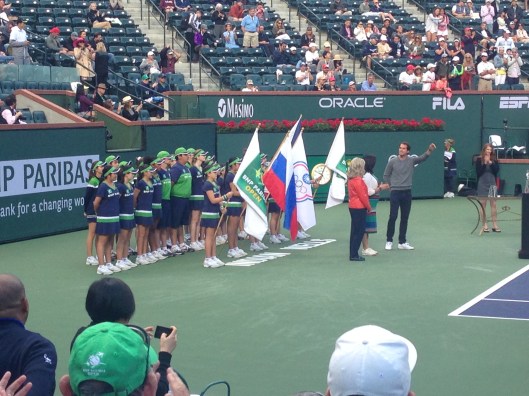
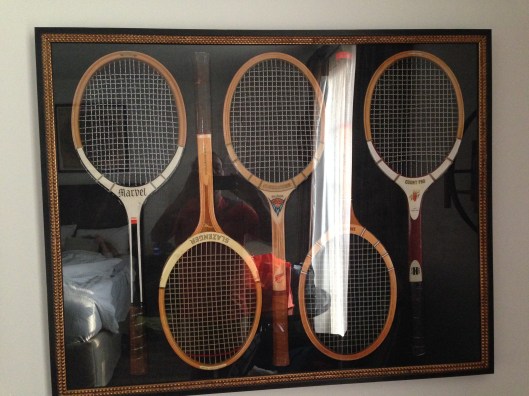
Let’s return for a moment now to consider that our society has professional athletes. Some people make a career out of playing a sport extremely well. But playing the game extremely well does not, in and of itself, enable professional athletics to exist. There have to be fans both at the venue and watching TV who pay, either with dollars or with taxes or with their attention to commercials. There are organizations who administer the sport. There are, in this example, thousands of coaches and tennis venues to develop the sport and spot prodigies early who then receive additional coaching and training. There are ranking systems and systems to seed players in tournaments. There are manufacturers who make tennis balls and tennis racquets which have evolved over time to allow more elegant play which pushes the game toward more extremes of human performance. This kind of evolution of artifacts does not happen “automatically.” It too requires communication and cooperation.
Indian Wells is just one event in one sport. If you dig beneath the surface just a little, you will see that nearly everything on the planet is the result of thousands of years of mainly cooperative enterprise. Of course, the players compete. They try their hardest to win. But they try to win within an agreed upon set of rules and regulations. If no-one followed the rules, there would be nothing very interesting to watch. If you’ve seen one bar fight, you’ve seen them all. There is no elegance and no beauty in watching thugs slug it out and waste time and resources. I dwell on this because it is critical to keep in mind that having a decent society that helps people thrive depends on having cooperation, teamwork, collaboration, and coordination. The individual human brain may be relatively large compared to an ape’s. But what really sets us apart is not our individual intelligence. Abandon a baby with a perfectly good brain into a forest by themselves and, if they survive at all, they will not behave much differently from an ape or a raccoon. They may scrabble for food and water, but they will not end up building a tennis court or constructing a tennis racquet.

It’s not turtles all the way down. It’s trust. It’s cooperation. That’s what makes us human. If we just grab everything for ourselves and lie about it, it subverts the very foundation of human life. Our human nature is to control our competition to acting within agreed upon boundaries for the good of all. If we forget that, we are not “lowering ourselves” to the level of wild animals. We are way below that. We are like a wild cat who refuses to use its hearing and fast reflexes to hunt. We are like a redwood tree who refuses to use the sun’s rays. We are like a deer in the forest who refuses to forage but instead expects other deer to bring them food. Willfully ignoring that we are a social species; intentionally lying in order to gain advantage to ourselves will never help create a bigger pie. In the short term, it can get you a bigger piece. But the cost is that you despoil what it means to be human. Grabbing all you can for yourself subverts the very essence of what makes humanity such a successful species. This has always been true throughout human history. Now, however, cooperation is more vital than ever both because we are on the brink of destroying the ecosystem we depend on for life itself and because we have even more brutally destructive weapons than ever before. We have cooperated through much of our human history. Now, we need to do it even more intelligently and more consistently — or face extinction. The earth doesn’t need us. But we need the earth. And, each other.
 ———————————————————
Author Page on Amazon: https://www.amazon.com/author/truthtable
 petersironwood