• About PeterSIronwood

petersironwood

~ Finding, formulating and solving life's frustrations.

petersironwood

Tag Archives: diversity

Me Too!

27 Sunday Aug 2017

Posted by petersironwood in America, driverless cars, psychology, Uncategorized

≈ 13 Comments

Tags

conformity, diversity, driving, learning, life, teamwork, traffic

earthfromspace

One of George Carlin’s routines captures well our attitude toward our own driving vis-a-vis other drivers on the road. Basically, we think anyone who wants to drive more slowly than we want to drive is an idiot while anyone who wants to driver faster than we do is an a**hole. We can all relate to being stuck behind someone who seems to be going much more slowly than necessary for the road conditions and traffic. It’s frustrating! We need to get somewhere! We might think, “Why do I have to be stuck behind this slowpoke?!” On the other hand, just as we are mentally or vocally swearing about the slowpoke in front of us, seemingly out of nowhere, some jerk comes careening out into the passing lane on a hill or blind curve and zooms around three or four cars. This time they were lucky. No semi was coming the other way and they lived — this time — despite their erratic driving and general a**holiness.

Driving is an ever-present paradox in cooperation and individuality. In many areas of the world, people rely on public transportation such as rail and busses to commute to work or see relatives and friends. That is not unknown in the US, but it is rare. If we can possibly afford a junker, we do so that we can have the “freedom” to take our own path. Yet, that freedom comes with a high cost. Not only do we have to pay for a car, insurance, gas, oil, taxes and upkeep. We have to follow a set of conventions and laws about traffic in order to minimize traffic accidents and even deaths.

According to Fortune, there were about 40,000 deaths in America in 2016 with 4.6 million people suffering severe injuries. The overall cost of traffic accidents, in terms of lost productivity, medical and property damage is estimated at $432 billion for 2016. The USA is far from the “deadliest” place to drive. Many other countries have far more accidents per mile driven. It is estimated that world-wide, there are about 1.25 million deaths per year from road accidents. Sadly, in the US, traffic fatalities often strike down young people in their prime. They are both less experienced and less cautious. Often, young people do dangerous things in order to “prove themselves” or “be accepted” by their peer group. Any such act, including texting while driving, puts at risk their own lives, the lives of their friends, and usually the lives of total strangers as well.

The monetary costs associated with accidents do not include lost productivity due to traffic jams. According to an article published in Money magazine, this was estimated to be 124 billion dollars in 2013 for the USA. This is a considerable amount of money. I am pretty sure, that’s way more than in my wallet right now. Let me check. Yep. Not even close. You know the old saying, “A billion here. A billion there. Pretty soon, you’re talking about real money.” These cost estimates do not even include the stress and strain that being stuck in “stop and go” traffic puts on the people stuck, the kids that get yelled at as a result, or the impact that higher blood pressure has on people’s brains, kidneys, and hearts.

What if I told you that George Carlin’s skit depicting people’s reactions to other drivers is only an accurate description of how people currently choose to react to traffic? What if I told you that you may well be subjecting yourself to stress and inefficiency in the way you handle stop and go traffic?

IMG_4695

To begin with, let’s think back to your days in “Driver’s Ed” classes in high school. Or, perhaps you were lucky enough to have attended a “defensive driving” course more recently in order to reduce your insurance rates or because a judge ordered you to. In any case, one of the basic concepts taught in those classes is that you stay an “assured safe distance” behind the car in front of you. In my informal polling, many people seem to have completely forgotten about this concept and, when asked, offer absurdly short distances as “safe” when it comes to how far behind the driver in front they need to be; e.g., at 70 miles per hour, some people think they should be one or two car lengths behind the car in front. That, my friends, is way off. You should be seven car lengths behind the car in front at 70 mph, not one or two. There are almost zero reasons you can be safely closer than that and having “really good reflexes” is not one of them. If you are going up a very steep hill, you can get a little closer. But there are many more reasons why you need more distance. These include poor visibility due to curvy roads, low light, fog, smoke or smog. They also include bad brakes, going downhill, a wet road, a snowy road, or an icy road. They include anything that is distracting you the driver such as kids, conversation, sleepiness, even the slightest bit of alcohol, or having the car in front of you following the car in front of them too closely. If your brakes or tires are the slightest bit compromised, you need even more distance for safety.

But following the assured distance for safety is not necessary the “best” distance; it is only the minimal distance for safety. If you are interested in driving “efficiently” — and having the traffic around you being more efficient, there is more you can do. If you are interested in driving without adding to your personal stress as well as adding to the stress around you, there is more you can do. Watch closely as you consider your current strategy for driving in stop and go traffic and an alternative strategy.

Let’s say that a car length is about 15-18 feet though obviously a stretch limo stretches for a lot more and a mini-cooper is much less. Now if you are traveling in traffic that varies from 70 mph to 0 mph, your minimum car length would also vary from 18 x 7 = 126 feet to 18 x 0 = 0 feet. When you are stopped, you might be near the rear bumper of the car in front of you. When you are going “full speed” you might be 126 feet away. If you do this, in stop and go traffic, what you will experience is a long series of frustrations. For awhile, everything will go smoothly, and you’ll go zipping along at 70 mph. But then, for no discernible reason, everyone will suddenly come to a screeching halt. You sit there for a few seconds or a few minutes, one of many people bumper to bumper with the a line of other cars. Eventually, people will start to go slowly. But then, they will all stop again. Or, perhaps they will speed up again and then stop. The traffic may even speed up to 70 mph again and then stop again, and once more, for no discernible reason whatsoever. You may find such phrases as “What the h*** is wrong with people!” caroming off of your cranium and rattling round in your brain. You try to figure out how you can minimize your time in this awful traffic. You look for tiny spaces. The lane next to you appears to be moving! Ah, there’s a space! Slam into it quickly. You do. Your lane is moving! Yay! All it once it comes to complete stop. The lane you just got out of now appears to be moving better. Just your luck! Wait, you can get back in. No! Some a**hole just got into that space from the other lane! Damn! Wait, everyone’s moving again.

This is a very frustrating way to drive — particularly if you are late, or just an impatient person or both. You are stopping and starting all the time. Your hour commute now stretches like taffy (or traffy) into two hours.  And worse than that, per se, is that this all seems senseless. And worse than that is that you are sending your blood pressure through the roof and even that magnificent sacrifice on your part seems to have zero effect on clearing up the traffic jam. And, even worse than that, in the long run, is that your experience is causing you to think very uncomplimentary things about your teammates. Teammates? Yes, your co-drivers — every last one of them — are potentially your teammates. But if you drive in traffic the way I’ve been describing, you don’t see them as teammates at all but more like competitors. And we all know what our job is in a competition, right? To win!! 

volleyballvictory

That same exact objective physical situation can become a completely different experience. And, to make the transformation is simple. I didn’t say it was easy. But it is simple. The key is to stop focusing on keeping the minimum safe distance between you and the car in front of you and instead keep a much longer distance between you and the car in front. The key is to stop focusing on your commute and your goals and instead to think of the traffic as a whole moving efficiently.  The key is to stop driving as fast as you possibly can and instead to try to match your speed to the average speed of the traffic ahead of you. If you do those three things, something amazing happens. You get to the same place in the same time but you will hit your brakes and accelerator far less often. Furthermore, you will feel far safer and less frustrated. You will be able to see a much larger picture of the traffic in front. You will notice that, yes, leaving a large space in front of you does make it possible for other drivers to zip in front of you. But you will also notice that most of the time, these drivers will zip back out of your lane a few moments later.

But wait! There’s more! When you stop putting your brakes on so much, it gives other people a completely different impression of the traffic. If a person is on a divided highway (with four each way) and only sees 4-8 cars ahead of them (because everyone is jammed together) and every single one has their brakes on, they will come to something of a screeching halt, particularly if they have been driving right behind the car in front of them. If, however, they look up and see only 7 of the 8 visible cars with their brake lights on (because yours are not on), they will be far less prone to slam on their brakes. Furthermore, they may well be able to see more of the traffic ahead because of the space in front of you. It no longer looks jammed so their behavior will be less erratic. If they are behaving less erratically, that will be true of the people behind them as well.

But wait! There’s more! People who drive mostly look forward, but they also hopefully glance in rear view mirror on occasion. This means that the people in front of you will also have a somewhat different perception of the traffic conditions based on the fact that you are not driving erratically and that you have a large space (=not stop and go; not crowded; not bumper to bumper) in front of you. You won’t have as much influence on the people in front of you as you will on the people behind you, but you will have some. You will also have a subtle influence on the people beside you. Why? Because they also see that large space. This puts them in a more “traffic is moving” frame of mind than a “traffic is stop and go; Crap!” frame of mind. Not only can they see the large space, they can see through the large space. They are able to see a greater number of cars diagonally ahead through your lane. They can see whether the tail lights are on. They can see perhaps 16 cars instead of just 4-5. The impression when you see all four cars stopped in front of you with their brake lights on is quite different from the impression formed when you see, say, 13 cars stopped and 3 cars moving. So, the cars beside you will also drive less erratically.

OLYMPUS DIGITAL CAMERA

But wait! There’s more!  This means that the cars in back of them will also drive less erratically. And that’s swell news for you and everyone else because — since people do look in their rear view mirrors, the impression of moving traffic will be even stronger in the drivers ahead of you. This in turn will ripple through the entire set of drivers and tend to be a virtuous cycle instead of a vicious cycle. In other words, just you, yes you, you one driver can have a significant effect on the entire set of drivers around you. I know it sounds too good to be true, but give it a try!

But wait! There’s more! Of course, very few people have only one commute in their life. Human beings have memory. If you are in “stop and go traffic” and stay smooth with a large space in front of you, a few other people will notice and decide to try it for themselves. Eventually, it may dawn on them that “despite” your large buffer space in front of you, you are making just as much progress as they are. They may think, “Me too!”  If those people try it and succeed in having a better experience for themselves and others around them, that will tend to cause other people to try it as well, not only in this traffic jam, but in future ones as well.

Driving exemplifies the paradoxical nature of the human condition. We all want the freedom to be ourselves and we want to feel a part of the group. But some paradoxes have solutions. In this case, as I said, the solution is actually simple. You decide that the best way to be a team player is to be different. You stop playing the game of making sure there are no “unused spaces” in traffic. You stop playing the game of switching lanes to zip into the smallest “unused” space. You stop staring into the taillights of a few cars and back off to where you can see a much larger sample of cars. You stop playing the “me, me, me, it’s all about me” game and instead make up a different game which is matching your speed to the average speed of the traffic ahead. You stop worrying if someone zips into the lane in front of you. Just ease off the gas a bit and relax. And, by being yourself, and playing this different game, you will actually make all the traffic around you work better. You are a better teammate by being different. 

The traffic is a lot like free market capitalism operating without much analysis, foresight, or insight. To the extent that people see an opening, they vie for it. Having two people do this at the same time, of course, causes a near miss, a sideswipe or a 20-car pileup. But generally speaking, the person who manages to gets into open space feels wonderful. OMG, I pulled it off! Not quite like winning the Superbowl but in that ballpark, so to speak. Chances are, the lane-switcher finds themself temporarily ahead of the people who had been next to them confirming that their act of private “heroism” had a practical impact as well; it was efficient by plugging up that damned hole.

This may be related to the line of thought so common in business that if you are really being efficient, every single minute of your calendar should be booked a week in advance. Gaps are anathema. Gaps are viewed to be even be worse than double-booked time. If word gets around I’m double booked all the time, everyone will know I am important. Well, important to some, in the same way that jeetos are important to some not despite their ghastly orange hue and anti-nutritional value. Having space in your calendar means you have time to learn, to observe, to think about what is going on, who is your customer, how can you do better, how can our company do better, and so on. It’s no accident that IBM’s motto was “Think” and that it was so successful for so many years in a dramatically ever-changing world of technology.

IMG_0052

You might just give the alternative strategy a try, both in business and in driving. Oh, I know. It seems impossible that one person’s behavior could have much impact when there are 7 billion people on the planet. Imagine that instead of using the 7 billion teammates as an excuse not to change because, “it won’t make any difference,” you thought: “Wow! Seven billion people on the planet! That’s potentially seven billion people who could change, even a little, in the direction of greater cooperation.” What if, instead of thinking of yourself — or you plus a small number of similar people — as being in competition with a much larger number of people worldwide, what if you thought of 7 billion as the astounding number of teammates you have? You might not influence all of them, but you can influence some and they can influence others. Nearly all of those seven billion people use language. Think about that. At some point in our distant past, people did not use language. Now, they do. How did that happen? At some point in our past, people did not have power over fire. Now they do. How did that happen? At some point in my lifetime, no-one had a mobile phone or a personal computer or access to the internet. Now, billions do. Can you hear the music of people working together?

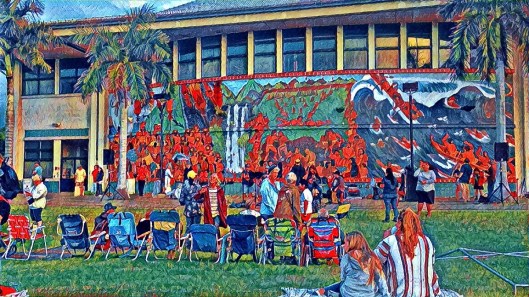
For several years, in the 1990s, my wife and I attended the Newport Folk Festival with John and Clare-Marie Karat. We heard an amazing array of great bands in a beautiful outdoor setting. I particularly like outdoor concerts because of the room it affords for dancing. I find it very difficult to sit still in the presence of stirring music. This concert was held in late summer and the weather was generally, hot, humid, and sunny or hazy. Although, as I said, the weather cooperated most days, one particular morning looked ominous. A particularly cool, hazy sprinkling morning warned us to wear clothes in layers and bring rain gear. An optimist, I wore my speedo underneath in case the weather cleared so I could dance in the sun which I hoped would soon appear.

When we arrived on the island, as usual, Wendy and Clare-Marie sprinted ahead with a blanket to get a prime spot for watching the stage while John and I lagged behind carrying the clutter and clatter of chairs and coolers. The music inspired as always but the weather was not cooperating. Everyone was huddled down in their rain gear, under their umbrellas. The thing about rain gear and umbrellas is that they are typically designed for keeping you dry temporarily in the rain. After sitting there with ten thousand other people, huddling and shivering in the cold rain, I finally decided enough was enough. I stripped down to my speedo and began dancing. After all, I thought, that’s what I came there to do! And, while most people dance to the beat of the music, I let the music dance through me. I don’t have some set moves that are done to the beat. Rather, every note impacts what my body does.

Now, the situation had changed. Instead of ten thousand people huddled under umbrellas getting wet and cold, there were only 9,999 people huddled under umbrellas getting wet and cold and there was one person, namely me,  joyously dancing in the rain. As a matter of fact, I felt warmer dancing in my speedo than I had sitting still under layers of soaking clothes. Yeah, people stared at me a little. So what? Michelle Shocked commented on how well the crowd was holding up in the horrid weather and gave a particular shout out to the guy “dancing nude” in the middle. Just for the record, I was not dancing nude (not even in my “tights”). There was a large umbrella right in front of me, and it might have looked as though I was nude from the stage. In any case, I kept dancing and I was having a great time. Then, a strange thing happened. A few more people got up, shed varying amounts of clothes and joined me. Now a half dozen people were dancing in the rain. Then, a dozen people. Then, two dozen. The rain continued and the cold continued, but the number of dancers grew and grew till it was probably over a thousand. Each person discovered for themselves, as had I, that it’s actually warmer and more comfortable to dance in the rain with a little clothing than to sit in a puddle of soaked clothes — not to mention, one hell of a lot more fun!

RainWaterGutters

When we first sat down in that cold rain, everyone looked around and saw that everyone else was coping with the rain in the same way. Everyone they saw had raincoats, umbrellas, or both. They looked at this spectacle and thought, “Me too!” But now, a few hours later, many people looked around and saw folks joyously dancing in the rain and thought, “Me too!” Indeed, “Me too!” is a double-edged sword. Use it wisely, whether it is dancing in the rain, leaving lots of space in stop-and-go traffic or taking the time to think in your job. You may be very pleasantly surprised at the results, both for you and your 7 billion planet-mates.

———————————————-

https://www.amazon.com/author/truthtable

http://fortune.com/2017/02/15/traffic-deadliest-year/

http://time.com/money/3511481/traffic-jams-cost-americans-124-billion-time-money/

https://en.wikipedia.org/wiki/Newport_Folk_Festival

The Dance of Billions

Claude, the Radio Operator

28 Sunday May 2017

Posted by petersironwood in America, apocalypse, family, management, Uncategorized

≈ 6 Comments

Tags

communication, dinosaurs, diversity, family, learning, politics, soldiers, stories

PicturesfromiPhoneChinaParisPrinceton 278

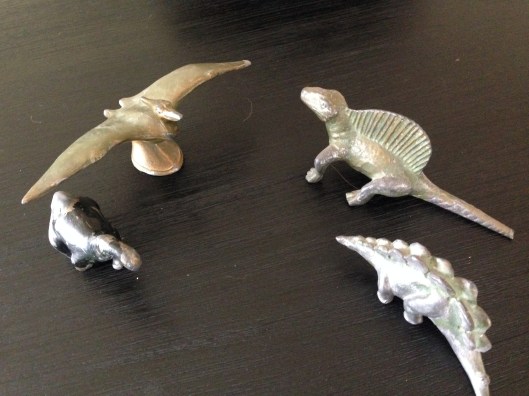
When I was about seven, I got my first bronzed dinosaur, the Tyrannosaurus Rex. I earned bribe money for being good about getting my butt stabbed by penicillin shots. In any case, I discovered these dinosaurs on the last page of my grandpa’s The Natural History Magazine. They looked really cool! The designers had chosen to make the T-Rex’s forearms look more robust than would have been a perfectly scale model with those teeny hands. The T-Rex was great! It was solid and cold and heavy because it was metal. There is something about metal or wood or stone that resonates with me much more deeply than plastic ever could. (Sorry, plastic. I know you are a cool invention and really inexpensive and very malleable and all of that. But, you just don’t touch my soul like wood, metal, and stone do.) When I moved the T-Rex, my muscles felt it. Perhaps this is one reason that I still have much of my dinosaur collection 65 years later. (How many of your plastic toys do you still have from 65 years ago?) I didn’t think so. But they are out there somewhere, along with my own forgotten plastic toys, polluting the world for centuries to come.

Bronze, as you have seen many times in your life, does not look worse when it oxidizes as iron does when it rusts. Instead, Bronze turns a beautiful powdery light green with the slightest hint of blue. So, T-Rex looked beautiful as well.  So, you might well think that the next time I had enough cash for one of these statues (1$ for the small size and 2$ for the large size) I would get another T-Rex. No, I got a Dimetrodon and a Stegosaurus. Later I got a Trachodon and a Brontosaurus. Anyway, what was fun about this diverse cast of characters is how different they were from each other and the richness with which they interacted. There’s no way it would have been as much fun if it were one army of T-Rex’s against another. (Poor brontosaurus’s tail fell off many times but my dad is no longer here to solder it back and anyway, the tail got lost in the last move).

IMG_0771

Similarly, a few years later, when I owned toy soldiers, I enjoyed having ones with different properties; that is, mainly different weapons. Liking the variety must have been true for other kids as well because the sets that I could buy were always mixed. My favorite type of soldier were hollow lead ones.  They were well enough hand-painted that you could see their faces, although not so well that you could determine whether they were fighting out of hate, out of fear, loyalty, patriotism, duty, because it’s a job, or for some private demon. I especially liked the bazooka men. I think I owned four of them. Of course, this weapon takes a while to reload and there probably aren’t a huge number of rounds. On the other hand, there were machine gunners, riflemen (more of them than anyone else), and a couple of officers who were pointing a pistol. There were also a couple of dudes sitting on the ground with a *serious* machine gun tucked between their spread-eagled legs. There were also a couple of hand grenade throwers. Another soldier had a rifle with a bayonet raised up above his head. This made arranging them for a pitched “battle” all that much more interesting. Although they had very different weapons, all of them had obvious lethal capabilities. All but one. There was one poor guy with no weapon whatever. His job was communications. His only visible “weapon” was a rather large boxy radio set. I suppose in a pinch, he could whack someone in the face with it. Even if that didn’t kill them, it would for sure put a crimp in their dinner plans.

It was difficult for me to decide which one of these soldiers I would “be.” I liked the bazooka man a lot. The rifleman looked cool. By the way, there were three versions. One type of rifleman lay on the ground with legs spread and the rifle stabilized by his elbows on the ground. Another type of rifleman sat on the ground and put the rifle across his upright knees for support. The third type, and my favorite, was the proudly standing rifleman. Thinking about it from an adult perspective, he’s probably the guy who was voted by his platoon:  “most likely to die quickly.” But I didn’t think about that then. Sometimes, I thought it would be cool to be the officer pointing the pistol. Obviously, in most ways, it wasn’t as devastating a weapon as a rifle. Although conceivably in very close quarters, he might outmaneuver a rifleman. But there was one guy that I definitely did not want to be.

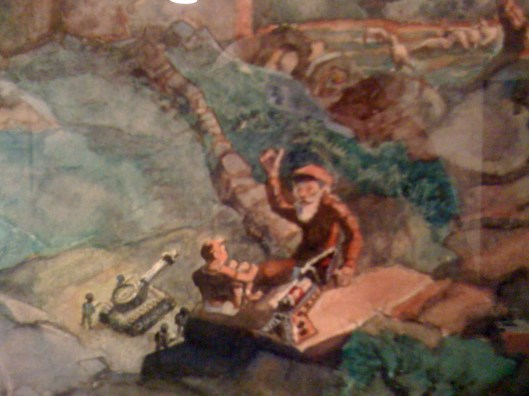
You guessed it. I never wanted to be the guy on the radio. Let’s call him “Claude.” Claude didn’t get to actually fight! And, it seemed to me at that point that I could stay alive no matter what obstacles and enemies were thrown at me — if only I were an excellent enough rifleman (or bazooka man, or pistol-wielding officer). On the other hand, it seemed as though “anybody” could do Claude’s communications job and would do it equally well. Furthermore, it seemed any enemy could just walk right up and shoot this dude Claude before he knew what hit him and way before he transforms his awkward radio set into a lethal weapon. Of course, Jason Bourne could do it, but I don’t think Claude had that kind of training. And, anyway, the first movie didn’t come out until 2002 and this was the early 1950’s. Treadstone didn’t exist back then. (BTW, this is not “my” Claude but it’s the closest image I could find.)

Claude

As I mentioned, these hand-painted lead soldiers were my favorites but I owned three other types. One were extremely detailed and beautiful lead soldiers. These suckers were expensive and, as I quickly discovered, not very durable in real “battles.” When you smashed them into each other, the horses tended to break, or what was more typical and worse, not break but bend into an uncomfortable and unrealistic position. At that point, I would very carefully ease the broken leg into position, Angstrom by Angstrom… Snap!! It would break off in my hands. That was worse. I felt as though I had personally snapped that beautiful white horse’s leg in half. It always seemed as though I could ease it back into position and I almost succeeded each time. Then, SNAP. Suddenly I am holding a three legged horse in one hand and a piece of horse leg in the other. My favorite of these collections were the “Coldstream Guards” with their white and bright red uniforms with splashes of gold.  It is sad, I can tell you, to be an eight year-old general and not be able to put your most beautiful soldiers into battle. But, beautiful as they were, they were fragile. I did manage to break a few of the hollow leaden ones as well, but I had to work at it.

Then, there were unpainted plastic soldiers. They came in a kind of gray-green suggestive of olive drab. Let’s call it “off-olive drab” like the olive from that bottle of garlic clove filled green olives that you accidentally left at the very back of the fridge for five years. Then, when you finally discovered, it, the olives looked as toxic as rain forest frogs; but far from a beautiful bright warning color, these were so drably off-olive that you almost didn’t see them. But, as for the soldiers, it wasn’t just their uniforms that were off-olive drab. All of them, including the little flat plastic stands, their expressionless faces, and their normal-sized (well, normal scaled I should say) hands exuded that same toxicity of colorlessness. Their one giant advantage was that they were far cheaper than the painted leaden ones. And, whereas the fancy ones were fragile and the leaden ones were rugged but breakable, these all-plastic soldiers could not be broken. For some reason, I do know that they can be cut with an ordinary steak knife provided you have enough patience and are smart enough after you’re caught the first time “ruining” the steak knives, to make sure the second time you experiment when you’re alone. The plastic ones can also be melted. However, melting them had the side-effect of greatly disturbing my parents because of the toxic fumes that permeated our house. (I think we will have to leave for another time the question of why I wanted to know these things). One great thing about these plastic soldiers was that they were to the same scale as the metal ones. So, they could all participate in the same battles without stretching the credibility till it snaps like a rubber band and stings the soul of make-believe.

Ah, but there was as well a fourth type of soldier. These were insanely cheap plastic soldiers! A hundred soldiers for a dollar! I ordered two sets so I would have an amazing two hundred soldiers along with the probably 75 I already had. And then they arrived. Yay! Imagine! My army would now rival those of Caesar, Hannibal, Grant, Patton!

My first clue that something must be terribly wrong was the size of the shipping box — unbelievably small for 200 soldiers. I opened the boxes and then got to the actual soldiers. They were in 2 point font.  They were approximately the size of one of the feet of my other soldiers. And, these soldiers gave a whole new depth of meaning to the expression, “cheap plastic.” These soldiers were fabricated out of some material that was like what plastic uses when it doesn’t bring out the good stuff for company. And, “fragile” doesn’t quite do justice to the care with which these teeny slats of plastic needed to be handled. Oh, by the way, speaking of “slats,” did I mention that they were two dimensional? Did I mention that not only couldn’t you discern the motivations of the solider from their face, you couldn’t discern whether they even had faces. These soldiers were not of molded plastic; they were basically stamped. In fact, each solider had to be detached from a long plastic rod by twisting.

How could I have possibly known I would waste my two dollars? The picture that accompanied the advertisement for these soldiers depicted something other than their product. The picture showed something every bit as detailed and colorful and three dimensional as the hollow leaden soldiers. These same comic books also advertised “sea monkeys.” In the picture, there are “families” of little human-looking aquatic monkeys. You can tell what mood they are in and how the various family members interact. Well, I thought this was fantastic! But I didn’t totally believe it was possible either so I asked my grandpa whether they were real. He said they were just brine shrimp. I also saw that there was a teeny asterisk in the corner of the picture, half hiding in the seaweed that some of the “sea monkeys” were harvesting for the family meal. Then, in almost unreadably tiny type, the asterisk was explained, “visual depiction may not precisely duplicate visual characteristics of crustacean provided”  or some equally incomprehensible legalese gibberish that very few 8 year olds are going to comprehend (in the more recent version shown here, I don’t even see that cryptic warning).

SeaMonkeys

Apparently, we live in a society where that’s okay. I think part of the reason it’s okay is that we live in a very differentiated society. If you think about the single artist, craftsman, or chef, they are much more about substance than puffery. You don’t typically expect someone who makes something to be dishonest about what it was they did. However, hiring a advertising expert brings into play a different set of factors. The advertising person cannot make a better painting, or chair or soufflé. Their expertise and their “product” is in making people buy the substantive product. If they can lie, exaggerate, or mislead and get away with it, so long as sales go up, that is a win for the advertiser. Needless to say, they would never describe what they do as a lie. Because, after all, who would advertise a “lie” as being a “lie”? Then, you might not want to buy one. They have a whole raft of explanations as to why what they are doing is really in everyone’s interest. They’ve rehearsed it and perfected it and —- since this is what they expert in — they will probably have you agreeing with them. I’m not sure it is just fine and dandy, especially when it’s combined with a low quality product such as brine shrimp or “toy soldiers” that are too small to be used or played with as toy soldiers. In these cases, the actual product is nothing like what they “depicting” it as.

It gets a bit murkier when their are unstated but implied benefits. BMW actually does make a fine car. However, you are not going to be driving it long if you drive it the way it is portrayed on commercials. Similarly, a car is not going to be very often the snappifying head-turner among young people seeking a mate that the advertisers would have you believe. It isn’t merely that advertising tends to have us spend money on products and services that aren’t really filling our needs, although that is problematic. We spend a huge amount of money on junk food, cosmetics, and so on — and more than on medical research. But in addition to that, doesn’t it seem to undermine the meaning of truth in all human discourse? Or, is it okay to lie if you are an advertiser because they are doing it for money? In other words, it’s okay to lie if you are benefiting yourself, perhaps because you are undoubtedly benefiting your client even more?

We are more and more and more connected electronically. This is good news. And this is bad news too. One thing, though is certain. The potential impact of a lie is tremendous and much much more than it was in the past. In distant times, a lie had only local impact. Now, a lie could literally destroy the world. So, to me, the balance point of when it’s “okay to lie” is way different than it was 20,000 years ago.

I believe there is a way for people to provide value to each other honestly and still have a thriving economy. In any case, even if we never reach that point and advertisers continue to oversell products, can we at least try to be vigilant not to let that attitude toward the truth permeate every other aspect of life? A large complex and highly differentiated society can only exist in an atmosphere of trust. You must trust that the drivers of the other cars on the road are not trying to kill you. You must trust that the food you buy is not poison. You must trust that the policeman is there to protect you. If that trust breaks down, there is no longer a society. So intentionally lying in order to make a buck (or a point) is really a push toward utter chaos and anarchy. Obviously, no single push will bring us there, but we must be extremely careful. Why? Because lack of trust is contagious (as is trust). A slight imbalance between trust and mistrust could become a vicious cycle. Information is the resolution of uncertainty, not the multiplication of uncertainty.

A communication network of people becomes more valuable as the number of people increases. A network of, say, 350,000,000 people is much more valuable than 10 relatively homogeneous networks of 35,000,000 each. And, to take this to the extreme, it’s much more valuable than 350,000,000 networks of one person each, no matter how smart or strong that one person is or how many treasure-troves of weapons they have. We need to work together whatever differences exist. That’s why it’s important that we all keep communicating. That’s why it’s important that we try to be as truthful as possible. That’s why I now think that Claude, the radioman, may be the most skilled and crucial solider of all.

IMG_1289


(The story above and many cousins like it are compiled now in a book available on Amazon: Tales from an American Childhood: Recollection and Revelation. I recount early experiences and then related them to contemporary issues and challenges in society).

Find it on: my Amazon author page

Family Matters: Part Two – Garlic Cloves and Puffer Fish

11 Thursday May 2017

Posted by petersironwood in America, family, management, psychology, Uncategorized

≈ 6 Comments

Tags

diversity, evolution, family, life, religion, school


PicturesfromiPhoneChinaParisPrinceton 177There are many directions to go for the first sequel to “Family Matters: Part One.” That blog focused mainly on my family of origin, so one obvious place to go is to talk about my children and grandchildren. But I don’t really want to speak for them. After all, they can still talk back. My parents and grandparents cannot. But the real reason is that everyone should get to define themselves, at least to the extent that it’s possible. I think it is possible to a great extent, but not completely. Not everyone can become a pro athlete or a great musician even if they try really really hard. Luck and innate predispositions play a role in our fate.

Certainly, there are many “how to” books out there that would lead you to believe that the only thing that stands between you and owning the universe is your attitude. It isn’t a totally bad thing to imagine that you can do anything and have no limitations due to circumstances or your innate abilities and predispositions. It’s a fiction, of course. It’s a complete and utter fiction. If you spent the first five years of your life drinking lead tainted water, e.g., no amount of the proper “attitude” is going to undo the harm. But, for people whose main obstacle to a fulfilled life is self-doubt, it could provide a good antidote, or at the very least, a few good anecdotes that arise from a series of unfortunate incidents taking place from following such advice.

What I have in mind however, is something different; viz., trying to show how family situations tend to be continuous threads in a way that is analogous to the continuous genetic threads. For example, my grandmother used to tell “Old Pete” stories and ran a dramatic club. My mother became an English and Drama teacher. I have always loved acting and storytelling. Several of my kids and grandkids have also written originally and extensively. My mother’s brothers all were jokesters and storytellers. Her oldest brother Karl was a principal and then superintendent of schools. The middle boy, Bob, became a psychiatrist. The youngest, Paul, became a lawyer. The next generation included two psychologists, two lawyers, a neurosurgeon, a teacher. I could elaborate further but the point is that storytelling, art, psychology, and education as well as science and engineering are threads throughout this very local part of my family tree.

Before I go any further, however, I need to explain why I subtitled this, “Garlic Cloves and Puffer Fish.” As a side note, it’s good to remember that both garlic and puffer fish are our distant cousins. The same basic machinery that makes the cells of a garlic plant “work” and live and reproduce is what does all those same things in our cells. And our other, somewhat less distant cousin, the Puffer Fish has that same machinery in every one of its cells. Of course, beyond that we even have most of the same organs and types of symmetry as the Puffer (or any other) Fish. Now, I bring up our relation to these distant cousins because I would like to have you view what I am about to say about various people as being observational and not rendering value judgements. It would be silly to go out to a garlic plant and yell, “Why can’t you be more like a Puffer Fish?!  What’s wrong with you?!” It would be equally ridiculous, of course, to go snorkeling and when you encounter a Puffer Fish scream at it: “What are you doing out here in the ocean? Why can’t you be more like your cousin Garlic who at least makes wonderful tasting (to most) and health-giving nutrients? No, instead, you poison people! What’s wrong with you?”

IMG_6609

Now, when it comes to people, of course, it isn’t just their genes that determines behavior. The family, neighborhood, culture, religion, and physical environment that they grow up in determines, at least in large measure, who they become. Humans come in many varieties. This is both because, when it comes to our own life, we can actually make ourselves different in some ways on purpose (there is a grain of truth in the “positive thinking will win you the universe” genre) and secondly, when it comes to someone perceiving us, their own background and character will determine what they see in you. Similarly, your background will help determine what you see in others. If you think back on your own experience, you’ll see this is true. Anyway, among these many ways that people differ is how neatness-oriented they are. The hit TV series, The Odd Couple, featured two bachelors living together; one was an utter slob (Oscar) and the other was a neatnik (Felix). We all probably know people close to those extremes. We may even know two such people in our family as defined with a small circle to say your second cousins. I’m not trying to say one of these characteristics is better or worse than the other. But I would like to point out that each makes a lot of sense, under certain conditions.

Some years ago, I was watching a TV program about Alice Waters, a famous chef, restaurant owner, and author. She believes in such things as organic, locally grown ingredients. In any case, she happened to make this offhand comment that “it didn’t really matter if a little piece of the garlic skin clings to a clove” {at least in the context of the sauce they were making for a huge fish}. Anyway, I do most of the cooking in my house and I do try to remove the skin of garlic cloves. Most of the time, it’s fairly easy. But every once in a while I have encountered a clove of garlic that is as pathologically stubborn about giving up its skin as a corrupt politician is about giving up the illusion of sanctity. Even a garlic plant has its own personality, I suppose. On the scale of neatnik to slob, I would put myself near the middle. Of course, to anyone who thinks it’s good to be super neat, I will seem like a slob. And to anyone who thinks cleaning is just not worth the trouble, I may seem like a neatnik. Anyway, my point is that maybe there comes a point where you don’t generally have to be absolutely precise in cooking. And I would guess that this rings true with your experience as well. There are some cooks whose approach is very intuitive and, although they may follow a recipe, their measurements may not be totally accurate. And, then their are cooks who will follow directions extremely carefully. Generally speaking, it doesn’t make that much difference. I tend to prefer dishes such as mixed ginger/curry vegetables, burritos, or omelets. In these dishes, you can get away with a huge variation in proportions and specific ingredients. I give these dishes care and attention to detail, but all within very broad parameters.

IMG_6516

In at least one case, however, it is crucial to be a “neatnik” cook and that is in the preparation of the Puffer Fish. The Puffer Fish contains a highly potent neurotoxin called tetrodotoxin. Most of this toxin is in the liver, skin, and other internal organs. It is very easy if you are even the least bit sloppy — and we are not talking Oscararian sloppihood, just normal college guy sloppihood — to nick something and release the poison into the flesh making it potentially deadly. Under those circumstances, being a neatnik is vital. In some cases, expert chefs push a little further and allow a tiny bit of the toxin to bleed into the flesh which will cause a “high” in the eater, but not be fatal. Personally, I think I’ll stick with tuna. The point is that being extremely neat and careful can be a very good thing. Packing your parachute — good to be careful! Performing cataract surgery — be precise!

On the other hand, suppose that you are spear fishing or out gathering nuts. A “neatnik” might want to make sure every fish is skewered in exactly the same way. Except, perhaps for Puffer Fish, it doesn’t matter that much; the point is to catch the fish. Similarly, if you are gathering walnuts, there generally isn’t much point in arranging them by size. Suppose you are making a rock wall. You would do well to make sure it doesn’t fall down but the way to do that is by careful arrangement and filling in the cracks carefully with cement. An alternative approach is to insist that every rock is exactly the same. This would make building the wall much easier. On the other hand, it would be absurdly time consuming to search for rocks of precisely the same size. Other approaches are to have one group of people cut rocks to preset measures and then the job of building the walls is easier or to make artificial rocks called “bricks.” Under various circumstances, any of these methods will work just fine. In other circumstances, any of these approaches might fail. It isn’t quite so simple a matter as Disney and the Three Little Pigs would have you believe.

When it comes to recipes, whether for bricks or for soufflés, It is difficult to know ahead of time which aspects of the process require a Felixian attention to detail and which aspects are fine for a more Oscarian approach. And, just as there are situations that are particularly suitable and best done by Neatniks there are other situations particularly well suited to Slobs, this same principle holds true for every approach and personality trait that I can think of. So when I describe people in my more extended family, I am not trying to pass judgement on who is better than whom. You might imagine that there is an attempt on my part to make out someone as “bad” or “good” based on your own personality preferences. Similarly, it’s quite possible that I accidentally make one or the other kind of personality sound better based on my own preferences than they really are.

Although it is quite natural for people to express different preferences on the neatnik to slob dimension, it is often a source of tension, argument, fights, and in extreme cases, probably divorce and murder. Most often, when an “Oscar” does something annoyingly sloppy, (and which to Oscar is actually typically exactly nothing), Felix will not try to dialogue about the situation and negotiate a solution. Rather, Felix’s first move is more often to call out Oscar’s character as being deficient because he is such a slob. Immediately and quite predictably, Oscar’s defenses go up. His next move is to point out that Felix is insanely OCD. And thus, the problem moves from what is immediate, simple, and fixable to one that is long-term, complex, and unfixable. Oscar will never convince Felix to be like Oscar and Felix will not ever convince Oscar to be like Felix. In fact, for Felix to even expect Oscar to act Felixian is rather silly.

You have undoubtedly heard the expression that you “marry the family” as well as your own spouse. I found this unfathomably silly when I was younger, but now I see that in many ways it is true. For example, if your spouse has unresolved issues from their childhood, those can impact your relationship. If your spouse’s family is into crime or drugs or unnecessary drama, those will certainly impact you. These people will almost certainly interact with you and your kids so they will impact your lives directly and indirectly.

Keeping all this in mind, let’s tune into “Uncle Al.” Al worked at one point as a commercial artist. In such a position, being something of a “Felix” probably worked to his benefit. But not every situation calls for OCD. Al lived in one of two houses at the end of a dead end street. What would you do if you drove to the end of his narrow, dead end street? Well, one possible action would be to abandon your car at the end of the street and walk home to buy another car or just wait there until you were beamed up by aliens. Most people however, would instead go into one of the two driveways at the end of the street, turn their car around and drive back out the dead end street. Al didn’t like that. I suppose most of us might be mildly annoyed. But after all, what else could people do other than abandon their car or back out the entire length of the street? So, while most people might be a little annoyed at strangers using their driveway for a U-turn maneuver, Al was instead, very annoyed. So annoyed was Uncle Al that he paid to have five steel posts put into the end of his drive. Indeed, this completely prevented any stranger from using his driveway as a place to turn around. Chalk one up for Uncle Al.

steelposts

Now, you may have detected a slight flaw in Al’s plan. He could no longer use his driveway either. For that matter, he could no longer use his garage to house his car either. But to Al’s way of thinking, that was worth it because he had achieved his goal. The phrase, “cutting off one’s nose to spite one’s face” comes to mind.  At another point, several of my ex-brothers-in-laws went over to clean Uncle Al’s house. When they opened up the refrigerator, the shelves were all filled with the same thing. Can you guess what it was? No, you probably can’t. Every shelf was filled with tiny paper mini-ramekins. And in each of those tiny paper mini-ramekins was tartar sauce. Upon questioning, the story finally came out. Every Friday, Al went to a nearby diner where they had an “all you can eat fish” special. The fish came with tartar sauce. Uncle Al hated tartar sauce. But he had paid for the tartar sauce! So, when he left the restaurant, he took the tartar sauce with him each and every time.

This seems a little on the crazy side, but I would guess that almost everyone has sometimes taken something that they have access to even though they end up not using it. In fact, it’s a little odder and more selfish than that. We might even know when we take the items that it’s very unlikely we use them. For example, in the IBM cafeteria, I would often take an extra napkin. Why? Because on rare occasions, someone, possibly even me, would spill something and having an extra napkin that could be deployed jack-knife quick proved very handy.  But most of the time, these hypothetical emergencies failed to eventuate. Now, what to do with the extra napkin? I could put it in the trash, or since it was clean, put it in the recycling. To me, taking the time and effort to recycle is completely worth it. Not everyone does that. We can return to that later, but re-use (or in this case, first use) trumps recycling. So, I would take the napkins back to my office. I had one drawer in particular that ended up with a collection of napkins as well as tea bags, plastic forks, tiny packets of salt and pepper, and other food-related items. Small stuff. There were no stashes of candy bars or soda cans or deer carcasses.

However, this example of hoarding was not an idle and useless exercise in hoarding. When people in the lab had birthdays or other types of celebration, it actually turned out to be quite handy to have a nearby supply of napkins and plastic forks. When I thought about the design rationale for this procedure, I never thought to myself, “I paid for this dinner and there’s no rule against taking two napkins, so I want to keep what is mine.” In terms of explanation, my saving napkins and Uncle Al’s taking tartar sauce are light-years apart. But looked at in terms of situations and behavior, there are actually a lot of similarities. As already explained, all of us are closely related. Although Uncle Al was not “related” in the way that people generally use that word, our ancestors were common for billions of years. So, I would hypothesize, the behavior of keeping something that is not of immediate use but could be used in the future is one that is found broadly in the animal kingdom and in plants. We imagine that the desert plant that stores water in it’s thick leaves does not “think about it.” It seems pretty silly to think it thinks at all. But let’s expand the idea of how information is coded just a little. It wouldn’t make a difference if the rationale were written in Spanish or English or French would it? It wouldn’t matter if the design rationale were printed in 14 point Helvetica or 12 point Times New Roman. It wouldn’t matter whether it was coded in ascii or EBCDIC. So, why not extend the concept a little further. The “design rationale” for the plant’s behavior is coded in it’s DNA.  We may not be able to “read” this design rationale quite as readily as we could one printed in our native language. But that is basically a matter of convenience, not a matter of underlying truth. The plant does have a design rationale for being “greedy.”

When it comes to human behavior, of course, there are not only genetic determiners but also social ones. (Actually, this can be true of non-human animals as well). So, it isn’t just that people may have a genetic propensity for keeping extra items for future use; their particular culture has inculcated values and design rationals and ethics around greed, waste, generosity, and so forth. The design rationale that Al gave, I find too self-centered for my taste. My Mom was generous to a fault. And, when I say she was generous to a “fault” what I mean is that she was so generous that she would often give away the same item to several people. So, perhaps being overly generous can be a fault?

In any case, just as people come in all sizes and shapes, they come in all kinds of behavioral predispositions. These predispositions are probably weakly related to your immediate family both because of where you live, among other things. There is no one “right answer” as to which characteristics are “best” under all circumstances. Some may innately be predisposed to Felixism while others may become that way because of strict teachings by their parents and schools. Regardless of why Felix is a neatnik, Oscar is never going to convince him that he (Felix) should be like Oscar. That was true in paragraph ten and it is true in paragraph 17. One thing should be clear to both Felix and Oscar: if they can work together effectively, they will be able to solve a wider range of problems than they would working alone.

Creativity and diversity are always vital, but probably never more so than right this minute. Humanity has changed so much in every external way in the last two thousand years and most of that since the industrial revolution and most of that after the computer revolution. Change is not only rapid, it is rapidifying. Yes, I made that word up. That’s another symptom of the same thing. Change in media, language, meaning are all happening more and more rapidly. So, in times of such great change and such great uncertainty, it has always seemed to me to absolutely and vitally important to include every viewpoint on the problem that we possibly can.

If I am lying on the beach under a sunny sky, feeling healthy and happy, I don’t really need your advice much, at least not this second. Yes, I may not be as neat as you would like or I am far too neat but I don’t really care and it doesn’t matter. You be you, and I’ll be me.

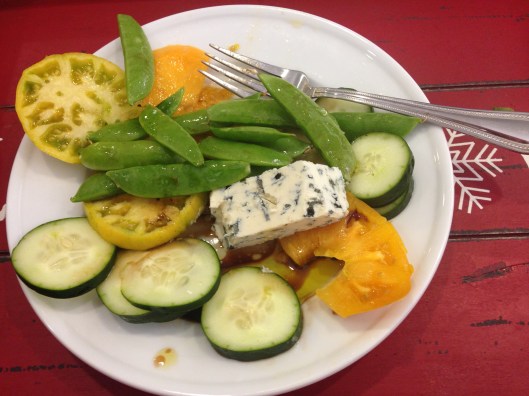
On the other hand, if I am thrown into something beyond my comprehension, I would want to have as many eyes on the problem as possible. Of course, it feels more comfortable to surround yourself only with those who already agree with you rather than a highly diverse group. You won’t argue as much about what the problem is or about what “fairness” really means or even argue about the right process is for combining your insights. A diverse group can initially provide a slight “shell” of added awkwardness for some. In my experience, when people are focused on a situation or a problem, they get past that very quickly and every stage of the process is enhanced. There are more ideas generated, higher quality ideas, the evaluation of ideas is more robust; they generate more ways to fit ideas together. Not only is the output of the group improved. It is just plain more fun during the entire process. Perhaps a better term would be to say that it is more engaging. If someone has a slight accent, you need to listen more closely. If someone comes from a different background, not only do they provide a different way of looking at things or even solution; they also stretch your mind. It may not be as broadening as  traveling to another culture, but it is more than one step in that direction. An all-celery salad gets old fast.

IMG_6371

Beyond all that, it seems important to remember that these variations in human predisposition are not entirely new human inventions. Many species of plants and animals exhibit different “philosophies” or “strategies” for dealing with the same issues: getting food and water, finding a mate, reproducing, avoiding predators, etc. (Yes, plants do these things). What works for a plant in one climate will not do in another climate. Of course, it isn’t just the climate. It also depends on what other species are present, the nature of the soil, etc. Some plants, for instance, put time and energy into making flowers to attract bees, having the bees fertilize the flowers, grow the fertilized flower into a fruit that is both colorful and tasty. This means the fruit (e.g., wild strawberries or raspberries) are eaten by our cousins the rabbits and carried in many directions out from tree by the rabbits. The rabbits excrete the digested seeds which now find themselves in a tiny pre-fertilized plot. Come on!  How about a hand of applause? Do you see how many ducks have be lined up her for this plan to work?

I may have had a reputation for being a little off the wall, but this plan? This is my craziest idea on a combination of illegal drugs and then put through a cognitive blender. I worked in “Corporate America” for about 40 years. I worked for IT companies, but let’s imagine instead a company that made self-reproducing garden ornaments. The way they worked was that each ornament, after one year split in two. Anyway, they were making good money. Now, I go into the top management and say, “Hey, I have a great idea for how to have these ornaments reproduce. No more just splitting in two. Instead, each element will grow a little ornament on top of the ornament but brightly colored. This will undoubtedly attract some sort of something which will fertilize —- oh, wait, did I tell you about the whole “two sexes” deal? Anyway, we’ll then have a process for turning a fertilized element into a fruitling. The fruitling will be fortified with vitamins and sugar so that … um … something will come along and put this into its belly and carry it away into the neighbors yards where they will help build the first step of the new ornament. Give me funding for about 100 million years of experimentation and I can pretty much guarantee….” No, they would not fund a project like that. Evolution is a slow smart cookie. That tree of living things? That’s our tree. And that little teeny branch way over there? That includes Oscar and Felix and everyone else regardless of gender, age, race, religion, or hoardingness.  Does it really make sense for us to destroy the whole branch if we can’t go in exactly the direction we want? And what about how the decisions affect every other part of the tree? It is, after all, a family matter.

(The story above and many cousins like it are compiled now in a book available on Amazon: Tales from an American Childhood: Recollection and Revelation. I recount early experiences and then related them to contemporary issues and challenges in society).

Tales from an American Childhood

Newer posts →

Subscribe

  • Entries (RSS)
  • Comments (RSS)

Archives

  • January 2026
  • December 2025
  • November 2025
  • October 2025
  • September 2025
  • August 2025
  • July 2025
  • June 2025
  • May 2025
  • April 2025
  • March 2025
  • February 2025
  • January 2025
  • December 2024
  • November 2024
  • October 2024
  • September 2024
  • July 2024
  • April 2024
  • March 2024
  • February 2024
  • January 2024
  • December 2023
  • August 2023
  • July 2023
  • May 2023
  • April 2023
  • March 2023
  • February 2023
  • January 2023
  • December 2022
  • November 2022
  • October 2022
  • September 2022
  • August 2022
  • July 2022
  • June 2022
  • May 2022
  • April 2022
  • March 2022
  • February 2022
  • January 2022
  • December 2021
  • November 2021
  • October 2021
  • September 2021
  • August 2021
  • July 2021
  • June 2021
  • May 2021
  • April 2021
  • March 2021
  • February 2021
  • January 2021
  • December 2020
  • November 2020
  • October 2020
  • September 2020
  • August 2020
  • July 2020
  • June 2020
  • May 2020
  • April 2020
  • March 2020
  • February 2020
  • January 2020
  • December 2019
  • November 2019
  • October 2019
  • September 2019
  • August 2019
  • July 2019
  • June 2019
  • May 2019
  • April 2019
  • March 2019
  • February 2019
  • January 2019
  • December 2018
  • November 2018
  • October 2018
  • September 2018
  • August 2018
  • July 2018
  • June 2018
  • May 2018
  • April 2018
  • March 2018
  • February 2018
  • January 2018
  • December 2017
  • November 2017
  • October 2017
  • September 2017
  • August 2017
  • July 2017
  • June 2017
  • May 2017
  • April 2017
  • March 2017
  • February 2017
  • January 2017
  • December 2016
  • November 2016
  • October 2016
  • September 2016
  • August 2016
  • July 2016
  • June 2016
  • May 2016
  • April 2016
  • March 2016
  • February 2016
  • January 2016
  • December 2015
  • November 2015
  • October 2015
  • September 2015
  • August 2015
  • May 2015
  • January 2015
  • July 2014
  • January 2014
  • December 2013
  • November 2013

Categories

  • AI
  • America
  • apocalypse
  • cats
  • COVID-19
  • creativity
  • design rationale
  • driverless cars
  • essay
  • family
  • fantasy
  • fiction
  • HCI
  • health
  • management
  • nature
  • pets
  • poetry
  • politics
  • psychology
  • Sadie
  • satire
  • science
  • sports
  • story
  • The Singularity
  • Travel
  • Uncategorized
  • user experience
  • Veritas
  • Walkabout Diaries

Meta

  • Create account
  • Log in

Blog at WordPress.com.

  • Subscribe Subscribed
    • petersironwood
    • Join 661 other subscribers
    • Already have a WordPress.com account? Log in now.
    • petersironwood
    • Subscribe Subscribed
    • Sign up
    • Log in
    • Report this content
    • View site in Reader
    • Manage subscriptions
    • Collapse this bar
 

Loading Comments...